LAFITAU, Joseph-François:Livre Rare Book

4 029 résultats
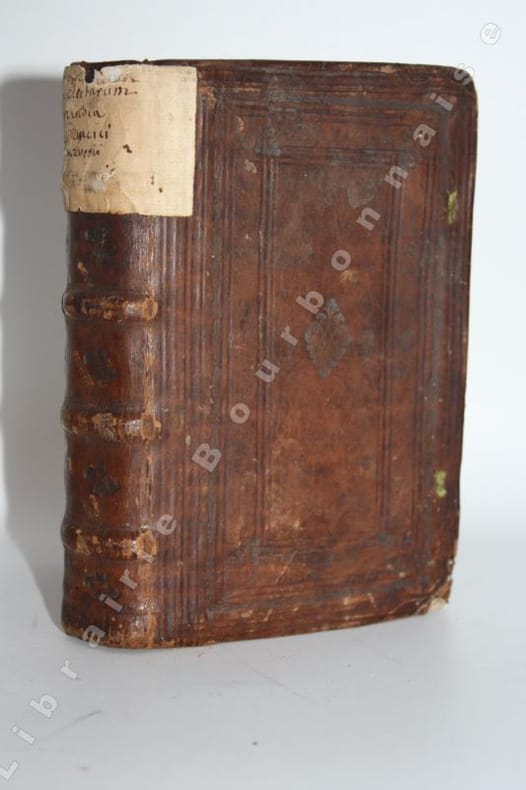
réf. 128545aafParis, Saugrain père & Jean Baptiste Coignard, fils. M D CC XXXIV., (1734), in-8vo, ill. avec 16 gravures sur planches, nom ms. d’un ancien propriétaire à plusieure endroits ‘Monberon’, reliure en plein veau, dos à cinq nerfs, pièce de titre et de tomaison en maroquin rouge, coiffes renforcées.
1915réf. 71330Rapport général sur les usines, l'organisation, les concessions et les franchises de la Companhia Brazileira de Energia Electrica, Publié par le Bureau de Londres avec L'approbation du Siège Social de la Société à Rio de Janeiro, Bureau de Londres, 1 vol. in-4 reliure souple plein cuir brun, Rio de Janeiro, New York, London (s.d.) [ circa 1912 - 1915 ], VII-333 pp. et 4 ff. n. ch. avec 27 planches hors texte, souvent dépliantes. Rappel du titre : Rapport général sur les Usines, l'Organisation, les Concessions et les Franchises de la Companhia Brazileira de Energia Electrica. Guinle & Co 107 Avenida Central, 109 Rio de Janeiro Brazil
1987réf. 74303Universe PublishingNY. New. Paperback. FREE UPGRADE to Courier/Priority Shipping Upon Request - IN STOCK AND IMMEDIATELY AVAILABLE FOR SHIPMENT - Flawless copy brand new pristine never opened -- Text in English. 64 pp. With 33 ills. 22 col. . 26 x 22 cm. -- with a bonus offer-- . 1987. 0876635346 . Universe Publishing(NY) paperback
1728réf. PHO-2076Amsterdam, Pierre Mortier, 1728. 3 vol. in-12 (17x10,5cm), 2ff.-314pp.-5ff. ; 227 pp. ; 192pp.-12ff., Reliure pastiche en demi-veau à coins, dos à 5 faux-nerfs fleuronné, pièce de titre en maroquin rouge, pièce de tomaison en maroquin vert, année dorée en pied, filet doré sur les plats. Mouillure au plan de Pisco, quelques très rares mouillure en marge sans gravité. Bon exemplaire, bien complet des cartes, plans et planches gravés, le titre gravé et le premier feuillet (page 1 &2) mal placés. Cachet de la Bibliothèque Géographique Hachette et Cie ; de la bibliothèque de Paul Lebaudy, avec son ex-libris gravé.
réf. 41568Paris. Hippolyte-Louis Guerin. 1744. 12mo. text is 16.5cm tall the first edition xlliii5300p. with engraved armorial headpiece above the dedication to King Stanislaus I of Poland title page vignette in contemporary full mottled calf rebacked raised bands gilt rules and decorations in the panels dark crimson leather label original marbled endpapers relayed bookplate "Bibliotheque du Seminaire de St. Sulpice de Montreal" a fine clean copy Ho11.1. ~ De Moraes. Bibliographia Brasiliana. V1. p93. Chadenat 754. not Sabin. ~ First edition of a French biography of the Jesuit martyr Ignacio de Azevedo by Father Gilles-Fran‡ois Beauvais 1695-1773 who modeled his book on the Italian biography by Father Cabral pseudonym of Giulio Cesare Cordara 1704-1785 published at Rome in 1743 under the title "Relazione Della Vita E Martirio Del Venerable Padre Ignazio de Azevedo". In the present biography dedicated to King Stanislaus I of Poland Beauvais made several additions for example the "Martyre du V‚n‚rable PŠre Diaz et de ses Compagnons" pp193-262. Most of the book is devoted to the life of the martyr Ignatius de Azevedo from Porto 1528-1570 who worked in Brazil as Visitator for the Jesuit Order. On 15 July 1570 he and his 39 companions while at sea were killed by French Calvinist pirates near the Canary Islands. In 1854 these "40 martyrs of Brazil" were canonized. Beauvais's biography may be regarded as a loose translation with additional material of Cordara's biography which was translated into Spanish in the same year and into German in 1856. A second edition of Beauvais's version was published at Brussels in 1854. The martyrdom of Ignacio de Azevedo and his companions has inspired many literary works up to the present day. Paris. Hippolyte-Louis Guerin. 1744 unknown
1839réf. 995Couverture rigide Hortet et Ozanne 1839 Paris 23,5x15,5 cm
1822réf. PHO-1375Paris, Leblanc, 1822 ,2 volumes in-8 de texte et un Atlas , petit in-folio (27,5x37,5cm) Texte ; 2 volumes in-8 , 2ff.-xxx-452pp. , 2ff.-506pp. , relié toile , dos lisse avec titre et tomaison. Atlas ; un volume in-folio ,2ffnch (Titre et liste des planches) et 26 planches dessinées par l’auteur dont une carte et 12 planches en couleurs d’époque, relié demi maroquin vert , dos orné avec titre et les armes royales et chiffre de Louis-Philippe, timbre de sa bibliothèque sur le titre (Neuilly) , ex-libris , exemplaire sur grand papier, frottements aux plats avec petit manque de papier , coins et coupes usés , quelques rousseurs.
1879réf. 001870Paris Maçia 1879
1740réf. 0056271740 S. l. n. e. [Amsterdam, Pierre Mortier], 1740. In-quarto (257 X 205 mm) veau fauve marbré, supra-libris (lettre « V ») doré au centre des plats, dos à nerfs orné, pièce de titre maroquin grenat, tranches rouges (Reliure de l'époque) ; portrait-frontispice, (2) ff. de faux-titre et titre, XL-284 pages, 6 planches hors-texte. Quelques feuillets uniformément brunis.
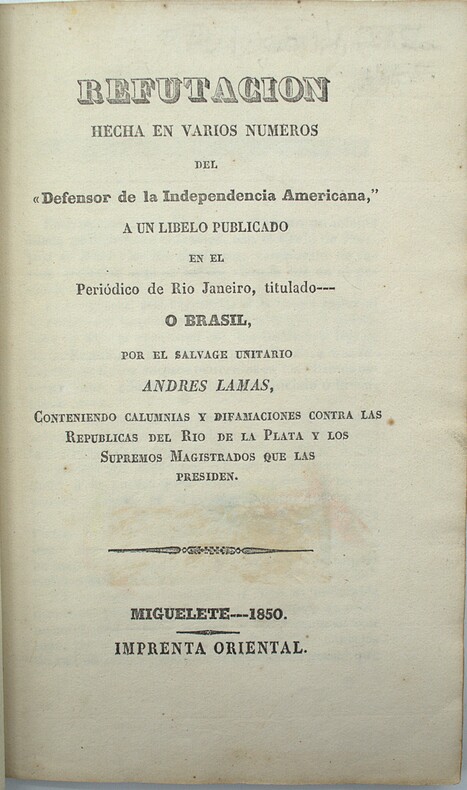
1850réf. PHO-2494Miguelete, Imprenta oriental, 1850, in-12 (20x13,5cm), 147pp., brochage papier postérieur, étiquette de titre manuscrit au plat.
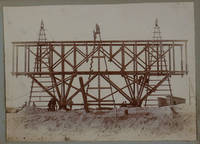
réf. PA9Oblong Octavo album ca. 14x205 cm. 50 card stock leaves. With 108 mounted gelatin silver photographs from ca. 125x175 cm 4 ¾ x 6 ¾ in to ca. 5x85 cm 2 x 3 ¼ in. Over thirty photos with period pencil captions in French on the mounts. Period red full cloth album neatly repaired on the hinges. A few images mildly faded several mounts slightly soiled or with the residue of photos being detached and repositioned but overall a very good album. Rare extensive collection of original photographs illustrating the large-scale construction of port facilities in the Patos Lagoon/Lagoa dos Patos Brazilian province of Rio Grande do Sul in the early 20th century. The first leaf bears a period pencil inscription in French “Porto Alegre Brésil” but it looks like most photos document the construction of Porto Novo in Rio Grande now one of the main ports of Brazil and Latin America. Several views look very similar to the original photos from the collections of the Library of the Port of Rio Grande Fereira G.R.M. O acervo antigo da biblioteca do Porto do Rio Grande// Revista Memória em rede. Universidade Federal de Pelotas. 2015. V. 7. No. 13. Pp. 172-180; see more. The photos were most likely taken by a French associate of the “Compagnie Française du Port du Rio Grande do Sul” which managed the construction of both ports in the 1910s. The Porto Novo of Rio Grande was built in 1910-1915. The port facilities in the provincial capital Porto Alegre went under major reconstruction in 1913. Due to WW1 the process slowed down and was not completed until 1921 mostly under Brazilian management. Most photos in the album show construction scenes and sites newly-built piers and quays the auxiliary railway hangars and warehouses piled cement blocks machinery construction workers etc. Several photos show suction dredges used in construction including “Gelderland” 1900 “Bento Gonzalves” and “Tulho de Castilhos.” A large photo portrays two European construction supervisors posing next to a cement block on a railway cart. One of the photos at the rear shows a scene with two workers standing next to a railway track leading to a large metal frame. The metal bars in the right lower corner bear white-painted signs “Rio Grande do Sul.” The other photos show Brazilian coastal defence ship “Marechal Deodoro” 1898-1924 docked ocean steamers including German liner “Santa Catharina” 1907-1914 the railway bridge at Pelotas Itapua da Lagoa lighthouse near Port Alegre built in 1860 at the entrance of Canal do Itapua which connects the Lagoa dos Patos with the Guaiba River estuary etc. Overall a historically significant original source on the early history of the Port of Rio Grande and the industrial development of the Patos Lagoon in southern Brazil. hardcover
réf. PC39Oblong Folio album ca. 26x35 cm or 10 x 13 ½ in. 111 black card stock leaves. With 110 mounted original gelatin silver photos mostly ca. 195x24 cm 7 ¾ x 9 ½ in the last photo is 19x21 cm 7 ½ x 8 ¼ in. Most photos are numbered in negative three views of Rio de Janeiro are also captioned in negative. About a hundred images are with paper labels with typewritten captions on the mounts. With nineteen smaller loose photos from ca. 8x14 cm 3 ¼ x 5 ½ in to ca. 6x85 cm 2 ¼ x 3 ¼ in housed in an envelope at the rear. Three images with period ink or pencil captions on verso one photo dated on verso “Easter Day – 1921 Rio Brazil”. Period black full sheep album fastened with metal bolts; gilt-lettered title on the front board. Paper label of the “Badger Line” of the “Heinn Company Milwaukee” on the inner side of the rear board. Binding rubbed on extremities front board with a crack at the stub ca. thirty photos with bigger or smaller creases or losses on the left margins or corners several photos detached and loosely inserted but overall a very good album of large interesting strong photos. Interesting extensive collection of large original gelatin silver photographs compiled by a female traveller and documenting the “second annual American Express cruise to and around South America” in January – April 1921 A 70 Days Cruise// The Gazette. Montreal January 31 1921 p. 18. Amex a freight and finance company which became famous through its payment cards opened its travel division in 1915. In the 1920s it offered tours and cruises to South America Hawaii California the Caribbean the Mediterranean China Japan and around the world as well as elaborate independent packages. The 1921 cruise to South America lasted seventy days and started on board the luxury steamship “Ebro” which departed New York and called at Havana went through Panama Canal and stopped at Lima Mollendo Arica and Valparaiso. From there the travellers went by train to Santiago and Buenos Aires and then sailed up the east coast on board the steamer “Aeolus” visiting Montevideo Santos Sao Paulo Rio de Janeiro and Bridgetown Barbados. Among the passengers were “a number of prominent Canadians” A 70 Days Cruise Ibid. including “Sir John Hendric former Governor of Ontario Canada and Lady Hendric” St. Louis Girl Who Starts on S. American Trip// St. Louis Globe-Democrat. January 28 1921 p. 5. The same article discussed several Louisans who went on the cruise – Miss Olguita Queeney Mr. & Mrs. C.W. Johnson and James W. Scudder. One of the captions identifies another traveller as "Mr. Charles Le Maire” who was a travel representative for the “Walford-Astoria” and several other hotels in Chicago under the management of the Boomer family. Fluent in Spanish Portuguese and French Le Maire was sent on a cruise “for the purpose of studying business travel and hotel conditions in the Latin American cities and to arrange with the various hotel owners and transportation companies for the handling of American and European visitors extending the service of arranging hotel and travel accommodations which the Boomer hotels inaugurated successfully in Europe” A “Commercial Traveler” for a Great Hotel System is Mr. Le Maire// National Hotel Reporter. Chicago January 31 1921 p. 1. The album belonged to a female traveller who went on a cruise one of the smaller loose photos of four ladies bears the caption “The Lindermans Mother & I at Tacna Chile”. It opens with five views of Havana showing Columbus Cathedral Catedral de San Cristobal Morro Castle and harbour Paceo El Prado Mercedes Church and a scene with Cuban farmers in a field. The images of Panama include interesting group portraits of the travellers posing at Gatun locks a view of the Panama Canal at the Culebra Cut and two photos of Panama City Metropolitan Cathedral ruins of the old Cathedral tower in Panama Viejo. A lively series of photos depicts the celebration of crossing the Equator and fancy-dress balls on board the S.S. “Ebro” “Father Neptune and his followers” spectators “Father Neptune holds court” “a tenderfoot about to be initiated” makeshift pool on the ship’s deck ball participants in fancy dress. Nineteen photos of Peru show Lima Cathedral and Plaza Mayor a military review the travellers having lunch at the Exposition Building the bull ring the Institute of Hygiene portraits of toy and fruit vendors elaborate forged metal gates to a private residence a pier in Barranco - “the bathing resort of Lima” Mollendo “the breakwater and landing place” passengers being landed in a chair and Tacna “the principal business street” a city park the travellers dining in a restaurant the train which “carried us from Tacna to Arica”. Over twenty images of Chile include views of Arica oxen moving cargo at the dock fruit vendors Antofagasta the beach at the Automobile Club Valparaiso the port and harbour and Santiago Santa Lucia Park National Congress Building “Mr. Chas le Maire giving an exhausted tourist a lift on the climb up the mountain” tourists posing on the steps of Virgin Mary on the summit of San Cristobal Hill city race track the tourists having lunch in a garden a flower stand an oxen-driven cart a “business section of Santiago” La Moneda Presidential Palace Fine Arts Museum. Several views show the interior towns of Los Andes and Rio Blanco which the party visited during a train ride to Buenos Aires Salto del Soldado Rio Blanco railway station train engines and cars of Ferrocarril Transandino Chile with the Andes in the background. Twenty-six views of Buenos Aires show Plaza Hotel Jockey Club the façade and interior of the dining room Monument of the Spanish Las Nereidas fountain Monument to the Two Congresses Palermo Park the tourists posing with a banner “American Express South American Cruise” “the Interpreter squad of the Argentine Police” city racetrack tourists having lunch the racetrack restaurant “gauchos roasting meat for our lunch at Tigre” &c. Over a dozen views of Brazil show Petropolis Santos general view city square “the Aeolus loading coffee at Santos” Sao Paolo snake farm Rio de Janeiro Sugarloaf Cable Car Sugarloaf Mountain and Botafogo Bay Palace Hotel a view from the Corcovado Mountain and several scenes of growing and harvesting coffee beans on a plantation near Sao Paolo. The album closes with six views of Bridgetown “the principal business street” “native women loading boats with coal” “an avenue of royal palms” windmills grinding sugar cane “native boys diving for coins” and a bird’s-eye view of Havana. Overall an attractive extensive collection of large original photos from the second American Express tour to South America. unknown
1999réf. Q-0913697249Williams College Museum of Art 1999. Paperback. New. In shrink wrap. Looks like an interesting title! Williams College Museum of Art paperback
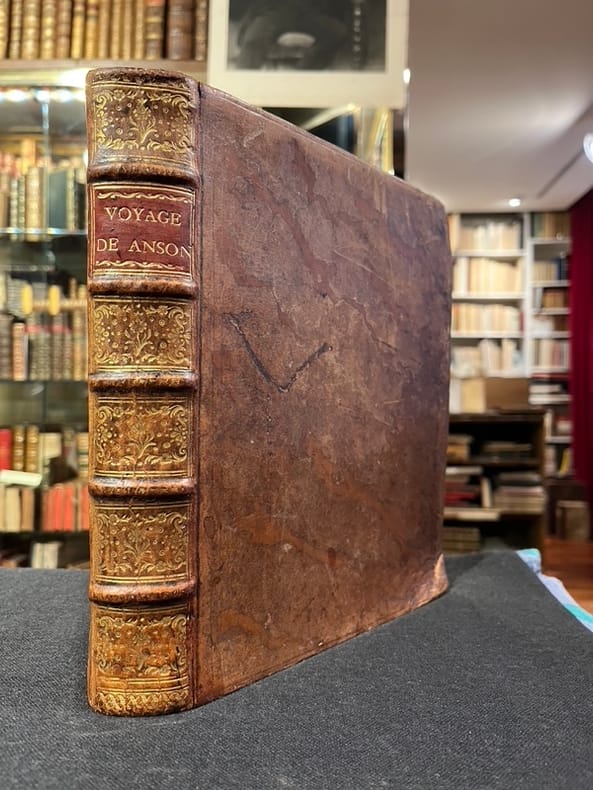
1750réf. 4284Genève, Barillot et Fils, 1750. In-4 de XXIV-363p., pleine basane brune. Dos à nerfs orné de filets et fleurons dorés.
réf. 232882Lisbonne, Antonio Rodrigues Galhardo [numéros 1-12] ; Imprimerie royale [numéros 13-16], s.d. (1826) 34 livraisons en 2 vol. in-8, 387 pp. en numérotation continue, avec des ff. vierges après les pp. 170 et 244 ; pp. 389-818, avec des ff. vierges après les pp. 674 et 704, basane fauve racinée, dos lisses ornés de filets, guirlandes et dents-de-rat dorés, pièces de titre et de tomaison, tranches mouchetées de bleu (reliure de l'époque). Charnières supérieures et coiffes frottées.
1960pp. x, 227. Footnotes. Index. List of Works Cited. Personalia. Black and white reproductions of historic documents. Frontispiece illustration of Isaac Aboab Da Fonseca (1605-93), the first rabbi in the New World. "Historiography has quite neglected the romantic and fascinating history of the underground and free-professing Jews in colonial Brazil, who formed the earliest Jewish community in America and became the "Jewish Pilgrim Fathers" of New York, as well as of Jamaica, Barbados, and other Jewish communities in the Caribbean area. The present work is an effort to fill this gap." - Preface. Wiznitzer was president of the Brazilian Jewish Institute of Historical Research and a frequent contributor to learned journals. Moderate wear to publisher's navy blue cloth brightly lettered in gilt upon backstrip. Binding intact. Prior owner's bookplate and small bookseller tag inside front board. Prior owner appears to have clipped author's photo/bio from dust jacket (not included) and mounted it upon recto of front free endpaper. Prior owner's blind stamp, name and date upon title page. Pencil underlining and marginal lines erased from about 45 pages. Foxing in vicinity of endpapers and, lightly, to edges. A sound copy of this important work. Book
1718réf. 3782Three separately published parts. 4to. 20 x 16.5 20.5 x 16 and 21 x 17 cm. I: 1 f. 16 pp. with engraved plates of Lobelia westiniana 31 cm x 20.5 cm and Rhexia imbricata & Berberis laurifolia 30 cm x 20.5 cm. II: 1 f. 11 pp. III: 2 ff. 13 pp. engraved plate of Billbergia speciosa 35.5cm x 22cm. Title pages slightly dusty. Part II unbound. Generally excellent. A rare series of three consecutively printed dissertations 2 of them illustrated on the flora of Brazil diligently recorded in standard Linnaean form by Carl Thunberg Linnaeus' foremost disciple and the greatest botanical explorer and collector of his day. The specimens were collected by Georg Wilhelm Freyreiss in his travels to Minas Gerais Brazil in 1814-15. Only eight species out of the thirty described by Thunberg in these booklets had been studied until recently Moraes Smedt and Hjertson. Most of the specimens can still be found today at Uppsala University. Although the dissertations are separately signed by Billberg Ahlberg and Holm Reyment notes that the work in each case was Thunberg's since it was customary for the professor to write the thesis which his students would then defend in public. Each dissertation is in the form of a scientific description of 10 different species of which several appear to be named and described for the first time: for example Billberg's thesis notes two Lobelia one Begonia and one Euphorbia; Ahlberg'sseveral orchids Epidendrum Cymbidium sp. nightshades Solanum sp. and a type of wild basil Ocymum; and Holm's a species of bromeliad Billbergia speciosa. Two of the theses are illustrated with detailed depictions of the specimens involved on large folding engravings. Carl Peter Thunberg 1743-1828 rector of the University of Uppsala earned the epithets "father of South African botany" and "the Japanese Linnaeus." Of the disciples whom Linnaeus sent off on far-flung collecting journeys Thunberg traveled the furthest reaching South Africa Indonesia Japan where in order to be admitted he had to pass himself off as a Dutch Protestant merchant and Sri Lanka. Thunberg is cited in naming some 254 species of plants and animals though significantly more plants than animals and authoring more than 160 monographs and scientific papers. OCLC: 3 parts together at NYPL U. Minnesota JCB Harvard. Pritzel 9314; BMNH 5 p. 2110; Stafleu & Cowan 14397; G. Eriksson in DSB XIII 391-3; not in Borba; R. Reyment "Carl Peter Thunberg 1743-1828 The Founder of Japanese Botanical Research"; Moraes Smedt and Hjertson "Notes on the Brazilian Plants Collected by Georg Wilhelm Freyreiss and Published by Carl Peter Thunberg in Plantarum brasiliensium" Harvard Papers in Botany 19/1 2014: 123-132. Zeipel & Palmblad
réf. 13014[Venise], s.n., s.d. ; [1588] ; in-16. 461 pp.-12 ff. (table). Plein veau brun, dos à nerfs fleurons à froid entre les nerfs, encadrement de filets et roulette à froid sur les plats avec fleurons aux angles et un fleuron doré au centre ors effacés). Tranches dorées guillochées. Trous de vers aux coins inf. Pâles mouillures. Étiquette papier ancienne sur le dos avec titre manuscrit. Reliure de la fin du XVIe siècle.
1822réf. 003091Leblanc, chez Abel Ledoux, (s. d.), 1822
1990réf. 91300Prestel Pub. As New. 1990. Hardcover. 379130965X . FREE UPGRADE to Courier/Priority Shipping Upon Request - IN STOCK AND IMMEDIATELY AVAILABLE FOR SHIPMENT - AS NEW THE TEXT BLOCK IS PRISTINE CLEAN UNMARKED AND IN EXCELLENT CONDITION - -- 720 pages. From Library Journal: "If you think that Maurice Prendergast 1858-1924 only produced decorative park and beach scenes rendered in an abstract style.this work will set the record straight. Thanks in large part to the generosity of the Eugenie Prendergast Foundation Mathews has .labored for over six years as part of a team of art historians to create a monumental ten-pound slip-cased tome that documents the total artistic output of the two Prendergast brothers Maurice and Charles A Catalogue Raisonne.The comprehensive catalogue raisonne with its highly detailed essays by eight art historians features 2200 illustrations 100 of which are in color. All works discussed are represented by an image and catalog entry and range from the sketchbooks monotypes and applied graphics of Maurice to the carved and painted panels and sculpture of Charles 1863-1948. A Herculean achievement the catalogue raisonne will long serve as a cornerstone in the arena of American art history reference. " Catalogue Raisonne Catalog Raisonné Complete Works Life and Work Raisonnee -- with a bonus offer . Prestel Pub hardcover
1758réf. 69200Lisboa: Miguel Rodrigues 1758. Integrating the Indigenous People of Brazil into Portuguese Society A scarce and monumentally important law in the history of the Indigenous peoples of Brazil. Far more than a simple reorganization of government and a step towards Jesuit expulsion this remarkable document prescribes the entire worldview of the Portuguese crown regarding the newly free Indigenous population in its colonies enumerating ninety-five articles which direct how they should live and work down to the most minute details of daily life. This decree following the June 6 decree which abolished the slavery of Native Brazilians was approved by King José I on August 7 1755. One piece in Marquis de Pombal's sweeping reforms Pombal's policy towards the American Indian was one of full integration with White society. The goal of this policy in Brazil was threefold—to curb the influence of the Jesuit order to encourage the "civilization" of Indigenous settlements and therefore their commercial and agricultural productivity and finally to draw a clear line between Natives now free and theoretically equal to Portuguese citizens and imported African slaves who would be the key to exploiting the New World's immense natural resources. This decree initially confined to Pará e Maranhão but soon extended to all of Brazil presents a complex and contradictory view of its newly free people subjects. The first article insists that a Portuguese Director is needed for each settlement as Indigenous leaders "due to the lamentable rusticity and ignorance with which they have been educated until now do not have the necessary aptitude required for government." The document is insistent beginning with the second article that the Directors are only there to advise and "may not in any case exercise coercive jurisdiction over the Indians" who are alternately referred to as equal to Whites and as idle immoral and childlike. Many of the articles herein are intended to transmute Indigenous Brazilians into good Portuguese citizens—Directors are to insist on the exclusive use of the Portuguese language in schools and business Articles 6-7 and each person is to be given a surname "with great care being taken by the Directors to introduce the same surnames as those of the families of Portugal" 11 our translation. Other articles enforce the restyling of homes to look more Portuguese the reorganization of households into the nuclear family unit and the adoption of Portuguese dress. Many others encourage agriculture and trading though the Director who receives one sixth of the produce of his settlement is required to supervise all transactions nominally to ensure that unscrupulous Portuguese merchants are not fleecing their poor naïve charges. Shockingly for the time Article 80 abolishes the enforced separation of the White and Indigenous populations and encourages the former to settle among the later. To prevent land runs care is taken that Native inhabitants should receive preference for land grants and "honorable positions" in local government. Perhaps most remarkable are Articles 88 and 89 which actively encourage miscegenation: "I recommend to the Directors that they apply unceasing care in facilitating and promoting on their part marriages between Whites and Indians….To facilitate said marriages the Directors will employ all the effectiveness of their zeal in persuading all White Persons who reside in their Settlements that the Indians are not of inferior quality to them that His Majesty deigning to qualify them for all those honors appropriate to the ranks of their posts consequently the same privileges will be enjoyed by persons who marry said Indians; thus banishing the most prejudicial imaginings of the Inhabitants of this State who have always considered such marriages to be infamous." The above is in stark contrast to Article 10 which reveals much about the true impetus of these reforms. That article reads in large part: "Among the lamentable principles and pernicious abuses that have resulted in the Indians' considerable decline one of them is undoubtedly the unjust and scandalous introduction of calling them Blacks; perhaps wanting with the infamy and vileness of this name to persuade them that nature had destined them to be the slaves of the Whites as is regularly imagined with respect to the Blacks of the African coast. And because besides being extremely detrimental to the civility of the Indians themselves this abominable abuse would be indecent to the Royal Laws of His Majesty to call Blacks men whom the said King was pleased to raise up and declare exempt from all infamy." This was all part of Pombal's plan and set the stage for vastly increased slave labor in Brazil. Indeed in 1761 Pombal banned the importation of slaves to Portugal and her eastern possessions instead routing the entirety of her share in the international slave trade to Brazil. By painting Whites and Native Brazilians as equals in direct opposition to Blacks the Portuguese administration created a clear and legally grounded distinction about which races were to be free and which to be enslaved. The strategy proved effective long outliving Portuguese dominion of Brazil—slavery was not abolished there until 1888 the last holdout in the Western Hemisphere. Despite the many articles encouraging Directors to be fair and theoretically putting limits on their ability to interfere with Indigenous autonomy the Directory system was unsurprisingly rife with abuse. Eventually corruption on behalf of the Directors was so frequent and so flagrant that the Directory was abolished in 1798. A crucial document of Portuguese colonial policy outlining a dramatically new and sometimes shockingly progressive attitude towards the Indigenous people of Brazil and with far-reaching consequences for Brazilian society and the role of slavery in its future. Folio. Disbound. Minimal staining along upper edge. Near fine. BORBA DE MORAES p.265. RODRIGUES 883 "Interesting and rare". unknown
1926réf. 231248Rio de Janeiro : Empreza Brasil editora 1926. 1st edition. Hardcover. Each volume individually SIGNED and inscribed by the President of the Camara dos Deputados do Brasil 1952 Nereu de Oliveira Ramos. Original stiff-card covers; finely and sumptuously bound each in full contemporary aniline calf. Raised bands with gilt cross-bands etc. Each housed in a custom hand-made slip-case. Some minor edge-wear to the case extremities. An uncommonly good example - of presentation quality. Language; Portuguese. Subjects; Brazil -- Congresso Nacional. -- Camara dos Deputados -- History. Volume especial; Inclui fotos do Deputado Eduardo Chuahy presidente da Assembleia Legislativa do Estado do Rio de Janeiro ALERJ de 1985-1986. Fotos dos componentes da Mesa da Camara dos Deputados em 1924 a 1923. Ata da inauguracao do edificio da Camara dos Deputados. Memoria historica e descriptiva do novo palacio da Camara dos Deputados / Arnolfo Rodrigues de Azevedo --O novo palacio da Camara dos Deputados / J. M. Goulart de Andrade. Responsibility: Arnolfo Rodrigues de Azevedo J. M. Goulart de Andrade.et al. Rio de Janeiro : Empreza Brasil editora hardcover
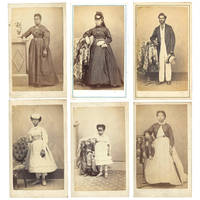
1890réf. 363568Rio de Janeiro Brazil: Photographia do Commercio 1890. A group of six carte-de-visite format albumen prints likely dating from the 1890s. The subjects are all Afro-Brazilians posed standing with their right arm resting on a piece of furniture a table a chair a pedestal. Five of the six images have printed backs identifying them as originating from Photographia do Commercio Rua da Carioca no. 40 Rio de Janeiro. These printed backs are in two styles both similar but one is smaller than the other. The sixth image has no identifying information but the distinctive pattern of the cloth on the table visible in the image places it in the same photo studio. Wilhelm Gaensby 1843–1928 emigrated to Brazil from Switzerland with his parents when he was five in 1848. He learned photography from Alberto Henschel and opened his own studio in Salvador in 1875. About 1893 he moved to Rio de Janeiro keeping his original studio in operation. A number of albums of Gaensby's landscape and scenic photographs survive but little has been written about his studio work. Perhaps the best survey of his career can be found in the chapter devoted to him in Os Fotógrafos do Império Editora Capivara 2005; translated from Brésil: Les premiers photographes d'un empire sous les Tropiques; Gallimard 2005. Generally very good or better. Medium contrast images tending towards sepia tones. Photographia do Commercio unknown
1860réf. PHO-2406Paris, Librairie de L. Hachette et Cie, 1860-65. 2 volumes de texte in-8 (235 x 148 mm) de : I/ lxiv pp., 486 pp., (1) f. d’errata ; II/ (2) ff., 480 pp., iv pp. de table ; et 1 Atlas in-folio (57x40cm). Texte : relié demi veau, dos lisse avec titre et tomaison, dos frotté, coiffes arasés, charnières faibles au tome 2, cachets aux titres. Atlas : sous portefeuille demi toile, titre et tomaison au plat, 2 chemises de livraison comportant 13 planches (16) et 2 planches en double (Fragment de carte et Ruine de l’église Saint Michel), portefeuille frotté, chemises de livraison ébarbées, rousseurs, petites mouillures marginales, une planche plus petite en marge.
1716XIV-298-[2] pp., 37 pl Basane havane de l'époque, dos à nerfs et fleuronné, pièce de titre rouge, tranches rouges 1716, 1716, in-4, XIV-298-[2] pp, 37 pl, Basane havane de l'époque, dos à nerfs et fleuronné, pièce de titre rouge, tranches rouges, 37 cartes et planches, dont 18 à double page, le tout gravé en taille-douce. Édition originale de cette relation très recherchée. L'auteur, qui avait été envoyé en Amérique du sud pour espionner les installations portuaires des colonies espagnoles, donne ici des descriptions et remarques intéressantes sur les peuples, la faune, la flore et la minéralogie du Brésil du Chili et du Pérou. Il effectue plusieurs relevés qui aboutissent à la première cartographie précise de l'Amérique méridionale ; il lève notamment les cartes de la Baie de tous les Saints (pl. XXXIII) et de l'île Sainte-Catherine (pl. III) au Brésil. Parmi les planches qui illustrent l'ouvrage se trouve celle qui représente le fraisier du Chili, en grandeur naturelle. Ce fraisier "différend du nôtre par les feuilles plus arrondies, plus charnues et fort velues", porte des fruits "gros comme une noix, & quelques fois comme un oeuf de poule ; ils sont d'un rouge blanchâtre & un peu moins délicat au goût que nos fraises des bois" (p. 70, pl. XI) : Frézier, au nom si prédestiné, ramena quelques pieds de cette espèce en France et les donna à Jussieu pour le Jardin Royal. Elle est à l'origine de toutes les espèces de fraises modernes. Amédée François Frézier (1682-1773), fils d'un gentilhomme écossais réfugié en France, servit dans l'infanterie, sous les ordres du duc de Charost, puis entra dans le corps du génie comme ingénieur en 1707 ; il contribua notamment à l'amélioration des fortifications de Saint-Malo. Il est connu tant pour ses talents de cartographe que pour ses connaissances en pyrotechnie; il est en effet l'auteur de l'un des meilleurs traités sur les fusées et sur les feux d'artifice de son temps (Traité des feux d'artifice. Paris, Chez Daniel Jollet, 1706). Il a également publié un ouvrage sur la taille de la pierre et du bois. Exemplaire qui présente un amusant petit défaut d'impression : le cuivre de la lettrine "M" de la page de dédicace a été placé de travers. Bel exemplaire. Reliure restaurée. Mouillure très pâle sur un feuillet, infimes rousseurs et rares petites taches. Bel état intérieur. Borda de Moraes I, p. 281. Chadenat n° 71. Leclerc, n° 587