44 résultats
1775réf. WRCAM15987Lisbon 1775. 18pp. Large quarto. Stitched very good. A royal proclamation indended to prevent fraud in the export of tobacco and to encourage agriculture and commerce in general. unknown books
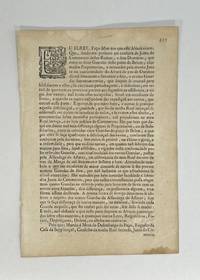
1757réf. WRCAM32595Lisbon 1757. Broadsheet 8 x 11 inches. Minor wear along left edge. Bright and clean. Very good. Official degree governing commerce to and from Brazilian ports. unknown books
1793réf. WRCAM32602Lisbon 1793. 3pp. Dbd. Bright and clean. Near fine. Official decree regarding international commerce with a focus on British trade. unknown books
1759réf. WRCAM32596Lisbon 1759. 3pp. Later patterned wrappers. Bright and clean. Near fine. Official decree and license governing freight prices of sugar tobacco and more into and out of Rio de Janeiro and other Brazilian ports. unknown books
1760réf. WRCAM32597Lisbon 1760. 3pp. Later patterned wrappers. Bright and clean. Near fine. Official decree regarding violations of certain commerce regulations. unknown books
1757réf. WRCAM32598Lisbon 1757. 2pp. Later patterned wrappers. Bright and clean. Near fine. Official decree regarding violations of certain commerce regulations. unknown books
1760réf. WRCAM32599Lisbon 1760. 4pp. Dbd. Minute edge wear. Near fine. Official decree regarding previous laws governing Brazilian commerce. unknown books
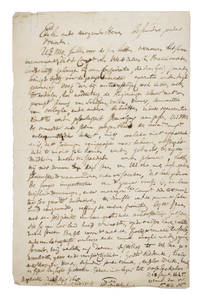
1750réf. ABC_50779Oosteeklo 1750. Ca. 23 x 14.5 cm. Kept in a plastic folder between tissue paper. 1 l. Copy of an unknown letter of the Stadholder Prince Frederik Hendrik or Frederick Henry 1584-1647 to the States General in The Hague on the difficulties and the danger that threatened the Dutch colony in Brazil. Probably the original letter was written by his secretary Constantijn Huygens who always accompanied the Prince when on campaign. At the time Frederick Henry was on campaign in Zeeuws Vlaanderen Zeeland-Flanders and he stayed in the army camp near Oosteeklo ca. 5 km south-east of Sas van Ghent awaiting the upcoming siege of Hulst. On the 28th he departed at the head of his army to Hulst where the siege began on the 8th of October. The city was captured on November 5th.The letter beginning with the words Edele ende mogende Heeren besundere goede Vrunden contains the special request to alleviate the emergency situation in the Dutch colony in Brazil now Northeast Brazil around Recife and Olinda in the state of Pernambuco caused by the uprising of the Portuguese sugar plantation owners as quickly as possible and to come to the aid of the Dutch West India Company government there.Both the script and the watermark Van der Ley point to the mid-18th-century as the time of copying. Also copied are two annotations apparently occurring in the lower margin of the original regarding the route of the letter from Oosteeklo to The Hague: 1: "Uytrecht d. 21 Sept. 1645 gele.d. Jac v.Dam te Rotterdam à f. 1-" and 2: "70 Stuv. tol. Muttelenbroek".Very interesting document regarding the colonial history of Brazil as well as the relation between the Dutch Stadholder and the States General.The edges of the leaf are very slightly frayed with a rust stain from a paper clip to the upper-left corner of the leaf not affecting the text. Otherwise in good condition.l Churchill Watermarks nr. 192 1740. AMERICAS AUTOGRAPHS DOCUMENTS & MANUSCRIPTS LOW COUNTRIES Autographs & Letters Brazil Latin America South America WIC unknown
1764réf. 10531Lisbon 1764. Disbound. Very Good binding. Folio. 1 ff. Removed from binding. Light staining; early manuscript number at the top corner; a couple instances of later notation in the margin. A nice example of this Alvará in which the king address matter related to the port of Belem in Brazil. Dated in print 28 September 1764. unknown
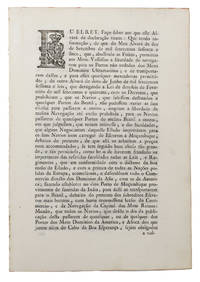
1772réf. ABC_48853Lisbon 1772. Folio ca. 29 x 20 cm. Na Regia Officina Typografica Disbound and subsequently mounted in a modern black stiff paper folder with a printed label mounted on the front wrapper. With a large decorated woodcut initial E incorporating the Portuguese royal coat of arms. 3 1 blank pp. Very rare first issue of two of a late 18th-century decree by the Portuguese King José I 1714-1777 dealing with difficulties in the transportation of enslaved people from Mozambique to Brazil. This text dated 12 December 1772 and signed Rey King at the end is also signed by the notorious Portuguese nobleman and diplomat Marquez de Pombal. Sebastião José de Carvalho e Melo 1st Marquis of Pombal 1699-1782 who was the Secretary of State of the Kingdom during the reign of Dom José I in the period of 1750-1777. It is concluded with a formal text dated 18 December 1772 and signed by João Baptista de Araújo a senior officer of the Secretariat of State.In 1761 Marquez de Pombal prohibited the importation of enslaved people in Portugal and Portuguese India not for humanitarian reasons but because they were needed for labour in Brazil. He stimulated the trade of mostly African enslaved people for that colony and with his support two companies for slave trade were founded the Companhia Geral de Comércio do Grão-Pará e Maranhão and the Companhia Geral de Comércio de Pernambuco e Paraíba. Both companies were privileged and had a monopolistic character. Their lists of shareholders included many Portuguese noblemen and clergy. Between 1757 and 1777 more than 25000 enslaved people were imported to Pará and Maranhão from West African ports.The two issues can be identified by their catchwords on p. 1: issue one shows the catchword as a vol- that catchword was changed in the second issue to a.The inner margin shows some signs of the previous binding. Otherwise in very good condition.l Gauz Portuguese and Brazilian books in the JCB 772/1; WorldCat 1045359449 3 copies; cf. Porbase 2301650 and no copies. AFRICA AMERICAS EUROPE HISTORY Brazil Broadsides Ephemera & Pamphlets East Africa Portugal Slavery South America Southern Africa unknown
1760réf. 5489Genoa: 29 July 1760. Hardcover. Fine. Manuscript in Italian written in a neat cursive in brown/black ink on laid paper. With some minor foxing some folding lines the creases slightly flattened the bottom edge of the leaves is slightly frayed. Otherwise in very good condition. A harrowing eye-witness account by a Jesuit Father of the Province of Brazil describing the forced expulsion of the Jesuits from Brazil in 1760 the hardships they endured during their capture and the perilous journey from Brazil to Genoa via Lisbon. The author begins his narrative with the persecution suffered by the Jesuits in Brazil following the official suppression of the Order. The Jesuit colleges were thoroughly plundered property seized precious silver taken and church furnishings stripped away. They were ordered not to open the church doors or ring the bells although on three occasions the Blessed Sacrament was brought to the sick an act which deeply moved the local people. The Jesuits endured many sufferings during their captivity. They were confined under harsh conditions; guarded constantly by soldiers. Their living quarters were cramped and filthy so small that they could neither sit nor lie down comfortably. Many suffered from hunger thirst and illness and several lost their lives during this ordeal. On 16 March the journey by sea began. The voyage was nothing short of a cruel martyrdom: extreme hunger and sickness afflicted the Jesuit Fathers. One elderly and saintly Father Francesco Paolo died shortly after the journey began not from disease but from severe distress caused by lack of food and medicine. Another Father Giovanni de Matha suffered a dangerous hemorrhage and narrowly survived while many others fell ill. They arrived at the mouth of the Tagus River in Portugal on 6 June after which they were transferred under guard to a Genoese ship effectively imprisoned once again. They were forbidden from going ashore or even signaling their arrival. More Jesuit Fathers from Brazil joined them later in June many weakened and sick from the hardships endured. Tragically some who had been sent ahead to Portugal suffered such extreme famine and thirst that they resorted to drinking their own urine and several died without the comfort of the last rites which were denied by the ship's captain. The captains and executioners of the royal orders showed little compassion even as they witnessed the Jesuits' pale and dying condition. Throughout this entire ordeal a royal minister constantly monitored the Jesuits offering false hopes that they might remain in the kingdom if they renounced their order and left the Jesuit habit behind. Some succumbed to these pressures but most remained steadfast. The Jesuits also faced opposition from the Bishop of Rio de Janeiro who initially used them for missions but later prohibited their confessions and sermons accusing them falsely of heretical teachings. He even excommunicated those who encouraged perseverance in the Jesuit order. Despite all these hardships the siege imprisonment brutal sea voyage hunger disease and ecclesiastical persecution the Jesuits maintained their faith and dignity praying for peace and the restoration of their Society. In a long postscript the writer gives further news that he has received from Brazil. He describes the devotion despite the Suppression of the Brazilian indigenous novices and the bravery of the students many of whom accompanied other Jesuit fathers in a cramped ship for the long voyage to Europe. A number of students held back -reluctantly- realizing that their presence on the ship would only lead to further overcrowding and privation for the Jesuit fathers in particular those who were old and frail. With sorrow they wept on the shore as the ship weighed anchor and departed for the miserable voyage. The account closes on 29 July 1760 expressing a solemn hope that after so many disasters peace will return to the Jesuit order. 29 July hardcover
1775réf. 15987Lisbon. 1775. A royal proclamation indended to prevent fraud in the export of tobacco and to encourage agriculture and commerce in general. 18pp. Large quarto. Stitched very good. unknown
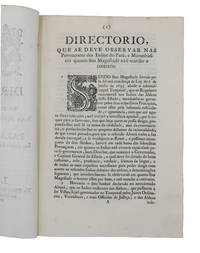
1758réf. 69200Lisboa: Miguel Rodrigues 1758. Integrating the Indigenous People of Brazil into Portuguese Society A scarce and monumentally important law in the history of the Indigenous peoples of Brazil. Far more than a simple reorganization of government and a step towards Jesuit expulsion this remarkable document prescribes the entire worldview of the Portuguese crown regarding the newly free Indigenous population in its colonies enumerating ninety-five articles which direct how they should live and work down to the most minute details of daily life. This decree following the June 6 decree which abolished the slavery of Native Brazilians was approved by King José I on August 7 1755. One piece in Marquis de Pombal's sweeping reforms Pombal's policy towards the American Indian was one of full integration with White society. The goal of this policy in Brazil was threefold—to curb the influence of the Jesuit order to encourage the "civilization" of Indigenous settlements and therefore their commercial and agricultural productivity and finally to draw a clear line between Natives now free and theoretically equal to Portuguese citizens and imported African slaves who would be the key to exploiting the New World's immense natural resources. This decree initially confined to Pará e Maranhão but soon extended to all of Brazil presents a complex and contradictory view of its newly free people subjects. The first article insists that a Portuguese Director is needed for each settlement as Indigenous leaders "due to the lamentable rusticity and ignorance with which they have been educated until now do not have the necessary aptitude required for government." The document is insistent beginning with the second article that the Directors are only there to advise and "may not in any case exercise coercive jurisdiction over the Indians" who are alternately referred to as equal to Whites and as idle immoral and childlike. Many of the articles herein are intended to transmute Indigenous Brazilians into good Portuguese citizens—Directors are to insist on the exclusive use of the Portuguese language in schools and business Articles 6-7 and each person is to be given a surname "with great care being taken by the Directors to introduce the same surnames as those of the families of Portugal" 11 our translation. Other articles enforce the restyling of homes to look more Portuguese the reorganization of households into the nuclear family unit and the adoption of Portuguese dress. Many others encourage agriculture and trading though the Director who receives one sixth of the produce of his settlement is required to supervise all transactions nominally to ensure that unscrupulous Portuguese merchants are not fleecing their poor naïve charges. Shockingly for the time Article 80 abolishes the enforced separation of the White and Indigenous populations and encourages the former to settle among the later. To prevent land runs care is taken that Native inhabitants should receive preference for land grants and "honorable positions" in local government. Perhaps most remarkable are Articles 88 and 89 which actively encourage miscegenation: "I recommend to the Directors that they apply unceasing care in facilitating and promoting on their part marriages between Whites and Indians….To facilitate said marriages the Directors will employ all the effectiveness of their zeal in persuading all White Persons who reside in their Settlements that the Indians are not of inferior quality to them that His Majesty deigning to qualify them for all those honors appropriate to the ranks of their posts consequently the same privileges will be enjoyed by persons who marry said Indians; thus banishing the most prejudicial imaginings of the Inhabitants of this State who have always considered such marriages to be infamous." The above is in stark contrast to Article 10 which reveals much about the true impetus of these reforms. That article reads in large part: "Among the lamentable principles and pernicious abuses that have resulted in the Indians' considerable decline one of them is undoubtedly the unjust and scandalous introduction of calling them Blacks; perhaps wanting with the infamy and vileness of this name to persuade them that nature had destined them to be the slaves of the Whites as is regularly imagined with respect to the Blacks of the African coast. And because besides being extremely detrimental to the civility of the Indians themselves this abominable abuse would be indecent to the Royal Laws of His Majesty to call Blacks men whom the said King was pleased to raise up and declare exempt from all infamy." This was all part of Pombal's plan and set the stage for vastly increased slave labor in Brazil. Indeed in 1761 Pombal banned the importation of slaves to Portugal and her eastern possessions instead routing the entirety of her share in the international slave trade to Brazil. By painting Whites and Native Brazilians as equals in direct opposition to Blacks the Portuguese administration created a clear and legally grounded distinction about which races were to be free and which to be enslaved. The strategy proved effective long outliving Portuguese dominion of Brazil—slavery was not abolished there until 1888 the last holdout in the Western Hemisphere. Despite the many articles encouraging Directors to be fair and theoretically putting limits on their ability to interfere with Indigenous autonomy the Directory system was unsurprisingly rife with abuse. Eventually corruption on behalf of the Directors was so frequent and so flagrant that the Directory was abolished in 1798. A crucial document of Portuguese colonial policy outlining a dramatically new and sometimes shockingly progressive attitude towards the Indigenous people of Brazil and with far-reaching consequences for Brazilian society and the role of slavery in its future. Folio. Disbound. Minimal staining along upper edge. Near fine. BORBA DE MORAES p.265. RODRIGUES 883 "Interesting and rare". unknown
1775réf. 21552Paris 1775. Very good condition. Detailed copper engraved map of the coast of Brazil from Para showing Cap de Rio Grande and Cap de Sergipe down to the Baye de Tous les Saints. Showing many towns and coastal ports. With decorative cartouche. From Prevost's "L'Histoire Generale des Voyages". Bellin 1703 - 1772 one of the most noted French mapmakers of the 18th century was named the hydrographer chief cartographer to the French Navy and later the Official Hydrographer to the French King. Folding 13 1/4 x 10 1/4" with ample margins. Strong impression very clean short diagonal crease at lower right corner in margin only. unknown
1775réf. 21550Paris 1775. Very good condition. Detailed copper engraved map of the coast of Brazil from Barre d'Iguape down to Riv. de la Plata. Showing many towns coastal ports native settlements and missions. With decorative cartouche. From Prevost's "L'Histoire Generale des Voyages". Bellin 1703 - 1772 one of the most noted French mapmakers of the 18th century was named the hydrographer chief cartographer to the French Navy and later the Official Hydrographer to the French King. 7 1/4 x 10". Strong impression very clean. unknown
1775réf. 21551Paris 1775. Very good condition. Detailed copper engraved map of the coast of Brazil from S. Salvador in Cap de Bahia down to Cap St. Thomas and S. Vincent. Showing many towns coastal ports and the Riv. Saint Francois. With decorative cartouche. From Prevost's "L'Histoire Generale des Voyages". Bellin 1703 - 1772 one of the most noted French mapmakers of the 18th century was named the hydrographer chief cartographer to the French Navy and later the Official Hydrographer to the French King. 7 x 9 3/4". Strong impression very clean. unknown
1751réf. 0056111751 Paris, Delaguette, 1751. Deux parties reliées en un volume in-12 (168 X 102 mm) veau brun, dos à nerfs orné, pièce de titre maroquin grenat, tranches rouges (Reliure de l'époque) ; (2) ff. de titre et avertissement, 212 pages, (2) ff. d'approbation et privilège - 74 pages, (2) ff. d'approbation et privilège. Coiffe inférieure arasée avec manque de cuir au caisson inférieur, petit manque à la coiffe supérieure, quelques épidermures au dos, coins émoussés, 3 petites déchirures en marge latérale et angle inférieure de la page de titre, petit trou en tête de la page de titre, mouillures claires en marge de quelques feuillets, gravure dépliante en grande partie fendue au pli central.
1740réf. 0056271740 S. l. n. e. [Amsterdam, Pierre Mortier], 1740. In-quarto (257 X 205 mm) veau fauve marbré, supra-libris (lettre « V ») doré au centre des plats, dos à nerfs orné, pièce de titre maroquin grenat, tranches rouges (Reliure de l'époque) ; portrait-frontispice, (2) ff. de faux-titre et titre, XL-284 pages, 6 planches hors-texte. Quelques feuillets uniformément brunis.
1774réf. 0056281774 Paris, Gouax, [1774]. In-folio broché, couverture muette d'attente de papier bleu ; (1) f. blanc, (1) f. de titre, XV planches, 12 pages, 2 pages d'"Explication des termes de marine de ce livre". Dos manquant, des pages cornées, déchirure avec manque à l'angle inférieur du second plat, du dernier feuillet blanc et de la dernière page de texte (sans atteinte au texte), mouillure claire en marge latérale de plusieurs pages, sans atteinte au texte ni aux dessins.
1772réf. 22777A Paris, chez L. Cellot, 1776. Un vol. au format in-12 (171 x 98 mm) de 1 f. bl., 468 pp. et 1 f. bl. Reliure de l'époque de plein veau marbré blond, plats jansénistes, dos à nerfs orné de filets gras à froid, jeu de petits filets verticaux dorés sur les nerfs, doubles caissons d'encadrement dorés, fleurons dorés, semis de pointillés et de petits fleurons dorés, pièce de titre et de tomaison de maroquin lie-de-vin, titre doré, tomaison dorée, palette dorée en queue, filet doré sur les coupes, tranches rouges.
1780réf. 18840genève pellet 1780 -in-4 une carte ancienne gravée sur cuivre (Copper etching) en noir par André, gravée par Arrivet. Format : 31 x 20,5 cm, pour illustrer l'uvre de l'Abbé Guillaume-Thomas Raynal intitulée "l'Histoire philosophique et Politique des Etablissemens et du Commerce des Européens dans les Deux Indes", pli central horizontal normal venant d'un atlas( horizontal centerfold), 1780 Genève Pellet Editeur,
1780réf. 18842genève pellet 1780 -in-4 une carte ancienne gravée sur cuivre (Copper etching) en noir par André, gravée par Arrivet. Format : 31 x 20,5 cm, pour illustrer l'uvre de l'Abbé Guillaume-Thomas Raynal intitulée "l'Histoire philosophique et Politique des Etablissemens et du Commerce des Européens dans les Deux Indes", pli central horizontal normal venant d'un atlas( horizontal centerfold), 1780 Genève Pellet Editeur,
1740réf. 4034Amsterdam Pierre Mortier 1740 in-12 veau fauve marbré, dos à nerfs, caissons ornés de fleurons, tr. rouges [Rel. de l'époque], qq. rouss
1779réf. 215101779 Rouen,L’imprimérie privilègiée, 1779.] 8°,pleine basane racinée epoque,usée,ors du dos usés,manque de cuir au bas du dos,coiffes abimées;tranches marbrées,interieur correct. circa 16,8 x 10,5. portrait, 351 pages, 7 planches gravées Borba de Moraes 273; cf. Sabin 29198. complet de la carte dépliante de Rio de Janeiro et des gravures de scénes de bataille. -
1750réf. 4284Genève, Barillot et Fils, 1750. In-4 de XXIV-363p., pleine basane brune. Dos à nerfs orné de filets et fleurons dorés.