Brazil Ministerio da IndustriaBiblio.com

3 990 résultats
réf. 0332234924.Ghardcover. Good. Access codes and supplements are not guaranteed with used items. May be an ex-library book. hardcover
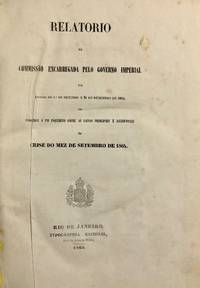
1865réf. SKU-154A historical and financial document from the Empire of Brazil of exceptional rarity and importance. Official report commissioned by the Imperial Government regarding the devastating banking and financial crisis of September 1864 the failure of Casa Souto and the collapse of the Court's credit system. Printed with the imperial coat of arms at the National Printing Office. Rio de Janeiro: Typographia Nacional 1865. Official First Edition 1865. 26 x 18 cm. Typographia Nacional hardcover
réf. 0260825921.Ghardcover. Good. Access codes and supplements are not guaranteed with used items. May be an ex-library book. hardcover
réf. 0260795364.Gpaperback. Good. Access codes and supplements are not guaranteed with used items. May be an ex-library book. paperback
1955réf. 30882Río de Janeiro: Irmaos di Giorgio & Cia. ca. 1955.- Cinco apartados reflejados en el índice con distinta paginación 66152176 36 pp.: Profusión de estados y gráficos; 4º mayor 27 x 186 cm; Cartulina Ed.- Cubiertas con pequeñas dobleces en las esquinas externas. RARO. BRASIL Livro no português Irmaos di Giorgio & Cia. paperback
2026réf. LRB34000218Paris: Editions Recreasoft 2026 Idioma: Português. Aproximadamente 779 páginas. Português : Reimpressão sob demanda. Edição original : 1853. Obra em português. Este relatório detalhado aborda a revisão das tarifas alfandegárias do Império do Brasil cobrindo o período de 1845 a 1849. Publicado em 1853 o documento oferece uma análise aprofundada do comércio imperial incluindo estatísticas e propostas de ajustes tarifários. Obra essencial para estudiosos da economia e história brasileira do século XIX. Imagens do livro não contratuais English: Print-on-demand reprint. Original edition : 1853. Text in Portuguese. This detailed report addresses the revision of customs tariffs in the Empire of Brazil covering the period from 1845 to 1849. Published in 1853 the document provides an in-depth analysis of imperial trade including statistics and proposals for tariff adjustments. A key work for scholars of 19th-century Brazilian economics and history. Book images are non-contractual. Editions Recreasoft. Softcover. New. Editions Recreasoft paperback
1760réf. 5489Genoa: 29 July 1760. Hardcover. Fine. Manuscript in Italian written in a neat cursive in brown/black ink on laid paper. With some minor foxing some folding lines the creases slightly flattened the bottom edge of the leaves is slightly frayed. Otherwise in very good condition. A harrowing eye-witness account by a Jesuit Father of the Province of Brazil describing the forced expulsion of the Jesuits from Brazil in 1760 the hardships they endured during their capture and the perilous journey from Brazil to Genoa via Lisbon. The author begins his narrative with the persecution suffered by the Jesuits in Brazil following the official suppression of the Order. The Jesuit colleges were thoroughly plundered property seized precious silver taken and church furnishings stripped away. They were ordered not to open the church doors or ring the bells although on three occasions the Blessed Sacrament was brought to the sick an act which deeply moved the local people. The Jesuits endured many sufferings during their captivity. They were confined under harsh conditions; guarded constantly by soldiers. Their living quarters were cramped and filthy so small that they could neither sit nor lie down comfortably. Many suffered from hunger thirst and illness and several lost their lives during this ordeal. On 16 March the journey by sea began. The voyage was nothing short of a cruel martyrdom: extreme hunger and sickness afflicted the Jesuit Fathers. One elderly and saintly Father Francesco Paolo died shortly after the journey began not from disease but from severe distress caused by lack of food and medicine. Another Father Giovanni de Matha suffered a dangerous hemorrhage and narrowly survived while many others fell ill. They arrived at the mouth of the Tagus River in Portugal on 6 June after which they were transferred under guard to a Genoese ship effectively imprisoned once again. They were forbidden from going ashore or even signaling their arrival. More Jesuit Fathers from Brazil joined them later in June many weakened and sick from the hardships endured. Tragically some who had been sent ahead to Portugal suffered such extreme famine and thirst that they resorted to drinking their own urine and several died without the comfort of the last rites which were denied by the ship's captain. The captains and executioners of the royal orders showed little compassion even as they witnessed the Jesuits' pale and dying condition. Throughout this entire ordeal a royal minister constantly monitored the Jesuits offering false hopes that they might remain in the kingdom if they renounced their order and left the Jesuit habit behind. Some succumbed to these pressures but most remained steadfast. The Jesuits also faced opposition from the Bishop of Rio de Janeiro who initially used them for missions but later prohibited their confessions and sermons accusing them falsely of heretical teachings. He even excommunicated those who encouraged perseverance in the Jesuit order. Despite all these hardships the siege imprisonment brutal sea voyage hunger disease and ecclesiastical persecution the Jesuits maintained their faith and dignity praying for peace and the restoration of their Society. In a long postscript the writer gives further news that he has received from Brazil. He describes the devotion despite the Suppression of the Brazilian indigenous novices and the bravery of the students many of whom accompanied other Jesuit fathers in a cramped ship for the long voyage to Europe. A number of students held back -reluctantly- realizing that their presence on the ship would only lead to further overcrowding and privation for the Jesuit fathers in particular those who were old and frail. With sorrow they wept on the shore as the ship weighed anchor and departed for the miserable voyage. The account closes on 29 July 1760 expressing a solemn hope that after so many disasters peace will return to the Jesuit order. 29 July hardcover
1760réf. 5489Genoa: 29 July 1760. Hardcover. Fine. Manuscript in Italian written in a neat cursive in brown/black ink on laid paper. With some minor foxing some folding lines the creases slightly flattened the bottom edge of the leaves is slightly frayed. Otherwise in very good condition. A harrowing eye-witness account by a Jesuit Father of the Province of Brazil describing the forced expulsion of the Jesuits from Brazil in 1760 the hardships they endured during their capture and the perilous journey from Brazil to Genoa via Lisbon. The author begins his narrative with the persecution suffered by the Jesuits in Brazil following the official suppression of the Order. The Jesuit colleges were thoroughly plundered property seized precious silver taken and church furnishings stripped away. They were ordered not to open the church doors or ring the bells although on three occasions the Blessed Sacrament was brought to the sick an act which deeply moved the local people. The Jesuits endured many sufferings during their captivity. They were confined under harsh conditions; guarded constantly by soldiers. Their living quarters were cramped and filthy so small that they could neither sit nor lie down comfortably. Many suffered from hunger thirst and illness and several lost their lives during this ordeal. On 16 March the journey by sea began. The voyage was nothing short of a cruel martyrdom: extreme hunger and sickness afflicted the Jesuit Fathers. One elderly and saintly Father Francesco Paolo died shortly after the journey began not from disease but from severe distress caused by lack of food and medicine. Another Father Giovanni de Matha suffered a dangerous hemorrhage and narrowly survived while many others fell ill. They arrived at the mouth of the Tagus River in Portugal on 6 June after which they were transferred under guard to a Genoese ship effectively imprisoned once again. They were forbidden from going ashore or even signaling their arrival. More Jesuit Fathers from Brazil joined them later in June many weakened and sick from the hardships endured. Tragically some who had been sent ahead to Portugal suffered such extreme famine and thirst that they resorted to drinking their own urine and several died without the comfort of the last rites which were denied by the ship's captain. The captains and executioners of the royal orders showed little compassion even as they witnessed the Jesuits' pale and dying condition. Throughout this entire ordeal a royal minister constantly monitored the Jesuits offering false hopes that they might remain in the kingdom if they renounced their order and left the Jesuit habit behind. Some succumbed to these pressures but most remained steadfast. The Jesuits also faced opposition from the Bishop of Rio de Janeiro who initially used them for missions but later prohibited their confessions and sermons accusing them falsely of heretical teachings. He even excommunicated those who encouraged perseverance in the Jesuit order. Despite all these hardships the siege imprisonment brutal sea voyage hunger disease and ecclesiastical persecution the Jesuits maintained their faith and dignity praying for peace and the restoration of their Society. In a long postscript the writer gives further news that he has received from Brazil. He describes the devotion despite the Suppression of the Brazilian indigenous novices and the bravery of the students many of whom accompanied other Jesuit fathers in a cramped ship for the long voyage to Europe. A number of students held back -reluctantly- realizing that their presence on the ship would only lead to further overcrowding and privation for the Jesuit fathers in particular those who were old and frail. With sorrow they wept on the shore as the ship weighed anchor and departed for the miserable voyage. The account closes on 29 July 1760 expressing a solemn hope that after so many disasters peace will return to the Jesuit order. 29 July hardcover books
réf. 0332352773.Gpaperback. Good. Access codes and supplements are not guaranteed with used items. May be an ex-library book. paperback
2026réf. x-103235982XTaylor & Francis Ltd 2026. Paperback. New. 526 pages. 7.01x1.21x10.00 inches. Taylor & Francis Ltd paperback
1969réf. R150183438L AMITIE.. 1969. In-8. Cartonnage d'éditeurs. Bon état, Couv. légèrement passée, Dos satisfaisant, Intérieur acceptable. 152 pages. Nombreuses illustrations en noir et blanc et en couleurs dans le texte et hors texte. Ancien ouvrage de bibliothèque: tampon et note au stylo sur la page de titre, étiquette de code sur le dos, pochette et étiquette sur la page de garde.. . . . Classification Dewey : 981-Brésil
L AMITIE.. 1969. In-8 Carré. Cartonnage d'éditeurs. Bon état. Couv. légèrement passée. Dos satisfaisant. Intérieur acceptable. 152 pages. Nombreuses illustrations en noir et blanc et en couleurs dans le texte et hors texte. Ancien ouvrage de bibliothèque: tampon et note au stylo sur la page de titre, étiquette de code sur le dos, pochette et étiquette sur la page de garde.
1994Octavo in grey blue pictorial glossy paper wraps; 464 p. 18 cm In Portuguese || Spirit writings. Emmanuel (Spirit) ; Channeling. Brazilian Spiritualism
1964réf. 217921Peking: Foreign Languages Press 1964. 23p. staplebound pamphlet very good. Published in the context of the Sino-Soviet split. Foreign Languages Press unknown books
Lisboa, David Corazzi, Editor, Empreza Horas Romanticas, 1883. 8vo.; 63 pp. Con 30 grabados entre el texto. Cubiertas originales.
1890réf. 361Typ Villeneuve 1890. booklet brochure without original cover new handmade cover Typ Villeneuve unknown
réf. 75350Paris, éd. Les lettres nouvelles, 1971, in-8 étroit, cartonnage souple éd., 254 pp., table des 9 nouvelles, lexique, Bel ensemble de 9 nouvelles, l'auteur faisant partie du "nouveau roman" brésilien Très bon état du papier; la couverture est légèrement défraîchie
Rio de Janeiro, Livraria José Olympio Editôra, 1969. 4to.; XXXIX-280 pp. Cubiertas originales.
réf. 1372paris 1957 in 8 broché
réf. 32158Rio de Janeiro, Imprensa Nacional 1929, 255x175mm, 177páginas, livro brochado. Petite déchirure au dos. Couverture un peu défraîchie par quelques rousseurs. Non coupé. Bon état à l’intérieur.
réf. 64691Rio de Janeiro, Miniterio da Cultura Departamento Nacional do Livro 2002, 255x170mm, 273páginas, livro brochado. Livro como novo.
2000réf. 18620Paris, Centre international de synthèse / Albin Michel, 2000 1 volume 15,4 x 23,5cm Broché. Paginé de [225] à 548, 6 feuillets; quelques illustrations in texte. Bon état (pâle petite tache en tranche supérieure).
1975réf. LFA-126740021N° 4 - 1975 : 206 pages, format 210 x 295 mm, illustrée, brochée couverture couleurs, bon état
1971réf. 831Marcel Rivière et Cie 15,5 x 25 Couverture souple Paris 1971 Broché, pp. 449 - 607. Au sommaire : D'AGUESSEAU ET LE TOURNANT DES ORDRES AUX CLASSES SOCIALES, Roland MOUSNIER / POUR UNE HISTOIRE SÉRIELLE DU BRÉSIL AU XVIII, Pierre CHAUNU / LA DÉCÉLÉRATION DE L'ÉCONOMIE FRANÇAISE: dans la seconde moitié du XIXe siècle (1), Maurice LEVY-LEBOYER / ASPECTS ET PROBLÈMES DE LA VIE AGRO-PASTORALE DANS LE COMTÉ DE NICE, Henri COSTAMAGNA / LE COMPORTEMENT JURIDIQUE DES INDIVIDUS D'APRÈS LES CONTRATS DE MARIAGE AU XIXe SIÈCLE (Grenoble, 1813-1860), Arsac, Pierre. Etiquette de bibliothèque en bas du dos et cachet sur la couverture et pages intérieures, couverture jaunie, bon et solide exemplaire.(C29) Livre