Brion de la Tour DesnosLivre Rare Book
947 résultats
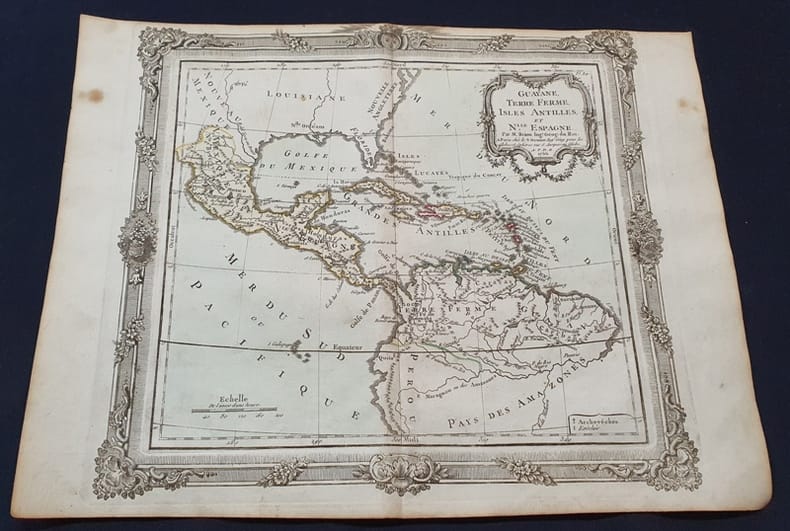
1772réf. Tir411772 Planche seule - dimensions 38 x 29 cm - planche aquarellée - Échelle en lieux . Le pli du milieu existant déjà sera donc envoyée pliée en deux .La nouvelle Espagne correspond au Mexique , Nicaragua, Panama / la Terre ferme au Vénézuela .
1772réf. Tir411772 Planche seule - dimensions 38 x 29 cm - planche aquarellée - Échelle en lieux . Le pli du milieu existant déjà sera donc envoyée pliée en deux .La nouvelle Espagne correspond au Mexique , Nicaragua, Panama / la Terre ferme au Vénézuela .
réf. M13700Paris , Desnos , 1766 , carte coloriée ,encadrée par un texte collé , 49,5 x 30 cm . Mouillure claire sur la marge inférieure.
réf. 26080The Times and the Globe London. Four letters by 'NIGER' to the Globe dated 29 and 30 January 9 February and 2 March 1850. Four letters to The Times two apiece from 'NIGER' and 'JACOB OMNIUM' dated in October and November 1850. A contemporary manuscript note to the present item reveals for the first time the identity of ‘Niger’ one of the two correspondents of whose letters it consists. And minor manuscript corrections to the last of the four letters would seem to suggest the involvement of the author. This is Sir James Robert Carmichael 1817-1883 2nd Bart who was intimately connected with British Guiana through his father Sir James Carmichael-Smyth 1779-1838. Having served from 1829 as governor of the Bahamas where he abolished the flogging of female slaves Carmichael-Smyth had been appointed governor of British Guiana in June 1833. According to Carmichael-Smyth’s entry in the Oxford DNB he ‘arrived at Georgetown Demerara shortly before the emancipation of slaves when much depended on the governor. Unmoved by the reckless hostility of a section of the planters Carmichael-Smyth by a firm impartial and vigorous government won the confidence of the slaves. He so closely supervised every department of government that as he himself observed he could sleep satisfied that no person could be punished without his knowledge and sanction. Carmichael-Smyth died suddenly at Camp House Georgetown Demerara of ‘brain fever’ after four days’ illness on 4 March 1838; he was widely esteemed and his death much regretted.’ The other correspondent ‘Jacob Omnium’ is Thackeray’s friend Matthew James Higgins 1810-1868 whose entry in the Oxford DNB states: ‘In 1838–9 he visited British Guiana where he later inherited the Alliance estate after the death of his mother and repeated the visit in 1846–7. This experience enabled him to keep his estate in good order during the critical period which followed the abolition of slavery and to put the case for the West India planters in defence of the protective sugar duties. He wrote four effective pamphlets upon the difficulties of the sugar-producing colonies in 1847 and 1849.’ The material consists of eight long letters in small print to the Globe and The Times laid down on nine foolscap 8vo pages over six leaves extracted from an album. The total length of text in 7-inch wide columns is 430 cm. In good condition lightly aged and worn on worn leaves. The first four letters from ‘Niger’ to the editor of the London newspaper the Globe are on the subject of ‘British Guiana and Governor Barkly’. These four are dated 29 and 30 January 9 February and 2 March 1850. ‘NIGER’ is identified in a contemporary hand at the end of the first letter as ‘Sir J R Carmichael’. The last four letters are an somewhat intemperate exchange in The Times of two letters apiece between ‘NIGER’ writing from London on 30 October headed ‘A WORD TO WEST INDIA PROPRIETORS’ and 12 November and ‘JACOB OMNIUM’ writing from Lombard Street on 10 and 16 November. At the start of the first of his letters to the Globe Carmichael states his position: ‘Mr Barkly has earned so high a reputation among men of all parties both in his late position in Parliament and in the discharge of his present arduous functions in Guiana that he may well afford to despise the bitter revilings of disappointed faction; but the article in question contains allegations so unfair ungenerous and unscrupulous in their nature that I consider the public should be made acquainted with the true state of the case at issue between the Morning Chronicle and the Governor of Guiana.’ This he proceeds to do presenting a mass of detail including some taken from ‘the lastest accounts’ he has received from ‘the West India mail’. In the first of his letters to The Times Carmichael discusses ‘the treatment the unfortunate race of Africa hae met with at the hands of the white man’: ‘I have known a slave to be destroyed by torture and a fine inflicted on the overseer as a punishment; but these thank God are tales of a bigone day. My only object in alluding to them is to point out to the West India proprietors that they have been guilty of a great and sad dereliction of duty of which they are now reaping the unavoidable punishment. They have treated the colonies as hotbeds from whence to forcec money into their pockets; they have forgotten what they owed to those whose toil supplied their wants and luxuries’. Higgins responds: ‘All that “Niger” says concerning the unhappy fate of the slaves in the British West Indies in bygone days may for all I know be most accurate. I cannot however divine why he has reverted to it. . Without disputing the accuracy of his picture of West Indian cruelty and West Indian mismanagement under the obsolete system of slavery I submit that it is . unfair and irrelevant to endeavour to introduce it into the present question between Lord John Russell and the free-labour sugar-growers’. In his last letter Higgins complains: ‘Your correspondent “Niger” preserves a great advantage over me. He well knows who I am the nature of my connexion with the colonies and the habits of my family and he very skilfully and I think somewhat unhandsomely turns the minutest points of that knowledge to his advantage whilst he carefully preserves his own incognito affording me no clue whereby I may infer what manner of man my assailant is.’ While acknowledging ‘Niger’ to be ‘a very able partisan’ Higgins concludes by accusing him of ‘doing his best to throw dust in the eyes of the British nation’. See Scan. I've yet to find an example of Carmichael-Smyth's handwriting to make a judgment on the signature. The setting out of the articles suggests a personal interest even file copy. The Times and the Globe, London. Four letters by 'NIGER' to the Globe dated 29 and 30 January, 9 February and 2 March 1850. Fou unknown
réf. B9781019938461Hardback. New. hardcover
réf. 1391243862.Ghardcover. Good. Access codes and supplements are not guaranteed with used items. May be an ex-library book. hardcover
réf. 139096650X.Gpaperback. Good. Access codes and supplements are not guaranteed with used items. May be an ex-library book. paperback
réf. 1177925397.Gpaperback. Good. Access codes and supplements are not guaranteed with used items. May be an ex-library book. paperback
réf. 0484311379.Ghardcover. Good. Access codes and supplements are not guaranteed with used items. May be an ex-library book. hardcover
réf. 133323242X.Gpaperback. Good. Access codes and supplements are not guaranteed with used items. May be an ex-library book. paperback
1987réf. 13231987 La Réalité 1987 Un volume grand in°4 reliure cartonnée éditeur sous jaquette 141 pages Nombreuses photographies en couleurs LR15
1993réf. 023329EQUINOXE ÉDITIONS 1993 Un album grand in-4°, 137 pp. Reliure éditeur toilée rouge à la bradel, premier plat titré or, jaquette illustrée. Photographies de Bernard Lavergne.
1971réf. 142382Couverture souple. Brochure de 40 pages.
1999réf. 143759Couverture souple. Brochure de 48 pages.
1992réf. 143461Couverture souple. Brochure de 32 pages.
réf. QWA-17497Fasquelle, 1936, in-8 br. (14,5 x 22,5), 170 p., avant-propos d Henry Bérenger, préface de G. Monnerville, 7 cartes et plans, 7 gravures h.-t., 2 tableaux, bon état.
1936réf. 7132Paris Fasquelle 1936 In-8 170 pp, avant-propos de M. Henry Bérenger, préface de Me G. Monnerville. Illustré de cartes et plans et de gravures hors-texte. Frontispice. Dos muet passé, coupures sans manque aux coiffes, rousseurs sur plats, d'usage à l'intérieur ; papier jauni, n° au tampon sur page de titre
1936réf. 72506Paris Fasquelle 1936 1 vol. broché in-8, broché, 166 pp., illustré de cartes et plans in-texte et de gravures en noir hors-texte. Envoi de l'auteur. Une planche un peu froissée. Sinon bon état général.
1936réf. 72506Paris Fasquelle 1936 1 vol. broché in-8, broché, 166 pp., illustré de cartes et plans in-texte et de gravures en noir hors-texte. Envoi de l'auteur. Une planche un peu froissée. Sinon bon état général.
réf. 38730Nyons Pènable Frères 1859 in 12 (17x10,5) 1 volume cartonnage de l'éditeur, orné d'un décor doré, 180 pages, petite usure sur l'extrémitié d'un coin du plat supérieur. Quatrième édition. J.-Joseph Bélières, Missionnaire et vice préfet apostolique de la Guyane française. Bon exemplaire ( Photographies sur demande / We can send pictures of this book on simple request )
1919réf. 15986Partitions sur le Bagne Borel-Clerc 1919
réf. 38566Paris, Hachette, 1998. 13 x 19, 514 pp., nombreuses illustrations et cartes en couleurs, cartonnage souple d'édition + jaquette, très bon état.
1973réf. ko673Institut français de recherches fruitières outre-mer Dos carré collé 1973 in-4 (29.5*21), 60 pages, tableaux, graphiques et illustrations ; état correct. Livraison a domicile (La Poste) ou en Mondial Relay sur simple demande.
1977réf. 137634Couverture souple. Broché. 230 pages.
réf. 10910London: George Bell and Sons 1901. First edition. Octavo half binding by Morrell of of brown morocco and marbled boards spine with one raised band and an intricate decorative panel containing spheres and petals reminds me a little of an astronomical chart; titling and binding have an 1890s feel top edge gilt pp. xxxvii 514. Armorial bookplate of Herbert Claiborne Pell light foxing throughout leather is starting to split at hinges coners are bumped and worn bare to boards. An interesting and unusual binding with attractive period design. NCBEL III column 617. London: George Bell and Sons, 1901. First edition. hardcover