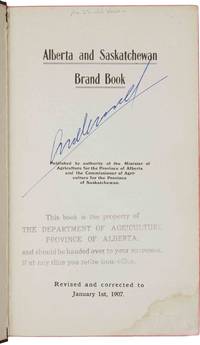
1907réf. 68072Edmonton Alberta: Published by authority of the Minister of Agriculture for the Province of Alberta and the Commissioner of Agriculture for the Province of Saskatchewan 1907. Canadian Provincial Brand Book A combined brand book for the Canadian provinces of Saskatchewan and Alberta illustrating all of the registered cattle brands for those provinces to January 1 1907. The list is organized alphabetically by brand giving the names of cattle owners and their ranch locations together with illustrations of their brands. Included are two supplements one for each province as well an index. Numerous ads are featured at rear. OCLC locates copies at five institutions including one in the Graff Collection at the Newberry Library though not listed in Storm's catalogue of the Graff Collection. Original blue patterned cloth front board gilt. Binding lightly rubbed and soiled. Edges stained red. Hinges starting. Text tanned. Dampstaining to lower edge of boards and to lower edge and foredge of text. Ink inscription and ink institutional stamp Department of Agriculture Province of Alberta to titlepage. Good. OCLC 21170209 1452154248. hardcover books
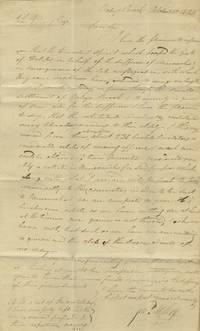
1825réf. BK0033Bailey's Brook Nova Scotia 1825. Autograph letter signed "Geo. McLeod" to John Young Esq. Halifax. Stampless folded letter with manuscript "7 / Paid" rate "Post Paid" notation and a clear "POST OFFICE PICTOU / PAID" handstamp. Light filing folds; very good. A contemporary account of rural relief organized for survivors of the Great Miramichi Fire written only eighteen days after the disaster. George McLeod reports traveling personally through Bailey's Brook and the surrounding settlements to solicit provisions and clothing gathering approximately 230 bushels of potatoes together with "considerable articles of wearing apparel" for immediate shipment through Pictou: "I went yesterday in person through the small settlement of Bailey's Brook & its vicinity in quest of some aide for the sufferers & have the pleasure to say that the inhabitants individually contributed very liberally according to their ability. I this day received from them into my store about 230 bushels buntatoes sic & considerable articles of wearing apparel & much more could be obtained if time permitted." The letter is particularly revealing about the material circumstances of disaster relief in a cash-poor agricultural community. The residents had little money available and "nothing else at hand" as their grain had not yet been threshed and the lateness of the season required them to contribute whatever could be gathered and transported without delay-nonetheless they were "willing to give." McLeod notes that additional supplies had been collected at Merigomish and would be combined with those from Bailey's Brook sent to the committee at Pictou and forwarded onward to Miramichi. He also records keeping a list of the individual contributors and the articles supplied under each name. We find no other examples of documents or primary source materials relating to the disaster in commerce or in auction records. A focused primary document of one of the largest fires in early Canadian history with a detailed description of the mechanics of relief. . unknown books
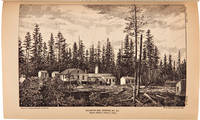
1902réf. 316588Newark Valley NY; near Uffington Ontario and other sites 1902. Illustrated with a manuscript plan of the 1899 camp and a map accomplished in red ink and pencil for the 1901 hunt. 174 pp. as described serially in manuscript in an Excelsior Diary ignoring the printed dates approximately 10000 words. 1 vols. Narrow agenda 12mo. Original leather edged canvas wallet binding stamped Excelsior Diary on flap. Owner name in ink on back cover and on front flyleaf. Very good conition entirely legible. Illustrated with a manuscript plan of the 1899 camp and a map accomplished in red ink and pencil for the 1901 hunt. 174 pp. as described serially in manuscript in an Excelsior Diary ignoring the printed dates approximately 10000 words. 1 vols. Narrow agenda 12mo. An excellent series of accounts of seven three-week deer hunts in Canada late October to mid-November 1897-1902 with names of the members of the hunting parties and a table by hunter of the game bag. Livermore a resident of Newark Valley New York travelled to Canada each year with a group of friends to hunt deer at a camp near Uffington Ontario; his diaries 20-40 pages for each hunt provide a brief account for each day's activities without much of a narrative thread mostly devoted to the hunting with notes on deer seen shot at and bagged. Also included are extensive notes on transportation to and from the camp other wildlife encountered on the hunt anecdotes e.g. a hound returning to camp with a nose full of porcupine quills some expense accounting and camp life. Livermore and his ten or so comrades most of whom hailed from Ottawa or Toronto bagged an average of 20 deer a year over the six hunts with a high of 30 in 1899 and 1900 the kill including bucks does and fawns rather indiscriminately. From the 1897 trip: "A.E. Bradstreet shot a fine doe 2-year old in narrows from upper pine near Burnt lake. Called for me to dress it. 1898: "I went with Mr. Miller North East of camp to a new watch & shot the first deer of the season at 8:30 & a fawn on same morning about 9:30." 1899: "Paddy Regan killed a very large buck yesterday in Rat lake weighed 240 pounds." 1900: "Weather very warm went bathing in lake today. Had plenty of fresh fish from lake perch bull heads chubs also some trout." 1901: "F. Smith shot a fine 5 i.e. 10 pt. buck at head of Jean Lake." 1902: "I went to pt. between watches on Jean Lake North side at 8:30 just landed I see a small Buck fawn 'fine one' crossing outlet of Jean went after him & made a finish at first watch on Stoney Creek." Though lacking a narrative thread this is a revealing manuscript giving the day to day details from a series of deer hunting trips to Canada at the turn of the 20th century. The first 60 days of the diary have entries in real time mostly devoted to Livernore's day job as a clerk in a shoe store and for example an 1892 visit to New York City; the manuscript is quite legible and very good throughout. unknown books
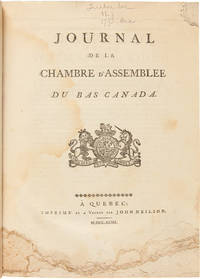
1838réf. 32893Montreal. 1838-1840. Rare Laws from the Patriot Uprising An important collection of Canadian laws as passed by the Special Council of Lower Canada from 1838 to 1840. When the Patriot Uprising of 1838 caused Canadian officials to suspend the 1791 constitution which had divided Canada into the Upper and Lower Provinces each with their own legislature and establish martial law the provincial judiciary assumed administrative control in the form of the Special Council. The Special Council continued in an administrative capacity until the Union Act of 1840 which reunited the provinces with a single legislature. A fundamental cause of the Patriot Uprising was the ambiguous extent of judiciary power; based on the reign of the Special Council recorded in detail here judicial powers were more clearly defined via the Union Act. TPL calls for six volumes bound in three. The present set features each volume bound separately lacking the sixth volume. The large portions of unnumbered pages at the end of each contain sessional papers appendices and indices. Key insight into a tumultuous period of Canadian legal history. The journals were also issued in French. OCLC locates these journals at fewer than ten institutions not all of which appear to hold complete runs. Quarto. Later cloth red and black gilt morocco labels. Moderate soiling on covers library labels at toe of spines. Uniform light toning. Perforated library stamps on titlepages occasional additional library markings. First twenty pages of last volume in typescript facsimile. Overall very good. Lacks the sixth volume. TPL 2173. GAGNON I:1830. OCLC 12010933 63013527. hardcover books
1845réf. 50950Montreal Toronto Quebec & Ottawa. 1845-1906. A Lengthy Run with a Rare Folio Atlas A long run of the geological survey of Canada with some works printed in English and some in French. Comprises the progress reports and maps for the Canadian geological survey for a period of about fifty years. Includes the rare large folio atlas PLAN OF VARIOUS LAKES AND RIVERS BETWEEN LAKE HURON AND THE RIVER OTTAWA. Toronto 1857 listed as numbers 16-38 in Ferrier's ANNOTATED CATALOGUE.OF THE GEOLOGICAL SURVEY CANADA. The atlas is usually encountered in quarto format with the maps folded to conform to the smaller size. A copy of the Ferrier bibliography is also included with the collection. A complete detailed list of the works is available upon request. Extra shipping will likely be required for this item. Seventy-seven works including numerous maps. Some original wrappers some volumes in contemporary leather bindings some in later yellow buckram. Some map volumes supplied at least in part in facsimile. Overall very good. hardcover books
1795réf. E0029Samuel Hearne was the first European to make an overland excursion across northern Canada to the Arctic Ocean xliv458 pages with two of four engraved plates after drawings by the author both folding and four of five folding engraved maps. Quarto 11 3/4" x 9 3/4" bound in full leather with raised spine bands and gilt lettering to spine. HillI page 141. Sabin 31181 First edition. Manuscript journal was found by La Pérouse when he captured Fort Albany; later one of his conditions of surrender was that it be published. Samuel Hearne 1745 – November 1792 was an explorer fur-trader author and naturalist. He was the first European to make an overland excursion across northern Canada to the Arctic Ocean In 1774 Hearne built Cumberland House for the Hudson's Bay Company its first interior trading post and the first permanent settlement in present Saskatchewan. From 1769 to 1772 Hearne was employed in north-western discovery searching especially for certain copper mines described by Indians as "Far-Away-Metal River". These copper mines were found in the Barren Lands where the ground is permanently frozen to within a few inches of the surface creating in many areas vast stretches of mosquito- and fly-infested swamp during the summer thaw. For this reason it was decided that travel in winter was preferable. His first attempt began on 6 November 1769. The large size of the expedition and too much European equipment being carried led to the desertion of his Indian guides and the failure of the expedition. His second commencing 23 February 1770 failed because his quadrant was broken and much of his equipment was stolen. Learning from the mistakes of the first two expeditions Hearne contrived to travel as the only European with a group of Indians led by the great chief Matonabbee. The group also included eight of Matonabbee's wives to act as beasts of burden in the sledge traces camp servants and cooks. This third expedition set out in December 1770 in order to reach the Coppermine River in summer by which he could descend to the Arctic in canoes. Matonabbee kept a fast pace so fast they reached the great caribou traverse before provisions dwindled and in time for the spring hunt. Here all the Indian hunters of the north gathered to hunt the vast herds of caribou migrating north for summer. A store of meat was laid up for Hearne's voyage and a band of warriors joined the expedition. Matonabbee ordered the women to wait for his return in the Athabasca country to the west. The Chipewyans were generally a mild and peaceful people however they were in a state of conflict with the Inuit. A great number of Indians joined Hearne's party to accompany them to the Coppermine River with intent to murder Inuit who were understood to frequent that river in considerable numbers.2 On July 14 1771 they reached the Coppermine River a small stream flowing over a rocky bed in the "Barren Lands of the Little Sticks". A few miles down the river just above a cataract were the domed wigwams of an Eskimo camp. At 1am on July 17 1771 Matonabbee and the other Indians fell upon the sleeping Eskimo in a ruthless massacre. Approximately twenty men women and children were killed; this would be known as the Massacre at Bloody Falls. A few days later Hearne was the first European to reach the shore of the Arctic Ocean by an overland route. By tracing the Coppermine River to the Arctic Ocean he had established there was no northwest passage through the continent at lower latitudes. This expedition also proved successful in its primary goal by discovering copper in the Coppermine River basin. However an intensive search of the area yielded only one four-pound lump of copper and commercial mining was not considered viable. Matonabbee led Hearne back to Churchill by a wide westward circle past Bear Lake in Athabasca Country. In midwinter he became the first European to see and cross Great Slave Lake. Hearne returned to Fort Prince of Wales on 30 June 1772 having walked some 5000 miles and explored more than 250000 square miles. Condition: Rebound in attractive leather with raised spine bands. Lacks frontispiece map and two plates. Plate I A North West View of Prince of Wales's Fort and Plate IV A Winter view of the Athapuscow Lake. Some internal spotting. Small repair to title page and verso and front free end paper edge else a better than very good copy. Printed for A Strahan and T Cadell hardcover books
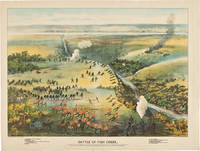
1885réf. 54034Toronto: Toronto Lithographing Co. ca.1885. Large Chromolithographs of the Riel Rebellion A trio of rare battlefield views depicting three of the major skirmishes fought during the North-West Rebellion in Saskatchewan in 1885. This series of battles is also known by several other names including the Saskatchewan Rebellion the Northwest Uprising and the Second Riel Rebellion the first Riel Rebellion occurred near Manitoba in 1869 and is also known as the Red River Rebellion. Both the 1869 and 1885 actions were led by Louis Riel the leader of the Métis people. Chronologically the lithographs are as follows: 1 "Battle of Fish Creek." This battle occurred on April 24 1885 and resulted in a stunning victory when around 200 Métis soldiers overcame a superior force of 900 government soldiers and temporarily halted an advance on Batoche. 2 "Battle of Cut Knife." On May 2 1885 a force of Cree warriors held off a superior group of Canadian army units. 3 "The Capture of Batoche." Effectively the end of the rebellion the Métis were soundly defeated in the second week of May after they ran out of ammunition on the third day of fighting. This action forced Riel to surrender on May 15. The Métis are one of the recognized aboriginal groups in Canada who trace their roots to the first interaction between First Nations people and the earliest European settlers usually French and largely as a result of the fur trade. The Métis are among the earliest mixed-race people in Canada and developed a separate distinct culture based on their ancestral origins usually stemming from the coupling of an indigenous woman and a male European settler. By the 19th century the Métis were well-assimilated into French-Canadian culture and many worked as fur traders for the North-West Company or Hudson's Bay Company or supplied furs as independent trappers. When those companies pulled out of the Red River and Saskatchewan regions in the mid-to-late 1800s the Canadian government took over the land and began to enforce their will on the Métis people. The first armed conflict between the Métis and the Canadian provincial government occurred in 1869 in the Red River region where Louis Riel led an unsuccessful rebellion. Some fifteen years later the Métis formed their own provincial government in western Saskatchewan after hearing that the Canadian government was sending mounted police to enforce Canadian law in the region. This Second Riel Rebellion occurred in a series of skirmishes between the Métis and the Canadian armed forces between March 26 and May 12 1885. Though led by Louis Riel the Métis ultimately lost again to the Canadian government. Still both rebellions helped the Métis gain some measure of recognition and respect from the Canadian government that they would very likely not have earned otherwise. The lithographs were produced by the Toronto Lithographing Company purveyors of patriotic views of famous Canadian wars. In this case the company assigned W.D. Blatchly to paint the scenes for the 1885 conflicts; Blatchly was at the time one of the leading artists in all of Canada. An excellent series of lithographs illustrating three important events in the famous rebellion with outstanding display appeal. Cut Knife and Fish Creek trimmed about ¾ inch along the top margin and about 1¼ inches along left margin. Capture at Batoche trimmed slightly more but evenly in each margin and adhered to backing board. Overall good plus. unknown books
1793réf. 32892Quebec. 1793-1817. Extensive Run of Early Canadian Legislative Journals A large and impressive archive of Canadian laws. In an effort to pacify the disparate French and British populations of Canada the Constitutional Act of 1791 divided Canada in two. Upper Canada was primarily populated by Loyalist emigrants of the American Revolution while the citizenry of Lower Canada which included Quebec was mostly of French descent. These are the laws of Lower Canada printed in English and French. Though the first volume appeared in 1793 it includes material from the first session of the first Parliament held in December 1792. The series continued till 1836. "Public accounts are included in the early numbers of the Journals and from 1809 to 1835-36 Sessional papers are published as appendices to the Journals" - TPL. Present here is a complete run from its inception to 1813 with an additional volume for 1817. The twenty-third twenty-fourth and twenty fifth volumes are lacking. Scarce. OCLC locates only six complete runs. A prime resource for the study of Canadian legal history. Later brown cloth red and black gilt morocco labels. Printed in alternating English and French. Slight wear to and moderate soiling on covers. Occasional foxing. First view leaves of first volume torn along lower blank margin. Occasional old institutional markings. Overall very good. TPL 640. SABIN 10491. OCLC 11820245 48957532. TRÉMAINE 835. hardcover books
1626réf. 851271626. First Edition. VAUGHAN William. The Golden Fleece Divided into Three Parts under which are discovered the Errours of Religion the Vices and Decayes of the Kingdome and lastly the Wayes to get Wealth and to restore Trading so much complayned of. Transported from Cambrioll Colchos out of the southermost Part of the Iland sic commonly called the Newfoundland by Orpheus Junior for the generall and perpetuall Good of Great Britaine. London Francis Williams 1626. Square octavo contemporary limp vellum recased hand-lettered spine title later endpapers. Housed in a custom clamshell box. $15000.Scarce first edition of this early allegorical promotion of settlements in Newfoundland ""one of the earliest contributions to English literature from AmericaÓ Baer.""Deeply concerned about the poor economic conditions prevailing in Wales"" William Vaughan ""became interested in overseas colonization as a means for improving the lot of his countrymen. As a result he decided to try to plant a colony in Newfoundland largely because it was easily accessible and also because it possessed an established fishery. In 1616 he purchased from the Newfoundland Company the part of the Avalon Peninsula to the south of a line from Caplin Bay across to Placentia Bay and decided to name the colony 'New Cambriol.' In the following year Vaughan set out a few ill-prepared colonists to the harbour of Aquaforte where they spent the winter huddled in cabins built by migratory fishermen for summer use. In 1618 Vaughan hired Richard Whitbourne to bring colonists and provisions to the settlement and appointed him governorÉmoving it to a better location at RenewsÉ but in the end only six colonists spent the winter of 1619 at Renews and the settlement was abandoned in the following yearÉ Vaughan did his best to promote Newfoundland settlement by publication of his somewhat fanciful book The Golden Fleece"" Howgego. ""The work is one of the earliest contributions to English literature from America and was intended to advertise Vaughan's colony. It is a queer fantasy in prose and verse in which a succession of historical characters present complaints against the evils of the age in the court of Apollo and finally find the Golden Fleece in Newfoundland"" Baer. ""Vaughan's treatise was divided into three parts the first concerned with religion the second with the 'Vices and Decayes of the Kingdome' and the third with 'wayes to get wealth and to restore Trading. The third part focused on colonizationÉ he created a unique text by bringing into this dialogue the central figures of contemporary Jacobean and Elizabethan colonization including John Guy Captain John Mason Richard Whitbourne Francis Drake and Martin Frobisher"" McDiarmid & Collinson. The Golden Fleece is an extraordinary work in vivid contrast to the more prosaic and practical propagandist tracts on Newfoundland which Whitbourne and Mason had written. Its purpose was simple enough: Vaughan was anxious to promote the island as a place for settlement. Success he believed would relieve overpopulation at home treble England's present income from the fishery which he estimated to be 20000 pounds and generally increase tradeÉVaughan provided us with some of the earliest English literature on North America"" Gillian Cell. Lacking the extraordinarily rare map by John Mason which ""is very rarely found with the book"" Church. STC 2460. Sabin 98693. Church 409. Howgego V18. Interior generally fine blank leaves between parts V4 Oo2 and blanks at both front and rear excised. Scarce. hardcover books