[Wine List - St Denis Hotel, New York]Biblio.com

4.282 resultados
1860ref. 9034New York: Lith. of W. Faust 105 Nassau St 1860. Broadside wine list 25.5 x 15.5 cm. 1 page. Porcelain card decorated in chromolithograph with text in blue and red. A very early wine list from an important New York hotel and dining establishment. The hotel was at the corner of Broadway and Eleventh Street across from Grace Church and Rectory. Both the hotel and the church were designed by the architect James Renwick Jr. Named for its original owner Denis Julien the St. Denis Hotel opened in 1853 just in time for the Crystal Palace Exhibition. The building was leased to William Taylor in 1875 who incorporated the Taylor Saloon into the facility. The list features Clarets from Finke Merman of Bordeaux mostly from 1847 and 1848. And French whites including 1847 Latour Blanche and 1847 d'Yquem. Champagne Sherries and Madeiras are also included. A solid piece of printing from a firm more known for fruit labels. Verso contains an unattributed primitive pencil drawing of a horse. Some darkening to the top edge of the recto. Lith. of W. Faust, 105 Nassau St unknown
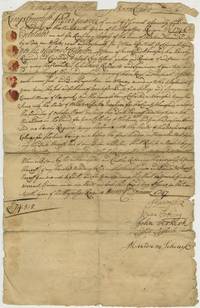
1789ref. List3854Kings County Province of New York Brooklyn 1789. Three manuscript documents on two pages measuring approximately 8 ¼ x 13 inches; relating to county taxation and court administration in Kings County including two early colonial warrants directed to the assessors and collector of "Brookland"; i.e. Brooklyn. Extensively repaired with archival tape with damage especially to right margin and at folds intersecting with text. Fair. Two colonial-era Kings County tax warrants issued in the twenty-first year of the reign of George II commanding the assessors and collector of Brookland to raise the town's share of the county rate. Addressed "To the assessors & Collector of Brookland" the documents open in formal warrant language: "Kings County. To the assessors & Collector of Brookland These We hereunder written being Supervisors for the Respective towns of the County abovesaid in the Province of New York; To the Assessors and Collector of Brookland Greeting in his Majesty's name you and each of you are hereby . strictly required and commanded ." One warrant directs the local officers "to assess collect and gather of and from every shop scholar inhabitants & resident neighbors within your town and precincts thereof their equal part share & proportion" of the town's tax burden specified as "the full and just sum of twenty six pounds & four pence Current Money of New York." The money was to be paid to "Mr. Peter Lefferts Treasurer for the County aforesaid" by the appointed February deadline. The second 1747 document directs the local officers to collect "Tax on Estates real and Personal for the More Effectuall fortifying of this Colony &c." to the tune of thirteen thousand pounds. The language is especially useful for showing the practical mechanics of colonial local government: the county supervisors apportioning the tax the town assessors and collector gathering it from inhabitants and the county treasurer receiving it. It further gives the collector authority in the event of nonpayment: "if any person or persons shall long refuse or neglect to pay their parts shares or proportions of the said sum of twenty six pounds and four pence being assessed as abovesaid it shall and may be lawful to and for you to levy illegible due to fold split and crease on the goods & chattels of the defaulters having regard to the laws of this Colony ." The document closes in the usual form "hereof you are not to fail" adding that the warrant is given "under our hands & seals this Sixth day of paper loss in the twenty first year of his Majesty's Reign Anno Dom'i 1747." Both are signed by Kings County supervisors S. Gerritsen Isaac Sebring John Verkerk Marten Schenck and Leffert Lefferts with one signature illegible. Lefferts of the prominent Lefferts family co-founded and served as the first president of the Long Island Bank Brooklyn's first bank and was the first judge of Kings County. On the verso of the first colonial-era warrant is a later Kings County account 1789-90 submitted to Sheriff Charles Turnbull a Revolutionary War veteran who took office as Brooklyn's High Sheriff in 1789. The account records ordinary county legal expenses including: "April 20 / To Summoning Grand Jury - £1-4 - To Making a List of Freeholders 1-10 - Sept. 4 To Summoning Grand Jury of Supreme Court 1-4 - . Term To Cash paid for Candles &c. 0-5 - 1790 To Summoning Grand Jury 1-4 - fall term / To Summoning Grand Jury 1-4 - £6-11" Taken together the two documents offer an appealing Kings County grouping: two colonial Brookland tax warrants and an early Federal sheriff's account. The 1747 warrants are the stronger piece particularly for the direct address to the town's assessors and collector county tax language and reference to Peter Lefferts as county treasurer. The later sheriff's account is less dramatic but it pairs naturally as another Kings County administrative document this time showing court-related duties such as summoning grand juries and preparing a list of freeholders. . unknown books
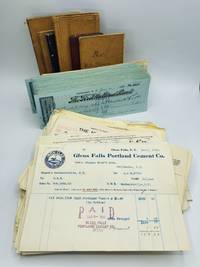
ref. 70600An archive of photographs ledgers canceled checks legal documents and other business and personal records from a Stillwater New York family who feuded over the disposition of a lumber and coal business at the turn of the last century. The troubles began following the death in 1898 of Stephen Wood Sr. the owner of Stephen Woods Sons Lumber and Coal in Stillwater New York. The business continued on under the direction of his two sons Stephen and Edward who were named executors of the estate. Two daughters were not included in the settlement. The sons cared for their widower mother Temmy but there was no formal settlement of the estate. When Edward who took care of the books died in 1908 matters became complicated and the family found itself in court because Edward's wife Louise C. Wood asked for a settlement of his portion of the estate. Temmy then sued saying she was owed a third of the estate which was also indebted to her for $6000 in personal loans. This legal dispute went on for several years during which Stephen Jr. died on February 14 1911 followed not long after by his mother Temmy who died in 1912. After Stephen Jr.'s death the remaining heirs settled the dispute with Louise paying her $1500. When Temmy died her estate was left to her granddaughters who signed their inheritance rights over to their mother. Among the court documents is a final settlement of the estate legal fees which were paid in 1917. In a typed letter dated November 8 1911 Emma Wood the daughter of Temmy Wood expressed the concern and frustrations she and her sister Kate felt over the legal troubles. "I understood Kate to say this morning that she does not want to have anything to do with it but that whatever you decide upon will be her decision also. I am in too nervous a state to discuss matters verbally with you so think best to write what I feel the honest thing to be done." Much of the material in this collection appears to be related to the request to settle the estate and therefore provides a detailed overview of the operations of the business along with the family's personal holdings and business dealings. Among the materials included are a handwritten bills ledger receipts legal documents family wills household notebooks and a photographic album. unknown
1789ref. List3854Kings County Province of New York Brooklyn 1789. Three manuscript documents on two pages measuring approximately 8 ¼ x 13 inches; relating to county taxation and court administration in Kings County including two early colonial warrants directed to the assessors and collector of "Brookland"; i.e. Brooklyn. Extensively repaired with archival tape with damage especially to right margin and at folds intersecting with text. Fair. Two colonial-era Kings County tax warrants issued in the twenty-first year of the reign of George II commanding the assessors and collector of Brookland to raise the town's share of the county rate. Addressed "To the assessors & Collector of Brookland" the documents open in formal warrant language: "Kings County. To the assessors & Collector of Brookland These We hereunder written being Supervisors for the Respective towns of the County abovesaid in the Province of New York; To the Assessors and Collector of Brookland Greeting in his Majesty's name you and each of you are hereby . strictly required and commanded ." One warrant directs the local officers "to assess collect and gather of and from every shop scholar inhabitants & resident neighbors within your town and precincts thereof their equal part share & proportion" of the town's tax burden specified as "the full and just sum of twenty six pounds & four pence Current Money of New York." The money was to be paid to "Mr. Peter Lefferts Treasurer for the County aforesaid" by the appointed February deadline. The second 1747 document directs the local officers to collect "Tax on Estates real and Personal for the More Effectuall fortifying of this Colony &c." to the tune of thirteen thousand pounds. The language is especially useful for showing the practical mechanics of colonial local government: the county supervisors apportioning the tax the town assessors and collector gathering it from inhabitants and the county treasurer receiving it. It further gives the collector authority in the event of nonpayment: "if any person or persons shall long refuse or neglect to pay their parts shares or proportions of the said sum of twenty six pounds and four pence being assessed as abovesaid it shall and may be lawful to and for you to levy illegible due to fold split and crease on the goods & chattels of the defaulters having regard to the laws of this Colony ." The document closes in the usual form "hereof you are not to fail" adding that the warrant is given "under our hands & seals this Sixth day of paper loss in the twenty first year of his Majesty's Reign Anno Dom'i 1747." Both are signed by Kings County supervisors S. Gerritsen Isaac Sebring John Verkerk Marten Schenck and Leffert Lefferts with one signature illegible. Lefferts of the prominent Lefferts family co-founded and served as the first president of the Long Island Bank Brooklyn's first bank and was the first judge of Kings County. On the verso of the first colonial-era warrant is a later Kings County account 1789-90 submitted to Sheriff Charles Turnbull a Revolutionary War veteran who took office as Brooklyn's High Sheriff in 1789. The account records ordinary county legal expenses including: "April 20 / To Summoning Grand Jury - £1-4 - To Making a List of Freeholders 1-10 - Sept. 4 To Summoning Grand Jury of Supreme Court 1-4 - . Term To Cash paid for Candles &c. 0-5 - 1790 To Summoning Grand Jury 1-4 - fall term / To Summoning Grand Jury 1-4 - £6-11" Taken together the two documents offer an appealing Kings County grouping: two colonial Brookland tax warrants and an early Federal sheriff's account. The 1747 warrants are the stronger piece particularly for the direct address to the town's assessors and collector county tax language and reference to Peter Lefferts as county treasurer. The later sheriff's account is less dramatic but it pairs naturally as another Kings County administrative document this time showing court-related duties such as summoning grand juries and preparing a list of freeholders. . unknown
2019Together 3 vols., 2 roy. 8vo. and 1 8vo., First Edition thus, with 40 fine plates; brown boards, upper boards lettered in gilt, brown morocco backs lettered in gilt, Commentary leaflet sewn as issued, a fine set in publisher's board slip-case lettered in blue. EDITION LIMITED TO 500 COPIES. Wonderful facsimiles of the original editions of 1909 and 1910 respectively.
ref. Z1-I-004-01797New-York Historical Society. Used - Good. Ships from UK in 48 hours or less usually same day. Your purchase helps support Sri Lankan Children's Charity 'The Rainbow Centre'. Ex-library so some stamps and wear but in good overall condition. 100% money back guarantee. We are a world class secondhand bookstore based in Hertfordshire United Kingdom and specialize in high quality textbooks across an enormous variety of subjects. We aim to provide a vast range of textbooks rare and collectible books at a great price. Our donations to The Rainbow Centre have helped provide an education and a safe haven to hundreds of children who live in appalling conditions. We provide a 100% money back guarantee and are dedicated to providing our customers with the highest standards of service in the bookselling industry. New-York Historical Society unknown
1989ref. BN124857Taylor & Francis Inc 1989. 1989. Hardcover. Polyphase Induction Motors Analysis Polyphase Induction Motors Analysis Paul Scotia New York USA Cochran Taylor & Francis Inc hardcover
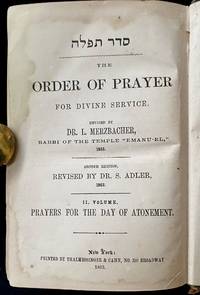
1863ref. 42038New York Printed by Thalmessinger & Cahn 1863. Hardback. 2nd Revised Edition edited revised and corrected by S. Adler 1st printing thus. Original gilt tooled leather 8vo 396 pages. In Hebrew and English on facing pages. Formerly Singerman 1780 now merged into Singerman 1667 as vol II variant 1 Thalmessinger & Cahn. The second of two volumes vol. 1 Daily prayers & vol. 2. Prayers for the Day of Atonement this volume substantially reworked by Adler and published 1860 vol. I and 1863 vol. 2 here. Together these comprise the First Edition of Samuel Adler's revised edition of Leo Merzbacher's 1855 Prayer-Book. Despite the modest title-page Adler's production here was not merely a revision but rather an entire reworking with additions and alterations to the liturgy. Rabbi Leo Merzbacher's original version of the prayers was quite traditional. "As resourceful and accomplished a liturgist as Merzbacher proved to be he seldom sought to .willfully turn aside from the traditional cannon" Friedland p. 36. Samuel Adler on the other hand Merzbacher's successor at Temple Emanu-El of New York had no such reservations about adopting radical change to the structure of the prayer-book. In his version of the "Order of Prayer" Adler did not rely on sources in Jewish tradition rather he changed the prayers according to his subjective views of how synagogue services should be conducted. See Eric Lewis Friedland Brandeis University dissertation The Historical and Theological Development of the non-Orthodox Prayerbooks in the United States 1967. Indeed it was precisely this 1860-1863 version of the "Order of Prayer" that was adopted by Temple Emanuel in New York and all subsequent issues of the "Order of Prayer" utilized this version containing Samuel Adler's revisions. The Union Prayerbook itself was largely based on Adler's 1860-1863 revisions here. Consequently this prayer-book was also the cause of much controversy. Orthodox Rabbi Bernard Illowy of St. Louis fumed that whomsoever utilized this "so-called" prayer-book was to be "entirely excluded from all religious communion" see Michael A. Meyer Response to Modernity: A History of the Reform Movement 1995 p. 237. Leo Merzbacher 1809-1856 received his Rabbinic ordination from the celebrated Rabbi Moses Sofer of Pressburg the "Chasam Sofer" the leading opponent of the Reform movement. Merzbacher immigrated to America in the 1840's "and was the first Reform rabbi in the country. After serving at Anshe Chesed and Rodeph Sholom in New York Merzbacher became the rabbi of Emanu-El the first Reform temple in the city.The 1855 edition of This prayer book was the first Reform edition issued in America for general use" Goldman. Merzbacher adopted changes in synagogue custom such as the prominent use of an organ and eradicating the observance of the second day of festivals. Samuel Adler 1809-1891 replaced Merzbacher in Temple Emanuel in 1857 following the latter's death where he served until 1891. Adler's son Felix was the founder of the Ethical Culture movement. SUBJECTS: Siddurim -- Texts. Reform Judaism -- Liturgy -- Yom Kippur -- Siddour -- Textes. Judai¨sme re´forme´ -- Liturgie -- Yom Kippour -- OCLC: 78354364. Lacks top 1 inch of backstrip spine covering and rear blank endpaper; wear to boards some stains but solid good condition. Rare and Important AMR-69-11-B-D. New York, Printed by Thalmessinger & Cahn unknown
ref. 39020[New-York] C. Hayward [Seconde moitié du XIXème siècle] 21,5 x 48 cm à vue (35 x 61 cm au cadre) sous verre, marie-louise, encadrement bois doré moderne
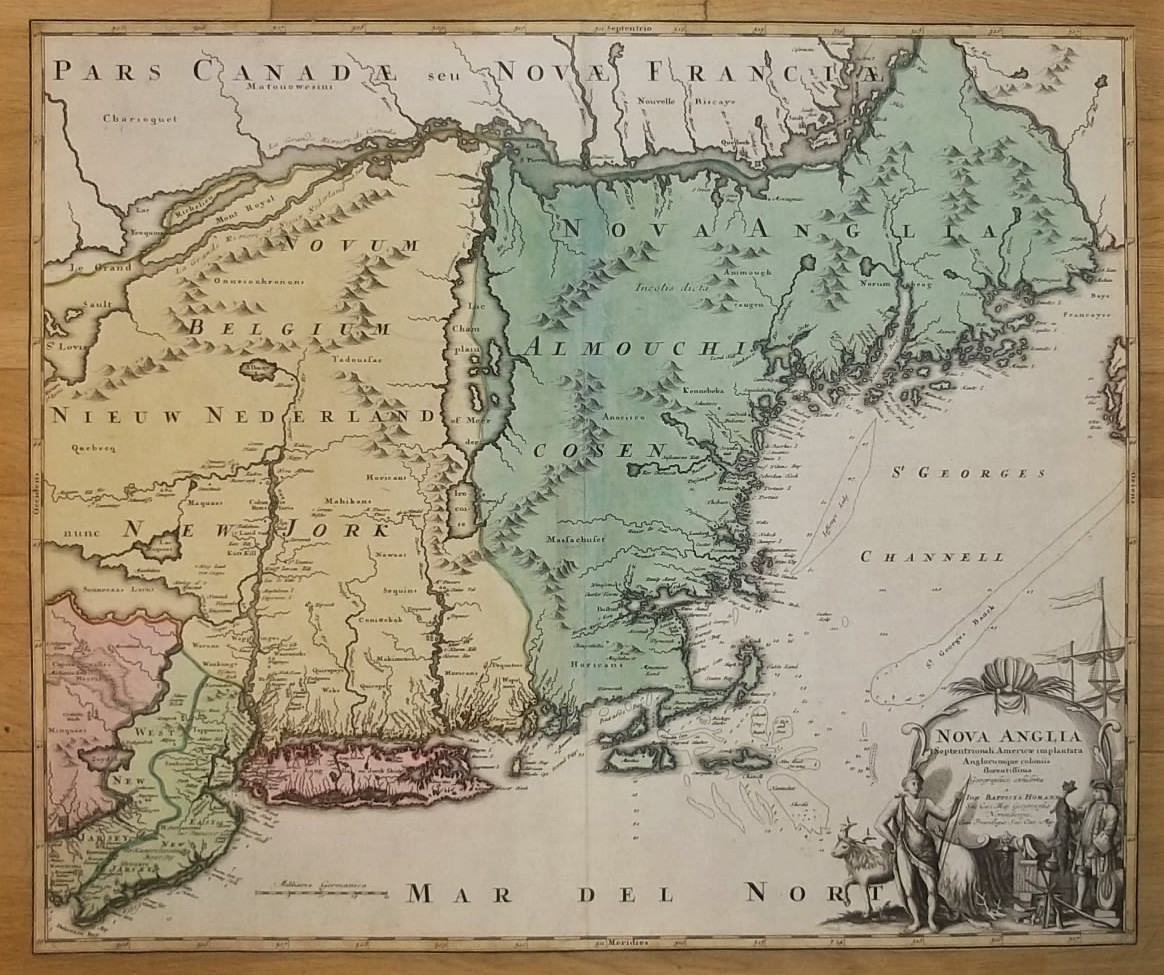
1730ref. 18639Nürnberg, Homann, ca. 1730. Ca. 49 cm x 58 cm.
1800ref. 38803Albany 1800. Folio broadside 13-1/2" x 16-3/8." Printed in five columns beneath the caption title. Expertly repaired long horizontal closed tear no loss. Very Good. During John Jay's term as Governor the Legislature passed 133 Acts listed here. ESTC lists holdings only at AAS; OCLC adds a few more. Evans 38093. ESTC W10245 1- AAS. unknown books
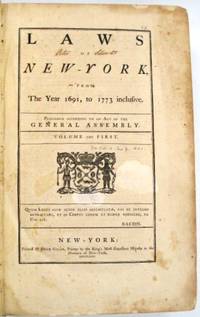
1774ref. 26611New York: Hugh Gaine 1774. Folio two volumes in a single contemporary calf volume some rubbing hinges firm but each has small separation at the top. Raised spine bands somewhat faded spine lettering. Pages iv 420; 4 421-835 i.e. 833 1 errata as issued. Contemporary signature of Peter Silvester on title page. Occasional light tanning light wear two lightened spots on title page not affecting any type. Very Good. Peter Van Schaack the editor signs the Preface in type. This comprehensive compilation commences with the First Assembly in 1691. It ends with the Sessions of the Twenty-Ninth Assembly in 1773 which enacted a law that made defacing statues of the King a crime. The Acts encompass the broad spectrum of the requirements of a developing society including a number of laws regulating the behavior of slaves and the institution of slavery. Evans 13467. ESTC W6510. Hugh Gaine unknown books
1800ref. 38803Albany 1800. Folio broadside 13-1/2" x 16-3/8." Printed in five columns beneath the caption title. Expertly repaired long horizontal closed tear no loss. Very Good. During John Jay's term as Governor the Legislature passed 133 Acts listed here. ESTC lists holdings only at AAS; OCLC adds a few more. Evans 38093. ESTC W10245 1- AAS. unknown
1774ref. 26611New York: Hugh Gaine 1774. Folio two volumes in a single contemporary calf volume some rubbing hinges firm but each has small separation at the top. Raised spine bands somewhat faded spine lettering. Pages iv 420; 4 421-835 i.e. 833 1 errata as issued. Contemporary signature of Peter Silvester on title page. Occasional light tanning light wear two lightened spots on title page not affecting any type. Very Good. Peter Van Schaack the editor signs the Preface in type. This comprehensive compilation commences with the First Assembly in 1691. It ends with the Sessions of the Twenty-Ninth Assembly in 1773 which enacted a law that made defacing statues of the King a crime. The Acts encompass the broad spectrum of the requirements of a developing society including a number of laws regulating the behavior of slaves and the institution of slavery. Evans 13467. ESTC W6510. Hugh Gaine unknown
ref. SKU1012434Samuel Wood 362 Pearl Street New York. PAPERBACK. Original 1807 Edition; The Picture Alphabet for Little Children contains alphabets with woodcuts illustrating objects; 16 pages total including covers with 2 letters to a page; Size: 3" x 2 inches; cover is loose at the lower edge of spine; a few spots to cover; This work has the distinction of being one of the first publications issued by Samuel Wood who would go on to a distinguished career in the American publishing trade; Very Scarce . Very Good. Samuel Wood, 362 Pearl Street, New York paperback
1850ref. 77033New York 1850. Folio. Originalt litografi. Arkets størrelse : 51 cm X 36 cm. I håndlaget passepartout fra Bleijenberg i Amsterdam. Folio. Original litho. Size of sheet. 51 cm X 36 cm. Mounted in passepartout from Bleijenberg in Amsterdam. G. Hayward’s Lith. 206 Pearl St. N. Y. Engelsk. The Manual of the Corporation of the City of New York commonly known as Valentine's Manual was published annually by the city's Common Council from 1841 to 1870 and is of historical interest today partly because of its statistics and listings of officials but mostly because of historical essays and images added by its compilers unrelated to other specific contents. Wikipedia. David Thomas Valentine 1801-1869. Litografen var George Hayward 1800-1872 opprinnelig fra England. unknown
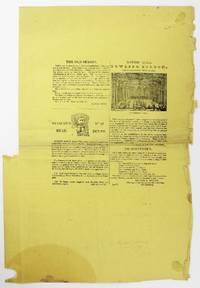
1845ref. 6460New York 1845. Good. Broadside approximately 18 x 12.5 inches. Untrimmed printed on yellow newsprint. Old horizontal fold with some rumpling and dust soiling in proximity. Faint dampstain at lower left corner. Chipping and wear to extremities. Paper remnants on verso corners from previous mounting. An untrimmed advertising circular perhaps a proof copy to four local New York City establishments of the mid-19th century that includes one of the earliest interior views of an American bowling alley. The Gothic Hall Bowling Saloon whose proprietor Charles D. Stiles took over the premises in 1845 here promises "The largest and most magnificent establishment of the kind in the city or the world" and "One of the finest and best ventilated bar-rooms in the city.stocked with the very best of Wines Liquors Ales and Segars." Indeed the woodcut illustration of the saloon shows high vaulted ceilings lined with pillars and the all-male crowd of patrons enjoying six lanes drinks and a spot to read the paper. Other establishments advertised on this broadside include two restaurants The Saracen's Head on Dey St. and The Old Shades the latter offering "All sorts of fine joints" as well as "A large store of the very best cigars as they are selected in Havana by an agent on the spot." The final advertisement is for sporting equipment manufactured by Goodyear's Insoluble Rubber and for sale at Brower & Brooks. Incidentally the address proffered for the bowling alley 316 Broadway is now the site of a massive federal building. unknown books
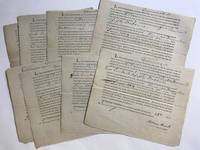
ref. 66156Eleven partly printed documents completed in manuscript each approx. 16 x 20 cm. Lightly creased along horizontal fold a few with short separations along the fold else all in very good condition. The lots in what is now called the Tribeca neighborhood of New York City include Nos. 1-5 and 7 along Greenwich St. in the Third Ward and Nos. 1-3 along Chambers St. Lot 4 on Chambers & Augustus Sts. and Lot 5 on Duane St. all in the Sixth Ward. The purchasers agreed to pay one fourth part of the value of the property on the day after the agreement was signed with the balance due in installments over the following year and a half. Each agreement was signed by the purchaser and dated January 28 1813. The buyers some purchased more than one lot were Andrew Hunt Isaac Graham John Van Orden Jacob Berry William Roe Elbert Anderson Jr. Wm. Al Burtis and Alexander Thomson. The purchase prices varied from $1850 - $4000 for the lots in Ward 6 and $3750 - $8250 for those in Ward 3. The Minutes of the Common Council of the City of New York from January 1813 Vol. 7 pp. 355 & 367-8 record the city's intention to sell "at auction at the Tontine Coffee House on Thursday the 28th Inst." lots on Greenwich St. Chambers Augustus & Duane Streets among others and record the sales of these particular lots to the buyers named in these documents. Early development of Tribeca as the city expanded beyond lower Manhattan. unknown books
1828ref. 754851828. Joseph Lyons George Stephens and Robert Cock. Joseph Lyons George Stephens and Robert Cock. Three "Colored People" Convicted for Rioting Manuscript. New York. Conviction for Rioting. Queens County New York January 11 1828. 2 pp. 12-1/2" x 8" leaf docket to verso. Moderate toning light foxing three horizontal fold lines with short tears at ends affecting text without loss. Content in neat hand with autograph signatures and former seals of three justices of the peace John Rhodes Jr. Luke Covert and Edward Parker. $1500. This document records the conviction of Joseph Lyons George Stephens and Robert Cock "colored people" for "the offence of a riot" in Jamaica New York on the night of January 7th 1828. Each man was sentenced to pay a fine of five dollars or face thirty days in jail. The complainants General Van Wyck Wicks 1779-1865 and Obadiah Leech 1792-1881 were both prominent locals. Wicks served as a captain in the War of 1812 and was a major-general of the local militia. His older brother had served as district attorney for Queens County from 1818-1821. Leech was an auctioneer and fellow veteran of the War of 1812. Peter Ross A History of Long Island 1905 574. unknown books
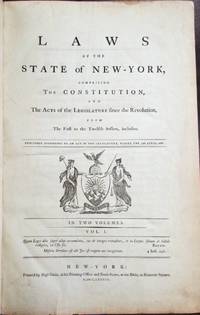
1789ref. 31069New York: Printed by Hugh Gaine 1789. Large folio. 10 3/4" x 15 1/2". Two volumes in 20th century binder's cloth with gilt-lettered morocco spine labels. Vol. I: 3 1 blank 336 11-Index 1 blank xii 1 1 blank; Vol. 2: 1-title 1 blank 471 1 blank 17-index 1 blank pp. Volume 1 is lacking the final blank leaf. A clean and bright text. Very Good. Samuel Jones and Richard Varick compiled this book "which comprehends the Constitution and the public Statutes of this State from the Revolution to the End of the Twelfth Session of the Legislature." Volume I opens with the 1777 New York Constitution. The Statutes through 1789 are printed all under the reign of the long-serving Governor George Clinton. Revolutionary Acts-- such as raising five Continental Battalions Lotteries regulating the militia treatment of deserters-- are included. Several Acts concerning New York's efforts gradually to eliminate slavery are here: barring slave importations after June 1 1785 for purposes of sale penalizing purchase of slaves or trading or selling liquor to slaves; criminal slave codes and other laws reflecting the existence of slavery in New York. Acts concerning Quakers respect their scruples against bearing arms. Many civil criminal governmental and commercial laws are printed all with a detailed index. Evans 22012. II Harv. Law Cat. 204. Printed by Hugh Gaine unknown books
1845ref. 6460New York 1845. Good. Broadside approximately 18 x 12.5 inches. Untrimmed printed on yellow newsprint. Old horizontal fold with some rumpling and dust soiling in proximity. Faint dampstain at lower left corner. Chipping and wear to extremities. Paper remnants on verso corners from previous mounting. An untrimmed advertising circular perhaps a proof copy to four local New York City establishments of the mid-19th century that includes one of the earliest interior views of an American bowling alley. The Gothic Hall Bowling Saloon whose proprietor Charles D. Stiles took over the premises in 1845 here promises "The largest and most magnificent establishment of the kind in the city or the world" and "One of the finest and best ventilated bar-rooms in the city.stocked with the very best of Wines Liquors Ales and Segars." Indeed the woodcut illustration of the saloon shows high vaulted ceilings lined with pillars and the all-male crowd of patrons enjoying six lanes drinks and a spot to read the paper. Other establishments advertised on this broadside include two restaurants The Saracen's Head on Dey St. and The Old Shades the latter offering "All sorts of fine joints" as well as "A large store of the very best cigars as they are selected in Havana by an agent on the spot." The final advertisement is for sporting equipment manufactured by Goodyear's Insoluble Rubber and for sale at Brower & Brooks. Incidentally the address proffered for the bowling alley 316 Broadway is now the site of a massive federal building. unknown
ref. 66156Eleven partly printed documents completed in manuscript each approx. 16 x 20 cm. Lightly creased along horizontal fold a few with short separations along the fold else all in very good condition. The lots in what is now called the Tribeca neighborhood of New York City include Nos. 1-5 and 7 along Greenwich St. in the Third Ward and Nos. 1-3 along Chambers St. Lot 4 on Chambers & Augustus Sts. and Lot 5 on Duane St. all in the Sixth Ward. The purchasers agreed to pay one fourth part of the value of the property on the day after the agreement was signed with the balance due in installments over the following year and a half. Each agreement was signed by the purchaser and dated January 28 1813. The buyers some purchased more than one lot were Andrew Hunt Isaac Graham John Van Orden Jacob Berry William Roe Elbert Anderson Jr. Wm. Al Burtis and Alexander Thomson. The purchase prices varied from $1850 - $4000 for the lots in Ward 6 and $3750 - $8250 for those in Ward 3. The Minutes of the Common Council of the City of New York from January 1813 Vol. 7 pp. 355 & 367-8 record the city's intention to sell "at auction at the Tontine Coffee House on Thursday the 28th Inst." lots on Greenwich St. Chambers Augustus & Duane Streets among others and record the sales of these particular lots to the buyers named in these documents. Early development of Tribeca as the city expanded beyond lower Manhattan. unknown
1917ref. 60220New York:: Mary Moore Orr 1917. First edition; No. 90 of 500 copies. publisher's sueded leather. . Leather binding spotted and rubbed along the edges. Folio. Illustrated from very fine photoengravings including interior views of the Church. . Louis C. Tiffany's own copy with his engraved armorial bookplate on the front moire silk endleaf. From a preface: "The general desire as outlined to Mr. Tiffany was to the effect that the interior of the church should be so transformed that it would be a temple of quiet sacred beauty whose atmosphere would be a source of inspiration and spiritual uplife alike to the regular parishoners and to visitors." Mary Moore Orr, hardcover
1828ref. 754851828. Joseph Lyons George Stephens and Robert Cock. Joseph Lyons George Stephens and Robert Cock. Three "Colored People" Convicted for Rioting Manuscript. New York. Conviction for Rioting. Queens County New York January 11 1828. 2 pp. 12-1/2" x 8" leaf docket to verso. Moderate toning light foxing three horizontal fold lines with short tears at ends affecting text without loss. Content in neat hand with autograph signatures and former seals of three justices of the peace John Rhodes Jr. Luke Covert and Edward Parker. $1500. This document records the conviction of Joseph Lyons George Stephens and Robert Cock "colored people" for "the offence of a riot" in Jamaica New York on the night of January 7th 1828. Each man was sentenced to pay a fine of five dollars or face thirty days in jail. The complainants General Van Wyck Wicks 1779-1865 and Obadiah Leech 1792-1881 were both prominent locals. Wicks served as a captain in the War of 1812 and was a major-general of the local militia. His older brother had served as district attorney for Queens County from 1818-1821. Leech was an auctioneer and fellow veteran of the War of 1812. Peter Ross A History of Long Island 1905 574. unknown