[West Florida]:Biblio.com
2 555 résultats
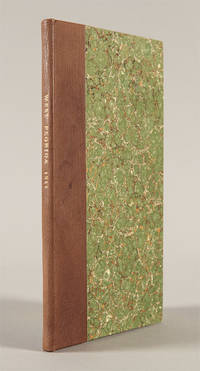
1811réf. 41305Washington City: A. & G. Way 1811. The report of the congressional committee appointed to evaluate the government of Mississippi Territory and the petition of the residents of West Florida what is now the southernmost portions Mississippi and Alabama to be annexed to that territory. The United States had supported the bloodless coup of Americans resident in what was then Spanish territory and annexed the land over Spain's bitter protests. Given the commercial stranglehold New Orleans and Louisiana would have on the region if West Florida were annexed to it thus giving Louisiana almost exclusive access to the Gulf the committee relying heavily on recent census data recommends that Mississippi be admitted to the Union and that West Florida as defined in the 1763 Treaty of Paris be annexed to it. The argument concludes: "The formation of new states on the southern extremity of the United States ought not to be delayed." An important step forward in the development of the Deep South. Scarce. Modern half calf and marbled boards. Lightly foxed. Very good. SHAW & SHOEMAKER 24296. hardcover
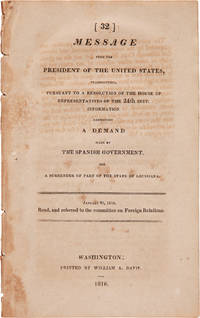
1816réf. 5200Washington. 1816. Prints two letters from Onìs and Monroe's reply in which he complains of expeditions being arranged by Robinson and Toledo against Spanish claims. Onìs also continues his objections to the American seizure of West Florida. Monroe replies that these activities are beyond the jurisdiction of the U.S. and asserts that the cession of Louisiana includes the territory as far west as the Rio Grande. 23pp. Dbd. Tanned and foxed otherwise a good clean copy. HOWES L502. STREETER TEXAS 1060. SERVIES 887. unknown books
1816réf. 5200Washington. 1816. Prints two letters from Onìs and Monroe's reply in which he complains of expeditions being arranged by Robinson and Toledo against Spanish claims. Onìs also continues his objections to the American seizure of West Florida. Monroe replies that these activities are beyond the jurisdiction of the U.S. and asserts that the cession of Louisiana includes the territory as far west as the Rio Grande. 23pp. Dbd. Tanned and foxed otherwise a good clean copy. HOWES L502. STREETER TEXAS 1060. SERVIES 887. unknown
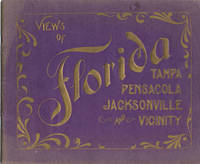
1906réf. 37024Portland: L.H. Nelson Co. 1906. 1906. FLORIDA. 8" x 9-3/4" oblong printed purple wrappers with gilt stamped title. 36pp including wrappers. No pagination. Many illustrations. Published exclusively for S.H. Kress & Company. "Beautiful Florida." "In this little volume we present a series of views covering the enterprising cities of Jacksonville Tampa and Pensacola-representative communities of this great State-which is destined by the individuality and picturesqueness of her scenery and from the enterprise and loyalty of her citizens to enjoy forever a unique and honorable position in the American Union." Black and white illustrations with captions and some with brief descriptions listed below to include the Windsor Hotel Jacksonville; a Bird's-Eye View of Jacksonville; many churches; a Florida Ostrich Farm Jacksonville; Tampa Bay Hotel Tampa; One of Tampa's Fine Residences; De Soto Park Tampa; Famous Old Houses of Pensacola; Barracks at Fort Barrancas; Pensacola Lighthouse et. al. Fading to lightly worn wrappers including residue from what appears to be the removal of a very small sticker to top of front wrapper a price written in ink to top forecorner of rear wrapper eight center pages loosened from the staples else a good copy. L.H. Nelson Co., 1906. unknown
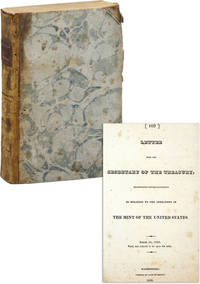
1820réf. 45290Washington DC: Gales & Seaton 1820. First Edition. Fourteen volumes bound in one; contemporary sheep-backed marbled boards red gilt-lettered spine label. Boards rubbed and leather rather dried and flaking late 19th-century rubberstamp of the Patten Free Library to front free endpaper else Very Good internally fine. State papers covering a myriad of topics including a proposed law to deter kidnapping though the majority of the contents devoted to the cession of the Floridas to the Spanish government and the court martialing of Colonel William King Governor of West Florida. Contents as follows:. 1. William H. Crawford 109. Letter from the Secretary of the Treasury Transmitting Sundry Statements in Relation to the Operations of the Mint of the United States. April 10 1820. Read and ordered to lie upon the table. 6pp.; two folding table plates. SHAW & SHOEMAKER 3830. 2. John C. Calhoun 110. Letter from the Secretary of War Transmitting Pursuant to a Resolution of the House of Representatives of the 25th ultimo Statements of the Amounts and Costs of Goods Furnished Annually to Indian Trading Houses Since the Year 1815. Specifying also the kinds and quantities of furs &c. &c. annually received since that period of said factories. April 13 1820. Read and ordered to lie on the table. 4pp.; one folding table plate. SHAW & SHOEMAKER 3852. 3. Return J. Meigs Jr. 111. Letter from the Postmaster General Transmitting a List of Unproductive Post Roads for the Year 1819. April 14 1820. Read and ordered to lie upon the table. 20pp. SHAW & SHOEMAKER 3771. 4. John Quincy Adams 112. Letter from the Secretary of State Transmitting a Copy of an Act of the Legislature of the State of Pennsylvania entitled an Act to Prevent Kidnapping. April 18 1820. Referred to the Select Committee appointed on the 18th of March last to consider of providing more effectually for reclaiming persons held to service. 8pp. SHAW & SHOEMAKER 3775. 5. Louisiana Legislature 113. Memorial of the General Assembly of the State of Louisiana. April 18 1820. Referred to the Select Committee appointed on the 13th of January last to enquire into the expediency of continuing in force for a limited time "An act regulating the currency within the United States of the gold coins of Great Britain France Portugal and Spain and the crowns of France and five franc pieces" as relates to the gold coins of those countries. 4pp. SHOW & SHOEMAKER 3887. 6. Albert Gallatin 114. Regulations for the Granting of Land Under the Spanish Government of Louisiana and Mr. Gallatin's instructions to the land commissioners in Louisiana and Missouri. April 19 1820. Printed by order of the House of Representatives. 20pp. SHAW & SHOEMAKER 3936. 7. John Quincy Adams 115. Letter from the Secretary of State to the Chairman of the Committee on Commerce Transmitting documents shewing the proceedings of the Executive hitherto in negotiating with Great Britain in relation to the commercial intercourse between the United States and the British American colonies and with France in relation to the general commerce between that country and the United States. April 22 1820. Laid before the House by the Chairman of the Committee on Commerce and ordered to be printed. 55pp. SHAW & SHOEMAKER 3774. 8. American Society of the City of New York 116. Memorial of the American Society of the City of New York for the Encouragement of Domestic Manufacture. April 24 1820. Read and referred to the Committee of the Whole House to which is committed the Bill laying duties on sales of merchandize at auctions. 4pp. SHAW & SHOEMAKER 3878. 9. John Johnson Jr. 117. Memorial of John Johnson Junior. April 24 1820. Referred to the Committee of the Whole House on the "Bill to regulate the duties on imports and tonnage and for other purposes." 4pp. SHAW & SHOEMAKER 3866. 10. William H. Crawford 118. Letter from the Secretary of the Treasury Transmitting Statements of Importation of Goods Wares and Merchandize in American and Foreign Vessels for the year ending on the 30th Sept. 1818. March 22 1820. Read and ordered to lie upon the table. 96pp. SHAW & SHOEMAKER 3827. 11. John C. Calhoun 119. Letter from the Secretary of War Transmitting a Copy of the Proceedings of a Court Martial for the Trial of Colonel William King of the Fourth Infantry and Sundry Orders and Documents Connected Therewith. May 3 1820. Read and referred to the Committee of Military Affairs. 128pp. SHAW & SHOEMAKER 3834. 12. Jame Monroe 120. Message from the President of the United States Communicating the Correspondence Which has Lately Taken Place Between the Secretary of State and General Vives the Spanish Minister in Relation to the Treaty for the Cession of the Floridas. May 9 1820. Read and ordered to be printed by the House of Representatives. 32pp. SHAW & SHOEMAKER 3900. 13. James Monroe 121. Message from the President of the United States Communicating Translations of Letters from the Minister of Spain to the Secretary of State Received Since the Message of the 9th Instant. May 12 1820. Read and ordered to lie upon the table. 8pp. SHAW & SHOEMAKER 3901. 14. James Monroe 122. Message from the President of the United States. Transmitting a Report of the Secretary of State on the Subject of Claims of Citizens of the United States for Spanish Spoliations Upon Their Property and Commerce. May 12 1820. Read and ordered to lie upon the table. 4pp.; 27 folding table plates. SHAW & SHOEMAKER 3908. Gales & Seaton unknown books
1820réf. 45290Washington DC: Gales & Seaton 1820. First Edition. Fourteen volumes bound in one; contemporary sheep-backed marbled boards red gilt-lettered spine label. Boards rubbed and leather rather dried and flaking late 19th-century rubberstamp of the Patten Free Library to front free endpaper else Very Good internally fine. State papers covering a myriad of topics including a proposed law to deter kidnapping though the majority of the contents devoted to the cession of the Floridas to the Spanish government and the court martialing of Colonel William King Governor of West Florida. Contents as follows:. 1. William H. Crawford 109. Letter from the Secretary of the Treasury Transmitting Sundry Statements in Relation to the Operations of the Mint of the United States. April 10 1820. Read and ordered to lie upon the table. 6pp.; two folding table plates. SHAW & SHOEMAKER 3830. 2. John C. Calhoun 110. Letter from the Secretary of War Transmitting Pursuant to a Resolution of the House of Representatives of the 25th ultimo Statements of the Amounts and Costs of Goods Furnished Annually to Indian Trading Houses Since the Year 1815. Specifying also the kinds and quantities of furs &c. &c. annually received since that period of said factories. April 13 1820. Read and ordered to lie on the table. 4pp.; one folding table plate. SHAW & SHOEMAKER 3852. 3. Return J. Meigs Jr. 111. Letter from the Postmaster General Transmitting a List of Unproductive Post Roads for the Year 1819. April 14 1820. Read and ordered to lie upon the table. 20pp. SHAW & SHOEMAKER 3771. 4. John Quincy Adams 112. Letter from the Secretary of State Transmitting a Copy of an Act of the Legislature of the State of Pennsylvania entitled an Act to Prevent Kidnapping. April 18 1820. Referred to the Select Committee appointed on the 18th of March last to consider of providing more effectually for reclaiming persons held to service. 8pp. SHAW & SHOEMAKER 3775. 5. Louisiana Legislature 113. Memorial of the General Assembly of the State of Louisiana. April 18 1820. Referred to the Select Committee appointed on the 13th of January last to enquire into the expediency of continuing in force for a limited time "An act regulating the currency within the United States of the gold coins of Great Britain France Portugal and Spain and the crowns of France and five franc pieces" as relates to the gold coins of those countries. 4pp. SHOW & SHOEMAKER 3887. 6. Albert Gallatin 114. Regulations for the Granting of Land Under the Spanish Government of Louisiana and Mr. Gallatin's instructions to the land commissioners in Louisiana and Missouri. April 19 1820. Printed by order of the House of Representatives. 20pp. SHAW & SHOEMAKER 3936. 7. John Quincy Adams 115. Letter from the Secretary of State to the Chairman of the Committee on Commerce Transmitting documents shewing the proceedings of the Executive hitherto in negotiating with Great Britain in relation to the commercial intercourse between the United States and the British American colonies and with France in relation to the general commerce between that country and the United States. April 22 1820. Laid before the House by the Chairman of the Committee on Commerce and ordered to be printed. 55pp. SHAW & SHOEMAKER 3774. 8. American Society of the City of New York 116. Memorial of the American Society of the City of New York for the Encouragement of Domestic Manufacture. April 24 1820. Read and referred to the Committee of the Whole House to which is committed the Bill laying duties on sales of merchandize at auctions. 4pp. SHAW & SHOEMAKER 3878. 9. John Johnson Jr. 117. Memorial of John Johnson Junior. April 24 1820. Referred to the Committee of the Whole House on the "Bill to regulate the duties on imports and tonnage and for other purposes." 4pp. SHAW & SHOEMAKER 3866. 10. William H. Crawford 118. Letter from the Secretary of the Treasury Transmitting Statements of Importation of Goods Wares and Merchandize in American and Foreign Vessels for the year ending on the 30th Sept. 1818. March 22 1820. Read and ordered to lie upon the table. 96pp. SHAW & SHOEMAKER 3827. 11. John C. Calhoun 119. Letter from the Secretary of War Transmitting a Copy of the Proceedings of a Court Martial for the Trial of Colonel William King of the Fourth Infantry and Sundry Orders and Documents Connected Therewith. May 3 1820. Read and referred to the Committee of Military Affairs. 128pp. SHAW & SHOEMAKER 3834. 12. Jame Monroe 120. Message from the President of the United States Communicating the Correspondence Which has Lately Taken Place Between the Secretary of State and General Vives the Spanish Minister in Relation to the Treaty for the Cession of the Floridas. May 9 1820. Read and ordered to be printed by the House of Representatives. 32pp. SHAW & SHOEMAKER 3900. 13. James Monroe 121. Message from the President of the United States Communicating Translations of Letters from the Minister of Spain to the Secretary of State Received Since the Message of the 9th Instant. May 12 1820. Read and ordered to lie upon the table. 8pp. SHAW & SHOEMAKER 3901. 14. James Monroe 122. Message from the President of the United States. Transmitting a Report of the Secretary of State on the Subject of Claims of Citizens of the United States for Spanish Spoliations Upon Their Property and Commerce. May 12 1820. Read and ordered to lie upon the table. 4pp.; 27 folding table plates. SHAW & SHOEMAKER 3908. Gales & Seaton unknown
réf. 2638S.L.: Pennsylvania Railroad; Southern Railroad and Florida Central & Peninsular R.R Ca. 1897. . 4to stiff cream wrappers lacking 2 inch section at front gutter and spine; plus loss at back inner corner; rubberstamp of NYPL on front wrapper and title. Dating is based on the NYPL stamp there was an edition in 1895. The Florida Short Line was a consortium made up by the Pennsylvania Railroad the Southern Railroad and the Florida Central & Peninsular R.R S.L.: Pennsylvania Railroad; Southern Railroad and Florida Central & Peninsular R.R, Ca. 1897. unknown books
1886réf. 41223Washington D.C.: Published by the United States Coast and Geodetic Survey 1886. Large folding nautical chart printed on heavy paper stock. Colored with minor wear. A rare original survey of the United States Atlantic Coast from Florida to Georgia to South Carolina to North Carolina. Map includes Cape Canaveral Daytona St. Augustine Fernandina Cumberland Island St. Simons Island Sappelo Island Savannah Hilton Head Beaufort Hunting Island Edisto Island James Island Folly Island Charleston Sullivans Island Isle of Palms Pawleys Island Myrtle Beach Bald Head Island Wilmington Wrightsville Jacksonville Emerald Isle Morehead Beaufort New Bern and Cape Hatteras. Established by President Thomas Jefferson in 1807 as the Survey of the Coast the U.S. Coast and Geodetic Survey was the United States' first civilian scientific agency. This agency has followed its mission to survey the U.S. coastline create nautical charts of the coast and help increase maritime safety since its founding and has often played fascinating roles in significant chapters of U.S. history. It served in all theaters of the Civil War in the service of the Union Army and Navy pioneered acoustic exploration in the wake of the sinking of the Titanic and during WWI it worked to detect enemy submarines. In addition this agency worked to survey and produce detailed maps and renderings of the U.S. coast. These nautical survey maps commonly referred to as "T-sheets" provide fascinating insights into the history of the United States coastline which has and will continue to shift. These maps are the most important data source for understanding the physical and ecological characteristics of the U.S. shoreline. The present map is a highly detailed and accurate sea chart of the United States Atlantic Coast from Florida to North Carolina and an important historical view of the developing states. Published by the United States Coast and Geodetic Survey unknown books
1886réf. 41223Washington D.C.: Published by the United States Coast and Geodetic Survey 1886. Large folding nautical chart printed on heavy paper stock. Colored with minor wear. A rare original survey of the United States Atlantic Coast from Florida to Georgia to South Carolina to North Carolina. Map includes Cape Canaveral Daytona St. Augustine Fernandina Cumberland Island St. Simons Island Sappelo Island Savannah Hilton Head Beaufort Hunting Island Edisto Island James Island Folly Island Charleston Sullivans Island Isle of Palms Pawleys Island Myrtle Beach Bald Head Island Wilmington Wrightsville Jacksonville Emerald Isle Morehead Beaufort New Bern and Cape Hatteras. Established by President Thomas Jefferson in 1807 as the Survey of the Coast the U.S. Coast and Geodetic Survey was the United States' first civilian scientific agency. This agency has followed its mission to survey the U.S. coastline create nautical charts of the coast and help increase maritime safety since its founding and has often played fascinating roles in significant chapters of U.S. history. It served in all theaters of the Civil War in the service of the Union Army and Navy pioneered acoustic exploration in the wake of the sinking of the Titanic and during WWI it worked to detect enemy submarines. In addition this agency worked to survey and produce detailed maps and renderings of the U.S. coast. These nautical survey maps commonly referred to as "T-sheets" provide fascinating insights into the history of the United States coastline which has and will continue to shift. These maps are the most important data source for understanding the physical and ecological characteristics of the U.S. shoreline. The present map is a highly detailed and accurate sea chart of the United States Atlantic Coast from Florida to North Carolina and an important historical view of the developing states. Published by the United States Coast and Geodetic Survey unknown
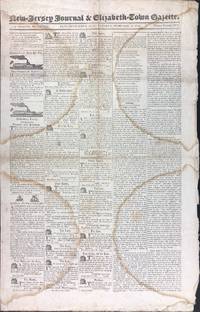
1825réf. 41367Elizabethtown NJ: J. & E. Sanderson 1825. First edition. Self wrappers. A very good- copy with 4 large semi-circular dampstain marks throughout. Unpaged 4 pp. Illus. with b/w in-text drawings. 20 3/4 x 13 inches. Contents include: a full column on the Liberation of Peru led by General Sucre; the first meeting at the new seat of Government in Florida where the governor states "No part of North America is so little known.Visitors.had pronounced it a bank of sand not worth the money paid for it"; republished letters from Andrew Jackson John Quincy Adams and Henry Clay. This issue not at the American Antiquarian Society. Uncommon. J. & E. Sanderson unknown books
1825réf. 41367Elizabethtown NJ: J. & E. Sanderson 1825. First edition. Self wrappers. A very good- copy with 4 large semi-circular dampstain marks throughout. Unpaged 4 pp. Illus. with b/w in-text drawings. 20 3/4 x 13 inches. Contents include: a full column on the Liberation of Peru led by General Sucre; the first meeting at the new seat of Government in Florida where the governor states "No part of North America is so little known.Visitors.had pronounced it a bank of sand not worth the money paid for it"; republished letters from Andrew Jackson John Quincy Adams and Henry Clay. This issue not at the American Antiquarian Society. Uncommon. J. & E. Sanderson unknown
1920réf. 53711Fort Pierce FL: n.p. 1920-1931. Oblong 4to. 12.25 x 7.5 in. 24 silver gelatin linen-backed photographs dated & negative number in lower margin of image each mounted on linen hinge sized 6.75 x 10.25 in. Contemporary limp pebbled leather post-binder yapp edges nickel-plated screw posts at gutter margin rounded corners wear rubbing w/o spine wear & minor loss to couple corners still a G exemplar with photos in excellent condition. This remarkable promotional photo album provides a series of photographs documenting the impact of the explosion of development interest in Florida during the Roaring 20s by offering a visual record over 11 years of the building and opening of the Port of Fort Pierce. The album opens with an image dated May 8 1921 showing the last 100 yards to be cut for the a 100 foot wide and 4 foot deep channel the Tuscawilla dredge finishing the last portions of the cut and finally the opening of the Fort Pierce Inlet to the sea which would scour the channel to a depth of 12 feet. A photo dated April 10 1924 shows the operation to dredge the inlet down to 25 feet in order to allow freighters and steamships to enter the Port. Due to erosion local interest began construction of another jetty in 1926 which is shown with railroad tracks stretching to the sea in December 1927 followed by images of the historic dredger the Corozal which had worked on digging the Panama Canal and was capable of dredging to a depth of 50 feet. Finally in Nov. 1929 the Port opened for business with the 4-masted lumber schooner Catherine Scott picking up a load of lumber for delivery to Cuba Feb. 5 1930 followed by the 2339 gross ton SS Betty Weems a Baltimore & Carolina Steamship Company freighter arriving amidst inaugural celebrations of the use of the Fort Pierce Port and opening. There are an addition number of photos up to July 1931 showing such ships as the oil tanker SS Herbert G. Wylie the SS Lillian a freighter owned and operated by A.H. Bull & Co. of New York and a number of other Baltimore & Carolina Steamships. Although the Port had been finished and opened by the end of 1929 the Great Depression and land bust in Florida resulted in such land developments as Indrio and San Lucie never being completed and the area would eventually prove successful as a Naval Amphibious Training Base during World War II with over 140000 troops trained and processed during the War. n.p., hardcover
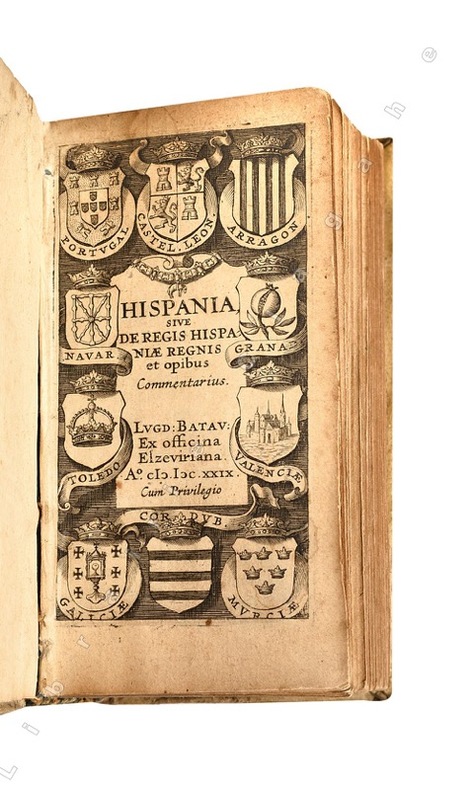
1629réf. 21438Lugd. Batav. (Leyde), ex officina Elzeviriana, 1629 ; in-24 (108 mm), vélin rigide de l’époque, titre manuscrit au dos ; [16], 498 pp., [1] f. de Privilège, titre gravé illustré de blasons.
1970réf. 70928Tuscaloosa AL: United Klans of America 1970. Large double-folio partly-printed broadside 22 ½ x 17 ½ inches partly a form completed in large black letter manuscript and signed by Robert Shelton as Imperial Wizard and Lewis Perkins as Imperial Kligrapp nation secretary establishing Klavern 200 Florida in Lake Worth Florida February 10 1976 all enclosed within a wide ornamental red border Klan symbols in corners and at head and with a large red central Klan device showing important Klan dates and phrases two fully robed and masked Klan members on rearing horses at the bottom closing with the word "Honor" beribboned imperial seal affixed. OCLC locates six copies of Klan charters from the 1920s one copy each but apparently does not locate one from the United Klans of America formed in the early 1960s when a number of organizations merged; we haven't found a sales record for a charter from either era but are aware of the sale of a 1920s charter for Belhaven N.C. some years ago. Old fold lines rubbed two inch separation at top; some storage wear and soil a good example. Organized with the merger of several Klan organizations in Tuscaloosa Alabama United Klans of America emerged in the early 1960s with its main leader Robert Shelton quickly rising to become its Imperial Wizard. Over the next two years it became well-known for its opposition to the Civil Rights movement and a number of its members were convicted of heinous crimes; including the lynching of Michael Donald in 1981 by UKA members one of whom confessed to the murder and was sentenced to life in prison. Through the Southern Poverty Law Center Donald's family brought a successful suit against the UKA which was unable to pay the several million dollars awarded; through bankruptcy Donald's mother was awarded the UKA property and sold it the UKA ceasing operations in 1988. United Klans of America unknown books
réf. 709291 The Seven Symbols of the Klan cover title. Lake Wales FL: United Klans of America 1966. Unrecorded variant OCLC locates a 1966 edition published in Tuscaloosa: Northwestern Duke Wisconsin Historical Society; OCLC also locates three copies of the first edition published in the 1920s. 6-panel brochure folded to narrow 8vo. Multi-paragraph descriptions of The Bible Cross Flag Sword Water Robe and Hood. Illustrated from a photograph of Robert Shelton the Imperial Wizard. Original decorated self-wrapper. 2 Application for membership in the United Klans of America small partly printed document this copy unused. Lake Wales FL: John Paul Rogers ca. 1965. Small slip 3 5/8 x 4 7/8 inches with a marginal stamp "Sons of the Confederacy /West Palm Beach FL." 3 Chapter letterhead illustrated with a subdued gray portrait of Rober Shelton in Klan regalia. West Palm Beach FL: United Klans of America Unit No. 180 nd ca. 1965. 4to. Head and illustration enclosed within a fiery red border. Unused. 4 Special occasion card offering God's blessing for comfort and cheer. West Palm Beach FL: United Klans of Americam Unit #180 nd ca. 1965. 24mo bifolium cover illustrated in red and blue with a pair of candles The Bible and a red cross. 5 Klan visitation card color illustrated with robed Klan members before a fiery cross. Calling card 2 ¼ x 3 ½ inches. Lake Wales FL: United Klans of America nd ca. 1965. "You have been visited by a proud Klansman." 6 Elect / John Paul Rogers / Seat 49 / Florida House of / Representative / Democrat political card text recto. Polk County FL: Paulette Rogers nd ca. 1960s. Recto illustrated from a photo of the candidate printed both sides in red and blue; verso prints the candidate's stands on various issues. Rogers served as grand dragon of the Florida United Klans mid-1960s to 1982; he won a race for a seat on the Polk County Commission in 2008 but was defeated in a race for mayor of Lake Wales in 2013. Creased. 7 Certificate of service as a delegate to the 1976 National Klonvokation. Tuscaloosa AL: United Klans of America 1976. 4to one-page clerically signed by Robert Shelton as Imperial Wizard and Lewis Perkins as Imperial Kligrapp. Tear through Klan seal at bottom. 8 Certificate of service as a delegate to the 1977 National Klonvokation. Tuscaloosa AL: United Klans of America 1977. 4to one-page clerically signed by Robert Shelton as Imperial Wizard. Tear through Klan seal at bottom. 9 Oath of Allegiance caption title. Tuscaloosa AL: United Klans Knight of the Ku Klux Klan nd ca. 1965. 4to. 3-page copy of the typescript oath in four sections. Some manuscript corrections for a possible new edition. Later stapling. 10 Official Business / Quarterly Unit Report caption title. Tuscaloosa AL: United Klans of America nd ca. 1975. Folio. One-page unused questionnaire seeking information about an individual unit's activities 21 questions some multi-part with a section for personal comments. 11 Application for citizenship in the Klan Youth Corp. Tuscaloosa AL: United Klans of America nd ca. 1975. Half-sheet 4to a partly-printed unused document seeking information on the applicant's's church school and grade employment social activities etc. 12 Bumper Sticker Eternal Vigulance sic / Is the Price Liberty / United Klans of America / Knight of the Ku Klux Klan complete text. NP: np nd ca. 1965. Never used but quite rubbed. 13 Visitation peel-off card 1 3/8 x 3 inches. NP: np nd ca. 1975. "You have been visited by the / United Klans of America / Knights of the Ku Klux Klan / Now would you like a Real Visit" complete text. 14 Peel off label four copies still attached to their section of computer label paper. NP: np ca. 1965. "K K K / The only Reason you are / White to day / Is Because Your Ancestors / Believed & Practiced / SEGREGATION / Be a Man Goin six the Klan" complete text. 15 Visitation peel-off card 2 x 3 ½ inches. NP: np nd ca. 1965. "The / Ku Klux Klan / Is Watching / You!" complete text. 16 Visitation card 3 x 3 ½ inches. NP: np nd ca. 1965. "Since Eighteen Hundred Sixty-Six / THE KU KLUX KLAN / Has been riding and will / continue to do so as long as / the WHITE MAN lives" complete text. 17-18 Two peel-off cards both 1960s and printed in red one 2 x 3 ½ inches reading "White Only" the other a bumper sticker 3 x 15 inches reading "Bus the Judges." 19-21 Three ephemeral items dealing with the American flag one a 1960s peel-off bumper sticker 5 x 6 inches picturing the Confederate battle flag and reading "Vote America / Throw the rascals out" the second "Flags of the Confederacy" 1960s 4to one-page picturing four Confederate flags the "Stars and Bars" the "Battle Flag" The "Second Confederate Flag" and the "Last Confederate Flag" with two or three paragraphs of descriptive text for each and the third "Flags of the Confederacy"Montgomery AL & Verona NJ: Tumbling Waters Museum c1978; 24mo 6-panel folding brochure illustrated with five flags describing each with several paragraphs of text. 22-23 Two outrageously racist creations both 4to one-page no creative responsibility noted for either the first offering a shaded outline figure of a Black man to shoot at the second presenting a page full of stereotypically racist questions and insinuations masquerading as an employment application. OCLC locates one copy of the first Michigan State. 24 "Brevard; Next Little Rock" caption headline of a front page editorial in the Brevard Frontier Cocoa Beach FL Friday April 6 1962 Vol.I No. 11 this number only. Folio. 8 pp. The editorial covers the top half of the front page 10 paragraphs in three columns reminding Brevard County readers of the Federal intervention in Little Rock in 1957 "Demands from the NAACP and allied groups should be ignored; unthinking edicts from the federal government tending to force their racial solutions on us should at least be questioned" and solutions should come from "our political representatives on the local and state levels." This periodical apparently unrecorded on OCLC. For the lot of 24 items most at least uncommon unknown books
1970réf. 70928Tuscaloosa AL: United Klans of America 1970. Large double-folio partly-printed broadside 22 ½ x 17 ½ inches partly a form completed in large black letter manuscript and signed by Robert Shelton as Imperial Wizard and Lewis Perkins as Imperial Kligrapp nation secretary establishing Klavern 200 Florida in Lake Worth Florida February 10 1976 all enclosed within a wide ornamental red border Klan symbols in corners and at head and with a large red central Klan device showing important Klan dates and phrases two fully robed and masked Klan members on rearing horses at the bottom closing with the word "Honor" beribboned imperial seal affixed. OCLC locates six copies of Klan charters from the 1920s one copy each but apparently does not locate one from the United Klans of America formed in the early 1960s when a number of organizations merged; we haven't found a sales record for a charter from either era but are aware of the sale of a 1920s charter for Belhaven N.C. some years ago. Old fold lines rubbed two inch separation at top; some storage wear and soil a good example. Organized with the merger of several Klan organizations in Tuscaloosa Alabama United Klans of America emerged in the early 1960s with its main leader Robert Shelton quickly rising to become its Imperial Wizard. Over the next two years it became well-known for its opposition to the Civil Rights movement and a number of its members were convicted of heinous crimes; including the lynching of Michael Donald in 1981 by UKA members one of whom confessed to the murder and was sentenced to life in prison. Through the Southern Poverty Law Center Donald's family brought a successful suit against the UKA which was unable to pay the several million dollars awarded; through bankruptcy Donald's mother was awarded the UKA property and sold it the UKA ceasing operations in 1988. United Klans of America unknown
réf. 709291 The Seven Symbols of the Klan cover title. Lake Wales FL: United Klans of America 1966. Unrecorded variant OCLC locates a 1966 edition published in Tuscaloosa: Northwestern Duke Wisconsin Historical Society; OCLC also locates three copies of the first edition published in the 1920s. 6-panel brochure folded to narrow 8vo. Multi-paragraph descriptions of The Bible Cross Flag Sword Water Robe and Hood. Illustrated from a photograph of Robert Shelton the Imperial Wizard. Original decorated self-wrapper. 2 Application for membership in the United Klans of America small partly printed document this copy unused. Lake Wales FL: John Paul Rogers ca. 1965. Small slip 3 5/8 x 4 7/8 inches with a marginal stamp "Sons of the Confederacy /West Palm Beach FL." 3 Chapter letterhead illustrated with a subdued gray portrait of Rober Shelton in Klan regalia. West Palm Beach FL: United Klans of America Unit No. 180 nd ca. 1965. 4to. Head and illustration enclosed within a fiery red border. Unused. 4 Special occasion card offering God's blessing for comfort and cheer. West Palm Beach FL: United Klans of Americam Unit #180 nd ca. 1965. 24mo bifolium cover illustrated in red and blue with a pair of candles The Bible and a red cross. 5 Klan visitation card color illustrated with robed Klan members before a fiery cross. Calling card 2 ¼ x 3 ½ inches. Lake Wales FL: United Klans of America nd ca. 1965. "You have been visited by a proud Klansman." 6 Elect / John Paul Rogers / Seat 49 / Florida House of / Representative / Democrat political card text recto. Polk County FL: Paulette Rogers nd ca. 1960s. Recto illustrated from a photo of the candidate printed both sides in red and blue; verso prints the candidate's stands on various issues. Rogers served as grand dragon of the Florida United Klans mid-1960s to 1982; he won a race for a seat on the Polk County Commission in 2008 but was defeated in a race for mayor of Lake Wales in 2013. Creased. 7 Certificate of service as a delegate to the 1976 National Klonvokation. Tuscaloosa AL: United Klans of America 1976. 4to one-page clerically signed by Robert Shelton as Imperial Wizard and Lewis Perkins as Imperial Kligrapp. Tear through Klan seal at bottom. 8 Certificate of service as a delegate to the 1977 National Klonvokation. Tuscaloosa AL: United Klans of America 1977. 4to one-page clerically signed by Robert Shelton as Imperial Wizard. Tear through Klan seal at bottom. 9 Oath of Allegiance caption title. Tuscaloosa AL: United Klans Knight of the Ku Klux Klan nd ca. 1965. 4to. 3-page copy of the typescript oath in four sections. Some manuscript corrections for a possible new edition. Later stapling. 10 Official Business / Quarterly Unit Report caption title. Tuscaloosa AL: United Klans of America nd ca. 1975. Folio. One-page unused questionnaire seeking information about an individual unit's activities 21 questions some multi-part with a section for personal comments. 11 Application for citizenship in the Klan Youth Corp. Tuscaloosa AL: United Klans of America nd ca. 1975. Half-sheet 4to a partly-printed unused document seeking information on the applicant's's church school and grade employment social activities etc. 12 Bumper Sticker Eternal Vigulance sic / Is the Price Liberty / United Klans of America / Knight of the Ku Klux Klan complete text. NP: np nd ca. 1965. Never used but quite rubbed. 13 Visitation peel-off card 1 3/8 x 3 inches. NP: np nd ca. 1975. "You have been visited by the / United Klans of America / Knights of the Ku Klux Klan / Now would you like a Real Visit" complete text. 14 Peel off label four copies still attached to their section of computer label paper. NP: np ca. 1965. "K K K / The only Reason you are / White to day / Is Because Your Ancestors / Believed & Practiced / SEGREGATION / Be a Man Goin six the Klan" complete text. 15 Visitation peel-off card 2 x 3 ½ inches. NP: np nd ca. 1965. "The / Ku Klux Klan / Is Watching / You!" complete text. 16 Visitation card 3 x 3 ½ inches. NP: np nd ca. 1965. "Since Eighteen Hundred Sixty-Six / THE KU KLUX KLAN / Has been riding and will / continue to do so as long as / the WHITE MAN lives" complete text. 17-18 Two peel-off cards both 1960s and printed in red one 2 x 3 ½ inches reading "White Only" the other a bumper sticker 3 x 15 inches reading "Bus the Judges." 19-21 Three ephemeral items dealing with the American flag one a 1960s peel-off bumper sticker 5 x 6 inches picturing the Confederate battle flag and reading "Vote America / Throw the rascals out" the second "Flags of the Confederacy" 1960s 4to one-page picturing four Confederate flags the "Stars and Bars" the "Battle Flag" The "Second Confederate Flag" and the "Last Confederate Flag" with two or three paragraphs of descriptive text for each and the third "Flags of the Confederacy"Montgomery AL & Verona NJ: Tumbling Waters Museum c1978; 24mo 6-panel folding brochure illustrated with five flags describing each with several paragraphs of text. 22-23 Two outrageously racist creations both 4to one-page no creative responsibility noted for either the first offering a shaded outline figure of a Black man to shoot at the second presenting a page full of stereotypically racist questions and insinuations masquerading as an employment application. OCLC locates one copy of the first Michigan State. 24 "Brevard; Next Little Rock" caption headline of a front page editorial in the Brevard Frontier Cocoa Beach FL Friday April 6 1962 Vol.I No. 11 this number only. Folio. 8 pp. The editorial covers the top half of the front page 10 paragraphs in three columns reminding Brevard County readers of the Federal intervention in Little Rock in 1957 "Demands from the NAACP and allied groups should be ignored; unthinking edicts from the federal government tending to force their racial solutions on us should at least be questioned" and solutions should come from "our political representatives on the local and state levels." This periodical apparently unrecorded on OCLC. For the lot of 24 items most at least uncommon unknown
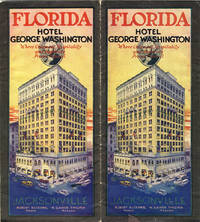
1926réf. 38235Jacksonville: The Record Company Printers n.d. circa 1926. n.d. circa 1926. 9" x 24" large sheet that folds to twelve 9" x 4" panels including 2 colorful panels. Black and white map entitled: "Hotel George Washington Jacksonville Florida Adams and Julia Streets" shows exactly where the hotel is located. It is the nearest first-class hotel to the Union Terminal the junction of five great railroads. Black and white photographs of the main dining room a typical bedroom the lobby and more. The rates for its 300 bedrooms are: single rooms $3.00 to $5.00 double rooms $5.00 to $8.00. Describes the main hotel office with telephones telegraphs newsstand taxi-cab office et.al.; Barber Shop Book and Gift Shop and a Drug Store. "The Hotel George Washington is the only Hotel in the South with Radio in every room the equipment being equalled only by the largest hotels in the country." Light wear to the extremities and to spine approximate 5" split to one of the folds else a good copy. The Record Company Printers, n.d. (circa 1926). unknown
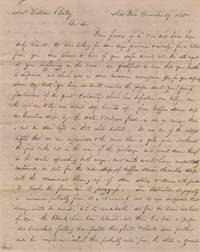
1835réf. BK0025New York City 1835. Autograph letter signed by the merchant firm Baker & Moore 4 pp. addressed to General William Battey care of Dr. Charles Luzenberg at the Franklin Infirmary on the Pontchartrain Railroad New Orleans. Stampless folded letter with red circular "NEW-YORK" December 31 datestamp and manuscript "25" rate. Appx. 1000 words. File folds; otherwise very good. A lengthy commercial letter written thirteen days after the Great Fire of New York describing the destruction of the city's mercantile district and tracing its immediate effects through insurance capital banking commodity prices and trade with New Orleans. Written by the New York firm of Baker & Moore to their associate William Battey the letter provides a near-contemporary account of the fire an assessment of the city's financial resilience and instructions for exploiting the resulting fluctuations in the markets for brandy wine raisins tobacco iron and copper. The fire began on the evening of December 16 during an extraordinary cold spell and northwest gale. Frozen hydrants wells cisterns and hoses left the city's volunteer fire companies largely unable to contain it. By the following day the fire had destroyed much of the commercial district between Wall Street and the East River including the Merchants' Exchange and hundreds of stores and warehouses. Buildings were eventually demolished with gunpowder to create firebreaks at Exchange Place and Coenties Slip. Contemporary estimates varied but approximately 674 buildings were destroyed with losses eventually placed at twenty million dollars or more.1 Baker & Moore begin by describing the extent of the burned district the severe weather and the use of explosives to arrest the flames: "Since my last you have no doubt received the paper sent you giving particulars of the great calamity which has befallen our City. On the 16th our City was about half burned up. From Coffee House Slip to Coenties Slip by the water & William Street is all in ruins. There is but one store left in that whole district. It was one of the coldest nights that we ever experienced & the wind blew a gale from Northwest. The fire broke out in the rear of the Exchange and went down through to the water spreading both ways and would have undoubtedly continued on but for the wide slips of Coffee House & Coenties Slip with the occasional blowing up of some stores & houses with powder to check the flame in its progress" The account quickly turns from the physical destruction to the distribution of its financial losses: "The destruction of property is immense probably from 10 to 15000000$ and it was supposed that many would be ruined but tis remarkable so far we have not heard of one. The Banks have been liberal and there has been a proper and benevolent feeling manifested throughout & should some further aid be brought in which probably will from the State or general government we think there may be no failures. The Insurance companies most of them are ruined and the principal loss is in Insurance capital. The loss will in some instances fall upon those who cannot well afford it. Many widows & orphans have had their all taken from them. The loss is large and New York has met with a great calamity but she is made of such materials & her facilities are so large & varied that the mercantile community will bear up under more than any other place in the Union & we think in one year's time it will be almost forgotten." The confidence expressed here correctly anticipated the city's rapid commercial recovery. Banks and government agencies extended credit and payment terms rebuilding began almost immediately and the burned district was reconstructed with new countinghouses and warehouses. The disaster also exposed the inadequacy of New York's water supply and firefighting arrangements contributing to later infrastructure and institutional reforms. Baker & Moore then apply the disaster to their own trade with New Orleans. Hundreds of warehouses and their contents had been destroyed increasing prices of imported foods wines and spirits. The firm instructs Battey to use the New York price current to obtain higher prices for their consignments: "This fire has advanced most all kinds of goods. Raisins are worth here $3-$3½. Wines such as Mess. Eastman's have advanced with us 4-6 cents. So many hundred casks destroyed must advance it and make it higher through the season. More than one half the Brandy was consumed tis now selling at $1.75 and some are asking $2. We wish what we sent you sold & this will be a favorable time to sell-show N.Y. price current-and get as good a price as you can. There will we think be no want of Brandy. Those raisins we think you had better dispose of at once. We think from N.O. current must pay something handsome for us. In regard to old Iron we find good old iron will always sell for the money for 112½ gross hundred equal to 1c per lb. Cast & wrought are same price. If you can come across a lot to do you may make it answer & pay us well. Copper if you can buy low enough may pay something. We thought hay might pay out but tis so high we cannot buy to send. We are of opinion that goods generally will be higher in consequence of this fire yet when we consign goods we wish them sold when they can to pay and we wish Eastman & Co. to sell and close up our affairs in their hands." The concluding paragraph briefly introduces events in Florida. The Second Seminole War had begun that month following mounting resistance to the forced removal of the Seminole people from Florida. Baker & Moore believed that the conflict might affect the movements of a brig expected in New Orleans: "We observe that trouble is anticipated with the Indians in Florida & if so our Brig may not get a load of them & be in N. Orleans earlier than we anticipated tis uncertain what will be the result they may detain her longer until they can get them on board." The wording appears to indicate that the vessel was expected to transport a group of Native people although the letter does not identify the brig its owners or the precise circumstances of the contemplated voyage. The recipient General William Battey was then in New Orleans apparently acting as Baker & Moore's commercial representative while also attending to his health at the Franklin Infirmary. The firm gave him considerable discretion to supervise consignments collect funds purchase goods when opportunities arose and forward current market information to New York. The address places him in the care of Dr. Charles Aloysius Luzenberg who founded the Franklin Infirmary with municipal support in 1835 and subsequently helped establish the Medical College of Louisiana the forerunner of Tulane's medical school.2 Baker & Moore appear to have been commission or importing merchants whose own affairs escaped direct damage but whose trade was immediately altered by the destruction of competing inventories. The letter thus follows the fire from the burned commercial district into the decisions of a New York firm and its representative in New Orleans. A substantial contemporary account of the Great Fire of 1835 documenting the destruction of New York's commercial center and the disaster's immediate movement through insurance banking commodity markets interregional credit and trade with New Orleans. We find no similar examples on the secondary market or in auction records. 1 Herbert Asbury "The Great Fire of 1835" The New Yorker July 26 1930. 2 Louisiana Historical Association "Luzenberg Charles Aloysius" in Dictionary of Louisiana Biography accessed August 2 2026 https://www.lahistory.org/resources/dictionary-louisiana-biography/dictionary-of-louisiana-biography-l/. . unknown books
1835réf. BK0025New York City 1835. Autograph letter signed by the merchant firm Baker & Moore 4 pp. addressed to General William Battey care of Dr. Charles Luzenberg at the Franklin Infirmary on the Pontchartrain Railroad New Orleans. Stampless folded letter with red circular "NEW-YORK" December 31 datestamp and manuscript "25" rate. Appx. 1000 words. File folds; otherwise very good. A lengthy commercial letter written thirteen days after the Great Fire of New York describing the destruction of the city's mercantile district and tracing its immediate effects through insurance capital banking commodity prices and trade with New Orleans. Written by the New York firm of Baker & Moore to their associate William Battey the letter provides a near-contemporary account of the fire an assessment of the city's financial resilience and instructions for exploiting the resulting fluctuations in the markets for brandy wine raisins tobacco iron and copper. The fire began on the evening of December 16 during an extraordinary cold spell and northwest gale. Frozen hydrants wells cisterns and hoses left the city's volunteer fire companies largely unable to contain it. By the following day the fire had destroyed much of the commercial district between Wall Street and the East River including the Merchants' Exchange and hundreds of stores and warehouses. Buildings were eventually demolished with gunpowder to create firebreaks at Exchange Place and Coenties Slip. Contemporary estimates varied but approximately 674 buildings were destroyed with losses eventually placed at twenty million dollars or more.1 Baker & Moore begin by describing the extent of the burned district the severe weather and the use of explosives to arrest the flames: "Since my last you have no doubt received the paper sent you giving particulars of the great calamity which has befallen our City. On the 16th our City was about half burned up. From Coffee House Slip to Coenties Slip by the water & William Street is all in ruins. There is but one store left in that whole district. It was one of the coldest nights that we ever experienced & the wind blew a gale from Northwest. The fire broke out in the rear of the Exchange and went down through to the water spreading both ways and would have undoubtedly continued on but for the wide slips of Coffee House & Coenties Slip with the occasional blowing up of some stores & houses with powder to check the flame in its progress" The account quickly turns from the physical destruction to the distribution of its financial losses: "The destruction of property is immense probably from 10 to 15000000$ and it was supposed that many would be ruined but tis remarkable so far we have not heard of one. The Banks have been liberal and there has been a proper and benevolent feeling manifested throughout & should some further aid be brought in which probably will from the State or general government we think there may be no failures. The Insurance companies most of them are ruined and the principal loss is in Insurance capital. The loss will in some instances fall upon those who cannot well afford it. Many widows & orphans have had their all taken from them. The loss is large and New York has met with a great calamity but she is made of such materials & her facilities are so large & varied that the mercantile community will bear up under more than any other place in the Union & we think in one year's time it will be almost forgotten." The confidence expressed here correctly anticipated the city's rapid commercial recovery. Banks and government agencies extended credit and payment terms rebuilding began almost immediately and the burned district was reconstructed with new countinghouses and warehouses. The disaster also exposed the inadequacy of New York's water supply and firefighting arrangements contributing to later infrastructure and institutional reforms. Baker & Moore then apply the disaster to their own trade with New Orleans. Hundreds of warehouses and their contents had been destroyed increasing prices of imported foods wines and spirits. The firm instructs Battey to use the New York price current to obtain higher prices for their consignments: "This fire has advanced most all kinds of goods. Raisins are worth here $3-$3½. Wines such as Mess. Eastman's have advanced with us 4-6 cents. So many hundred casks destroyed must advance it and make it higher through the season. More than one half the Brandy was consumed tis now selling at $1.75 and some are asking $2. We wish what we sent you sold & this will be a favorable time to sell-show N.Y. price current-and get as good a price as you can. There will we think be no want of Brandy. Those raisins we think you had better dispose of at once. We think from N.O. current must pay something handsome for us. In regard to old Iron we find good old iron will always sell for the money for 112½ gross hundred equal to 1c per lb. Cast & wrought are same price. If you can come across a lot to do you may make it answer & pay us well. Copper if you can buy low enough may pay something. We thought hay might pay out but tis so high we cannot buy to send. We are of opinion that goods generally will be higher in consequence of this fire yet when we consign goods we wish them sold when they can to pay and we wish Eastman & Co. to sell and close up our affairs in their hands." The concluding paragraph briefly introduces events in Florida. The Second Seminole War had begun that month following mounting resistance to the forced removal of the Seminole people from Florida. Baker & Moore believed that the conflict might affect the movements of a brig expected in New Orleans: "We observe that trouble is anticipated with the Indians in Florida & if so our Brig may not get a load of them & be in N. Orleans earlier than we anticipated tis uncertain what will be the result they may detain her longer until they can get them on board." The wording appears to indicate that the vessel was expected to transport a group of Native people although the letter does not identify the brig its owners or the precise circumstances of the contemplated voyage. The recipient General William Battey was then in New Orleans apparently acting as Baker & Moore's commercial representative while also attending to his health at the Franklin Infirmary. The firm gave him considerable discretion to supervise consignments collect funds purchase goods when opportunities arose and forward current market information to New York. The address places him in the care of Dr. Charles Aloysius Luzenberg who founded the Franklin Infirmary with municipal support in 1835 and subsequently helped establish the Medical College of Louisiana the forerunner of Tulane's medical school.2 Baker & Moore appear to have been commission or importing merchants whose own affairs escaped direct damage but whose trade was immediately altered by the destruction of competing inventories. The letter thus follows the fire from the burned commercial district into the decisions of a New York firm and its representative in New Orleans. A substantial contemporary account of the Great Fire of 1835 documenting the destruction of New York's commercial center and the disaster's immediate movement through insurance banking commodity markets interregional credit and trade with New Orleans. We find no similar examples on the secondary market or in auction records. 1 Herbert Asbury "The Great Fire of 1835" The New Yorker July 26 1930. 2 Louisiana Historical Association "Luzenberg Charles Aloysius" in Dictionary of Louisiana Biography accessed August 2 2026 https://www.lahistory.org/resources/dictionary-louisiana-biography/dictionary-of-louisiana-biography-l/. . unknown
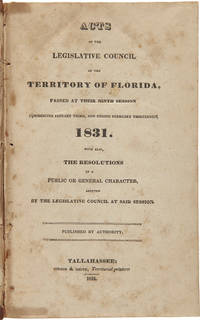
1831réf. 31652Tallahassee: Gibson & Smith 1831. Early Florida Laws Prints a list of the officers of the Territory of Florida acts and resolutions of the legislative council laws of the United States relative to the Territory and the text of the Treaty of Washington. Includes important early laws relating to Indian affairs transportation commercial development etc. Servies locates only one copy in Florida. Original half calf and boards printed label. Spine heavily chipped front board detached boards spotted and edgeworn. Front free endpaper excised pencil notation on p.3 contemporary ink signature illegible on p.5. Light scattered foxing. A good copy. SERVIES 1541. AII FLORIDA 132. GILCREASE p.335. hardcover
1831réf. 31652Tallahassee: Gibson & Smith 1831. Early Florida Laws Prints a list of the officers of the Territory of Florida acts and resolutions of the legislative council laws of the United States relative to the Territory and the text of the Treaty of Washington. Includes important early laws relating to Indian affairs transportation commercial development etc. Servies locates only one copy in Florida. Original half calf and boards printed label. Spine heavily chipped front board detached boards spotted and edgeworn. Front free endpaper excised pencil notation on p.3 contemporary ink signature illegible on p.5. Light scattered foxing. A good copy. SERVIES 1541. AII FLORIDA 132. GILCREASE p.335. hardcover books
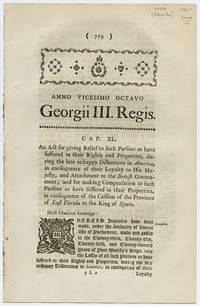
1788réf. 54471London. 1788. Very scarce official printing of this act of Parliament that made provisions for those who lost their property when Great Britain ceded Florida back to Spain as a part of the Treaty of Paris in 1783. ESTC locates five copies. Dbd. Folio. Stab holes at gutter margin. Light tanning. Very good. unknown
1788réf. 54471London. 1788. Very scarce official printing of this act of Parliament that made provisions for those who lost their property when Great Britain ceded Florida back to Spain as a part of the Treaty of Paris in 1783. ESTC locates five copies. Dbd. Folio. Stab holes at gutter margin. Light tanning. Very good. unknown books
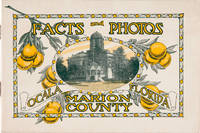
1910réf. 57046Lynchburg Va.: J.P. Bell Company Incorporated ca. 1910. Thoroughly Illustrated Florida Promotional Pamphlet A rare promotional booklet for Marion County Florida around the turn of the 20th century primarily focused on attracting farmers. The county's slogan "Good as the Best for Fruit and Vegetables/ Better than the Rest for 'Hog and Hominy'" adorns the first page. The final page drives home the point stressing that "This county contains good land within its boundaries.Her resources are unlimited; the industrious farmer can succeed." The pamphlet itself is mostly made up of photographic illustrations with occasional text about the climate schools and other amenities in the region. The illustrations show homes farms street scenes flora golf clubs and other recreations and more. An insert at the end comprises two postcards to be detached and mailed to the Marion County Board of Trade for further information. Marion County was greatly affected by the Great Freeze of 1894-5 which saw Orlando reach its all-time record low temperature of eighteen degrees Fahrenheit and wreaked havoc on Florida's citrus crop. Land that had cost as much as $1000 per acre in the early 1890s dropped dramatically in value and even at the time of this pamphlet's printing per-acre prices in Marion County were advertised in a range from ten to a hundred dollars. This pamphlet is quite rare; OCLC locates only two institutional copies at Duke University and the State Library of Florida. Oblong octavo. Original pictorial wrappers stapled. Minor wear. Near fine. OCLC 21247139. unknown