8 404 résultats
1979réf. 28311Boston MA: Vose Galleries of Boston Inc. . As New. Paperback. FREE UPGRADE to Courier/Priority Shipping Upon Request - IN STOCK AND IMMEDIATELY AVAILABLE FOR SHIPMENT - AS NEW THE TEXT BLOCK IS PRISTINE CLEAN UNMARKED AND IN EXCELLENT CONDITION - -- with a bonus offer--; T-VOSENHL . 1979. Vose Galleries of Boston, Inc. paperback
1986réf. 27465Vose Galleries of Boston Inc. . New. Paperback. FREE UPGRADE to Courier/Priority Shipping Upon Request - IN STOCK AND IMMEDIATELY AVAILABLE FOR SHIPMENT - FLAWLESS COPY PRISTINE NEVER OPENED -- with a bonus offer--; T-VOSEHUNT; Vose Galleries of Boston Inc.; Hoppin M. J. foreword; Vose Robert C. Jr. essay The Return of William Morris Hunt - Vose Galleries of Boston Inc. - September 30 - November 26 1986 . 1986. Vose Galleries of Boston, Inc. paperback
réf. Z1-I-017-01432Bibliolife. Used - Like New. Used - Like New. This is a reproduction of an out of print title. This book may have occasional imperfections such as missing or blurred pages poor pictures errant marks etc. that were either part of the original artifact or were introduced by the scanning process. Ships from UK in 48 hours or less usually same day. Your purchase helps support Sri Lankan Children's Charity 'The Rainbow Centre'. 100% money back guarantee. We are a world class secondhand bookstore based in Hertfordshire United Kingdom and specialize in high quality textbooks across an enormous variety of subjects. We aim to provide a vast range of textbooks rare and collectible books at a great price. Our donations to The Rainbow Centre have helped provide an education and a safe haven to hundreds of children who live in appalling conditions. We provide a 100% money back guarantee and are dedicated to providing our customers with the highest standards of service in the bookselling industry. Bibliolife unknown
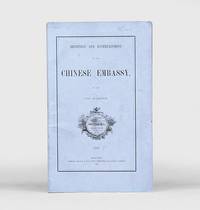
1868réf. 150997Boston: Alfred Mudge & Son City Printers 1868. The land of Washington has greeted the land of Confucius First edition in wrappers of this work commemorating the August 1868 visit to Boston by the first Chinese embassy to the United States. The contents includes the text of a banquet speech by Ralph Waldo Emerson articulating Confucianism's contribution to notions of human goodness. In 1867 the Qing court appointed the Bostonian Anson Burlingame 1820-1870 as its envoy extraordinary to the Western powers and the following year Burlingame led China's first official embassy to the United States and Europe. Burlingame was the ideal choice for such a task possessing "a frank noble disposition habits of industry a charming and persuasive manner and promising talents as an orator" quoted in the ANB. With the Chinese ministers Zhigang and Sun Jiagu at his side Burlingame landed on America's Pacific Coast in March 1868 before city-hopping eastwards and reaching Washington in June. There after extended negotiations the two parties concluded the landmark Burlingame-Seward Treaty the first time a foreign power explicitly recognized China's sovereignty. Following these negotiations the embassy journeyed to Boston staying between 20 August and 2 September. The present commemorative volume prints the full text of speeches given at the welcome reception and grand banquet. Other sections detail the engagements laid on for Burlingame and his party such as visits to the governor's mansion and local manufacturing sites. Burlingame's effusive and somewhat hyperbolic words at the banquet capture the historical importance of the embassy: "the presence here of my associates with the sunshine of the Orient upon their faces and the warmth of its fires in their hearts arouses more emotions than the most eloquent tongue can express. The land of Washington has greeted the land of Confucius. The great thoughts of the one have been wedded to the great deeds of the other" p. 20. Pages 52-55 contain the text of a speech by Ralph Waldo Emerson who was invited to address the welcome banquet. To attendees Emerson extolled the longevity of China's culture and its scientific technological and cultural successes achieved long before those of European countries. Discussing Chinese philosophy Emerson praised Confucius as having anticipated Jesus' teachings of goodness towards others by five hundred years - an expression of Confucianism's sustained influence on Emerson's transcendentalism. "Confucianism reinforced Emerson's emphasis on the moral imperative for every individual and. the Confucian ideal of the ethical solitary learned and decorous man certainly appealed to Emerson's sense of himself" Versluis p. 70. The speech was later reprinted in his Miscellanies 1904. Copies of the present work were also bound in cloth with no stated priority between the two bindings. Octavo. Emblem of the city of Boston to title page. Original blue coated card wrappers title and emblem of the city of Boston to front cover in black. Small pencilled annotation to front cover library stamp of Tufts College to title page. Wrappers lightly soiled and rubbed in places with one small chip slight colour bleed to verso of wrappers internally clean and bright. A very good copy of this fragile publication. BAL III 23. Arthur Versluis American Transcendentalism and Asian Religions 1993. hardcover
réf. DADAX0905899059Colt Books 0000-00-00. First Edition. hardcover. New. 0.00x0.00x0.00. Buy with confidence. Excellent Customer Service & Return policy. Colt Books hardcover
1933Very Good Turkish Original wrappers. Cr. 8vo. (19 x 13 cm). In Turkish. 305, [1] p., errata. Extremely rare in this condition and in original wrappers. Fading on spine, slight stains on cover. Untrimmed. Otherwise a very good copy. Repaired by tape on the front cover's bottom corner. Yorulmaz's rare first Turkish translation of 'Das Kapital' has been the subject of many 'translation studies'. The most important work in the entrepreneurship of Yorulmaz's left thought repertoire that was published within his cultural series was 'Sermaye [= Das Kapital]'. Published as the 7th book of 'the Capital Culture Series', an abridged translation of Das Kapital by Karl Marx. Yorulmaz wrote about his translation: "I had an experience on these empty days and I am translating and publishing a loyal story of 14 volumes, "Das Kapital", collected by Gabriel Dövil. If this abridged edition is requested, I will finally begin with these 14 volumes, starting in June 1937, and translating four every year." Yorulmaz had translated 'Das Kapital' to Turkish from Gabrielle Deville's French translation which was an abridged edition. According to his comments, the purpose of Yorulmaz was, if this abridged edition is requested or demanded he would translate full text of 'Das Kapital'. However, he couldn't realize this dream. Nevertheless, the effect of the 'Sermaye' in the Turkish leftist thought had been considerable. As "Capital" was the first translation of "Das Kapital" into Turkish, it functioned at that time to fill the gap that existed in terms of socialist thought. He was concerned with knowing Karl Marx's thoughts, and therefore in his preface to 'Sermaye', he described his intellectual approach as "[one] sect which is one of the deepest thoughts and has made the biggest earthquake in the world in social and political life". In his preface, he wrote: "We have nothing but a small realized interference about Karl Marx's study in the law school in Ankara by Cavit Bey and the Turkish attorney Sükrü Kaya Bey, five to ten pages of translations." (Source: Haydar Rifat Yorulmaz'in çevirileri, (1908-1940): Bir sol düsünce 'repertuvari'nin kurulusu, Bilal Çelik). In the preface of the 1888 English Edition of 'Das Kapital', Engels says "I was told that the Armenian translation, which was expected to be published in Istanbul a few months ago, did not see the light of day because the publisher was afraid to release a book bearing the name of Marx, while the translator refused to show it as his own work.". (Das Kapital in Turkey, Savran & Tonak). Haydar Rifat was a Turkish lawyer, intellectual, translator and author. He brought the works of world-famous writers such as Emil Ludwig, Lenin, Gustav, Balzac, Tolstoy, Dostoevsky and Karl Marx into Turkish; he published his translations under the series titled 'Dün ve Yarin Tercüme Külliyati' [i.e. Yesterday and Tomorrow as Translation]. In addition, many articles he wrote in the fields of law and literature appeared in various newspapers and magazines. Not in OCLC.
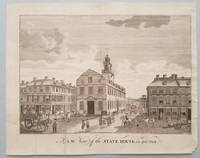
1793réf. 3843"One of the more important images of postcolonial Boston" The building now known as "the Old State House" at the head of State Street in downtown Boston stands on the site of the first Town House that was built in the 1650s and burned in 1711. Its successor building the State House housed both town and provincial officers and activities until 1742 at which time town personnel moved to a location in the newly constructed Faneuil Hall. Of this view Deák notes: "The view from Washington Street shows the rear of the structure flanked by eminent merchant houses. Fashionable residents tradesmen mounted pedestrians and a variety of horse-drawn vehicles animate the streets. We can look past the State House down State Street far off into the distance of the harbor. There numerous masts of ships can be detected towering above the town's buildings which are constructed close together and are of substantial proportions.What we have in this engraving is one of the more important images of postcolonial Boston showing it as a thriving independent seaport" p. 128. References: Lewis Guide to Engravings in American Magazines 1741-1810: pp. 11 49. Stokes & Haskell American Historical Prints: Early Views of American Cities etc.: B-109. Deák Picturing America: 194. Condition: Old fold lines some of which have been strengthened on the reverse; minor edge tears. Scattered spots of very light foxing. Overall a well-preserved and visually pleasing example. ICN 7755. From the July, 1793 issue of Massachusetts Magazine
1984réf. 85069New York: Simon & Schuster. As New. 1984. Paperback. 0671460889 . FREE UPGRADE to Courier/Priority Shipping Upon Request - IN STOCK AND IMMEDIATELY AVAILABLE FOR SHIPMENT - AS NEW THE TEXT BLOCK IS PRISTINE CLEAN UNMARKED AND IN EXCELLENT CONDITION - - 647 pages. -- with a bonus offer--; 4to - over 9¾" - 12" tall . Simon & Schuster paperback
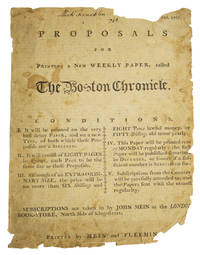
1767réf. 313300Boston: Printed by Mein and Fleeming 1767. 2 pp. prospectus printed recto and verso of a single sheet. 4to 10-1/2 x 8 inches. Damage at edges with loss to text month October missing from heading lower corner torn away with loss to"G" in Fleeming in imprint a few letters lost from right margin on recto and 12 lines affected on verso toned and stained. Signed "Mich. Franklin 1768" at top of recto. 2 pp. prospectus printed recto and verso of a single sheet. 4to 10-1/2 x 8 inches. Rare early American newspaper prospectus announcing publication of The Boston Chronicle a weekly Loyalist paper. "John Mein a bookseller was the publisher and John Fleeming the printer. With the beginning of the second year the size of the paper was enlarged to folio and it was publihsed every Monday and Thursday and was the first newspaper to be published twice a week in New-England. To avoid popular resentment of his political views Mein was forced to leave the country before the close of its second year and the paper was continued by Fleeming in the name of the firm until its publication ceased on the 25th of June 1770" Evans. The five "conditions" listed on the recto detail the general design of the paper - that it will be printed on high quality demy paper with specially designed type 8 pages in quarto priced at 6 shillings and 8 pence printed every Monday and delivered to subscrribers with care. The verso with text in three columns outlines a plan of the contents of the paper including coverage of current events and issues essays on moral subjects notices on newly published books poetry etc. Ford Broadsides 1418; Shipton-Mooney 41736; Bristol B2787 recording 4 copie; Evans 10565 for newspaper Printed by Mein and Fleemin[g] unknown
1767réf. 313300Boston: Printed by Mein and Fleeming 1767. 2 pp. prospectus printed recto and verso of a single sheet. 4to 10-1/2 x 8 inches. Damage at edges with loss to text month October missing from heading lower corner torn away with loss to"G" in Fleeming in imprint a few letters lost from right margin on recto and 12 lines affected on verso toned and stained. Signed "Mich. Franklin 1768" at top of recto. 2 pp. prospectus printed recto and verso of a single sheet. 4to 10-1/2 x 8 inches. Rare early American newspaper prospectus announcing publication of The Boston Chronicle a weekly Loyalist paper. "John Mein a bookseller was the publisher and John Fleeming the printer. With the beginning of the second year the size of the paper was enlarged to folio and it was publihsed every Monday and Thursday and was the first newspaper to be published twice a week in New-England. To avoid popular resentment of his political views Mein was forced to leave the country before the close of its second year and the paper was continued by Fleeming in the name of the firm until its publication ceased on the 25th of June 1770" Evans. The five "conditions" listed on the recto detail the general design of the paper - that it will be printed on high quality demy paper with specially designed type 8 pages in quarto priced at 6 shillings and 8 pence printed every Monday and delivered to subscrribers with care. The verso with text in three columns outlines a plan of the contents of the paper including coverage of current events and issues essays on moral subjects notices on newly published books poetry etc. Ford Broadsides 1418; Shipton-Mooney 41736; Bristol B2787 recording 4 copie; Evans 10565 for newspaper Printed by Mein and Fleemin[g] unknown books
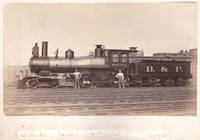
réf. 5490Rhode Island and Massachusetts: Boston & Providence Railroad 1880s. 2 oblong 8vo photograph albums 7.5" x 10.5" brown cloth over boards gilt titles at front-cover; 1 8vo disbound album. 62 bromide print photos 4.5" x 8" with printed and manuscript labels mounted on paperboard leaves; all photos numbered and arranged in sequence: 1-23 in Album 1 19 total lacking 12 13 15 and 20; 26-49 on loose leaves from disbound album 2 23 total lacking #24 #25 and #40; 50-64 plus 5 unnumbered and unlabeled images in album 3 20 total. An impressive photo archive documenting a range of locomotives built for the Boston & Providence Railroad by the Rhode Island Locomotive Works; the Taunton Locomotive Mfg. Co.; Mason Machine Works; the Hinkley & Williams Works and the Boston & Providence itself. Forty-two of the various engines pictured were produced between 1867 and 1887 by the R. I. Lo. Works; seven by the Bos. & Prov. from 1854-1873; six by Taunton L. M. C. from 1868-1886; two by Hinkley & Williams from 1868-1887; and one by Mason Machine Works in 1884. Also included here are images of the Highland and Mount Hope train stations as well as an unidentified railroad bridge. A typical label reads: "26. Squantum. Taunton L. Mfg. Co. 1886. 37.5 / 16 / 20 / 4.5 / 59564 Outside." The engineers and others who operated the trains appear in many photos enlivening the scenes. Incorporated 1831 the Boston and Providence Railroad was built in two sections in 1834 and 1835 and was acquired in 1888 with a ninety-nine year lease by Old Colony Railroad. Of particular note was Master Mechanic George S. Griggs 1905-1970 who was hired in 1834 at age twenty-nine to organize the department and improve the early engines built in the Roxbury shops. As Charles E. Fisher details "Perhaps the highest compliment that can be paid him was that his work on the locomotive was closely followed by the Taunton Locomotive Works and Hinkley & Drury. Mr. Griggs continued to build inside connected locomotives long after the other roads had discarded them and they were a common sight on this road as late as the seventies." Given the date of the Old Colony's acquisition of the Boston & Providence these photos may relate to the takeover. A valuable record of the Boston & Providence fleet of locomotives. REFERENCES: Fisher Chas. E. "Locomotives of the New Haven R.R." The Railway and Locomotive Historical Society Bulletin No. 47 September 1938 pp. 79-89. CONDITION: Spine perished on one album some images and mounts toned or foxed damp stains to edges of some leaves bindings worn at extremities photos with generally good tonality. Rhode Island and Massachusetts: Boston & Providence Railroad, 1880s unknown
réf. 5490Rhode Island and Massachusetts: Boston & Providence Railroad 1880s. 2 oblong 8vo photograph albums 7.5" x 10.5" brown cloth over boards gilt titles at front-cover; 1 8vo disbound album. 62 bromide print photos 4.5" x 8" with printed and manuscript labels mounted on paperboard leaves; all photos numbered and arranged in sequence: 1-23 in Album 1 19 total lacking 12 13 15 and 20; 26-49 on loose leaves from disbound album 2 23 total lacking #24 #25 and #40; 50-64 plus 5 unnumbered and unlabeled images in album 3 20 total. An impressive photo archive documenting a range of locomotives built for the Boston & Providence Railroad by the Rhode Island Locomotive Works; the Taunton Locomotive Mfg. Co.; Mason Machine Works; the Hinkley & Williams Works and the Boston & Providence itself. Forty-two of the various engines pictured were produced between 1867 and 1887 by the R. I. Lo. Works; seven by the Bos. & Prov. from 1854-1873; six by Taunton L. M. C. from 1868-1886; two by Hinkley & Williams from 1868-1887; and one by Mason Machine Works in 1884. Also included here are images of the Highland and Mount Hope train stations as well as an unidentified railroad bridge. A typical label reads: "26. Squantum. Taunton L. Mfg. Co. 1886. 37.5 / 16 / 20 / 4.5 / 59564 Outside." The engineers and others who operated the trains appear in many photos enlivening the scenes. Incorporated 1831 the Boston and Providence Railroad was built in two sections in 1834 and 1835 and was acquired in 1888 with a ninety-nine year lease by Old Colony Railroad. Of particular note was Master Mechanic George S. Griggs 1905-1970 who was hired in 1834 at age twenty-nine to organize the department and improve the early engines built in the Roxbury shops. As Charles E. Fisher details "Perhaps the highest compliment that can be paid him was that his work on the locomotive was closely followed by the Taunton Locomotive Works and Hinkley & Drury. Mr. Griggs continued to build inside connected locomotives long after the other roads had discarded them and they were a common sight on this road as late as the seventies." Given the date of the Old Colony's acquisition of the Boston & Providence these photos may relate to the takeover. A valuable record of the Boston & Providence fleet of locomotives. REFERENCES: Fisher Chas. E. "Locomotives of the New Haven R.R." The Railway and Locomotive Historical Society Bulletin No. 47 September 1938 pp. 79-89. CONDITION: Spine perished on one album some images and mounts toned or foxed damp stains to edges of some leaves bindings worn at extremities photos with generally good tonality. Rhode Island and Massachusetts: Boston & Providence Railroad, 1880s unknown books
réf. B306408-1Boston 1985-2000. 77 exhibition catalogues each 6pp. printed on a single sheet as follows: 84 Peterborough St. in order by date: Alex Katz: 'Twelve Hours'. Nov. 1985. Eric Fischl: The Works on Glassine 1979-80. Dec. 1985-Jan. 1986. Ross Bleckner. Jan.-Feb. 1986. Brett De Palma. Feb.-March 1986. Lucio Pozzi. March-April 1986. David Bowes Michael Byron Chuck Connelly McDermott&McGough. April-May 1986. David Salle. May 1986. Marcel Odenbach. June 1986. With Karen Meyerhoff. Frank Egloff. Oct.-Nov. 1986. Julian Schnabel. Nov.-Dec. 1986. Enzo Cucchi: L'elefante di Giotto. Jan. 1987. Michael Byron. Feb. 1987. Sandro Chia. April-May 1987. Terry Winters. May 1987. Nicos Baikos. Sept.-Oct. 1987. 4pp. Philip Taaffe. Oct.-Nov. 1987. David McDermott. Peter McGough. Nov.-Dec. 1987. Claudio Parmiggiani: A lume spento. Jan. 1988. Ray Smith. Feb.-March 1988. Francesco Clemente. April-May 1988. Ceccobelli. Pizzi Cannella. May-June 1988. David Bowes: A Painter's Lexicon. Sept.-Oct. 1988. Roni Horn. Oct.-Nov. 1988. Sherrie Levine. Nov.-Dec. 1988. Ross Bleckner. Jan.-Feb. 1989. Matt Mullican. Feb.-March 1989. Gerhard Merz. March-April 1989. Richmond Burton. April-May 1989. Alex Katz. Sept.-Oct. 1989. Meyer Vaisman. Nov. 1989. Baselitz. Dec. 1989. . 207 South St. in order by date: David Salle. March-April 1990. Richmond Burton. Moira Dryer. April-May 1990. Lucio Pozzi: "for the Sexes." May-June 1990 Annette Lemieux. October 1990. Peter Halley Nov. 1990. Peter Halley. Nov.-Dec. 1990. Günther Förg. Dec. 1990-Jan. 1991. Moira Dryer. Feb.-March 1991. Rosemarie Trockel. April 1991. Richmond Burton. May-June 1991. Frank Egloff.Sept.-Oct. 1991. Ray Smith. Nov. 1991. Meyer Vaisman. Dec. 1991-Jan. 1992. David Dupuis Christopher Lucas Carl Ostendarp Matthew Weinstein. Jan-Feb. 1992. Nicola De Maria. April-May 1994. Mimmo Paladino. Dec. 1994-Jan. 1995 with: invitation card for the exhibition. Scott Grodesky. Jan.-Feb. 1995 with: invitation card for the exhibition. Richmond Burton. April-May 1995 with: invitation card for the exhibition. Ophrah Shemesh. Sept.-Oct. 1995 with: invitation card for the exhibition. Peter Halley. Nov.-Dec 1995 with: invitation card for the exhibition. Jaqueline Humphries. March-April 1996 with: invitation card for the exhibition. Annette Lemieux. April-May 1996. Ray Smith. Oct.-Nov. 1996 with: invitation card for the exhibition. Tom Sachs. Nov.-Dec. 1996 with: invitation card for the exhibition. The Body of Painting: Ellen Gallagher Christopher Lucas Matthew Ritchie. Jan. 18 1997. Single folio sheet. Matthew Antezzo. March-April 1997 with: invitation card for the exhibition. Barry X Ball. April-May 1997 with: invitation card for the exhibition. Magdalena Campos-Pons. Sept.-Oct. 1997 with: invitation card for the exhibition. Philip Taaffe. Oct.-Nov. 1997 with: invitation card for the exhibition. Michael Craig-Martin. Nov.-Dec. 1997 with: invitation card for the exhibition. Nicky Hoberman. Jan.-Feb. 1998 with: invitation card for the exhibition. Donna Moylan. Feb-March 1998 with: invitation card for the exhibition. Ellen Phelan: Through Dolls and Flowers. April 1998 with: invitation card for the exhibition. Fabian Marcaccio. May 1998 with: invitation card for the exhibition. Joan Banach. Sept.-Oct. 1998. Peter Halley. Oct.-Nov. 1998 with: invitation card for the exhibition. Matthew Ritchie. Nov.-Dec. 1998 with: invitation card for the exhibition. William Wood. Jan.-Feb. 1999 with: invitation card for the exhibition. Tom Sachs. March-April 1999 with: invitation card for the exhibition. Alex Katz: February 5:30 PM. April-May 1999 with: invitation card for the exhibition. Ellen Gallagher. May-July 1999 with: invitation card for the exhibition. Cyber/Cypher: Pedro Barbieto Matthew Ritchie James Siena Joh Simon. Sept.-Oct. 1999 with: invitation card for the exhibition. Richard Patterson. Nov.-Dec. 1999 with: invitation card for the exhibition. Eric Fischl. Dec. 1999-Jan. 2000 with: invitation card for the exhibition. Ross Bleckner. Jan.-Feb.2000 with: invitation card for the exhibition. Annette Lemieux: Crossing the Rubicon. Feb.-March 2000 with: invitation card for the exhibition. 4to. Wraps. Mario Diacono came from Italy in 1968 to teach Italian literature at the University of California Berkeley and at Sarah Lawrence College. He returned to Italy to found his first art gallery in Bologna. There from 1978-1979 he showed young Arte Povera and Conceptual Italian artists like Jannis Kounellis and Vito Acconci. From 1980-1984 Diacono had a gallery in Rome showing mostly American artists including Julian Schnabel David Salle Joseph Kosuth Eric Fischl and Jean-Michel Basquiat in 1982. Mario Diacono opened his first gallery in Boston in 1985 at 84 Peterborough Street which had been the Starn Twins studio. In the spring of 1990 the gallery moved to 207 South Street a building that contained other art galleries as the area showed promise to be a new arts district. Diacono showed Alex Katz Eric Fischl Ross Bleckner David Salle Julian Schnabel Enzo Cucchi Sandro Chia Francesco Clemente Philip Taaffe Richmond Burton Roni Horn Ross Bleckner Rosemary Trockel Annette Lemieux and Baselitz among many others. However once the Gulf War broke out the art market collapsed and Diacono closed his South Street gallery in 1992. Diacono then moved to New York City for a short period of time and from early 1992 to the summer of 1993 he held exhibitions there together with Perry Rubenstein showing Ross Bleckner Philip Taaffe Richmond Burton and others. Upon his return to Boston he held exhibitions at 207 South Street again from 1994 to 2000. Artists he showed included David Salle Richmond Burton Peter Halley Rosemarie Trockel Annette Lemieux Barry X. Ball Matthew Ritchie Ross Bleckner and Günter Förg. Boston, 1985-2000. paperback
réf. B306408-1Boston 1985-2000. 77 exhibition catalogues each 6pp. printed on a single sheet as follows: 84 Peterborough St. in order by date: Alex Katz: 'Twelve Hours'. Nov. 1985. Eric Fischl: The Works on Glassine 1979-80. Dec. 1985-Jan. 1986. Ross Bleckner. Jan.-Feb. 1986. Brett De Palma. Feb.-March 1986. Lucio Pozzi. March-April 1986. David Bowes Michael Byron Chuck Connelly McDermott&McGough. April-May 1986. David Salle. May 1986. Marcel Odenbach. June 1986. With Karen Meyerhoff. Frank Egloff. Oct.-Nov. 1986. Julian Schnabel. Nov.-Dec. 1986. Enzo Cucchi: L'elefante di Giotto. Jan. 1987. Michael Byron. Feb. 1987. Sandro Chia. April-May 1987. Terry Winters. May 1987. Nicos Baikos. Sept.-Oct. 1987. 4pp. Philip Taaffe. Oct.-Nov. 1987. David McDermott. Peter McGough. Nov.-Dec. 1987. Claudio Parmiggiani: A lume spento. Jan. 1988. Ray Smith. Feb.-March 1988. Francesco Clemente. April-May 1988. Ceccobelli. Pizzi Cannella. May-June 1988. David Bowes: A Painter's Lexicon. Sept.-Oct. 1988. Roni Horn. Oct.-Nov. 1988. Sherrie Levine. Nov.-Dec. 1988. Ross Bleckner. Jan.-Feb. 1989. Matt Mullican. Feb.-March 1989. Gerhard Merz. March-April 1989. Richmond Burton. April-May 1989. Alex Katz. Sept.-Oct. 1989. Meyer Vaisman. Nov. 1989. Baselitz. Dec. 1989. . 207 South St. in order by date: David Salle. March-April 1990. Richmond Burton. Moira Dryer. April-May 1990. Lucio Pozzi: "for the Sexes." May-June 1990 Annette Lemieux. October 1990. Peter Halley Nov. 1990. Peter Halley. Nov.-Dec. 1990. Günther Förg. Dec. 1990-Jan. 1991. Moira Dryer. Feb.-March 1991. Rosemarie Trockel. April 1991. Richmond Burton. May-June 1991. Frank Egloff.Sept.-Oct. 1991. Ray Smith. Nov. 1991. Meyer Vaisman. Dec. 1991-Jan. 1992. David Dupuis Christopher Lucas Carl Ostendarp Matthew Weinstein. Jan-Feb. 1992. Nicola De Maria. April-May 1994. Mimmo Paladino. Dec. 1994-Jan. 1995 with: invitation card for the exhibition. Scott Grodesky. Jan.-Feb. 1995 with: invitation card for the exhibition. Richmond Burton. April-May 1995 with: invitation card for the exhibition. Ophrah Shemesh. Sept.-Oct. 1995 with: invitation card for the exhibition. Peter Halley. Nov.-Dec 1995 with: invitation card for the exhibition. Jaqueline Humphries. March-April 1996 with: invitation card for the exhibition. Annette Lemieux. April-May 1996. Ray Smith. Oct.-Nov. 1996 with: invitation card for the exhibition. Tom Sachs. Nov.-Dec. 1996 with: invitation card for the exhibition. The Body of Painting: Ellen Gallagher Christopher Lucas Matthew Ritchie. Jan. 18 1997. Single folio sheet. Matthew Antezzo. March-April 1997 with: invitation card for the exhibition. Barry X Ball. April-May 1997 with: invitation card for the exhibition. Magdalena Campos-Pons. Sept.-Oct. 1997 with: invitation card for the exhibition. Philip Taaffe. Oct.-Nov. 1997 with: invitation card for the exhibition. Michael Craig-Martin. Nov.-Dec. 1997 with: invitation card for the exhibition. Nicky Hoberman. Jan.-Feb. 1998 with: invitation card for the exhibition. Donna Moylan. Feb-March 1998 with: invitation card for the exhibition. Ellen Phelan: Through Dolls and Flowers. April 1998 with: invitation card for the exhibition. Fabian Marcaccio. May 1998 with: invitation card for the exhibition. Joan Banach. Sept.-Oct. 1998. Peter Halley. Oct.-Nov. 1998 with: invitation card for the exhibition. Matthew Ritchie. Nov.-Dec. 1998 with: invitation card for the exhibition. William Wood. Jan.-Feb. 1999 with: invitation card for the exhibition. Tom Sachs. March-April 1999 with: invitation card for the exhibition. Alex Katz: February 5:30 PM. April-May 1999 with: invitation card for the exhibition. Ellen Gallagher. May-July 1999 with: invitation card for the exhibition. Cyber/Cypher: Pedro Barbieto Matthew Ritchie James Siena Joh Simon. Sept.-Oct. 1999 with: invitation card for the exhibition. Richard Patterson. Nov.-Dec. 1999 with: invitation card for the exhibition. Eric Fischl. Dec. 1999-Jan. 2000 with: invitation card for the exhibition. Ross Bleckner. Jan.-Feb.2000 with: invitation card for the exhibition. Annette Lemieux: Crossing the Rubicon. Feb.-March 2000 with: invitation card for the exhibition. 4to. Wraps. Mario Diacono came from Italy in 1968 to teach Italian literature at the University of California Berkeley and at Sarah Lawrence College. He returned to Italy to found his first art gallery in Bologna. There from 1978-1979 he showed young Arte Povera and Conceptual Italian artists like Jannis Kounellis and Vito Acconci. From 1980-1984 Diacono had a gallery in Rome showing mostly American artists including Julian Schnabel David Salle Joseph Kosuth Eric Fischl and Jean-Michel Basquiat in 1982. Mario Diacono opened his first gallery in Boston in 1985 at 84 Peterborough Street which had been the Starn Twins studio. In the spring of 1990 the gallery moved to 207 South Street a building that contained other art galleries as the area showed promise to be a new arts district. Diacono showed Alex Katz Eric Fischl Ross Bleckner David Salle Julian Schnabel Enzo Cucchi Sandro Chia Francesco Clemente Philip Taaffe Richmond Burton Roni Horn Ross Bleckner Rosemary Trockel Annette Lemieux and Baselitz among many others. However once the Gulf War broke out the art market collapsed and Diacono closed his South Street gallery in 1992. Diacono then moved to New York City for a short period of time and from early 1992 to the summer of 1993 he held exhibitions there together with Perry Rubenstein showing Ross Bleckner Philip Taaffe Richmond Burton and others. Upon his return to Boston he held exhibitions at 207 South Street again from 1994 to 2000. Artists he showed included David Salle Richmond Burton Peter Halley Rosemarie Trockel Annette Lemieux Barry X. Ball Matthew Ritchie Ross Bleckner and Günter Förg. Boston, 1985-2000. paperback books
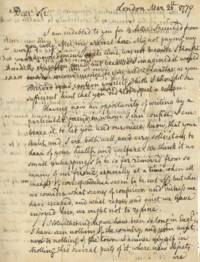
1779réf. List3711London 1779. Autograph letter signed Joseph Green to Boston merchant Samuel Eliot. Folded letter datelined "London Mar. 26th 1779" with "Rec'd 22nd Decr. 1779" docket on top flap. 7 x 9 ¼ inches 3pp. Some repairs with archival tape folded small tears at some folds. Excellent. A thoughtful Revolutionary-era letter written by Joseph Green the Boston clergyman poet satirist and wit whose verses made him one of the best-known literary figures in colonial New England. A graduate of Harvard College and member of Boston's mercantile elite Green maintained friendships with figures including Mather Byles and Benjamin Church. He is known for his satirical poetry and as a signer of the 1773 attestation supporting Phillis Wheatley's authorship of Poems on Various Subjects Religious and Moral. A Loyalist during the American Revolution and named in the 1778 Massachusetts Banishment Act Green departed Boston in 1775 and spent the remainder of his life in England. The present letter was written only a year before his death in London in 1780. Written during the period of British blockade and privateering that turned the Atlantic into a contested military space the letter survives as a rare example of communication successfully passing between a Loyalist exiled in London and a Boston merchant. Green repeatedly returns to the difficulty of maintaining contact noting that "all means of correspondence seem to be cut off" and explaining that he is able to write only because he has found "a particular friend in whom I can confide." The letter itself written in March and not received until December 1779 provides tangible evidence of the obstacles confronting transatlantic correspondence during the Revolution. Green writes: "Having now an opportunity of writing by a particular friend in whom I can confide I embrace it to let you and our niece know that your Aunt and I are both well and very solicitous to hear of your health and welfare. We think it no small unhappiness to be so far removed from so many of our friends especially at a time when all means of correspondence seem to be cut off; but when we consider what scenes of confusion and distress we have escaped and what repose and quiet we have enjoyed here we ought not to repine. "Notwithstanding we have been so long in Engl'd I have seen nothing of the country and your Aunt next to nothing of the town. I amuse myself in trolling thro' several parts of it where new objects are perpetually presenting themselves; and I am the fonder of this exercise as it contributes to health as well as amusement. "The climate here agrees well with my constitution. I enjoy better health than I did at home & my friends tell me I am younger. But I know better than to believe them in this because I think if I was to go about it I could prove I am near four years older than when I left Boston." Green's remarks describe the reality of transatlantic communication during the Revolutionary War when Loyalists abroad and their friends in America frequently depended upon trusted private carriers rather than regular postal channels. The letter's journey from London to Boston-requiring months to arrive and bearing Eliot's receipt docket of December 22 1779-illustrates precisely the obstacles Green describes. Green continues with observations on one of the great public controversies of wartime Britain the celebrated court martial of Admiral Augustus Keppel following his engagement with the French fleet off Brest. Green describes the intense public reaction and the partisan passions surrounding the affair: "We have had a forced and ostentatious display of joy on acct. of Admiral Keppel's acquittal. He has been try'd by a court martial on a charge brought against him by Admiral Palliser for misconduct in the engagement he had the last summer with the French fleet off Brest. This has been made a party affair and has been carry'd to a most extravagant height. The whole city has been illuminated three or four nights and there have been great rejoicings thro' the Kingdom. But the matter is now pretty well over and Palliser has ruin'd himself by it." Most affecting however is Green's reflection on the increasingly remote prospect of ever returning to Boston. He seems to realize that his exile may be permanent writing that "At the time I left Boston it was uncertain when I should return or whether I should return at all. But the improbability was not so great then as it is now. The door was then shut now it is bolted." Green's letter offers a moving account of Loyalist exile-separation from friends and family with hope for return fading. We find no other records of letters written by Green during this period in commerce or at auction.
1779réf. List3711London 1779. Autograph letter signed Joseph Green to Boston merchant Samuel Eliot. Folded letter datelined "London Mar. 26th 1779" with "Rec'd 22nd Decr. 1779" docket on top flap. 7 x 9 ¼ inches 3pp. Some repairs with archival tape folded small tears at some folds. Excellent. A thoughtful Revolutionary-era letter written by Joseph Green the Boston clergyman poet satirist and wit whose verses made him one of the best-known literary figures in colonial New England. A graduate of Harvard College and member of Boston's mercantile elite Green maintained friendships with figures including Mather Byles and Benjamin Church. He is known for his satirical poetry and as a signer of the 1773 attestation supporting Phillis Wheatley's authorship of Poems on Various Subjects Religious and Moral. A Loyalist during the American Revolution and named in the 1778 Massachusetts Banishment Act Green departed Boston in 1775 and spent the remainder of his life in England. The present letter was written only a year before his death in London in 1780. Written during the period of British blockade and privateering that turned the Atlantic into a contested military space the letter survives as a rare example of communication successfully passing between a Loyalist exiled in London and a Boston merchant. Green repeatedly returns to the difficulty of maintaining contact noting that "all means of correspondence seem to be cut off" and explaining that he is able to write only because he has found "a particular friend in whom I can confide." The letter itself written in March and not received until December 1779 provides tangible evidence of the obstacles confronting transatlantic correspondence during the Revolution. Green writes: "Having now an opportunity of writing by a particular friend in whom I can confide I embrace it to let you and our niece know that your Aunt and I are both well and very solicitous to hear of your health and welfare. We think it no small unhappiness to be so far removed from so many of our friends especially at a time when all means of correspondence seem to be cut off; but when we consider what scenes of confusion and distress we have escaped and what repose and quiet we have enjoyed here we ought not to repine. "Notwithstanding we have been so long in Engl'd I have seen nothing of the country and your Aunt next to nothing of the town. I amuse myself in trolling thro' several parts of it where new objects are perpetually presenting themselves; and I am the fonder of this exercise as it contributes to health as well as amusement. "The climate here agrees well with my constitution. I enjoy better health than I did at home & my friends tell me I am younger. But I know better than to believe them in this because I think if I was to go about it I could prove I am near four years older than when I left Boston." Green's remarks describe the reality of transatlantic communication during the Revolutionary War when Loyalists abroad and their friends in America frequently depended upon trusted private carriers rather than regular postal channels. The letter's journey from London to Boston-requiring months to arrive and bearing Eliot's receipt docket of December 22 1779-illustrates precisely the obstacles Green describes. Green continues with observations on one of the great public controversies of wartime Britain the celebrated court martial of Admiral Augustus Keppel following his engagement with the French fleet off Brest. Green describes the intense public reaction and the partisan passions surrounding the affair: "We have had a forced and ostentatious display of joy on acct. of Admiral Keppel's acquittal. He has been try'd by a court martial on a charge brought against him by Admiral Palliser for misconduct in the engagement he had the last summer with the French fleet off Brest. This has been made a party affair and has been carry'd to a most extravagant height. The whole city has been illuminated three or four nights and there have been great rejoicings thro' the Kingdom. But the matter is now pretty well over and Palliser has ruin'd himself by it." Most affecting however is Green's reflection on the increasingly remote prospect of ever returning to Boston. He seems to realize that his exile may be permanent writing that "At the time I left Boston it was uncertain when I should return or whether I should return at all. But the improbability was not so great then as it is now. The door was then shut now it is bolted." Green's letter offers a moving account of Loyalist exile-separation from friends and family with hope for return fading. We find no other records of letters written by Green during this period in commerce or at auction. books
1779réf. 3689Scarce Contemporary Stony Point Battle Plan This rather crude woodcut depicts a battle plan of General "Mad Anthony" Wayne's daring and dramatic capture of the British fortification at Stony Point about 30 miles up the Hudson River from New York City. The battle planned in detail by Washington took place around midnight on July 16 1779. The lower portion of the battle plan includes a four item key: "A. The British Fortress B. Abattes abatis in front C. The Reserve D. The detached Party who stormed the Works." Nebenzahl's A Bibliography of Printed Battle Plans of the American Revolution 1775-1795 cites only a 1784 London-printed battle plan by Faden for the Stony Point engagement #145. The offered plan is not noted by Nebenzahl was published in America and was issued five years earlier than the Faden plan. The Bickerstaff's Boston Almanack for 1780 would almost certainly have been published in November or December of 1779 – within six months of the actual battle. A very scarce almanac in the trade. Auction records indicate the most recent copy sold at the Gutman sale in 2005 for $4800. Prior to that Swann sold an example in 1979. References: For the almanac: Evans: 16287; Drake: 3290. For the map: Cresswell: 309. Condition: Map appears on verso of title page and measures about 6 ½ x 3 ¾." Almanac is complete in 24 pp. Slight loss of road table text at upper tip of final leaf. ICN 7643. Printed and sold by Draper and Folsom, and John Mycall of Newbury.
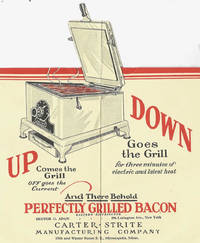
1929réf. 10268Boston: various 1929. Archive. One medium-sized file box containing approximately six hundred twenty-five items including: commercial brochures 121 samples 11 posters 3 typed letters signed/TLS 304 autograph letters signed/ALS 149 postcards & telegrams 29 and periodicals 5. The commercial or trade brochures are mostly small booklets bi-folds and tri-folds graphically illustrated with images of the equipment on offer and frequently printed in two colors or in duotone. A small but deeply engaging archive depicting the business activities of the Boston Massachusetts kitchen equipment supply firm W.H. Davenhall. The supply company serviced businesses with food production and serving needs far beyond the traditional restaurants and hotels. There are in fact few of those represented therein. The company's stock in trade seemed to have been the many "secondary" food establishments growing in number in the early twentieth century including soda fountains candy shops tea rooms diners cafeterias educational dining facilities gas stations with food offerings cafes lunch shops beauty parlors fraternity houses and military bases. The types of equipment depicted in the archive represents changes in food production for a population rapidly moving away from traditional home dining and increasingly consuming food in new types of establishments. The rapid economic expansion that made all this change possible came to a halt with the Crash of 1929 and the Great Depression. The archive illustrates the experience of a small business in the years leading up to the Crash with issues collecting debts bankruptcy of suppliers and clients etc. The correspondence includes offers of new equipment or supplies often the line between brochure and correspondence is blurred orders inquiries demands for payments complaints requests for new supplier arrangements bankruptcy notices of former customers and more. In addition to the typed and handwritten letters there are postcards and telegrams. A handful of label samples and posters are included as well. Finally there are materials produced by trade periodicals including: Institutional Merchandising Hot Off the Griddle published by Westinghouse American Restaurant Magazine and The Soda Fountain. A wide range of business topics is visible in this archive: bill collection disputes about what was delivered or when disputes about salesmen adding items to an order bankruptcy of a client price changes a UNH fraternity orders a half dozen aluminum pitchers surprised complicated returns of defective merchandise development of school cafeterias the Crash of '29 deliveries abandoned or rejected and more. Condition is generally very good or better. A more detailed description including complete lists of suppliers and clients is available by request. various unknown
1929réf. 10268Boston: various 1929. Archive. One medium-sized file box containing approximately six hundred twenty-five items including: commercial brochures 121 samples 11 posters 3 typed letters signed/TLS 304 autograph letters signed/ALS 149 postcards & telegrams 29 and periodicals 5. The commercial or trade brochures are mostly small booklets bi-folds and tri-folds graphically illustrated with images of the equipment on offer and frequently printed in two colors or in duotone. A small but deeply engaging archive depicting the business activities of the Boston Massachusetts kitchen equipment supply firm W.H. Davenhall. The supply company serviced businesses with food production and serving needs far beyond the traditional restaurants and hotels. There are in fact few of those represented therein. The company's stock in trade seemed to have been the many "secondary" food establishments growing in number in the early twentieth century including soda fountains candy shops tea rooms diners cafeterias educational dining facilities gas stations with food offerings cafes lunch shops beauty parlors fraternity houses and military bases. The types of equipment depicted in the archive represents changes in food production for a population rapidly moving away from traditional home dining and increasingly consuming food in new types of establishments. The rapid economic expansion that made all this change possible came to a halt with the Crash of 1929 and the Great Depression. The archive illustrates the experience of a small business in the years leading up to the Crash with issues collecting debts bankruptcy of suppliers and clients etc. The correspondence includes offers of new equipment or supplies often the line between brochure and correspondence is blurred orders inquiries demands for payments complaints requests for new supplier arrangements bankruptcy notices of former customers and more. In addition to the typed and handwritten letters there are postcards and telegrams. A handful of label samples and posters are included as well. Finally there are materials produced by trade periodicals including: Institutional Merchandising Hot Off the Griddle published by Westinghouse American Restaurant Magazine and The Soda Fountain. A wide range of business topics is visible in this archive: bill collection disputes about what was delivered or when disputes about salesmen adding items to an order bankruptcy of a client price changes a UNH fraternity orders a half dozen aluminum pitchers surprised complicated returns of defective merchandise development of school cafeterias the Crash of '29 deliveries abandoned or rejected and more. Condition is generally very good or better. A more detailed description including complete lists of suppliers and clients is available by request. various unknown books
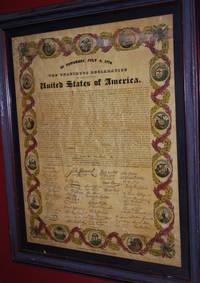
1835réf. 90478Boston MA: Prentiss Whitney / Boston Bewick Company 1835. Broadside. Fine. 26 x 21 x 1.0. Broadside. Condition: Fine. Prentiss Whitney / Boston Bewick Company Boston MA 1835. 1 pages. Paper on cloth backing hand-colored covered with a thin ancient layer of protective lacquer or varnish. No folds or tears. Short wrinkles on the untaut paper surface. Framed in glass. Size: 26 x 21 x 1.0. An imposing and beautiful broadside document! Prentiss Whitney of Boston Massachusetts published this beautiful copy of the Declaration of Independence. It is approximately 26"" tall by 21"" wide. It has a four-line title printed in 4 different fonts. The text of the document is primarily in a handscript font with some words enlarged and bolded in print type of four different fonts. Bottom section contains the signature replicas. The entire document is surrounded by two intertwined vines which encircle 13 state medallions filled with symbolic vignettes and an eagle and shield Federal medallion. Vines and medallions are fully hand-colored. At the very bottom is printed: 'STEREOTYPED BY THE BOSTON BEWICK COMPANY. PUBLISHED BY PRENTISS WHITNEY 30 WASHINGTON STREET.' It is undated but probably published in 1835. Prentiss Whitney 1787-1870 was an auctioneer publisher of historic patriotic American prints and an entrepreneurial investor at 30 Washington St. Boston in the 1830's and 1840's. His ancestor Rev. Peter Whitney of Northborough Ma was one of the first to call for publishing the Declaration of Independence 'American independence vindicated. A sermon delivered September 12 1776. At a lecture appointed for publishing the Declaration of Independence passed July 4 1776. By the representatives of the United States of America in general congress assembled'. The Boston Bewick Company no. 47 Court Street Boston was an association of authors artists printers and bookbinders which was in existence from 1834-1838. It is mostly known for producing engravings and for hiring Nathaniel Hawthorne as editor of the 'American Magazine of Useful and Entertaining Knowledge'. The Act to incorporate the Boston Bewick Company states it is founded for: 'the purpose of employing improving and extending the art of engraving polytyping embossing and printing and carrying on the business thereof.' 1835 Boston Bewick ad: 'Engraving Stereotyping and Printing.: Boston Bewick Company. The Boston Bewick Company Respectfully Give Notice that They are Ready to Receive Orders for Engraving on Wood Steel and Copper; and for Copper-plate Letter Press and Xylographic Printing in All Their Branches.' Prentiss Whitney's prints are excessively scarce. The only other known copy of Whitney's 'Declaration' is in the Albert H. Small Declaration of Independence Collection University of Virginia. Whitney's other prints include an 1835 engraving titled 'Destruction of Tea in Boston Harbor in 1773' which was painted by artist George Loring Brown and engraved by Richard P. Mallory Collection of the Boston Athenaeum. 'The Capture of H.B.M. Sloop of War Frolic Capn. Whinyates by the U.S. Sloop of War Wasp Capn. Jab Jones on the 18th of Oct. 1812' Aquatint drawn and engraved by F. Kearny from a sketch by Lieutenant Claxton of the Wasp U.S. Naval Academy Annapolis. 'The Battle at Bunker's Hill or the Death of General Warren' Painted by John Trumbull and engraved by J. Norman. History::U.S.A.::Pre-Civil War Military History::USA::Revolutionary War History::U.S.A.::General/Other RBRoffice RBRoffice Prentiss Whitney / Boston Bewick Company unknown
1775réf. 3851Six Views of Revolutionary War-era Boston from The Atlantic Neptune This rarely offered two-sheet set of six small views of Boston circa 1775 is from J.F.W. Des Barres' monumental Atlantic Neptune. The views present a wonderful visual record of Boston in the days immediately preceding the American Revolution. The views are: On sheet 1: · a A Front View of the Lines Taken from the Advanced Post Near Browns House · b A View of the Harbour of Boston Taken from Fort Hill · c A View of the Country Towards Dorchester Taken from the Advanced Works on Boston Neck On sheet 2: · d A View of Boston from Dorchester Neck · e Long Island Open on the North Side of Nicks Mate Island · f Boston from Willis Creek The Atlantic Neptune was a cartographic undertaking of heroic proportions. Consisting of more than 250 charts and views it was the first systematic survey of the east coast of North America. The project was important for both trade and military purposes. The latter need was clearly met in these views by references to military installations lines redoubts and advanced posts. Published between 1774 and 1802 the charts and views were of outstanding accuracy for their time; many served as the "best available" for decades to come. Each of the views was engraved on a separate plate with a platemark of 6 ½ x 10." The Stevens Catalogue notes in this regard: "Although the plates themselves do not appear to have been altered they were evidently reprinted several times for they have been found imposed and printed in different positions on the sheets. In some cases the plates were transposed from one sheet to the other hence it was necessary to describe both sheets together." The arrangement of the views on the present sheets coincides with State 3 cited in the Stevens Catalogue. Sheet 1 bears the J. Bates watermark; sheet 2 that of J. Whatman. Bates paper was used from roughly 1777-1781; Whatman from roughly 1782-1790. The Stevens Catalogue states that "All issues of the Boston views appear to have been printed on Bates paper." Sheet 2 here is on Whatman paper thus very likely a later impression of the sheet. References: Henry Newton Stevens Catalogue of the Atlantic Neptune: Nos. 99 & 100. Deak Picturing America: 132. Condition: Very good with scattered light foxing primarily in the text block beneath the images on sheet 1 and short professionally repaired edge tears. ICN 7808.3 British Admiralty
1785Very Good Turkish, Ottoman (1500-1928) Original dark brown handsome full leather bdg. with a traditional flap. Folio. (32 x 22 cm). In Ottoman script (Old Turkish with Arabic letters). [9], 288 leaves. The size of the text block in red borders: 25 x 14.5 cm. 33 lines on each page. Printed on paper with European watermarks. Handwritten title on bottom edge. Marginal cutting on the first page. Overall a very good copy. The 20th incunable of the Islamic world, printed by Ibrahim Müteferrika's legendary Basmahane. Süleymân Izzî succeeded Mehmed Subhî Efendi (ca. 1711 - 1769) in 1745 as an official court historian (vaka'nüvis) and held this office until 1753, and is known as one of the three chroniclers for coherent historiography, representing the events in the Ottoman history from 1730 to 1744 and is a particularly valuable source on the Habsburg-Ottoman War between 1736 and 1739, as proven by his chronicle titled "Tevârîh-i Sâmî ve Sâkir ve Subhî", published in 1784. During this time, he recorded the contemporary events taking place between 1744 and 1753 in the Ottoman Empire. This work was the last item in a series of chronicles published by the printing house founded by Müteferrika. Franz Babinger writes that some parts of the book have been translated into German. Hammer translated one of the parts in question into German. All published, Izzi has planned the third part of his work, but this third part was never published. Contents: "Ahd-i Hümâyûn".; "Zikr-i iâde-i fenn-i tiba'at" [i.e. On the book pressing and publishing with a preface by Ahmed Vâsif Efendi].; "Fihrist-i Târîh-i Izzî" [i.e. Content of Izzi's history].; Izzî tarihinin birinci bölümü [i.e. The first chapter].; Izzî tarihinin ikinci bölümü [The second chapter]. The workshop of Müteferrika began its historical mission in 1728. They published 17 works in 22 volumes. The printing house served as a means to the long-term goal of Müteferrika, his efforts to broaden the horizon and modernize the knowledge of Ottoman society and Islamic civilization. This is evidenced by the subjects of the books selected for publishing, the motivations put forth in the publisher's introductions, as well as by the documents illuminating the background of the publication of each book, also published in print. In 1742, with the publication of the Persian dictionary of Hasan Suûrî, a chapter of Ottoman book printing came to an end. With the death of Müteferrika, the printing of Turkish books was temporarily interrupted. The first generation of Ottoman-Turkish prints was soon followed by a new series, when in 1756 Ahmed and Ibrâhîm Efendi (the latter perhaps the founder's son, according to speculative sources) made an attempt to resurrect the legacy of Müteferrika through the possession of a decree obtained from the Sultan. However, this experiment did not prove to be lasting, as it did not last longer than the new edition of the first Turkish printed book, the Lugat-i Vankûlî. After this for several decades there was no continuation to the Turkish book printing established by Müteferrika, until in 1783 the workshop was put in operation again for the publication of six more works. The subjects of these late 18th century works were dominated by history and military technology, thus Müteferrika's strategy of book distribution made its way hand in hand with the efforts of modernization of the Ottoman state. The second edition of Lugat-i Vankûlî followed the principles of the first edition, and its introduction was composed on the model of the introductory pages of the two last books published under Müteferrika's supervision. The works published after 1783 display a noticeable development in typography not only as to its somewhat refined visual impression, but also in its structure. For example, the d+h and r+h ligatures, characteristic of the first generation of Müteferrika's printed books, are replaced by separate letters. This extremely rare presented book is from the seven publications of this late period of the
2012réf. L3 box257 a1osMasterpieces of Early Chinese Painting and Calligraphy in American Collections From Chinese Five Dynasties 907-960; Song Dynasty 960-1279; Yuan Dynasty 1271-1368. Sponsored by The Metropolitan Museum of Art Museum of Fine Arts Boston The Cleveland Museum of Art The Nelson-Atkins Museum of Art Shanghai Museum. Edited by Shanghai Museum Editors-in-Chief: Chen Xiejun Chen Kelun. Published by Shanghai Fine Arts Publishing House 2012. Burgundy red buckram cloth hardcover 600 pages. This book is oversize and heavy: 17" x 12.5" x 3". This book includes: Five Forewords and Dedication by the five Museum Directors in Chinese and English; Six introductory articles in Chinese and English; Sixty pieces of painting and calligraphy collections: 52 painting 8 calligraphy with brief introduction in Chinese and English detailed introduction in Chinese. Shanghai Fine Arts Publishing House. hardcover
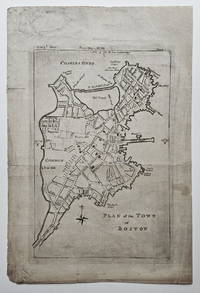
1784réf. 3834This extremely scarce map of Boston appeared as part of the Geographical Gazetteer of the Towns in the Commonwealth of Massachusetts a work issued in parts as a supplement to The Boston Magazine from October 1784 through December 1785. The map appeared with the October 1784 issue of The Boston Magazine. Wheat & Brun note that this map is based largely on Norman's Plan of the Town of Boston with the Attack on Bunkers-Hill. published in the Boston edition of An Impartial History of the War in America in 1781. The present map covers a somewhat smaller geographic area and on a modestly larger scale than the map that appeared in An Impartial History. It also adds/eliminates/changes some street names and landmarks making it more than a direct re-engraving and suggesting the involvement of a cartographer -- perhaps Osgood Carleton with whom Norman collaborated on several maps and charts in the late 18th and early 19th centuries. Norman's 1781 Plan was itself sourced directly from the map appearing in the English edition of An Impartial History 1778. Although the present map is not listed in the Boston Engineering Department's List of Maps of Boston Published Subsequent to 1600 1904 it is referenced in the listing for a 1789 version of the map that had apparently been re-engraved for Norman's Boston Directory 1789. Very scarce. No examples listed for sale in the Antique Map Price Record 1983-2011 and we not aware of any other examples being offered in the past twenty years. A lovely example of one of the most uncommon 18th century maps of Boston. References: Wheat & Brun Maps and Charts Published in America before 1800: 242. Jolly Maps of America in Periodicals before 1800: 402. Lewis: A Guide to Engravings in American Magazines 1741-1810: p. 3. Stauffer American Engravers Upon Copper and Steel: 2361. Condition: A strong image. Soiling and some darkening to plate area apparently as printed. Blank area of upper right corner skillfully replaced and three short fold separations repaired on the reverse. ICN 7760. [Greenleaf and Freeman].
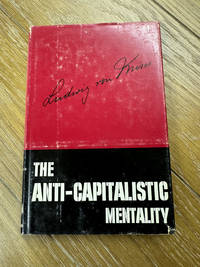
1956réf. 052024Hardcover. Condition: Very Good. Dust Jacket Condition: Very Good. 1st Edition. D. Van Nostrand Company 1956. Rare first edition copy SIGNED BY AUTHOR. Jacket is in excellent shape with just very minor shelf wear. Pages are crisp clean and unmarked. D. Van Nostrand Company, 1956 hardcover