9.878 Ergebnisse
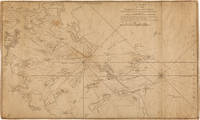
1800Best.-Nr. WRCAM52103London: R. Laurie and J. Whittle 1800. Engraved map sheet size approximately 21 x 34 3/4 inches. Backed with linen. Mid-19th-century ownership inscription near title. A few small chips and minor closed tears at edges light soiling and scattered faint foxing. Very good. Framed. An extremely scarce nautical chart of Boston Harbor from the second edition of the important 18th-century American atlas the NORTH AMERICAN PILOT. The chart depicts the state of the harbor just after the start of the Revolution having been reprinted from the first edition published in 1776 and 1777. The Boston peninsula and the "Ruins of Charlestown" are located in the west / far left of the chart area which follows the mainland coast as far south as Dorchester and Milton and out to Point Shirley and the Shirley Cut to the northeast in the upper center of the image; the Hull peninsula and Point Allerton are also visible in the lower right-hand quadrant of the map. In the center of the chart are the numerous islands that dot Boston Harbor as well as depth measurements and clearly marked shallow areas such as the shoals formerly known as the Dorchester Flats now a populated area of reclaimed land. Additionally there are a number of guidelines showing the best routes through the harbour to various points and markings for various points on land to aid in navigation. The second edition of the PILOT contained seven more maps than the first for a total of seventeen charts of which this plan of Boston Harbor was the seventh. The first edition was published by Robert Sayer and John Bennett who were succeeded by Laurie and Whittle before the publication of this atlas. The original chart engravings were executed by Thomas Jefferys. Rare in any form or edition OCLC traces only one copy of this individual map from the 1800 printing located at the State Library of Massachusetts. OCLC 843954569. PHILLIPS ATLASES 1220 ref. HOWES J84 ref. SABIN 55557 ref. R. Laurie and J. Whittle unknown books
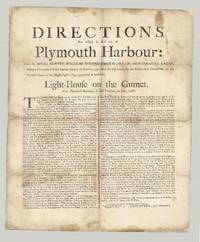
Best.-Nr. 9850Boston: Commonwealth of Massachusetts 1785. Broadside 16.125” x 13.25”. Title above two columns of text. CONDITION: Good old folds with a few small losses to lettering and ornamental border along folds mostly reinstated by hand. One of only two known copies of an eighteenth-century broadside consisting of sailing directions centering around the Gurnet Light on the north side of Plymouth Bay to guide ships entering and leaving one of the most historic harbors in the United States—the site of the Mayflower’s landing. This pilot was originally published in 1768 in connection with the construction of what is thought to have been the second lighthouse “on the Gurnet head” which included twin beacons or “two lanthorns” as noted in the directions distinguishing it from the Boston Light and making it the first twin lighthouse in America. It was built on land rented from John and Hannah Thomas for five shillings a year and John served as its first keeper. During the Revolutionary War John Thomas raised and served with a regiment of volunteers from Plymouth County. Following his departure from home Hannah took over his lighthouse duties making her the first female lighthouse keeper in America. John died from smallpox in Quebec in 1776 and Hannah continued to serve as keeper until 1786. The Gurnet or Gurnet Point is located at the end of a long narrow peninsula that together with Saquish Neck forms the northern boundary of Plymouth Bay and protects it from some of the sea’s mightiest swells. The Gurnet lighthouse served as a critical aid in navigation through much of the latter half of the eighteenth century. These sailing directions advise “to the southward you may bring them the twin lights in one which is a very good Mark to clear you of Brown’s Island or Sand Bank.” Mariners “coming from the northward bound into Plymouth” are warned “you must not bring the Lights more Southerly than S. by W. to avoid High Pine Ledge which lays N. from the Gurnet Head about two and a half and three miles…” A number of other navigational hazards are mentioned throughout these very detailed directions including the Gurnet Rock Dick’s Flat Muscle Banks etc. While printed from a different typesetting the text of this second edition is nearly identical to that of the first edition suggesting that the directions had proven quite reliable. The Boston Marine Society began as a fellowship of mariners in 1742 and was incorporated in 1754. Among its founders was Moses Bennet the first of the committee members mentioned in this broadside’s title. The Society was founded to “make navigation more safe” 1754 charter and to provide relief for the families of mariners lost at sea. “The construction of lighthouses and placement of buoys and markers has often been accomplished with the advice of the Society. Of particular concern to the Society was the appointment of pilots to see to the safe passage of vessels in and out of the port” The Boston Marine Society. While OCLC appears to indicate eight holdings for the 1768 edition consultation of the catalogs of the libraries listed reveals that just two have physical copies Harvard and AAS. The Boston Public Library is also listed as having a copy of the 1768 but theirs is actually the 1785 edition. The OCLC records for the 1785 edition are similarly misleading showing what initially appears to be five physical holdings but all of these turn out to be digital or microform. Bristol and Ford record only the BPL copy. In short there are just two recorded examples of the 1768 edition and one of the 1785. An exceptionally rare and vital New England maritime broadside of the eighteenth-century. REFERENCES: Bristol R.P. Supplement to Charles Evans’ American bibliography B6058; Shipton C.K. National index of American imprints through 1800 44677; Ford 2408; Rink Technical Americana 3876; ESTC W24527; “Plymouth Gurnet Lighthouse” at lighthousefriends online; “The Boston Marine Society” at The Boston Marine Society online. Offered in partnership with Ten Pound Island Books of Gloucester Mass. Boston: [Commonwealth of Massachusetts,] 1785 unknown
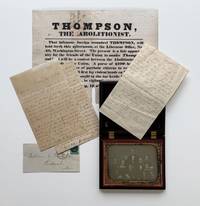
Best.-Nr. 9998Boston: October 1835. Letterpress broadside 8.875" x 12 sheet size. Early ink inscription on verso reading: "Return to C.C. Mason of the Me Cong. the M.E. Ch." CONDITION: Good old folds a few tissue repairs on verso to small holes loss along fold in lower margin just nicking "2" in "2 o'clock" a few small losses to lower edgesome toning and foxing. with Garrison William Lloyd. Autograph letter signed to William E. Gould regarding the confrontation with the pro-slavery mob in October 1835. Boston 8 December 1877. 2 pp. 7.75" x 5" with original cover addressed to Gould with 3 cent stamp and Boston postmark. Written in response to Gould's letter requesting information on the Thompson broadside see below. CONDITION: Very good old folds. with Gould Emma Maynard Dow. Autograph letter signed by Emma Maynard Dow Gould William Gould's wife to John likely John Mead Gould William's brother regarding the broadside and Garrison letter offered here. Probably Boston 2 May 1892. 1 p. 7.75" x 4.875". CONDITION: Very good old folds. with Half plate daguerreotype of the Gould family. Portland Maine 1853. Housed in a thermoplastic case. CONDITION: Very good image clear and un-touched mat tarnished case fully intact and attractive. An exceptionally rare broadside relating to one of the most notorious moments in the history of abolitionism accompanied by a letter of William Lloyd Garrison providing an account of events and referring to his "ruffianly seizure" by the pro-slavery mob with a related family letter and Gould family daguerreotype. In 1835 one of the leading British abolitionists George Thompson 1804-1878 traveled from the United Kingdom for a lecture tour of the United States in response to an invitation from William Lloyd Garrison whom he had met in 1832 in Scotland where the two became friends. In the 1877 ALS included here Garrison recalls the events surrounding the broadside: "On the 21st of October 1835 the Boston Female Anti-Slavery Society attempted to hold its annual meeting. At that time George Thompson the eloquent and successful advocate of British West India Emancipation was laboring here with the Abolitionists and by their invitation to effect a similar deliverance for the Southern slave population. To intensify the popular pro-slavery spirit against him he was falsely and maliciously branded by the press as a British emissary who had been sent here by the British Government with his pockets lined with British gold 'for the purpose of overthrowing our Glorious Union' etc etc." The broadside explicitly intended to incite a mob yet attempting to characterize its purpose as patriotic calls for the pro-slavery supporters to seize and tar Thompson: That infamous scoundrel THOMPSON will hold forth this afternoon at the Liberator Office No. 48 Washington Street. The present is a fair opportunity for the friends of the Union to snake Thompson out! It will be a contest between the Abolitionists and the friends of the Union. A purse of $100 has been raised by a number of patriotic citizens to reward the individual who shall first lay violent hands on Thompson so that he may be brought to the tar kettle before dark. Friends of the Union be vigilant! Aware of the gathering mob Thompson did not attend the meeting as scheduled and Garrison instead went to speak to the Society. Garrison continues with his description of the events unfolding including fascinating details of the author and publisher of the inciting broadside: "It was deemed prudent by ladies for his own personal safety that he should not attend the meeting aforesaid; nevertheless it was rumored that he was to be present and this led to the issuing of the mob-exciting placard which you have copied in your letter and about which you express a wish to be further informed. That placard was written by James L. Homer editor of the Boston Gazette and printed in his office and distributed throughout the city!" Garrison concludes with his own experience on the day: "The result was the gathering of a mob of five thousand persons the breaking up of the ladies meeting my ruffianly seizure and being dragged through the streets finally rescued by the city constabulary and incarceration in Leverett Street jail to save my life." Garrison was indeed seized by the pro-slavery mob and was dragged through the streets with a rope around his waist with the intent of tarring and feathering him or worse. Boston Mayor Theodore Lyman II intervened and confined Garrison for his own safety. The example of the broadside offered here at one time owned by Reverend C. C. Mason of the Methodist Episcopal Church was subsequently given to William Gould whose curiosity regarding events surrounding it led him to write to Garrison. Gould's letter penned from Portland Maine on November 14th 1877 is in the Boston Public Library's Anti-Slavery Collection MS A.1.2 v.39 p. 154A. He writes in part: "I have copied upon the page annexed a sheet sent me by an old minister. It is so very different from the state of things today that I want to frame it for my Library & I would be very glad to frame also any reply you may be pleased to make to me when I now ask you if you will. Kindly tell me what year this was. What was the result of the appeal and if it is known who was the author of the document." Also included here is an 1892 letter from Gould's wife Emma 1836-1918 to his brother John offering the collection of items to him: "Edw. has framed a relic which he thinks you may like. It is a placard printed in Boston in Feb. sic 1835 intended to incite a pro-slavery mob at the time of an anti-slavery meeting with it is an autographed letter from Wm. Loyd sic Garrison explaining it which he wrote Edw. in reply to one from him asking information about the affair. If you would like it perhaps Theo will come for it. I am breaking up and packing and it will be one thing out of my way. If you do not come for it he will give it to the Historical Society." Emma refers here to her husband by his middle name Edward. Lending additional interest to this lot is a half plate daguerreotype of the Gould family of Portland Maine. Edward Gould 1805-1894 and his wife Althea Chase Gould 1808-1894 are seated at center surrounded by their six children. William E. Gould the eldest son stands at the center his hand resting on his father's shoulder. To the left of William is his brother John Mead Gould who would go on to achieve distinction in the Civil War. Although often cited in accounts of the abolitionist movement the Thompson broadside is exceptionally rare. We locate just two copies in institutions at The National Museum of African American History & Culture and the Massachusetts Historical Society. OCLC records a copy at the Library of Congress dated 1851 in the record but it is pictured on the LC site and appears to be a reproduction of some sort. An important group of items documenting the conflict in Boston surrounding abolitionism in the 1830s and a wonderful example of private historical preservation. Provenance: Reverend Charles C. Mason b. ca. 1820 to William E. Gould 1837-1919 to his brother John Mead Gould 1839-1930. Boston: [October, 1835] unknown