10 310 résultats
1839réf. 36501Boston: Press of Dow & Jackson 1839. With the ownership signature of "Samuel E. Sawyer" a member of the library at the head of the titlepage. Includes a history of the Boston Mercantile Library Association the constitution and by-laws a list of officers by year of service and a list of members. The library catalogue runs some forty-six pages listing more than two thousand works in a number of disciplines. Included are works of American and world history and travel science trade literature religion manners and more. Scarce with AMERICAN IMPRINTS and OCLC together locating only five copies. 12mo. Contemporary marbled wrappers string-tied. Wrappers rubbed and worn. Minor foxing. Very good. AMERICAN IMPRINTS 57241. OCLC 20321096. unknown books
1839réf. 36501Boston: Press of Dow & Jackson 1839. With the ownership signature of "Samuel E. Sawyer" a member of the library at the head of the titlepage. Includes a history of the Boston Mercantile Library Association the constitution and by-laws a list of officers by year of service and a list of members. The library catalogue runs some forty-six pages listing more than two thousand works in a number of disciplines. Included are works of American and world history and travel science trade literature religion manners and more. Scarce with AMERICAN IMPRINTS and OCLC together locating only five copies. 12mo. Contemporary marbled wrappers string-tied. Wrappers rubbed and worn. Minor foxing. Very good. AMERICAN IMPRINTS 57241. OCLC 20321096. unknown
1961réf. 50152Boston: Jewish Community Council of Metropolitan Boston 1961. Broadside 17" x 11". Printed in blue ink on white wove stock recto only. Original vertical and horizontal folds; a few inconspicuous nicks to extremities; Very Good or better. The observance included performances by Cantor Gregor Shelkan and the Children's Chorus of the Y.L. Peretz School. Signed in type by the event's sponsors which included the Bessarabian Society of Boston the Jewish Labor Committee the United Shepetovker of Boston and the Workmen's Circle Arbeiter Ring. Jewish Community Council of Metropolitan Boston unknown books
1961réf. 50152Boston: Jewish Community Council of Metropolitan Boston 1961. Broadside 17" x 11". Printed in blue ink on white wove stock recto only. Original vertical and horizontal folds; a few inconspicuous nicks to extremities; Very Good or better. The observance included performances by Cantor Gregor Shelkan and the Children's Chorus of the Y.L. Peretz School. Signed in type by the event's sponsors which included the Bessarabian Society of Boston the Jewish Labor Committee the United Shepetovker of Boston and the Workmen's Circle Arbeiter Ring. Jewish Community Council of Metropolitan Boston unknown
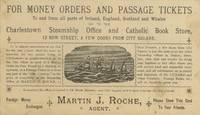
1890réf. List3882Charlestown Massachusetts 1890. Double-sided printed cardstock measuring 5 ¾ x 3 ¼ inches. Some small stains and manuscript pencil markings. Excellent. A card advertising Martin J. Roche's Steamship Office and Catholic Book Store in the Charlestown neighborhood of Boston likely from the early 1890s. Roche was a steamship agent in Boston from about 1885 on advertising steamship travel especially from Ireland in Catholic newspapers like the Sacred Heart Review in which he also authored a recurring column titled "Our Irish Letter."1 The card notes that Roche is also an "Agent for 'S.H. Review'." Newspaper advertisements indicate that he opened the Catholic bookstore aspect of his business in about 1891; the card advertises "Irish Song Books Histories and Story Books of all kinds; also Prayer Books Rosaries Scapulars Statues etc. at the lowest prices". At the time-subsequent to the wave of Irish immigration during the famine-most Irish immigrants were young unmarried women. Many settled in the Boston area. 1 The Sacred Heart Review 1 no. 14 April 6 1895 21. . unknown books
1890réf. List3882Charlestown Massachusetts 1890. Double-sided printed cardstock measuring 5 ¾ x 3 ¼ inches. Some small stains and manuscript pencil markings. Excellent. A card advertising Martin J. Roche's Steamship Office and Catholic Book Store in the Charlestown neighborhood of Boston likely from the early 1890s. Roche was a steamship agent in Boston from about 1885 on advertising steamship travel especially from Ireland in Catholic newspapers like the Sacred Heart Review in which he also authored a recurring column titled "Our Irish Letter."1 The card notes that Roche is also an "Agent for 'S.H. Review'." Newspaper advertisements indicate that he opened the Catholic bookstore aspect of his business in about 1891; the card advertises "Irish Song Books Histories and Story Books of all kinds; also Prayer Books Rosaries Scapulars Statues etc. at the lowest prices". At the time-subsequent to the wave of Irish immigration during the famine-most Irish immigrants were young unmarried women. Many settled in the Boston area. 1 The Sacred Heart Review 1 no. 14 April 6 1895 21. . unknown
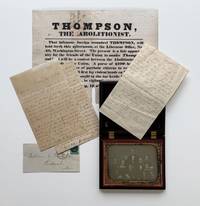
réf. 9998Boston: October 1835. Letterpress broadside 8.875" x 12 sheet size. Early ink inscription on verso reading: "Return to C.C. Mason of the Me Cong. the M.E. Ch." CONDITION: Good old folds a few tissue repairs on verso to small holes loss along fold in lower margin just nicking "2" in "2 o'clock" a few small losses to lower edgesome toning and foxing. with Garrison William Lloyd. Autograph letter signed to William E. Gould regarding the confrontation with the pro-slavery mob in October 1835. Boston 8 December 1877. 2 pp. 7.75" x 5" with original cover addressed to Gould with 3 cent stamp and Boston postmark. Written in response to Gould's letter requesting information on the Thompson broadside see below. CONDITION: Very good old folds. with Gould Emma Maynard Dow. Autograph letter signed by Emma Maynard Dow Gould William Gould's wife to John likely John Mead Gould William's brother regarding the broadside and Garrison letter offered here. Probably Boston 2 May 1892. 1 p. 7.75" x 4.875". CONDITION: Very good old folds. with Half plate daguerreotype of the Gould family. Portland Maine 1853. Housed in a thermoplastic case. CONDITION: Very good image clear and un-touched mat tarnished case fully intact and attractive. An exceptionally rare broadside relating to one of the most notorious moments in the history of abolitionism accompanied by a letter of William Lloyd Garrison providing an account of events and referring to his "ruffianly seizure" by the pro-slavery mob with a related family letter and Gould family daguerreotype. In 1835 one of the leading British abolitionists George Thompson 1804-1878 traveled from the United Kingdom for a lecture tour of the United States in response to an invitation from William Lloyd Garrison whom he had met in 1832 in Scotland where the two became friends. In the 1877 ALS included here Garrison recalls the events surrounding the broadside: "On the 21st of October 1835 the Boston Female Anti-Slavery Society attempted to hold its annual meeting. At that time George Thompson the eloquent and successful advocate of British West India Emancipation was laboring here with the Abolitionists and by their invitation to effect a similar deliverance for the Southern slave population. To intensify the popular pro-slavery spirit against him he was falsely and maliciously branded by the press as a British emissary who had been sent here by the British Government with his pockets lined with British gold 'for the purpose of overthrowing our Glorious Union' etc etc." The broadside explicitly intended to incite a mob yet attempting to characterize its purpose as patriotic calls for the pro-slavery supporters to seize and tar Thompson: That infamous scoundrel THOMPSON will hold forth this afternoon at the Liberator Office No. 48 Washington Street. The present is a fair opportunity for the friends of the Union to snake Thompson out! It will be a contest between the Abolitionists and the friends of the Union. A purse of $100 has been raised by a number of patriotic citizens to reward the individual who shall first lay violent hands on Thompson so that he may be brought to the tar kettle before dark. Friends of the Union be vigilant! Aware of the gathering mob Thompson did not attend the meeting as scheduled and Garrison instead went to speak to the Society. Garrison continues with his description of the events unfolding including fascinating details of the author and publisher of the inciting broadside: "It was deemed prudent by ladies for his own personal safety that he should not attend the meeting aforesaid; nevertheless it was rumored that he was to be present and this led to the issuing of the mob-exciting placard which you have copied in your letter and about which you express a wish to be further informed. That placard was written by James L. Homer editor of the Boston Gazette and printed in his office and distributed throughout the city!" Garrison concludes with his own experience on the day: "The result was the gathering of a mob of five thousand persons the breaking up of the ladies meeting my ruffianly seizure and being dragged through the streets finally rescued by the city constabulary and incarceration in Leverett Street jail to save my life." Garrison was indeed seized by the pro-slavery mob and was dragged through the streets with a rope around his waist with the intent of tarring and feathering him or worse. Boston Mayor Theodore Lyman II intervened and confined Garrison for his own safety. The example of the broadside offered here at one time owned by Reverend C. C. Mason of the Methodist Episcopal Church was subsequently given to William Gould whose curiosity regarding events surrounding it led him to write to Garrison. Gould's letter penned from Portland Maine on November 14th 1877 is in the Boston Public Library's Anti-Slavery Collection MS A.1.2 v.39 p. 154A. He writes in part: "I have copied upon the page annexed a sheet sent me by an old minister. It is so very different from the state of things today that I want to frame it for my Library & I would be very glad to frame also any reply you may be pleased to make to me when I now ask you if you will. Kindly tell me what year this was. What was the result of the appeal and if it is known who was the author of the document." Also included here is an 1892 letter from Gould's wife Emma 1836-1918 to his brother John offering the collection of items to him: "Edw. has framed a relic which he thinks you may like. It is a placard printed in Boston in Feb. sic 1835 intended to incite a pro-slavery mob at the time of an anti-slavery meeting with it is an autographed letter from Wm. Loyd sic Garrison explaining it which he wrote Edw. in reply to one from him asking information about the affair. If you would like it perhaps Theo will come for it. I am breaking up and packing and it will be one thing out of my way. If you do not come for it he will give it to the Historical Society." Emma refers here to her husband by his middle name Edward. Lending additional interest to this lot is a half plate daguerreotype of the Gould family of Portland Maine. Edward Gould 1805-1894 and his wife Althea Chase Gould 1808-1894 are seated at center surrounded by their six children. William E. Gould the eldest son stands at the center his hand resting on his father's shoulder. To the left of William is his brother John Mead Gould who would go on to achieve distinction in the Civil War. Although often cited in accounts of the abolitionist movement the Thompson broadside is exceptionally rare. We locate just two copies in institutions at The National Museum of African American History & Culture and the Massachusetts Historical Society. OCLC records a copy at the Library of Congress dated 1851 in the record but it is pictured on the LC site and appears to be a reproduction of some sort. An important group of items documenting the conflict in Boston surrounding abolitionism in the 1830s and a wonderful example of private historical preservation. Provenance: Reverend Charles C. Mason b. ca. 1820 to William E. Gould 1837-1919 to his brother John Mead Gould 1839-1930. Boston: [October, 1835] unknown books
réf. 9998Boston: October 1835. Letterpress broadside 8.875" x 12 sheet size. Early ink inscription on verso reading: "Return to C.C. Mason of the Me Cong. the M.E. Ch." CONDITION: Good old folds a few tissue repairs on verso to small holes loss along fold in lower margin just nicking "2" in "2 o'clock" a few small losses to lower edgesome toning and foxing. with Garrison William Lloyd. Autograph letter signed to William E. Gould regarding the confrontation with the pro-slavery mob in October 1835. Boston 8 December 1877. 2 pp. 7.75" x 5" with original cover addressed to Gould with 3 cent stamp and Boston postmark. Written in response to Gould's letter requesting information on the Thompson broadside see below. CONDITION: Very good old folds. with Gould Emma Maynard Dow. Autograph letter signed by Emma Maynard Dow Gould William Gould's wife to John likely John Mead Gould William's brother regarding the broadside and Garrison letter offered here. Probably Boston 2 May 1892. 1 p. 7.75" x 4.875". CONDITION: Very good old folds. with Half plate daguerreotype of the Gould family. Portland Maine 1853. Housed in a thermoplastic case. CONDITION: Very good image clear and un-touched mat tarnished case fully intact and attractive. An exceptionally rare broadside relating to one of the most notorious moments in the history of abolitionism accompanied by a letter of William Lloyd Garrison providing an account of events and referring to his "ruffianly seizure" by the pro-slavery mob with a related family letter and Gould family daguerreotype. In 1835 one of the leading British abolitionists George Thompson 1804-1878 traveled from the United Kingdom for a lecture tour of the United States in response to an invitation from William Lloyd Garrison whom he had met in 1832 in Scotland where the two became friends. In the 1877 ALS included here Garrison recalls the events surrounding the broadside: "On the 21st of October 1835 the Boston Female Anti-Slavery Society attempted to hold its annual meeting. At that time George Thompson the eloquent and successful advocate of British West India Emancipation was laboring here with the Abolitionists and by their invitation to effect a similar deliverance for the Southern slave population. To intensify the popular pro-slavery spirit against him he was falsely and maliciously branded by the press as a British emissary who had been sent here by the British Government with his pockets lined with British gold 'for the purpose of overthrowing our Glorious Union' etc etc." The broadside explicitly intended to incite a mob yet attempting to characterize its purpose as patriotic calls for the pro-slavery supporters to seize and tar Thompson: That infamous scoundrel THOMPSON will hold forth this afternoon at the Liberator Office No. 48 Washington Street. The present is a fair opportunity for the friends of the Union to snake Thompson out! It will be a contest between the Abolitionists and the friends of the Union. A purse of $100 has been raised by a number of patriotic citizens to reward the individual who shall first lay violent hands on Thompson so that he may be brought to the tar kettle before dark. Friends of the Union be vigilant! Aware of the gathering mob Thompson did not attend the meeting as scheduled and Garrison instead went to speak to the Society. Garrison continues with his description of the events unfolding including fascinating details of the author and publisher of the inciting broadside: "It was deemed prudent by ladies for his own personal safety that he should not attend the meeting aforesaid; nevertheless it was rumored that he was to be present and this led to the issuing of the mob-exciting placard which you have copied in your letter and about which you express a wish to be further informed. That placard was written by James L. Homer editor of the Boston Gazette and printed in his office and distributed throughout the city!" Garrison concludes with his own experience on the day: "The result was the gathering of a mob of five thousand persons the breaking up of the ladies meeting my ruffianly seizure and being dragged through the streets finally rescued by the city constabulary and incarceration in Leverett Street jail to save my life." Garrison was indeed seized by the pro-slavery mob and was dragged through the streets with a rope around his waist with the intent of tarring and feathering him or worse. Boston Mayor Theodore Lyman II intervened and confined Garrison for his own safety. The example of the broadside offered here at one time owned by Reverend C. C. Mason of the Methodist Episcopal Church was subsequently given to William Gould whose curiosity regarding events surrounding it led him to write to Garrison. Gould's letter penned from Portland Maine on November 14th 1877 is in the Boston Public Library's Anti-Slavery Collection MS A.1.2 v.39 p. 154A. He writes in part: "I have copied upon the page annexed a sheet sent me by an old minister. It is so very different from the state of things today that I want to frame it for my Library & I would be very glad to frame also any reply you may be pleased to make to me when I now ask you if you will. Kindly tell me what year this was. What was the result of the appeal and if it is known who was the author of the document." Also included here is an 1892 letter from Gould's wife Emma 1836-1918 to his brother John offering the collection of items to him: "Edw. has framed a relic which he thinks you may like. It is a placard printed in Boston in Feb. sic 1835 intended to incite a pro-slavery mob at the time of an anti-slavery meeting with it is an autographed letter from Wm. Loyd sic Garrison explaining it which he wrote Edw. in reply to one from him asking information about the affair. If you would like it perhaps Theo will come for it. I am breaking up and packing and it will be one thing out of my way. If you do not come for it he will give it to the Historical Society." Emma refers here to her husband by his middle name Edward. Lending additional interest to this lot is a half plate daguerreotype of the Gould family of Portland Maine. Edward Gould 1805-1894 and his wife Althea Chase Gould 1808-1894 are seated at center surrounded by their six children. William E. Gould the eldest son stands at the center his hand resting on his father's shoulder. To the left of William is his brother John Mead Gould who would go on to achieve distinction in the Civil War. Although often cited in accounts of the abolitionist movement the Thompson broadside is exceptionally rare. We locate just two copies in institutions at The National Museum of African American History & Culture and the Massachusetts Historical Society. OCLC records a copy at the Library of Congress dated 1851 in the record but it is pictured on the LC site and appears to be a reproduction of some sort. An important group of items documenting the conflict in Boston surrounding abolitionism in the 1830s and a wonderful example of private historical preservation. Provenance: Reverend Charles C. Mason b. ca. 1820 to William E. Gould 1837-1919 to his brother John Mead Gould 1839-1930. Boston: [October, 1835] unknown
1885Very Good Turkish, Ottoman (1500-1928) Original cloth bdg. 4to. (26 x 19 cm). In Ottoman script (Old Turkish with Arabic letters). [4], 1422, [2] p. Text block separated in two columns. Fading title gilt lettering on spine, otherwise a very good copy. Scarce bible in Ottoman Turkish, printed by one of the most famous Armenian printers and published by the English & American Bible Societies in Turkey during the second half of the 19th century. Arshag Hagop Boyajian, (1837-1914), was an Ottoman Armenian printer and a leader of the Armenian Protestant community in the Ottoman Empire. He was born in Diyarbakir and educated at Robert College in Istanbul. During the Crimean War (1853-1856), he served as a translator at the headquarters of the British army in Üsküdar (Scutari), on Istanbul's Asian shore. After a short stay in the United States to perfect his knowledge of modern printing techniques, he established a... (Source: Brill).
1846réf. 57019Boston:: Pulbished by all the Booksellers 1846. First edition. original printed wrappers. Very light foxing; wrappers unchipped and unworn; overall very nice. 8vo. Pulbished by all the Booksellers, unknown
1941réf. 28176New York:: Reynal and Hitchcock 1941. First edition. publisher's cloth in dust jacket. A near fine copy in a very sharp jacket with just a little of the usual rubbing and some light soiling to the back panel. 8vo. Reynal and Hitchcock, hardcover
1885réf. 42031Philadelphia: W.H. Butler n.d. ca 1885. 1885. TRADE CATALOG. 5 11/16" x 12 3/4" color sheet folded to 6 panels. Illustrations. Among the successful shoe-machines invented by the Globe Buffer company was the “Globe Buffer” a machine for “buffing” or sandpapering the bottoms of boots and shoes. The first “ Globe Buffer" was set up in November 1881. The company also manufactured the “Globe Heel Scourer” for smoothing or scouring the edges of heels of boots and shoes. The company also introduced the "Globe Insole" an invention the promised to replace the flexible leather that was currently in vogue for insoles to shoes. It was invented and patented by Mr. George A. Fullerton and consists of a substance very similar to leather but which is stronger and much more flexible. To test the merits the shoes thousands of pairs were produced and worn and in not a single pair of them did a stitch give out. The material for the insoles is stronger than any leather of the same thickness. It is preserved while leather is destroyed by perspiration. The edges are smooth which prevents them from cutting the stitches. Shoes made of it will not squeak. The brochure offers one cover panel showing 2 cherubs one holding a woman's boot and the other the "Globe Flexible Insole; one panel offering the company's guarantee; and one panel offering information about their insoles. "Remember that the INSOLE is the foundation of the shoe and that Glove Flexible Insole" is superior in every particular to leather or any other known substance. That the stitches and tacks are all beneath the surface thus contributing a smooth soft cushion." Opposite 3 panels offers a beautiful color sailing scene showing a yacht race and with "Compliments of the Globe Buffer co. only Manufacturers of Globe Flexible Insoles at the bottom of one panel. One panel has been separated and neatly reattached using cellophane tape. W.H. Butler, n.d. [ca 1885]. hardcover
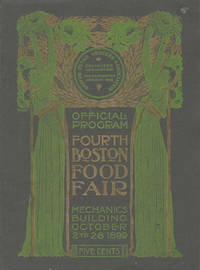
1899réf. 7503Boston: F.M. Porter Co 1899. Quarto stapled in wrappers 24 x 17.5 cm. 80 pages; 1 plate. Illustrated black & white and chromolithograph plate. Advertising. FIRST EDITION. The "Official catalog musical program list of exhibitors" for this fourth congress of members of the Boston Retail Grocers Association. The association was founded in 1881 and held its first food fair that year. Photographic portraits of the senior members of the Association are included as is a description of Miss Nellie Dot Ranche of Chicago who was brought in for the occasion to run the Domestic Science Programs. It's interesting that the committee reached out to the Midwest at this moment when Cooking Schools in Boston were on the rise and very visible. The copious advertising displays a range of categories of goods one would find in a grocery of the turn of the 19th century: coffee cocoa mustard Havana cigars root beer Ceylon tea French Coca Wine virgin olive oil nut meats and salt as well as household goods including: thread collars washing liquids bluing ink. Also represented are goods and services aimed at the grocers and retailers: boxes and bags promotional printing specialized contracting refrigeration etc. Tiny bit of spotting to green and gold-printed gray wrappers otherwise fine. OCLC locates just one copy Winterthur. F.M. Porter Co unknown books
1899réf. 7503Boston: F.M. Porter Co 1899. Quarto stapled in wrappers 24 x 17.5 cm. 80 pages; 1 plate. Illustrated black & white and chromolithograph plate. Advertising. FIRST EDITION. The "Official catalog musical program list of exhibitors" for this fourth congress of members of the Boston Retail Grocers Association. The association was founded in 1881 and held its first food fair that year. Photographic portraits of the senior members of the Association are included as is a description of Miss Nellie Dot Ranche of Chicago who was brought in for the occasion to run the Domestic Science Programs. It's interesting that the committee reached out to the Midwest at this moment when Cooking Schools in Boston were on the rise and very visible. The copious advertising displays a range of categories of goods one would find in a grocery of the turn of the 19th century: coffee cocoa mustard Havana cigars root beer Ceylon tea French Coca Wine virgin olive oil nut meats and salt as well as household goods including: thread collars washing liquids bluing ink. Also represented are goods and services aimed at the grocers and retailers: boxes and bags promotional printing specialized contracting refrigeration etc. Tiny bit of spotting to green and gold-printed gray wrappers otherwise fine. OCLC locates just one copy Winterthur. F.M. Porter Co unknown
réf. 22724Boston: Hubbard W. Swett & Co. 128 Washington Street. 1859. William White Printer 4 Spring Lane. The 'Rebellion' was precipitated by the whipping of Thomas J. Whall a Catholic boy at the Eliot School for refusing to recite the ten commandments in the Protestant King James translation. It resulted in the creation of nationwide Catholic parochial schools. 29pp 8vo. Saddle-stitched pamphlet with uncut edges and without wraps. On aged and worn paper. In double column and small print. A transcript of the closing arguments in the case without editorial interpolation. Scarce. No other copy traced of original edition. Boston: Hubbard W. Swett & Co., 128 Washington Street. 1859. [William White, Printer, 4 Spring Lane.] paperback
réf. 81353Barba Paris, Barba, 2 volumes, 1810, pleines reliures d'époque, 17x10.5cm, 12 gravures H.T., xij (avertissement, discours préliminaire -pour les 2 volumes-), 310 p., 331 p., des trous de ver et des épidermures sur la reliure, coins émoussés, des rousseurs sur les toutes premières pages de chaque volume, intérieur propre pour le reste.
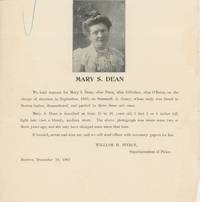
1905réf. List2839Boston Massachusetts 1905. Single 8.5 x 8.5 inch sheet cut from a larger whole; likely missing a portion. Marks at upper left side some folding. Otherwise excellent to near fine. Wanted poster for Mary S. Dean dated December 16 1905. Three months prior a young woman's torso had been found in a suitcase floating in Boston Harbor. A month later a suitcase containing her limbs was found and she was identified as Susanna Geary. In September Geary had gone to the medical practice on Tremont Street where Dean worked as a nurse and Dean had performed an abortion for her - at the time an illegal procedure in Massachusetts. Geary developed sepsis from the surgery; when she died Dean and three men one a doctor conspired to dismember Geary and dispose of her body in the ocean.1 The doctor was acquitted and the two men pleaded guilty but Mary S. Dean was never found. 1 "Says McLeod Made Plans: Crawford Testifies in Suit Case Trial" The Boston Globe November 28 1905. unknown books
1905réf. List2839Boston Massachusetts 1905. Single 8.5 x 8.5 inch sheet cut from a larger whole; likely missing a portion. Marks at upper left side some folding. Otherwise excellent to near fine. Wanted poster for Mary S. Dean dated December 16 1905. Three months prior a young woman's torso had been found in a suitcase floating in Boston Harbor. A month later a suitcase containing her limbs was found and she was identified as Susanna Geary. In September Geary had gone to the medical practice on Tremont Street where Dean worked as a nurse and Dean had performed an abortion for her - at the time an illegal procedure in Massachusetts. Geary developed sepsis from the surgery; when she died Dean and three men one a doctor conspired to dismember Geary and dispose of her body in the ocean.1 The doctor was acquitted and the two men pleaded guilty but Mary S. Dean was never found. 1 "Says McLeod Made Plans: Crawford Testifies in Suit Case Trial" The Boston Globe November 28 1905. unknown
1866réf. 38815Boston: Nichols and Noyes 1866. First edition. Paper wrappers. Lacking the wrappers else a very good copy contents lightly soiled. 22 pp. 16mo. Results of the meeting called by pastor Dr. N. Adams to address congregational concerns over the lack of activity in the church. Some of the recommendations include a renewal of covenant addresses to church members union among churches observance of the Sabbath Sabbath schools and a city missionary society. Sabin 70116. Nichols and Noyes unknown books
1832réf. 50297Boston: Crocker and Brewster 1832. Paperback. Good. Paperback. 14pp1 table. Plain blue wraps over side stitched signatures. Foxed throughout with some minor loss to the edges else a good example. Crocker and Brewster paperback books
1929réf. 10117Boston Massachusetts: The Sisterhood; Printed by The Alpine Press Inc 1929. Octavo 20.5 x 13.75 cm. viii 257 iii pages. Table of contents. Committee from page iii. Stated "Revised Edition". A charitable cookbook emanating from the locus of Conservative Judaism in Boston with approximately eight hundred recipes the majority of them attributed. Representative among them: Potato Ball Soup Sweet and Sour Cabbage Soup Cold Beet Soup Gefilte Fish Marinat Sour Fish Pickled Herring Chopped Liver Sardine Entrée with walnuts and celery Stewed Tongue Chinese Chicken Chow Mein Cheese Blintzes Sweet Potatoes and Apples Boiled Asparagus Carrot Zimis i.e. tsimmes Squash Pie Potato Kugel Noodle Pudding Banana Macaroon Mousse Prune Frozen Cream Cheese Cake Paravah Cake Pound Cake Hazelnut Torte Mon Kichles i.e. kichlach Plum Jam Apple Butter. A concluding section groups holiday recipes for Passover Purim Rosh Hashanah Yom Kippur Eve and Hanukah. Clean and bright. In publisher's beige cloth lettered in black; some very light soil to boards otherwise near fine. OCLC locates twelve copies; edition not in Brown; none of the editions in Bitting or Cagle. [The Sisterhood; Printed by] The Alpine Press, Inc hardcover books
1929réf. 10117Boston Massachusetts: The Sisterhood; Printed by The Alpine Press Inc 1929. Octavo 20.5 x 13.75 cm. viii 257 iii pages. Table of contents. Committee from page iii. Stated "Revised Edition". A charitable cookbook emanating from the locus of Conservative Judaism in Boston with approximately eight hundred recipes the majority of them attributed. Representative among them: Potato Ball Soup Sweet and Sour Cabbage Soup Cold Beet Soup Gefilte Fish Marinat Sour Fish Pickled Herring Chopped Liver Sardine Entrée with walnuts and celery Stewed Tongue Chinese Chicken Chow Mein Cheese Blintzes Sweet Potatoes and Apples Boiled Asparagus Carrot Zimis i.e. tsimmes Squash Pie Potato Kugel Noodle Pudding Banana Macaroon Mousse Prune Frozen Cream Cheese Cake Paravah Cake Pound Cake Hazelnut Torte Mon Kichles i.e. kichlach Plum Jam Apple Butter. A concluding section groups holiday recipes for Passover Purim Rosh Hashanah Yom Kippur Eve and Hanukah. Clean and bright. In publisher's beige cloth lettered in black; some very light soil to boards otherwise near fine. OCLC locates twelve copies; edition not in Brown; none of the editions in Bitting or Cagle. [The Sisterhood; Printed by] The Alpine Press, Inc hardcover
réf. 3727267Boston; New-England Printed by Green & Russell at their Office in Queen-street MDCCLVII. 1757. First Edition. 27 1 blankpp. Small 8vo. In contemporary homemade two-piece coarse paper cover with annotations; hand-stitched. Ownership inscriptions: on upper homemade cover “Lydia Studley Her Book” and on verso of final leaf “Lydia Studley.” Cover and all pages with rounded corners; foxing and minor soiling; without half-title else very good. Colonial Boston sermon given on the occasion of the installation of the Reverend Samuel Baldwin 1731-1784 as pastor of the First Congregational church in Hanover Massachusetts. At the foot of page 27 is an interesting provenance: “Lydia Studley Her Book. Given to her by the Reverend Mr. Samuel Baldwin.” She is likely Lydia Studley 1748–1828 of Hanover Plymouth County Massachusetts: Baldwin became a fervent American Revolution patriot. A Harvard College graduate “he carried his arms to church; and on one occasion while the British were lying at Boston and infesting the coast he thanked the Lord ‘that there was hemp sufficient to hang all the Tories.’”¹ The author Rev. William Cook was born in Hadley Massachusetts in 1696. He also graduated from Harvard and became pastor of the East Church in Sudbury Baldwin’s birthplace until his death in 1760.² Here Cook preaches on St. Paul’s farewell sermon to the Church at Ephesus as recounted in Acts 20:20—“I kept back nothing that was profitable to you”—words quite suitable for an ordinand beginning his ministry. John Stetson Barry’s A Historical Sketch of the Town of Hanover 1853 notes Baldwin “officiated as a Chaplain in the Army and gave eloquent exhortations to his own flocks at home and to the minute men of the town” pp65–66 and that he is listed on the Staff Officers Roll in 1776 as Chaplain upon the Bristol Alarm. p121 ESTC W28888. Evans 7879. Sabin 16294. Thomas History of Printing in America p534. Notes. 1. Baldwin The Baldwin Genealogy from 1500 to 1881 Cleveland 1881 p624. 2. Hudson The History of Sudbury Massachusetts. 1638-1889. Sudbury 1889 p291. unknown
1916réf. 41829Lynn Mass: The Hancock Press 1916. 1916. TRADE CATALOG. 6" x 4" in orange and green pictorial wrappers with a stylish young lady on the front wrapper holding her hat on a windy day. 20pp. to include wrappers. List containing style numbers and brief description of several boots listed in the catalog. Pricing stated as $5.00 up. The boots shown are black & white brown & white solid black and solid brown. Colorful illustrations of either a couple women or landscapes bordering each picture of a boot. "For Autumn Wear extraordinary boots await your inspection. KAPLAN'S WOMAN'S SHOP 85-87-89 Main St. Ware. Mass." Briefly describes La France shoe designing which is always the last word in pronounced fashion trend. Light wear to spine and top fore-edge of front wrapper else a very nice copy. The Hancock Press, 1916. unknown
réf. 20567Tablette recouverte de papier maroquiné rouge, décor de roulettes dorées sur les plats, ardoise façon vélin pour la marque de points d'un coté avec son crayon en étain, tableau imprimé des paiements du Boston au verso, Molette tournante pour le comptage des points (quelques usures sur les tranches). Dix-neuvième siècle, (100 x 155 mm). Bon état compte tenu de la fragilité de l'objet.