Einstein, Albert [Gertie Simon]Biblio.com
70,453 results
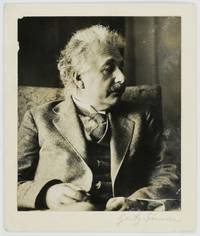
ref. 77255Berlin Gerty Simon unpublished ca. 1935. Original photograph 21.3 x 17.8 cm on original cardboard mount 25.0 x 21.0 cm. = Gertrud "Gerty" Simon 1887-1970 was a German photographer who worked during the interwar period. "Born Gertrud Cohn in Bremen to a well-to-do Jewish family with her father being a lawyer she practiced in Berlin and later in London. She captured many important political and artistic figures in Weimar Berlin including singer and actress Lotte Lenya her husband composer Kurt Weill sculptor painter and print maker Käthe Kollwitz her colleague Max Liebermann and physicist Albert Einstein. Gerty Simon moved to Berlin after the First World War. Her husband Wilhelm like her father was a lawyer. They had one son Bernard Bernd born in 1921. Her Berlin studio was at Clausewitzstrasse. With the arrival of the Nazi Party in power in 1933 life became very difficult for Simon and her family. In 1933 her son's school the Landschulheim Herrlingen later the Bunce Court School a progressive boarding school transferred from Southern Germany to Otterden Kent. Simon followed while her husband remained in Berlin unable to continue as a lawyer and judge but finding work as a notary. The family was not reunited until 1939 and father and son were both imprisoned as enemy aliens. At 19 Bernard was even sent to an internment camp in Australia until 1942 despite having lived in the UK for seven years. Simon rapidly re-established her studio in Chelsea and portrayed many significant individuals there such as historian and broadcaster Sir Kenneth Clark actress Dame Peggy Ashcroft and politician Aneurin Bevan. She stopped working as a professional photographer from 1937 for unknown reasons" Wikipedia. The photo shows Einstein in suit and tie looking toward his left with a "Rembrandtesque" light falling on his right side. Signed i.e. approved outside the plate by the photographer. One of the lesser-known and very rare photographs of Einstein. Tiny chips to the left and upper edge and some surface damage to the outer right side; otherwise very good the impression fine and strong. A beautiful photograph.
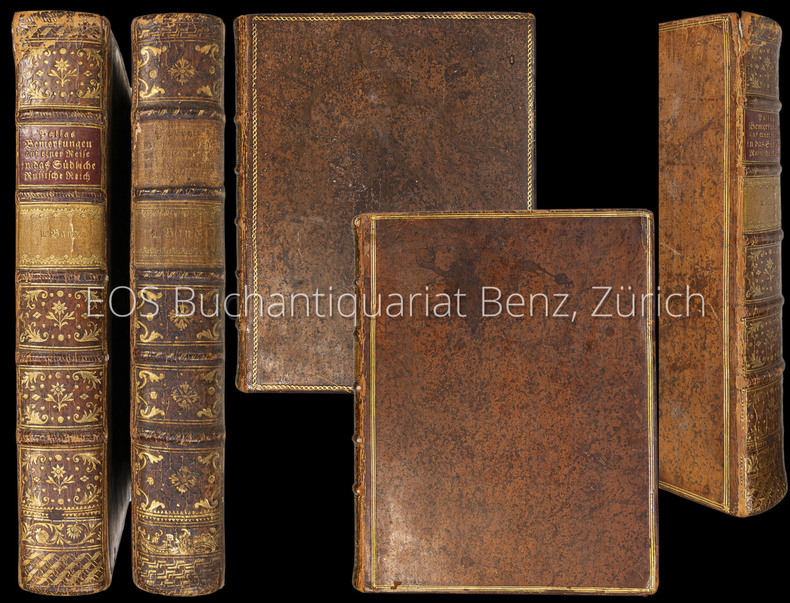
1799ref. 7152CB1799. 2 Bände inkl. Tafeln und Karten. Leipzig Gottfried Martini 17991801. 4°. XXXII 516 S.; XXIV 526 S. Mit 52 meist gef. davon 23 koloriert Kupfertafeln und 3 Kupferkarten alt montiert auf einem Blatt dieses lose. Lederbände der Zeit mit reicher Rücken- und Deckelvergoldung nicht uniform. Cox I 199. Henze III 708. Lipperheide Kaa 17. Nissen ZBI 3064. Grässe V 109. Erste Ausgabe. Der Naturforscher und Ethnograph Peter Simon Pallas 17411811 bereiste in den Jahren 1793 und 1794 die südlichen Gebiete Russlands. Die Ergebnisse dieser wissenschaftlich sehr ertragreichen Forschungsreise legte er in vorliegendem Werk nieder. Die prachtvollen kolorierten Umrissradierungen zeigen Städte 21 Tafeln Trachten 17 Tiere 4 sowie Pläne Kunst- und Kulturgegenstände gezeichnet von G. Geissler und gestochen von Adam Aubertin Frosch und Scheffner. Bei vorliegendem Exemplar die Tafeln miteingebunden. Mit Besitzerstempel und handschriftlichem Namenszug auf den Titelblättern. Das Papier durchgehend etwas stockfleckig. Die Einbände berieben und bestossen. Das hintere Rückengelenk von Band I am Kopf angeplatzt. unknown
1799ref. 7152CB2 Bände (inkl. Tafeln und Karten). Leipzig, Gottfried Martini, 1799–1801. 4°. XXXII, 516 S.; XXIV, 526 S. Mit 52 meist gef. (davon 23 koloriert) Kupfertafeln und 3 Kupferkarten (alt montiert auf einem Blatt, dieses lose). Lederbände der Zeit mit reicher Rücken- und Deckelvergoldung (nicht uniform).
ref. ST14910London: NdA Press 1980. No. 4 OF 10 COPIES SPECIALLY BOUND BY DESIGNER BOOKBINDERS from an edition of 50 copies signed by the author and artist. 315 x 130 mm. 12 3/8 x 5". 35 1 pp. 4 leaves. Calligraphed text in red and black written out by Sally Johnson on a unique vellum copy and photo-lithographed on BFK Rives paper for this edition. STRIKING MULTI-COLOR MOROCCO INLAID IN AN ABSTRACT DESIGN BY JEFF CLEMENTS covers and spine with wrap-around design composed of brown black taupe and citron morocco with geometric blind rules and a quadrilateral tooled in white on the upper cover DARK GREEN MOROCCO DOUBLURES tooled with a blind geometric design tan suede endleaves. In a custom gray cloth drop-back box with niche for the accompanying cassette tape. Patterned flyleaves frontispiece and six double-page etchings by Natalia d'Arbeloff. With a cassette tape recording of a reading of the play by Charles Turner and Jack LeWhite. A typed letter signed by binder Jeff Clements and a photocopied review of the Designer Bookbinders exhibit in which this binding appeared laid in. ◆In mint condition. Despite the vaguely unpleasant title this is a notable and obviously extremely limited artist's book offered here in a striking binding that is distinctly tall and narrow with design elements inspired by events in the text a dramatic dialogue between a "Shakespearean Superstar and his Understudy." According to the binder's letter to Professor John Burton the original purchaser of the binding "The design is very much based on the narrative itself with references to blindness as in the blind sun in white within the incised leather; the play takes place in a sewer also evident and the lower corner on the back cover is a hint about the mule which appears on the last pages of the play." Perhaps these plot elements are not as compelling as "King Lear" but they certainly are curious. Clements notes further that the binding was completed in 1981 and exhibited in a Designer Bookbinders show and he has enclosed a copy of a review of that show underlining the portion where the critic compares this binding to the paintings of British artists William Scott and Ben Nicholson. Clements 1934-2021 studied at the Plymouth College of Art and Design receiving the National Diploma in Design in 1955 and continued his education in bookbinding at the Central School of Arts and Crafts. He became a fellow of Designer Bookbinders in 1957 and served as the organization's president from 1981 to 1983. Since 1988 he has been based in Amsterdam where he operates Binderij Meridiaan with Katinka Keus. British-American artist Natalia or Natalie d'Abeloff is a painter printmaker book-artist cartoonist and teacher but is best known for her livres d'artiste copies of which are held by institutions including the Rijksmuseum the Victoria and Albert Museum and the Library of Congress. The present work represents an early venture into multimedia works an area she has continued to explore in the digital age creating a "Bloggers' Parliament" and authoring a popular web comic. Jerry Jenkins Curator of Contemporary British Published Collections at the British Library notes the many ways the various elements of Abeloff's books--paper print illustrations--and the techniques she employs give her works appeal to a number of senses on a number of levels. With "Fungus and Curmudgeonly" he was impressed by the impact of being able to follow the text while hearing actors perform the roles noting that "this offers an aural immersion into the play along with the performance." She is a Fellow of the Society of Designer Craftsmen and her papers are held by the V&A. NdA Press unknown
ref. ST14910London: NdA Press 1980. No. 4 OF 10 COPIES SPECIALLY BOUND BY DESIGNER BOOKBINDERS from an edition of 50 copies signed by the author and artist. 315 x 130 mm. 12 3/8 x 5". 35 1 pp. 4 leaves. Calligraphed text in red and black written out by Sally Johnson on a unique vellum copy and photo-lithographed on BFK Rives paper for this edition. STRIKING MULTI-COLOR MOROCCO INLAID IN AN ABSTRACT DESIGN BY JEFF CLEMENTS covers and spine with wrap-around design composed of brown black taupe and citron morocco with geometric blind rules and a quadrilateral tooled in white on the upper cover DARK GREEN MOROCCO DOUBLURES tooled with a blind geometric design tan suede endleaves. In a custom gray cloth drop-back box with niche for the accompanying cassette tape. Patterned flyleaves frontispiece and six double-page etchings by Natalia d'Arbeloff. With a cassette tape recording of a reading of the play by Charles Turner and Jack LeWhite. A typed letter signed by binder Jeff Clements and a photocopied review of the Designer Bookbinders exhibit in which this binding appeared laid in. ◆In mint condition. Despite the vaguely unpleasant title this is a notable and obviously extremely limited artist's book offered here in a striking binding that is distinctly tall and narrow with design elements inspired by events in the text a dramatic dialogue between a "Shakespearean Superstar and his Understudy." According to the binder's letter to Professor John Burton the original purchaser of the binding "The design is very much based on the narrative itself with references to blindness as in the blind sun in white within the incised leather; the play takes place in a sewer also evident and the lower corner on the back cover is a hint about the mule which appears on the last pages of the play." Perhaps these plot elements are not as compelling as "King Lear" but they certainly are curious. Clements notes further that the binding was completed in 1981 and exhibited in a Designer Bookbinders show and he has enclosed a copy of a review of that show underlining the portion where the critic compares this binding to the paintings of British artists William Scott and Ben Nicholson. Clements 1934-2021 studied at the Plymouth College of Art and Design receiving the National Diploma in Design in 1955 and continued his education in bookbinding at the Central School of Arts and Crafts. He became a fellow of Designer Bookbinders in 1957 and served as the organization's president from 1981 to 1983. Since 1988 he has been based in Amsterdam where he operates Binderij Meridiaan with Katinka Keus. British-American artist Natalia or Natalie d'Abeloff is a painter printmaker book-artist cartoonist and teacher but is best known for her livres d'artiste copies of which are held by institutions including the Rijksmuseum the Victoria and Albert Museum and the Library of Congress. The present work represents an early venture into multimedia works an area she has continued to explore in the digital age creating a "Bloggers' Parliament" and authoring a popular web comic. Jerry Jenkins Curator of Contemporary British Published Collections at the British Library notes the many ways the various elements of Abeloff's books--paper print illustrations--and the techniques she employs give her works appeal to a number of senses on a number of levels. With "Fungus and Curmudgeonly" he was impressed by the impact of being able to follow the text while hearing actors perform the roles noting that "this offers an aural immersion into the play along with the performance." She is a Fellow of the Society of Designer Craftsmen and her papers are held by the V&A. NdA Press unknown books
1565ref. 64830Frankfurt a. M., Georg Rab für Sigmund Feyerabend u. Simon Hüter, 1565. 4°. Titel in Rot u. Schwarz m. großer Holzschn.-Vignette. Mit zahlr. schemat. Holzschn.-Illustrationen im Text u. großer Holzschn.-Druckermarke am letzten Blatt. 12 nn., 349 num., 1 nn. Bll., Flex. Pgmt. d. Zt. m. durchzogenen Bünden, spanischen Kanten u. handschriftl. Deckeltitel.
1952ref. 53361Falaize | Paris 1952 | 11.50 x 17.50 cm | broché
ref. 117101London printed by Francis. Leach. for Tho. Horne at the Royal Exchange Francis Saunders at the New Exchange and Tho. Bennet at the Half-Moon in St. Pauls Church-yard 1693. . First edition in English; 2 vols in 1 folio 32 x 20 cm; title-page printed in red and black 11 engraved maps and illustrations in-text woodcuts of 'magical squares' between pages 228 and 246 armorial bookplate to front pastedown occasional mild toning; contemporary full blind panelled calf spine in six compartments with gilt morocco lettering piece extremities rubbed a very good handsome copy; 4 144 4 including separate title-page 145-260 pp. A handsome copy of the first edition in English of La Loubère's account of Siam 'universally regarded as the finest work on seventeenth-century Thailand' Wyatt. La Loubère was Louis XIV's envoy to the court of Siam. Before setting out on his mission he read widely on Siam and its history. This background knowledge combined with objective observation makes his book a 'magisterial description' Lach. He returned to France in 1688 just a month after the Siamese revolution which saw the overthrow of the pro-French King Narair and ushered in over a hundred years of anti-European policy. Notable for its publication of the "Siamese method" of constructing magic squares and for one of the earliest accounts of a parachute. Mendelssohn 1979 III 43; Lach III 3 1194-1196; Wing L201. London, printed by F[rancis]. L[each]. for Tho. Horne at the Royal Exchange, Francis Saunders at the New Exchange, and Tho. Benn unknown
2013ref. Atlantic-9780123847195Acad Pr 2013. 2nd Ed. Hardcover. New. Acad Pr hardcover
2013ref. Atlantic-9780123847195Acad Pr 2013. 2nd Ed. Hardcover. New. Acad Pr hardcover
1532ref. 81628Basel: Basileae Apud Io. Hervagium Mense Martio 1532. First Edition. Leather-bound Vellum. Good Plus. Folio.IN LATIN. No Map. Vellum.Text 30.5 x 20 cm. Manuscript title to spine. Vellum stained as per usual and apart from a very small tear near top of spine is in lovely and solid condition. Lacks the rarely seen woodcut map of the world "Typus Cosmographicus Universalis" and lacks Hervagius' printer's device to title page but this device bust on a pedestal is present on verso of last leaf. Very light toning throughout and darkening and tidelines to first 170 or so pages but restricted to very wide margins not text. Additional tidelines at bottom to final 30 pages and again with no effect upon the clarity of the text. Pages are supple with a nice easy-to-read typeface. Simon Grynaeus wrote the preface "Declaratio" but John Huttich alone compiled this massive and invaluable historical work. Later editions dropped this preface because it contained text critical of The Inquisition. One title page variant noted in WorldCat. Index complete 16 leaves unpaginated and bound following title page. Collates complete but as usual the end-pages read: . 576 577 578 577 578 581-585 584. Final leaf "Index Ternionum" and on the verso is the printer's device featuring a bus of a three-headed Hermes/Trismegistus figure on a pedestal that is typically featured on the title page. In-text woodcuts DropCaps. FIRST EDITION of one of the earliest accounts of exploration in the Americas -- a very early compendium of travels and explorations. The most complete edition of this important and rare collection of 15th and 16th century voyages. The work contains accounts of the voyages of Cadamosto the three voyages of Columbus Nino Pinzon Vespucius Cabral Marco Polo and part of the Fourth Decade i.s. Chapter of Peter Martyr d'Anghiera an Italian historian in the employ of Spain who wrote the first accounts of explorations in Central and South America. Sabin 34100. As for the absence of the map in this copy Harrisse in his Bibliotheca Americana Vetustissima wrote: ".Notwithstanding the statement in Mr. Grenville's Catalogue respecting the frequent absence of the map "there is no doubt but that a map does belong to the work.Mr. Muller has reproduced ten copies in exact facsimile" Harrisse remarks: "Whether they were the maps really belonging to the work and described by Munster we are unable to say as no two copies of this edition had the same. Basileae Apud Io. Hervagium, Mense Martio unknown
1792ref. 21136Parma 1792. 12mo. Bodoni 19th-century gold- and blind-tooled mottled calf by Loutrel with a pink morocco title label on the spine lettered in gold a blind-tooled single fillet border on both boards fleurons on the spine head edge gilt marbled endpapers. 2 volumes. 44 25 bis. - 44 bis. 45-144; 8 168 pp. Extremely rare imprint limited to only 25 copies all printed on "paper vélin". This copy nearly matches one recorded in the BNF. However ours has additional title pages to both parts both of which carry the author's name as well as the supplementary pages 25 bis. - 44 bis. which are lacking in the BNF copy.Simon Pierre Mérard de Saint-Just 1749-1812 was a rich French nobleman who was in charge of the residence of the future Louis XIII for several years. After retiring from his public duties in 1782 he concentrated on both book collecting and literary pursuits. He who wrote primarily for his own enjoyment and issued his works in very limited editions. The present work contains fables and short stories on animals humans and emotions many of which are adapted or translated from the writings of John Gay 1685-1732 who Mérard calls "the British La Fontaine" in the introduction.The imprint is almost certainly fictitious as several fables bear dates as late as 1794 while the epilogue is dated 1795 in the table of contents. The work was most likely printed in Paris in of after 1795 though a connection with Giambattista Bodoni cannot be entirely ruled out. Copies dated 1787 and 1799 are also known but it remains unclear whether these are different editions or merely issues with different title pages.With the stamp of the bookbinder on the verso of the first free flyleaf of the first volume. Occasionally mildly foxed or stained the fore edge and lower margins are untrimmed. Otherwise in excellent condition.l Cioranescu 44414; Monglond II 370; Quérard VI 52; not in Brooks. BOOK HISTORY & PRINTING LITERATURE & LINGUISTICS Book History Printing & Typography Fable Books hardcover
1814ref. 153276Paris: Mme Ve Courcier 1814. The cornerstone for all subsequent work on probability Second edition revised by the author from the first edition of 1812; "the cornerstone for all subsequent work on probability" Tomash and Williams. The copy of the Danish statistician Anders Hald 1913-2007 with his ownership signature to front free endpaper. Hald served as professor at the University of Copenhagen from 1960 to 1982. Quarto 254 x 200 mm. Bound with 50 pp. supplement at rear Sur l'Application du calcul des Probabilités à la philosophie naturelle. Recent brown half sheep spine lettered in gilt marbled sides speckled edges. Light rubbing to sheep else binding firm light toning and occasional spotting to contents. A very good copy. unknown
1537ref. 39475Basel: Johannes Hervagen 1537. Folio. 12 1/2 x 8 inches. Augmented edition. a-d4 a-z6 A-Z6 Aa-Dd6 Ee2. 24 1-599 1. 624 pp. Lacking the woodcut world map attributed to Hans Holbein the Younger and Sebastian Münster. Woodcut printer's devices on title and verso of last leaf historiated initials head and tail pieces woodcut illustrations on pp. 127-29. Title Contents Dedication Grynaeus's Text Index Texts. Contemporary ink manuscript annotations in margins. Contemporary full limp vellum with brown ink manuscript title on spine and remanants of two pairs of leather ties with pill-shaped watermark on laid paper a blue cloth clamshell box with gilt-lettered leather titling-piece on spine A fine example of the most influential collection of early sixteenth-century travel literature. Besides the three voyages of Columbus the present work includes descriptions of those of Petrus Alonzo and Pinzo three of Vespucci's four voyages and Peter Martyr's De Insulis Nuper Inventis. According to Borba the present edition is the first to contain the letter of Maximilian of Transylvania reporting the news of Magellan's voyage p. 585. This augmented edition holds the second and third letters of Cortes and selected letters of Juan Zumarraga the first Archbishop of Mexico. Though the account of Magellan's voyage was originally published in 1522 in a 16-leaf ephemeral edition of a letter addressed to Charles V its appearance in Grynaeus's collection of voyages marks the first time his landmark discoveries appear in an historical context side-by-side with those of Columbus Vespucci and the Portuguese navigators. Adams G1337. Alden 537/14. Borba I. Burmeister 62. Church 123. Harrisse 223. Sabin 34103. European Americana 537/14. Johannes Hervagen unknown
1537ref. 39475Basel: Johannes Hervagen 1537. Folio. 12 1/2 x 8 inches. Augmented edition. a-d4 a-z6 A-Z6 Aa-Dd6 Ee2. 24 1-599 1. 624 pp. Lacking the woodcut world map attributed to Hans Holbein the Younger and Sebastian Münster. Woodcut printer's devices on title and verso of last leaf historiated initials head and tail pieces woodcut illustrations on pp. 127-29. Title Contents Dedication Grynaeus's Text Index Texts. Contemporary ink manuscript annotations in margins. Contemporary full limp vellum with brown ink manuscript title on spine and remanants of two pairs of leather ties with pill-shaped watermark on laid paper a blue cloth clamshell box with gilt-lettered leather titling-piece on spine A fine example of the most influential collection of early sixteenth-century travel literature. Besides the three voyages of Columbus the present work includes descriptions of those of Petrus Alonzo and Pinzo three of Vespucci's four voyages and Peter Martyr's De Insulis Nuper Inventis. According to Borba the present edition is the first to contain the letter of Maximilian of Transylvania reporting the news of Magellan's voyage p. 585. This augmented edition holds the second and third letters of Cortes and selected letters of Juan Zumarraga the first Archbishop of Mexico. Though the account of Magellan's voyage was originally published in 1522 in a 16-leaf ephemeral edition of a letter addressed to Charles V its appearance in Grynaeus's collection of voyages marks the first time his landmark discoveries appear in an historical context side-by-side with those of Columbus Vespucci and the Portuguese navigators. Adams G1337. Alden 537/14. Borba I. Burmeister 62. Church 123. Harrisse 223. Sabin 34103. European Americana 537/14. Johannes Hervagen unknown books
ref. 110602Paris chez Maradan 1789-93. 4 XXXII 773 3 4 550 2 4 491 1 4 722 2 4 559 1 pp. Atlas volume : 4 pp. 1 large folding engraved map of the Russian Empire by Tardieu 10 other engraved maps 5 folding 97 engraved plates 23 folding by N. Thomas. Conttemporary three calf. Spines gilt with red labels. . First French edition translated by Gauthier de la Peyronie. A fine copy. Peter Simon Pallas 1741-1811 German naturalist and explorer. In 1767 Pallas was invited by Cathrine II of Russia to become a professor at St. Petersburg Academy of Sciences and a year later he led an expedition to South East Russia and Siberia concentrating on natural history and ethnography. He published his major findings from the expedition in 1771-76 under the title; Reise durch verschiedene Provinzen des Russischen Reichs in three volumes. Later translated into Russian French and English. unknown
1587ref. 6397Alcalá de Henares: Juan Gracián 1587. First Edition Primera edición. Alcalá de Henares Juan Gracián 1587. En 4º. 10 105 i.e.103 hojas incluyendo 2 hojas de errata licencia y tasa impresas aparte. Portada con grabado en madera. Encuadernación de principios del siglo XIX en pasta lomera cuajada de dorados y tejuelo en marroquén. Contiene las 2 hojas de errata licencia y tasa no descritas por Palau Catalina García Martín Abad ni ninguna otra bibliografía consultada. Tampoco aparecen registradas estas dos hojas en el Catálogo Colectivo del Patromonio Bibliográfico Español. Primera edición de una de las obras más importantes dedicadas a la lógica que tenemos en español; obra pionera no en vano dice de ella Palau: "Este libro es un caudal de doctrina profunda y un modelo de claridad". A pesar de que en el título se indica "Primera parte" es todo lo publicado. Su segunda parte que trataba sobre la fisiología o filosofía natural así como una tercera parte dedicada a la filosofía moral que ya se anunciaban en esta primera quedó sin imprimir. En la Biblioteca Real se conserva un manuscrito Ms. II/1158 que Mathiela Morreale supone autógrafo y contiene de hecho algunas correcciones y sugerencias sobre diagramas y tablas propias del autor. A partir de la segunda mitad del siglo XVI surge un interés por el estudio y discusión de temas de filosofía y lógica en lengua vernácula. Fue quizá Alessandro Piccolomini uno de los primeros autores en escribir un tratado de lógica publicado en italiano en 1551 con el título "L'instrumento della filosofia". Este comienzo de discutir y transmitir la filosofía en lengua vulgar no fue fácil. Al igual que Piccolomini Simón Abril se tuvo que enfrentar a quienes despreciaban y tenían en poco las ciencias si se hacían en lenguas comunes. No dudó en exigir nuestro autor a las autoridades competentes que llevasen a cabo las reformas necesarias para la difusión de la filosofía en España propuesta que incluía la difusión del conocimiento filosófico más allá de las aulas universitarias. Donde mejor se recogen sus teorías educativas es en "Apuntamentos de cómo se deben reformar las doctrinas y la manera de enseñarlas" 1589 que dirigió a Felipe II. "Lo que procuramos es la propiedad y claridad del lenguaje. especialmente siendo esto lo primero que acerca de esta materia 'la lógica' nace en esta lengua" Simón Abril p.251 Pedro Simón Abril manchego nacido en Alcaraz de La Sierra Albacete 1530-1595 fue procesado por la Universidad de Huesca por enseñar allí las disciplinas de Artes y Filosofía lo que era entonces privilegio único de esa institución académica. Como el maestro se negó a suspender sus enseñanzas fue excomulgado desde los púlpitos y tuvo que ceder finalmente y reducir el estudio a la disciplina de Gramática. Este ejemplo muestra la oposición a su labor que desgraciadamente no tuvo continuidad inmediata ya que sus textos no consiguieron modificar el modo en que se enseñaba y difundía la filosofía científica. Para muchos se trata de un personaje imprescindible del Renacimiento y del humanismo español considerado como el primer divulgador y traductor de diversas obras clásicas además de un gran renovador del teatro de su época. Juan Antonio Pellicer a finales del siglo XVIII lo tenía como el mejor traductor español antiguo. Entre sus traducciones más importantes nos encontramos con textos de Platón Terencio Esopo Cicerón y Aristóteles entre otros. Fue también profesor de griego y latín en la Universidad de Zaragoza donde alcanzó la cátedra y posteriormente de poesía en Tudela. La tercera y última parte del libro acaso la más interesante versa sobre la lógica dedicada a la analítica donde se dan ciertas pautas tocantes a los negocios. El autor escribió además alguna obra de economía: Manuel Colmeiro en su célebre Biblioteca de los Economistas Españoles recoge la cita de Nicolás Antonio en su Biblioteca Hispana de un manuscrito con el título Libro de la tasa del pan y del modo que se debe tener en hacella. Sus estudios e investigaciones relativos a la lógica quedan muy bien expuestos al ver como se plantea su actitud hacia dos visiones enfrentadas del mundo los sistemas ptolemaico y copernicano: "Ponen todos los astrólogos la tierra en el centro del mundo y el sol en el cuarto cielo y los demás cielos por su orden y hacen sus juicios de conjunciones oposiciones eclipses y otras cosas semejantes y salvan las apariencias y salen los juicios verdaderos. Viene Nicolao Copérnico y trueca la suerte y hace el sol centro del mundo y la tierra súbela al cuarto cielo y hácela movible y salva las apariencias y conforme a este presupuesto hace los mismos juicios y sálenle bien". Como vemos Pedro Simón no rechaza la teoría heliocéntrica de Copérnico por motivos religiosos ni filosóficos le parece tan válida como la teoría ptolemaica porque ambas comparten "condiciones esenciales de estar en conformidad con los sentidos y observar las exigencias del razonamiento legítimo". Autor prolijo este enorme humanista español merecería un plan de publicación de su obras completas especialmente aquellos títulos que aun no han sido publicados. Simón Abril nos ha dejado según he podido recopilar 12 obras impresas y más de 30 manuscritos repartidos por las bibliotecas públicas españolas. Posiblemente haya sido Luis de Cañigral Cortés quien más y mejor ha estudiado la obra del autor junto a su predecesora Margherita Morreale de Castro. En el siglo XIX se publicó una "muy correcta segunda edición" de esta obra en la colección "La verdadera ciencia Española. Biblioteca Económica" Vol. LXVIII Barcelona 1886. Muy buen ejemplar en perfecta condición. Nuestro ejemplar contiene 2 hojas de erratas licencia y tasa no descritas en ninguna bibliografía. Curiosamente el Catálogo Colectivo del Patrimonio Bibliográfico Español tampoco menciona la existencia de estas dos hojas. Hace unos años revisé un ejemplar defectuoso de varias hojas ofrecido en Christie's el 20 de marzo de 2013 lote 37 que sin embargo también contenía estas dos hojas. El ejemplar digitalizado por la Biblioteca Virtual del Patrimonio Bibliográfico no las contiene ni los ejemplares minuciosamente descritos por Catalina García y Martín Abad. Por tanto estas hojas sin signatura debieron imprimirse aparte algo más tarde y fueron añadidas sólo en unos pocos ejemplares. En nuestro ejemplar que está intonso se encuentran encuadrenadas entre los dos pliegos de preliminares. Juan Gracián unknown
1821ref. 2163Founding document and constitution of the Republic of Colombia Simón Bolívar 1783-1830. Constitucion de la Republica de Colombia. Rosario de Cucuta but Bogotá Bruno Espinosa Impresor de Gob. Gral. 1821.- 11°. 4°. 66 pp. lacks V pp. preliminaries. Collates: π B-I4 K1. Later half calf with decorated paper sides. First edition of the first constitution of Gran Colombia known as the Constitution of Cúcuta. A monument of post-colonial liberty and arguably the most important book ever printed in Latin America. Gran Colombia consisted of current Colombia Venezuela Ecuador Panama northern Peru western Guyana and northwest Brazil. This is one of the very few copies that were printed of the first edition. A decree in this volume prints the order to reprint the constitution at Bogota in two or three thousand copies and to print one thousand copies of a Caracas edition. Rio and Philadelphia would also print editions in 1822. The publication of this document meant the realization of Simón "the Liberator" Bolivar's most ambitious dream: to unite the current territories of Colombia Ecuador Panama and Venezuela in a single State. The constitution was the result of the Congress of Cúcuta meeting for five months between May 6 and October 14 1821. The congress was installed by Antonio Nariño with the participation of 57 deputies representatives of 19 provinces. In nearly two hundred plenary sessions they worked in four commissions of which one was dedicated to the Constitution and laws. In this congress the Fundamental Law of the Republic of Colombia was ratified promulgated in Angostura in 1819 establishing a centralist republican government. Simón Bolívar was elected President of the Republic and Francisco de Paula Santander Vice President. The Constitution was the most important work of the Congress and it remained in force until the dissolution of Gran Colombia in 1830. Provenance: this copy is inscribed "Jose Ma. Wiesner" at two places including in between the names of the Diputado secretaries on the last page. José María Wiesner was involved in a polemic about the salt mine of Zipaquira near Bogota in 1836. Joseph Wienser was a German engineer who migrated to Colombia in the early 19th century to work on the same salt mine. Condition: some pages slightly soiled illegible inscription in foot margin of p. 17 53. Corner missing of H2 not affecting text. Otherwise in very good condition. This copy lacks five preliminary pages containing the introduction by the Congreso General. The title-page is printed on different paper though seemingly contemporary. It has similar printing defects on the title as the Colombia National Library copy such as the ink spill in the final "n" of the word Constitucion. But other minor defects do not match the other copies we've seen BNC; LoC; Benson. Reference: Sabin 14573 Caracas 1822; Not in Palau!; online reference is a messy entanglement of e-books and later editions. Literature: Horst Dippel 'Constitutions of the World from the Late 18th Century to the Middle of the 19th Century in: Sources on the Rise of Modern Constitutionalism. Vol. 3: America. K.G. Saur 2010 p. 115 note 1. On Wiesner see: Denuncio a la respetable opinión pública al Supremo Gobierno y al tribunal que conozca en la causa de Juan José Lozano y Juan Nepomuceno Solano por alcance y malversación de los caudales de la salina de Chita. Tunja por V. de Baños 1838. BNC: FPD 469 FOL.642-643. Bruno Espinosa, Impresor de Gob. Gral.
1925ref. 3783Paris, Editions de la Galerie Simon, 1925. 1 vol. in-8 (19,6 x 12,9 cm), broché sous couverture rempliée illustrée d'une gravure sur le premier plat. Édition originale illustrée de 9 EAUX-FORTES ORIGINALES DE JUAN GRIS dont 1 en couverture, 4 hors texte et 4 in texte, imprimées en sépia par Charlot Frères. - Tirage : 112 exemplaires. Celui-ci, l'un des 90 sur vergé d'Arches signé à l'encre par le poète et le peintre (n° 94). - Édité par Daniel-Henry Kahnweiler l'ouvrage contient les seules gravures sur cuivre de Juan Gris (1887-1927). Kahnweiler notera par ailleurs : « On ne peut que regretter que Gris n'ai débuté que peu de temps avant sa mort dans la gravure à l'eau-forte dans laquelle il aurait excellé ». Depuis longtemps Tzara désirait travailler avec Juan Gris et "Mouchoir de Nuages" sera la seule collaboration entre l'écrivain et le peintre. Skira 144 ; Kahnweiler p. 294 ; Rauch 99 ; Hugues 19 ; Hofer 126 ; Pompidou p. 184; Chapon p. 285 ; Galland p. 918 ; Hugues 19.
1798ref. 20855Paris, J.B.M. Duprat; Bachelier, 1798-1805. 4 volumes relié en deux tomes in-4 demi-vélin de XXXII-368; [4]-382 et XXIV-304; 24; 40-347-[1]; [2]-65-[1]; 78-[2] pages, dos lisses, étiquette de titre brune. Reliure XIXe. Collation: vol. 1: a-d4; A-Z4; Aa-Zz4. vol. 2: []2; A-Z4; Aa-Zz4; Aaa4; Bbb3 (le feuillet Bbb4 semble être un feuillet blanc). vol. 3: a-c4; A-Z4; Aa-Pp4. suppl. 1: A-C4. vol. 4: a-e4; A-Z4; Aa-Vv4; Xx2. suppl. 2: []1; AH4; I2 (le second feuillet est la planche dépliante). suppl. 3: A-K4.
ref. elala1968Utrecht.Paris: Le Breton 1756. 12mo. pp. viii 256. disbound. First Edition. An important and scarce tract in the bitter French-English dispute over the proper geographical boundaries of 'Acadia' as it was ceded by France to Great Britain under the Treaty of Utrecht 1713. The author a French lawyer wrote the work in specific response to English cartographer Thomas Jefferys' Conduct of the French with Regard to Nova Scotia London: 1755 which set forth the English territorial claims. Included is discussion of the early exploration and cartography of the region. Worldcat and Voilà only locate two copies in Canada at the Toronto Public Library and the University of Montreal. Dionne II 561. JCB I 1129. Sabin 38622. Not in Bell Casey Howes TPL but since acquired or Vlach. 1st Edition. Utrecht.Paris: Le Breton, 1756.
ref. 457960Unbound. Fine. Watercolor or gouache on artists board. Signed "W. Simon" in lower right corner. Framed and matted. Image size approximately Measuring 13½" x 16". Unexamined out of the frame but appears fine. Angular and abstract buildings in reds pinks oranges browns. and blues one labeled "Men's Furnishings" another "Times" and two others more cryptically label "B2" and "K4." Walter Augustus Simon 1916 - 1979 was an African-American artist foreign service officer and later an art teacher. He studied at Pratt the National Academy of Fine Arts in Harlem and later at NYU where he was mentored by Hale Woodruff. After serving in the military in WWII and beyond he became one of very few Black foreign service officers serving mostly in the Middle East. Upon returning to the U.S. he completed his education and taught at numerous schools including Atlanta University Georgia State College Virginia State University and Patterson State College. He was known for his abstract oil paintings which have brought as much as $30000 at auction but we prefer his acrylics which are clean exhilarating and direct. unknown
ref. 457960Unbound. Fine. Watercolor or gouache on artists board. Signed "W. Simon" in lower right corner. Framed and matted. Image size approximately Measuring 13½" x 16". Unexamined out of the frame but appears fine. Angular and abstract buildings in reds pinks oranges browns. and blues one labeled "Men's Furnishings" another "Times" and two others more cryptically label "B2" and "K4." Walter Augustus Simon 1916 - 1979 was an African-American artist foreign service officer and later an art teacher. He studied at Pratt the National Academy of Fine Arts in Harlem and later at NYU where he was mentored by Hale Woodruff. After serving in the military in WWII and beyond he became one of very few Black foreign service officers serving mostly in the Middle East. Upon returning to the U.S. he completed his education and taught at numerous schools including Atlanta University Georgia State College Virginia State University and Patterson State College. He was known for his abstract oil paintings which have brought as much as $30000 at auction but we prefer his acrylics which are clean exhilarating and direct. unknown books
1980ref. 54578BELTZ & GELBERG 1980. 1. hardcover. Katze mit Hut Maloftege! GELBERG EXTRA BELTZ & GELBERG hardcover
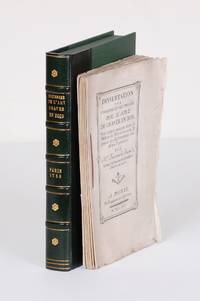
1758ref. 76869Paris: J. Barbou 1758. unbound cord tied housed in a green half-morocco goat over cloth boards clamshell case spine tooled in gold leaf with title author and date. large 12mo. unbound cord tied housed in a green half-morocco goat over cloth boards clamshell case spine tooled in gold leaf with title author and date. 92 3 pages. Pour éclaircir quelques traits de l"histoire de l'Imprimerie & prouver que Guttemberg n'en est pas l'Inventeur. Very rare first edition Bigmore and Wyman p.227. Unbound textblock lightly soiled with minor creasing at corners. Faint moisture staining throughout with some affecting the text. In this text Fournier sets out to prove that Gutenberg was not the inventor of the printing press by examining the history of printing. He believed that the technology Gutenberg made popular existed long before the German printer's work. Fournier also followed up this text with two additional works which are not present: De l'origine et des productions de l'imprimerie primitive en taille de bois 1759 and Observations sur un ouvrage intitulé Vindiciae Typographicae 1760. These two works provided further discussion of the origins of woodcut prints including a passage refuting popular belief about the origin wood engraving and some ideas for further study. Fournier 1712--1768 was born in Paris and trained as a wood engraver and type founder being a member of the 18th century dynasty of the well-known Fournier family. He later turned to steel engraving. He published a table of the proportions of the different printing characters whose purpose was to propose for all typefaces a fixed measurement in "typographic points" and a systematic gradation. He worked closely with the collaborators of the Encyclopédie providing the printer Le Breton with all the documentation relating to the typographic foundry and plans for his own instruments as well as providing Diderot with his collection of ancient alphabets. Finally after multiple disputes with his Parisian colleagues he became infamous for the printing of his famous Manuel Typographique 1764 1766 just prior to his death. J. Barbou unknown