1 469 résultats
réf. 35600764, Paris, Impr. Royale, 1785. 7 pp., vignette sur bois en tête
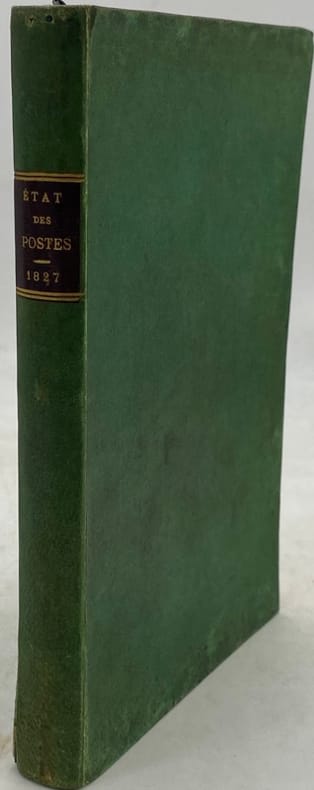
réf. 178429Paris, Imprimerie Royale, 1827 in-8, 247 pp., texte dans double encadrement noir, vélin vert (rel. de l'époque). Mors inférieur en partie fendu. Sans la carte. Ex-libris Kergorlay.
1849réf. 20441Paris L. MAISON 1849 in-18 pleine percale un guide, reliure pleine percale bleu marine in-18 cartonnage illustré Editeur (hard-back percale in-18 editor) (10 x 14,5 cm), à plaques spéciales editeur or et à froid pour le dos et les plats, titre frappé or sur le dos et au premier plat, toutes tranches lisses (all edges smoothes), orné d'une grande carte dépliante des routes de france en noir insérée dans la garde en fin de volume + 1 grande Carte Spéciale dépliante hors-texte en couleurs des Chemins de Fer et de la Navigation à Vapeur, en tout début d'ouvrage, 660 Pages + 2 p. de Tarif de la Poste aux Chevaux, 1849 à Paris L. MAISON Editeur des GUIDES-RICHARD Editeur,
réf. 9640Sans lieu ni date (circa 1787). In 4° de 17 pp. tel que paru.
réf. GF297911 page in4 - bon état -
1826réf. 53303Paris Imprimerie Royale 1826 In-12, demi-maroquin brun long grain, plats de papier marbr, dos sans nerfs; doublures et gardes de papier crme, tranches lisses.Ce livre des postes pour l'anne 1826 fournit les renseignements suivants: dates des 5 clipses (3 de Soleil et 2 de Lune), dates des quatre saisons, calendrier dtaill (avec les indications des levers et des couchers du Soleil et de la Lune, le temps moyen au midi vrai), les heures des mares dans les ports principaux, un extrait des lois et rglements relatif la poste aux chevaux, l'inventaire des relais sur les routes postales. L'ouvrage se termine par un index. Manque la carte des routes. Petits dfauts la reliure.
1776réf. GF308981776 Paris - Ribou - 1776 - 1 volume in8 broché d'origine de papier gris avec titre imprimé sur une étiquette blanche "Route de Rouen par St Germain - Numéro 2" - 46 pages - minimes accrocs à la couverture -
1776réf. GF308991776 Paris - Ribou - 1776 - 1 volume in8 broché d'origine de papier gris avec titre imprimé sur une étiquette blanche "Route de Beauvais - Numéro 3" - 47 pages -
1776réf. GF309001776 Paris - Ribou - 1776 - 1 volume in8 broché d'origine de papier gris avec titre imprimé sur une étiquette blanche "Route d'Amiens - Numéro 4" - 70 pages - petit accroc en queue -
1777réf. GF309041777 Paris - Ribou - 1777 - 1 volume in8 broché d'origine de papier gris avec titre imprimé sur une étiquette blanche "Route de S. Omer par Amiens et Arras - Numéro 9" - IV - 48 pages - (couverture un peu tachée au dos) -
1777réf. GF309061777 Paris - Ribou - 1777 - 1 volume in8 broché d'origine de papier gris avec titre imprimé sur une étiquette blanche "Route de Noyon et Saint Quentin - Numéro 12" - IV - 71 pages -
1777réf. GF309071777 Paris - Ribou - 1777 - 1 volume in8 broché d'origine de papier gris avec titre imprimé sur une étiquette blanche "Route du Havre - Numéro 7" - 58 pages - (notes au crayon sur la couverture ) -
1861réf. 11172Paris Bureau de la Revue des Deux Mondes 1861 -in-8 demi-Maroquin un fort volume, reliure demi-maroquin cerise grand in-octavo à coins (binding half morocco with corners), reliure d'époque signée "PETIT" successeur de "SIMIER", dos 4 nerfs (spine with raised bands) décoré "or" et à froid (gilt and blind stamping decoration), titre et tomaison frappés "or" (gilt title and volume numbering) dans un encadrement d'un double filet fin "or", triple filets fins "or" en place des nerfs avec un filet à froid de part et d'autre des nerfs, plats décorés or (gilt decoration on the cover) avec 3 filets fins "or" aux mors et aux coins (joints and corners with three gilt line), papier marbré aux plats (cover with marbled paper), toutes tranches lisses (all edges smoothes) peignées (painting edges) rouge et bleu, sans illustrations (nop illustration), 1016 pages, 1861 Paris Bureau de la Revue des Deux Mondes Editeur,
1873in 16°, pp. 4 b., 4, 335, 4 b., leg. coeva m/pelle, ds. a nervi con tit. e fregi in oro. Storia delle Poste non solo francesi e inglesi ma anche italiane ed europee, riforme postali, organizzazione, timbri e cartoline. Tracce d'umido alle ultime pp. e lievi sfregamenti alla leg. ma buon esemplare. 445/32
réf. ARTPHO/Box29/RS8/121125-RNov 13 1980. Very Good. PAGES SLIGHTLY YELLOWING. COUPLES OF STAINS ON THE FIRST PAGE. Sold by the U.K Charity Kisharon Langdon. Offering Opportunities and Support for People within the Autism and Learning Disability Community. unknown
réf. 68707271-75Elsevier. Used - Very Good. Pages intact with possible writing/highlighting. Binding strong with minor wear. Dust jackets/supplements may not be included. Stock photo provided. Product includes identifying sticker. Better World Books: Buy Books. Do Good. Elsevier unknown
19197 vols., [of 8], 8vo., with illustrations and diagrams in the text; original blue wrappers, wire-stitched as issued, a remarkably well-preserved, bright, clean collection. The collection comprises B1: Elementary Principles of Telegraphy and Systems up to Morse Duplex; B2: Telegraph Concentrators; B3: Wheatstone System Morse Keyboard Perforators; B4: Quadruplex, Quadruplex Repeated Circuits and Telegraph Repeaters, Simplex and Duplex; B5: Hughes Type-Printing Telegraph; B6: Baudot Multiplex Type-Printing Systems; B7: Western Electric Duplex Multiplex. Murray Duplex Multiplex. Siemens & Halske Automatic Type-Printing Systems. The set wants only B8: Fire Alarm Systems. GROUP COLLECTIONS OF THIS NOTABLE AND HISTORIC SERIES ARE RARE.
1875réf. 15568Edinburgh: Gibb. Poor with no dust jacket. 1875. First Edition. Hardcover. Lacking the "Plan of Edinburgh and Leith". Binding poor. Joints split and hinges broken. Boards detached. Lacking the front free endpaper and the half-title page. One preliminary leaf detached. ; Seventieth annual publication. iii-xx 695 1 pages 1 double page map of the county of Edinburghshire 148 11 pages advertisements at rear. Also advertisements on endpapers. Blind-stamped cloth boards with gilt lettering on spine. Page dimensions: 217 x 135mm. Useful historical and genealogical source. Alphabetical listing of people's names with their profession and street address. Also listing of names by street address. The advertisements at the rear are for numerous local businesses. Seller ref: KnightCol; 8vo . Gibb hardcover
réf. 107015aafParis Félix 18 Quai des Orfèvres, Imp. Bisson Rue St. Martin 135, 1 feuille richement ornée et coloriée (modèle n° 203). Montée sur papier blanc, (1 Blatt Briefpapier mit kol. Abb.). 1 feuille.
réf. 142519aafBern, Oberpostdirektion, Druck Gebr. Fretz, Zürich, o.J. (1929- 30 - 31) gr. in-8°, 78 S. + 1 Bl. leer., mit vielen Fotogr. Abb. s./w. und farbig auf Tafeln, / 78 S. ill. + gef, Reiskarte d. Schweiz 1929 / 79 S. ill. + 1 gef. gr. Reiskarte 1930, 3 illustrierte Original-Broschüren. (Umschlagentwurf: O. Baumberger).
réf. 61011aafDirection générale des Postes et Télégraphes, 1934, env. 75 cm x 52 cm, reliure en toile.
réf. 3752577770.Ghardcover. Good. Access codes and supplements are not guaranteed with used items. May be an ex-library book. hardcover
réf. 0306416549.Ghardcover. Good. Access codes and supplements are not guaranteed with used items. May be an ex-library book. hardcover
1876P., Roy, 1876. In-4 reliure éditeur demi chagrin vert, plat de percaline verte estampés à froid, 476 pages avec 75 gravures. Une réparation ancienne sans manque à une page, rousseurs sur la tranche et les marges (plutôt marge latérale), sinon exemplaire plus que correct. Un chapitre est consacré à la poste aérienne pendant le siège de Paris.
1981réf. 91175Washington DC: U.S. Government Printing Office 1981. Presumed First Edition First Printing. Wraps. Very good. iv 120 1 pages. Wraps. Tabular Data. The 1981 Senate hearings regarding the implementation of the nine-digit ZIP code ZIP4 were marked by intense debate over automation costs and mandatory versus voluntary usage. The hearings primarily held before the Subcommittee on Civil Service Post Office and General Services aimed to address public and Congressional concerns that the system was premature and overly burdensome. A major focus was ensuring the new longer code would be voluntary specifically for residential users to alleviate public fear of forced compliance. Postmaster General Bolger testified that he supported making it voluntary except for bulk mailers seeking discounts. Critics in the Senate such as Senator David Durenberger and Senator Roger Jepsen argued that the system was not fully tested might increase costs and that the public did not want it. The program was designed to cut costs through automated mail sorting using optical character readers OCRs. In April 1981 Congress considered legislation to block the June 1 1981 implementation date proposed by the Postal Service with leaders calling for a cost-benefit analysis. Despite the contention the Senate moved forward with the program with the legislative battle continuing through the end of the year eventually leading to the authorization of the program by late 1981 with full implementation planned for subsequent years. The hearings highlighted the transition from manual to automated mail processing and the friction caused by requiring the public to adopt a more detailed addressing system. The nine-digit zip code ZIP4 was introduced by the USPS in 1983 to improve mail sorting automation and speed up delivery. It adds a four-digit suffix to the original five-digit code identifying specific geographic segments—such as a city block apartment building or individual high-volume receiver. The first five digits define the region and local post office. The added 4 indicates a sector several blocks and a segment one side of a street. The system allows automated machinery to sort mail to smaller more precise delivery areas reducing manual handling. While proposed earlier the extended code was officially introduced in 1983. Initial uptake was slow due to a at the time small incentive for large-scale mailers. It provided increased accuracy faster delivery times sometimes up to two days faster and reduced costs for bulk mailers. While not mandatory for citizens it is heavily used by businesses for address verification mailing efficiency and better logistical analytics. The system evolved from the original 1963 five-digit Zone Improvement Plan ZIP to handle growing mail volumes. U.S. Government Printing Office paperback