Poste, GeorgeBiblio.com

169 Ergebnisse
2012Best.-Nr. DADAX1468450646Springer 2012-03-22. Softcover reprint of the original 1st ed. 1986. paperback. New. 5.98x1.04x9.02. Buy with confidence. Excellent Customer Service & Return policy. Springer paperback
Best.-Nr. B9781461290308Paperback / softback. New. paperback
2011Best.-Nr. x-1461290309Springer US 2011. Paperback. New. reprint edition. 218 pages. 9.01x5.98x0.50 inches. Springer US paperback
Best.-Nr. BOOKS030754IEx-lib. with endpaper edge & spine marks; G Hardback; text. ISBN: unmarked; no DJ. xvi 202 pp. Keywords: BIOLOGY GENETICS VIROLOGY ISBN 0-306-42502-5. hardcover
Best.-Nr. B9781461292593Paperback / softback. New. The many advances in our understanding of receptor biology that have occurred during the intervening period mirror the extraordinary growth of knowledge in the biological sciences and in cell and molecular biology in particular. paperback
2011Best.-Nr. x-146129259XSpringer US 2011. Paperback. New. 484 pages. 9.02x5.98x1.05 inches. Springer US paperback
Best.-Nr. 21288675-nnew. unknown
Best.-Nr. 21288675like new. unknown
Best.-Nr. 0428198953.Ghardcover. Good. Access codes and supplements are not guaranteed with used items. May be an ex-library book. hardcover
Best.-Nr. 0282241663.Gpaperback. Good. Access codes and supplements are not guaranteed with used items. May be an ex-library book. paperback
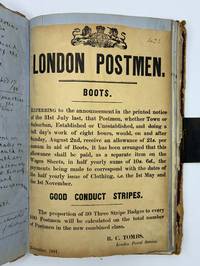
1870Best.-Nr. 1851Original manuscript. 1870-1906. 32 x 21cm. Contemporary full burgundy roan with titles in gilt to the spine "Correspondence E" and working metal clasp. Marbled endpapers. Decorative engraved stationer's label for Waterlow & Sons to the front pastedown. The contents comprising approximately 480pp. of manuscript ink text on blue lined-paper with many notices circulars and other item inserted throughout with a detailed index. The binding remains secure with heavy rubbing to the spine and boards and with chipping to the spine ends and board corners. The contents with cracking to the front hinge the front free endpaper detached a couple of leaves with large tears and with the occasional smaller tear elsewhere and with a little wear to the edges of some of the inserted sheets. An extensive letter book for Post Offices operating within London's Eastern District during the late nineteenth century including transcriptions of official letters orders and notices regarding all aspects of mail delivery the conduct of post office employees and the operation of postal system at large the book almost entirely dealing with the 1870s-1890s. Typical entries include: "proceedings in cases of intoxication" of employees; instructions for the supply of uniforms to the Boy Sorters employed in the Metropolitan District this comprising a blouse and trousers every eight months and a belt once in three years; details regarding the introduction of a 'boatage' fee to be levied on all messages for delivery after dark at the docks; concerns of compressed cotton spontaneously igniting in post office storerooms; procedures for the delivery of circulars; a note from the Royal Mint solicitors with instructions should spurious coins be offered at post offices; notice that messages intended for conveyance by the Eastern Railway should be handed to the post boy at Liverpool Station thus saving the transmission by wire to the Shoreditch PO; notes 1881 on diseases and the workplace including measles and scarlet fever; a letter dated 1870 discussing pay structure for the Eastern District PO - "one postmaster £500 one clerk £260 increasing by £10 to £350 two clerks £80 three inspectors £130 fourteen sub-sorters 16/- sixty-two letter carriers 18/- and eleven sorters 24/-"; another dated 1870 extending night delivery in Leytonstone district to the Merchant Seaman's Orphan Asylum with additional expense for the extra work involved; detailed records regarding the number of registered letters delivered during various years the number delivered during 1874 in the Eastern District recorded as 36307; closure of PO in Stoke Newington; rules for prolonged leave and other leave of absence notes; a list of post offices pillar and wall boxes opened in the Eastern District during various years; details of pay increases to letter carriers in Bethnal Green and Bow with additional boy sorters to assist; pay structures for male and female employees; a letter from the postmaster in 1876 relating that no boy under fourteen years old is to be taken on as a telegraph messenger; information regarding the cost duration and leasing of private boxes; an application for outdoor boy telegraph messengers; a confidential circular raising concerns regarding theft from letters by employees with betting habits; amongst many many other things. An uncommon and in-depth insight into the workings of the capital's postal system previously forming part of the collection of the celebrated Bath Postal Museum prior to its closure. Provenance: Ex. Bath Postal Museum. [Original manuscript]. hardcover
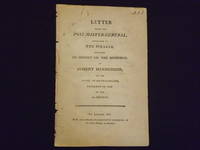
1805Best.-Nr. 101503Pamphlet 8vo removed dbd 7 pp. Removed partially disbound ink numbers in upper right corners some wear or small chips at extremities moderate aging and browning; good or better. Gideon Granger 1767-1822 provides information on what would be involved in terms of costs for carrying mail between Fayetteville North Carolina to Charleston South Carolina. Granger born in Connecticut and a Yale graduate would become the Post-Master General under President Thomas Jefferson. While he would fail in a congressional bid in 1798 he would eventually serve in the New York Senate in 1820-1821. ANB.
Best.-Nr. 0666096236.Ghardcover. Good. Access codes and supplements are not guaranteed with used items. May be an ex-library book. hardcover
Best.-Nr. 1332043453.Gpaperback. Good. Access codes and supplements are not guaranteed with used items. May be an ex-library book. paperback
Best.-Nr. 69-3644Paris France: La Poste ca 2000. 80 x 60 cm. Offset Color Lithograph. Good small tears on left and right edges Paris, France: La Poste, [ca 2000] unknown
Best.-Nr. 042870980X.Ghardcover. Good. Access codes and supplements are not guaranteed with used items. May be an ex-library book. hardcover
Best.-Nr. 54077Simon & Schuster Little Golden Book # 212-25 Very Good Condition. Illus. by Richard Scarry. Simon & Schuster Little Golden Book # 212-25 unknown
Best.-Nr. 0483355550.Ghardcover. Good. Access codes and supplements are not guaranteed with used items. May be an ex-library book. hardcover
Best.-Nr. 0666052719.Ghardcover. Good. Access codes and supplements are not guaranteed with used items. May be an ex-library book. hardcover
Best.-Nr. 1333467206.Gpaperback. Good. Access codes and supplements are not guaranteed with used items. May be an ex-library book. paperback
Best.-Nr. ria9782329221083_inpPaperback. New. New Book; Fast Shipping from UK; Not signed; Not First Edition; Instruction generale sur le Service des postes / Direction générale des postesDate de l'édition originale : 1868Le présent ouvrage s'inscrit dans une politique de conservation patrimoniale des ouvrages de la littérature Française mise e paperback
1981Best.-Nr. 91175Washington DC: U.S. Government Printing Office 1981. Presumed First Edition First Printing. Wraps. Very good. iv 120 1 pages. Wraps. Tabular Data. The 1981 Senate hearings regarding the implementation of the nine-digit ZIP code ZIP4 were marked by intense debate over automation costs and mandatory versus voluntary usage. The hearings primarily held before the Subcommittee on Civil Service Post Office and General Services aimed to address public and Congressional concerns that the system was premature and overly burdensome. A major focus was ensuring the new longer code would be voluntary specifically for residential users to alleviate public fear of forced compliance. Postmaster General Bolger testified that he supported making it voluntary except for bulk mailers seeking discounts. Critics in the Senate such as Senator David Durenberger and Senator Roger Jepsen argued that the system was not fully tested might increase costs and that the public did not want it. The program was designed to cut costs through automated mail sorting using optical character readers OCRs. In April 1981 Congress considered legislation to block the June 1 1981 implementation date proposed by the Postal Service with leaders calling for a cost-benefit analysis. Despite the contention the Senate moved forward with the program with the legislative battle continuing through the end of the year eventually leading to the authorization of the program by late 1981 with full implementation planned for subsequent years. The hearings highlighted the transition from manual to automated mail processing and the friction caused by requiring the public to adopt a more detailed addressing system. The nine-digit zip code ZIP4 was introduced by the USPS in 1983 to improve mail sorting automation and speed up delivery. It adds a four-digit suffix to the original five-digit code identifying specific geographic segments—such as a city block apartment building or individual high-volume receiver. The first five digits define the region and local post office. The added 4 indicates a sector several blocks and a segment one side of a street. The system allows automated machinery to sort mail to smaller more precise delivery areas reducing manual handling. While proposed earlier the extended code was officially introduced in 1983. Initial uptake was slow due to a at the time small incentive for large-scale mailers. It provided increased accuracy faster delivery times sometimes up to two days faster and reduced costs for bulk mailers. While not mandatory for citizens it is heavily used by businesses for address verification mailing efficiency and better logistical analytics. The system evolved from the original 1963 five-digit Zone Improvement Plan ZIP to handle growing mail volumes. U.S. Government Printing Office paperback
1880Best.-Nr. 2111902160200356Not Available 1880. Soft Cover. Fine. Volume: 1 Not Available paperback
Best.-Nr. 1853153931.Gpaperback. Good. Access codes and supplements are not guaranteed with used items. May be an ex-library book. paperback
2012Best.-Nr. x-147570285XSpringer 2012. Paperback. New. reprint edition. 252 pages. 10.00x7.00x0.60 inches. Springer paperback