[Aviation]ABAA

19,282 results
1950ref. 158188Paris: Union Aéromaritime de Transport 1950. Two vintage Union Aéromaritime de Transport UAT airline ticket envelopes circa 1950s. UAT was founded in 1949 in Paris by a group of technicians and the shipping line Chargeurs Réunis and was headquartered out of the 8th arrondissement of Paris. In 1963 the company merged with Transports Aériens Intercontinentaux to form Union de Transports Aériens. 8 x 4.75 inches. Near Fine. Union Aéromaritime de Transport unknown books
1965ref. 108656Washington DC: U.S. Government Printing Office 1965. Softcover. Very Good. First edition. Very good with a large coffee stain around the wrappers and spine. U.S. Government Printing Office unknown books
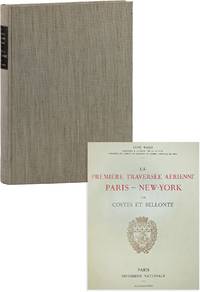
1931ref. 85868Paris: Imprimerie Nationale 1931. First Edition. Small folio. 34cm. Later heavy grain oatmeal cloth with black leather title label to spine. 258pp.; 1. Clean and strong minor bumping to spine ends; internally clean and fresh illustrated throughout with photographs color images and charts all with captioned tissue guards. A near fine copy. From the library of Nathaniel Tarn noted poet translator and anthropologist bearing his bookplate to the front pastedown. A lavish and justifiably celebratory account of the first aerial crossing from Paris to New York performed in 1930 as the second traversal attempt by Costes and Bellonte with the first having to be abandoned in 1929 due to bad weather. The duo successfully made the crossing of 3850 miles in 37 hours and 18 minutes to international fanfare in their Breguet 19 Super Bidon named "Point D'Interrogation" or "Question Mark". Bellonte's rather lush and impressive account is quite scarce in trade and considering the importance of Costes and Bellonte's singular achievement seems sparse in institiutional holdings. Imprimerie Nationale unknown books
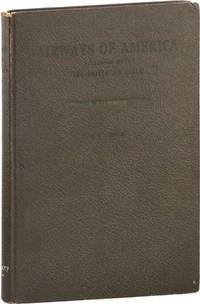
1933ref. 88120New York: The Geograhpical Press / Columbia University 1933. First Edition. Octavo. Brown simulated leather over boards hardcover; 207pp; illus; map endpapers; large folding map in rear pocket as issued. Private or non-circulating library copy with neat white ink shelf-number at base of spine and ink annotation to rear endpaper no institutional markings. Light external wear but still a sound Very Good copy. A fascinating work dating from the earliest years of American commercial aviation utilizing aerial photography to identify prominent geological and geographical features visible to the trans-continental air traveller. The book's sub-title suggests that this was the first of a planned series of related studies but we find no evidence that further works were published. The Geograhpical Press / Columbia University unknown books
1914ref. 83910London: W.H. Smith & Son N.d. ca 1914. Lithograph in colors 77cm x 50cm ca. 30" x 20". Mild toning in margins with subtle repair to closed tears; Near Fine. Professionally mounted on archival linen. An anti-Progressive satirical image using a crash-landed bi-plane to symbolize the recklessness of Asquith's Liberal government; the unfortunate banged-up chap at center appears to be a caricature of David Lloyd George Asquith's Chancellor of the Exchequer and later Prime Minister. The artist is unidentified but possibly Edward Huskinson long-time editor of The Tattler and a popular Conservative cartoonist of the period. W.H. Smith & Son unknown books
1949ref. 164751949. Original press photograph of British aviator Richarda Morrow-Tait 1923-1982 the first woman to pilot an aircraft around the world dated August 19 1949 the day she completed her historic circumnavigation at London's Croydon Airport. Departing Britain on August 18 1948 with navigator Michael Townsend Morrow-Tait undertook a journey that lasted one year and one day overcoming mechanical failures difficult weather conditions and a serious crash in Alaska. Initially flying a Percival Proctor IV named Thursday's Child she continued her journey in a replacement aircraft Next Thursday's Child a Vultee BT-13 Valiant after raising funds to resume the expedition. Her successful return established a landmark in women's aviation history during the early postwar expansion of civilian flight. Original black-and-white gelatin silver press photograph August 19 1949. Measures 7 x 8½ inches. Depicts Morrow-Tait seated in the cockpit of Next Thursday's Child. The original press caption printed beside the image reads: "British round-the-world flyer returned home 8/19 to Britain which she left just a year and a day ago. Her flight to London's Croydon Airport ended the 1st single-engine round-the-world flight by a woman at point where she started it." Pencil inscriptions and a press stamp appear on the verso documenting the photograph's circulation as editorial material. The caption dates the image to the completion of her flight and identifies both the aviation record and the airport at which she concluded her journey. Morrow-Tait began her circumnavigation at age 24 having accumulated approximately 85 hours of flying experience. Her route took her across Europe and Asia to Japan Alaska and North America before returning across the Atlantic to Britain. Following her crash in Alaska she spent several months securing financing and a replacement aircraft making the successful completion of her flight particularly notable. Her achievement followed the pioneering long-distance flights of women aviators such as Amelia Earhart whose attempted circumnavigation ended in disappearance in 1937. Contemporary press coverage frequently emphasized Morrow-Tait's marriage and motherhood alongside her flying accomplishments documenting the public expectations confronting women pursuing aviation records in the postwar period. Pencil annotations and press stamp on verso. In very good condition. An original dated press photograph recording the completion of the first aerial circumnavigation piloted by a woman. unknown books
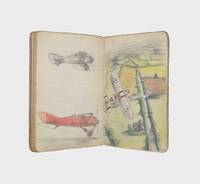
1926ref. 378080Leicestershire 1926. 216 pp. Content to most pages with intermittent and concluding blanks; 91 pp. have sketches or drawings in pencil and crayon 32 pp. of these in color. 8vo 7" x 4". Blue cloth boards with contrasting red spine ruled pages. Faint dampstaining to front board with minor staining to edges of first 15 or so leaves overall very good and images vivid. 216 pp. Content to most pages with intermittent and concluding blanks; 91 pp. have sketches or drawings in pencil and crayon 32 pp. of these in color. 8vo 7" x 4". The impressive sketches are mostly aviation scenes of biplanes in flight some from the pilot's perspective. One double-page sketch depicts a crash landing; others illustrate World War I battlefields including a grave scene with an excerpt from "In Flanders Fields." The compiler was likely John William Gannon 1904-1949 an employee at Dryad Metal Works in Leicestershire. Numerous sketches consist of diagrams of engine parts planned projects as well some non-aviation sketches e.g. jewelry pieces. An album of early aviation drawings by an accomplished artist. unknown books
1942ref. 313964New York 1942. 1p. on Sergievsky's personal letterhead. 8vo. Old folds lower right hand corner chipped not affecting text or signature otherwise a fine letter with a bold clear signature. 1p. on Sergievsky's personal letterhead. 8vo. A letter written by the renowned Russian ace and world record setting Sikorsky test pilot on behalf of Danish-born ballet and Broadway dancer Paul Haakon considered by many to be one of greatest ballet dancers of the 20th century. Reading in part: "I have known Paul Haakon Longreen for over sixteen years. In the theatrical profession he is known under the name of Paul Haakon. It is very well known that he is one of the best dancers in the world. He gave up his dancing recently to become a flying instructor purely to serve his country. I sincerely believe that anything which could be done to facilitate his joining the United States Army Air Force reserve would benefit our war effort." Despite Sergievsky's recommendation in our letter it seems Haakon never became a combat pilot during WWII and instead toured as an entertainer with the United Service Organizations. He died in New York in 1992. unknown books
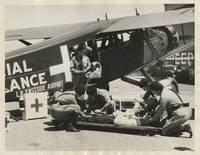
1934ref. BK0141Los Angeles: Associated Press 1934. Original press photograph measuring approximately 9 x 7 inches. Typed press caption affixed to verso International News Photos stamp manuscript editorial markings. Excellent. A press photograph documenting an early women's airborne emergency medical organization in Los Angeles. The image shows members of a women's flying medical unit gathered beside an airplane during first aid maneuvers on July 9 1934. The unit brought together women interested in aviation and emergency medicine and trained its members to provide rapid medical assistance in the event of disasters and other national emergencies. The detailed original caption explains that the newly organized medical unit was a detachment of the Women's Air Reserves conducting its first maneuvers in Los Angeles intended "to prepare its members to render speedy and effective service in first aid work in times of disaster or national emergency." It identifies Lieut. Emma Kittredge standing as directing a first aid exercise beside the detachment's ambulance ship. The photograph provides a visual record of women's involvement in aviation organized emergency preparedness and medical training during the interwar period. . Associated Press unknown books
ref. 4651bd2Department of Trade and Industry 1967. Reprinted in 1970 incorporating amendments one to three. Octavo gray wrappers stapled ii 22 pp. Fine. Notes written on stationary from The Excelsior Hong Kong laid-in. unknown books
1983ref. vas5252Montreal Que.: International Civil Aviation Organization 1983. Fourth Edition. Quarto stiff blue wrappers 72 pp. Fine. International Civil Aviation Organization, 1983. Fourth Edition. unknown books
1979ref. vas5251Montreal Que.: International Civil Aviation Organization 1979. Fourth Edition. Quarto stiff blue wrappers 31 pp. Near-Fine. International Civil Aviation Organization, 1979. Fourth Edition. unknown books
1976ref. vas5250Montreal Que.: International Civil Aviation Organization 1976. 8th Edition. Quarto stiff blue wrappers 65 pp. Near-Fine. International Civil Aviation Organization, 1976. 8th Edition. unknown books
1982ref. vas5248Montreal Que.: International Civil Aviation Organization 1982. Seventh Edition. Quarto stiff blue wrappers 60 pp. Good. International Civil Aviation Organization, 1982. Seventh Edition. unknown books
1569ref. vas5247Montreal Que.: International Civil Aviation Organization 1976. Doc 9156-AN/900. Quarto stiff printed wrappers viii 30 179 25 3 36 12 1 pp. Very Good. International Civil Aviation Organization, 1976. Doc 9156-AN/900. unknown books
1965ref. vas5253Monbteal Que.: International Civil Aviation Organization 1965. Doc 748/2. Second Edition. Quatro softbound lxxiv 182 pp. Tables. Fine. International Civil Aviation Organization, (1965). Doc 748/2. Second Edition. paperback books
1988ref. vas5236Gatwick Swet Sussex: Civil Aviation Authority 1988. Quarto stiff blue wrappers plastic ring binder 19 leaves. Near-Fine. Civil Aviation Authority, 1988. unknown books
1971ref. vas5249Montreal Que.: International Civil Aviation Organization 1971. 6th Edition. Quarto stiff blue wrappers 32 pp. Very Good. International Civil Aviation Organization, (1971). 6th Edition. unknown books
1980ref. 335435glCheltenham England: Civil Aviation Authority November 1980. Octavo paperbound stapled blue wrappers 24 pp. Near-Fine with light foxing to covers. Civil Aviation Authority, November 1980. unknown books
1948ref. 335436glLondon: His Majesty’s Stationery Office 1948. Octavo paperbound stapled blue wrappers 24 pp. Very Good with pilot’s bookplate and wear to covers. His Majesty’s Stationery Office, 1948. unknown books
1987ref. 4651bdKhartoum: Civil Aviation Authority Republic of the Sudan 1987. Octavo typewritten wrappers stapled iv 23 leaves. Near-Fine. Civil Aviation Authority, Republic of the Sudan, 1987. unknown books
1919ref. 12189Washington: G.P.O. 1919. 1st edition. 4to. 446pp. original cloth with illustrations. Front hinge loose signature on pastedown endpaper otherwise good. G.P.O. unknown books
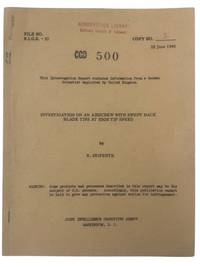
1946ref. 236021946. German aeronautical research on swept-back airscrew blade design 1946 documenting the Allied technical intelligence program that captured translated and rapidly disseminated advanced German aviation research immediately following the Second World War. Prepared from work conducted at the British Ministry of Aircraft Production M.A.P. Völkenrode and originating in research begun under the renowned aerodynamicist Albert Betz at Göttingen the report examines swept-back propeller blade tips operating at extremely high rotational speeds as German engineers sought solutions to compressibility effects encountered as aircraft approached the speed of sound. R. Seiferth's Investigation on an Airscrew with Swept Back Blade Tips at High Tip Speed a draft translation dated April 1 1946 issued by the Joint Intelligence Objectives Agency as CGD 500 on 22 June 1946. Reports and Translations. 10 × 8 inches. Six leaves stapled. The title page identifies the work as a translation prepared at M.A.P. Völkenrode while the printed JIOA wrapper states "This Interrogation Report contains Information from a German Scientist exploited by United States." The report summarizes experimental investigations into swept-back airscrew geometry at high tip speeds discussing aerodynamic efficiency compressibility effects and comparative testing. The front wrapper bears the manuscript notation "500 Seiferth" and the ownership stamp of the California Institute of Technology Aeronautics Library preserving the provenance of this copy within one of America's leading postwar centers of aeronautical research. Light handling wear; original staples intact; library stamp and manuscript notation to front wrapper. Overall good condition. Although focused on propeller aerodynamics rather than the turbojet itself the report examines many of the same high-speed airflow problems that confronted the emerging jet age including shock-wave formation compressibility aerodynamic efficiency and transonic flight. It presents experimental investigations into swept-back airscrew geometry at high tip speeds and comparative testing within the broader body of German aerodynamic research that proved invaluable to Allied aircraft designers developing the first generation of practical jet aircraft turboprop engines and high-speed military aviation after 1945. By the end of the war Germany possessed the world's most advanced operational jet aircraft including the Messerschmitt Me 262 fighter and Arado Ar 234 jet bomber while German scientists were conducting extensive research into swept wings high-speed aerodynamics and propulsion concepts that were years ahead of most Allied programs. Recognizing the extraordinary military and scientific value of this work Allied technical intelligence teams immediately secured German laboratories interrogated leading engineers and translated thousands of reports before the information could be lost. Issued by the Joint Intelligence Objectives Agency as CGD 500 on 22 June 1946 Seiferth's report formed part of that remarkable series of intelligence publications that transferred German wartime aeronautical knowledge into American and British research establishments accelerating the development of the first generation of postwar jet-powered aircraft. unknown books
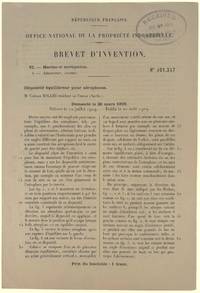
1909ref. 221611909. Bollée Camille. Dispositif équilibreur pour aéroplanes 1909 documents early efforts to solve the problem of aircraft stability in the immediate years following the Wright brothers first powered flight when engineers in Europe and the United States sought mechanical solutions to controlled flight. Issued by the French government this patent establishes a technical approach to maintaining equilibrium through adjustable aerodynamic surfaces mounted on a rotating vertical shaft shifting emphasis from pilot skill to engineered stabilization. The document supports research into early aviation engineering international patent exchange and the rapid development of aeronautical control systems in the pre-World War I period. Bollée Camille. Dispositif équilibreur pour aéroplanes. Paris: Office National de la Propriété Industrielle 1909. Three pages with one illustrated plate containing six technical diagrams; original printed paper wrapper measuring approximately 11 x 7.5 inches. Patent submitted March 26 1909 granted July 12 and published August 21. The text describes a stabilization system "composed of a generally vertical shaft. capable of a rotating motion around its axis upon which one or several surfaces are mounted" designed to counterbalance lateral instability through adjustable aerodynamic elements. Diagrams illustrate variable positioning of these surfaces to alter lift and drag with the stated objective "to maintain the balance of airplanes. for example during lateral gusts or slips." Front page bears a Chicago patent office stamp dated July 27 1910 indicating circulation and review within American patent or engineering contexts. This patent was produced during a period of intense international experimentation in powered flight when inventors across France Germany and the United States pursued competing methods to improve control safety and maneuverability. Bollée's design reflects early recognition of the need for mechanical stabilization systems that could respond dynamically to environmental forces anticipating later developments in controlled flight technologies. The presence of an American stamp demonstrates transatlantic interest in aeronautical innovation at a moment when aviation knowledge circulated rapidly through patent systems and technical publications. Light age toning with faint crease to upper corner; document remains clean and legible; overall near fine condition. This item provides direct evidence of early twentieth century engineering approaches to flight stability and the global exchange of aviation technology. unknown books
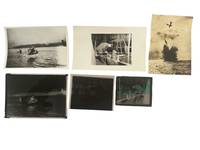
1912ref. 225241912. Unknown photographer Wright hydroaeroplane and early biplane models photo archive circa 1912 to 1913 documents early American seaplane experimentation during the period when the Wright Company adapted its pusher aircraft technology for water takeoff alighting and military use. The photographs capture a hydroaeroplane on or near water a dramatic water-impact or alighting scene and a hangar interior where men work over the open framework of a Wright-type machine providing visual evidence of experimental aircraft handling float design rigging and workshop adjustment. Wright State University's Wright Brothers Collection identifies a 1913 photograph of Orville Wright standing in the Miami River between the pontoons of a Wright Model CH Flyer confirming the Great Miami River as a documented site for Wright Model CH hydroaeroplane testing in this period. Six pieces total comprising three silver gelatin prints each approximately 7 x 5 inches and three contemporaneous negatives including two large-format film negatives and one smaller glass or film negative likely made in the Dayton Ohio area and a Wright Company hangar. The largest print shows a pusher-type biplane with forward elevator and floats partly submerged near a piling giving the aircraft an unmistakable hydroaeroplane profile. A second sepia-toned print captures a tall column of spray in open water as a small aircraft passes overhead or just beyond the splash likely recording a hard alighting water-impact or test-run sequence. A third print shows an interior hangar scene with two mechanics or engineers in caps and a man in a straw boater leaning over the exposed structure of a Wright machine; visible details include struts bracing wires control runs open framework and fittings along the central bay. The three negatives correspond to the water-impact and hangar views preserving additional technical detail of the rigging geometry float or skid attachments and pusher layout. The visual evidence aligns closely with Orville Wright's 1913 Model C-H hydroaeroplane work on the Miami River south of Dayton though attribution to a specific flight or photographer should remain cautious without inscriptions or provenance beyond the images themselves. Contemporary and local Wright histories describe the Model C-H as a hydroaeroplane tested by Orville on the Miami River in 1913 and one Dayton aviation history account states that in May 1913 he resumed testing the Model C-H at a secluded Miami River site and made 100 flights carrying up to 800 pounds of payload. The photographs matter because they show the Wright enterprise after Wilbur Wright's death in 1912 when Orville continued technical experimentation even as competitors especially Glenn Curtiss pressed forward in flying-boat development. Light edge creases and small corner bumps to the prints one print with faint silvering and toning negatives with light emulsion scuffing and edge tape remnants but strong density and detail very good overall. Focused early aviation archive preserving both river testing and workshop evidence from the moment Wright biplane design was being adapted to hydroaeroplane use on the eve of World War I. unknown books