19 421 résultats
1785réf. ST15350Paris: Cuchet 1783-1784; 1784; Amsterdam and Paris: Gueffier 1785. FIRST EDITIONS. Second Issue of the first work with the four-page "Supplément" at the end. 223 x 127 mm. 8 x 5". Three separately published works bound as a three-volume set the first work occupying the first two volumes. Uniform contemporary orange paste-paper boards backed with marbled sheepskin corners tipped with vellum raised bands flanked by decorative gilt rolls one red and one green morocco label. First work with a folding table and 14 ENGRAVED PLATES nine numbered plates in first volume five in second two of the latter folding; second with three engraved plates; third work with one folding plate. First work: Darmon 51; PMM 229; Norman I 769; Maggs Bros. "The History of Flight" 65. A hint of rubbing to extremities intermittent minor browning small rust spots or offsetting in the text bed largely due to inferior paper stock four leaves with one-inch brown stain to text nothing obscured a couple of short marginal tears from rough opening but QUITE A FINE SET--the text clean fresh and well-margined the plates with excellent impressions and the binding remarkably well preserved with few signs of wear. This is the second issue with the rare "Supplément" in the second volume of the earliest account of the first public experiments with hot air balloons and it is considered to be the first authoritative technical and historical work on aerostation as well as the first serious discussion of balloon travel as a practical possibility. The experiments were conducted by the Montgolfier brothers Joseph 1740-1810 and Etienne 1745-99 who had been intrigued by the experiments of Cavendish and Priestly with "inflammable air." The eminent scientist Faujas 1741-1823 who was the promoter financier and chronicler of the Montgolfiers quickly published this account after the brothers had launched a balloon at Annonay in June of 1783 then a balloon carrying some farm animals in September and finally a balloon carrying Pilatre de Rozier and the Marquis d'Arlandes in November. This last flight--the first manned aerial voyage in history--covered five-and-one-half miles across Paris and lasted 25 minutes. Plate 8 here shows the two original aeronauts viewed from the terrace of Franklin's home in Passy. The third volume begins with a discussion of the inflammable gas used to lift the balloons and gives a summary of Montgolfier's history of balloon flights. The final work sets forth another scientific innovation an electrostatic machine that employed sheets of taffeta to create friction that produced static electricity. The Royal Academy of Sciences tested the machine and found it a great improvement--less expensive and less liable to accidents--than earlier machines that had used plates of glass. The work seems to be very rare: we could find no copy sold at auction in either RBH or ABPC. This is a most appealing set its combination of works on inventions offering a glimpse of the popular fascination with emerging technologies especially those related to flight in the late 18th century. Cuchet, 1783-1784; 1784; Amsterdam and Paris: Gueffier unknown
2003réf. 4805New York: Crown Publishers 2003. First Edition First Printing. Hardcover. Near Fine/Near Fine. 8 3/4 X 11 1/4 Inches. 110 PP. First printing with complete number line to the "1" on the copyright page. Original price of $19.95 on front flap. Signed by Sally Ride directly on the FFEP. A superb example with sharp corners. Crown Publishers hardcover
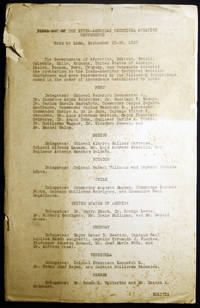
1937réf. 030009Lima Peru: The Inter-American Technical Aviation Conference 1937. 42 pages; a type-script conference report attended by various delegates from Argentina Bolivia Brazil Colombia Chile Ecuador United States of America Mexico Panama Peru Uruguay and Venezuela. Names are listed of the delegations listed by country. The conference sessions were divided into various committees dealing with international aviation issues of coordination and initiatives; legislation; meteorological protection; a committee on radio communications and a committee on aviation touring and aero-clubs. The deliberations resulted in various votes recommendations and resolutions regarding these topics; these included creation of an American Aeronautical commission; establishment of courses on air law in national universities; encouragement and facilitation of international air commerce; fuel duty exemption recommendations; establishment of international airports and other topics including standardization of radio traffic and meteorological data for flights. The development of air travel on an international scale was in earnest at this point and yet there was still a largely unregulated unsophisticated and disorganized international approach to commercial aviation lacking standardized safety procedures and protocols especially in Central & South America. At the end of the conference several people and events central to the development of aviation and its Western hemisphere pioneers were memorialized. Approx. 8" x 12 1/2" paper size; stapled paper binding; top sheet detached edge-frayed & dusty; contents in good condition. Conference Report. Soft Cover. Good. The Inter-American Technical Aviation Conference paperback
1944réf. 228708Annapolis.: United States Naval Institute. 1944. First edition. . Gilt decorated hard cover. . Fine copy. . 4to. Illustrated. Important reference work. Very scarce in this condition. United States Naval Institute. hardcover
2000réf. 8793New York: HarperCollins 2000. Early Edition. Hardcover. Near Fine/Near Fine. 6 1/4 X 9 1/2 Inches. 279 PP. SIGNED AND INSCRIBED BY GORDON COOPER TO FILMMAKER MICHAEL LENNICK directly on the title-page. One of the original "We Seven" Mercury Astronauts. A second printing copy with number line to the "2" on the copyright page. Original price of $25.00 intact on front flap. Michael Lennick started out in Hollywood as a visual effects man on The Fly Videodrome and The Dead Zone. He eventually made t Science" as well as his film "2001 and Beyond" which explores the science behind science fiction films. Film producer and friend Chris Darling said Lennick's "films featured a veritable who's who of NASA personalities and jaw-dropping footagehis way to his award-winning work docuseries "Rocke never before seen by the general public." The Hollywood Reporter 2014. HarperCollins hardcover
1925réf. 41983Garden CityNY: Garden City Publishing Co 1925. Later printing. Hardcover. Very good. 544p large octavo illustrated. A very good copy in tan cloth. Dated 1925 but much later. Original edition was published by Boni and Liveright. This copy inscribed by Wiley Post the first pilot to fly around the world solo. Inscribed by Post in 1935 to aviation pioneer Will D Parker in 1935. Parker built his own plane in 1912 and flew with a British unit in World War 1 Garden City Publishing Co hardcover
1989réf. 1387New York: Doubleday 1989. First Edition First Printing. Hardcover. Near Fine/Near Fine. 6 1/4 X 9 1/2 Inches. 334 PP. Signed "With all good wishes Ed Gibson 5/22/98" directly on the title-page. Stated First Edition on the copyright page. Original price of $18.95 intact on front flap of DJ. Skylab 4 Astronaut with over 15 hours of extra-vehicular activity EVA. Doubleday hardcover
2005réf. 4787New York: HarperCollins 2005. First Edition First Printing. Hardcover. Near Fine/Near Fine. Wendell Minor. 8 3/4 X 11 1/4 Inches. First printing with complete number line to the "1" on the copyright page. Original price of $15.99 on rear panel. Signed by both Buzz Aldrin and Wendell Minor on the title-page. PSA/DNA autograph authentication to same page with slip laid-in. HarperCollins hardcover
1988réf. 5562Boston: Quinlan Press 1988. First Edition First Printing. Hardcover. Near Fine/Very Good. 6 1/4 X 9 1/4 Inches. 227 PP. Signed by Schirra on the half title-page. Original price of $16.95 on inside rear flap. A clean copy with hint of wear at DJ edges and crown of spine. An increasingly difficult book to find in true collectible condition. Quinlan Press hardcover
1944réf. 57229New York: MacMillan 1944. reprint. Very Good. octavo. orig. cloth xix 868pp. b/w pls. text ills. diags. maps appends. glossary index Very comprehensive account of aviation technology to date. Neat ownership inscription o/w nice copy MacMillan hardcover
1785réf. ST15350Paris: Cuchet 1783-1784; 1784; Amsterdam and Paris: Gueffier 1785. FIRST EDITIONS. Second Issue of the first work with the four-page "Supplément" at the end. 223 x 127 mm. 8 x 5". Three separately published works bound as a three-volume set the first work occupying the first two volumes. Uniform contemporary orange paste-paper boards backed with marbled sheepskin corners tipped with vellum raised bands flanked by decorative gilt rolls one red and one green morocco label. First work with a folding table and 14 ENGRAVED PLATES nine numbered plates in first volume five in second two of the latter folding; second with three engraved plates; third work with one folding plate. First work: Darmon 51; PMM 229; Norman I 769; Maggs Bros. "The History of Flight" 65. A hint of rubbing to extremities intermittent minor browning small rust spots or offsetting in the text bed largely due to inferior paper stock four leaves with one-inch brown stain to text nothing obscured a couple of short marginal tears from rough opening but QUITE A FINE SET--the text clean fresh and well-margined the plates with excellent impressions and the binding remarkably well preserved with few signs of wear. This is the second issue with the rare "Supplément" in the second volume of the earliest account of the first public experiments with hot air balloons and it is considered to be the first authoritative technical and historical work on aerostation as well as the first serious discussion of balloon travel as a practical possibility. The experiments were conducted by the Montgolfier brothers Joseph 1740-1810 and Etienne 1745-99 who had been intrigued by the experiments of Cavendish and Priestly with "inflammable air." The eminent scientist Faujas 1741-1823 who was the promoter financier and chronicler of the Montgolfiers quickly published this account after the brothers had launched a balloon at Annonay in June of 1783 then a balloon carrying some farm animals in September and finally a balloon carrying Pilatre de Rozier and the Marquis d'Arlandes in November. This last flight--the first manned aerial voyage in history--covered five-and-one-half miles across Paris and lasted 25 minutes. Plate 8 here shows the two original aeronauts viewed from the terrace of Franklin's home in Passy. The third volume begins with a discussion of the inflammable gas used to lift the balloons and gives a summary of Montgolfier's history of balloon flights. The final work sets forth another scientific innovation an electrostatic machine that employed sheets of taffeta to create friction that produced static electricity. The Royal Academy of Sciences tested the machine and found it a great improvement--less expensive and less liable to accidents--than earlier machines that had used plates of glass. The work seems to be very rare: we could find no copy sold at auction in either RBH or ABPC. This is a most appealing set its combination of works on inventions offering a glimpse of the popular fascination with emerging technologies especially those related to flight in the late 18th century. Cuchet, 1783-1784; 1784; Amsterdam and Paris: Gueffier unknown books
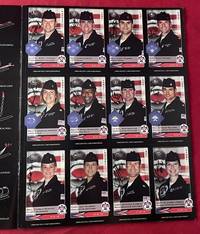
2008réf. 9349Washington DC: United States Air Force 2008. First Edition First Printing. Original wraps. Near Fine. Original 2008 Air Force "Thunderbird" program with original pilot trading card pages intact. Eleven of the twelve F-16 Thunderbird pilots have signed their card in this show souvenir album. Autographs includes: Lt. Col Greg Thomas Maj. Chris Austion Maj. Kirby Ensser Maj. Scott Poteet SpaceX Polaris Dawn Pilot/Astronaut Maj. Samantha Weeks first-female solo demonstration pilot on the United States Air Force Aerial Demonstration Squadron the Thunderbirds Maj. T. Dyon Douglas Lt. Col. Rob Skelton Maj. Anthony Mulhare Maj. Charla Quayle Capt. Gifford Ploetz and Capt. Elizabeth Kreft. Original staple binding clean and intact. United States Air Force unknown
1928réf. E1267NY: Aeronautical Chamber of Commerce of America 1928. First. Hardcover. Khaki colored cloth stamped in blue and red 551 pps. with index statistical appendices. Illustarted with monochrome photos and drawings. This edition the 10th annual covers Lindbergh's famous flight to Paris. Sections include: Ephocal Flights of 1927 Civil Avaiation in the U.S. Governmental including miltary Aviation Airports and Airways Airships and Balloons Aeronautical Education and Foreign Aeronautical Review. A tight clean fine copy couple of tiny nicks to the front cover. Aeronautical Chamber of Commerce of America hardcover
2012réf. 2123Annapolis: Naval Institute Press 2012. First Edition First Printing. Hardcover. Near Fine/Near Fine. 6 1/4 X 9 1/2 Inches. 264 PP. First printing with full and complete numberline to the "1" on the copyright page. Signed and inscribed to WWII B-17 Pilot Les Williams. Accompanied by note signed by Stearman asking Williams to review the book on Amazon. Stearman served on the National Security Council staff for over 17 years. Naval Institute Press hardcover
réf. a623851934-1939. 22 octavo wraps pamphlets published by Shtamparija Vazdukhoplavstva Vojske each in original blue printed wraps with illustration of two small planes on front. Authors include: K Frat Khinko Khauer Tomislav Kalashitj Kapetan Boshko R. Stanojlovitz K. Lekitm Zhegartsa Petra. Each pamphlet is about 14-35pp no illustrations. Those dated 1934-1935 are issued at Novi Sad the others from Zamun Serbia. Entirely in Cyrillic script. Appears to accounts by early aviators. Good some pages are browned some overall wear.A few tiny chips . 22 aviation pamphlets. . paperback
1942réf. 74006Santa Cruz: N.p. ca. 1942. Original typescript 18-page rectos only document recounting the aviation design skills of Walter Henry Barling and seeking investors for his proposed Barling Aircraft Corporation. In a binder with an original 8 x 10 photograph of the Barling Bomber with its development crew standing in front of it with Walter Barling at the far right standing right next to General "Billy: Mitchell; William Lendrum Mitchell was a United States Army general who is regarded as the father of the United States Air Force.Walter Henry Barling was born in England and for a time worked as a designer for the Royal Aircraft Company there but soon immigrated to the United States. He was an engineer of the first order and was soon at work on experimental aircraft for the US government. While his contributions to the history of flight are many and varied he is chiefly remembered as the designer of the ill-fated "Barling Bomber." The Barling Bomber is generally attributed the press called it "Mitchell's Folly" to William "Billy" Mitchell a U.S. Army Air Service General and most vocal advocate of strategic airpower who in 1919 discovered Walter H. Barling who had previously worked for the Royal Aircraft Factory. Mitchell asked Barling to design a bomber capable of carrying enough bombs to sink a battleship. Mitchell's goal was to demonstrate the effectiveness of airpower by sinking a battleship from the air and needed a large strategic bomber in order to accomplish this feat. Mitchell projected the cost of two prototype bombers at $375000. On 15 May 1920 the Army Engineering Division sought bids for the construction of a bomber based on Barling's sketches with the requirement that it be capable of carrying a 5000 lb 2300 kg bomb load to an altitude of 10000 ft 3000 m at a speed of no less than 100 mph 160 km/h.23 Barling had all of its engines mounted level with the fuselage. The aircraft used three wings but was not actually a triplane. More correctly it was a two-and-a-half wing aircraft. The middle wing had no control surfaces and was shorter and narrower than the two primary wings. The top and bottom wings had a chord of 13 ft 6 in 4.11 m and each had a surface area of about 2000 sq ft 190 m2. The stabilizer and elevator surfaces were 575 sq ft 53.4 m2 with an 8 ft 2.4 m chord. The fins and rudders looked like a box kite and had a surface area of 250 sq ft 23 m2. The undercarriage consisted of 10 wheels including two wheels mounted towards the front of the aircraft to prevent a nose-over on takeoff and a tail skid. The gross weight of the bomber was 42569 lb. It had a fuel capacity of 2000 gallons and carried 181 gallons of oil. On 22 August 1923 the Barling Bomber made its maiden flight from Wilbur Wright Field in Fairfield Ohio. At the time it was by far the heaviest aircraft in the world and remains large even by today's standards. Although capable of carrying a 5000 lb 2300 kg bomb load it was soon discovered that the aircraft was seriously underpowered and performance was disappointing. When it failed to fly over the Appalachian Mountains the program was discontinued. Many historians point out its influence in the development of the great bombers of WWII; the B29 and B17.But Walter Barley's aviation career did not end there. He turned to civil aviation and designed a three place low wing high performance monoplane which could be made by quality production methods such as those used in Ford Automobile plants. This craft was to become the well known NB3. It was put into manufacture by the Nicholas Beasley Airplane Company. There are two pages extolling the excellence of the NB3. Barling soon felt that another larger ship was in order so he designed the Barling B6. It was built flight tested and made ready for manufacture. In 1931 due to hard times in the business world the plant that was to build the B6 shut down. Barling purchased all the drawings specification lists valuable dies and jigs and had them shipped along with himself and his family to Santa Cruz California. In California he did some consulting work for J. H. McCollough and the two eventually in 1939 decided to form the Barling Aircraft Company. The remaining pages are a plea to investors stating that they can build great numbers of reliable and inexpensive NB3 and 6s. The final two page are marked "Confidential" and are a list of Barling's demands salary etc should some entrepreneur decide to foot the bill and actually fund the Barling Aircraft Company. Apparently William Barling never found a backer and he spent the rest of his life in Santa Cruz where he died in 1965. N.p. unknown
1976réf. 74691Reno: N.p. 1976-77. A marvelously diverse album of 284 original color and monochrome photographs of the many military and civilian aircraft in use between WWI and ca. 1976. Each photograph with extensive and knowledgeable annotations in a very neat hand. Original two-post stiff board binding one post lacking and replaced by wire; very serviceable. Silver sticker for the National Air Races in Reno. Some fading to a few of the color photos but none have fallen out or are damaged. A meticulous labor of love.Near the front of the album is an award of appreciation by the Tucson Detachment of the Marine Corps League to Patrick Levy-Galleguillos for donated a WWII F-4 Corsair. to the Pima County Air Museum. We can safely presume that this is the compiler of the album. There is also a ticket to the 13th Annual West Coast Fly-In Santa Cruz 1977 pasted to the inner from cover. This cataloger can not make much sense of most of the annotations but to a aviation buff we assume them to be helpful. Many of the photographs were taken at the National Championship Air Races held in Reno in 1976 but the compiler traveled far and wide in the years 1976-77 to take these photographs. Open Houses at Air Force Bases and Naval Air Stations museums airports airplane graveyards etc. He also took photographs of mounted aircraft the type you see in front of an aviation museum. Among the places he visited were Bakersfield. Fresno Van Nuys Half Moon Bay and Mojave CA; Reno and Sparks NV; many from Kingman AZ. N.p. unknown
réf. 12Paterson N.J.: Wright Aeronautical Corperation October 1929. 2nd edition. Pages 119 pp.8vo. Brown cloth binding. 2nd edition. Illustrated throughout with numerous fold-out plans. Owner�s signature on title page else in very good condition. Paterson, N.J.: Wright Aeronautical Corperation October, 1929. hardcover
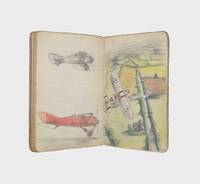
1926réf. 378080Leicestershire 1926. 216 pp. Content to most pages with intermittent and concluding blanks; 91 pp. have sketches or drawings in pencil and crayon 32 pp. of these in color. 8vo 7" x 4". Blue cloth boards with contrasting red spine ruled pages. Faint dampstaining to front board with minor staining to edges of first 15 or so leaves overall very good and images vivid. 216 pp. Content to most pages with intermittent and concluding blanks; 91 pp. have sketches or drawings in pencil and crayon 32 pp. of these in color. 8vo 7" x 4". The impressive sketches are mostly aviation scenes of biplanes in flight some from the pilot's perspective. One double-page sketch depicts a crash landing; others illustrate World War I battlefields including a grave scene with an excerpt from "In Flanders Fields." The compiler was likely John William Gannon 1904-1949 an employee at Dryad Metal Works in Leicestershire. Numerous sketches consist of diagrams of engine parts planned projects as well some non-aviation sketches e.g. jewelry pieces. An album of early aviation drawings by an accomplished artist. unknown
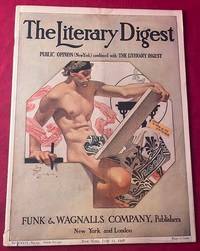
1908réf. 9516New York: Funk & Wagnalls 1908. First Edition. Original wraps. Very Good. 9 X 12 Inches. "SECRET OF THE WRIGHT AIR-SHIP" - Page 861 Important early 1908 complete issue of "The Literary Digest" featuring one of the few illustrated covers by J.C. Leyendecker. Includes the all-important four-page spread on the Wright Brothers airplane. While Orville and Wilbur had filed for a patent in 1903 and had done early public flying test runs in 1905 it wasn't until 1908 that they had mastered their plane and set off to share this information with the world. THIS IS ONE OF THE ORIGINAL EARLY MAGAZINE'S THAT SHARED THE INVENTION! This feature includes a photograph of the flyer in air as well as a diagram of how the wings work. In 1908 the Wright brothers transformed aviation from a little-known experiment into a public reality through a series of highly successful demonstrations in the United States and Europe. Their flights proved that airplanes could be controlled carry passengers and remain airborne for extended periods earning them worldwide recognition. The year also saw the first fatal airplane accident when a mechanical failure caused a crash that killed passenger Thomas E. Selfridge and seriously injured Orville Wright. By the end of 1908 the achievements of Wilbur Wright and Orville had convinced the world that powered flight was practical and marked the beginning of the aviation age. This issue also includes U.S. and world news of the day including hunger among New York schoolchildren as well as political news from Germany and Japan. Condition: Original staples clean and intact. Light rubbing and soiling to covers. Closed tear at bottom left corner of front cover. Funk & Wagnalls unknown
1937réf. 72247Detroit: Humanity Publishing Compnay 1937. First edition. Quarto. 304 pp. Profusely illustrated from photographs. Publisher's faux-morocco green cloth with yellow lettering to front and spine. Lettering a bit faded but a very clean and attractive copy.Comes with three original photographs of a plane in service to the Lawson Air Line an unusual looking biplane with a very large covered cockpit at the front of the plane. This volume definitely is more than the cover would indicate. The ads in the back are a major clue although there is a hint in the publisher's notice: "The call of the Public for full information concerning the life and deeds of ALFRED LAWSON as well as the high prices asked and paid for books and documents relating to his connection with the establishment of the AIRCRAFT INDUSTRY and AIRLINES has created the necessity for this book."The book is primarily a compilation of other articles written by Lawson about the aviation world in general. But the ads in back tell another tale. One touts: "LAWSONOMY - Alfred Lawson - coined the word LAWSONOMY for his greatest work and has dissected the appellation as follows --- LAW - Stands for the procedure of God's Eternal acts. / SON - Stands for the continuity of the procedure of God's Eternal acts. / OMY - Stands for the process of the continuity of the procedure of God's Eternal acts." The next page introduces "The First Lawsonomy Baby. The Perfect Baby." and her parents ".who gave birth to a perfectly balanced physical and mental Baby."Another ad touts "Lawsonomy: The Base of Absolute Knowledge." It includes principles such as "Lawsonomy is based upon life as it is and not upon a theory of what it ought to be. Truth is Constructive and lives but falsity is destructive and dies. Truth is real and eternal but falsity is ephemeral and abortive. Truth breeds strength and intellect but falsity breeds weakness and smart-alick-ism." The symbol in the center of the page shows Lawsonomy at the center and everything eminating from it - music art heredity culture photography penetrability history radio drama prophecy navigation electricity evolution and much much more. At the bottom: "If it isn't Truth it isn't Lawsonomy."Born in 1869 Alfred Lawson declared his birth to be ".the most momentous occurrence since the birth of mankind." He claimed that he was "destined for greatness" and "If Lawson should die today posterity will honor and glorify him as no other mortal because he has given mankind the true base from which to start an edifice of super-knowledge of the universe and its laws."Lawson tried his hand at professional baseball failing as a player as well as on the business side his newly created leagues folding almost as quickly as they were started - one within a month. He then decided to publish two aviation magazines Fly and Aircraft although he knew nothing about publishing or aviation - and Lawson acknowledged that in 1908 only three men could fly - the two Wrights and Glenn Curtiss but he downplayed their accomplishments noting that the latter could only travel in short hops. He did however become the aircraft industry's most vocal "evangelist" touting air travel as the travel of the future.Lawson had many strange ideas including the notion that physics and economics were inseparable and one could not be understood without the other. His physics however was based on even stranger principles based on "Suction" and "Pressure" and including other principles such as "Penetrability" but he saw the concept of "Energy" as a complete fabrication and fallacy. Many other weird concepts flow from these such as achieving a balanced "state of maturity" in the body "Equaeverpoise" through a combination of diet hygiene rest and exercise that would allow one to live 200 years.In part because of his "success" - he failed at baseball he failed at running an airline his books do not appear to have flown off the shelves - by 1943 Lawson decided to found a school - devoted to studying Lawsonomy. Lawson's books were the only ones allowed on campus. The biggest problem was the program took years other problems include the usefulness of the studies!. One was expected to take interim exams in 10 and 20 years and a comprehensive exam after 30 years at which point one became a "Knowledgian." Unfortunately Lawson was the only Knowledgian at the time of his death and it took a Knowledgian to bestow that degree on others. One could then go on as their post-graduate work to study Lawsonian religion. Humanity Publishing Compnay hardcover
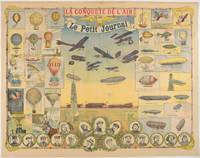
1909réf. 32820695This spectacular color lithograph commemorates the Grande Semaine d'Aviation of 1909 the first international public flying event and a turning point in aviation history. The powered aircraft featured at the event dominate the center. Surrounding it are portraits of pioneering figures in flight including Wright Curtiss Latham Fournier and Blériot and vignettes from aviation history. The event held at Reims France in August 1909 attracted more than 500000 spectators to watch famous aviators compete in contests of distance altitude and speed all from the massive grandstands constructed for the event. The meeting signified a transition in the public perception of flight. Once an experimental curiosity practiced by a few it came to be seen as a viable technology with the potential for practical application. This print a supplement to Parisian newspaper Le Petit Journal highlights technological advances in aviation history. The fall of Icarus is depicted in the upper right corner next to two unrealized designs for flying machines from the 17th century. Vignettes show the various hot air balloons of the 18th century and capture the 19th-century shift to airships capable of controlled flight. At the center the collection of heavier-than-air planes flown at Reims in the early 20th century point to the transitional nature of this pioneer era. In 1903 the Wright brothers achieved a twelve-second flight in their biplane; in 1909 technology had advanced enough for Louis Blériot to cross the English Channel in a powered monoplane. The array of airplanes shown in Reims exemplified this transformational period as Wright-style flyers and propeller-led monoplanes were featured side by side. The debut of lightweight more reliable engines at Reims also indicated the advances that were to come. The Grande Semaine showed that heavier-than-air flight was proven to be a viable technology full of possibilities. The next few decades brought the first major wartime use of airplanes the invention of the jet engine and growth of commercial aviation. Within sixty years man's "conquest of the air" had extended to outer space. This is a visually stunning record of a critical moment in technological history marking the beginning of modern aviation. Le Petit Journal
réf. a62592Washington 1989 Federal Aviation Administration. Oblong 4to 446pp. original printed wraps. A few depository library stamps and numbers on front and on title page. VG. . paperback
1925réf. 74522N.p.: Government Printing Office ca. 1925. Small octavo. Unpaginated 60 leaves. Publisher's brown cloth with cover lettering. Very good.The first page reads - Aviation Section Signal Corps U.S. Army. School or Squadron. Then in the spaces below in manuscript it reads Brooks Field Texas 9/13/23 to 4/18/1924. Harold W. Fisher. The first 28 leaves log his various flights and we learn that he graduated. He was then transferred to Air Service Advance Flying School at Kelly Field Texas where he logged another 9 leaves of flights. [Government Printing Office?] hardcover
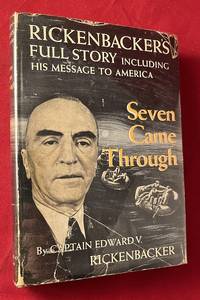
1943réf. 5515Garden City NY: Doubleday Doran and Company 1943. First Edition First Printing. Hardcover. Very Good/Very Good. 5 3/4 X 8 Inches. 118 PP. Signed "To my good friend & associate / "Hugh Knowlton" / With my very best wishes / Capt. Eddie Rickenbacker 1943" directly on the FFEP. Stated "First Edition" on the copyright page. Original price of $1.50 intact on front flap. Signed by Capt. Eddie Rickenbacker to his friend and the man largely responsible for his purchase of Eastern Airlines from General Motors in 1938. Rickenbacker a Medal of Honor Recipient is best known as the most successful fighter ace of WWI. After WWI Rickenbacker parlayed his fame into an eventual purchase of Eastern Airlines for $3.5 million. In 1942 Rickenbacker was sent by the Secretary of War Henry Stimson on a tour of Pacific Theater Operations at the outset of WWII and survived 24 days adrift at sea after his plane crashed. A clean copy with minor toning. DJ a bit chipped and worn at edges and folds. Tape repairs to inside of DJ. Doubleday, Doran and Company hardcover