500 résultats
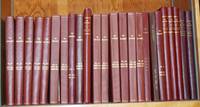
1970réf. 216453Washington DC: The International Association of Machinists and Aerospace Workers 1970. Hardcover. Twenty four professionally bound volumes of the newspaper a complete run up to Feb. 1970. Large folios 11.5x19.25 inches all bound in maroon or brick red buckram with spine titles the newsprint is evenly browned without any chipping and still flexible some issues have mailing labels no other flaws. Illustrated. A very large and heavy set international shipping will be expensive. The International Association of Machinists and Aerospace Workers hardcover books
1960réf. 168847San Jose / Salinas: I. A. of M. and A. W. 1960. Respectively 26p. and 7p. similar 5.5x3.5 inch staplebound wraps format the one laid into the other. A rear blank for "Notes" has been torn out causing its signature opposite title leaf to be loose. Staples are a tad rusty centerfold of the longer booklet has sustained a small tear and blue-pencil smears pencil used as bookmark. Fully usable copies. The pair. I. A. of M. and A. W. unknown books
1973réf. 210406Detroit: UAW 1973. Pamphlet. 6p. wraps 8.5x11 inches very good. UAW unknown books
1978réf. 123313New Britian Connecticut U.S.A.: Lexington Books 1978 hardback book in near fine conditionstamped aerospace library. Hardcover. Near Fine. New Britian, Connecticut, U.S.A.: Lexington Books hardcover
1970réf. 010234Fort Wayne Indiana: International Telephone and Telegraph Corporation ITT-Aerospace/Optical Division 1970. Hardcover. Very Good/No Jacket. 4to - over 9¾" - 12" tall. chapter pagination; HB 3-ring binder; blk.w/chromeno title; slight rub; PONtitle; some notes; cleantight pgs. Volume 1 summary sheets and section 1 through section 9. Made for Dept.of Trans. FAA Contract DOT FA 70WA-2288 dated January 13 1970. "This instruction book provides the information necessary to install align operate and maintain the Type FA-8190 UHF Transceiver. International Telephone and Telegraph Corporation, ITT-Aerospace/Optical Division hardcover
1990réf. 237732PN. New. 1990. Soft Cover. Date is original print. This is a reprint edition . PN paperback
1972réf. 2081502112501363A5 Revised new edition Volume 1-5 First edition Volume 6-8 Boxed Publishing Co. Ltd. 1972. Soft Cover. Fine. Number of books: 1 A5 Revised new edition [Volume 1-5] First edition [Volume 6-8] Boxed Publishing Co., Ltd. paperback
2016réf. 2092902140700909Japan Aerospace Exploration Agency 2016. Soft Cover. Fine. Size: A4 Number of books: 1 book Japan Aerospace Exploration Agency paperback
2005réf. 88970Japan: JAXA Japan Aerospace Exploration Agency c2005. Presumed First Edition First printing thus. Single sheet printed on one side contains 4 detachable stickers. Very good. The format is approximately 84.75 inches by 1.75 inches. RARE. The patch is in a clear plastic sleeve. One four-part patch illustrating in color aspects of the Kibo Japanese Experiment Module are highlighted. There are illustrations of 1J/A 1J 2 J/a along with Kibo on this four circle patch. The Japan Aerospace Exploration Agency JAXA 'National Research and Development Agency Aerospace Research and Development Organization' is the Japanese national air and space agency. Through the merger of three previously independent organizations JAXA was formed on 1 October 2003. JAXA is responsible for research technology development and launch of satellites into orbit and is involved in many more advanced missions such as asteroid exploration and possible human exploration of the Moon.2 Its motto is One JAXA and its corporate slogan is Explore to Realize formerly Reaching for the skies exploring space. Kib Japanese: 'Hope' also known as the Japanese Experiment Module JEM is a Japanese science module for the International Space Station ISS developed by JAXA. It is the largest single ISS module and is attached to the Harmony module. The first two pieces of the module were launched on Space Shuttle missions STS-123 and STS-124. The third and final components were launched on STS-127. NASA launched the JEM complex over three flights using the Space Shuttle. The shuttle had a large payload bay which carried the modules into orbit along with the crew. This is in contrast to the Russian modules which are launched into orbit on multistage Proton rockets and then rendezvous and dock with the station automatically. On 12 March 2007 the Experiment Logistics Module-Pressurized Section ELM-PS the main laboratory arrived at the Kennedy Space Center KSC from Japan. It was stored in the Space Station Processing Facility SSPF until launched into orbit aboard Endeavour on 11 March 2008 as part of the STS-123 mission. On 30 May 2003 the Pressurized Module PM arrived at KSC from Japan. It was stored at the SSPF until launched into orbit aboard Discovery on 31 May 2008 as part of the STS-124 mission. On 3 June 2008 the PM was attached to the Harmony module. At first the ELM-PS the small cargo bay was connected to a temporary location on Harmony and later on 6 June 2008 was moved to its final berthing location on top zenith of the main laboratory. The Exposed Facility EF and Experiment Logistics Module-External Section ELM-ES arrived at KSC on 24 September 2008. The two elements were launched on Endeavour on 15 July 2009 as part of the STS-127 mission. The ELM-ES was brought back to Earth at the end of the mission. The assembly of the EF was completed during the fifth spacewalk of the mission. JAXA (Japan Aerospace Exploration Agency) unknown
1965réf. 18487Presses Universitaires de France 1965 collection Que sais-je #1198. in12. 1965. broché. Cet ouvrage publié en 1965 dans la collection Que sais-je ? traite des problèmes physiologiques rencontrés par les cosmonautes lors des vols spatiaux. Préfacé par le général Grandpierre il offre une première approche des défis physiques et médicaux auxquels sont confrontés les hommes de l'espace. Il s'agit d'une réédition numérique d'un livre du XXe siècle
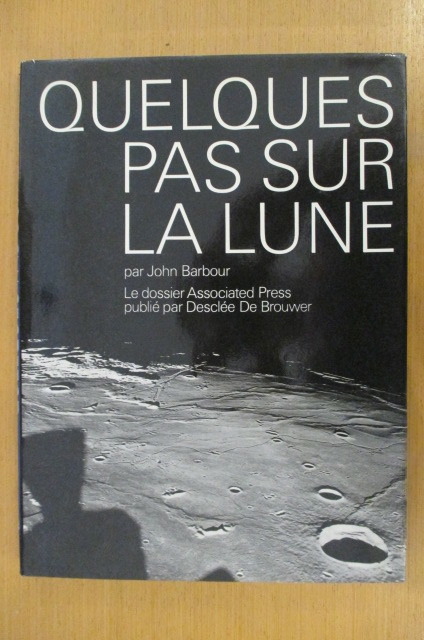
réf. ESP028C431969 / 214 pages. Relié avec jaquette. Editions Desclée De Brouwer
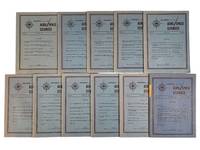
1959réf. 223131959. Journal of the Aerospace Sciences 1959 documents foundational research in American aerospace engineering during the early Cold War space race. Published the year after the establishment of NASA and amid intensified U.S. efforts to match Soviet rocket achievements following the 1957 launch of Sputnik these issues contain contemporary technical studies on hypersonic aerodynamics missile stability spacecraft propulsion and planetary trajectory design. Articles by scientists and engineers working at leading research institutions and government laboratories record the theoretical groundwork that would shape the next decade of American spaceflight including early analytical work on Mars trajectories reentry materials and competing propulsion systems for interplanetary travel. Journal of the Aerospace Sciences. Volume 26 numbers 1 2 4 5 6 7 8 9 10 11 and 12. New York: Institute of the Aeronautical Sciences 1959. Eleven issues from the journal's 1959 volume lacking only the March issue. The periodical served as the principal research forum of the Institute of the Aeronautical Sciences the professional organization that later became the American Institute of Aeronautics and Astronautics. Together these figures represent a cohort of scientists who would define American spaceflight theory and practice in the decade to come.Archive consists of 11 printed volumes in original wrappers approx. 50-80 pages per issue totaling over 800 pages. This archive includes: Volume 26 No. 1 January 1959: Features research on turbulent skin-friction drag at supersonic speeds jet nozzle structures nonlinear flutter problems and B-47 gust response. Includes Frank E. Goddard Jr. T.C. Adamson Jr. S.P. Shen. Vol. 26 No. 2 February 1959: Contains work on spiked bodies at hypersonic speeds reentry missile stability and panel flutter. Contributors include Seymour M. Bogdonoff E.V. Laitone and Frederick L. Ryder. Vol. 26 No. 4 April 1959: Publishes the Twenty-Second Wright Brothers Lecture by Maurice Roy of ONERA France. Other articles include thermal stresses hypersonic shock tunnels and boundary-layer transition. Vol. 26 No. 5 May 1959: Focuses on heat transfer at hypersonic speeds lift-drag ratios at supersonic speeds low-thrust spacecraft flight mechanics and chemically reacting boundary layers. Authors include A.J. Hanawalt Clinton E. Brown and Daniel E. Rosner. Vol. 26 No. 6 June 1959: Includes Hans Bethe's paper on the ablation of glassy materials structural matrix analysis and free-molecule flow dynamics. Vol. 26 No. 7 July 1959: Features M.A. Biot on thermomechanical reciprocity airplane turbulence responses and reentry motion. Also includes research on fatigue stress and laminar dissociated airflows. Vol. 26 No. 8 August 1959: Discusses transonic wing/body aerodynamics supersonic plate divergence mercury plasma tunnels and propellant burning models. Includes Hans U. Eckert. Vol. 26 No. 9 September 1959: Opens with Richard H. Battin's landmark article on planetary reconnaissance trajectories from MIT along with contributions on missile drag optimization rocket flight variational problems and real-gas flows. Vol. 26 No. 10 October 1959: Features George Paul Sutton's comprehensive comparison of interplanetary propulsion systems addressing ion rockets nuclear heating and solar sails. Also includes optimal aircraft climb paths and spherical cap snapping. Vol. 26 No. 11 November 1959: Includes studies on flutter energy equations jet-flap compressors porous-wall cooling and actuator disc dynamics in turbomachinery. Vol. 26 No. 12 December 1959: Closes the year with work on thermal buckling subsonic turbulence reattachment zoom climb optimization and hypersonic similitude. Contributors include Carl Gazley Jr. Wallace D. Hayes and George Gerard. In 1959 the Journal of the Aerospace Sciences served as the official scientific platform for cutting-edge American aerospace research marking the transition from aeronautical to astronautical engineering. That year saw sustained focus on hypersonics ballistic missile trajectories spacecraft propulsion and heat transfer under extreme atmospheric conditions as the U.S. sought to stabilize its strategic position after the 1957 Sputnik crisis and ahead of the 1960 Mercury program. Research in these volumes was underwritten by military contracts NASA collaboration established in 1958 and Cold War exigencies. Light foxing to several wrappers particularly July issue; some edge wear and surface abrasions. Two issues show sticker residue at spine or lower edge. Interiors uniformly clean bindings firm and covers largely bright and intact. Overall very good condition. The studies record the technical environment that produced early American satellite programs and later lunar navigation systems linking university laboratories defense contractors and federal research agencies. unknown
1959réf. 223131959. Journal of the Aerospace Sciences 1959 documents foundational research in American aerospace engineering during the early Cold War space race. Published the year after the establishment of NASA and amid intensified U.S. efforts to match Soviet rocket achievements following the 1957 launch of Sputnik these issues contain contemporary technical studies on hypersonic aerodynamics missile stability spacecraft propulsion and planetary trajectory design. Articles by scientists and engineers working at leading research institutions and government laboratories record the theoretical groundwork that would shape the next decade of American spaceflight including early analytical work on Mars trajectories reentry materials and competing propulsion systems for interplanetary travel. Journal of the Aerospace Sciences. Volume 26 numbers 1 2 4 5 6 7 8 9 10 11 and 12. New York: Institute of the Aeronautical Sciences 1959. Eleven issues from the journal's 1959 volume lacking only the March issue. The periodical served as the principal research forum of the Institute of the Aeronautical Sciences the professional organization that later became the American Institute of Aeronautics and Astronautics. Together these figures represent a cohort of scientists who would define American spaceflight theory and practice in the decade to come.Archive consists of 11 printed volumes in original wrappers approx. 50-80 pages per issue totaling over 800 pages. This archive includes: Volume 26 No. 1 January 1959: Features research on turbulent skin-friction drag at supersonic speeds jet nozzle structures nonlinear flutter problems and B-47 gust response. Includes Frank E. Goddard Jr. T.C. Adamson Jr. S.P. Shen. Vol. 26 No. 2 February 1959: Contains work on spiked bodies at hypersonic speeds reentry missile stability and panel flutter. Contributors include Seymour M. Bogdonoff E.V. Laitone and Frederick L. Ryder. Vol. 26 No. 4 April 1959: Publishes the Twenty-Second Wright Brothers Lecture by Maurice Roy of ONERA France. Other articles include thermal stresses hypersonic shock tunnels and boundary-layer transition. Vol. 26 No. 5 May 1959: Focuses on heat transfer at hypersonic speeds lift-drag ratios at supersonic speeds low-thrust spacecraft flight mechanics and chemically reacting boundary layers. Authors include A.J. Hanawalt Clinton E. Brown and Daniel E. Rosner. Vol. 26 No. 6 June 1959: Includes Hans Bethe's paper on the ablation of glassy materials structural matrix analysis and free-molecule flow dynamics. Vol. 26 No. 7 July 1959: Features M.A. Biot on thermomechanical reciprocity airplane turbulence responses and reentry motion. Also includes research on fatigue stress and laminar dissociated airflows. Vol. 26 No. 8 August 1959: Discusses transonic wing/body aerodynamics supersonic plate divergence mercury plasma tunnels and propellant burning models. Includes Hans U. Eckert. Vol. 26 No. 9 September 1959: Opens with Richard H. Battin's landmark article on planetary reconnaissance trajectories from MIT along with contributions on missile drag optimization rocket flight variational problems and real-gas flows. Vol. 26 No. 10 October 1959: Features George Paul Sutton's comprehensive comparison of interplanetary propulsion systems addressing ion rockets nuclear heating and solar sails. Also includes optimal aircraft climb paths and spherical cap snapping. Vol. 26 No. 11 November 1959: Includes studies on flutter energy equations jet-flap compressors porous-wall cooling and actuator disc dynamics in turbomachinery. Vol. 26 No. 12 December 1959: Closes the year with work on thermal buckling subsonic turbulence reattachment zoom climb optimization and hypersonic similitude. Contributors include Carl Gazley Jr. Wallace D. Hayes and George Gerard. In 1959 the Journal of the Aerospace Sciences served as the official scientific platform for cutting-edge American aerospace research marking the transition from aeronautical to astronautical engineering. That year saw sustained focus on hypersonics ballistic missile trajectories spacecraft propulsion and heat transfer under extreme atmospheric conditions as the U.S. sought to stabilize its strategic position after the 1957 Sputnik crisis and ahead of the 1960 Mercury program. Research in these volumes was underwritten by military contracts NASA collaboration established in 1958 and Cold War exigencies. Light foxing to several wrappers particularly July issue; some edge wear and surface abrasions. Two issues show sticker residue at spine or lower edge. Interiors uniformly clean bindings firm and covers largely bright and intact. Overall very good condition. The studies record the technical environment that produced early American satellite programs and later lunar navigation systems linking university laboratories defense contractors and federal research agencies. unknown books
1974réf. 748530PN. New. 1974. Soft Cover. Date is original print. This is a reprint edition. . PN paperback
2016réf. 2091202133203087K-VART 2016. Soft Cover. Fine. Volume: 1 K-VART paperback
1964réf. 09958US: Aerospace Research Laboratory Office of Aerospace Research U.S. Air Force 1964. First Edition. Paperback. Fair/No dust jacket. 10.7 x 8.4 x 0.8 inches. Paperback publication. The covers and title page have organization stamps number marked near the spine and the previous owner's name. The covers have some edge wear and tear and a few creases. The spine is creased. The binding is tight. The interior pages are clean and unmarked. Electronic delivery tracking will be issued free of charge. ARL 64-34 Aerospace Research Laboratory, Office of Aerospace Research, U.S. Air Force paperback
2013réf. BN193760Elsevier Science Publishing Co Inc 2013. 2013. Hardcover. Product Manufacturing and Cost Estimating using CAD/CAE Product Manufacturing and Cost Estimating using CAD/CAE Kuang-Hua Williams Presidential Professor School of Aerospace and Mechanical Engineering AME University of Oklahoma Norman OK USA Chang Elsevier Science Publishing Co Inc hardcover
réf. ria9781394187454_inpHardback. New. New Book; Fast Shipping from UK; Not signed; Not First Edition; N/A hardcover
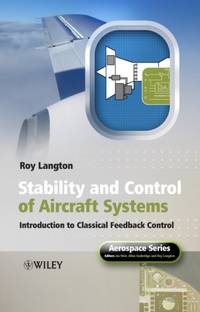
réf. ria9780470018910_inpHardback. New. New Book; Fast Shipping from UK; Not signed; Not First Edition; Introduction to Feedback Control provides an easy to read and to understand monograph that describes control theory using minimal mathematics and focusing on simple rules tools and methods for the analysis and testing of feedback contr hardcover
réf. ria9781119382911_inpPaperback / softback. New. New Book; Fast Shipping from UK; Not signed; Not First Edition; N/A paperback
1998réf. __1840148233Ashgate Pub Ltd 1998. Hardcover. New. illustrated edition. 250 pages. 9.50x6.50x1.00 inches. Ashgate Pub Ltd hardcover
1963réf. 5211Washington D. C.: Library of Congress. Very Good with no dust jacket. 1963. First Edition. Softcover. This new publication containing 594 entries 510 institutes and 84 laboratories . Names of institutes are given as found in Soviet sources published for the most part in 1962 and in a few cases 1963. Light blue stiff wraps with blue cloth spine. Uncommon in the trade.; 8-1/2" x 11"; ix 133 pp; Mild soiling/wear to wraps prior owner name stamped to front cover clean and unmarked within. . Library of Congress paperback
1961réf. 713088PN. New. 1961. Soft Cover. Date is original print. This is a reprint edition. . PN paperback
1963réf. 718307PN. New. 1963. Soft Cover. Date is original print. This is a reprint edition. . PN paperback
1961réf. 714627PN. New. 1961. Soft Cover. Date is original print. This is a reprint edition. . PN paperback