222 résultats
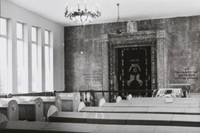
réf. 24786Israel: NP n/d. vg. Oblong quarto. Bolted blue faux-leather with inlaid b/w reproduction of a photograph of the exterior of the synagogue. Inside of front and back board lined in silk-moire. This unique album was presented to Mr. & Mrs. Harry Burston on occasion of their visit to Israel on October 1971. Printed presentation plates in English and Hebrew on title-page. Verso of title-page with 39 original signatures of guests who attended the reception at the synagogue on Nov. 1 1971. Album contains 14 original 4 1/4" x 6 1/2" glossy b/w photographs inserted on card stock. Each photo protected by tissue guard. One photo shows the exterior the rest is of the interior of the Synagogue and Cultural Center in Tel-Aviv. Photographs with captions in English and Hebrew. "In Eternal Memory: This building was built in Memory of the Jewish Communities in China by Igud Yotzei Sin in Israel. The construction of the building was possible thanks to the Administrator General and Official receiver of the State of Israel who handed over the proceeds received from the sale of the Synagogue in Shanghai and through the generous donations from the former residents of China in Israel and all over the world. The building was set thanks to the great devotion extended by the President of the Building Committee Mr. M. A. Zaigraeff. The inauguration of the skeleton of the building took place on the 20th August 1959. The inauguration of the opening of the building took place on 6th September 1961. Architects & Building plans: Mr. G. Rabinovitch Mr. A. Kahane Aron Kodesh." In 1951 a group of Jewish leaders from several communities of former China residents in Israel founded "Igud Olei Sin" which was later changed to "Igud Yotsei Sin." Small sticker of S. Sanzetti Photo Studio on inside of rear board. Minor age toning on title-page and on margin of card stock. Near fine condition. Unique copy. NP unknown books
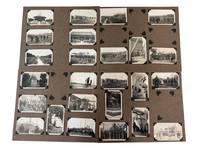
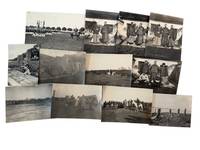
1910réf. 235901910. Late Qing China and Philippines photo archive depicting military authority public punishment foreign presence and imperial architecture circa 1910 in the years immediately before the Xinhai Revolution ended dynastic rule in China. The Chinese photographs show Beijing monuments urban crowds soldiers execution spectators and foreign personnel at a moment when Qing authority remained visible but unstable. The group places tourist views of imperial architecture beside scenes of coercion and military order linking travel photography to the political crisis of the late Qing state. Photo archive of 32 silver gelatin photographs each 2.5 x 4.25 inches cornered in on 11 x 13.5 inch brown album leaves mainly China with several Philippines views circa 1910. The images show Beijing landmarks including the Temple of Heaven palace buildings imperial gates stone lions carved walls ceremonial terraces walled compounds and garden architecture. Several views show Chinese crowds gathered near military or judicial scenes including a public execution aftermath with a severed head displayed from a pole before laughing onlookers and children with a placard stating the events transpired. Other photographs show Chinese soldiers and civilians in open grounds foreign military or naval personnel a group of men in white naval style uniforms seated in a circle Chinese junks harbor traffic street scenes rickshaws and colonial buildings. The Philippines photographs appear to include Manila street and harbor views a woman and girl a domed theater or civic building tropical shoreline and American colonial urban scenes. China in 1910 stood between the punitive settlement that followed the Boxer Rebellion and the republican revolution that began in Wuchang in October 1911. Foreign troops remained in North China under treaty rights imperial and provincial authorities tried to preserve order through policing army reform and public punishment and revolutionary societies used anti Manchu and anti foreign resentment to attack the legitimacy of Qing rule. The execution photographs show law as spectacle with the punished body displayed before civilians and soldiers rather than hidden within prison administration. The Beijing views record the ceremonial architecture of the dynasty at the same time that its political power was nearing collapse while the Philippines views place China within a wider American and European imperial geography of ports garrisons and colonial travel. Light surface wear toning and occasional fading; mounted with photo corners on album leaves. Overall very good condition. A concentrated visual record of military order public punishment foreign presence and imperial space in East Asia immediately before the fall of the Qing dynasty. unknown books
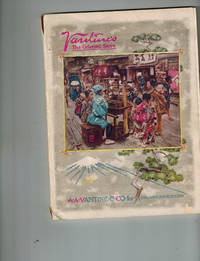
1916réf. 007165New York: A.A. Vantine & Co. Inc. 1916. Magazine. Very Good Plus. Pictorial Printed Wrappers. First Edition. 8vo - over 7¾" - 9¾" tall. A RARE catalogue and in lovely condition of the major importer of Oriental goods into America from 1866 to 1921. Very Good Plus in original full color pictorial wrappers 120 pp. plus 2 order pages at rear pre-addressed envelope tipped at page 106. numerous black and white and color photographs throughout small tears at spine ends small spot rear wrapper else Near Fine. In 1916 Vantine's was located at Fifth Avenue and 39th Street. Clothing furniture housewares fabric toys and other merchandise imported from China and Japan are described in the catalogue and merchandise from Vantine's has been avidly collected over the years. Worldcat locates no copies of the 1916 edition. A.A. Vantine & Co., Inc. Paperback books
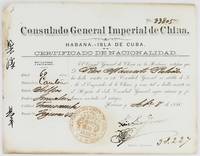
1880réf. 2592Havana: September 8 1880. Very good. Partially-printed broadside 6.5 x 8.25 inches completed in manuscript in Spanish and Chinese. Small marginal wormhole mild edge wear light toning. Ink stamp of the Consulado General at bottom-center. A scarce certificate issued in 1880 by the Chinese Consulate in Havana authenticating the registration and details of a Chinese laborer in Cuba. The printed form is completed in manuscript with the name of the recipient his age place of origin occupation and place of residence. The present examples were completed for a sixty-year-old laborer from Canton being called Pedro Pulido who was going to work and/or live at 48 Calle Figueroa in Havana. The printed text states that "El Cónsul General de China en la Habana certifica que blank ha hecho constar en este Consulado General ser súbdito de S.M. el Emperador de la China y como tal se halla inscrito en el Registro de dicho Consulado General segun número y filiacion anotados al márgen." The certificate is dated September 8 1880 and is stamped with the seal of the consulate in red and with the rubberstamped signature of the Consul General Lin Liang Yuan. The form are also bears two ink signatures in Chinese in the left margin a rare occurrence. An excellent document of the bureaucracy surrounding imported Chinese labor to Cuba in the last quarter of the 19th century. September 8 unknown books
1974réf. 006070No Place: China Painting Association 1974. Book. Near Fine. Pictorial Printed Wrappers. First Edition. Elephant Folio - over 15" - 23" tall. Both volumes Near Fine small marginal stains first 3 pages of No. 1. China Painting Association Paperback books
1949réf. AG20030MAGAZINE: Knowledge-Special Issue for 3 Years Anniversary æ‚å¿—ã€ŠçŸ¥è¯†ã€‹çºªå¿µåˆ›åˆŠä¸‰å‘¨å¹´çºªå¿µå· Shenyang: Published by Northeast Bookstore May 1 1949 special issue for the 3-year anniversary of Knowledge magazine. Volume 11 Issue 2. 8vo 37pp. Printed pictorial wrappers Spine stapled with 4 restapling holes on right minor tears and stained to cover shelf worn overall good condition. Shenyang Northeast Bookstore is the press was led by China Communist Party Propaganda Department. Chairman Mao wrote an inscription of quotation from Confucius "To learn something and timely practice it" for the magazine on the title page. The cover has a picture: Move Forward Under Chairman Mao's Flag depicting a portrait of Mao and the Red Army with army's flag as background troops are moving forward below handwriting on the bottom: Present to Members of All-China Youth Federation music for 'Protect Peace of the World' on the back cover. 1949年5月1日,知识æ‚志社·东北书店å‘行,作为创刊三周年纪念å·ã€‚第å一å·ç¬¬äºŒæœŸï¼Œå…±37页。å°çš®æœ‰è½»å¾®æ’•è£‚和污æ¸ï¼Œå°ºå¯¸8vo,å“相较好。 沈阳东北书店出版社是ä¸å…±ä¸å¤®ä¸œåŒ—å±€å®£ä¼ éƒ¨é¢†å¯¼çš„å‘行机构,毛主å¸å¼•ç”¨äº†å”å的论è¯ä¸çš„"学而时习之"为本书题è¯ã€‚æ‚å¿—å°é¢ä¸ºå›¾ç‰‡"在毛泽东的旗帜下å‰è¿›",下é¢æœ‰æ‰‹å†™å—ä½“ï¼šèµ å…¨å›½é’代大会代表。 Northeast Bookstore paperback books
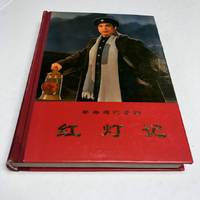
1972réf. AG-10057The Red Lantern Script红ç¯è®° Hong Deng Ji Beijing: Published by People's Publishing House printed by Beijing Xinhua Printing Factory distributed by Xinhua Bookstore Beijing Distributing Agency February 1972 FIRST EDITION 8vo. The May 1970 Script Revised Collectively by the China Peking Opera Troupe. iv374 pp. colophon consists of scripts stage photos selected theme score stage action instructions and designs beginning with quotations from Chairman Mao on the second and third pages printed pictorial stiff cover wrappers fine condition. 京剧《红ç¯è®°ã€‹å‰§æœ¬ 北京:人民出版社出版,中国京剧团集体制作,基于1970年五月演出本,1970年12月第一版,书的å‰ä¸¤é¡µæœ‰æ¯›ä¸»å¸è¯å½•ï¼Œå…±374页主体内容。精装,å“相éžå¸¸å¥½ã€‚ People’s Publishing House hardcover books
1934réf. AG20010SUPPRESSING COMMUNIST-BANDITRY IN CHINA 中国共产党的镇压-汤良礼 Shanghai: Published by China United Press June 1934 this book belongs to China To-Day series Volume 1 introduced the Communist movement in China and the effect to the Republic government during the past years illustrated with text and photos large 8vo x110pp. printed cloth covers missing front free endpaper light foxing to the bottom edge of some pages else fine condition. 上海è”åˆå‡ºç‰ˆç¤¾1934年出版,本书为今日ä¸å›½ç³»åˆ—丛书的第一部,用文å—和照片的形å¼ä»‹ç»äº†å…±äº§å…šåœ¨è¿‡åŽ»ä¸€äº›æ—¶é—´çš„活动以åŠå¯¹æ°‘国政府产生的一些影å“。18×25cm,110页,精装帆布硬质å°çš®ï¼Œå†…页下边缘少许磨æŸï¼Œå…¶ä»–å“相æžå¥½ã€‚ China United Press hardcover books
1927réf. 009475New York: Privately Printed for A. W. Bahr 1927. Book. Fine. Cloth. First Edition. 4to - over 9¾" - 12" tall. Printed by R. R. Donnelley & Sons Co. at the Lakeside Press Chicago. Fine in original green cloth with black label at spine printed and ruled in gilt in unprinted brown paper jacket Near Fine chip at bottom edge of spine. Prior owner's name label front flap and his small bookplate front paste down hidden by front flap. 51 pp. text followed by 36 plates 3 of which are colored. SCARCE. Privately Printed for A. W. Bahr Hardcover books
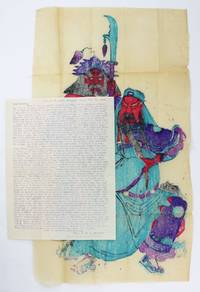
1928réf. 6054Shanghai China: February 24 1928. Very good. 1p. plus colored woodblock print 21.5 x 12.5 inches. With original envelope. Old folds minor wear. Mimeographed fundraising letter sent by Reverend H.G.C. Hallock to a supporter in Vermont. Henry Galloway Comingo Hallock 1870-1951 was a West Virginia native who studied at Princeton Theological Seminary. He moved to China as a Presbyterian missionary and teacher in 1905 where he taught Sunday School served as a pastor and also taught theology at St. John's University in Shanghai. He survived war disease famine and a Japanese prison during World War II; he died in China in 1951. One thing that set Hallock apart was his inclusion of local Chinese woodblock prints with his fundraising letters which today have become desirable collectibles. Such a print is present here showing the God of War Wu-ti. His letter opens discussing the print: "Wars in China suggest sending you 'Wu-ti' the Chinese god-of-war. . The general idea about Wu-ti is that he delights in war. That is not the Chinese idea of him. . Officials and scholars worship him as the ideal of loyalty soldiers do it to make them brave and protect them in battle and the people worship him to protect them from war's horrors. He's called 'Peace Bringer Protector Great God of Loyalty.' But he makes not peace nor protects nor makes loyal so is a failure. He's also called 'Warrior Prince.' As to that name he's a great success! There are lots of wars." He goes on to discuss the many conflicts which are like "a real Chinese puzzle" noting that it's not the people of China who are at issue or fault. "Recently I have received letters from America suggesting that since 'China has altogether gone to the bad and the Chinese are absolutely impossible' and since our 'work among them has gone for nothing' then I should 'quit and come home.' I hope you don't think thus. The masses of Chinese tho reminding me of 'dumb driven cattle' are still friendly as ever. The war-lords the Nationalists the Reds the bandits wars and evil propaganda are disturbing elements; but they are NOT China nor the Chinese. . The troubles in China have come from a fiercely aggressive and 'noisy minority' who make the great mass of Chinese suffer untold hardships." He goes on to defend the Christian work being done in China as of great benefit to the people. February 24 unknown books
1933réf. AG20055YOUNG CHINA Magazine年轻的中国 Toronto: the monthly magazine of the comradeship for China the young People's Department of the China inland mission. 1933-1934 volume vii and viii together 24 issues. Articles about the Chinese people written by journalists in China with photos illustrated for the rest of the world Index of 2 volumes including titles of paper making in china Burmese girls at play disbelieving does not change the truth large 8vo 143pp. 16 leaves index bound in hard titled boards near fine condition. $850 《年轻的中国》1933-1934年出版于多伦多,1-12å†Œï¼Œæ–‡ç« ä¸ºåœ¨ä¸å›½çš„记者写的关于ä¸å›½çš„故事,é…有照片和图片。18×25cm,硬皮包装为官方åˆè®¢ï¼Œå…±143页,åŽé¢æœ‰32页文章目录。 Toronto hardcover books
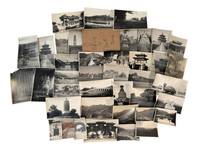
1910réf. 235921910. Peking and North China travel photo archive circa 1912 to 1918 documenting the former imperial capital during the turbulent opening years of the Republic of China when centuries of Qing imperial rule had only recently ended and Beijing remained the political and cultural heart of northern China. The photographs record a landscape where imperial monuments Buddhist temples ancient roads and rural villages continued to define daily life despite the collapse of the dynasty in 1912. Produced during the era that followed the Xinhai Revolution and preceded the consolidation of the warlord period the archive preserves a city and surrounding countryside poised between imperial tradition and an uncertain republican future. Photo archive of 40 original silver gelatin photographs ranging from approximately 2 × 3 inches to 4 × 6 inches Peking Beijing and North China circa 1912 to 1918. The photographs depict the Temple of Heaven the Summer Palace Pei Hai Beihai Park the Forbidden City and its surrounding walls the White Dagoba at Miaoying Temple monumental ceremonial gateways pagodas temple courtyards the Great Wall north of Peking the Western Hills stone bridges lakes canals and mountain landscapes. Other photographs show Buddhist monks walking through temple precincts camel caravans crossing rocky valleys mule carts on country roads grazing livestock village architecture and rural agricultural scenes beyond the capital. Contemporary manuscript captions identify numerous locations including "The Great Wall of China" "Temple of Heaven Peking" "Pei Hai Grounds Peking" "Bridge over stream between Jade Fountain & Summer Palace" "The 3rd Green Golf at Paomachang Peking" "Western Hills near Peking" "Camel Drive at the Great Wall Nankow Pass north of Peking" and "Temple in the Western Hills near Peking Golden Roof." One inscription notes that several views "were taken by the younger Miss Dunne last summer" preserving a small but meaningful record of the archive's contemporary provenance. This photo archive belong to one of the most consequential transitions in modern Chinese history. The Qing dynasty collapsed in 1912 after more than two and a half centuries of rule ending the imperial system that had governed China since 221 BCE. Although the Republic of China replaced the monarchy Beijing remained filled with imperial architecture ceremonial spaces and religious institutions whose daily rhythms changed only gradually. The Forbidden City was still occupied by the abdicated emperor Puyi until 1924 Buddhist monasteries continued to function throughout the Western Hills and camel caravans remained an essential means of transporting goods across northern China's mountain passes. Foreign travelers could still move through monuments that only a generation earlier had been closely associated with imperial authority while political power increasingly shifted among competing republican governments and regional military leaders during the emerging Warlord Era. Rather than emphasizing political upheaval directly the archive records the remarkable continuity of Beijing's monumental landscape and traditional patterns of travel religion and commerce immediately after the fall of the last Chinese dynasty. Light surface wear occasional corner creasing and scattered silvering consistent with age; manuscript identifications on many versos. Overall in very good condition. A concentrated visual record of Peking and North China at the moment imperial China gave way to the Republic preserving both the enduring ceremonial landscape of the Qing capital and the traditional life that continued beneath profound political change. unknown books
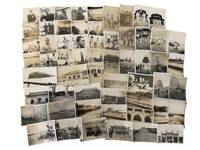
1933réf. 236941933. Colonial Italian Navy photo archive depicting sailors of the gunboat Lepanto in China circa 1933 to 1943 documenting Italy's Tianjin concession Italy's formal colonial territory in China granted in 1901 following the Boxer Rebellion. It covered approximately half a square kilometer and was strategically located on the east bank of the Hai River. Tianjin concession was governed by an Italian military official and maintained its own police force and legal framework. the Italian Navy maintained a strategic presence in China with personnel and several vessels including the gunboats Lepanto and Carlotto to protect Italian concessions in Tianjin and Shanghai. Originally built as an Azio class minelayer Lepanto reached Shanghai in 1933 and was reclassified as a gunboat in 1934 for coastal and Yangtze service protecting Italian citizens missions and treaty port interests. A United States Navy photograph places the vessel on the Whangpoo River at Shanghai during the mass evacuations of 1937 where foreign warships occupied the same congested waterway as refugee steamers and commercial traffic. The archive records this overseas station from the viewpoint of its sailors moving between shipboard hierarchy armed readiness collective leisure Chinese urban life and monumental sites visited under naval escort. Photo archive of 58 silver gelatin photographs ranging from 2" x 2" to 2" x 3.5" China circa 1933 to 1943. The photographs show Lepanto moored in Chinese harbors; Italian sailors posed on deck beside shipboard fittings and beneath the motto "In hoc signo vinces"; officers addressing assembled crews; uniformed men gathered around deck guns; rifle practice on open ground; sailors carrying packs and weapons; and formal and informal portraits of ratings petty officers and decorated officers. Group photographs place sailors at the Temple of Heaven and before other Chinese ceremonial buildings gates monuments and courtyards while wider views record Shanghai and Tientsin waterfronts docks municipal architecture Chinese junks sampans bridges rail lines and harbor shipping. Several images show Chinese residents at close range including children boatmen laborers and crowds encountered during shore leave; others depict shipboard entertainments meals athletic groups relaxed deck scenes and men photographed in work clothes apart from formal naval ceremony. The recurrence of the vessel uniformed crews weapons exercises official gatherings and organized excursions establishes the working structure of an Italian station ship rather than a general tourist itinerary. Italy's naval deployment in China descended from the foreign military privileges established after the Boxer Uprising including the Italian concession at Tientsin and the maintenance of armed detachments consular facilities and river patrol vessels. Lepanto replaced the aging gunboat Sebastiano Caboto and spent a decade operating from Shanghai and along the Yangtze using its shallow draft to reach places inaccessible to larger warships during years of civil conflict Japanese expansion and the Sino Japanese War. Following Italy's armistice with the Allies the crew scuttled Lepanto at Shanghai on September 9 1943 to prevent seizure; Japan raised and recommissioned the vessel as Okitsu in 1944 and the Republic of China received it after Japan's surrender operating it as Hsien Ning. Light surface wear toning occasional creasing and minor edge wear; photos remain legible and mostly clean. Overall in very good condition. A detailed visual record of how an Italian gunboat crew carried naval authority Fascist state ceremony armed preparedness and foreign privilege into the ports and public spaces of Republican China. unknown books
1933réf. 709351933. Macau: Imprensa Nacional 1933. Macau: Imprensa Nacional 1933. Rare 1933 Digest of Laws Regulating Macau's Sex Trade Macau. China. Prostitution. Regulamento das Meretrizes Aprovado pelo Portaria Provincial No. 1:093 De 7 de Abril de 1933. Macau: Imprensa Nacional 1933. 22 pp. Text in Portuguese and Chinese. Stitched pamphlet in printed paper wrappers. Some edgewear a few chips and minor tears to wrappers early annotations to front wrapper light toning to interior. $950. Only edition located. Laws governing prostitution in the Portuguese colony of Macau 1557-1999 were first enacted in the mid-nineteenth century. By the 1930s the government administered the trade directly through the Regulamento das Meretrizes. No copies located on OCLC. unknown books
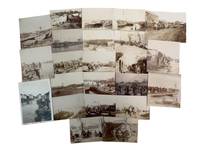
1900réf. 238871900. Peking and northern China photographic archive documenting everyday commerce informal labor transportation and waterfront life during the final Qing and early Republican periods circa 1900 to the 1920s. Rather than concentrating on monuments or official events the photographs turn repeatedly toward merchants barbers vendors boatmen fishermen cart drivers and working streets. French manuscript captions identify Peking Tien Tsin and other northern Chinese locations suggesting a Francophone traveler recording the commercial and social landscape encountered along the route. Early twentieth century photographs of China survive in substantial institutional collections but small groups centered on ordinary economic activity and working neighborhoods like this one are less frequently encountered than architectural military and tourist views. Photo archive of 23 sepia toned silver gelatin photographs ranging from approximately 2 x 3 to 3 x 4 inches Peking Tien Tsin and northern China circa 1900 to the 1920s. The photographs show merchants displaying wares in open air markets; a street barber attending a seated customer; vendors working from tables baskets and temporary stalls; men gathered around cooking vessels beneath makeshift shelters; horse and donkey carts carrying goods; fishermen and boatmen among crowded wooden craft; and waterfront workers loading or unloading vessels. River and harbor views record dense concentrations of sampans and other small boats beside wooden landings while street scenes show carts animals warehouses a water tower and commercial traffic moving through the same urban environment. French inscriptions on the versos identify subjects and places including "Pékin marché" "Pékin restaurant en plein air" "Tien Tsin" "Tien Tsin rue Dillon" "voiture chinoise" and "port de bateaux français." Other captions appear to identify Chin Van Tao possibly an early romanization of Qinhuangdao though that reading remains uncertain. Several photographs carry French captions written directly in the negative or along the lower edge providing contemporary identifications of the scenes and further associating the group with a Francophone traveler or photographer. The photographs span the final years of the Qing dynasty the 1911 Revolution the establishment of the Republic in 1912 and the subsequent Republican period when Peking remained a major political and commercial center. After the Qing abdication in February 1912 Peking became the seat of Yuan Shikai's government and remained the principal seat of the Beiyang government until 1928. The material culture recorded here changed more slowly than the political institutions around it: carts animal transport open air markets small trades river traffic and neighborhood commerce continued to structure daily life. The French captions also broaden the archive beyond Peking connecting the capital to Tien Tsin and northern Chinese waterways and ports. Light to moderate surface wear occasional spotting edge wear minor creasing and varying degrees of fading and toning; manuscript verso inscriptions remain generally legible. Overall in very good condition. A concentrated visual record of merchants boatmen barbers vendors transport workers markets and waterways sustaining everyday economic life in northern China across the late Qing and early Republican eras. unknown books
1799réf. 254690Paris: Chez F. Buisson Imprimeur-Librair rue Hautefeuille no. 20 1799. Seconde édition augmentée d'un Précis de l'Histoire de la Chine par le traducteur et du Voyage en Chine et en tartare de J. C. Huttner traduit de l'allemand par le même Traducteur. Vol.1 : with half-title portrait frontispiece of Macartney clxxxiv 311 pp. Plates 1-6. VOLUME II : half-title 408 pp. Plates 7-13. VOLUME 3 : Half title 414 2 Catalogue "Voyages" de la librairie chez Buisson pp. Plates 14-27. VOLUME 4 : half-title 380 pp. Plates 28-35. VOLUME. 5 : half-title. 350 pp 1 plate 36 and 2 folding maps Plates 37 & 38. 5 vols. 8vo. Nineteenth century brown boards red paper labels some rubbing else Very Good. Seconde édition augmentée d'un Précis de l'Histoire de la Chine par le traducteur et du Voyage en Chine et en tartare de J. C. Huttner traduit de l'allemand par le même Traducteur. Vol.1 : with half-title portrait frontispiece of Macartney clxxxiv 311 pp. Plates 1-6. VOLUME II : half-title 408 pp. Plates 7-13. VOLUME 3 : Half title 414 2 Catalogue "Voyages" de la librairie chez Buisson pp. Plates 14-27. VOLUME 4 : half-title 380 pp. Plates 28-35. VOLUME. 5 : half-title. 350 pp 1 plate 36 and 2 folding maps Plates 37 & 38. 5 vols. 8vo. Cordier Biblioteca Sinica IV 2385 Chez F. Buisson, Imprimeur-Librair, rue Hautefeuille, no. 20 unknown books
1939réf. 96005Shanghai 1939. Paperback. Generally Very Good. Group 1 Pagination varies but generally 100-100 variously numbered pages or perhaps more on the earlier reports. Softcovers in original wrapper. 29 cm. Backstrips chipped and partially gone. Reports internally sound and clean. Group 2. numbered pages range between 22 and 8 with most having 10-12. Final page of report is printed inside back cover and usually unnumbered. Softcovers in original wrapper. 33 cm. 1925-1926 and 36 cm. 1928 issues. Bound with two staples along left side. Corner creasing on some issues. April 1928 issue printed on higher acid paper than the other issues and its browned pages are chipped and stained around edges. Group 3. folded and unnumbered four-page reports. 28 cm. Issues beginning with April 1929 given Volume is issue numbers beginning with Vol. V No.4. Group 4. Reports before July 1937 generally 24p. Reports thereafter are much shorter mostly 4-8 pages. Softcovers. 27 cm. Staples rusty. Folded strip on outer pages foxed. September 1937 issue creased and soiled. Title in Chinese and English. Slip printed in red and tipped to front cover of thin July 1937 issue reports that since their printer's office was located in the war zone the issue had not come out on schedule and was "bridged" -- the July August and December issues are only four pages as war problems continued. The lengthier January 1938 issue with Shanghai under Japanese control contains Notes to the Table of Wholesale Prices July-December 1937 explaining the war effects during that period and whether numbers were hypothetical or based on real transactions etc. during the war period. Japan gained control of Shanghai in November 1937 although they did not take control of the foreign concessions until after declaring war on the USA in 1941. We don't know what effect that had on the accuracy of these reports. paperback books
réf. 11140177 leaves. 8vo 234 x 158 mm. later wrappers. Japan & China: ca. 1925-26. In the mid-1920s a group of 28 students at the Agricultural School of the then-named Tokyo Imperial University led by Prof. Takaishi Hajime 高石発 made a tour of northeastern China to study the state of agriculture. They departed from the port of Kobe and arrived at Tianjin. Thereafter they visited Beijing Dalian Fushan Mukden today’s Shenyang and finally Harbin before travelling by land through Korea to Japan. At that time there was a considerable Japanese presence both military and industrial in this area of the country. The Japanese-owned South Manchuria Railway Co. was a large conglomerate involved in every aspect of the economic cultural and political life of Manchuria. This highly legible manuscript is an illustrated journal of the tour kept by one of the students. He records his impressions of each city its landmarks and local customs. In the countryside he describes the agricultural research stations agricultural activities of the farmers and their crops local industries such as salt-making and fisheries various large industrial activities including manufacturing vegetable oils and fertilizers electrical power generation etc. The student has tipped-in a number of maps city plans and newspaper clippings. Fine copy preserved in a chitsu. unknown books
1879réf. VBF09CHINA PANORAMA OF PEKING during the Celebrations of the Sixtieth Anniversary of the Emperor Kang-He's birthday. Shanghai: Tien-Shin-Chai 1879. Profusely illustrated throughout with 292 pages lithographed with images mostly captioned below in English script and on the side Small 8vo measures: 6 1/8 x 3 3/4 inches 155 x 96 mm original gilt pictorial purple silk wrappers front cover dulled. First edition thus. With 6 page Introduction in English explaining that the festivities being described date back to the western calendar year 1721. Six pages of text as introduction in English at the front and in Chinese at the back. Tien-Shin-Chai, paperback books
1900réf. 238861900. German colonial northern China photo archive circa 1900 to 1910 documenting foreign military presence Chinese commercial and social life and the unequal encounters produced by European imperial expansion in the years surrounding the Boxer Rebellion. German occupation of Kiautschou Bay began in 1897 followed by the 1898 lease that placed the territory around Tsingtao under German control for 99 years and established the port as an Imperial German naval and commercial base. The photographs move between colonial military spectacle and less formal encounters as cavalry formations and Chinese prisoners appear alongside merchants transport rural scenes and a European man repeatedly photographed wearing Chinese garments among Chinese men. German manuscript captions identifying Tsingtao and locations in Manchuria connect the group to a German speaking observer traveling through a northern China increasingly shaped by foreign military intervention. Photo archive of 12 silver gelatin photographs approximately 3 x 4 inches each northern China including Tsingtao and Manchuria circa 1900 to 1910. Several photographs depict a European man among Chinese men wearing a long Chinese robe and cap in posed portraits outside a masonry building; in one he stands between two Chinese men similarly dressed while another records a larger group in which Chinese and European subjects wear combinations of local and Western clothing. Other images show a mounted officer passing ranks of uniformed troops carrying standards; groups gathered around loaded wagons or carts; horsemen and spectators assembled across open ground; and broad views of people and animals distributed across a field. Two particularly stark photographs show Chinese men restrained individually against upright wooden stakes in an open landscape their bodies separated at regular intervals along what appears to be a shoreline or field. Some photos with Manuscript German captions on the versos reference to Tsingtao and Manchuria. Germany's presence at Tsingtao belonged to the larger division of Chinese territory into foreign concessions and spheres of influence at the end of the nineteenth century. The Imperial German Navy administered Kiautschou and developed Tsingtao as a planned colonial city and naval base including residential segregation between European and Chinese populations. That colonial project intersected directly with the violence of the Boxer Rebellion in 1900. After the killing of German minister Clemens von Ketteler in Beijing Germany dispatched approximately 20000 troops to China; although the foreign legations had already been relieved when much of the German force arrived German and other international troops subsequently conducted punitive expeditions in which suspected Boxers were executed and villages were looted and burned operations that continued until the Boxer Protocol of September 1901. The photographs of bound prisoners therefore belong to a period in which execution and punitive violence formed a documented component of foreign intervention although the absence of a securely deciphered caption prevents assigning these particular scenes to a specific campaign. The images of a European participant adopting Chinese clothing present another dimension of the colonial encounter recording personal appropriation and performance of local dress within the same photographic record that encompasses military formations prisoners commerce transportation and everyday contact. Light surface wear occasional creasing toning and fading; manuscript verso captions remain substantially legible. Overall in good condition. A German vernacular photographic record of northern China during the era of the Boxer intervention and Kiautschou colonial rule preserving military power coercion commerce and informal cross cultural encounters within the same small format archive. unknown books
1940réf. 006910Helsinki Finland: Suomalais-Ugrilainen Seura 1940. Book. Fine. Cloth. First Edition. Folio - over 12" - 15" tall. Two volumes in original dustjackets. Both volumes are Fine Vol.I dustjacket Very Good 1 1/2" triangular chip bottom edge at spine tears at spine folds and 2 tears horizontally at spine Vol. II jacket Near Fine small chips bottom edge of spine. List of donors laid in. One folding plate map index 15 folding maps at rear Vol. II. Numerous black and white photographs in text. A classic scholarly text ''In the spring of 1906 I received orders from the Russian General Staff to undertake a journey from Russian Turkestan through Chinese Turkestan and Western China and the provinces of Kan Su Shensi and Shansi to Peiping as the final goal. The object of this expedition was to study the conditions in the interior of Northern China collect statistical materials and perform various tasks of a military nature'' Preface. Mannerheim also collected archaeological and ethnographic materials and manuscripts and studied little-known peoples and tribes in Norther China. Mannerheim later became the 6th President of Finland after serving as Commander-in-Chief of the Finnish armed forces during WWII. Suomalais-Ugrilainen Seura Hardcover books
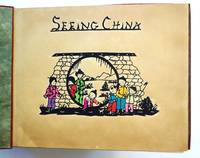
réf. 006911Chefoo China: Women's Bible School American Presbyterian Mission Book. Near Fine. Soft cover. First Edition. Oblong Folio. No Date circa 1930. Near Fine pages with light toning. Oblong folio 10" x 13 3/4". Bound in beautiful red pictorial embossed silk over limp boards string-tied 28 pp of cut-out illustrations in black and white many with colorful silk inlays with tissue guards publisher's 1 page explanatory leaf laid in also an original 6 1/2" x 10 1/2" cut-out with colorful silk inlays and string hanger readt-to-hang laid in. Cut-out chapter headings are Travel and Transportation Customs and Habits Chinese Birth-Year Cycle latest date 1935 Occupations The Eight Immortals Myths and Legends Chinese Recipes Chinese Children Chinese Junks and The Magician. Well over 100 cut-outs in all including the bonus laid in cut-out and SCARCE THUS. Women's Bible School, American Presbyterian Mission Paperback books
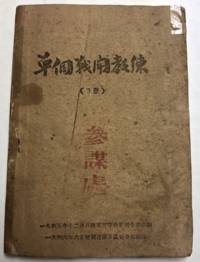
1946réf. AG-10067CHINA - Defense Fighting Jin-Ji-Lu-Yu Military Region: Published by the Commander of Eighth Route Left-Behind Corps in December 1945 reprinted by Commander of Jin-Ji-Lu-Yu Military Region June 1946 volume 2 of 2 with red Chinese characters on front cover: General Staff. This book illustrated techniques of defense and fighting back one on one in many different combat situations and warfare chiefly directed for military use. 12mo ii 69 pp. started from 37 to 105 8 large folded picture maps many images on each folded sheet minor wear occasionally strengthened at folds cello-tape repair to spine and right top of front cover good. å•ä¸ªæˆ˜æ–—教练 晋冀é²è±«å†›åŒºï¼š1945年12月八路军留守军团å¸ä»¤éƒ¨å‡ºç‰ˆï¼Œ1946年晋冀é²è±«å†›åŒºå¸ä»¤éƒ¨ç¿»å°ã€‚下册,书å°çš®çº¢è‰²å—体为"å‚谋处"字样。书内部带有8处粘贴的注释折å 图。共68页(从37页到105页), 书脊处和å°çš®å³ä¸Šè§’有胶带粘贴修补。其他å“相很好。 Commander of Eighth Route Left-Behind Corps paperback books
1955réf. AG-1012CHINA RECONSTRUCTS 62 issues. Beijing: China periodical 1955-1971 edited in Wai Wen Building distributed by GUOZI SHUDIAN printed in the People's Republic of China. Small folio 23×30 cm each issue approx. 52 pages; original pictorial colored wrappers. All issues are English language texts. China Reconstructs is a monthly magazine published in English French Spanish Arabic and Russian by the China Welfare Institute Soong Ching Ling Chairman to present a positive image of China to the outside world. These interesting magazines are filled with articles on a huge range of subjects: Eternal Glory to the Great Leader and Teacher Chairman Mao Tsetung; Four Young Woodcut Artists; Is Selling Vegetables Revolutionary Work; Socialist Drama; A Model for Revolutionary Peking Opera; The Red lantern; Workers Armed with Mao Tsetung's Thought Are Most Resourceful; During the Great Leap Forward period articles about great progress in Agriculture; Industrial Education was published in No. 4 1959. Some Chinese Folk Toys; Festival Lanterns; Color Pictorial: Chairman Mao's Hometown-Shaoshan; Painted Pottery of Neolithic China; a study in Chinese Literature-Lu Xun; Tsou Tao-fen Patriotic Intellectual; Selected Works of Mao Tsetung; On the Long March with Chairman Mao; Communist Heroine Liu Hu-lan; Health Work Develops in Tibet; Commemorating the Centenary of the Birth of the Great Lenin; a Soldier-Sculptor; People of the World Unite and Defeat the U.S. Aggressors and All Their Running Dogs; Heroic Images of Our Great Era; 1500 Red Hearts United in Battle; The Bright Sunshine of Mao Tse-tung's Thought Lights up the Land; Vice Chairman Lin Piao's Speech At the Rally Celebrating the 20th Anniversary of the Founding of the PRC.; China's First Underground Nuclear Test; The Power of the Good Old Three; The revolution in Education in Progress; Art that Serves Proletarian Politics; When Chairman Mao Gives the Signal We Advance; Hundreds of Millions of Chairman Mao's Books Published in 1967; World's People Eagerly Seek Chairman Mao Badges; Chinese Scientists Survey World's Highest Peak; New Look in Traditional Arts and Crafts; Peoples of Europe and North America We Support You!; Painting Pictures of Chairman Mao is Our Greatest Happiness; Chairman Mao's Important Inscription for Japanese Worker Friends; All China is Red; Working and Living with Chinese Peasants; The Great January Revolution in Shanghai; In Memory of Norman Bethune; The First Hydrogen Bomb; One Million People in Peking at Solemn Mass Memorial Funeral for Chairman Mao Tsetung &c. 《ä¸å›½å»ºè®¾ã€‹æ‚志,外文大厦编辑,国å书店å‘行,本组有1955年—1976年的部分期刊,《ä¸å›½å»ºè®¾ã€‹æ˜¯ä¸€æœ¬æœˆåˆŠï¼Œæœ‰è‹±æ–‡ï¼Œæ³•è¯ï¼Œè¥¿ç牙è¯ï¼Œé˜¿æ‹‰ä¼¯è¯ã€ä¿„è¯ç‰è¯è¨€ï¼Œç”±å®‹åº†é¾„ç¦åˆ©åŸºé‡‘会出版,旨在å‘世界展示ä¸å›½å»ºè®¾çš„好的方é¢ï¼ŒåŒ…å«äº†å¤šä¸ªä¸å›½ç›¸å…³ä¸»é¢˜çš„æ–‡ç« ã€‚ Contents of collection: 1955 No. 12; 1956 No. 1 5; 1959 No. 4 11; 1960 No. 12; 1961 No. 3; 1962 No. 7; 1963 No. 7; 1964 No. 3; 1965 No. 347 89 11 12; 1966 No. 1-6 10; 1967 No. 1-7 9-12; 1968 No. 1-5 7-12; 1969 No. 1 2 3 4 12; 1970 No. 1 4extra 6 8; 1971 No. 3 4 8 10 12; 1972 No. 3; 1976 No. 11/12 edited in Wai Wen Building, distributed by GUOZI SHUDIAN, printed in the People’s Republic of China. paperback books
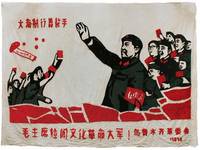
1967réf. 16838Urumqi XinJiang Uyghur Autonomous Region: Cultural Revolution Committee of Urumqi / Xinjiang Army Divisioni 1967/8. Two extraordinary hand-crafted parade banners ca. 110" x 84" 9 feet x 7 feet one slightly smaller. Each entirely composed of hook-work with colored yarns on white muslin backing. Slight age-toning and soil; a few threads loose but no significant losses; Near Fine condition overall. Folded and stored in original velvet draw-string carrying bags as found. Both banners bear the inscription "Chairman Mao Reviewing the Great Army of the Cultural Revolution" and depict the August 1966 mass rally at Tiananmen Gate where more than 10 million Red Guards from all over China converged to express their solidarity with Mao and his second-in-command Lin Biao. Additional text on the lower banner reads "Long Live Chairman Mao for ten thousand years" and "Sailing in the ocean requires a helmsman" -- both quotes from Lin Biao. The agencies responsible for the banners are identified in lower right of each: "Cultural Revolution Committee of Xinjiang Army Division 1968" upper banner and "Cultural Revolution Committee of Urumqi 1967" lower. The presence of Biao the figure to the right of Mao holding the Little Red Book in the top banner is of particular interest. Biao compiler of The Quotations of Chairman Mao popularly known as the "Little Red Book" and coiner of the phrase "Maoism" was probably more responsible than any other figure for creating the cult of personality around Mao particularly at the time of the Cultural Revolution. He quickly ascended Party ranks and was widely seen as Mao's obvious successor. But in 1971 Biao was exposed in the process of an apparent coup attempt the details of the event have never been made public. He died in an airplane crash attempting to leave China and from this point forward was officially condemned as a traitor by the Communist Party; any record of his achievements on behalf of the Revolution was expunged from the official record and any positive image of Biao would have been confiscated and destroyed as a matter of course - suggesting either that these banners left China prior to 1971 or that they remained out of sight until some later date. The second possibility is plausible given whence the banners issued - both were created by Red Guard branches in the Xinjiang Uyghur Autonomous Region an extremely remote province in China's northwest corner and for many years the center of a militant independence movement for Uyghur and other Turkic minorities. Cultural Revolution Committee of Urumqi / Xinjiang Army Divisioni unknown books