NAVIGATION IN CHINABiblio.com
6 771 résultats
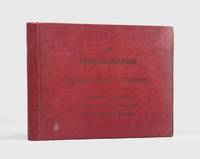
1900réf. 176895Shanghai: Brewer & Co. c. 1900. From the Chefoo Bluff to Lamtong Head Sole edition untraced institutionally the copy of Vice-Admiral Seymour's chief of staff in Tianjin during the Boxer Uprising. This photographic guide is designed for "the navigator of this changeable and frequently foggy locality" preface. We have traced only one other copy which appeared in commerce in 2017. Navigators in the late Qing period could rely on only a small network of lighthouses and fixed navigational aids when sailing the Chinese coast. "In thick weather even a person familiar with the coast is at a loss to identify a well-known Islands with its summit" preface. The thirty views include the Chefoo Bluff in the Pechili Gulf the waters near the Hieshans Light House Zhejiang and Hong Kong's Lamtong Head. A concerted period of lighthouse-building in the 1910s and 1920s obviated the need for further publications of this kind. Provenance: though unmarked as such this copy was owned by Captain Edward Henry Bayly C.B. 1849-1904 Commander of the International Forces at Tianjin in June 1900. Bayly had a lifelong career in the Royal Navy. He was promoted to the rank of lieutenant in September 1873 commander in June 1887 and captain in January 1894 having served overseas in numerous ships. Bayly captained HMS Pelorus during the fleet review for Queen Victoria's diamond jubilee in 1897 and in 1899 became captain of the armoured cruiser HMS Aurora on the China station. During the Boxer Uprising he replaced the wounded John Jellicoe as chief of staff to Seymour was mentioned by Seymour in dispatches and remained at Tianjin until the withdrawal of naval forces. He retired at his own request in February 1904. Landscape octavo. With 30 mounted collotypes within red frames. Original red cloth front cover lettered in gilt white coated endpapers leaves hinged with white linen as issued. A little shaken binding sunned and stained contents well preserved a little toning at fore edges: a very good copy. hardcover
1980réf. 2090202120414273Heibonsha 1980. Soft Cover. Fine. Number of books: 1 Heibonsha paperback
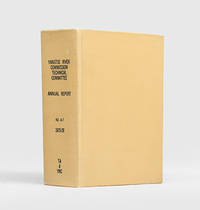
1925réf. 188317Beijing & Shanghai: Yangtse River Commission 1925-26-28. Measuring China's longest river First editions of these invaluable technical publications which record a wealth of data from gauging stations across hundreds of charts and diagrams. The Yangtse River Commission was formed by presidential order in December 1922 and the American engineer George Gottlieb Stroebe 1877-1965 served as the first head of its survey department. After several years of operation the commission switched its focus to the middle section of the river stretching from Hankou to Yichang. In 1925 it installed new gauges and discharge measurement stations while also collecting data with equipment maintained by the customs service. Until 1926 inclusive reports were released in the name of the commission's technical committee before responsibility transferred to the Ministry of Communications. The table of contents for the fifth annual report 1926 calls for 221 plates but numbers 150-221 were not issued. 3 works bound in 1 octavo 255 x 180 mm. Together 351 diagrammatic plates 2 folding tables; tables in text. Text in English and Chinese. 1966 tan buckram by the Heckman Bindery Indiana label on rear pastedown spine lettered in black original green card wrappers bound in. Ex-Library of Congress with its ink stamps and shelf-marks on the original wrappers index card holder on rear pastedown and "duplicate" deaccession stamp on front free endpaper. Contents toned one original wrapper creased at foot occasional marking and offsetting internally couple of short closed tears: very good. hardcover
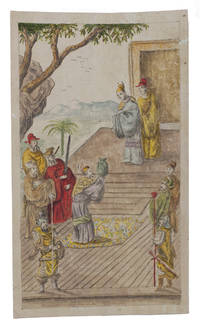
1670réf. E9PF9I9C81WOChina 1670. A series of 8 Chinese drawings ca. 24 x 14.5 cm: 5 coloured 1 also highlighted in gold showing scenes from a Chinese novel many military or diplomatic plus a Chinese watercolour drawing and a Japanese woodblock print. A series of 8 pen and ink drawings 5 coloured 1 also highlighted in gold drawn from Chinese books possibly the 14th-century Sanguo yanyi or Romance of the Three Kingdoms. All mounted on European paper 6 on 3 different patterns of decorated paper. The paper of the drawings ranges from 23.5 x 14 cm to 24 x 15 cm. They show the following outdoor and indoor scenes:1 2 warriors on horseback one of whom has just beheaded the other and carries his head away the beheaded warrior has not yet fallen from his horse while his superior watches on horseback with 2 attendants.2 a man standing with a spear in the prow of a boat while 2 men and a woman sit at a tea table in the boat which flies a flag and pennant.3 5 people on 2 boats one flying a flag and pennant.4 4 soldiers bringing a woman to a dignitary at his house.5 a delegation visiting a dignitary.6 2 men playing go with 4 attendants and a guard.7 a dignitary at a writing table with attendants and visitors.8 a seated dignitary with 6 standing figures 1 with a document at a table.In the backing paper of number 7 one can make out an Amsterdam coat of arms watermark. It is difficult to see clearly but seems to follow the general style of Laurentius 71-95 1662-1675. The 3 patterns of decorated backing paper show: a flower pattern printed in gold on green; 2 patterns with more abstract decorations in a diamond pattern printed in gold on white.With this series we include a watercolour drawing and a woodblock print:9 watercolour drawing of irises along a stream with hills in the background 17 x 22.5 cm.10 rectangular woodblock print of a Samurai at a tea ceremony 14 x 10 cm possibly derived from a Japanese book.Some edges of the drawings a little frayed but otherwise in very good condition. unknown
1942réf. 2091502135500862Not Available 1942. Soft Cover. Fine. Number of pages: 444p Size: B5 size 17x25 cm Not Available paperback
1875réf. 64770Yokohama & Tokyo Japan Hong Kong Canton China Saigon Vietnam: No Compiler ca. 1875-1893. Thick Oblong folio. 14.5 x 10.75 x 2.25 in. 50 pp unpaginated on thick cream-coloured boards each mounted with white silk hinge at gutter margin w/ 41 tipped-in albumen photos sixed from 6 x 8 in. up to 8.5 x 11 in. 5 of which are hand-coloured many w/ photographer’s annotated caption w/in the negative at lower fore-edge frequently with image inventory number many w/ manuscript in pencil captions. Beautiful beveled lacquer boards Mother-of-Pearl & bone inset panel on black laccquer on front cover depicting Rickshaw drive pulling Japanese Geisha w/ Mount Fuji in background a.e.g. rebacked w/ maroon-coloured calf minor edgewear minor curving to textblock a couple images w/ minor creasing from mounting 1 w/ very minor tear still an excellent exemplar with the nearly all the photographs retaining bright strong contrast. This superb Asian Souvenir Export photo album filled with large albumen prints offers a vivid representation of people life and the architectural landscape of Victorian-Era Hong Kong Saigon in French Indochina Vietnam Canton Guangzhou China and Meiji-era Japan. Fifteen of the photographs depict scenes and life in and around Hong Kong with several of the photos by famed Chinese photographer Lai Afong 1839-1890 including a view of Happy Valley the Public Gardens the Peak Hill District with 55 houses at the Peak Cemetery and another view of the public gardens with harbour in the background by William Pryor Floyd 1834-c.1900 a prolific British Commercial Photographer. One of the Hong Kong photographs depicts the Mount Austin Hotel which was built above the Victoria Gap opened in 1891 and was named after Colonial Secretary John Gardiner Austin and operated for just a short time converted by 1897 into the Mount Austin Barracks. Another Hong Kong photo depicts the six-story expansion completed in 1893 to the Hong Kong Hotel facing Victoria Harbor on Queen’s Road which included a private ferry launch for guests. The last Hong Kong photo is a striking street scene by Lai Afong. Of particular interest are the several original albumen photos capturing Saigon French Indochina or Cochin China and surrounding areas with images shot by Emile Gsell 1838-1879 noted French military photographer and his successor Otto Wegener 1849-1922 noted Swedish photographer who continued to sell Gsell’s prints as well as Vidal/Salin-Vidal. These images include views of a “Native House Saigon” “Native Street Saigon” French “Military Hospital Ship” docked in Saigon “Monkey Palms Saigon” “French Settlement Saigon” along some railroad tracks and traditional sampans boats along a canal in Cholon Saigon. In our experience this many French Indochina Vietnam photographs included for travel in and around Saigon are quite uncommon. Nine of the original albumen photographs capture such scenes in and around Canton Guangzhou China such as the 500 Mages or interior shot of the 500 Lohan disciples of the Buddha inside the Hualin Temple in the western suburb of Canton the “Execution Yard” in Canton Pagoda near Cantonas well as two very nice images of the “Flower Boats” in Canton possibly by Lai Afong or Emil Rumsfield visually capturing these multi-tiered wooden houseboats or pleasure boats operating as exclusive floating brothels featuring music dining and socializing and essential to the Pearl River’s social economy into the 20th Century. A couple others include prisoners in wooden stocks in Canton China taken from a cracked glass negative and well-dressed Mandarin Chinese official.The remainder of the albumen photographs sprinkled through the album encompass a hand-coloured albumen of Japanese rickshaw pulling kimono-clad Japanese women; the Yokohama Hataba or English/French treaty pier; Yokohama Park with cherry blossoms viewing & rickshaws; the famed view of the staged seppuku scene with nearby kaishakunin Samurai assistant standing with drawn sword for beheading and beautiful Kamakura Temple shot by Felice Beato. Other Beato photos include a fine Palanquin photo of young geisha and porters; and a very nice “Setting Silk-Worm-Eggs to the Paper” with young silkworm women workers carefully extracting the threads. Adolfo Farsari 1841-1898 photos include one of the No. 9 House in Yokohama Japan as well as two shots of the Grand Hotel in Yokohama. See: Terry Bennett History of Photography in China Chinese Photographers 1844-1879; Metadata Database of Japanese Old Photographs in Bakumatsu-Meiji Period Nagasaki University Library Collection 2006; Early Photography of Japan Harvard College Library; Bennett Photography in Japan 1853-1912 2006; Old Photos of Japan. A Photo Blog of Japan in the Meiji Laisho and Showa Periods. [No Compiler], hardcover
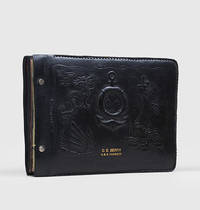
1934réf. 115861Chefoo Yantai Shanghai Singapore: 1934-37. Battleships baseball and the Bund A substantial private photographic record compiled by Yeoman Second Class Charles Edmond Berry during his 1934-37 service aboard USS Parrott DD-218 with the Asiatic Fleet. Combining personal snapshots and commercial studio prints the album captures both naval operations and sailors' pastimes alongside a survey of East Asian ports before the Second Sino-Japanese War. Opening with portraits of Parrott's officers and crew two colour-tinted views of the destroyer at anchor and a playful Afong Studio promotional image featuring the ship the album moves between naval duties and life at leisure. It includes panoramic views of the Asiatic Fleet at Chefoo and Hong Kong American destroyers on station gunnery practice loading shells and baseball matches. Scenes of liberty parties at Chefoo's Beach Cafe including the next morning's breakfasts and sailors enjoying themselves along Shanghai's Bund supply a convivial counterpoint. Other photographs document streets and waterfronts in Shanghai Hong Kong Qingdao Peking and Singapore; excursions to the Great Wall; cremation ceremonies in Bali; temples and city life in Japan; and Pan American Airways flying boats landing and disembarking passengers. There are views of Chinese Republican warships including the cruiser Yixian subsequently sunk by Japanese aircraft in September 1937. Commercial prints are credited to Afong in Chefoo and to Joseffa and Skvirsky in Shanghai. The related ephemera retained in the original sailcloth bag give the album additional personal immediacy: Berry's dog tags and devotional medallion a naval despatch shipboard newsletter voyage programmes mock proceedings before Neptune's court tourist booklets and a folding map of Shanghai. The Parrott stationed in the Far East since 1925 gathered hydrographic data near Saigon in 1935 and resumed neutrality patrols in 1936. Her wartime service included engagements off Borneo and Bali and transatlantic convoy escorts; she was decommissioned following a collision in 1944. Oblong photograph album 380 x 280 x 51 mm. 319 corner-mounted original photographs 102 x 63 to 292 x 240 mm including 6 colour-tinted prints and 4 panoramas 292 x 145 mm many studio prints captioned in the negative or bearing photographers' stamps a few annotated on verso. 52 heavy black card leaves most of the coloured and patterned tissue guards preserved. Contemporary heavily embossed black padded calf post-binder front cover decorated with Chinese dragon junk Great Wall lifebelt and anchor title lettered in gilt nickel-plated binding posts. Accompanied by related ephemera including illustrated tourist pamphlets 2 mock summonses to Neptune's court naval despatch from USS Parrott USS Henderson voyage programme shipboard newsletter dated 23 March 1937 folding map of Shanghai dog tags and Bakelite devotional medallion all preserved in the original canvas sailcloth bag. Binding lightly scuffed occasional creasing to mounting leaves minor damage to a couple of photographs; overall in excellent condition. hardcover
1933réf. 2111902160200105North China Water Conservancy Commission 1933. Soft Cover. Fine. Number of pages: 317 pages of the main volume additional maps Size: 26cm x 18cm Number of books: 4 North China Water Conservancy Commission paperback
réf. MC80Folio logbook ca. 38x245 cm or 15 x 9 ¾ in. 1 – printed title page 67 1 - blank leaves of watermarked laid paper. A copy of “The Seaman's Journal Being an Easy and Correct Method of Keeping the Daily Reckoning of a Ship During the Course of Her Voyage” New York: Burtus & Crane with the entries carefully completed in brown ink on recto and verso of the leaves with a gap of recto of leaf 41 i.e. comprising 133 pp. of text. Title page with a woodcut vignette depicting a sail ship under the American flag hand coloured and with a period ink title “Bashee Islands 1809” underneath. Period red ink stamp “C. Teubner” on the title page watercolour drawing of a maritime signal flag on the front pastedown endpaper. Period brown quarter sheep with marbled papered boards neatly repaired on hinges and extremities. Paper slightly age-toned text with occasional stains leaf 23 and others but overall a very good logbook written in a legible hand. Historically significant original content-rich logbook with a detailed record of the first trade voyage of a New York East Indiaman “America” from New York to Canton Guangzhou and back in June 1809 – June 1810. A namesake of the famous Salem merchant ship and privateer during the War of 1812 ship “America” built in 1803-1804 made five privateer cruises in 1812-1815 broken up in 1831 this “America” was built on the New York shipyard of Adam and Noah Brown for the noted local merchant company “Minturn & Champlin” and launched in May 1809 shortly before her first voyage The United States Gazette May 15 1809 p. 3. The ship’s tonnage was 493 tons Morrison J.H. History of New York Ship Yards. N.Y. 1909 p. 47. On June 21 1809 New York authorities cleared “America” for a voyage to Canton under the command of Captain Mather Evening Post Marine List// The Evening Post. New York June 21 1809 p. 3. The logbook opens with “America’s” 158-day outbound voyage starting on June 24 1809 when the ship discharged the pilot after the passing of the Sandy Hook spit at the south entrance to New York Bay. She passed the Cape of Good Hope on September 12-13 1809 without calling at port and crossed the Indian Ocean choosing the route to China via the Alas Strait between Lombok and Sumbawa Islands Lesser Sunda Islands of Indonesia. On October 21-22 “America” anchored near the “Bally Town” also marked “Laboagee” on some old maps; it is a settlement south of the modern-day town of Selong on the east coast of Lombok to get fresh water and trade for fresh supplies. A part of the crew went on shore where they were received by a local “king” who also visited the ship. “America” then crossed the “Java” Bali Sea proceeded north through the Makassar Strait between Borneo and Sulawesi crossed on October 26 – November 4 and went across the “Celebean” Celebes Sea towards the Pacific Ocean passing “Sarangaran” Sarangani and “Meangis” Miangas Islands. On November 11 1809 while in the “Celebean Sea” east of “Meangis” Island the compiler saw an island which “I did not find laid down in any chart Capt. Mather “America’s” Captain during the voyage in ship Aeolus from the Cape of Good Hope bound to China first discovered it on Sunday the 30th of November 1806…” The ship then sailed north in the Western Pacific Ocean along the east coast of the Philippines November 13-24 crossed the South China Sea passing “Bashee” Babyan “Lemma” Lamma and “Ladrones” Wanshan Islands arriving to Macao Macau on November 29. The goal of the voyage was to trade in Canton and quickly return to New York but “America” stayed there longer than expected. Captain Mather later reported that “all the English & American ships were embargoed at Canton from Jan. 27 to Feb. 22 in consequence of a new difficuly between the English and Chinese occasioned by a Chinese having been killed by a British seaman; and the English refused to deliver up any one unless the criminal could be pointed out which could not be done. It was expected the difficulty would be amicably settled” National Intelligencer. Washington City D.C. 18 June 1810 p. 3. The logbook omits the ship’s almost three-month stay in China and resumes with her departure from Macao on February 24 1810. On her 104-days return voyage “America” crossed the South China Sea sailed through the Gaspar Strait between Bangka and Belitung Islands east of Sumatra Java Sea and Sunda Strait went across the Indian Ocean and passed Cape of Good Hope April 25 and St. Helena Island May 6. The logbook ends at sea south-east of New York Bay close to the point recorded on the first day of the outbound voyage. New York “Evening Post” newspaper reported that “Arrived at this port on Saturday last the following vessels with valuable cargoes: Ship America Mather 105 days from Canton and 44 from the Cape of Good Hope with teas nankeens china silk and cassia to Minturn and Champlin owners” Evening Post Marine List// The Evening Post. New York June 11 1810 p. 3. The logbook follows the “America’s” voyage day by day thoroughly recording the ship’s geographical position and course weather winds currents operations with sails sundry works on board and ship’s repairs geographical objects passed vessels encountered termometer readings in the Strait of Alas and Western Pacific Ocean/ Philippine Sea the number of the day of the voyage and various events comets caught sharks fights on board an incident with a crew member falling overboard &c. Very interesting is a lengthy description of interactions with the inhabitants of the “Bally town” on Lombok Island where an “American ensign” was flying on shore notes about the sighting of an unknown island in the Western Pacific Ocean “two large comets” in the Indian Ocean endured storms various events on board names of encountered ships &c. Overall an important content-rich source on the history of early American trade voyages to China at the beginning of the 19th century. One of the latest mentions of the ship “America’s voyage to Canton still commanded by “Captain Mather” and owned by “Messrs. Minturn & Champlin” dates back to 1815 Alexandria Gazette. Alexandria Virginia 11 October 1915 p. 1. Excerpts from the logbook: June 24 1809. Transactions North Atlantic. These 24 hours begins with light winds and pleasant weather at 4 a.m. got under way with a light breeze from the south west at 11 a.m. … of Sandy Hook discharged the pilot. The wind hauled to the west. Set all the tending sails below and aloft. Several outward bound vessels in company. The America outsailed them all. July 15 1809. Transactions North Atlantic. <…> @ 8 a.m. saw a brig to the south and west stearing sic! to the north & east I took her to be a king’s brig. August 17 1809. Transactions North Atlantic. <…> @ 10 a.m. saw an Hermaphrodite Brig to the west steering to the N.W… September 25 1809. Transactions Indian Ocean. <…> All hands employed trimming ship got some bales of cotton out the fore hold … them in the cabin filled 8 casks with salt water between decks sailmakers mending sales carpenters repairing jolly boat. October 16 1809. Transactions Indian Ocean. <…> Ship under full sail all hands employed getting the guns out the main hold & mounting them carpenters at the boats. October 21 1809. Transactions Straits of Alas. <…> @ 5 a.m. made the land Lombock & Sambawa western extremity of Sambawa bearing north <…> @ 7 a.m. saw the Peak of Lombock bearing N. by W. dist. 3 or 4 leagues <…> got to the mouth of the Strait of Alas. At 1 p.m. came too with the small bower in 14 fathoms water sticky bottom Bally town bearing N.W. by west dist. 2 miles. Furled all sail & out all boats ready for watering. Saw an American ensign flying on shore at Bally town. At 3 p.m. out all boats mannd sic! & arm’d went on shore to the town of Bally. First & second officers. Treated well by the natives… The Land at the entrance of the Straits of Alas both on the Lombock & Sambawa sides is very remarkable - there projects from the Island of Lombock about 100 yards a Rock resembling much in form a cannon with the mouth planted downwards as you pass the mouth of the Straits this Rock sheets in & the little Town of Bally opens to the view it consists merely of a few huts belonging to the natives who received us in a friendly manner & immediately commenced trafficking sic! their productions wh. consists chiefly of ducks fowls cocoa nuts plantains & other fruit generally found in these Latitudes for money jack knives looking glasses & particularly rasors sic! - they take care however to get the full value of what they dispose of & are no novices in making a bargain. They demanded 10 dollars or 4 muskets for permission to fill our water which proved to be very brackish - they however let us have some fine turtle. The inhabitants of this Island are of a copper colour middling stature & well made they chew great quantities of Beetle sic! nut wh. renders their teeth black & their gums very red. They are all armed with axes & spears & wear nothing but a piece of calico <…> tied around the middle. The King to whom we were introduced was sitting on his throne which was composed of a block of wood surrounded by his guards who were armed in the manner already described he received us very graciously and promised to supply us with whatever we stood in need of. October 22 1809. Transactions in Bally Roads. First part fresh gales & clear weather at 4 a.m. got the long boat & pinnace out & commenced watering the ship. At 8 a.m. got all the water & stock on board. Monday October 23 1809. First part calm with pleasant weather. At 5 a.m. got the boats in. At 8 a.m. King & a great many of the natives came on board to see the Captain & the ship. Bro’t some fruit off as a present to the Captain at 10 a.m. got under way with a light breeze from the south… November 11 1809. Transactions Celebean Sea. <.> @ 4 a.m. an island in sight N.W. by W. dist. 6 or 7 leagues <…> This island I did not find laid down in any chart Capt. Mather in ship Aeolus from the Cape of Good Hope bound to China first discovered it on Sunday the 30th of November 1806 about 3 p.m. in the bearing N.O. by E ½ E. dist. 5 or 6 leagues. <…> November 25 1809. Transactions China Sea. <…> @ 4 p.m. made the Bashee Islands bearing west dist. 8 or 9 leagues… November 26 1809. Transactions China Sea. <…> @ 10 a.m. passed several fishing boats. November 27 1809. Transactions China Sea. <…> @ 4 p.m. made the Great Lemma Islands bearing W.N.W. dist. 5 or 6 leagues same tie sounded in 28 fathoms water fine grey mud… November 28 1809. Transactions China Sea. <…> @ 6 p.m. the peak of the Great Ladrone bore east ½ south distance 2 leagues… November 29 1809. Transactions China Sea. <…> @ 3 p.m. took a pilot for Macao the peak of the Great Ladrone bearing S.E. by E. 3 miles. <…> @ midnight came too with the small bower anchor in 5 fathoms water. Furled all sail. The compadore went on shore for a pilot @ 9 a.m. the compadore came off with some fresh provisions & hopes of getting a pilot the next day. <…> We were informed of several Ladrone corsairs being out. February 24 1810. Transactions China Sea. <…> @ 6 p.m. discharged the pilots Macao bearing W. ½ S. dist. 3 or 4 leagues <…> @ 4 a.m. the Middle Island bore east 2 leagues <…> @ 7 a.m. lost sight of the Frances Henrietta… March 9 1810. Transactions Straits of Gasper. <…> @ 6 p.m. saw the ship Ocean at anchor to the South of us @ 9 got under sail to the best advantage of the wind the ship Ocean in company <…> Latter part ditto. wind & weather & Meridian the Brothers bore N.E. 2 leagues the farthermost point of Sumatra in sight S.W. by W. 7 or 8 leagues. Spoke the ship Ocean & parted with her. March 11 1810. Transactions Java Sea. At anchor. @ 10 a.m. was boarded by the Gov. of Batavia boats. Latter part light airs & calm with cloudy wr. @ Meridian South pt. of Cracatau S.W. by W. ½ W. Center of Middle Islands NE. by E. ½ E. Center of Tamarin Island N.W. ½ W… March 13 1810. Transactions Straits of Sunda. <…> @ 6 p.m. Java head bore S.E. dist. 12 leagues from which I take my departure <…> lost sight of the ship Ocean Capt. McPherson… April 23 1810. Transactions Indian Ocean. <…> Caught 2 sharks & two albatrosses. Put the ship’s & Captain’s name with the Lat. & Long. of ship around the neck of one A. & let him go. April 24 1810. Transactions Indian Ocean. <…> Saw two large comets the blare of which lasted nearly 5 minutes. May 11 1810. Transactions South Atlantic. <…> @ 3 p.m. James Tylee fell overboard rounded the ship too & lowered the gig found she was sinking & lowered the jolly boat after her. June 1 1810. Transactions Western Ocean. <…> @ 3 p.m. heard a noise on the main deck went forward & found Henry Lockwood had Mr. Clark the second officer under him on deck the Captain & myself parted them. June 2 1810. Transactions Western Ocean. <…> @ 5 a.m. saw a sail to the N. & E. standing to the S. & W. @ 6 bore off N.W> by N @ 10 a.m. spoke & boarded the brig Sally & Eliza Captn. Bell 21 days from Alexandria bound to Antigua all well. hardcover
réf. 9421220th century. . 8 erotic paintings and 2 calligraphies. Dimensions of the paintings: 31 x 31.5 cm. Bound between two large grey cardboards 37.5 x 39 cm. [20th century]. hardcover
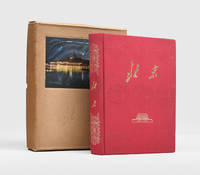
1959réf. 185404Beijing: "Beijing" huace bianji weiyuanhui 1959. The splendours of a socialist capital First edition deluxe issue published to mark the tenth anniversary of the founding of the People's Republic of China. Though unmarked as such this copy was owned by Solomon Adler one of the select group of Westerners permanently resident in China during the Mao era. The celebratory photobooks published in 1959 - equivalents were produced for Shanghai and other major cities - were predominantly distributed as gifts to party officials and foreign VIPs the latter group also receiving brochures containing translations of the captions. Among the many plates is an impressive folding panorama of Tiananmen Square and its vicinity showing the Great Hall of the People and the history museums which were all built in record time by a state keen to display communism's accomplishments. Immediately following the title page is a high-quality reproduction of Dong Xiwen's famous painting Kaiguo dadian "The Founding Ceremony". The work was repainted several times over the course of the 1950s as several party leaders present at the founding ceremony fell out of favour with Mao. An economist by training Adler 1909-1994 worked in the US in the 1940s but later fell under suspicion during the "red scare." After a period spent at Cambridge University he moved to China in 1962 living in Beijing until his death three decades later and working on the official Chinese translation into English of Mao's Selected Works. Parr & WassinkLundgren note three other issues: "a special deluxe clothbound issue with a gold brocade box and red cover;. a third edition with 120 selected photos printed on loose pages and placed in a brocade box; and a fourth edition with a silver brocade case". Quarto. With 64 tipped-in colour plates 8 folding 2 folding colour plates; illustrations throughout; title page printed in dark and light brown. Text in Chinese. With publisher's 8-page brochures of English and Russian captions loosely inserted. Original red silk over bevelled boards spine and front cover lettered in gilt spine with decorative gilt patterns front board decoratively blocked in blind with gilt vignette of Tiananmen cream patterned endpapers. Housed in original textured cardboard box front cover with calligraphic title in blind and photographic onlay showing fireworks in Beihai park. Silk bright with just light soiling and marking couple of edge creases to folding plates: a near-fine copy in very good box the onlay with some cockling. Parr & WassinkLundgren The Chinese Photobook: From the 1900s to the Present pp. 180-1. hardcover
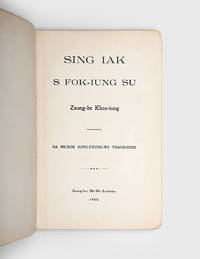
1905réf. 184601Shanghai: American Bible Society 1905. The Word on the street First edition traced in two institutions only designed to aid Christian missionaries preaching to China's 18 million Shanghainese speakers. Although unstated on the title page this version was prepared by John Alfred Silsby a presbyterian missionary eventually resident in the city for four decades. During the 19th century Christian missionaries produced transliteration and romanization systems for over 20 Chinese dialects. The first romanized Shanghainese gospel was published in 1856 Matthew edited by Chao Yin Sung and the first romanized New Testament appeared in 1870-1. Silsby 1858-1939 issued the Gospel of Matthew as a standalone work in 1895 and this edition of the gospels followed a decade later. In 1913 he completed his important reference An English-Chinese Vocabulary of the Shanghai Dialect. This work was printed by the Presbyterian Mission Press on behalf of the American Bible Society. Copies are held by Cambridge University and National Taiwan University. Octavo in 4 parts. Original brown moiré cloth over limp card covers spine lettered in gilt. A few contemporary pencilled notes on one page. Spine sunned tidemarks at foot of inner front cover and first blank endleaves browned: very good. Thousand Tongues 252. hardcover
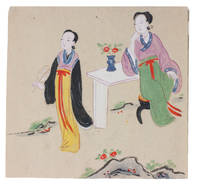
1655réf. E9PFZ6Y3Z0MCChina 1655. Colour drawings 3 ca. 28 x 18 cm the 4th cut down to 16.5 x 17.5 cm apparently showing Manchurian scenes. A series of 4 colour drawings of Manchurian scenes. All mounted on Dutch paper probably from the period 1650-1660. The paper of the drawings themselves ranges in three cases from 27 x 16 cm to 30 x 19.5 cm; the fourth has been cut down to 16.5 x 17.5 cm. The drawings show the following all outdoor scenes:1 a dignitary on horseback with his attendant on foot carrying a parasol.2 2 ladies 1 holding the other's sleeve with a flowering tree and an octagonal stone basin.3 a lady with a flowering plant in a basket with a deer at her side.4 2 ladies: 1 with a fan; the other leaning on a table with a vase of flowers.All 4 backed with matching European paper watermarked with a 7-point foolscap above "4" and 3 balls. The closest matches in the literature Laurentius 431-437 especially 431 and 435 date from 1651 to 1658. unknown
2020réf. 2081502111900463Chinese book office 2020. Soft Cover. Fine. Size: Hardcover Chinese book office paperback
2000réf. 0803759China Renmin University Press 2000-01-01. paperback. Used - Good. Ship out in 2 business day And Fast shipping Free Tracking number will be provided after the shipment.Language: Chinese . The archives in this collection are stored in the First Historical Archives of China as a treasure. They systematically record the invasion of the Eight-Power Allied Forces in full detail. as well as the response of the Qing Government including the whole compensation procedure of the government after the war. It is a systematic exposure of the archives on the Boxer Movement in 1900. Most of the archives are exposed to the public for the first time which will help scholars. Satisfaction guaranteedor money back. China Renmin University Press paperback
1797réf. 035987London: G. Nicol 1797. 1st Edition 1st Printing. Hardcover. Very Good . 11 1/8" Tall. Frontispieces Plates And Illustrations. Ii Xxxiv518; Ii Xx 626. The Two Complete Text Volumes In Full Size Text Blocks 10 5/8" Tall; The Plates Were Issued 1796 In A Separate Volume Not Present Here; But The Plate Of The Camellia Sesanqua Is Present Between Pp 466 And 467. Original Quarter Morocco Binding Five Bands Morocco Spine Labels Over Boards Covered With Marbled Paper Original Off-White Endpapers Preliminary And Final Blank In Each Volume. Bindings With Old Wear But Nicely Furbished Morocco Labels Clean With Brilliant Gilt A Little Loss Of Leather At Tops Of Spines And At Top Right Front Spine Edge Paper Frayed Along All Edges Of Boards Hinges Tight Contents Clean Just A Few Tiny Foxing Spots. Small Very Old Booksellers' Label Of The China Times Bookseller 94 Consular Road Tientsin. And Another From Sydney. Former Owner's Signature Dated 1894 Erased In Volume 1 Of George Ernest Morrison And A Few Marginalia Which Appear To Be His; George Ernest "G. E." Morrison 1862 - 1920 Also Known As Morrison Of Peking Or Chinese Morrison Was An Australian Adventurer Appointed In February 1897 As The Times Correspondent In Peking Despite His Lack Of Knowledge In The Chinese Language. He Traveled To Vladivostok And Reported To The Times That Russian Engineers Were Making Preliminary Surveys From Kirin Towards Port Arthur Then Sent A Telegram To Say That Russia Had Presented A Five-Day Ultimatum To China Demanding The Right To Construct A Railway To Port Arthur. This Was A Triumph For The Times And Its Correspondent But He Had Also Shown Prophetic Insight In Another Phrase Of His Dispatch When He Stated That "The Importance Of Japan In Relation To The Future Of Manchuria Cannot Be Disregarded". After A Visit To Siam And England Then To Australia 1899-1900 He Returned To Peking. When The Boxer Uprising Broke Out And During The Siege Of The Legations From June To August Morrison As An Acting-Lieutenant Showed Great Courage Always Ready To Volunteer For Every Service Of Danger. After A Siege Of 55 Days The Legations Were Relieved By A Multinational Force Which Then Ransacked Much Of The Palaces In Peking With Morrison Taking Part In The Looting. There Was Great Uncertainty Regarding The Future Of China In The Following Months And Through The Times Morrison Managed To Depict A Skewed Picture Before The British Public. While Russia And Japan United In Opposing Any Dismemberment Of China The Country Was Nevertheless Punished By The Imposition Of A Heavy Indemnity. In 1904 Morrison Became A Correspondent With The Japanese Army. He Was Present At The Entry Of The Japanese Into Port Arthur Early In 1905 And Represented The Times At The Usa Peace Conference. In 1907 He Crossed China From Peking To The French Border Of Tonkin And In 1910 Rode From Honan Across Asia To Russian Turkestan. From Andijan He Took A Train To St Petersburg And Then Traveled To London Arriving On 29 July 1910. A Great Chinese Physician Dr. Wu Lien-Teh Succeeded In Staying The Spread Of This Mortal Sickness Which Seemed To Threaten The Whole World. Morrison Published A Series Of Articles Advocating The Launching Of A Modern Scientific Public Health Service In China. When The Chinese Revolution Began In 1911 Morrison Took The Side Of The Revolutionaries. In August Morrison Resigned His Position On The Times To Become Political Adviser To The Chinese Government And Immediately Went To London To Assist In Floating A Chinese Loan Of £10 Million. In China During The Following Years He Had An Anxious Time Advising And Endeavoring To Deal With The Political Intrigues That Were Continually Going On. He Visited Australia Again In December 1917 And Returned To Peking In February 1918. He Represented China During The Peace Discussions At Versailles In 1919 But His Health Began To Give Way And He Retired To England Well Aware That He Had Only A Short Time To Live. He Died On 30 May 1920 . A Nice Historical Association. Later Ownership Signatures Of G B Wilson. G. Nicol hardcover
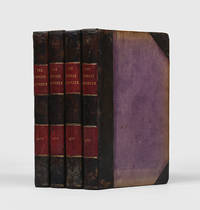
1875réf. 160133Shanghai: American Presbyterian Mission Press 1875-78. The most important interdenominational missionary journal of the time A collection of four scarce early volumes of this Shanghai-based periodical which served as the expatriate missionary community's premier forum for sinological exchange including contributions on philosophy social history linguistics literature and religion. Early volumes are now seldom encountered in commerce. The Chinese Recorder and Missionary Journal was first published in 1868 in Fuzhou under the editorship of Stephen Livingstone Baldwin and then Justus Doolittle. In 1874 editorial responsibilities were passed to Alexander Wylie 1815-1887 the agent of the British and Foreign Bible Society in Shanghai with the city's American Presbyterian Mission Press taking over printing and distribution. Issued every two months the journal featured articles by leading missionary-sinologists including Emil Bretschneider Henry Yule Timothy Richard and Samuel Wells Williams. 24 parts in 4 vols octavo 235 x 153. With 4 folding plans and maps 3 woodblock and printed on delicate rice paper illustrations in text. Vol. VIII bound without the index. Contemporary black half sheep A. H. Chen Shantou recently rebacked with original spines laid down red spine labels purple wavy-grain cloth sides. Bindings somewhat worn and faded small piece of leather reglued at head contents generally fresh folding plans with occasional creasing and stub tears. A very good set. Francesca Torocco The Cultural Practices of Modern Chinese Buddhism 2007. hardcover
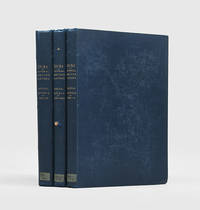
1895réf. 182165Shanghai: Published at the Statistical Department of the Inspectorate General of Customs 1895-1905. I believe the Inspectorate aided by its Medical Officers can do good work A lengthy run of this valuable specialist compendium. Each issue had a circulation of around 500 copies only the majority sent to customs stations and libraries as well as diplomats and naval officers and copies are therefore rare in commerce. The Chinese Maritime Customs Service was founded in 1854 by Britain and other foreign powers to collect taxes on maritime trade for the Chinese government but its remit quickly expanded to include domestic customs administration the postal service waterway and harbour management and scientific research. In 1870 Inspector-General Sir Robert Hart instituted this series information to be provided by the medical officers assigned to customs stations. Issues were issued on a yearly or half-yearly basis sometimes in double numbers. "This network of epidemic monitoring and ecological investigation which was gradually built up by the medical officers and medical missionaries extended throughout East Asia and created a huge medical database" Gao p. 54. 17 works bound in 3 quarto 271 x 220 mm. With plates charts maps and diagrams throughout some folding and a few in colour; occasional text in French. Contemporary blue library cloth spines lettered in gilt top edges sprinkled brown other edges untrimmed original yellow wrappers bound in. Ex-Bodleian Library with its shelf labels on spines pencilled pressmarks and accession and cancellation ink stamps. Bindings lightly worn and rubbed one spine with abrasions to cloth occasional short closed tears internally the odd repair and loss but a very good usable collection. Gao Xi "Discovering Diseases: Research on the Globalization of Medical Knowledge in Nineteenth-Century China" in David Luesink William H. Schneider and Zhang Daqing eds China and the Globalization of Biomedicine 2019. hardcover
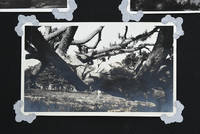
1920réf. 152667China: 1920. From palace to park lake to shining sea A collection of 230 vernacular photographs recording a couple's trip to Beijing Jinan and Qingdao a decade after the abdication of the last Qing emperor. Arranged chronologically the album combines landscape and architectural views with candid shots of the travellers and the people they met. The appearance of many easily identifiable landmarks more than compensates for a lack of captions. The travellers begin their holiday in Beijing recently the site of the May Fourth demonstrations. The first 35 images capture the serenity of the Summer Palace once an imperial retreat with images showing the East Palace Gate and the exterior Hall of Joyful Longevity. The visitors strike jaunty individual poses on a stone lion and ride regally on the back of a bronze deer statue. The lady is captured from a distance on a balcony overlooking the Kunming Lake the largest body of water in the palace complex with the famous 17-arch bridge visible in the background. Like many before them these travellers are drawn to such architectural wonders as the Glowing Clouds and Holy Land Archway as well as the full-size marble boat restored by the Empress Cixi in the 19th century using funds allocated for outfitting a real navy. Several vistas of the lake show its solitude and remoteness - qualities accentuated by the palace's transition in 1914 from a working royal residence into a publicly accessible monument to China's imperial past. Until 1924 the Forbidden City remained the private residence of the last emperor Pu Yi and this album thus contains only a few images taken in the accessible outer court. The travellers find more freedom however in nearby Beihai Park climbing up to the imposing White Pagoda and snapping several views of Beijing from on high. Also captured here are two soldiers on duty by one of the bridge archways as well as the classic view of the pagoda looming over the park's picturesque lake. China's rapidly growing network of railway lines afforded travellers conveniences unknown even a couple of decades before. The visitors record their journey on the Beijing-Zhangjiakou line the first stretch of railway built by the Chinese government rather than foreign investors alighting near Nankou. There the lady poses in a sedan chair and later with three young children fascinated by a camera held by one of the couple's acquaintances. Visiting the Ming tombs affords many opportunities to photograph and be photographed with the famous stone animal sculptures while in one image the lady lies comfortably in a tree. Back on the train they travel to the Great Wall near Badaling and Qinglongqiao. A dozen pictures taken on the wall show the brickwork in a state of disrepair as was common with sections of the wall by this time and the travellers take refreshments on a level section with some local children for company. A well-earned rest on the return train refreshes them for a visit to the Jade Peak Pagoda on Jade Spring Hill today the site of residences for top political leaders with the camera capturing several nice landscape views of the pagoda and a temple desecrated inside. Following further excursions to the unmissable Temple of Heaven and the Cishou Pagoda they follow the steel rails to Jinan admiring the Yangtze River and waterfront industries in the company of local perhaps warlord troops. The holiday ends in the Japan-controlled coastal resort of Qingdao its station platform teeming with adult and child passengers and its seafront peppered with colonial architecture including the Grand Hotel. The final photographs commemorate time spent at the beach and climbing a nearby mountain most likely Laoshan - the relaxing denouement to a holiday of considerable excitement. Landscape folio 260 x 335 mm. Original brown pebble-grain leatherette tied with brown cord through punch holes front cover lettered in gilt within blind frame covers lined with black moiré-patterned cloth 52 black card leaves with 230 gelatin silver photographs each c. 75 x 130 mm mounted with silver photo corners first blank with pencilled title "China 1920". With 3 gelatin silver photographs 63 x 40 mm loosely inserted. 2 photographs no longer present. Photographs clear most with silver mirroring and a few with corners lifting image loose from its mount and another partially split vertically a few leaves beginning to split at gutter couple of expertly repaired tears: a very good example. hardcover
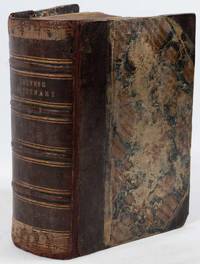
1865réf. 219705Shanghae sic & London.: London Mission Press and Trubner & Co. 1865. Two volumes in one: Volume I. ii Title i-x Advertisement Preface 762 pp including Index of Chinese characters pp 1-99 pagination duplicated for pp 224 & 239. Volume II. ii Title 724pp iv List of the Radicals of the Chinese Language. 22 x 15 cm contemporary half calf spine gilt between raised bands expertly rebacked mounting the original spine numerous annotations and underlinings in pencil a handful in ink at the head the final blanks with notes and translation age-toned and worn boards rubbed but a good complete copy of the scarce reprint. Provenance: With the early inked signature of "Hugh Wadell Newchwang 1869" the pioneering missionary whose work laid the foundation for the Irish Presbyterian Church's long-term presence in East Asia. In 1869 Waddell 1839–1901 landed at Newchwang now Yingkou where he established a mission station that included a church school and dispensary. His daughter was Helen Waddell poet scholar and theological novelist. Recent signature of A. Allan Shearer Wellington. Scarce reprint of the second part of Morrison's Dictionary first published between 1815 and 1823 with a notable provenance. The 1865 reprint was issued as a single volume combining the second part of the dictionary with an index of characters arranged according to the Kangxi radicals. "The Second Part of Morrison's Dictionary has been generally commended by experienced Sinologues as the most perfect and useful of the whole. The present is merely a reprint of it with such slight modifications as are mentioned at the close of the original preface." Preface Löwendahl 1334 . London Mission Press [and] Trubner & Co. hardcover
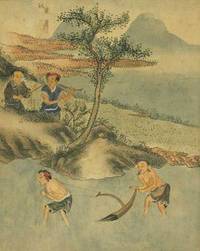
1920réf. 218778China Late 19th or early 20th century. 34 scenes on paper each featuring several figures in traditional dress disporting themselves amid landscapes and in a few instances houses all done by the same artist. Each picture is a separate scene; subjects include fishing visiting boating farming wrestling courting harvesting rice and hunting--a particularly effective image shows a tiger hunt and several scenes include wild and domestic animals. 1 vols. Images measure 8-3/4 x 7 inches plus margins bringing the overall page size to 11 x 8 inches. The mounted leaves are linked in the Oriental accordion fashion and contained within two substantial wood covers. Fine condition. 34 scenes on paper each featuring several figures in traditional dress disporting themselves amid landscapes and in a few instances houses all done by the same artist. Each picture is a separate scene; subjects include fishing visiting boating farming wrestling courting harvesting rice and hunting--a particularly effective image shows a tiger hunt and several scenes include wild and domestic animals. 1 vols. Images measure 8-3/4 x 7 inches plus margins bringing the overall page size to 11 x 8 inches. A very interesting and engaging collection of genre scenes. The trees rocks and landscapes are particularly well rendered and the figures are full of life. unknown
1810réf. 38599Canton Guangzhou workshop 1810. Watercolour and opaque body-colour with ink on thick chinese paper depicitng 1. A Temple Compound and 2. An Imperial Pleasure Garden. Sheet size: 16 1/8 x 22 inches. An exceptional pair of Chinese export watercolours rich in architectural detail exemplifying the pictorial conventions developed to frame China for European eyes. A fine pair of large-scale architectural fantasy views produced in a Canton workshop for the export trade at the height of the China Trade period. The compositions exemplify the hybrid artistic language developed for Western patrons by Chinese painters trained in native techniques yet attuned to foreign tastes for picturesque and monumental subjects. The first painting depicts a two-courtyard Buddhist or Taoist temple approached through a three-bay shan-men ceremonial gateway flanked symmetrically by drum and bell towers. A painted screen wall in the inner court displays guardian deities in brilliant red while the gilded Buddha presides from an elevated rear hall. The temples architecture is stylized but evocative of southern Chinese religious compounds. Above the gateway a plaque bears brush-written characters reading "Beautiful Hall of Profound Reverence" a fictive name likely invented by the workshop for decorative effect rather than to identify a specific site. The second painting shows a walled palace complex centered around a multi-tiered pavilion rising from a lotus pond filled with sculptural rocks and pleasure boats. Dragon grottoes stone causeways and ornamental bridges evoke the fantastical terrain of imperial parks such as the Yuanmingyuan rendered here in a compressed stage-set perspective. White elephants bearing crimson banners guard the main gate signaling a courtly or ceremonial setting. While reminiscent of northern gardens the details are compositional inventions rather than topographical records. The palette vermilion malachite green gamboge and carbon black and the use of crisp ink outlines are typical of late 18th-century Canton export workshops. Unlike smaller pith-paper images destined for albums these works were painted on thick laid paper of generous dimensions. Loose drawings such as these were often compiled into custom albums in British India where Chinese watercolours were often combined with Indian and Persian material to appeal to the tastes of British collectors. The Persian-Urdu foliation on the verso indicates their inclusion in such a collection likely assembled in Calcutta or Lucknow in the early 19th century. While drawing upon recognizable architectural forms and cultural symbols the views are best understood as imaginary or composite constructions designed to satisfy European curiosity about China. The temple compound reflects generic southern typologies while the palace garden borrows selectively from northern models such as the Yuanmingyuan. unknown
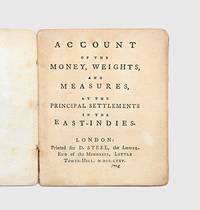
1775réf. 191552London: Printed for D. Steel 1775. Catties cowries candarines and comashees An otherwise untraced pocket reference for supercargos with alphabetically arranged sections for major destinations along eastern trade routes including China Medina Mecca Bengal Bombay and Batavia. The final page concerns Japan evidence of British commercial dealings with the Dutch East India Company. Pages 19-24 concern the sterling value of local coins offering exchange rates for the Chinese tael a Bengali English crown and for sequins dollars piastres and other currencies used in Arabia. For Bengal a special section discusses sea shells cowries as a currency for "coolies labourers and other small payment" over 2400 cowries making one "current rupee". The publisher David Steel 1734-1799 specialized in handbooks charts maps and other maritime material for naval use and for seaborne commerce. Trading out of his warehouse at Little Tower Hill Steel built a publishing empire that was continued by his son of the same name and his daughter-in-law Penelope Steel. The latter continued the business alone following David Steel the younger's death in 1803. In 1775 Steel published two other longer works for the India and China trade including the 56-page Indian Trader's Complete Pocket-Assistant which was an expanded form of the present handbook. Small duodecimo pp. 24. Sewn into contemporary marbled wrappers edges trimmed. Housed in custom grey card box. 1974 ownership signature of one E. Harris on inner front cover; date added in same ink on title page. Covers rubbed some browning internally: well-preserved. Not in ESTC or Witt. unknown
1867réf. 193376Mainly China and Japan: 16 October 1863 - 29 July 1867. Tensions and turbulence in the treaty ports A revealing source spanning Courtenay's entire East Asia command during which Scylla - a wooden screw corvette - patrolled the coast of China and Japan. Courtenay spent five months as the senior officer in charge of the Shanghai division bringing him into contact with the likes of Sir Harry Parkes and also co-ordinated anti-piracy operations. Courtenay 1820-1894 made captain in 1859 and was promoted to vice-admiral in 1881. These letters report on Scylla's movements and occurrences onshore. Many recently opened cities were still tense and Western officers and civilians faced jeering stone-throwing and other acts of xenophobia. A lengthy letter from 2 September 1864 sent to Vice-Admiral Sir Augustus Kuper the commander-in-chief describes anti-foreign sentiment in Nagasaki in the wake of the Namamugi Incident and the Battle of Shimonoseki Straits. He records measures taken to counteract the influence of soldiers deployed in disguise by the hostile Choshu domain and relays rumours of a Choshu attack on the European enclave. "Considering that there are fifty people here either Dutch or under Dutch protection I am surprised that there should be no vessel of war of that nation here." In Amoy the ship's arrival "caused great excitement: numerous reports were spread of the reason of her coming among others are to the effect that we had landed several hundred men and that I was going to the city to seize the tautai" 26 December 1865. Care was also required in dealing with the Russians Courtenay reminding his officers to be "extremely guarded in asking questions or making observations" 25 July 1866. Other correspondence concerns piracy. Courtenay found the Chinese maritime police "utterly inefficient" 30 November 1865 and used his authority to send the gunboat HMS Grasshopper to seize lorchas on the coast. Quarto 320 x 205 mm. With 70 leaves filled with neat manuscript in several hands 2 bound- or tipped-in manuscript slips; additional blank. Recent quarter calf spine lettered in gilt green cloth sides front cover lettered in gilt green endpapers. A little marking internally: a well-preserved example. hardcover
1973réf. 2091202133213203Gakushu Kenkyusha 1973. Soft Cover. Fine. Number of books: 4 books in total Gakushu Kenkyusha paperback