TIMKOVSKI (G.)Livre Rare Book

27 353 résultats
réf. 6542Paris, Librairie Orientale de Dondey-Dupré Père et Fils, M DCCC XXVII (1827). 2 volumes de texte, in-8, XII-478 pp. (Tome I) - 459 pp. (Tome II), reliure ancienne demi-basane frottée, plats cartonnés marbrés, bon état général, sans l'atlas.
1981reprint of Serie Orientale Roma,1958 ed. 4to, pp.xxxvii, 537, 160 illustrations, decorated hard cover slihtly worn, contents very good. a detailed study of the history and techniques of mounting paintings in China with chapters on the judging of antique scrolls, the connoisseurship of seals and the collecting of scrolls. Van Gulik considered this to be his most important work. scaece also in reprint.
London, Hakluyt society, 1913-16 stated, actually Peking, 1942 4 vols. complete. In all aspects identical to the new edition in the Hakluyt Society, Secondo Series XXXIII, XXXVII, XXXIII, XLI, revised throughout in the light of recent discoveries by Henri Cordier but printed in Beijing in 1942. Vol 1 portrait frontis , 2 maps, xxiii, 318 pp. Vol II 6 plates and map of Asia in pocket, xiii, 367 pp. Vol III map and 2 text illus, xv, 270 pp. Vol. IV, xii-359. hard rebound in half black cloth with gilt lettering on spine, and blue boards . very scarce chinese reprint . much scarcer than the london original (before the days of photo-reproduction), from the plates of the Hakluyt Society's 1913-16 edition, This could not have been a pirated edition, as the original plates seem to have been used. . It is a miracle that some academic in Beijing was interested enough to print these volumes in those times and another miracle that they survived the l wars between the Nationalists, the Communists and Japan that were devastating China in 1942. No copies traced in any library or auction records, and the Hakluyt Society cannot account for the Peking printing. A rarity In excellent condition.
1916réf. 513081 vol. in-8 br., Imprimerie Nationale, 1916, pp. 50-104 avec 18 planches hors texte (pagination double, également paginée : pp. 369-424)
1782réf. P1-2F-1Paris, Chez l'auteur & Froulé & Nyon, 1782. In-8 (14x20cm), xxij, 340pp. et (6) 376pp. et (6) 362pp., 3 volumes reliés demi-basane époque, pièce de titre et de tomaison, tranches marbrées, petit travail de ver sur quelques pages, rousseurs rares, dos à 5 nerfs ornés. Première édition in-8 après l'originale in-4 parue la même année, et illustrée de 6 planches dépliantes, un plan de Pondichéry , une chauderie et un pagotin, un temple ou pagode des gentils de la cote de Coromandel, la fête de Teroton ou course du char, une vue de la ville de Canton, des Hottentots ; les planches sont gravées par Jean-Baptiste Marie Poisson d'après les dessins de Sonnerat. Three volumes set of Sonnerat, Paris, 1782. In-8° illustrated with 6 plates. Very nice set, half calf contemporary.
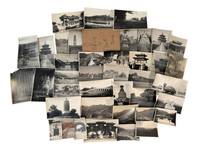
1910réf. 235921910. Peking and North China travel photo archive circa 1912 to 1918 documenting the former imperial capital during the turbulent opening years of the Republic of China when centuries of Qing imperial rule had only recently ended and Beijing remained the political and cultural heart of northern China. The photographs record a landscape where imperial monuments Buddhist temples ancient roads and rural villages continued to define daily life despite the collapse of the dynasty in 1912. Produced during the era that followed the Xinhai Revolution and preceded the consolidation of the warlord period the archive preserves a city and surrounding countryside poised between imperial tradition and an uncertain republican future. Photo archive of 40 original silver gelatin photographs ranging from approximately 2 × 3 inches to 4 × 6 inches Peking Beijing and North China circa 1912 to 1918. The photographs depict the Temple of Heaven the Summer Palace Pei Hai Beihai Park the Forbidden City and its surrounding walls the White Dagoba at Miaoying Temple monumental ceremonial gateways pagodas temple courtyards the Great Wall north of Peking the Western Hills stone bridges lakes canals and mountain landscapes. Other photographs show Buddhist monks walking through temple precincts camel caravans crossing rocky valleys mule carts on country roads grazing livestock village architecture and rural agricultural scenes beyond the capital. Contemporary manuscript captions identify numerous locations including "The Great Wall of China" "Temple of Heaven Peking" "Pei Hai Grounds Peking" "Bridge over stream between Jade Fountain & Summer Palace" "The 3rd Green Golf at Paomachang Peking" "Western Hills near Peking" "Camel Drive at the Great Wall Nankow Pass north of Peking" and "Temple in the Western Hills near Peking Golden Roof." One inscription notes that several views "were taken by the younger Miss Dunne last summer" preserving a small but meaningful record of the archive's contemporary provenance. This photo archive belong to one of the most consequential transitions in modern Chinese history. The Qing dynasty collapsed in 1912 after more than two and a half centuries of rule ending the imperial system that had governed China since 221 BCE. Although the Republic of China replaced the monarchy Beijing remained filled with imperial architecture ceremonial spaces and religious institutions whose daily rhythms changed only gradually. The Forbidden City was still occupied by the abdicated emperor Puyi until 1924 Buddhist monasteries continued to function throughout the Western Hills and camel caravans remained an essential means of transporting goods across northern China's mountain passes. Foreign travelers could still move through monuments that only a generation earlier had been closely associated with imperial authority while political power increasingly shifted among competing republican governments and regional military leaders during the emerging Warlord Era. Rather than emphasizing political upheaval directly the archive records the remarkable continuity of Beijing's monumental landscape and traditional patterns of travel religion and commerce immediately after the fall of the last Chinese dynasty. Light surface wear occasional corner creasing and scattered silvering consistent with age; manuscript identifications on many versos. Overall in very good condition. A concentrated visual record of Peking and North China at the moment imperial China gave way to the Republic preserving both the enduring ceremonial landscape of the Qing capital and the traditional life that continued beneath profound political change. unknown
1910réf. 235921910. Peking and North China travel photo archive circa 1912 to 1918 documenting the former imperial capital during the turbulent opening years of the Republic of China when centuries of Qing imperial rule had only recently ended and Beijing remained the political and cultural heart of northern China. The photographs record a landscape where imperial monuments Buddhist temples ancient roads and rural villages continued to define daily life despite the collapse of the dynasty in 1912. Produced during the era that followed the Xinhai Revolution and preceded the consolidation of the warlord period the archive preserves a city and surrounding countryside poised between imperial tradition and an uncertain republican future. Photo archive of 40 original silver gelatin photographs ranging from approximately 2 × 3 inches to 4 × 6 inches Peking Beijing and North China circa 1912 to 1918. The photographs depict the Temple of Heaven the Summer Palace Pei Hai Beihai Park the Forbidden City and its surrounding walls the White Dagoba at Miaoying Temple monumental ceremonial gateways pagodas temple courtyards the Great Wall north of Peking the Western Hills stone bridges lakes canals and mountain landscapes. Other photographs show Buddhist monks walking through temple precincts camel caravans crossing rocky valleys mule carts on country roads grazing livestock village architecture and rural agricultural scenes beyond the capital. Contemporary manuscript captions identify numerous locations including "The Great Wall of China" "Temple of Heaven Peking" "Pei Hai Grounds Peking" "Bridge over stream between Jade Fountain & Summer Palace" "The 3rd Green Golf at Paomachang Peking" "Western Hills near Peking" "Camel Drive at the Great Wall Nankow Pass north of Peking" and "Temple in the Western Hills near Peking Golden Roof." One inscription notes that several views "were taken by the younger Miss Dunne last summer" preserving a small but meaningful record of the archive's contemporary provenance. This photo archive belong to one of the most consequential transitions in modern Chinese history. The Qing dynasty collapsed in 1912 after more than two and a half centuries of rule ending the imperial system that had governed China since 221 BCE. Although the Republic of China replaced the monarchy Beijing remained filled with imperial architecture ceremonial spaces and religious institutions whose daily rhythms changed only gradually. The Forbidden City was still occupied by the abdicated emperor Puyi until 1924 Buddhist monasteries continued to function throughout the Western Hills and camel caravans remained an essential means of transporting goods across northern China's mountain passes. Foreign travelers could still move through monuments that only a generation earlier had been closely associated with imperial authority while political power increasingly shifted among competing republican governments and regional military leaders during the emerging Warlord Era. Rather than emphasizing political upheaval directly the archive records the remarkable continuity of Beijing's monumental landscape and traditional patterns of travel religion and commerce immediately after the fall of the last Chinese dynasty. Light surface wear occasional corner creasing and scattered silvering consistent with age; manuscript identifications on many versos. Overall in very good condition. A concentrated visual record of Peking and North China at the moment imperial China gave way to the Republic preserving both the enduring ceremonial landscape of the Qing capital and the traditional life that continued beneath profound political change. unknown books
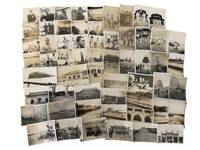
1933réf. 236941933. Colonial Italian Navy photo archive depicting sailors of the gunboat Lepanto in China circa 1933 to 1943 documenting Italy's Tianjin concession Italy's formal colonial territory in China granted in 1901 following the Boxer Rebellion. It covered approximately half a square kilometer and was strategically located on the east bank of the Hai River. Tianjin concession was governed by an Italian military official and maintained its own police force and legal framework. the Italian Navy maintained a strategic presence in China with personnel and several vessels including the gunboats Lepanto and Carlotto to protect Italian concessions in Tianjin and Shanghai. Originally built as an Azio class minelayer Lepanto reached Shanghai in 1933 and was reclassified as a gunboat in 1934 for coastal and Yangtze service protecting Italian citizens missions and treaty port interests. A United States Navy photograph places the vessel on the Whangpoo River at Shanghai during the mass evacuations of 1937 where foreign warships occupied the same congested waterway as refugee steamers and commercial traffic. The archive records this overseas station from the viewpoint of its sailors moving between shipboard hierarchy armed readiness collective leisure Chinese urban life and monumental sites visited under naval escort. Photo archive of 58 silver gelatin photographs ranging from 2" x 2" to 2" x 3.5" China circa 1933 to 1943. The photographs show Lepanto moored in Chinese harbors; Italian sailors posed on deck beside shipboard fittings and beneath the motto "In hoc signo vinces"; officers addressing assembled crews; uniformed men gathered around deck guns; rifle practice on open ground; sailors carrying packs and weapons; and formal and informal portraits of ratings petty officers and decorated officers. Group photographs place sailors at the Temple of Heaven and before other Chinese ceremonial buildings gates monuments and courtyards while wider views record Shanghai and Tientsin waterfronts docks municipal architecture Chinese junks sampans bridges rail lines and harbor shipping. Several images show Chinese residents at close range including children boatmen laborers and crowds encountered during shore leave; others depict shipboard entertainments meals athletic groups relaxed deck scenes and men photographed in work clothes apart from formal naval ceremony. The recurrence of the vessel uniformed crews weapons exercises official gatherings and organized excursions establishes the working structure of an Italian station ship rather than a general tourist itinerary. Italy's naval deployment in China descended from the foreign military privileges established after the Boxer Uprising including the Italian concession at Tientsin and the maintenance of armed detachments consular facilities and river patrol vessels. Lepanto replaced the aging gunboat Sebastiano Caboto and spent a decade operating from Shanghai and along the Yangtze using its shallow draft to reach places inaccessible to larger warships during years of civil conflict Japanese expansion and the Sino Japanese War. Following Italy's armistice with the Allies the crew scuttled Lepanto at Shanghai on September 9 1943 to prevent seizure; Japan raised and recommissioned the vessel as Okitsu in 1944 and the Republic of China received it after Japan's surrender operating it as Hsien Ning. Light surface wear toning occasional creasing and minor edge wear; photos remain legible and mostly clean. Overall in very good condition. A detailed visual record of how an Italian gunboat crew carried naval authority Fascist state ceremony armed preparedness and foreign privilege into the ports and public spaces of Republican China. unknown
1933réf. 236941933. Colonial Italian Navy photo archive depicting sailors of the gunboat Lepanto in China circa 1933 to 1943 documenting Italy's Tianjin concession Italy's formal colonial territory in China granted in 1901 following the Boxer Rebellion. It covered approximately half a square kilometer and was strategically located on the east bank of the Hai River. Tianjin concession was governed by an Italian military official and maintained its own police force and legal framework. the Italian Navy maintained a strategic presence in China with personnel and several vessels including the gunboats Lepanto and Carlotto to protect Italian concessions in Tianjin and Shanghai. Originally built as an Azio class minelayer Lepanto reached Shanghai in 1933 and was reclassified as a gunboat in 1934 for coastal and Yangtze service protecting Italian citizens missions and treaty port interests. A United States Navy photograph places the vessel on the Whangpoo River at Shanghai during the mass evacuations of 1937 where foreign warships occupied the same congested waterway as refugee steamers and commercial traffic. The archive records this overseas station from the viewpoint of its sailors moving between shipboard hierarchy armed readiness collective leisure Chinese urban life and monumental sites visited under naval escort. Photo archive of 58 silver gelatin photographs ranging from 2" x 2" to 2" x 3.5" China circa 1933 to 1943. The photographs show Lepanto moored in Chinese harbors; Italian sailors posed on deck beside shipboard fittings and beneath the motto "In hoc signo vinces"; officers addressing assembled crews; uniformed men gathered around deck guns; rifle practice on open ground; sailors carrying packs and weapons; and formal and informal portraits of ratings petty officers and decorated officers. Group photographs place sailors at the Temple of Heaven and before other Chinese ceremonial buildings gates monuments and courtyards while wider views record Shanghai and Tientsin waterfronts docks municipal architecture Chinese junks sampans bridges rail lines and harbor shipping. Several images show Chinese residents at close range including children boatmen laborers and crowds encountered during shore leave; others depict shipboard entertainments meals athletic groups relaxed deck scenes and men photographed in work clothes apart from formal naval ceremony. The recurrence of the vessel uniformed crews weapons exercises official gatherings and organized excursions establishes the working structure of an Italian station ship rather than a general tourist itinerary. Italy's naval deployment in China descended from the foreign military privileges established after the Boxer Uprising including the Italian concession at Tientsin and the maintenance of armed detachments consular facilities and river patrol vessels. Lepanto replaced the aging gunboat Sebastiano Caboto and spent a decade operating from Shanghai and along the Yangtze using its shallow draft to reach places inaccessible to larger warships during years of civil conflict Japanese expansion and the Sino Japanese War. Following Italy's armistice with the Allies the crew scuttled Lepanto at Shanghai on September 9 1943 to prevent seizure; Japan raised and recommissioned the vessel as Okitsu in 1944 and the Republic of China received it after Japan's surrender operating it as Hsien Ning. Light surface wear toning occasional creasing and minor edge wear; photos remain legible and mostly clean. Overall in very good condition. A detailed visual record of how an Italian gunboat crew carried naval authority Fascist state ceremony armed preparedness and foreign privilege into the ports and public spaces of Republican China. unknown books
1688réf. 59323Seconde édition, 1 vol . in-12 reliure postérieure milieu XIXe dem-chagrin marron, dos à 4 nerfs, Chez Jean Baptiste Deville, Lyon, 1688, 11 ff. (frontispice, titre, Epistre, Avis au Public et Avis nécessaire), 444 pp., 2 ff. n. ch., et 1 f. manuscrit, avec 3 figures gravées dont 2 hors texte (la figure en frontispice du thé étant comprise dans la pagination)
1688Seconde édition, 1 vol . in-12 reliure postérieure milieu XIXe dem-chagrin marron, dos à 4 nerfs, Chez Jean Baptiste Deville, Lyon, 1688, 11 ff. (frontispice, titre, Epistre, Avis au Public et Avis nécessaire), 444 pp., 2 ff. n. ch., et 1 f. manuscrit, avec 3 figures gravées dont 2 hors texte (la figure en frontispice du thé étant comprise dans la pagination) Seconde édition de cet ouvrage de référence pour l'histoire du café, du thé et du chocolat. Etat satisfaisant pour cet exemplaire incomplet des 3 derniers feuillets (dont la dernière page des tables, remplacées par une copie manuscrite du XIXe, et les 5 pages du Privilège), mais bien complet par ailleurs. Hormis le dos un peu frotté et qq. rousseurs, l'exemplaire est par ailleurs agréable et les gravures plus fraîches qu'à l'ordinaire (ex-libris gravés, l'un héraldique à trois merlettes de Joannis Francisci Rondé, l'autre de L. Gounelle). Vicaire, 293 Français
original red hardcovers, gilt titles, with no dust jacket; 195 x 270 mm.; Reprint of the edition first published 1895 in Oxford At The Clarendon Press. With translations, critical and exegetical notes, prolegomena, and copious indexes. In Five Volumes. Volume I (Confucian Analects, with a biographical note by Dr. L. T. Ride) --pg.503. Volume II (The Works of Mencius) --pg. 587. Volume III (The Shoo King, or The Book of Historical Documents--two parts) --pg. Xii, 735. Volume IV (The She King, or The Book of Poetry--two parts) --pg. Xii, 785. Volume V (The Ch'un Ts'ew, with the Tso Chuen--two parts) --pg. Xi, 933. Includes chinese text, authoritative, annotated translations. heavy set, would require extra shipping. scarce in such complete and very good condition.
1929réf. 169367London.: Admiralty. 1929. Large black and white coastal chart 103 x 70.5cm horizontal fold a little light browning and soiling neat manuscript highlighting beacons good copy. Compiled from the latest surveys to 1884 corrected to 1929 with a large correction in 1926. Includes arrows indicating the direction and strength of the surface drift during NE. Monsoon. . Admiralty. unknown
1883réf. 197077Paris.: Canson Libraire-Editeur. 1883. Chromolithograph highlighted with hand colour 64 x 47.3 cms; 90.5 x 65.6 cms sheet original fold small chip and fold split at the outer margin and slight toning at the fold but in very good condition. Richly coloured and beautiful large plate with flowers and birds from "Ornements de la Chine: Recueil de Dessins Pour l'Art et l'Industrie" A Collection of Designs for Art and Industry one of the most attractive 19th century books of design of which only 500 copies were issued. This work was a seminal influence on the introduction of Chinoiserie and Islamic decorative art to French artists and craftsmen. In 1863 the authors Eugène Collinot and Adalbert de Beaumont founded their own faience factory in the Bois de Boulogne specializing in wares inspired by Persian and Iznik pottery. see "Grove Dictionary of Art". . Canson, Libraire-Editeur. unknown
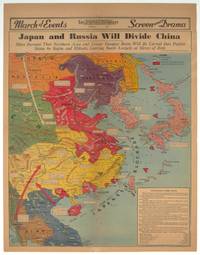
1940réf. 209821Los Angeles.: Los Angeles Examiner. 1940. Printed colour pictorial map on a single newspaper leaf 42.3 x 39.9 cms; 54.3 x 42.5 cms sheet archivally laid down on linen slight discolouration to lower centrefold and sheet slightly age-toned but in very good condition. A striking geopolitical map by Los Angeles Examiner artist Howard Burke covering China Japan Southern Russia and the northern part of French Indochina and Siam showing how the "Aggressors Divide China." Areas under Japanese occupation are shown in red and their naval blockade shown by an arc of naval vessels with vivid arrows indicating lines of supply. Text labels including sources of agricultural and raw materials provide a dynamic overview of the geopolitical situation and show the influence of American scientific illustrator and cartographer Richard Edes Harrison who argued for examining geographic issues from multiple perspectives and Los Angeles Times artist Charles Owens. . Los Angeles Examiner. unknown
2000réf. 1001111China Press 2000-01-01. hardcover. Used - Good. Ship out in 2 business day And Fast shipping Free Tracking number will be provided after the shipment.Hardcover. 260x380mm;306 Language: Chinese. Pub. Date:2006. During two decades since its establishment. the Station has been making great efforts to make improvement and innovation as the nations foundational facility for earth observation in a bid to provide abundant and various remote sensing data. All kinds of representative satellite images received or being received by the Station are collected in this atlas. including images received from US Landsat-5 TM and Landsat-7 ETMextensively us. Satisfaction guaranteedor money back. China Press hardcover
1837réf. REIS0786Leipzig, im Industrie-Comptoir (Baumgärtner) 1835-1837. 2 Bde. 4°. IV, VIII S., 408 S., mit 2, davon e. dopplblattgr., gest., Karten, (Taf. 51 u. 72), 1 mehrf. gef., gest. Karte, mit 71 parallel gezählten (V, 1-50. 52-71), ganzseitig illustrierten Seiten mit je vier Motiven; 1 gest. Taf., IV S., 370 S., mit 1 Karte (Taf. 2), 1 mehrf. gef., gest. Karte, mit 69 parallel gezählten (1. 3-70) ganzseitig illustrierten Seiten mit je drei oder vier Motiven bzw. einer Karte, sowie einer Textillustration. Pappbände d. Zeit, mit Rückenbeschriftungen von alter Hand und goldgeprägten Rückenschildchen, Buchschnitte mit verblasster Marmorierung, Ecken bestoßen, berieben, entlang der Gelenke schadhaft, zweiter Band etwas fleckig. Seiten insgesamt wenig vergilbt, vereinzelt gebräunt u. mäßig fleckig, mit wenigen Blatteinrissen. Sabin V,574. Engelmann. Bibliotheca geographica 99 - zweibändige, reich illustrierte, deutsche Übersetzung der 'Voyage pittoresque autour du monde', einer Sammlung von Berichten über berühmte Entdeckungsfahrten und Forschungsreisen, herausgegeben von Jules Dumont d'Urville (1790-1842), französischem Seefahrer und Entdeckungsreisenden. Der Schriftsteller und Redakteur Johann August Diezmann (1805-1869) übersetzte zahlreiche Werke aus dem englischen und französischen und gab zwei Taschenwörterbücher und mehrere Zeitungen und Zeitschriften heraus. Die Landkarten des ersten Bandes zeigen Hawai, Taiti (Tahiti) und eine Weltkarte, die des zweiten die Tonga Inseln, Neuseeland und den Pazifik. [3 Warenabbildungen]
réf. DADAX0521875668New unknown
1927réf. CHINA015952B.T. Batsford London and Kelley & Walsh Shanghai. 1927. First U.K. edition. Quarto. pp xx 227. 48 colour plates two of which are folding. Most of the illustrations reproduce the signs outside the premises of various tradespeople. Introduction by Evan Morgan. Cream linen covers with gilt device to front. Patterned endpapers. From the library of A.E. Richardson architect historian and Batsford author with his bookplate on front pastedown and ownership inscription on verso of front free endpaper.Very good indeed. No dustwrapper. B.T. Batsford, London, and Kelley & Walsh, Shanghai. unknown
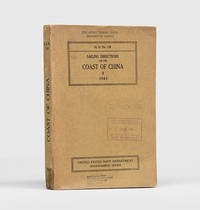
1943réf. 172166Washington DC: United States Navy Department Hydrographic Office 1943. First edition first printing pleasingly with all the printed supplement tickets still present and the detailed maps well preserved. Updated chapters offer information on general subjects such as pilotage storm and weather signals quarantine regulations and ocean currents as well as detailed discussion of stretches of river and ocean along China's east coast down to Hong Kong and up the Yangtze. While common institutionally as expected copies are now seldom encountered in commerce. Octavo. With 2 folding maps 2 diagrammatic plates illustrations in text. With all 8 leaves 4 blank of printed supplement tickets bound in at front as issued. Original brown card wrappers spine and front cover printed in black. Ex-Civil Affairs Training School University of Chicago with its ink stamps on front cover and "discard" noted in pencil. Wrappers well preserved first map with stub tear just touching neatline second map split along one fold neatly repaired on verso with archival tape couple of small nicks and chips internally not affecting text: a very good copy. unknown
1992réf. 2080502106915906Not Available 1992. Soft Cover. Fine. The book is in fine condition. Not Available paperback
2002réf. 89215Geneva, La Borie 2002 Grand in-4. Reliure éditeur pleine toile bleu-roi, jaquette rempliée illustrée en couleurs, 314 pp., catalogue raisonnée et illustré de 536 pièces, planches en couleurs, bibliographie, index. Exemplaire en très bon état.
1698réf. 47094ABKöln u. (Frankreich ?), Gervinus Quentel u.a., 1669-1698. 7 v. 8 Bdn. 12°. Leder. Vergold. Rückentitel u. florale Rückenvergold., Kantenvergold., Exlibris a. vord. Deckel. Ber. u. best., Rü.-Gelenke tls. m. kl. Einrissen, Kapit. tls. m. kl. Fehlst. Gebr. u. tls. fl., Innengel. tls. l. gelockert. Schöne kleine Ausgabe.
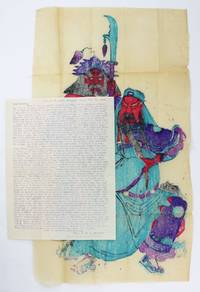
1928réf. 6054Shanghai China: February 24 1928. Very good. 1p. plus colored woodblock print 21.5 x 12.5 inches. With original envelope. Old folds minor wear. Mimeographed fundraising letter sent by Reverend H.G.C. Hallock to a supporter in Vermont. Henry Galloway Comingo Hallock 1870-1951 was a West Virginia native who studied at Princeton Theological Seminary. He moved to China as a Presbyterian missionary and teacher in 1905 where he taught Sunday School served as a pastor and also taught theology at St. John's University in Shanghai. He survived war disease famine and a Japanese prison during World War II; he died in China in 1951. One thing that set Hallock apart was his inclusion of local Chinese woodblock prints with his fundraising letters which today have become desirable collectibles. Such a print is present here showing the God of War Wu-ti. His letter opens discussing the print: "Wars in China suggest sending you 'Wu-ti' the Chinese god-of-war. . The general idea about Wu-ti is that he delights in war. That is not the Chinese idea of him. . Officials and scholars worship him as the ideal of loyalty soldiers do it to make them brave and protect them in battle and the people worship him to protect them from war's horrors. He's called 'Peace Bringer Protector Great God of Loyalty.' But he makes not peace nor protects nor makes loyal so is a failure. He's also called 'Warrior Prince.' As to that name he's a great success! There are lots of wars." He goes on to discuss the many conflicts which are like "a real Chinese puzzle" noting that it's not the people of China who are at issue or fault. "Recently I have received letters from America suggesting that since 'China has altogether gone to the bad and the Chinese are absolutely impossible' and since our 'work among them has gone for nothing' then I should 'quit and come home.' I hope you don't think thus. The masses of Chinese tho reminding me of 'dumb driven cattle' are still friendly as ever. The war-lords the Nationalists the Reds the bandits wars and evil propaganda are disturbing elements; but they are NOT China nor the Chinese. . The troubles in China have come from a fiercely aggressive and 'noisy minority' who make the great mass of Chinese suffer untold hardships." He goes on to defend the Christian work being done in China as of great benefit to the people. February 24 unknown
1928réf. 6054Shanghai China: February 24 1928. Very good. 1p. plus colored woodblock print 21.5 x 12.5 inches. With original envelope. Old folds minor wear. Mimeographed fundraising letter sent by Reverend H.G.C. Hallock to a supporter in Vermont. Henry Galloway Comingo Hallock 1870-1951 was a West Virginia native who studied at Princeton Theological Seminary. He moved to China as a Presbyterian missionary and teacher in 1905 where he taught Sunday School served as a pastor and also taught theology at St. John's University in Shanghai. He survived war disease famine and a Japanese prison during World War II; he died in China in 1951. One thing that set Hallock apart was his inclusion of local Chinese woodblock prints with his fundraising letters which today have become desirable collectibles. Such a print is present here showing the God of War Wu-ti. His letter opens discussing the print: "Wars in China suggest sending you 'Wu-ti' the Chinese god-of-war. . The general idea about Wu-ti is that he delights in war. That is not the Chinese idea of him. . Officials and scholars worship him as the ideal of loyalty soldiers do it to make them brave and protect them in battle and the people worship him to protect them from war's horrors. He's called 'Peace Bringer Protector Great God of Loyalty.' But he makes not peace nor protects nor makes loyal so is a failure. He's also called 'Warrior Prince.' As to that name he's a great success! There are lots of wars." He goes on to discuss the many conflicts which are like "a real Chinese puzzle" noting that it's not the people of China who are at issue or fault. "Recently I have received letters from America suggesting that since 'China has altogether gone to the bad and the Chinese are absolutely impossible' and since our 'work among them has gone for nothing' then I should 'quit and come home.' I hope you don't think thus. The masses of Chinese tho reminding me of 'dumb driven cattle' are still friendly as ever. The war-lords the Nationalists the Reds the bandits wars and evil propaganda are disturbing elements; but they are NOT China nor the Chinese. . The troubles in China have come from a fiercely aggressive and 'noisy minority' who make the great mass of Chinese suffer untold hardships." He goes on to defend the Christian work being done in China as of great benefit to the people. February 24 unknown books