[PHOTOGRAPHIES/PHOTOGRAPHS]Livre Rare Book

25 612 résultats
1930réf. 4389Circa 1930. 1930 2 vols Oblongs (275 x 370 mm) ( 280 x 360 mm) de : 86 photographies (180 x 13mm) réparties sur [24] ff., [1]f avec 11 petites photos.; 92 photographies (150 x 955mm), (130 x 170 mm), (255 x 195 mm) sur [24] ff. Dont [2]ff. (petites photographies), [3] ff. Blancs. Vol. 1: Chagrin bordeau, dos à nerfs orné. Vol 2: chagrin vert, dos lisse muet.
1900Very Good Turkish, Ottoman (1500-1928) Original pictorial wrappers. Cr. 8vo. (20 x 14 cm). In Ottoman script (Old Turkish with Arabic letters). 42 p., 10 b/w plates, and 1 Chinese city plan in text. Hejra: 1318 = Gregorian: 1900. Chipped slightly, faded on paper. Otherwise a good copy. First and only edition of this rare travel account of China by Dihlevî in the 19th century, which described China's location, its latitude and longitude, shores and islands, mountains, lakes, rivers, channels, waters, climate, mines, crops, architecture, provinces, social life, important cities, and dresses of Chinese people, important streets, etc. Also talked about the traditions of pagan peoples and Muslims in China. Travel memoirs of China, printed in the early period of Ottoman travel literature. MÇOB 80.; MKAHTBK, Suppl. pp.338.; Özege 3359.; No copy in OCLC.
réf. 6162SLND [Canton, circa 1880]. 1 vol in-4° ( 250 x 205 mm ) de: [14] ff dont 2 blancs et 12 peintures à l'encre et à la gouache sur papier contrecollées (rares salissures ou taches, coloris trés frais) Cartonnage d'époque monté en accordéon, plats recouverts de papier japon dominoté bleu rouge et blanc à motifs géométriques et floraux. (Usures et défauts dusage).
1907réf. 31534[Chine - Tianjin 1907] in-8 oblong (18 x 13 cm environ) demi-basane brune, carton fort entièrement monté sur onglets, tranches dorées, dos manquant
1884réf. 006574Leipzig, F. A. Brockhaus, 1884. XXIV, 412; XIII, 406 S. Orig.-Leinenbände. "Colquhoun, Ingenieur der indischen öffentlichen Bauten, unternahm 1882 eine Reise quer durch SW-China, auf größtenteils von Europäern noch nicht begangener Route. Hauptzweck seines Unternehmens war die Feststellung der kommerziellen und physikalischen Verhältnisse SW-Chinas und der Schan-Staaten sowie die Ermittlung einer geeigneten Eisenbahntrasse nach Burma ... Sein Reisewerk vermittelte reiche Auskünfte über Geographie und Ethnographie des durchzogenen Gebiets" (Henze I, 595). Die deutsche Ausgabe nicht bei Cordier: Bibliotheca Sinica. Ein schönes, gut erhaltenes Exemplar in einwandfreiem Zustand.
2003réf. 004317Chicago, Art Media Resources, 2003. 391 S. Großformatiger Orig.-Pappband mit Schutzumschlag. Ein schönes, gut erhaltenes Exemplar in einwandfreiem Zustand.
1979réf. 008076Kehl, Swan Verlag, 1979. 150 S., 1 Blatt. Großformatiger Orig.-Leinenband. Eindrucksvolle Automobil-Fahrt mit kettengebtriebenen Expeditionsfahrzeugen der Firma Citroen. Ein gut erhaltenes Exemplar mit nur leichten Gebrauchsspuren.
réf. 3699Xiao Pan. Affiche sur papier photo au format 50 x 70 cm., en belle condition.
Very Good Turkish, Ottoman (1500-1928) A modern fine black leather bdg. Small 4to. (26 x 18 cm). In Ottoman script. 3 volumes set: ([13], 448, [11], [6] p.; 386, [12], [6] p.; 203 p). Ibn Battuta was the greatest medieval Muslim traveler and the author of one of the most famous travel books, the Ri?lah (Travels). His great work describes his extensive travels covering some 75,000 miles (120,000 km) in trips to almost all of the Muslim countries and as far as China and Sumatra (now part of Indonesia). Ibn Battuta was from a family that produced a number of Muslim judges (qadis). He received the traditional juristic and literary education in his native town of Tangier. In 1325, at the age of 21, he started his travels by undertaking the pilgrimage (hajj) to Mecca. At first his purpose was to fulfill that religious duty and to broaden his education by studying under famous scholars in Egypt, Syria, and the Hejaz (western Arabia). That he achieved his objectives is corroborated by long enumerations of scholars and Sufi (Islamic mystic) saints whom he met and also by a list of diplomas conferred on him (mainly in Damascus). Those studies qualified him for judicial office, whereas the claim of being a former pupil of the then-outstanding authorities in traditional Islamic sciences greatly enhanced his chances and made him thereafter a respected guest at many courts. That renown was to follow later, however. In Egypt, where he arrived by the land route via Tunis and Tripoli, an irresistible passion for travel was born in his soul, and he decided to visit as many parts of the world as possible, setting as a rule "never to travel any road a second time." His contemporaries traveled for practical reasons (such as trade, pilgrimage, and education), but Ibn Battuta did it for its own sake, for the joy of learning about new countries and new peoples. He made a living of it, benefitting at the beginning from his scholarly status and later from his increasing fame as a traveler. He enjoyed the generosity and benevolence of numerous sultans, rulers, governors, and high dignitaries in the countries he visited, thus securing an income that enabled him to continue his wanderings. From Cairo, Ibn Battuta set out via Upper Egypt to the Red Sea but then returned and visited Syria, there joining a caravan for Mecca. Having finished the pilgrimage in 1326, he crossed the Arabian Desert to Iraq, southern Iran, Azerbaijan, and Baghdad. There he met the last of the Mongol khans of Iran, Abû Sa'îd (ruled 1316-36), and some lesser rulers. Ibn Battuta spent the years between 1327 and 1330 in Mecca and Medina leading the quiet life of a devotee, but such a long stay did not suit his temperament. Embarking on a boat in Jiddah, he sailed with a retinue of followers down both shores of the Red Sea to Yemen, crossed it by land, and set sail again from Aden. This time he navigated along the eastern African coast, visiting the trading city-states as far as Kilwa (Tanzania). His return journey took him to southern Arabia, Oman, Hormuz, southern Persia, and across the Persian Gulf back to Mecca in 1332. There a new, ambitious plan matured in his mind. Hearing of the sultan of Delhi, Mu?ammad ibn Tughluq (ruled 1325-51), and his fabulous generosity to Muslim scholars, he decided to try his luck at his court. Forced by lack of communications to choose a more indirect route, Ibn Battuta turned northward, again passed Egypt and Syria, and boarded ship for Asia Minor (Anatolia) in Latakia. He crisscrossed that "land of the Turks" in many directions at a time when Anatolia was divided into numerous petty sultanates. Thus, his narrative provides a valuable source for the history of that country between the end of the Seljuq power and the rise of the house of Ottoman. Ibn Battuta was received cordially and generously by all the local rulers and heads of religious... Hejra: 1333; 1335; 1336 = Roumi: 1335 ; 1337; 1340 = Gregorian: 1917; 1919; 1921. Ozege: 21289. For fihrist: 5771.
réf. 3700Xiao Pan. Affiche sur papier photo au format 50 x 70 cm., en belle condition.
réf. 9440Beijing, Beijing tebie shi gongshu, 1940 (ROC 29). 1 volume-in 8, 65 pp., black fabric hardback with a printed Chinese motif on the cover, flat spine, equipped with a paper slipcase in bad condition, decorated with 129 photos and 1 map of Beijing and its surrounding, in very good condition.
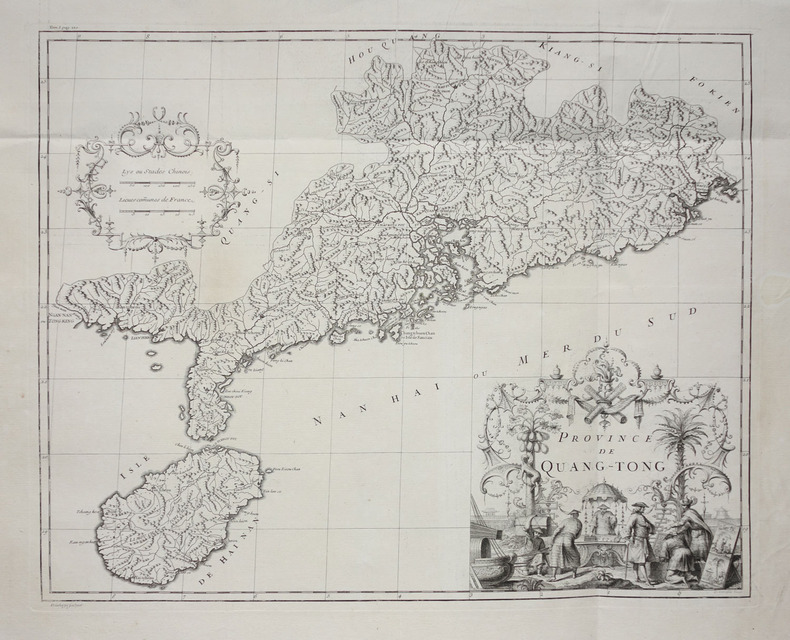
1785réf. LBW-3647[1785]. 366 x 458 mm.
1833réf. LBW-1990Paris, 1833-1839. 270 x 368 mm.
1785réf. LBW-3631[1785]. 391 x 247 mm.
1840réf. LBW-3679[1840]. 235 x 263 mm.
1735réf. LBW-2732[Paris, 1735]. 421 x 529 mm.
1840réf. LBW-3680[1840]. 219 x 314 mm.
1965Very Good Uighur Original wrappers. Cr. 8vo. (20 x 14 cm). In Uighur with the Latin alphabet. [20], 155, [2] p., b/w ills. Exceedingly rare first and only Uyghur translation of the speeches of the revolutionary leaders and members of the CCP or authors and intellectuals like Hua Guofeng, (1921-2008), Deng Xiaoping, (1904-1997), Fang Yui, (1916-1997), Guo Moruo [Dindang], (1892-1978), Ji Dengkui, (1923-1988). These speeches were made at the National Science Conference held in Beijing on March 18-31,1978. We couldn't find any copy in OCLC.
1905réf. 012782Rostock, Volckmann, 1905. VI, 384 S., 2 Blatt. Dekorativer Orig.-Leinenband. Cordier: Bibliotheca Sinica 2172f. und 2598. Ausgeschiedenes Bibliotheksexemplar: mehrfach gestempelt und der Rücken mit kleinem Signaturschildchen, sonst schönes, gut erhaltenes Exemplar mit nur leichten Gebrauchsspuren.
1902réf. 008760Dinglingen, China-Inland-Mission, 1902. VII, 276 S. Orig.-Leinenband. Nicht bei Cordier: Bibliotheca Sinica. Der Vortitel mit kleinem chinesischem Stempel, sonst gut erhaltenes Exemplar mit nur leichten Gebrauchsspuren.
1909réf. 008725Leipzig, Dieterich'sche Verlagsbuchhandlung Theodor Weicher, 1909. XI, 236 S. Orig.-Leinenband. Cordier: Bibliotheca Sinica 4179. Das Titelblatt mit kleinem chinesischem Stempel und ca. 20 Seiten mit kleinen Randnotizen in Bleistift, sonst gut erhaltenes Exemplar mit nur leichten Gebrauchsspuren.
1979réf. 008735Wiesbaden, Franz Steiner, 1979. 4 Blatt, 360 S. Orig.-Broschur. Das Titelblatt mit kleinem chinesischem Stempel, sonst gut erhaltenes Exemplar mit nur leichten Gebrauchsspuren.
1991réf. 008266Hong Kong, FormAsia, 1991. 150 S., 2 Blatt. Großer querformatiger Orig.-Pappband mit Schutzumschlag. Ein gut erhaltenes Exemplar mit nur leichten Gebrauchsspuren.
1956réf. 008758London, Lion and Unicorn Press, 1956. 26 Blatt. Etwas größerer Orig.-Leinenband. Eins von 200 handschriftlich numerierten Exemplaren. Mit Exlibris des britischen Typografen und Buchgestalters Ruari McLean (1917-2006). Ein schönes, gut erhaltenes Exemplar mit nur kleichten Gebrauchsspuren.
1895réf. 008798Stuttgart, Strecker & Moser, 1895. 87 S. Orig.-Leinenband. Max von Brandt (1835-1920) war Konsul in Japan, kaiserlich-deutscher Gesandter in China und Ostasien-Experte: "Seine vielbeachteten Abhandlungen und Sachbücher über Ostasien zählten zu den besten völkerkundlichen Beschreibungen, die zu seiner Zeit zur Verfügung standen" (Wikipedia). Cordier: Bibliotheca Sinica 3165. Mit kleinem chinesischen Stempel und gering fleckig, sonst gut erhaltenes Exemplar mit nur leichten Gebrauchsspuren.