Trade Paperback. Good. 8vo - over 7¾" - 9¾" tall. Wraps
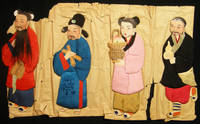
Best.-Nr. 029115China Four multi-dimensional figurines in cloth & card affixed to a backing-paper. They all have finely hand-painted faces & other features; the clothing is all carefully styled and sewn from colorful silk scraps with a 3-d 'puffy' textured result. The reverse of one of the figures with a small number-stamp and 'China.' Undated and circa 20th century presumably Chinese souvenir hand-work. Average figure height approx. 7"; overall length of the panel of four 13". The backing paper very chipped & wrinkled; figures bright and nicely accomplished in very good condition. Dolls. Very Good. hardcover
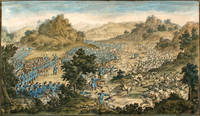
1775Best.-Nr. 1691811775. QIANLONG EMPEROR OF CHINA 1736-1796. Suite of four engravings depicting the conquests of the Qianlong Emperor. From the suite of sixteen engraved plates. Printed in Paris under the direction of Charles-Nicholas Cochin. Broadsheets image size: 515 x 890 mm. Preserved in the contemporary French green paper mounts with black ink outline borders. Professionally framed. With the original French printed labels describing the individual engravings affixed to back of frames. Paris 1769-1774. These four contemporary hand-coloured engravings represent individual scenes from the exceedingly rare series of sixteen engravings commissioned by the Qianlong Emperor to commemorate the victory of his 1755-1760 military campaigns against the Western Mongols. The four plates are: I. "General Fou Te Accepts the Surrender of the Ili" showing the triumphal march of the Emperor and his general to Beijing. Drawn by Sichelbart and engraved by B.L. Prévost in 1769 Pirazzoli-t'Serstevens 1; II. "The victory of Khorgos." in the Spring of 1758 against the forces of Amoursana. Drawn by J. D Attiret cut by C. N. Cochin and engraved by J. Ph. Le Bas in 1774. Pirazzoli-t'Serstevens 4; III. "The great victory of the Qurman." on February 3 1759 when the Chinese general Fou-te with only 600 soldiers defeated an army of 5000 Muslims. Drawn by Damasceno and engraved by A. de St. Aubin in 1770. Pirazzoli-t'Serstevens 8. IV. "The Emperor Gives a Victory Banquet to the Officers and Soldiers who have distinguished themselves in battle" at Tseu-kuang-ko the Imperial Palace Gardens Beijing on July 5 1754. Drawn by Castiglione and engraved by J. Ph. le Bas 1770 Pirazzoli-t'Serstevens 16. These large Chinese-French prints are among the most impressive works ever produced by the method of copper engraving. This is the first series of engraved plates to document the conquests of the Qianlong Emperor. They represented an amalgam of Chinese imagery Italian interpretation and Parisian copperplate engraving at its apogee. The drawings were supplied by Jesuit artists attached to the Emperor's court in Beijing. Upon completion they were shipped to France for engraving as the craft was unknown in China. After the Emperor was shown battle prints by the Augsburg artist Georg Philipp Rugendas 1666-1743 he wished to see his military conquests recorded in intaglio prints as well. He therefore ordered his Jesuit court painters Giuseppe Castiglione 1688-1766 called "Lang Shining" Jean Denis Attiret 1702-1768 "Wang Zhicheng" Ignaz Sichelbart 1708-1780 "Ai Qimeng" and Giovanni Damasceno Sallusti i.e. Joannes Damascenus a SS. Concepcione d. 1781 later bishop of Beijing called "An Deyi" to prepare sketches for the prints which they did in 1764 and 1765. Four of the drawings had been completed by the time of Castiglione's death when the decision was made to send the work to France via the ships of the Compagnie des Indes. According to the Emperor's decree no expense was to be spared. The first four drawings reached Paris in the autumn of 1766 and the remaining twelve in July 1767. The Marquis de Marigny director of the Academie Royale de Peinture et Sculpture decreed that the work should be carried out under the supervision of Charles-Nicholas Cochin 'fils' 1715-1790. As the French paper manufacturers did not have paper of the desired proportions the paper-merchant Prudhomme was ordered to make it to custom; the new size was called Grand Louvois. The copperplates were imported from England. Cochin chose Beauvais for the actual printing of the sheets on the grounds that he was "the only one who can be completely trusted both regarding his talents as well as his honesty which is well-known." The work proceeded slowly; standards of the highest quality were called for and some of the pictures especially the one by Sallusti needed careful editing. The original order was for 100 copies of each print but by 1768 this figure was increased to 200 copies so that at least 100 would survive the journey back to China ! -- however several authorities claim that many copies were lost at sea. In any event the final delivery was not shipped until 1775 occasioned in part by the difficulty the printers had producing a uniform series of prints from drawings by different artists. Three of the initial drawings were made by Attiret six by Damasceno one by Sichelbart and at least two by Castiglione; the remaining are unsigned but have been attributed to Castiglione by C. & M. Beurdeley and others. The engravers were L.J. Masquelier 1 J. Aliamet 2 J. Ph. Le Bas 5 A. St.-Aubin 2 F.D. Née 1 B.L. Prevost 2 P.P. Choffard 2 and N. de Launay 1. The Emperor's instructions stated that all the impressions were to be sent to him along with the original copper plates. However there is plentiful evidence that prints were pulled for the King of France and influential persons in Paris as well. Most of the surviving sets and individual prints appear to belong to this surreptitious group. The above series is not only a landmark in the history of Chinese and European art but also testifies to the direct artistic cooperation between China and Europe in the eighteenth century. It has been a common misconception that China was only interested in itself and detested the foreigners -- here the Emperor himself proved the contrary. VERY RARE IMPRESSIONS WITH CONTEMPORARY FRENCH HAND-COLOURING. The complete set of sixteen black and white engravings or a few individual prints from this set have come onto the market for sale only rarely. We can locate no other examples of any of the prints with contemporary colouring having been for sale or in public or private collections. PROVENANCE: Robert Barnwell Roosevelt 1829-1906 the uncle of Theodore Roosevelt and great-uncle of Eleanor Roosevelt. He was an early conservationist and worked for the protection of waterways. Roosevelt served in Congress and was later appointed to a diplomatic post in the Netherlands. He is credited with influencing his nephew Theodore Roosevelt to become a conservationist. With the ownership label "R.B. Roosevelt/ 26 East 20th Street/ New York" attached to the verso on one print. Cohen-De Ricci 1012-1013. Cordier Bibliotheca Sinica 641-642. Fünf Jahrhunderte Buchillustration 141. Brunet V 1178. P. Pelliot "Les conquêtes de l'empereur de la Chine" T'oung Pao ed. H. Cordier & P. Pelliot vol 20 1921 pp. 183-274. Michèle Pirazzoli t'Serstevens Gravures de conquêtes de l'Empereur de la Chine Kien-Long au Musée Guimet 1969. Hartmut Walravens "The Introduction of Copper-Engraving into China" 62nd IFLA General Conference August 25-31 1996. unknown
1775Best.-Nr. 1691811775. QIANLONG EMPEROR OF CHINA 1736-1796. Suite of four engravings depicting the conquests of the Qianlong Emperor. From the suite of sixteen engraved plates. Printed in Paris under the direction of Charles-Nicholas Cochin. Broadsheets image size: 515 x 890 mm. Preserved in the contemporary French green paper mounts with black ink outline borders. Professionally framed. With the original French printed labels describing the individual engravings affixed to back of frames. Paris 1769-1774. These four contemporary hand-coloured engravings represent individual scenes from the exceedingly rare series of sixteen engravings commissioned by the Qianlong Emperor to commemorate the victory of his 1755-1760 military campaigns against the Western Mongols. The four plates are: I. "General Fou Te Accepts the Surrender of the Ili" showing the triumphal march of the Emperor and his general to Beijing. Drawn by Sichelbart and engraved by B.L. Prévost in 1769 Pirazzoli-t'Serstevens 1; II. "The victory of Khorgos." in the Spring of 1758 against the forces of Amoursana. Drawn by J. D Attiret cut by C. N. Cochin and engraved by J. Ph. Le Bas in 1774. Pirazzoli-t'Serstevens 4; III. "The great victory of the Qurman." on February 3 1759 when the Chinese general Fou-te with only 600 soldiers defeated an army of 5000 Muslims. Drawn by Damasceno and engraved by A. de St. Aubin in 1770. Pirazzoli-t'Serstevens 8. IV. "The Emperor Gives a Victory Banquet to the Officers and Soldiers who have distinguished themselves in battle" at Tseu-kuang-ko the Imperial Palace Gardens Beijing on July 5 1754. Drawn by Castiglione and engraved by J. Ph. le Bas 1770 Pirazzoli-t'Serstevens 16. These large Chinese-French prints are among the most impressive works ever produced by the method of copper engraving. This is the first series of engraved plates to document the conquests of the Qianlong Emperor. They represented an amalgam of Chinese imagery Italian interpretation and Parisian copperplate engraving at its apogee. The drawings were supplied by Jesuit artists attached to the Emperor's court in Beijing. Upon completion they were shipped to France for engraving as the craft was unknown in China. After the Emperor was shown battle prints by the Augsburg artist Georg Philipp Rugendas 1666-1743 he wished to see his military conquests recorded in intaglio prints as well. He therefore ordered his Jesuit court painters Giuseppe Castiglione 1688-1766 called "Lang Shining" Jean Denis Attiret 1702-1768 "Wang Zhicheng" Ignaz Sichelbart 1708-1780 "Ai Qimeng" and Giovanni Damasceno Sallusti i.e. Joannes Damascenus a SS. Concepcione d. 1781 later bishop of Beijing called "An Deyi" to prepare sketches for the prints which they did in 1764 and 1765. Four of the drawings had been completed by the time of Castiglione's death when the decision was made to send the work to France via the ships of the Compagnie des Indes. According to the Emperor's decree no expense was to be spared. The first four drawings reached Paris in the autumn of 1766 and the remaining twelve in July 1767. The Marquis de Marigny director of the Academie Royale de Peinture et Sculpture decreed that the work should be carried out under the supervision of Charles-Nicholas Cochin 'fils' 1715-1790. As the French paper manufacturers did not have paper of the desired proportions the paper-merchant Prudhomme was ordered to make it to custom; the new size was called Grand Louvois. The copperplates were imported from England. Cochin chose Beauvais for the actual printing of the sheets on the grounds that he was "the only one who can be completely trusted both regarding his talents as well as his honesty which is well-known." The work proceeded slowly; standards of the highest quality were called for and some of the pictures especially the one by Sallusti needed careful editing. The original order was for 100 copies of each print but by 1768 this figure was increased to 200 copies so that at least 100 would survive the journey back to China ! -- however several authorities claim that many copies were lost at sea. In any event the final delivery was not shipped until 1775 occasioned in part by the difficulty the printers had producing a uniform series of prints from drawings by different artists. Three of the initial drawings were made by Attiret six by Damasceno one by Sichelbart and at least two by Castiglione; the remaining are unsigned but have been attributed to Castiglione by C. & M. Beurdeley and others. The engravers were L.J. Masquelier 1 J. Aliamet 2 J. Ph. Le Bas 5 A. St.-Aubin 2 F.D. Née 1 B.L. Prevost 2 P.P. Choffard 2 and N. de Launay 1. The Emperor's instructions stated that all the impressions were to be sent to him along with the original copper plates. However there is plentiful evidence that prints were pulled for the King of France and influential persons in Paris as well. Most of the surviving sets and individual prints appear to belong to this surreptitious group. The above series is not only a landmark in the history of Chinese and European art but also testifies to the direct artistic cooperation between China and Europe in the eighteenth century. It has been a common misconception that China was only interested in itself and detested the foreigners -- here the Emperor himself proved the contrary. VERY RARE IMPRESSIONS WITH CONTEMPORARY FRENCH HAND-COLOURING. The complete set of sixteen black and white engravings or a few individual prints from this set have come onto the market for sale only rarely. We can locate no other examples of any of the prints with contemporary colouring having been for sale or in public or private collections. PROVENANCE: Robert Barnwell Roosevelt 1829-1906 the uncle of Theodore Roosevelt and great-uncle of Eleanor Roosevelt. He was an early conservationist and worked for the protection of waterways. Roosevelt served in Congress and was later appointed to a diplomatic post in the Netherlands. He is credited with influencing his nephew Theodore Roosevelt to become a conservationist. With the ownership label "R.B. Roosevelt/ 26 East 20th Street/ New York" attached to the verso on one print. Cohen-De Ricci 1012-1013. Cordier Bibliotheca Sinica 641-642. Fünf Jahrhunderte Buchillustration 141. Brunet V 1178. P. Pelliot "Les conquêtes de l'empereur de la Chine" T'oung Pao ed. H. Cordier & P. Pelliot vol 20 1921 pp. 183-274. Michèle Pirazzoli t'Serstevens Gravures de conquêtes de l'Empereur de la Chine Kien-Long au Musée Guimet 1969. Hartmut Walravens "The Introduction of Copper-Engraving into China" 62nd IFLA General Conference August 25-31 1996. unknown books
1937Best.-Nr. 4763New York & London : Harper & Brothers Publishers 1937. 1937. Hardcover. Very Good. Illustrated by Sapojnikoff with cartoons throughout ; 317 pp. ; important psychological study of Chinese habits and consumer practices ; "No matter what you may be selling your business in China should be enormous if the Chinese who should buy your goods would only do so." But will they'. 400 Million Customers is essential reading for all foreigners seeking to do business in the booming economies of Asia and all analysts of globalization and cultural difference. Carl Crow opened the first western advertising agency in Shanghai and ran it for twenty-five years promoting everything from American lipsticks and moisturizers to French brandy and pharmaceuticals and nothing was straightforward. In this highly readable account of his work in Shanghai illustrated with delightful line drawings Crow uses anecdotes and examples to illustrate the particular challenges of doing business in China. In Crow's time no foreigners managed to dominate the Chinese market and today -- when the population of China has trebled - the question remains whether the country is a potential mass market for the west or a golden illusion. Crow's book remains as apt now as when it was written in 1937 and leading business schools recommend it as one of the best accounts of Chinese business culture." ; ex-lib ; library binding ; no dustjacket ; pockets labels stamps ; FAIR This listing contains text in Chine se GB fonts New York & London : Harper & Brothers, Publishers, 1937. hardcover
1937Best.-Nr. 4762New York & London : Harper & Brothers Publishers 1937. 1937. 5th or later Edition . Hardcover. Very Good. 7th edition ; Black cloth with pasted paper spine title in black and gold ; endpages illustrated by Sapojnikoff and cartoons throughout ; 317 pp. ; important psychological study of Chinese habits and consumer practices ; "'No matter what you may be selling your business in China should be enormous if the Chinese who should buy your goods would only do so." But will they'. 400 Million Customers is essential reading for all foreigners seeking to do business in the booming economies of Asia and all analysts of globalization and cultural difference. Carl Crow opened the first western advertising agency in Shanghai and ran it for twenty-five years promoting everything from American lipsticks and moisturizers to French brandy and pharmaceuticals and nothing was straightforward. In this highly readable account of his work in Shanghai illustrated with delightful line drawings Crow uses anecdotes and examples to illustrate the particular challenges of doing business in China. In Crow's time no foreigners managed to dominate the Chinese market and today -- when the population of China has trebled - the question remains whether the country is a potential mass market for the west or a golden illusion. Crow's book remains as apt now as when it was written in 1937 and leading business schools recommend it as one of the best accounts of Chinese business culture." ; VG This listing contains text in Chinese GB fonts New York & London : Harper & Brothers, Publishers, 1937. hardcover
Hardcover in dj 8vo, t Edition. Four Princes: Henry VIII, Francis I, Charles V, Suleiman the Magnificent and the Obsessions that Forged Modern Europe 'Never before had the world seen four such giants co-existing. Sometimes friends, more often enemies, always rivals, these four men together held Europe in the hollow of their hands.' Four great princes - Henry VIII of England, Francis I of France, Charles V of Spain and Suleiman the Magnificent - were born within a single decade. Each looms large in his country's history and, in this book, John Julius Norwich broadens the scope and shows how, against the rich background of the Renaissance and destruction of the Reformation, their wary obsession with one another laid the foundations for modern Europe. Individually, each man could hardly have been more different - from the scandals of Henry's six wives to Charles's monasticism - but, together, they dominated the world stage.
8vo, br. ed. 268. Richly researched and engagingly written, this important history of imperial China shows in fascinating detail how Emperor Jiajing and his grand secretaries governed. Drawing on a treasure trove of the grand secretaries' personal writings, John W. Dardess's narrative brings to life the inner workings of the largest polity on the face of the earth.
1980Best.-Nr. N4937Tokyo: Nigensha Publishing 1980. Silk broidery. Fine. Folio. Leporello format book bound in silk broidery and in the original decorative box. FOLIO. Attached brochure in English: Autor Chiang Chao-shen "LETTERS AND POEMS BY FOUR SUNG MASTERS SU SHIH. MI FEI" 19pp English and Chinese A FINE COPY. VERY CLEAN AND FRESH. Nigensha Publishing unknown
4 Fine with Mylar Cover. Hardcover. Oversize. 430 pages.An in depth and extensive examination of the five basic Chinese script forms, the vmaterials used, calligraphy as an expression of the artist and the traditions utilized in Chinese calligraphy. Large full size examples in black and white. extra shipping for international orders.
1946Best.-Nr. ABE-147309154266236 PAGES-28,5 CM X 38 CM-EN COUVERTURE "LA FIN DE LA MONARCHIE EN ITALIE", ARRIVEE AU PORTUGAL DE LA REINE MARIE-JOSE ET DE SES QUATRE ENFANTS-EN COUVERTURE INTERIEURE "LE PROCES DU GENERAL MIKHAILOVITCH"-LES PROBLEMES DE LA CONFERENCE DES QUATRE FRONTIERE FRANCO-ITALIENNE, 3P PAR LE COLONEL M.VERNOUX, 2 PHOTOS, CARTE-LA FAMINE EN CHINE, PAR ANDRE PIERRE, 3 PHOTOS-AUX MAQUIS DE FRANCE, 2P, 5 PHOTOS, MONT MOUCHET-UNE GRANDE COLLECTION MECONNUE LA GALERIE DES MIRABEAU, 6P PAR MARCEL PROVENCE, 10 ILL-LA FRANCE EN AUTRICHE, 4P PAR HENRI CHERET, 9 PHOTOS-ABD EL-KADER OU MEHEMET-ALI, 1P, 3 PHOTOS, LOUVECIENNES-LE GENERAL DE GAULLE A BAYEUX, 1P, 2 PHOTOS-LE THEATRE PAR YVES GANDON: "LA MEGERE APPRIVOISEE" DE GASTON BATY, PHOTO MARGUERITE JAMOIS ET LUCIEN NAT-CINEMA PAR DENIS MARION: CHARLOT-AU SALON NATIONAL INDEPENDANT LES GRAVEURS SUR BOIS SUISSES, PAR YVES SJOBERG, 2P, 4 ILL, ZBINDEN, PATOCCHI, MULLER, FRANCILLON-EN DERNIERE PAGE PUBLICITE COULEURS DE GRUAU POUR LA MARQUE SCANDALE
1948Best.-Nr. ABE-161382392016040 PAGES-28,5 CM X 38 CM-EN COUVERTURE: LA CHINE NATIONALISTE LANCE UN S.O.S. A WASHINGTON, MME TCHIANG KAI CHEK ET MME GEORGE MARSHALLEN COUVERTURE INTERIEURE: DEPART POUR L'ANTARCTIQUE, COMMANDANT CHARCOT-OAS D'ENGAGEMENT SANS LIMITE, RUHR, 2P, 7 PHOTOS-LE CONGRES DU PARTI RADICAL, 1P, 6 CROQUIS-VERS CAO BANG CAPITALE DU REDUIT VIETMINH, PAR LUCIEN BODARD, 3 PAGES-GUERILLAS AU TONKIN-LA TROISIEME REPUBLIQUE ENTRE DANS L'HISTOIRE, 3 PAGES PAR MARCEL ASTRUC PEINTURE, 12 ILL-SAINTE CATHERINE CHEZ LES COUSETTES, 1P, 5 PHOTOS-LE CINEMA EN COULEURS ETAPE NOUVELLE DUE A LA SCIENCE FRANCAISE, PAR ROBERT COULOM, 2 PAGES, 8 PHOTOS-JOUETS POUR TOUS, PAR MARTIAL PIECHAUD, 3 PAGES, 14 PHOTOS-LES BALLETS DES CHAMPS ELYSEES, 1P, 4 CROQUIS DE REINOSO-CIRQUE ET VARIETES RHAPSODIE CARAIBE, 1P, 4 PHOTOS, KATHERINE DUNHAM-A TRAVERS LES EXPOSITIONS: LEGUEULT, CHRISTIAN CAILLARD (ILL "FIGURE DU MEXIQUE") HENRI DE WAROQUIER
1947Best.-Nr. LFA0083fN° 117 - 27 décembre 1947 - Une revue de 32 pages, format 380 x 280 mm, nombreuses illustrations
1953Best.-Nr. LFA-126720164Revue mensuelle de culture et de synthèse Franco-Asiatique : 113 pages, format 160 x 235 mm, illustrée, brochée, bon état
1973Best.-Nr. 134687Imprimé en Chine Imprimé en Chine 1973. In-12 agrafé de 35 pages illustrées. Bon état
Best.-Nr. H13245, Antwerpen, Sheed & Ward, 1953, 447pp. + 16 buitentekstill. & 3 kaarten, linnen band, goede staat, H13245
1973Best.-Nr. 80395Couverture souple. Broché. 36 pages.
1973Best.-Nr. 98585Couverture souple. Broché. 36 pages.
1973Best.-Nr. 98586Couverture souple. Broché. 36 pages.
1949Best.-Nr. 33093Couverture souple. Numéro complet.
1949Best.-Nr. 33102Couverture souple. Numéro complet.
1949Best.-Nr. 33105Couverture souple. Numéro complet.
1949Best.-Nr. 33109Couverture souple. Numéro complet.
1956Best.-Nr. 36642Couverture souple. Revue. 70 pages.
1954Best.-Nr. 36849Couverture souple. Revue. Environ 120 pages.