Applied Human Geography
2020réf. DBS-9781774073254Delve 2020. 1st. Hardcover. New. Delve hardcover
487 résultats
2021réf. DBS-9781774076378ARCLER PRESS 2021. 1st. Hardcover. New. ARCLER PRESS hardcover
2020réf. DBS-9781774073254Delve 2020. 1st. Hardcover. New. Delve hardcover
2020réf. DBS-9781774073254Delve 2020. 1st. Hardcover. New. Delve hardcover
2021réf. DBS-9781774077924ARCLER PRESS 2021. 1ST. Hardcover. New. ARCLER PRESS hardcover
2021réf. DBS-9781774077924ARCLER PRESS 2021. 1ST. Hardcover. New. ARCLER PRESS hardcover
2021réf. DBS-9781774077610ARCLER PRESS 2021. 1ST. Hardcover. New. ARCLER PRESS hardcover
2021réf. DBS-9781774077610ARCLER PRESS 2021. 1ST. Hardcover. New. ARCLER PRESS hardcover
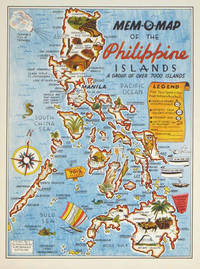
1945réf. 204557U.S.A.: Mem-O-Map Co. 1945. Colour pictographic / pictorial map 32.1 x 23.8 cms; 35.4 x 26.6 cms sheet very good condition. Rare pictorial map published in 1945 by John G. Drury aTechnical Officer who served with the 214th Ordnance Battalion to mark the end of World War II as souvenirs for the military. Military personnel could fill in banners "came in on good ship." and "departed on good ship." their name organisation and "Line of Advance or movement" blank in this example. Pictographs mark various memorable spots and wildlife including larger-than-life insects. A "Terrible Tillie Typhoon" looms over the coast at Luzon. Drury published a series of five maps: Philippines and Okinawa in 1945; Japan and Korea Oahu and Europe in 1946. They are all scarce. “These almost whimsical maps are designed to support the creation of personalised geographies. At a time when digital mapping is beginning to experiment with the creation of personalised content that would render the same map in different ways for different users Mem-O-Maps demonstrate the principle in action." Kenneth Field ICA Commission on Map Design. . Mem-O-Map Co. unknown
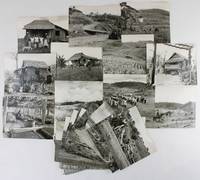
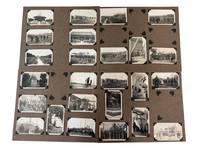
1950réf. 3741Philippines 1950. Very good. Thirty-one original photographs each measuring 4 x 5 inches. Minor wear and dust soiling. Mostly sharp clean images. Fascinating group of over thirty candid photographs depicting Philippine settlers and their homes on the large southern island of Mindanao just after World War II. Over half over these show settlers and their homes in the Panguantucan and Nabaliwa areas of Bukidnon province in the center of the island as wells as images of coffee and soybean farms a poultry enterprise rural roads and bridges and more. Additional photographs show similar scenes in Lanao del Sur also on Mindanao and a few in the Tinambac municipality of the more central Camarines Sur province -- farmers with their products by the road agricultural families at work a plant nursery and settlers' children in the fields. Mindanao is one of the principal centers of agricultural production in the Philippines and the island was subject to a series of resettlement efforts across the 20th century by both colonial and independent governments aimed at increasing production. The photos are captioned in manuscript in English on the versos and scattered images of crude roads and construction equipment suggest that these images were taken by a U.S. Army engineer or a private contractor after the war. unknown
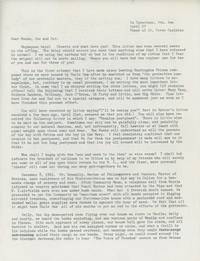
1945réf. List2748Philippines 1945. Single letter; five 8.5 x 11” pages. Pinhole at top of first page missing final pages overall fine. The unknown author of this letter was an American Jesuit missionary in the Philippines who before the war was a novice living in Novaliches just outside Manila. He apparently had not written a significant letter home for a long time: in this letter written in April of what is likely 1945 he recounts his experiences from between December 8 1941 and early January of 1945 shortly before the civilian POW camp in which he was interned was liberated. After the “Nips” bomb Pearl Harbor “A feverish month ensued”: “We proceeded to put the Community on ‘war-time alert’ with all hands occupied in digging air-raid trenches camouflaging our fortress-like house with a garlanded roof and mud-daubed walls; grain supplies were rushed in against the hour of need. We felt that all it might take Uncle Sam all of six months to put an end to the efforts of the pretender.” Around Christmas they evacuated to the Jesuit Ateneo Grade School then in Intramuros as the Japanese were advancing quickly towards Novaliches. Of course this did not prove to be much safer: “When darkness came the Japs began their bombing of the Port Area. The bombs began to bounce off the pavement; bombers just skimming our roof-top on their way. We spent the night on our tummies and how we prayed. We thought that each decade of the beads would be our last this side of Purgatory. . When the church sto Domingo was hit the floor beneath us did some tricks and we were lifted up a bit and let down amidst the dust and smoke that poured in from above.” The missionaries try to “salvage important papers and other valuables from the Mission House prior to abandoning it to the fire which threatened the entire Walled City.” During this time they and “a thousand refugees” live in the Ateneo while “Dawn and night raids were supplied by the Japs with nary an American plane to say to them no” – American forces had taken a serious hit and withdrawn outside Manila. It was declared an open city before “the little scrawny but arrogant Japs came into the city and took over” in January of 1942. The missionaries persuade the Japanese to let them stay in the Ateneo: “We convinced them that it was impossible for us to give up the building because it belonged to the Pope and the Vatican State would hold us responsible. This argument with many ingenious trimmings enabled us to hold on to the Ateneo until June ‘43 when the main building was taken for a military hospital”. The author describes how despite what he calls his “partial internment” in Manila he is able to get around checkpoints by pretending to be Belgian. He finishes his studies and begins work at a Belgian convent in Paranaque in February of 1943 living between there and Manila: “Incidentally none of this would have been possible if the Japs had gumption enough to find out that I was one of the hated Americans. . All vehicles were obliged to stop here a checkpoint at Baclaran and all passengers get down and file between a Jap sentry and a Filipino constabulary soldier to be searched for hidden arms etc. Since several Belgian Fathers not considered enemy aliens frequently passed this way I was able to walk through unmolested as an unoffending Belgian. . I carefully kept my helmet covering the tell-tale red arm-band which was worn on the arm furtherest away from the Jap. The Filipino would do no more than give me a knowing grin.” On July 10 1944 all of the American civilian POWs are taken to internment camps in Santo Tomas and then Los Baños. In Los Baños the POWs cut wood repair roads and farm. Los Baños would be liberated in February of 1945; the author paints a slightly confusing picture of the leadup to this: “Conditions generally ‘worsened’ when on Jan. 8th about the time that the American troops landed at Mindero an island just across from Batangas the Japs got jittery believing that the Yanks were going to do the obvious and cross over the bay to Batangas and they the Japs at Batanga decamped! ‘You are free but remain in camp until the Americans come. Outside your camp Japanese troops will shoot any who leave.’ Great was the joy in Mudville. From nowhere came flag poles on which we quickly unfurled American and British flags .; a short-wave radio was set up and we enjoyed daily Frisco broadcasts .” It sounds as if the missionary was reporting contrary to the usual narrative of the Los Baños raid that the Japanese had essentially given up control of the camp and were like the prisoners simply waiting for the Americans to come get their people. Perhaps something further happened in the nearly two intervening months; however the remainder of the letter is missing. Of interest to scholars of modern Jesuit history and of the civilian POW experience during the Second World War. unknown
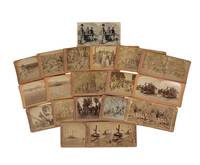
1898réf. 231701898. Stereoview archive documenting the rapid overseas deployment of American troops at the moment the Spanish American War gave way to a longer and more revealing imperial presence in the Philippines. This archive marks the transition from the 1898 defeat of Spain to the far more sustained American military occupation that followed. After the U.S. victory over Spain the Treaty of Paris transferred the Philippines to the United States for $20 million. This resulted in a battle between American forces and Filipino nationalists under Emilio Aguinaldo in February 1899 when Filipino hopes for independence collided with the reality of a new colonial ruler. This collection of photos preserves the process of colonialism through troop deployment provisioning medical treatment and the routines of military presence. Archive of 19 stereoview cards most published by B. W. Kilburn and James M. Davis centered on American military activity in the Philippines with additional views from Puerto Rico Cuba and the United States. Each measure 3.5" x 7". The core of the images remain in Philippine occupation; "The 17th Infantry crossing the river P.I." shows movement through tropical terrain; "Our Volunteers awaiting orders under the tropical sun in the Philippines" captures the idleness and bodily strain of expeditionary service; "2nd Division Hospital established in Angeles Church P.I." reveals improvised medical infrastructure inside a colonial religious building; "Dealing out pork and beans to the Oregon Volunteers P.I." appears in multiple variants and preserves the logistics of feeding American troops in camp; and "The Insurgent House of Congress on Fire Malolos P.I." places the war directly in relation to the destruction of Filipino political institutions. The remaining cards broaden that story outward: "Troop D 5th U.S. Cavalry lining up for dinner Mayaguez P.R." points to U.S. military operations in Puerto Rico; "Modern Krupp Gun Morro Castle Havana Cuba" preserves the Spanish imperial military landscape at Havana just as U.S. power displaced it; and the exhibition drill cards including "The Little Commodore" Boston '98 and "Grand Stand Exhibition Drill Boston '98" connect the overseas war to patriotic spectacle and military display at home. Stereographs were a common late nineteenth century format for circulating military imagery and was used to render mobilization and drill into mass-viewed visual media. Minor toning edge wear and rubbing; images and printed captions remain legible; overall very good condition. This collection preserves the American campaign in the Philippines not as abstract policy but as a contemporary visual record of how troops were deployed housed fed and sustained while the United States transformed victory over Spain into colonial rule in the Pacific. unknown
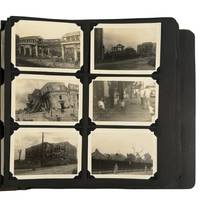
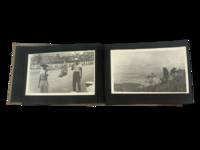
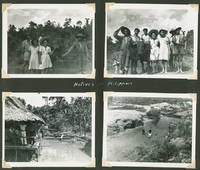
1945réf. 212431945. World War II Philippines photo album 1940s documenting United States Army Forces Far East activity and civilian conditions in Luzon during Japanese occupation and subsequent military operations. The album records military presence infrastructure damage and daily life among Filipino civilians providing visual evidence of the Pacific Theater at a critical stage of conflict. The material captures both organized military environments and surrounding local landscapes situating the campaign within its geographic and social context. Album comprises 48 silver gelatin photographs each measuring approximately 3" x 4.25" mounted on 8 loose black album pages within faux brown leather covers measuring approximately 10.5" x 12". The photographs depict a range of wartime and civilian scenes including damaged buildings rural and urban environments and Filipino civilians engaged in daily activity. Several images show U.S. soldiers stationed at an encampment with rows of tents including one photograph of a Filipino man possibly affiliated with the Philippine Scouts posed in front of a tent. Additional photographs depict large U.S. naval vessels alongside smaller wooden boats occupied by Filipino men and women approaching or departing from these ships. Other images capture natural landscapes including volcanic terrain and cloud formations above Luzon. The sequence of photographs reflects both military occupation and local life with visual emphasis on interaction between American forces and Filipino civilians. Created during the prolonged conflict in the Philippines where American and Filipino forces resisted Japanese occupation from 1941 to 1945 these photographs provide a record of conditions during one of the most significant campaigns in the Pacific Theater. The images reflect both the presence of U.S. military operations and the lived environment of the island during wartime. Album pages are loose within covers; photographs remain clean and well-preserved with minimal wear; overall very good condition. This album offers a concentrated visual record of wartime Luzon and the intersection of military and civilian experience. unknown
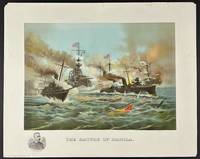
1898réf. 13092New York: Muller Luchsinger & Co 1898. Color chromolithograph 16 x 20 inches printed on thick glossy paper. Corners a bit chipped several short closed edge tears minor surface wear. Image area still vibrant and clean. Very good overall. A striking and very rare lithograph capturing an important moment during the Spanish-American War specifically the American Navy's assault on Manila Bay in the Philippines in 1898. In the present scene three U.S. warships from the Asiatic Squadron in the left and middle including Admiral Dewey's flagship the U.S.S. Olympia fire their guns toward a few retreating ships flying the Spanish flag. A Spanish ship at middle right is almost completely sunken with just a portion of the flag peaking above the water. The scene depicts the first major engagement of the Spanish-American War a decisive victory for the American Navy that stands as one of the most lop-sided naval battles in history. During the course of the encounter the Spanish Pacific Squadron was destroyed and effectively ended Spanish colonial rule in the Philippines. The bombardment was commanded by Rear Admiral George Dewey 1837-1917 whose head-and-shoulders portrait appears in the bottom left corner. The work was accomplished by the New York firm of Muller Luchsinger & Company a prolific but still somewhat obscure producer of prints lithographs and chromolithographs in the latter-19th and early-20th centuries. OCLC records just two institutional copies at the Library of Congress and the Clements Library. A dynamic and patriotic American naval scene picturing the United States Navy's obliteration of the Spanish Navy in Manila. Muller, Luchsinger & Co unknown
1910réf. 235901910. Late Qing China and Philippines photo archive depicting military authority public punishment foreign presence and imperial architecture circa 1910 in the years immediately before the Xinhai Revolution ended dynastic rule in China. The Chinese photographs show Beijing monuments urban crowds soldiers execution spectators and foreign personnel at a moment when Qing authority remained visible but unstable. The group places tourist views of imperial architecture beside scenes of coercion and military order linking travel photography to the political crisis of the late Qing state. Photo archive of 32 silver gelatin photographs each 2.5 x 4.25 inches cornered in on 11 x 13.5 inch brown album leaves mainly China with several Philippines views circa 1910. The images show Beijing landmarks including the Temple of Heaven palace buildings imperial gates stone lions carved walls ceremonial terraces walled compounds and garden architecture. Several views show Chinese crowds gathered near military or judicial scenes including a public execution aftermath with a severed head displayed from a pole before laughing onlookers and children with a placard stating the events transpired. Other photographs show Chinese soldiers and civilians in open grounds foreign military or naval personnel a group of men in white naval style uniforms seated in a circle Chinese junks harbor traffic street scenes rickshaws and colonial buildings. The Philippines photographs appear to include Manila street and harbor views a woman and girl a domed theater or civic building tropical shoreline and American colonial urban scenes. China in 1910 stood between the punitive settlement that followed the Boxer Rebellion and the republican revolution that began in Wuchang in October 1911. Foreign troops remained in North China under treaty rights imperial and provincial authorities tried to preserve order through policing army reform and public punishment and revolutionary societies used anti Manchu and anti foreign resentment to attack the legitimacy of Qing rule. The execution photographs show law as spectacle with the punished body displayed before civilians and soldiers rather than hidden within prison administration. The Beijing views record the ceremonial architecture of the dynasty at the same time that its political power was nearing collapse while the Philippines views place China within a wider American and European imperial geography of ports garrisons and colonial travel. Light surface wear toning and occasional fading; mounted with photo corners on album leaves. Overall very good condition. A concentrated visual record of military order public punishment foreign presence and imperial space in East Asia immediately before the fall of the Qing dynasty. unknown
1963réf. 59482Philadelphia & New York: J.B. Lippincott Co. 1963. Thick 8vo. 12 425 1 pp. Double-page map. Quarter-black over red publisher’s cloth silver stars & lettering front cover & spine slight shelfwear rubbing w/ d.j. cover art by Robert Hallock minor dustsoiling toning to spine price-clipped still NF/VG copy inscribed by Colonel Wendell Welby Fertig 1900-1975 to Eric Offret 1949-1986 upon his graduation from high school in San Diego June 1967 “This is a part of the story of our effort in the Philippines. “Chief” can supply some details. It is a story of a fight against odds -- and we won!” First edition 2nd printing of this work detailing the efforts of self-promoted Brigadier General Fertig a reservist mining engineer who had assisted in the evacuations of Bataan and Corregidor who accepted the offer from Major General Sharp to oversee the resistance in Visayan-Mindanao to the Japanese invasion. Fertig linked up with Filipino-American Luis Morgan a local constabulary officer as Fertig attempted to manage the disparate groups of Filipino guerillas managing non-Americans including Australian soldiers a Syrian engineer and German soldier of fortune and negotiating between Filipino Christians and Lanao Moros. J.B. Lippincott Co., hardcover
1930réf. 64636London UK: Herbert Jenkins Ltd. 1930. Thick 8vo. 317 1 pp. Photo frontisp. 15 photo plates. Green publisher’s cloth blue lettering & border ruling maps on endpapers slightly cocked slight occasional foxing very minor shelfwear w/ d.j. photo cover art minor chipping head & foot of spine dustsoiling edgewear small chip on back cover still a VG/VG- copy from the library of Claude Bridgland. First edition 1st printing stated of this rousing travelogue of the author’s “thrilling record of forty years’ adventures among the Igorote Head-hunters the Negrito Pygmies Aeta of Luzon whose poisoned arrows are the terror of the forests of Luzon the Dusun Python-hunters of the Borneo jungles the Corsairs and Sultans of the Sulu Sea and the Moro warriors of Mindanao.” Burdett b. 1864 was renowned for his pearling and smuggling expeditions gold mining in the Kimberley mines and extended expeditions into the Philippines Indonesia and across the South Pacific. Exceedingly scarce in original dustjacket. Herbert Jenkins, Ltd., hardcover
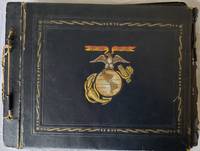
1944réf. 159501944. United States Marine Corps photo album 1944-1945 documenting Marine service in the Pacific Theater during the final campaigns against Japanese forces including visual evidence of combat environments military infrastructure and daily life during Allied advances toward the Philippines. Compiled by an active Marine the album records conditions faced by servicemen during a decisive phase of World War II when United States forces intensified operations to dismantle Japanese control across strategic island territories. The photographs show armed Marines in field settings encampments and operational zones alongside damaged urban structures marked by bullet impacts aircraft staged on active airfields and transportation along jungle rivers providing direct visual documentation of wartime movement occupation and destruction. Photograph album containing 93 silver gelatin photographs and approximately 30 postcards assembled by a United States Marine serving in the Pacific Theater. Images depict Marines in group portraits at base camps informal scenes of soldiers at rest and aircraft on airfields including fighter planes with visible nose art. Additional photographs document jungle landscapes river travel using local barges and built environments showing structural damage consistent with recent combat. The album includes interactions between American servicemen and local civilian populations as well as images of local animals such as dogs and monkeys. Postcards depict illustrated views of Marine bases and wartime scenes several addressed to the compiler's family in Georgia. Laid into the album are photographic negatives newspaper clippings reporting wartime developments military documents and a ribbon extending the documentary scope beyond the mounted photographs. Produced during the closing phase of World War II this album aligns with major United States Marine Corps operations supporting the liberation of the Philippines in 1944 and 1945 and the broader Allied campaign across the Pacific. Marine aviation and ground units operated from forward airfields and temporary encampments such as those depicted here sustaining continuous engagement with Japanese forces while navigating tropical terrain and heavily damaged urban zones. The inclusion of civilian encounters and informal group scenes adds dimension to the study of occupation dynamics and servicemen's daily routines within active war zones. Album pages detached from original ties with some tearing and evidence of missing photographs light wear throughout; overall fair to good. A substantial primary visual record of Marine experience during the final stage of the Pacific War. unknown
1944réf. 224221944. Olson Laverne Edwin vernacular photo album circa 1944-1946 documents U.S. Navy enlisted service across the Philippines and Hawaii during the final phase of World War II and the immediate postwar occupation period providing direct visual and documentary evidence of military presence local communities and wartime social life in the Pacific Theater. The album is anchored by Olson's official U.S. Navy Certificate of Satisfactory Service confirming duty from December 18 1944 through April 23 1946 situating the material within the aftermath of the U.S. return to the Philippines following the Leyte landings and the transition into occupation and reconstruction. The photographs support research into Pacific War military infrastructure American servicemen's daily life and interactions with local populations in recently contested and strategically critical regions. Album titled "Snapshots: The Philippines and The Islands of Hawaii" compiled circa 1944-1946 contains 25 items: 23 silver gelatin photographs one wallet-sized U.S. Navy Certificate of Satisfactory Service and one Roosevelt Commemorative Birthday Ball exchange coupon dated January 30 1946. Album measures approximately 4.5 x 3.5 inches with most photographs approximately 4 x 2.5 inches. Images include candid and landscape views from the Philippines likely including Leyte depicting rural villages shoreline activity docked naval vessels and local labor such as fishing and canoe transport. One photograph shows a group of Filipino children and young men gathered along a beach while another captures men and boys navigating shallow coastal waters in a canoe. Hawaiian images include group recreation scenes and coastal landscapes reflecting off-duty life within a major U.S. naval hub. The Roosevelt Birthday Ball coupon printed with the slogan "Dance That Others May Walk" provided access to multiple Honolulu venues and connects the album to wartime charitable campaigns supporting polio treatment through organized social events. Created during the closing campaigns of the Pacific War and the first year of U.S. postwar presence in the Philippines the album situates an enlisted sailor within a broader military and geopolitical transformation that included amphibious warfare territorial reoccupation and the reestablishment of American administrative and logistical systems. The Philippines served as a critical site of both combat and reconstruction while Hawaii functioned as a central staging and support base for naval operations. The inclusion of both official documentation and leisure-related ephemera demonstrates how military service encompassed bureaucratic recordkeeping mobility across strategic locations and participation in organized morale and fundraising activities tied to the American home front. Light wear to album covers minor handling and edge wear to photographs with images remaining sharp; service certificate shows toning and wear; pages largely intact. Overall very good condition. unknown
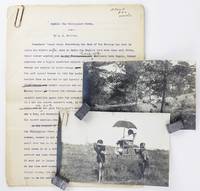
1905réf. 5191N.p. 1905. About very good. 3pp. rectos only. About 900 words. Folio. Typescript with manuscript corrections and notations. Light wear and soiling slight creasing. Together with two silver gelatin photographs. A short but interesting essay on the mountain city of Baguio. It reads a bit like a travel article or potential newspaper puff piece for tourism and has been edited by hand with manuscript notations and corrections. It opens "Somewhere 'round about Petersburg the Czar of the Russias has what he calls his winter palace; down in Indian the English have what they call Simla their summer capital and here we Americans have Baguio." The author goes on to discuss the oppression of the tropics and therefore the need for cooler cities to enable functional government discussing the needs of the "white man" for livable conditions in such a place: "In the Philippines there are some months of the year that are extraordinarily summer summer in all the sense that the word implies summer until one can't rest and do it comfortably. It is during this time that the summer capital comes in as a life-saving station for the overworked and rundown public servant and such others as care to take advantage of the rural pueblo. . drudging all year in a comparatively warm atmosphere and then to be hit with a blast that seems like a draft from the furnace of the place that has its main thoroughfare paved with good resolutions is more than the average Anglo-Saxon can stand." He continues: "Shortly after the arrival of the civil commission in the islands the Governor wasn't long in deciding.that the English were pretty wise in having their summer capitals. He also decided the Philippines must have one. It was necessary if the white man was to stay indefinitely." He describes the process of locating Baguio in the pine forests and establishing a small town there despite the lack of a road and precipitous ascent to the area: "The committee reported the climate fine incomparable just like that of the United States in late fall and that one had to sleep under heavy blankets at night to keep warm. . despite skepticism . it proved a fact and one that was a blessing. Think of the pleasure of residing in the Philippines where flies seldom bother where mosquitos as a rule are few where patent leather shoes never crack.and having a delightfully hilly resort not ninety miles away to go to when one's spleen enlarges from a languid life or the malaria attacks with unrelenting persistence." He goes on to note that it costs nearly as much to go to Baguio as it does to travel to China "so that its full benefit has not yet been felt by the more humble in life". The typescript is accompanied by two photographs of the Philippines one depicting a trail through a pine forest presumably around Baguio and the other showing a Filipino woman being carried by two Filipino men in a sedan chair. unknown
1931réf. 64637London UK: Herbert Jenkins Ltd. 1931. Thick 8vo. 320 pp. Photo frontisp. 15 photo plates. Green publisher’s cloth blue lettering & border ruling very slight shelfwear slight foxing to fore-edges w/ d.j. photo cover art minor chipping head of spine dustsoiling edgewear 1 minor closed tear still a NF/VG copy. First edition 1st printing stated of this follow-up travelogue recording his adventures in the Kimberley Gold Rush the pearl fisheries of the Indian Ocean coping with the Pirates of Panay hunting for sunken treasure and shocking discoveries in a supposed Indigenous “cannibal” cooking pot. Burdett b. 1864 was renowned for his pearling and natural history expeditions sailing through the Indian Ocean Indonesia and extended expeditions into the Philippines Indonesia and across the South Pacific. Exceedingly scarce in original dustjacket. Herbert Jenkins, Ltd., hardcover
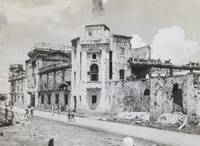
réf. PD10Oblong Octavo album ca.182x295 cm or 7 ¼ x 11 ½ in. 30 card stock leaves with 2 free endpapers. With 105 original gelatin silver photographs including one loose from ca. 104x75 cm 4 x 3 in to 47x64 cm 1 ¾ x 2 ½ in. All photos with white ink captions in English on the mounts seven photos captioned in negatives some photos dated. Period dark green half leather binding with raised bands; guilt-tooled ornaments on the front cover and the spine. Seven photos missing one page lacks fragments at the right margin several pages with minor tears but otherwise a very good album with strong interesting photos. Historically interesting collection of original photographs mostly documenting the technical reconstruction of Manila’s communication networks after the end of World War II. As follows from the photographs the compiler was a technician or lineman with the U.S. Army Signal Corps. First stationed in Pittsburgh in 1943 he likely underwent specialized technical training at one of the city's industrial or academic centers before being deployed to Finschhafen New Guinea. There he was tasked with establishing the communications infrastructure for the Allied base following the recapture of the town from Japanese forces. Finally he was sent to Manila in the fall of 1945 where he assisted in the massive effort to reconstruct the city’s destroyed telephone and telegraph systems during the initial months of the post-war occupation. The album contains 105 rare early photographs from the Pacific Theatre with most images taken in Manila in the fall of 1945. The photos capture Japanese ships sunk by U.S. forces in Manila Bay and the city’s architecture before and after the artillery bombardment Escolta Street Jones Bridge the ruins of City Hall the University of the Philippines the Manila Hotel San Vicente de Paul Parish Department of Finance Building today’s National Museum of Anthropology Commerce & Agriculture Building today’s National Museum of Natural History and Legislative Building today’s National Museum of Fine Arts. Especially interesting are about fifteen candid photographs documenting the technical reconstruction of Manila’s communication networks. Outdoor scenes show the compiler’s companions with climbing spikes and safety belts repairing overhead trunk lines. Interior views depict a “Test Desk” with technicians both American and Philippian operating specialized consoles and patch cords the massive Main Distribution Frame MDF with thousands of line terminations and heavy power panel equipment. The series also includes several photographs from Clark Field showing “Ralph” and “Eddie” posing beside wrecked aircraft. The other interesting photos from the collection show “a Native of New Guinea” posing with American soldiers as well as the compiler and his friends in military uniforms in Finschhafen and Pittsburgh beside their tents barracks and orderly room. Overall historically interesting collection of original gelatin silver photographs illustrating rare scenes from the service of the U.S. Army Signal Corps in the Pacific Theatre of World War II. hardcover
1962réf. 2383All volumes near fine in blue cloth. First editions thus. Consisting of the following: Volume 1: GIRONIERE PAUL DE LA. Twenty Years in the Philippines. Frontispiece is "Una Mestiza de Manila" with tissue guard intact. 1962. Volume 2: CARERI GIOVANNI FRANCESCO GEMELLI. A Voyage to the Philippines. Frontispiece is a water color by Alfredo Carmelo b.1896 depicting Manila galleons moored at the mouth of the Pasig River. 1963. Volume 3: BOWRING SIR JOHN. A Visit To The Philippine Islands. Frontispiece is a black and white portrait of Bowring. 1963. Volume 4: SALEEBY NAJEEB M. The History of Sulu. Frontispiece is black and white photo of Saleeby. 1963. The Filipiniana Book Guild publications expanded to 24 volumes in the first series. These first four volumes are extremely rare. The Princeton library has all volumes except these four. Only digital copies are located in the National Archives of the Philippines. Manila, Philippines, Filipiniana Book Guild, 1962-1963. hardcover
1945réf. 64628Los Angeles CA: 40th Infantry Division ca. 1945. Oblong 4to. 120 pp unpaginated. with 200 silver gelatin photographs all mounted and numbered in lower corner w/in negative keyed to indices inserted after the title page occasional creasing to corners. Brick-red publisher’s cloth post-binder two hidden nickel-plated screwposts at gutter margin 40th Infantry Division sunburst emblem patch on front cover in gilt on blue field minor thumbing edgewear slightly shaken occasional fraying to a couple leaves at fore-edge still a VG copy. First edition thus of this 40th Infantry Division regimental souvenir album visually recording the Western National Guard “Sunshine Division’s” participation in the grueling and bloody island hopping campaign during World War II from Guadalcanal to The Philippines often involved in heavy fighting and credited with capturing or killing over 11000 Japanese troops while suffering 715 casualties. These photographs follow the 40th Division’s arrival and activities in Hawaii followed by their movement to Guadalcanal and arrival at Kukum Dock. Photos depict wrecked Japanese ships beached nearby the typical bare-breasted shots of New Britain Indigenous Peoples arrival of nurse units and training on New Britain. As depicted in these images the bloody Philippine Islands campaign opened with multiple regiments from the 40th Division landing at the Lingayen Gulf on Luzon in order to retake the main Philippine Island in January 1945 including views of Tarlac Bamban battle damage artillery pieces war dogs used by segregated African-American patrols on Luzon well-prepared Japanese positions built to repel the American forces machine gunners Japanese casualties and the results of Japanese troops using grenades to commit Hari Kari.The next phase of the campaign involved the 40th Division participating in the Panay & Guimaras Invasion landing at Tigbauan on Panay Island securing Iloilo City and nearby airfields coordinating with Philippine guerrilla forces with photos of the guerrillas views of the landing craft Philippine peoples and guerrillas wounded by Japanese snipers being treated by American forces and the Division artillery. The 40th Division later came together with other forces and moved onto Negros Island from the end of March through August 1945 pushing deep into Negros Island capturing Bacolod and its airfield before continuing on in the heavy surrounding jungle dislodging Japanese troops in the surrounding area. Their artillery and tank battalions proved particularly effective and many of these photographs depict not only the movements and equipment but the aftermath as well. This album does not include the National Guard Division’s participation in the enforcement of the orders to round up and illegally incarcerate Japanese-Americans throughout the West into War Relocation Centers and Internment Camps for the duration of the War. No copies in Worldcat -- this volume should not be confused with the regimental history published in Baton Rouge LA by the Army & Navy Publishing Company -- “40th Infantry Division: the years of World War II 7 December 1941-7 April 1946. 40th Infantry Division, hardcover
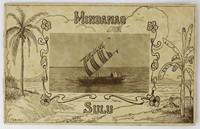
1905réf. 5045Manila: Sugar News Press 1905. Very good. 22pp. Illustrated. Oblong quarto. Original pictorial wrappers stapled. Moderate dust-soiling and edge wear. Light even toning to text. An early and seemingly-unrecorded promotional touting the people and scenery in Mindanao and Sulu in the southern Philippines in the first decade of the 20th century. The work opens with a Foreword detailing the positive aspects of Mindanao particularly its principal city described here as the "Metropolis of Mindanao and Sulu" with "a population of more than thirty thousand a mixture of Moros or Mohammedan Filipinos Christian Filipinos Chinese Japanese and Europeans." Following the Foreword the remainder of the work is mostly comprised of thirty-four duotone photographic prints printed mostly two per page but occasionally with from one to five per page. The photographs feature numerous scenic and street views in and around Zamboanga including various "Moro houses" and about fifteen portraits of indigenous Filipinos such as a "Moro woman weaving materials for head-turbans and sarongs" a view inside a "weaving school" "Yakan Moros on the island of Basilan" "Muhammad Jamallul Sultan of Sulu" "Joloano Warriors" "Moro Kulintang" and their musical instruments Bogobo and Cotabato warriors "Bajaos - the sea gypsies of Sulu" and "Bogobo musicians." The final two pages of the work are taken up with two poems -- the first is a traditional Filipino poem entitled "No Te Vayas" noted as "Zamboanga's 'Auld Lang Syne" and one titled simply "Zamboanga" by Susan Hart Dyer. The front cover is decorated with a central photograph of an indigenous sailing vessel surrounded by an illustrated beach scene signed at bottom left "Jh. Mendoza." The inside front cover contains an illustration of the Philippine Islands from Batanes down to Sulu. We could locate no other copies of the work by title and imprint information in OCLC. Sugar News Press unknown
1945réf. 54321Philippines; Okinawa; San Diego. 1945. Photo Album of a Seabee in the Philippines in 1945 A fascinating photographic account of military service in the Philippines compiled by a member of the 142nd U.S. Naval Construction Battalion the Seabees in 1945. Most of the images approximately three-quarters of the album were taken in Guiuan on Samar Island in the central Philippines where the photographer was stationed: Guiuan city square the Seabees' camp numerous portraits of local girls who sometimes pose with American soldiers local families and their activities indigenous architecture and other local scenes. They also show the Immaculate Conception Church with shots of the exterior and detailed views of the silver altar - built in 1595 to 1844 but completely destroyed by Typhoon Haiyan in 2013. Several other photos evidently portray the album's compiler posing next to an American fighter plane while boiling sea shells in front of his tent etc. The final portion of the album contains photos taken during the operations aboard the U.S.S. "Monrovia" and "President Harris" in October-November 1945 including views of Okinawa on the way to China and snapshots of soldiers unloading cargo in China before returning to Manila. There are also eight clear views of Manila showing destroyed Japanese cranes and boats in the harbor American army headquarters and a warehouse. The album concludes with a few photos of the homeward voyage and shows soldiers discharged in San Pedro California. Overall a very good album depicting local life and the activities of the 142nd U.S. Naval Construction Battalion in the Philippines and Yellow Sea in the last months of the World War II. 133 silver gelatin photographs most 2½ x 4 inches but ranging from 2½ x 2½ to several 10 x 7 inches. Oblong folio. Black leatherette album strong tied. Light wear. Photos in corner mounts with many captions. Very good. hardcover