US Marines; Philippines U SBiblio.com
878 risultati
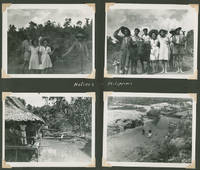
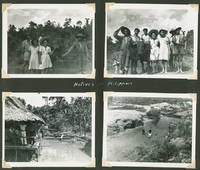
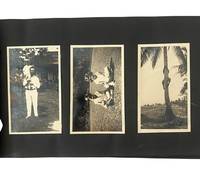
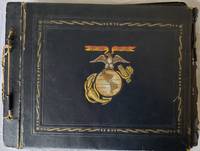
1944rif. 159501944. United States Marine Corps photo album 1944-1945 documenting Marine service in the Pacific Theater during the final campaigns against Japanese forces including visual evidence of combat environments military infrastructure and daily life during Allied advances toward the Philippines. Compiled by an active Marine the album records conditions faced by servicemen during a decisive phase of World War II when United States forces intensified operations to dismantle Japanese control across strategic island territories. The photographs show armed Marines in field settings encampments and operational zones alongside damaged urban structures marked by bullet impacts aircraft staged on active airfields and transportation along jungle rivers providing direct visual documentation of wartime movement occupation and destruction. Photograph album containing 93 silver gelatin photographs and approximately 30 postcards assembled by a United States Marine serving in the Pacific Theater. Images depict Marines in group portraits at base camps informal scenes of soldiers at rest and aircraft on airfields including fighter planes with visible nose art. Additional photographs document jungle landscapes river travel using local barges and built environments showing structural damage consistent with recent combat. The album includes interactions between American servicemen and local civilian populations as well as images of local animals such as dogs and monkeys. Postcards depict illustrated views of Marine bases and wartime scenes several addressed to the compiler's family in Georgia. Laid into the album are photographic negatives newspaper clippings reporting wartime developments military documents and a ribbon extending the documentary scope beyond the mounted photographs. Produced during the closing phase of World War II this album aligns with major United States Marine Corps operations supporting the liberation of the Philippines in 1944 and 1945 and the broader Allied campaign across the Pacific. Marine aviation and ground units operated from forward airfields and temporary encampments such as those depicted here sustaining continuous engagement with Japanese forces while navigating tropical terrain and heavily damaged urban zones. The inclusion of civilian encounters and informal group scenes adds dimension to the study of occupation dynamics and servicemen's daily routines within active war zones. Album pages detached from original ties with some tearing and evidence of missing photographs light wear throughout; overall fair to good. A substantial primary visual record of Marine experience during the final stage of the Pacific War. unknown
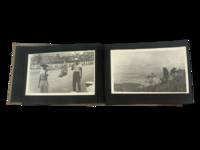
1944rif. 224221944. Olson Laverne Edwin vernacular photo album circa 1944-1946 documents U.S. Navy enlisted service across the Philippines and Hawaii during the final phase of World War II and the immediate postwar occupation period providing direct visual and documentary evidence of military presence local communities and wartime social life in the Pacific Theater. The album is anchored by Olson's official U.S. Navy Certificate of Satisfactory Service confirming duty from December 18 1944 through April 23 1946 situating the material within the aftermath of the U.S. return to the Philippines following the Leyte landings and the transition into occupation and reconstruction. The photographs support research into Pacific War military infrastructure American servicemen's daily life and interactions with local populations in recently contested and strategically critical regions. Album titled "Snapshots: The Philippines and The Islands of Hawaii" compiled circa 1944-1946 contains 25 items: 23 silver gelatin photographs one wallet-sized U.S. Navy Certificate of Satisfactory Service and one Roosevelt Commemorative Birthday Ball exchange coupon dated January 30 1946. Album measures approximately 4.5 x 3.5 inches with most photographs approximately 4 x 2.5 inches. Images include candid and landscape views from the Philippines likely including Leyte depicting rural villages shoreline activity docked naval vessels and local labor such as fishing and canoe transport. One photograph shows a group of Filipino children and young men gathered along a beach while another captures men and boys navigating shallow coastal waters in a canoe. Hawaiian images include group recreation scenes and coastal landscapes reflecting off-duty life within a major U.S. naval hub. The Roosevelt Birthday Ball coupon printed with the slogan "Dance That Others May Walk" provided access to multiple Honolulu venues and connects the album to wartime charitable campaigns supporting polio treatment through organized social events. Created during the closing campaigns of the Pacific War and the first year of U.S. postwar presence in the Philippines the album situates an enlisted sailor within a broader military and geopolitical transformation that included amphibious warfare territorial reoccupation and the reestablishment of American administrative and logistical systems. The Philippines served as a critical site of both combat and reconstruction while Hawaii functioned as a central staging and support base for naval operations. The inclusion of both official documentation and leisure-related ephemera demonstrates how military service encompassed bureaucratic recordkeeping mobility across strategic locations and participation in organized morale and fundraising activities tied to the American home front. Light wear to album covers minor handling and edge wear to photographs with images remaining sharp; service certificate shows toning and wear; pages largely intact. Overall very good condition. unknown
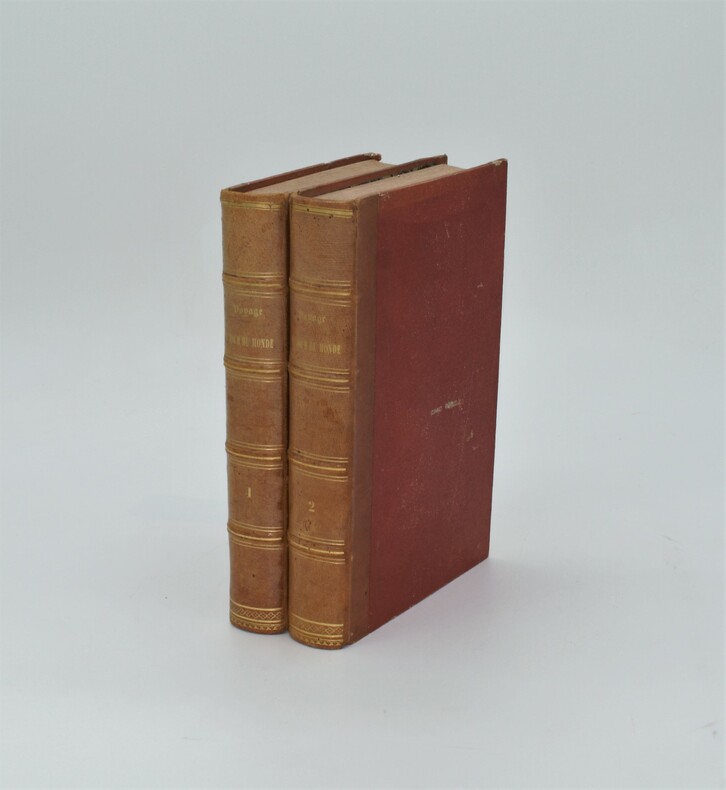
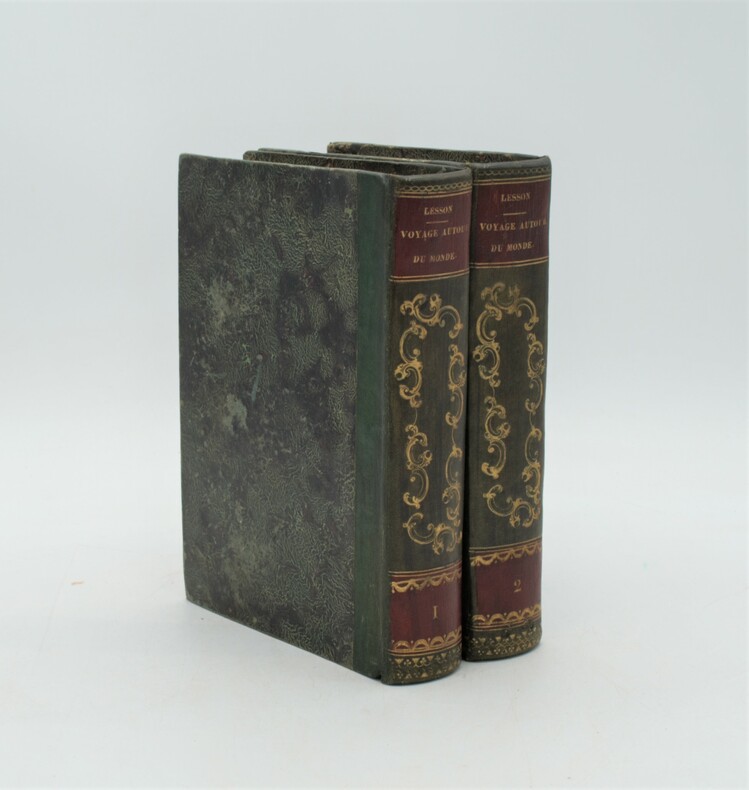
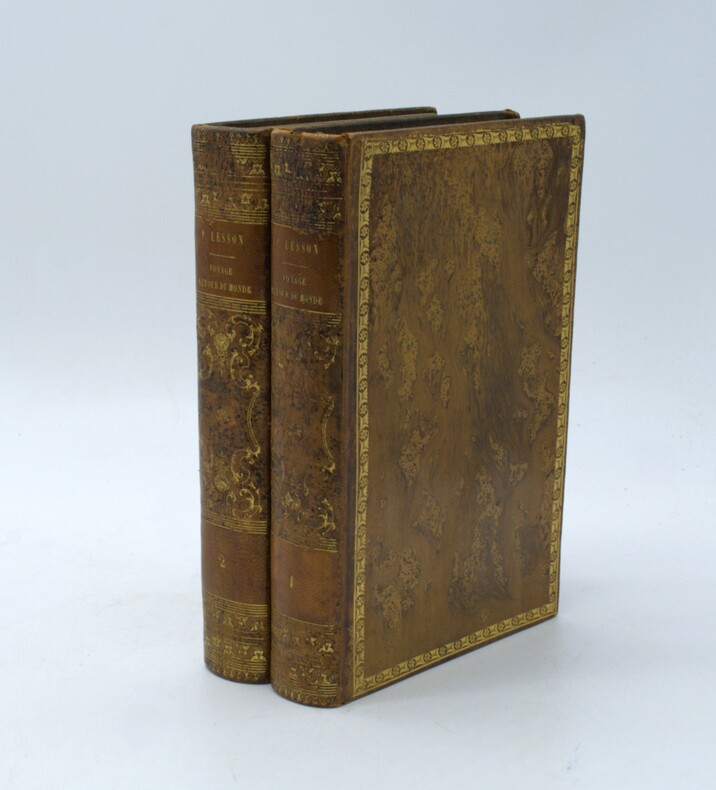
1839rif. PHO-1319Paris, Pourrat frères, 1839. 2 volumes in-8 (220x150), demi-basane maroquinée à grain long fauve , 2ff.-510pp.-1f. , 2ff.-547pp.-2ff. , illustré d’un frontispice et de 36 planches dont 19 en couleurs d’époque représentant des animaux, des poissons et des oiseaux, frottements aux plats , coins usés, très peu de rousseurs .
1707rif. PHO-767Amsterdam, Étienne Roger, 1707. 2 volumes in-12 (160x100) ,relié plein veau époque , dos à nerfs orné , tranches rouges , titre en rouge et noir , coiffes usées . 508pp-515pp illustré d’un frontispice et de 15 figures sur 10 planches .Ex-libris Mich Comitis vandalini Mniszech (1742-1806)
1782rif. PHO-10601782 , A Paris , Chez l'auteur & Froulé & Nyon, In-8 (150x225mm), xxij, 340pp. et (6) 376pp. et (6) 362pp.,illustré de 7 planches dépliantes gravées par Poison d’après l’auteur, relié plein veau marbré époque , dos lisse avec pièces de titre et tomaison vertes, tranches mouchetées rouges, filets sur les plats , dos frottés , coiffes et coins usés , petites rousseurs.
Ambas obras en un volumen, 18 x 12,5 cm., holandesa piel de época con tejuelo y puntas, la primera obra impresa en Madrid, Aribau y Cía., 1876, 321 págs. + 1 hoja. Y la segunda impresan también en Madrid, por Anllo y Rodríguez, 1877, XX + 307 págs. + 4 hojas. (Según Retana La crítica de este libro de F. Cañamaque cayó muy mal en Filipinas hasta el punto que las autoridades prohibieron la entrada y circulación del libro).
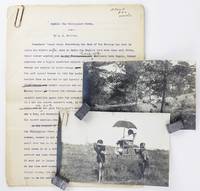
1905rif. 5191N.p. 1905. About very good. 3pp. rectos only. About 900 words. Folio. Typescript with manuscript corrections and notations. Light wear and soiling slight creasing. Together with two silver gelatin photographs. A short but interesting essay on the mountain city of Baguio. It reads a bit like a travel article or potential newspaper puff piece for tourism and has been edited by hand with manuscript notations and corrections. It opens "Somewhere 'round about Petersburg the Czar of the Russias has what he calls his winter palace; down in Indian the English have what they call Simla their summer capital and here we Americans have Baguio." The author goes on to discuss the oppression of the tropics and therefore the need for cooler cities to enable functional government discussing the needs of the "white man" for livable conditions in such a place: "In the Philippines there are some months of the year that are extraordinarily summer summer in all the sense that the word implies summer until one can't rest and do it comfortably. It is during this time that the summer capital comes in as a life-saving station for the overworked and rundown public servant and such others as care to take advantage of the rural pueblo. . drudging all year in a comparatively warm atmosphere and then to be hit with a blast that seems like a draft from the furnace of the place that has its main thoroughfare paved with good resolutions is more than the average Anglo-Saxon can stand." He continues: "Shortly after the arrival of the civil commission in the islands the Governor wasn't long in deciding.that the English were pretty wise in having their summer capitals. He also decided the Philippines must have one. It was necessary if the white man was to stay indefinitely." He describes the process of locating Baguio in the pine forests and establishing a small town there despite the lack of a road and precipitous ascent to the area: "The committee reported the climate fine incomparable just like that of the United States in late fall and that one had to sleep under heavy blankets at night to keep warm. . despite skepticism . it proved a fact and one that was a blessing. Think of the pleasure of residing in the Philippines where flies seldom bother where mosquitos as a rule are few where patent leather shoes never crack.and having a delightfully hilly resort not ninety miles away to go to when one's spleen enlarges from a languid life or the malaria attacks with unrelenting persistence." He goes on to note that it costs nearly as much to go to Baguio as it does to travel to China "so that its full benefit has not yet been felt by the more humble in life". The typescript is accompanied by two photographs of the Philippines one depicting a trail through a pine forest presumably around Baguio and the other showing a Filipino woman being carried by two Filipino men in a sedan chair. unknown
1931rif. 64637London UK: Herbert Jenkins Ltd. 1931. Thick 8vo. 320 pp. Photo frontisp. 15 photo plates. Green publisher’s cloth blue lettering & border ruling very slight shelfwear slight foxing to fore-edges w/ d.j. photo cover art minor chipping head of spine dustsoiling edgewear 1 minor closed tear still a NF/VG copy. First edition 1st printing stated of this follow-up travelogue recording his adventures in the Kimberley Gold Rush the pearl fisheries of the Indian Ocean coping with the Pirates of Panay hunting for sunken treasure and shocking discoveries in a supposed Indigenous “cannibal” cooking pot. Burdett b. 1864 was renowned for his pearling and natural history expeditions sailing through the Indian Ocean Indonesia and extended expeditions into the Philippines Indonesia and across the South Pacific. Exceedingly scarce in original dustjacket. Herbert Jenkins, Ltd., hardcover
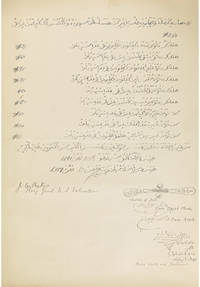
1899rif. 24064PHILIPPINES.Facsimile of original treaty ceding sovereignty of the Archipelago of Jolo to the United States. Jolo Province of Sulu Philippines August 20 1899. Bound in 20th century cloth comprising a large three-page lithographed facsimile of the manuscript treaty written in the Tausug language and signed in print by the Sultan of Jolo and Brig. General John C. Bates 16½ x 12 in. With a small format copy of the document in English the first leaf mimeographed the final leaf lithographed with facsimile signatures. Historical Background The Sultanate of Sulu began in the early 15th century and once included the northeastern side of Borneo and many islands to the northeast including the island of Jolo. By the late 19th century it had been reduced to a string of islands under Spanish occupation rule. The Treaty of Paris that ended the Spanish-American War transferred control of the Philippines including the Sulu to the United States. The sultanate was home to several ethnic groups including the Moro and Tausug. On August 20 1899 the United States signed this treaty with Sultan Hadji Mohammed Jamalul Kiram II and several of his tribal chiefs. The "Bates Treaty" after General John C. Bates recognized U.S. sovereignty over the whole archipelago of Jolo. The U.S. agreed to protect the sultan and his subjects and not to sell any island in the archipelago to any other nation without the sultan's consent. The treaty promised religious freedom especially for the Muslim Moros and free trade with the Philippines. It prohibited piracy and the introduction of war material. The most controversial article recognized slavery but allowed any slave to purchase his or her freedom by paying "the usual market value" to the master. Finally the treaty promised monthly payments to the Sultan and his chiefs totaling 730 Mexican dollars per month approx. $365. This treaty theoretically removed the Sultanate of Sulu from participation in the Philippine American War 1899-1902. Some Americans criticized the treaty for granting too much autonomy to the Sultan and for allowing slavery to continue. Over the next five years political conditions deteriorated and there were revolts in several areas even threatening Jolo City where U.S. authorities were stationed. In March 1904 the United States abrogated the treaty unilaterally per Secretary of War William Howard Taft's telegram to Gov. General Luke E. Wright 1846-1922: "By order of the President you are hereby directed to notify the sultan of Sulu and the dattos who signed the so-called Bates treaty of August 20 1899 which was a modus vivendi and mere executive agreement that in view of the failure on the part of the sultan … to discharge the duties and fulfill the conditions imposed upon them by said agreement they have forfeited all rights to the annuities therein stipulated to be paid to them and all other considerations… they are subject to the laws enacted therein under the sovereignty of the United States." Although the Philippine-American War officially ended in July 1902 with the dissolution of the First Philippine Republic resistance continued for several more years especially in remote areas and the islands occupied by the Moro people. In June 1913 American troops under General John "Black Jack" Pershing 1860-1948 attacked a group of fighters atop Mount Bagsak on the island of Jolo. At the Battle of Bud Bagsak the Americans destroyed the Moro resistance and killed its leader Datu Amil. In the text of the treaty there was a critical "translation error." The Treaty in the Tausug version discussed "The support aid and protection of the Jolo Island and Archipelago" but the word "sovereignty" was not used. The English-language version noted that "The sovereignty of the United States over the whole Archipelago of Jolo and its dependencies is declared and acknowledged." In 1946 the English text provided justification for America's decision to incorporate the Sulu Archipelago into the Philippine state. Sultan Hadji Mohammed Jamalul Kiram II 1868-1936 was a member of the Muslim royal house that ruled the Sulu archipelago from the 15th to the 20th centuries. Proclaimed sultan when his older brother died in 1884 it took ten years to consolidate his authority. In 1912 he took a world tour and visited President William Howard Taft at the White House in Washington D.C. He surrendered his political powers to the United States government in 1915 but retained cultural and religious authority. He died leaving seven daughters but no male heir. His younger brother made an ineffectual claim to the abolished sultanate. John C. Bates 1842-1919 was born in Missouri the son of Abraham Lincoln's Attorney General Edward Bates and educated at Washington University in St. Louis. During the Civil War John C. Bates served as an aide to General George G. Meade. He served in the Indian Wars of the late nineteenth century and rose to the rank of colonel. In 1898 he received promotion to brigadier general and commanded in the Spanish-American War. He also commanded a division of volunteers in the Philippines during the early stages of the Philippine-American War. He later served as the Chief of Staff of the U.S. Army for several months before his retirement in 1906. He was the last Army Chief of Staff to have served in the American Civil War. Condition Dust soiling stains margins strengthened. books
1715rif. PHO-1978Rouen : Jean-Baptiste Machuel le jeune, 1715. 4 volumes in-12 (160 x 97 mm). 3 frontispices gravés sur cuivre et 42 cartes, plans et figures dont de nombreux dépliants. Plein veau époque, dos à nerfs ornés avec tomaison et pièce de titre, tranches rouges. Tome 1, 7ffnch (préface)408pp-12ff (table), illustré d’un frontispice par Scotin le jeune, 3 cartes dont la mappemonde et 6 planches. Tome 2 ,2ff (titre et chapitre) 396pp-5ff (table), contient le traité des vents (p275), illustré d’un frontispice et 9 planches dont la rose des vents et les cartes des 2 hémisphères. Tome 3 ,393pp,5ff (table), illustré d’un frontispice par Scotin le jeune, 2 cartes et 6 planches. Tome 4, 20pp-381pp-8ff (table), illustré de 18 planches dont 3 cartes. L'illustration se compose de 3 titres-frontispices et de 42 planches hors texte, souvent dépliantes : mappemonde, cartes des différentes îles, profils de côtes, vues de ports (Manille, Bahia, Scio) et vues d'îles (Canaries, Cap Vert), monuments, Indiens, scènes de bataille, naufrage, flore (abricotier, cacaotier), oiseaux, poissons, insectes et une curieuse représentation de la « vache de la montagne ou cheval marin ».
1839rif. PHO-1115Paris, Pourrat frères, 1839. 2 volumes in-8 (220x150), demi veau vert contemporain, dos lisse orné avec pièces de titre et auteur , tomaison rouges ,petits frottements aux plats , manque de papier p299 avec atteinte et réparation p301,rousseurs ,mouillures. Édition originale, illustrée d'un portrait de l'auteur et 38 planches gravées sur cuivre et sous serpentes, dont 18 finement coloriées représentant des animaux, des poissons et des oiseaux.
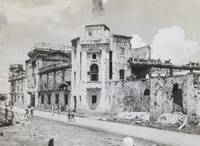
rif. PD10Oblong Octavo album ca.182x295 cm or 7 ¼ x 11 ½ in. 30 card stock leaves with 2 free endpapers. With 105 original gelatin silver photographs including one loose from ca. 104x75 cm 4 x 3 in to 47x64 cm 1 ¾ x 2 ½ in. All photos with white ink captions in English on the mounts seven photos captioned in negatives some photos dated. Period dark green half leather binding with raised bands; guilt-tooled ornaments on the front cover and the spine. Seven photos missing one page lacks fragments at the right margin several pages with minor tears but otherwise a very good album with strong interesting photos. Historically interesting collection of original photographs mostly documenting the technical reconstruction of Manila’s communication networks after the end of World War II. As follows from the photographs the compiler was a technician or lineman with the U.S. Army Signal Corps. First stationed in Pittsburgh in 1943 he likely underwent specialized technical training at one of the city's industrial or academic centers before being deployed to Finschhafen New Guinea. There he was tasked with establishing the communications infrastructure for the Allied base following the recapture of the town from Japanese forces. Finally he was sent to Manila in the fall of 1945 where he assisted in the massive effort to reconstruct the city’s destroyed telephone and telegraph systems during the initial months of the post-war occupation. The album contains 105 rare early photographs from the Pacific Theatre with most images taken in Manila in the fall of 1945. The photos capture Japanese ships sunk by U.S. forces in Manila Bay and the city’s architecture before and after the artillery bombardment Escolta Street Jones Bridge the ruins of City Hall the University of the Philippines the Manila Hotel San Vicente de Paul Parish Department of Finance Building today’s National Museum of Anthropology Commerce & Agriculture Building today’s National Museum of Natural History and Legislative Building today’s National Museum of Fine Arts. Especially interesting are about fifteen candid photographs documenting the technical reconstruction of Manila’s communication networks. Outdoor scenes show the compiler’s companions with climbing spikes and safety belts repairing overhead trunk lines. Interior views depict a “Test Desk” with technicians both American and Philippian operating specialized consoles and patch cords the massive Main Distribution Frame MDF with thousands of line terminations and heavy power panel equipment. The series also includes several photographs from Clark Field showing “Ralph” and “Eddie” posing beside wrecked aircraft. The other interesting photos from the collection show “a Native of New Guinea” posing with American soldiers as well as the compiler and his friends in military uniforms in Finschhafen and Pittsburgh beside their tents barracks and orderly room. Overall historically interesting collection of original gelatin silver photographs illustrating rare scenes from the service of the U.S. Army Signal Corps in the Pacific Theatre of World War II. hardcover
1848rif. 24537Paris A. Franck 1848 in-4 demi-chagrin vert, dos à nerfs, caissons de filets et fleurons dorés au dos, tranches mouchetées [Rel. de l'époque], qqs très lég. épidermures et rouss. pâles éparses
1839rif. PHO-1704Paris, Pourrat frères, 1839. 2 volumes in-8 (220x150), plein veau raciné époque, dos lisse orné avec pièces de titre, auteur et tomaison, frises aux plats et aux coupes, , 2ff.-510pp.-1f. , 2ff.-547pp.-2ff. , illustré d’un frontispice et de 41 planches dont 19 en couleurs d’époque représentant des animaux, des poissons et des oiseaux, un cahier (tome 2) dérelié, 1 planche volante, petits frottements, 1 coin usé, quelques rousseurs .
Barcelona - Madrid, Instituto Padre Enrique Florez - Consejo Superior de Investigaciones Científicas, 1957 - 1989. Cincuenta y tres volúmenes en 4to., con un promedio de 350 pp. por volúmen. Cubiertas originales.
1706rif. PHO-1901Amsterdam, Jacques Desbordes, 1706. 3 volumes in-12° (sur 3), 10ff-405pp-3pp (catalogue); 2ff-402pp-14ff( table) ; 4ff.-388pp.-10ff., illustré de 3 frontispices, 1 portrait et 30 (32) cartes et planches dépliantes dont une belle carte (25x36cm), manque la page de titre tome 1. Relié plein veau époque, dos à nerfs ornés avec pièce de titre et tomaison, tranches rouges, charnières frottées, début de fente (tome 1), coiffes usées, petit manque de cuir au dos, mouillure au tome 3, traces de restauration, manque la grande carte mais la carte de Ceylan est bien présente.
1781rif. 0042251781 Genève, Pellet, 1781. Dix volumes in-8 (130 X 207 mm) basane fauve marbrée, dos lisse orné à la grotesque de motifs dorés, pièces de titre et de tomaison grenat et vert, coupes ornées d'une guirlande dorée, coiffes filetées, tranches jaspées (reliure de l'époque). Tome I : portrait, XVI pages de faux-titre, titre, avertissement et table, 348 pages, (1) f. d'errata, (2) tableaux dépliants ; Tome II : frontispice, XII pages de faux-titre, titre et table, 378 pages, (1) f. d'errata, (4) tableaux dépliants ; Tome III : frontispice, VII pages de faux-titre, titre et table, 372 pages, (1) f. d'errata ; Tome IV : frontispice, XII pages de faux-titre, titre et table, 308 pages, (1) f. d'errata, (3) tableaux dépliants ; Tome V : frontispice, VII pages de faux-titre, titre et table, 259 pages, (1) f. d'errata, (1) tableau dépliant ; Tome VI : frontispice, XII pages de faux-titre, titre et table, 308 pages, (1) f. d'errata ; Tome VII : frontispice, XVI pages de faux-titre, titre et table, 359 pages, (1) page d'errata, (5) tableaux dépliants ; Tome VIII : frontispice, XII pages de faux-titre, titre et table, 352 pages ; Tome IX : frontispice, VIII pages de faux-titre, titre et table, 262 pages, (1) f. blanc, (1) f. d'errata, (9) tableaux dépliants ; Tome X : frontispice, V pages de faux-titre, titre et table, 348 pages, (1) f. d'errata. Quelques petites restaurations à la reliure.
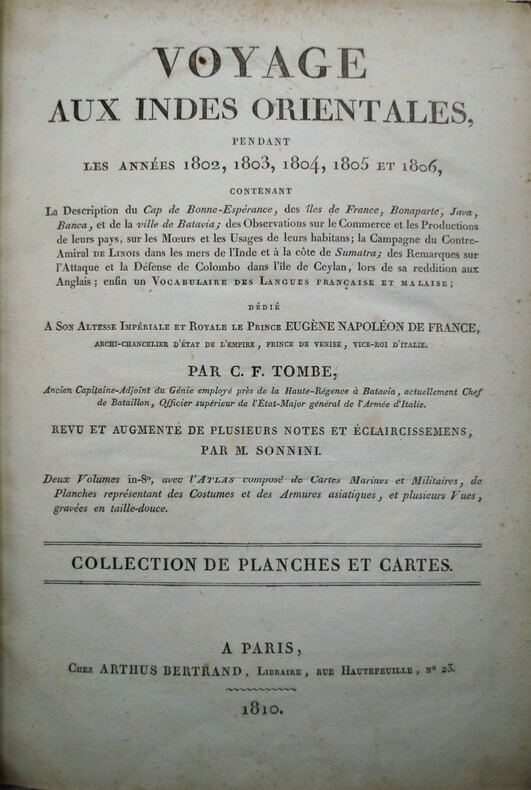
1810rif. PHO-1157Paris: Arthus Bertrand, 1810. — Atlas in-4, (295x200) (2 ff.), 18 cartes et planches , la plupart dépliantes ,relié demi veau ,dos lisse avec fers de navire , manque au dos .
1945rif. WRCAM54321Philippines; Okinawa; San Diego 1945. 133 silver gelatin photographs most 2 1/2 x 4 inches but ranging from 2 1/2 x 2 1/2 to several 10 x 7 inches. Oblong folio. Black leatherette album strong tied. Light wear. Photos in corner mounts with many captions. Very good. A fascinating photographic account of military service in the Philippines compiled by a member of the 142nd U.S. Naval Construction Battalion the Seabees in 1945. Most of the images approximately three- quarters of the album were taken in Guiuan on Samar Island in the central Philippines where the photographer was stationed. Guiuan city square the Seabees' camp numerous portraits of local girls who sometimes pose with American soldiers local families and their activities native architecture and other local scenes. They also show the Immaculate Conception Church with shots of the exterior and detailed views of the silver altar - built in 1595 to 1844 but completely destroyed by Typhoon Haiyan in 2013. Several other photos evidently portray the album's compiler posing next to an American fighter plane while boiling sea shells in front of his tent etc. The final portion of the album contains photos taken during the operations aboard the USS "Monrovia" and "President Harris" in October-November 1945 including views of Okinawa on the way to China and snapshots of soldiers unloading cargo in the Yellow Sea China before returning to Manila. There are also eight clear views of Manila showing destroyed Japanese cranes and boats in the harbor American army headquarters and a warehouse. The album concludes with a few photos of the homeward voyage and shows soldiers discharged in San Pedro California. Overall a very good album depicting local life and the activities of the 142nd U.S. Naval Construction Battalion in the Philippines and Yellow Sea in the last months of the World War II. hardcover books
1962rif. 2383All volumes near fine in blue cloth. First editions thus. Consisting of the following: Volume 1: GIRONIERE PAUL DE LA. Twenty Years in the Philippines. Frontispiece is "Una Mestiza de Manila" with tissue guard intact. 1962. Volume 2: CARERI GIOVANNI FRANCESCO GEMELLI. A Voyage to the Philippines. Frontispiece is a water color by Alfredo Carmelo b.1896 depicting Manila galleons moored at the mouth of the Pasig River. 1963. Volume 3: BOWRING SIR JOHN. A Visit To The Philippine Islands. Frontispiece is a black and white portrait of Bowring. 1963. Volume 4: SALEEBY NAJEEB M. The History of Sulu. Frontispiece is black and white photo of Saleeby. 1963. The Filipiniana Book Guild publications expanded to 24 volumes in the first series. These first four volumes are extremely rare. The Princeton library has all volumes except these four. Only digital copies are located in the National Archives of the Philippines. Manila, Philippines, Filipiniana Book Guild, 1962-1963. hardcover
1945rif. 64628Los Angeles CA: 40th Infantry Division ca. 1945. Oblong 4to. 120 pp unpaginated. with 200 silver gelatin photographs all mounted and numbered in lower corner w/in negative keyed to indices inserted after the title page occasional creasing to corners. Brick-red publisher’s cloth post-binder two hidden nickel-plated screwposts at gutter margin 40th Infantry Division sunburst emblem patch on front cover in gilt on blue field minor thumbing edgewear slightly shaken occasional fraying to a couple leaves at fore-edge still a VG copy. First edition thus of this 40th Infantry Division regimental souvenir album visually recording the Western National Guard “Sunshine Division’s” participation in the grueling and bloody island hopping campaign during World War II from Guadalcanal to The Philippines often involved in heavy fighting and credited with capturing or killing over 11000 Japanese troops while suffering 715 casualties. These photographs follow the 40th Division’s arrival and activities in Hawaii followed by their movement to Guadalcanal and arrival at Kukum Dock. Photos depict wrecked Japanese ships beached nearby the typical bare-breasted shots of New Britain Indigenous Peoples arrival of nurse units and training on New Britain. As depicted in these images the bloody Philippine Islands campaign opened with multiple regiments from the 40th Division landing at the Lingayen Gulf on Luzon in order to retake the main Philippine Island in January 1945 including views of Tarlac Bamban battle damage artillery pieces war dogs used by segregated African-American patrols on Luzon well-prepared Japanese positions built to repel the American forces machine gunners Japanese casualties and the results of Japanese troops using grenades to commit Hari Kari.The next phase of the campaign involved the 40th Division participating in the Panay & Guimaras Invasion landing at Tigbauan on Panay Island securing Iloilo City and nearby airfields coordinating with Philippine guerrilla forces with photos of the guerrillas views of the landing craft Philippine peoples and guerrillas wounded by Japanese snipers being treated by American forces and the Division artillery. The 40th Division later came together with other forces and moved onto Negros Island from the end of March through August 1945 pushing deep into Negros Island capturing Bacolod and its airfield before continuing on in the heavy surrounding jungle dislodging Japanese troops in the surrounding area. Their artillery and tank battalions proved particularly effective and many of these photographs depict not only the movements and equipment but the aftermath as well. This album does not include the National Guard Division’s participation in the enforcement of the orders to round up and illegally incarcerate Japanese-Americans throughout the West into War Relocation Centers and Internment Camps for the duration of the War. No copies in Worldcat -- this volume should not be confused with the regimental history published in Baton Rouge LA by the Army & Navy Publishing Company -- “40th Infantry Division: the years of World War II 7 December 1941-7 April 1946. 40th Infantry Division, hardcover
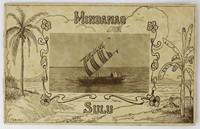
1905rif. 5045Manila: Sugar News Press 1905. Very good. 22pp. Illustrated. Oblong quarto. Original pictorial wrappers stapled. Moderate dust-soiling and edge wear. Light even toning to text. An early and seemingly-unrecorded promotional touting the people and scenery in Mindanao and Sulu in the southern Philippines in the first decade of the 20th century. The work opens with a Foreword detailing the positive aspects of Mindanao particularly its principal city described here as the "Metropolis of Mindanao and Sulu" with "a population of more than thirty thousand a mixture of Moros or Mohammedan Filipinos Christian Filipinos Chinese Japanese and Europeans." Following the Foreword the remainder of the work is mostly comprised of thirty-four duotone photographic prints printed mostly two per page but occasionally with from one to five per page. The photographs feature numerous scenic and street views in and around Zamboanga including various "Moro houses" and about fifteen portraits of indigenous Filipinos such as a "Moro woman weaving materials for head-turbans and sarongs" a view inside a "weaving school" "Yakan Moros on the island of Basilan" "Muhammad Jamallul Sultan of Sulu" "Joloano Warriors" "Moro Kulintang" and their musical instruments Bogobo and Cotabato warriors "Bajaos - the sea gypsies of Sulu" and "Bogobo musicians." The final two pages of the work are taken up with two poems -- the first is a traditional Filipino poem entitled "No Te Vayas" noted as "Zamboanga's 'Auld Lang Syne" and one titled simply "Zamboanga" by Susan Hart Dyer. The front cover is decorated with a central photograph of an indigenous sailing vessel surrounded by an illustrated beach scene signed at bottom left "Jh. Mendoza." The inside front cover contains an illustration of the Philippine Islands from Batanes down to Sulu. We could locate no other copies of the work by title and imprint information in OCLC. Sugar News Press unknown
1945rif. 54321Philippines; Okinawa; San Diego. 1945. Photo Album of a Seabee in the Philippines in 1945 A fascinating photographic account of military service in the Philippines compiled by a member of the 142nd U.S. Naval Construction Battalion the Seabees in 1945. Most of the images approximately three-quarters of the album were taken in Guiuan on Samar Island in the central Philippines where the photographer was stationed: Guiuan city square the Seabees' camp numerous portraits of local girls who sometimes pose with American soldiers local families and their activities indigenous architecture and other local scenes. They also show the Immaculate Conception Church with shots of the exterior and detailed views of the silver altar - built in 1595 to 1844 but completely destroyed by Typhoon Haiyan in 2013. Several other photos evidently portray the album's compiler posing next to an American fighter plane while boiling sea shells in front of his tent etc. The final portion of the album contains photos taken during the operations aboard the U.S.S. "Monrovia" and "President Harris" in October-November 1945 including views of Okinawa on the way to China and snapshots of soldiers unloading cargo in China before returning to Manila. There are also eight clear views of Manila showing destroyed Japanese cranes and boats in the harbor American army headquarters and a warehouse. The album concludes with a few photos of the homeward voyage and shows soldiers discharged in San Pedro California. Overall a very good album depicting local life and the activities of the 142nd U.S. Naval Construction Battalion in the Philippines and Yellow Sea in the last months of the World War II. 133 silver gelatin photographs most 2½ x 4 inches but ranging from 2½ x 2½ to several 10 x 7 inches. Oblong folio. Black leatherette album strong tied. Light wear. Photos in corner mounts with many captions. Very good. hardcover
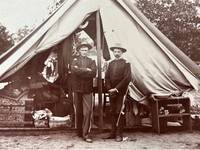
1898rif. 236541898. Spanish American and Philippine American war US military photographs circa 1898 to 1901 documenting the Spanish American War mobilization and the subsequent American occupation of the Philippines. A caption identifying "Co. B Pa. Vol. Mt. Gretna" places one image within Pennsylvania's 1898 volunteer encampment where state militia companies entered federal service during the Spanish American War. A separate inscription "Vigan Philippine Islands Christmas 1901" establishes an American military presence in northern Luzon during the Philippine American War. The photographs record how soldiers were assembled housed transported armed and sustained across stateside and overseas settings. Photo archive of 11 photographs seven silver gelatin and two sepia toned photographs most mounted to cardstock ranging from approximately 5 x 4 to 8 x 10 inches Pennsylvania the Philippine Islands and unidentified locations circa 1898 to 1901. A large company portrait before a conical tent is captioned "Co. B Pa. Vol. Mt. Gretna" among the assembled officers and enlisted men. Other photographs show soldiers standing in opposing ranks along a wooded camp street; five armed men before numbered canvas tents; a mounted officer amid trees and tentage; a long formation carrying an American flag beside railroad tracks telegraph poles freight cars and industrial buildings; and uniformed men posed near a railroad water tower. Two soldiers stand before an open tent crowded with trunks bedding shelving cookware and personal effects while another view records enlisted men seated on the steps of a raised tent furnished with cots. An interior scene shows three soldiers eating smoking pipes and preparing food around a carved table with rifles resting across their laps and beside their chairs. One mount is inscribed "Chas. W. Grammes 925 Maple St. Allentown Pa." while another bears the dated inscription "Vigan Philippine Islands Christmas 1901." Mount Gretna served as Pennsylvania's principal volunteer encampment during the 1898 mobilization but Pennsylvania regiments received different assignments after mustering into federal service. Some units remained stateside or served in Puerto Rico while the 10th Pennsylvania Volunteer Infantry deployed to the Philippines and later fought Filipino forces after the war with Spain had formally ended. Because the Mount Gretna caption omits a regiment number the company shown cannot be securely identified with Philippine service yet the image preserves the state level mobilization from which such overseas assignments were made. By late 1901 Vigan functioned as an American controlled provincial center in Ilocos Sur where military authority and the new colonial administration operated amid continuing resistance elsewhere in the archipelago. Light surface wear and silvering to several images; tonal variation edge wear and staining to some cardstock mounts. Overall good condition. A concentrated visual record of American military organization from Pennsylvania's 1898 volunteer camps to the daily realities of occupation service in the Philippines. unknown
1938rif. 235471938. Large photograph album documenting the colonial Philippines China Japan Hawaii and the United States in the inter war period 1929 and 1930. Likely compiled by an American missionary the photographs are dated and captioned showing colonial education and missionary activities expatriate tourist and native communities village visits portraits of Indigenous Filipinos and well documented Pacific travel infrastructure including photos of early railways and steam ship travel. The album includes many named individuals identified locations typed and handwritten observations and captions with ethnographic and paternalistic undertones characteristic of colonial travel photography in 1929. Photo album of approximately 140 silver gelatin and sepia toned photographs all 2.5 x 4.5 inches Philippines Shanghai and Japan 1929 and 1930. The photographs show white men and women in pith helmets cloche hats field clothing and travel dresses; a man identified as "fellow teacher Mr. Paul Russel"; a group captioned "Miss Knape Mrs. Chillson Ms. Hawkins Ms. Lynch Mrs. Cash"; group photographs of travelers likely American teachers standing in dense tropical vegetation; men crossing streams with walking sticks and hats; indigenous families and children outside thatched or leaf covered dwellings. A typed verso caption identifies "the home in Tagbilaran" comparing it to a house in Albay giving domestic detail of expatriate residence and social life outside Manila. Philippine locations including Tagbilaran and Albay village houses coastal and river landscapes and jungle terrain; In China Shanghai's "native city"; and Japanese sites including Kamakura and Tokyo. A photo from Shanghai depicts a street scene with horse drawn carts and Chinese garden or pavilion architecture. Photographs from Japan show the Great Buddha at Kamakura temple and shrine buildings a large torii steps to a temple complex and a Tokyo Imperial Palace bridge view. The provincial Philippines images include repeated portraits of local and Indigenous peoples including women and girls captioned "These are the belles of the jungle" families outside thatched dwellings children gathered near village houses and residents approached by the travelers for staged photographs. These captions and scenes document Indigenous Filipino subjects through paternalistic and exoticizing language while recording houses clothing family groups and village life in Bohol and nearby provincial districts in the 1920s. One photograph is captioned "December 29 1929" and describes the travelers as "trying to convince Filipinos to allow their photograph to be taken." In the period after the Spanish American War when the United States governed the islands as a colonial possession and made public education one of the central instruments of American administration. American teachers had entered the colonial school system in large numbers after 1901 and by the 1920s their work housing mobility and social networks formed a recognizable expatriate layer in provincial towns as well as Manila. The English captions reference to a "fellow teacher" and named residences in Tagbilaran and Albay point to a likely American teaching or expatriate circle though no creator is identified in the visible material. The Shanghai and Japan views extend the itinerary across treaty port China and Japanese tourist sites moving from the "native city" of Shanghai to Kamakura's Buddhist monuments and Tokyo imperial architecture. Some tonal variation in the photographs some pages unbound from album. Every image remains legible those detached from the album carry the album residue and many have handwritten and typed captions en verso; there are likely many more inscriptions which remain concealed as they are adhered to the album leaves. Overall in very good condition. A large dated visual record of a teacher in the American colonial Philippines and other East Asian travel routes during the interwar consolidation of American power in the Pacific. unknown