Philippines GovernorBiblio.com
577 résultats
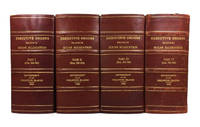
1936réf. 74073Manila: Bureau of Printing 1936. Hardcover. Very Good. Parts 1-4 in 4 vols. Red 1/2 leather with marbled boards. 19cm. Edges rubbed. No Jackets. These four very thick volumes contain Executive Orders Nos. 543-895; each Executive Order is separately paginated. Bureau of Printing hardcover
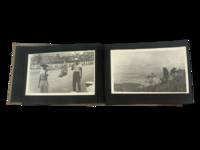
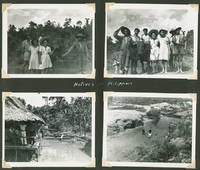
1944réf. 224221944. Olson Laverne Edwin vernacular photo album circa 1944-1946 documents U.S. Navy enlisted service across the Philippines and Hawaii during the final phase of World War II and the immediate postwar occupation period providing direct visual and documentary evidence of military presence local communities and wartime social life in the Pacific Theater. The album is anchored by Olson's official U.S. Navy Certificate of Satisfactory Service confirming duty from December 18 1944 through April 23 1946 situating the material within the aftermath of the U.S. return to the Philippines following the Leyte landings and the transition into occupation and reconstruction. The photographs support research into Pacific War military infrastructure American servicemen's daily life and interactions with local populations in recently contested and strategically critical regions. Album titled "Snapshots: The Philippines and The Islands of Hawaii" compiled circa 1944-1946 contains 25 items: 23 silver gelatin photographs one wallet-sized U.S. Navy Certificate of Satisfactory Service and one Roosevelt Commemorative Birthday Ball exchange coupon dated January 30 1946. Album measures approximately 4.5 x 3.5 inches with most photographs approximately 4 x 2.5 inches. Images include candid and landscape views from the Philippines likely including Leyte depicting rural villages shoreline activity docked naval vessels and local labor such as fishing and canoe transport. One photograph shows a group of Filipino children and young men gathered along a beach while another captures men and boys navigating shallow coastal waters in a canoe. Hawaiian images include group recreation scenes and coastal landscapes reflecting off-duty life within a major U.S. naval hub. The Roosevelt Birthday Ball coupon printed with the slogan "Dance That Others May Walk" provided access to multiple Honolulu venues and connects the album to wartime charitable campaigns supporting polio treatment through organized social events. Created during the closing campaigns of the Pacific War and the first year of U.S. postwar presence in the Philippines the album situates an enlisted sailor within a broader military and geopolitical transformation that included amphibious warfare territorial reoccupation and the reestablishment of American administrative and logistical systems. The Philippines served as a critical site of both combat and reconstruction while Hawaii functioned as a central staging and support base for naval operations. The inclusion of both official documentation and leisure-related ephemera demonstrates how military service encompassed bureaucratic recordkeeping mobility across strategic locations and participation in organized morale and fundraising activities tied to the American home front. Light wear to album covers minor handling and edge wear to photographs with images remaining sharp; service certificate shows toning and wear; pages largely intact. Overall very good condition. unknown
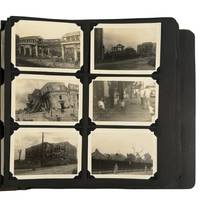
1945réf. 212431945. World War II Philippines photo album 1940s documenting United States Army Forces Far East activity and civilian conditions in Luzon during Japanese occupation and subsequent military operations. The album records military presence infrastructure damage and daily life among Filipino civilians providing visual evidence of the Pacific Theater at a critical stage of conflict. The material captures both organized military environments and surrounding local landscapes situating the campaign within its geographic and social context. Album comprises 48 silver gelatin photographs each measuring approximately 3" x 4.25" mounted on 8 loose black album pages within faux brown leather covers measuring approximately 10.5" x 12". The photographs depict a range of wartime and civilian scenes including damaged buildings rural and urban environments and Filipino civilians engaged in daily activity. Several images show U.S. soldiers stationed at an encampment with rows of tents including one photograph of a Filipino man possibly affiliated with the Philippine Scouts posed in front of a tent. Additional photographs depict large U.S. naval vessels alongside smaller wooden boats occupied by Filipino men and women approaching or departing from these ships. Other images capture natural landscapes including volcanic terrain and cloud formations above Luzon. The sequence of photographs reflects both military occupation and local life with visual emphasis on interaction between American forces and Filipino civilians. Created during the prolonged conflict in the Philippines where American and Filipino forces resisted Japanese occupation from 1941 to 1945 these photographs provide a record of conditions during one of the most significant campaigns in the Pacific Theater. The images reflect both the presence of U.S. military operations and the lived environment of the island during wartime. Album pages are loose within covers; photographs remain clean and well-preserved with minimal wear; overall very good condition. This album offers a concentrated visual record of wartime Luzon and the intersection of military and civilian experience. unknown
réf. B9781377119496Paperback. New. paperback
1945réf. 54321Philippines; Okinawa; San Diego. 1945. Photo Album of a Seabee in the Philippines in 1945 A fascinating photographic account of military service in the Philippines compiled by a member of the 142nd U.S. Naval Construction Battalion the Seabees in 1945. Most of the images approximately three-quarters of the album were taken in Guiuan on Samar Island in the central Philippines where the photographer was stationed: Guiuan city square the Seabees' camp numerous portraits of local girls who sometimes pose with American soldiers local families and their activities indigenous architecture and other local scenes. They also show the Immaculate Conception Church with shots of the exterior and detailed views of the silver altar - built in 1595 to 1844 but completely destroyed by Typhoon Haiyan in 2013. Several other photos evidently portray the album's compiler posing next to an American fighter plane while boiling sea shells in front of his tent etc. The final portion of the album contains photos taken during the operations aboard the U.S.S. "Monrovia" and "President Harris" in October-November 1945 including views of Okinawa on the way to China and snapshots of soldiers unloading cargo in China before returning to Manila. There are also eight clear views of Manila showing destroyed Japanese cranes and boats in the harbor American army headquarters and a warehouse. The album concludes with a few photos of the homeward voyage and shows soldiers discharged in San Pedro California. Overall a very good album depicting local life and the activities of the 142nd U.S. Naval Construction Battalion in the Philippines and Yellow Sea in the last months of the World War II. 133 silver gelatin photographs most 2½ x 4 inches but ranging from 2½ x 2½ to several 10 x 7 inches. Oblong folio. Black leatherette album strong tied. Light wear. Photos in corner mounts with many captions. Very good. hardcover
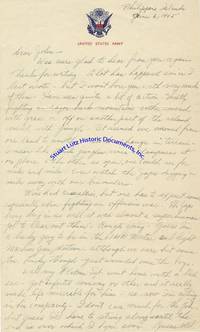
réf. 4410WORLD WAR II IN THE PHILIPPINES. ALS. 3pg. 6 x 10 . June 6 1945. Philippine Islands. An autograph letter signed Claude an American GI stationed in the Philippines. He wrote on United States Army stationery to his friend John about fighting the Japanese: Dear John Was sure glad to hear from you again Thanks for writing. A lot has happened since I last wrote - but I won't bore you with very much of them - Have seen quite a bit of action. Mostly fighting n razor back mountains either covered with grass or off on another part of the island covered with jungle - It seemed we moved from one land to another - such a change in terrain - I mean like thick jungles vines & dampness at one place & the other so open one could see for miles and miles - even watch the japs digging in miles away with our binoculars. Weve had casualties but one has to expect some especially when fighting an offensive war - The japs being dug in so well it was almost a superhumanjob to clear out them - Rough going - guess I'm a lucky guy to be in the 60MM Mortar and light Machine Gun platoon - although we were hit some too. Lucky though just wounded were the boys. Well my Platoon Sgt. Went home with a bad ear - got infected someway or other and it really made life miserable for him - so now I'm acting in his compacity - I don't care much for the job but guess I'll have to string along until the end is over which I hope soon. Guess old Nick here was lucky - Had a few close one's too close for comfort. just hope my luck holds on. Guess as far as the point system goes - I'll be in the Army quite awhile yet. Only can figure out 69 points - Quite a jump to dig up 16 more And I've been in this Army 38 months already - Seems like half my life - When I get home I won't know how to act like a civilian - ha - I know one thing I'll have to learn to control my Army slang or else - I'm writing this in our rest area - although we aren't resting as yet - A lot of hard work to build it up & get it in shape first - Havent been her long - but it's a nice area - About like Fort Lewis. Pine trees - cold at night need three blankets still my pups get cold and now that the rainy season has set in it reminds me of Fort Lewis more so as we had so much rain there. Have one camp on a golf course - Been quite some time since I played golf - last tie in the Hawaiian Is. on the isle of Moloka! - More or less pasture. I'd send you a v-mail but as far as I know yet they go straight home with out being photographed and I don't think you'd want that kind. So am using the borderless airmail variety - No two cent overprints have showed up in this area as but if they do I'll remember you - Some of my other friends were asking about them too. Mr. Weltack has been sending me a first day cover now and then and I really appreciate it - as I have no way or time to bother with them. Hope I can continue after the war as I really get a kick out of FD. 's F.Fs F.AM's & all the other better covers. I belonged to the AAMS at one time and have been thinking about joining the MACC in the future. Its been a long time since I saw a good game of baseball- Was in 1939 I guess - In Chicago at the Cub park - The Cubs were playing the Giants at the time. My dad & cousin are great Cub fans but me I like to see a good game - The best men win - I used to play a little too. You know how young guys are - getting up a team & trying to lick the neighboring town teams a log of good clean fun. Well John write when you have time. I enjoy hearing from you. Best of Wishes Sincerely Claude. The letter is in fine condition. unknown
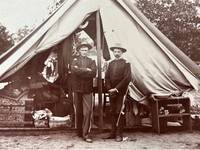
1898réf. 236541898. Spanish American and Philippine American war US military photographs circa 1898 to 1901 documenting the Spanish American War mobilization and the subsequent American occupation of the Philippines. A caption identifying "Co. B Pa. Vol. Mt. Gretna" places one image within Pennsylvania's 1898 volunteer encampment where state militia companies entered federal service during the Spanish American War. A separate inscription "Vigan Philippine Islands Christmas 1901" establishes an American military presence in northern Luzon during the Philippine American War. The photographs record how soldiers were assembled housed transported armed and sustained across stateside and overseas settings. Photo archive of 11 photographs seven silver gelatin and two sepia toned photographs most mounted to cardstock ranging from approximately 5 x 4 to 8 x 10 inches Pennsylvania the Philippine Islands and unidentified locations circa 1898 to 1901. A large company portrait before a conical tent is captioned "Co. B Pa. Vol. Mt. Gretna" among the assembled officers and enlisted men. Other photographs show soldiers standing in opposing ranks along a wooded camp street; five armed men before numbered canvas tents; a mounted officer amid trees and tentage; a long formation carrying an American flag beside railroad tracks telegraph poles freight cars and industrial buildings; and uniformed men posed near a railroad water tower. Two soldiers stand before an open tent crowded with trunks bedding shelving cookware and personal effects while another view records enlisted men seated on the steps of a raised tent furnished with cots. An interior scene shows three soldiers eating smoking pipes and preparing food around a carved table with rifles resting across their laps and beside their chairs. One mount is inscribed "Chas. W. Grammes 925 Maple St. Allentown Pa." while another bears the dated inscription "Vigan Philippine Islands Christmas 1901." Mount Gretna served as Pennsylvania's principal volunteer encampment during the 1898 mobilization but Pennsylvania regiments received different assignments after mustering into federal service. Some units remained stateside or served in Puerto Rico while the 10th Pennsylvania Volunteer Infantry deployed to the Philippines and later fought Filipino forces after the war with Spain had formally ended. Because the Mount Gretna caption omits a regiment number the company shown cannot be securely identified with Philippine service yet the image preserves the state level mobilization from which such overseas assignments were made. By late 1901 Vigan functioned as an American controlled provincial center in Ilocos Sur where military authority and the new colonial administration operated amid continuing resistance elsewhere in the archipelago. Light surface wear and silvering to several images; tonal variation edge wear and staining to some cardstock mounts. Overall good condition. A concentrated visual record of American military organization from Pennsylvania's 1898 volunteer camps to the daily realities of occupation service in the Philippines. unknown
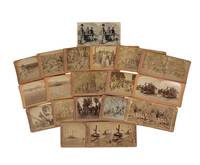
1898réf. 231701898. Stereoview archive documenting the rapid overseas deployment of American troops at the moment the Spanish American War gave way to a longer and more revealing imperial presence in the Philippines. This archive marks the transition from the 1898 defeat of Spain to the far more sustained American military occupation that followed. After the U.S. victory over Spain the Treaty of Paris transferred the Philippines to the United States for $20 million. This resulted in a battle between American forces and Filipino nationalists under Emilio Aguinaldo in February 1899 when Filipino hopes for independence collided with the reality of a new colonial ruler. This collection of photos preserves the process of colonialism through troop deployment provisioning medical treatment and the routines of military presence. Archive of 19 stereoview cards most published by B. W. Kilburn and James M. Davis centered on American military activity in the Philippines with additional views from Puerto Rico Cuba and the United States. Each measure 3.5" x 7". The core of the images remain in Philippine occupation; "The 17th Infantry crossing the river P.I." shows movement through tropical terrain; "Our Volunteers awaiting orders under the tropical sun in the Philippines" captures the idleness and bodily strain of expeditionary service; "2nd Division Hospital established in Angeles Church P.I." reveals improvised medical infrastructure inside a colonial religious building; "Dealing out pork and beans to the Oregon Volunteers P.I." appears in multiple variants and preserves the logistics of feeding American troops in camp; and "The Insurgent House of Congress on Fire Malolos P.I." places the war directly in relation to the destruction of Filipino political institutions. The remaining cards broaden that story outward: "Troop D 5th U.S. Cavalry lining up for dinner Mayaguez P.R." points to U.S. military operations in Puerto Rico; "Modern Krupp Gun Morro Castle Havana Cuba" preserves the Spanish imperial military landscape at Havana just as U.S. power displaced it; and the exhibition drill cards including "The Little Commodore" Boston '98 and "Grand Stand Exhibition Drill Boston '98" connect the overseas war to patriotic spectacle and military display at home. Stereographs were a common late nineteenth century format for circulating military imagery and was used to render mobilization and drill into mass-viewed visual media. Minor toning edge wear and rubbing; images and printed captions remain legible; overall very good condition. This collection preserves the American campaign in the Philippines not as abstract policy but as a contemporary visual record of how troops were deployed housed fed and sustained while the United States transformed victory over Spain into colonial rule in the Pacific. unknown
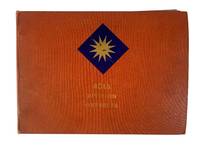
1944réf. 220931944. 40th Infantry Division Pacific campaign photograph album documenting combat operations and daily military life of U.S. Army forces during World War II. The 40th Infantry Division served extensively in the Southwest Pacific Theater participating in campaigns across New Guinea New Britain and the Philippines as Allied forces advanced against Japanese defensive positions. The photographs record amphibious landings artillery operations destroyed towns and the collaboration between American troops and Filipino guerrilla forces during the campaign to liberate the Philippines. The album therefore documents the operational environment of Pacific warfare including jungle terrain fortified Japanese defensive networks and the logistical systems required to sustain prolonged combat across island battlefields. Photograph album containing approximately 200 original black and white photographs documenting operations of the 40th Infantry Division during the Pacific campaigns of World War II. Each photograph is sequentially numbered in white ink at the lower corner and corresponds to descriptive entries in a photographic index within the album. Early images depict American Red Cross workers disembarking from landing craft and greeted by U.S. soldiers illustrating the presence of female support personnel assigned to medical and relief operations. Additional photographs record amphibious landing scenes aerial views of destroyed towns in Luzon artillery and tank operations and soldiers operating mounted machine guns overlooking jungle valleys. Several images depict Japanese military casualties reflecting the intense close combat that characterized fighting across the Pacific islands. A printed military map within the album shows Japanese tunnel and cave fortifications in the Zambales Mountains illustrating defensive positions encountered during operations in the Philippines. The album also documents logistical and civilian dimensions of the campaign. Photographs show ships unloading cargo Filipino guerrilla units marching through urban streets and groups of local porters assisting Allied forces in moving supplies through mountainous terrain. Weapons and equipment visible in the images include field artillery pieces mortars and armored vehicles such as the M4 Sherman. One photograph depicts African American soldiers accompanied by scout dogs operating in jungle terrain illustrating the presence of Black servicemen serving within the segregated structure of the wartime U.S. Army. Other photographs show tent encampments mess areas interactions with local populations and the recovery of prisoners of war following combat operations. The photographs collectively present a visual record of combat logistics and daily military life during the Pacific campaigns. Album contains approximately 200 photographs with indexed numbering. Light handling wear visible to album and photographs consistent with wartime field compilation. Overall condition very good. unknown
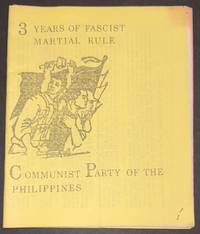
1975réf. 333236Mansfield Depot CT: Philippine Research Center 1975. 8.5x14 inch sheets stapled together and folded with a cover sheet; 18 pages. Article reprinted from an Ang Bayan special issue dated October 6 1975. Rear cover has the address of the Philippine Research Center in Mansfield Depot CT but it has been neatly blotted out with a marker. Philippine Research Center unknown
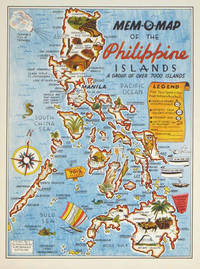
1945réf. 204557U.S.A.: Mem-O-Map Co. 1945. Colour pictographic / pictorial map 32.1 x 23.8 cms; 35.4 x 26.6 cms sheet very good condition. Rare pictorial map published in 1945 by John G. Drury aTechnical Officer who served with the 214th Ordnance Battalion to mark the end of World War II as souvenirs for the military. Military personnel could fill in banners "came in on good ship." and "departed on good ship." their name organisation and "Line of Advance or movement" blank in this example. Pictographs mark various memorable spots and wildlife including larger-than-life insects. A "Terrible Tillie Typhoon" looms over the coast at Luzon. Drury published a series of five maps: Philippines and Okinawa in 1945; Japan and Korea Oahu and Europe in 1946. They are all scarce. “These almost whimsical maps are designed to support the creation of personalised geographies. At a time when digital mapping is beginning to experiment with the creation of personalised content that would render the same map in different ways for different users Mem-O-Maps demonstrate the principle in action." Kenneth Field ICA Commission on Map Design. . Mem-O-Map Co. unknown
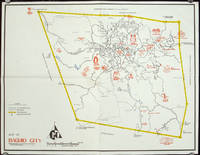
1960réf. 206510circa1960. Printed pictorial map 44.8 x 58 cm 46.7 x 60.3 cms sheet original folds a little wear but in very good condition. Attractive 1960s tourist map of Baguio city when it was the "Summer Capital" of the Philippines. Tourist attractions are shown pictorially in red blue triangles denote wood carving shops the city boundaries outlined in yellow sealed and unsealed roads are also shown. . unknown
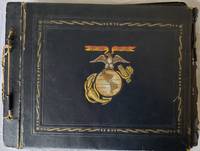
1944réf. 159501944. United States Marine Corps photo album 1944-1945 documenting Marine service in the Pacific Theater during the final campaigns against Japanese forces including visual evidence of combat environments military infrastructure and daily life during Allied advances toward the Philippines. Compiled by an active Marine the album records conditions faced by servicemen during a decisive phase of World War II when United States forces intensified operations to dismantle Japanese control across strategic island territories. The photographs show armed Marines in field settings encampments and operational zones alongside damaged urban structures marked by bullet impacts aircraft staged on active airfields and transportation along jungle rivers providing direct visual documentation of wartime movement occupation and destruction. Photograph album containing 93 silver gelatin photographs and approximately 30 postcards assembled by a United States Marine serving in the Pacific Theater. Images depict Marines in group portraits at base camps informal scenes of soldiers at rest and aircraft on airfields including fighter planes with visible nose art. Additional photographs document jungle landscapes river travel using local barges and built environments showing structural damage consistent with recent combat. The album includes interactions between American servicemen and local civilian populations as well as images of local animals such as dogs and monkeys. Postcards depict illustrated views of Marine bases and wartime scenes several addressed to the compiler's family in Georgia. Laid into the album are photographic negatives newspaper clippings reporting wartime developments military documents and a ribbon extending the documentary scope beyond the mounted photographs. Produced during the closing phase of World War II this album aligns with major United States Marine Corps operations supporting the liberation of the Philippines in 1944 and 1945 and the broader Allied campaign across the Pacific. Marine aviation and ground units operated from forward airfields and temporary encampments such as those depicted here sustaining continuous engagement with Japanese forces while navigating tropical terrain and heavily damaged urban zones. The inclusion of civilian encounters and informal group scenes adds dimension to the study of occupation dynamics and servicemen's daily routines within active war zones. Album pages detached from original ties with some tearing and evidence of missing photographs light wear throughout; overall fair to good. A substantial primary visual record of Marine experience during the final stage of the Pacific War. unknown
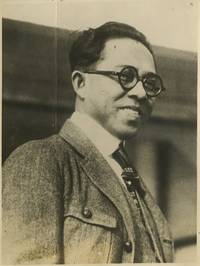
1920réf. List38122New York City: Keystone View Co. Inc 1920. Photo measuring 5 ⅞ x 7 ¾ inches. With caption Keystone stamp manuscript and later sticker verso. Fold along left third of image with several pinholes around margins and one small hole in photo; very good. A portrait of Hadji Gulamu Rasul around the 1920s. Rasul was the son of Filipino statesman Abd ul-Bagui Butu Rasul and some sources state that he was the adopted son of Jamalul Kiram II the last sultan of Sulu. The sultanate was a Sunni Muslim state that ruled parts of what are now the Philippines Malaysia and Indonesia from the 1400s until the 1915 Carpenter Agreement was signed in the American-occupied Philippines. Under American rule Rasul represented the district of Sulu in the Philippines' congress from 1938-1941 and 1949-1953. The caption on this photograph states that he was in Seattle "in search of his white wife who deserted him when she found he had several native wives"; however other newspaper articles from the same period state that he was in Washington to study law. Keystone View Co., Inc unknown
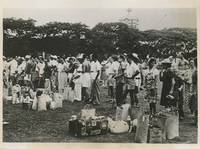
1945réf. List38144N.p.: Central Press Association and International News Photos 1945. Photograph measuring 9 ¾ x 7 ¼ inches. With manuscript on negative; caption Central Press Association and International News Photos stamps manuscript and later sticker verso. Some wear and wrinkling; excellent. Japan invaded the Philippines in early December 1941 defeating the islands and the US military by May of the following year. The University of Santo Tomas was used as a civilian internment camp housing a number of Americans and Brits. The camp was crowded and conditions were poor with shortages of food and other rations and harsh weather; it was liberated when American Filipino Australian and Mexican forces retook the Philippines in 1945. Offered here is a photograph allegedly "taken by a Japanese serviceman" showing "life in the Santo Tomas internment camp". A crowd of people mill around the grounds with their baggage with the university building visible above the trees in the background. Central Press Association and International News Photos unknown
réf. 46560408like new. unknown
réf. 46892026like new. unknown
réf. 44014099like new. unknown
2021réf. AME_9781774076354Delve 2021. UNKNOWN. Hardcover. New/New. Delve hardcover
réf. 1391031687.Gpaperback. Good. Access codes and supplements are not guaranteed with used items. May be an ex-library book. paperback
réf. 1391099362.Ghardcover. Good. Access codes and supplements are not guaranteed with used items. May be an ex-library book. hardcover
2011réf. 218888Philippines: Armed Forces of the Philippines 2011. 1st Edition . Hardcover. Near Fine/No Jacket. 12 1/2 x 9 1/2. 125 pages in near fine condition. Pages are clean and unmarked with colour illustrations throughout. Blue matte hardcovers with yellow embossed titles. Endpapers are lightly wrinkled. Otherwise unblemished. 1ST EDITION. NF/- - Armed Forces of the Philippines hardcover
réf. 1773612239_newArcler Press 2018-12-30. Hardcover. New. 9x6x1. Arcler Press hardcover
réf. 1773612239_usedArcler Press 2018-12-30. Hardcover. Like New. 9x6x1. Arcler Press hardcover
2021réf. AME_9781774076736Society Publishing 2021. UNKNOWN. Hardcover. New/New. Society Publishing hardcover