837 résultats
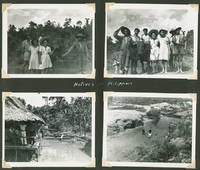
1945réf. 54321Philippines; Okinawa; San Diego. 1945. Photo Album of a Seabee in the Philippines in 1945 A fascinating photographic account of military service in the Philippines compiled by a member of the 142nd U.S. Naval Construction Battalion the Seabees in 1945. Most of the images approximately three-quarters of the album were taken in Guiuan on Samar Island in the central Philippines where the photographer was stationed: Guiuan city square the Seabees' camp numerous portraits of local girls who sometimes pose with American soldiers local families and their activities indigenous architecture and other local scenes. They also show the Immaculate Conception Church with shots of the exterior and detailed views of the silver altar - built in 1595 to 1844 but completely destroyed by Typhoon Haiyan in 2013. Several other photos evidently portray the album's compiler posing next to an American fighter plane while boiling sea shells in front of his tent etc. The final portion of the album contains photos taken during the operations aboard the U.S.S. "Monrovia" and "President Harris" in October-November 1945 including views of Okinawa on the way to China and snapshots of soldiers unloading cargo in China before returning to Manila. There are also eight clear views of Manila showing destroyed Japanese cranes and boats in the harbor American army headquarters and a warehouse. The album concludes with a few photos of the homeward voyage and shows soldiers discharged in San Pedro California. Overall a very good album depicting local life and the activities of the 142nd U.S. Naval Construction Battalion in the Philippines and Yellow Sea in the last months of the World War II. 133 silver gelatin photographs most 2½ x 4 inches but ranging from 2½ x 2½ to several 10 x 7 inches. Oblong folio. Black leatherette album strong tied. Light wear. Photos in corner mounts with many captions. Very good. hardcover books
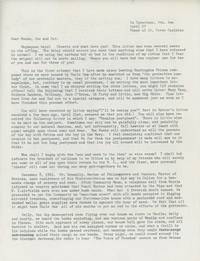
1945réf. List2748Philippines 1945. Single letter; five 8.5 x 11” pages. Pinhole at top of first page missing final pages overall fine. The unknown author of this letter was an American Jesuit missionary in the Philippines who before the war was a novice living in Novaliches just outside Manila. He apparently had not written a significant letter home for a long time: in this letter written in April of what is likely 1945 he recounts his experiences from between December 8 1941 and early January of 1945 shortly before the civilian POW camp in which he was interned was liberated. After the “Nips” bomb Pearl Harbor “A feverish month ensued”: “We proceeded to put the Community on ‘war-time alert’ with all hands occupied in digging air-raid trenches camouflaging our fortress-like house with a garlanded roof and mud-daubed walls; grain supplies were rushed in against the hour of need. We felt that all it might take Uncle Sam all of six months to put an end to the efforts of the pretender.” Around Christmas they evacuated to the Jesuit Ateneo Grade School then in Intramuros as the Japanese were advancing quickly towards Novaliches. Of course this did not prove to be much safer: “When darkness came the Japs began their bombing of the Port Area. The bombs began to bounce off the pavement; bombers just skimming our roof-top on their way. We spent the night on our tummies and how we prayed. We thought that each decade of the beads would be our last this side of Purgatory. . When the church sto Domingo was hit the floor beneath us did some tricks and we were lifted up a bit and let down amidst the dust and smoke that poured in from above.” The missionaries try to “salvage important papers and other valuables from the Mission House prior to abandoning it to the fire which threatened the entire Walled City.” During this time they and “a thousand refugees” live in the Ateneo while “Dawn and night raids were supplied by the Japs with nary an American plane to say to them no” – American forces had taken a serious hit and withdrawn outside Manila. It was declared an open city before “the little scrawny but arrogant Japs came into the city and took over” in January of 1942. The missionaries persuade the Japanese to let them stay in the Ateneo: “We convinced them that it was impossible for us to give up the building because it belonged to the Pope and the Vatican State would hold us responsible. This argument with many ingenious trimmings enabled us to hold on to the Ateneo until June ‘43 when the main building was taken for a military hospital”. The author describes how despite what he calls his “partial internment” in Manila he is able to get around checkpoints by pretending to be Belgian. He finishes his studies and begins work at a Belgian convent in Paranaque in February of 1943 living between there and Manila: “Incidentally none of this would have been possible if the Japs had gumption enough to find out that I was one of the hated Americans. . All vehicles were obliged to stop here a checkpoint at Baclaran and all passengers get down and file between a Jap sentry and a Filipino constabulary soldier to be searched for hidden arms etc. Since several Belgian Fathers not considered enemy aliens frequently passed this way I was able to walk through unmolested as an unoffending Belgian. . I carefully kept my helmet covering the tell-tale red arm-band which was worn on the arm furtherest away from the Jap. The Filipino would do no more than give me a knowing grin.” On July 10 1944 all of the American civilian POWs are taken to internment camps in Santo Tomas and then Los Baños. In Los Baños the POWs cut wood repair roads and farm. Los Baños would be liberated in February of 1945; the author paints a slightly confusing picture of the leadup to this: “Conditions generally ‘worsened’ when on Jan. 8th about the time that the American troops landed at Mindero an island just across from Batangas the Japs got jittery believing that the Yanks were going to do the obvious and cross over the bay to Batangas and they the Japs at Batanga decamped! ‘You are free but remain in camp until the Americans come. Outside your camp Japanese troops will shoot any who leave.’ Great was the joy in Mudville. From nowhere came flag poles on which we quickly unfurled American and British flags .; a short-wave radio was set up and we enjoyed daily Frisco broadcasts .” It sounds as if the missionary was reporting contrary to the usual narrative of the Los Baños raid that the Japanese had essentially given up control of the camp and were like the prisoners simply waiting for the Americans to come get their people. Perhaps something further happened in the nearly two intervening months; however the remainder of the letter is missing. Of interest to scholars of modern Jesuit history and of the civilian POW experience during the Second World War. unknown books
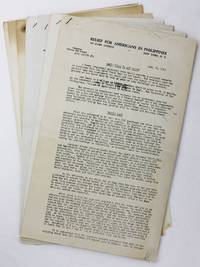
1945réf. 4668New York 1945. Very good. Sixteen issues totaling 75pp. Legal-size sheets stapled. Previously folded. Light wear and toning. An extensive run of newsletters by a New York-based aid group Relief for Americans in the Philippines. Included here are issues 9 12 14 through 18 and 20 through 28 which were published between 1942 and 1945. The organization was devoted to the support of Americans who were imprisoned at San Tomas Gabuio and other camps after Japan occupied the Philippines during World War II. At the outset of the war the Philippines were a commonwealth of the United States but within three weeks of the attack on Pearl Harbor the Japanese seized control. The 20000 American and 80000 Filipino troops on the ground departed and any remaining American or British citizens were rounded up in Manila and transferred to the University of Santo Tomas where they were left to fend for themselves. The only exceptions were a 7:30 pm roll call each night and the use of room monitors. The background of the captives varied wildly from business executives and retired soldiers to prostitutes. At the end of the war the total number of prisoners liberated was 3785 2870 of which were American. Issue 14 remarks on the first anniversary of the non-profit organization: “On May 8th 1942 just a year ago and two days after the fall of Corregidor our organization came into being for furthering plans for the shipment of food medical supplies and other necessities for the internees and also to serve as a clearing house and point of dissemination for information concerning the welfare of these internees.” The monthly newsletter prints news and developments from the camps in the Pacific and documents the efforts of the organization to provide aid to the prisoners there. The issues also print a running list of all those believed to be in the Philippines “solely for the purpose of obtaining names and addresses of the nearest relatives of who we have no record.” A scarce record of this little-known relief effort during World War II. unknown books
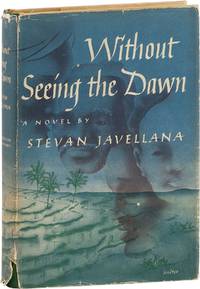
1947réf. 82279Boston: Little Brown & Company 1947. First Edition. First Printing. Octavo 21cm; khaki cloth-covered boards blocked and titled in green and gilt on spine and decorations embossed to spine and front cover; dustjacket; xvi34-3591pp. Pictorial bookplate to front pastedown. Very slight waviness to lower edge of textblock; two very small nicks on rear endpaper and rear pastedown; Near Fine. Dustjacket designed by George Salter unclipped priced $2.75 shelf-worn with 1.5" closed tear to rear spine fold with several tiny chips small tears and attendant creases; Very Good. The Filipino author's only published novel later released under the title The Lost Ones. Javellana's experience as a guerrilla during the Japanese invasion of the Philippines is evident in his two-part novel "Day" and "Night" describing events before and during the war. He focuses on the struggle of his people through farmer folk characters feeling that was ".the most sincere most accurate and most moving story about the Philippines would be the story of those who dug their plows into the rich earth and prayed for the coming of rain and whose sons were with the guerrillas" from rear panel. A film adaptation Santiago! was directed by Filipino director Lino Brocka 1939-1991 who co-founded the Free the Artist Movement and the Concerned Artists for Phillipines CAP; he was appointed by President Corazon Aquino for Constitutional Commission to draft the country's new constitituion. Without Seeing the Dawn also received an award-winning TV mini-series adaptation Malayo Pa Ang Umaga. 82279. Little, Brown & Company unknown
1947réf. 82279Boston: Little Brown & Company 1947. First Edition. First Printing. Octavo 21cm; khaki cloth-covered boards blocked and titled in green and gilt on spine and decorations embossed to spine and front cover; dustjacket; xvi34-3591pp. Pictorial bookplate to front pastedown. Very slight waviness to lower edge of textblock; two very small nicks on rear endpaper and rear pastedown; Near Fine. Dustjacket designed by George Salter unclipped priced $2.75 shelf-worn with 1.5" closed tear to rear spine fold with several tiny chips small tears and attendant creases; Very Good. The Filipino author's only published novel later released under the title The Lost Ones. Javellana's experience as a guerrilla during the Japanese invasion of the Philippines is evident in his two-part novel "Day" and "Night" describing events before and during the war. He focuses on the struggle of his people through farmer folk characters feeling that was ".the most sincere most accurate and most moving story about the Philippines would be the story of those who dug their plows into the rich earth and prayed for the coming of rain and whose sons were with the guerrillas" from rear panel. A film adaptation Santiago! was directed by Filipino director Lino Brocka 1939-1991 who co-founded the Free the Artist Movement and the Concerned Artists for Phillipines CAP; he was appointed by President Corazon Aquino for Constitutional Commission to draft the country's new constitituion. Without Seeing the Dawn also received an award-winning TV mini-series adaptation Malayo Pa Ang Umaga. 82279. Little, Brown & Company unknown books
194480p., illus. New World Neighbors series for children. Pictorial endpapers w/ map. Hardcover Very good condition w/ pictorial paste-on label.
2020réf. DBS-9781774071625Society Publishing 2020. 1st. Hardcover. New. Society Publishing hardcover
2020réf. DBS-9781774071625Society Publishing 2020. 1st. Hardcover. New. Society Publishing hardcover
2020réf. DBS-9781774071632Society Publishing 2020. 1st. Hardcover. New. Society Publishing hardcover
2020réf. DBS-9781774071632Society Publishing 2020. 1st. Hardcover. New. Society Publishing hardcover
2020réf. AME_9781774071632Society Publishing 2020. UNKNOWN. Hardcover. New/New. Society Publishing hardcover
2021réf. DBS-9781774076859Society Publishing 2021. 1st. Hardcover. New. Society Publishing hardcover
2021réf. DBS-9781774076859Society Publishing 2021. 1st. Hardcover. New. Society Publishing hardcover
2021réf. AME_9781774076859Society Publishing 2021. UNKNOWN. Hardcover. New/New. Society Publishing hardcover
2021réf. DBS-9781774076842Society Publishing 2021. 1st. Hardcover. New. Society Publishing hardcover
2021réf. DBS-9781774076842Society Publishing 2021. 1st. Hardcover. New. Society Publishing hardcover
1981réf. 3cb6in4 toilé sous jaquette illustrée sous rhodoïd. Abondante iconographie dont 8 planches couleurs. Texte bilingue français/anglais
2026réf. x-981982303XWorld Scientific Publishing Co Pte Ltd 2026. Hardcover. New. 560 pages. 6.00x2.00x9.00 inches. World Scientific Publishing Co Pte Ltd hardcover
2020réf. DBS-9781773614045ARCLER PRESS 2020. 1st. Hardcover. New. ARCLER PRESS hardcover
2020réf. DBS-9781773614045ARCLER PRESS 2020. 1st. Hardcover. New. ARCLER PRESS hardcover
2020réf. AME_9781773614045ARCLER PRESS 2020. UNKNOWN. Hardcover. New/New. ARCLER PRESS hardcover
2021réf. DBS-9781774077207Society Publishing 2021. 1st. Hardcover. New. Society Publishing hardcover
2021réf. DBS-9781774077207Society Publishing 2021. 1st. Hardcover. New. Society Publishing hardcover
2021réf. AME_9781774077207Society Publishing 2021. UNKNOWN. Hardcover. New/New. Society Publishing hardcover
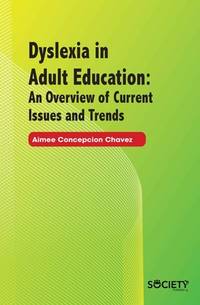
2020réf. DBS-9781774073223Society Publishing 2020. 1 st. Hardcover. New. Society Publishing hardcover