Issues of a New Epoch
réf. 1331280249.Gpaperback. Good. Access codes and supplements are not guaranteed with used items. May be an ex-library book. paperback
Bonita · États-Unis50,30 $US≈ 44,94 €
926 résultats
réf. DADAX0520240715New unknown
réf. DADAX0333324811New unknown
réf. DADAX1845428382New unknown
réf. 1331280249.Gpaperback. Good. Access codes and supplements are not guaranteed with used items. May be an ex-library book. paperback
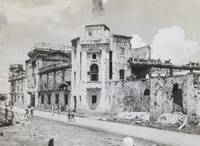
réf. PD10Oblong Octavo album ca.182x295 cm or 7 ¼ x 11 ½ in. 30 card stock leaves with 2 free endpapers. With 105 original gelatin silver photographs including one loose from ca. 104x75 cm 4 x 3 in to 47x64 cm 1 ¾ x 2 ½ in. All photos with white ink captions in English on the mounts seven photos captioned in negatives some photos dated. Period dark green half leather binding with raised bands; guilt-tooled ornaments on the front cover and the spine. Seven photos missing one page lacks fragments at the right margin several pages with minor tears but otherwise a very good album with strong interesting photos. Historically interesting collection of original photographs mostly documenting the technical reconstruction of Manila’s communication networks after the end of World War II. As follows from the photographs the compiler was a technician or lineman with the U.S. Army Signal Corps. First stationed in Pittsburgh in 1943 he likely underwent specialized technical training at one of the city's industrial or academic centers before being deployed to Finschhafen New Guinea. There he was tasked with establishing the communications infrastructure for the Allied base following the recapture of the town from Japanese forces. Finally he was sent to Manila in the fall of 1945 where he assisted in the massive effort to reconstruct the city’s destroyed telephone and telegraph systems during the initial months of the post-war occupation. The album contains 105 rare early photographs from the Pacific Theatre with most images taken in Manila in the fall of 1945. The photos capture Japanese ships sunk by U.S. forces in Manila Bay and the city’s architecture before and after the artillery bombardment Escolta Street Jones Bridge the ruins of City Hall the University of the Philippines the Manila Hotel San Vicente de Paul Parish Department of Finance Building today’s National Museum of Anthropology Commerce & Agriculture Building today’s National Museum of Natural History and Legislative Building today’s National Museum of Fine Arts. Especially interesting are about fifteen candid photographs documenting the technical reconstruction of Manila’s communication networks. Outdoor scenes show the compiler’s companions with climbing spikes and safety belts repairing overhead trunk lines. Interior views depict a “Test Desk” with technicians both American and Philippian operating specialized consoles and patch cords the massive Main Distribution Frame MDF with thousands of line terminations and heavy power panel equipment. The series also includes several photographs from Clark Field showing “Ralph” and “Eddie” posing beside wrecked aircraft. The other interesting photos from the collection show “a Native of New Guinea” posing with American soldiers as well as the compiler and his friends in military uniforms in Finschhafen and Pittsburgh beside their tents barracks and orderly room. Overall historically interesting collection of original gelatin silver photographs illustrating rare scenes from the service of the U.S. Army Signal Corps in the Pacific Theatre of World War II. hardcover
1945288 pages. Features: One War to Go - The Coming Fight with Japan; U.S. Meat in This War - how boneless beaf solved the logistics of meat for the first time; Philips of Eindhoven - The big Dutch electrical company, in the U.S. to stay, shows no signs of changing its cartel tactics; The New Transport Planes - Consolidated Vultee's Clipper - the state of the art, how we got here, and what's in the future; The Bogey of Economic Maturity - Washington spenders claim capitallism is moribund; Commander Eugene F. McDonald of Zenith; The Medal - today's heroes are heirs to the great tradition of Pisanello; The Military Police - bully boys in the last war, this time they have won the G.I.'s respect; Battle for the Philippines - the U.S. settled the battle of the Pacific; and more. Many excellent vintage ads in color and black and white, perhaps being the one-page War Loan ad which features photo of Admiral Hirohito on horse, with inset photo of Admiral Halsey who has expressed his desire to ride the Emperor's horse, Shirayuki. Another great color ad by International Harvester shows U.S. troops storming Pacific beach with title "Till The Japs Say Uncle"; Somewhat above-average external wear. Unmarked. Spine lean. A worthy vintage copy of this sensational WWII-era issue. Book
1930Generously illustrated with black and white photos and illustrations. Features: The Taking of Hamjah's Head - One of the most elusive outlaws ever to trouble the Philppine Constabulary finally meets his fate - with photos; Smuggling on the Spanish Main - J. Vance Marshall became acquainted with two leading Spanish-American contrabandistas and became entangled in some most exciting happenings; The Man Who Was Buried Alive! - Part II (conclusion) of the amazing adventures of the "Marquis de Champaubert", with photos; The Voyage of the "Annie Marble" - part I - Quaint experiences of a three month journey through France in a fifteen-foot boat, with photos; "Monty" the Man-Eater - Part II - One of the most remarkable lion stories ever published; M'tagati (the Zulu word for witchcraft); Money For Nothing - A veteran prospector buys a mine for almost nothing but it produces thousands of pounds of gold, with photo; The Little Red Karen - Hugh Nisbet, a veteran of the forests of Burma and Siam, describes his encounter with Nanchai, a Siamese dacoit who was believed to be proof against bullet and sword - with two photos; Over Shoshone Falls in a Canvas Boat - Al Faussett, a former lumberjack, went over Idaho's Shoshone Falls - a cataract considerably higher than Niagara - in a twelve-foot canvas boat! (with phot of Faussett in his boat); The Kamalu "Ju-Ju" - Frank Hives aims to shut down a mysterious Nigerian Ju-Ju, or fetish, responsible for the disappearance of hundreds of victims; Sheep-Farming in the Sahara - A photo-illustrated account of how R.V.C. Bodley has partnered with an Arab chief to breed sheep, incidentally showing how the rulers of tribes deal with thieves and murderers who occasionally disturb the peace of the desert; Desert Ghosts - weird little story from the Egyptian desert; Black Magic - A queer tale from India; and more. 84 pages plus 28 pages of great ads. Clean and unmarked with light wear. A lovely vintage copy of this fascinating issue. Book
réf. 8629New York and London: Frederick A. Praeger, 1964. 1 volume in-8, 325 pp., black hardback with an orange chipped dust jacket, flat spine, a personal note on the first end page, very good condition.
Alcalá de Henares, 1994. 4to. mayor; 202 pp. Cubiertas originales.
201023x15. 382p. Trad. V. Alonso Blanco. Col. Andanzas, N. 736.
réf. DADAX0367863227New unknown
réf. 1021837431.Gpaperback. Good. Access codes and supplements are not guaranteed with used items. May be an ex-library book. paperback
réf. DADAX0367318091New unknown
réf. DADAX0813337844Routledge 1999-09-10. paperback. New. 6.00x0.83x9.00. Buy with confidence. Excellent Customer Service & Return policy. Routledge paperback
Chicago, Imperial Publishing Company, 1899. 4to. mayor cuadrado; ejemplar falto de portada, 415 pp., 7 hs. Con numerosas ilustraciones fotográficas en láminas, muchas de ellas tomadas por el propio Stickney, Ayudante del Almirante Dewey, a bordo del "Olympia" en la Bahía de Manila. Encuadernación original en tela estampada.
1967Reliure toile de l'éditeur. 250 pages.
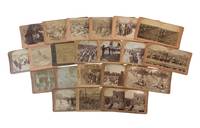
1898réf. 231301898. Spanish-American War stereoview archive circa 1898-1899 documenting how the war was pictured through mass-produced photographic views that followed U.S. mobilization battlefield action occupation and military life across both Cuba and the Philippines. These stereoviews preserves the visual system by which the war was circulated to American audiences showcasing camp organization troop movement burial hospital care naval power and overseas deployment. Particularly notable is the archive's coverage of the Rough Riders the Santiago campaign in Cuba and U.S. presence in Manila and Malate showing how stereoview photography helped normalize the war's expansion from anti-Spanish conflict into a broader American imperial presence. Archive of 21 stereoviews Various publishers. Spanish-American War stereoview archive. Cuba the Philippines and the United States circa 1898-1899. each measuring 3" x 7". The views are drawn from multiple phases and theaters of the war including camp and drill scenes in the United States embarkation and troop arrivals at Tampa battlefield and occupation imagery from Cuba and extensive and some grisly scenes from Manila and surrounding areas in the Philippines. Captions and images show soldiers in formation cavalry drill military reviews naval artillery hospital interiors encampments burial grounds and troops in active position. Cuban views include Morro Castle after bombardment dead and wounded on the battlefield of Santiago U.S. soldiers preparing to invade Cuba and troops dining near Cabañas Fortress. Philippine views include a departure for Manila American pickets routing a Filipino reconnoitering party the 18th Infantry engaged by Filipino outposts volunteers awaiting orders under the tropical sun Army Hospital Manila and "Our Boys in Camp at Malate P.I." One stereoview identifies Roosevelt's Rough Riders in the mobilization phase linking the archive to one of the war's most publicly mythologized units. As a group the stereoviews demonstrate the process by which the Spanish-American War was framed not simply as a short military victory over Spain but as a sustained structure of U.S. troop deployment and occupation extending from Cuba into the Philippines. The Manila and Malate scenes are especially important in this regard since they place American soldiers within the opening phase of the Philippine conflict where U.S. military presence quickly moved beyond liberation rhetoric into imperial control. The archive's mixture of battlefield casualties camp routine naval spectacle and celebratory review scenes shows how stereoscopic publishing converted war into a domestic viewing experience while reinforcing the legitimacy of American expansion abroad. Wear to mounts some toning; overall very good condition. A strong cross-theater visual archive of the Spanish-American War and the emergence of U.S. imperial power in Cuba and the Philippines. unknown books
1898réf. 231301898. Spanish-American War stereoview archive circa 1898-1899 documenting how the war was pictured through mass-produced photographic views that followed U.S. mobilization battlefield action occupation and military life across both Cuba and the Philippines. These stereoviews preserves the visual system by which the war was circulated to American audiences showcasing camp organization troop movement burial hospital care naval power and overseas deployment. Particularly notable is the archive's coverage of the Rough Riders the Santiago campaign in Cuba and U.S. presence in Manila and Malate showing how stereoview photography helped normalize the war's expansion from anti-Spanish conflict into a broader American imperial presence. Archive of 21 stereoviews Various publishers. Spanish-American War stereoview archive. Cuba the Philippines and the United States circa 1898-1899. each measuring 3" x 7". The views are drawn from multiple phases and theaters of the war including camp and drill scenes in the United States embarkation and troop arrivals at Tampa battlefield and occupation imagery from Cuba and extensive and some grisly scenes from Manila and surrounding areas in the Philippines. Captions and images show soldiers in formation cavalry drill military reviews naval artillery hospital interiors encampments burial grounds and troops in active position. Cuban views include Morro Castle after bombardment dead and wounded on the battlefield of Santiago U.S. soldiers preparing to invade Cuba and troops dining near Cabañas Fortress. Philippine views include a departure for Manila American pickets routing a Filipino reconnoitering party the 18th Infantry engaged by Filipino outposts volunteers awaiting orders under the tropical sun Army Hospital Manila and "Our Boys in Camp at Malate P.I." One stereoview identifies Roosevelt's Rough Riders in the mobilization phase linking the archive to one of the war's most publicly mythologized units. As a group the stereoviews demonstrate the process by which the Spanish-American War was framed not simply as a short military victory over Spain but as a sustained structure of U.S. troop deployment and occupation extending from Cuba into the Philippines. The Manila and Malate scenes are especially important in this regard since they place American soldiers within the opening phase of the Philippine conflict where U.S. military presence quickly moved beyond liberation rhetoric into imperial control. The archive's mixture of battlefield casualties camp routine naval spectacle and celebratory review scenes shows how stereoscopic publishing converted war into a domestic viewing experience while reinforcing the legitimacy of American expansion abroad. Wear to mounts some toning; overall very good condition. A strong cross-theater visual archive of the Spanish-American War and the emergence of U.S. imperial power in Cuba and the Philippines. unknown
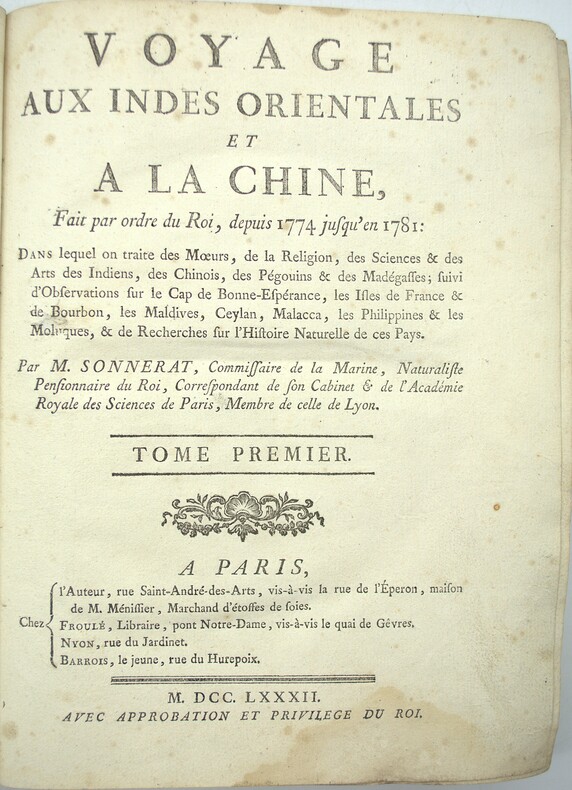
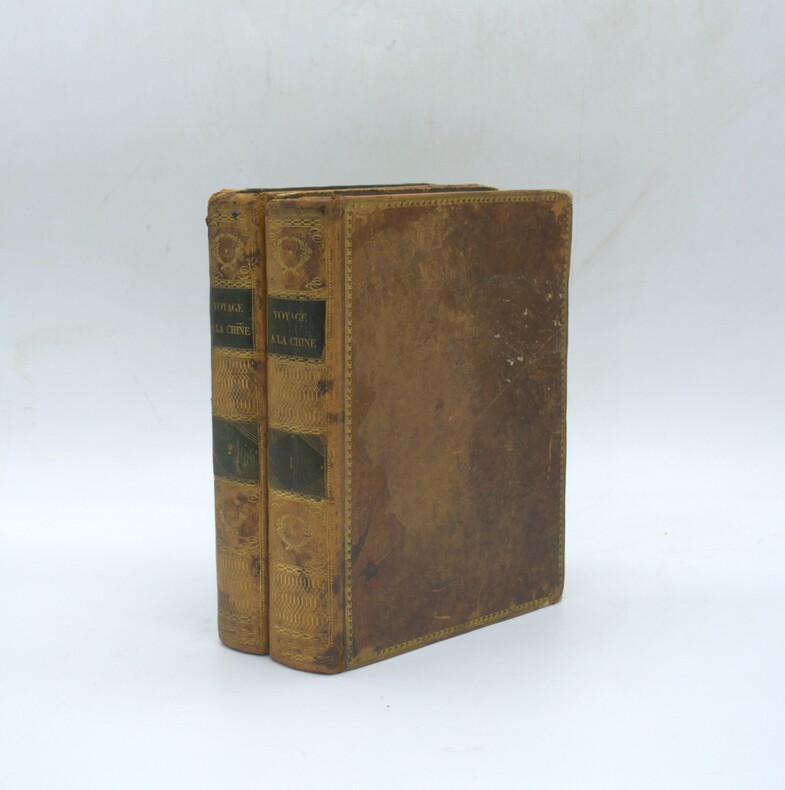
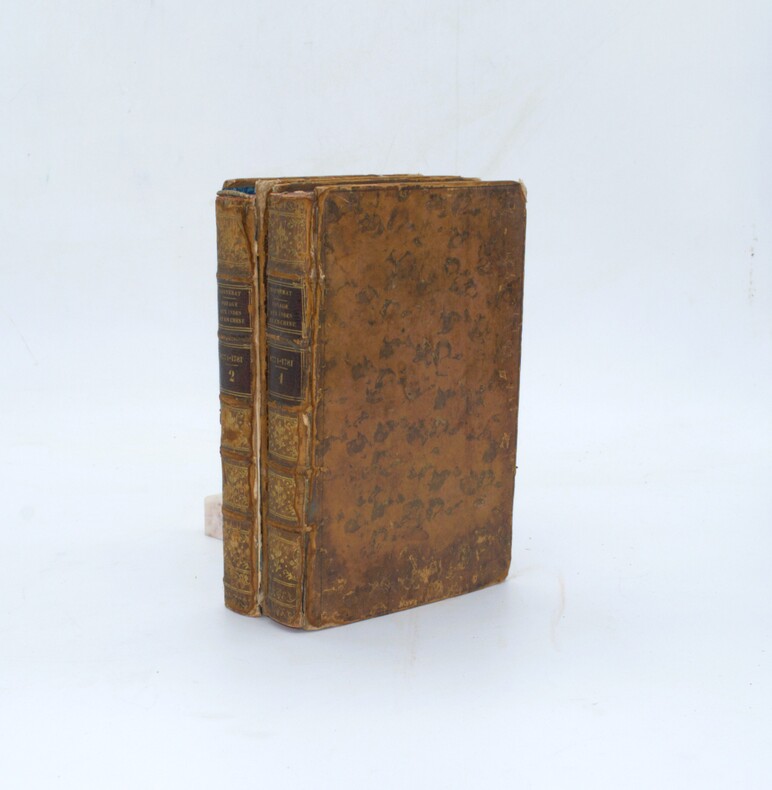
1782réf. PHO-10601782 , A Paris , Chez l'auteur & Froulé & Nyon, In-8 (150x225mm), xxij, 340pp. et (6) 376pp. et (6) 362pp.,illustré de 7 planches dépliantes gravées par Poison d’après l’auteur, relié plein veau marbré époque , dos lisse avec pièces de titre et tomaison vertes, tranches mouchetées rouges, filets sur les plats , dos frottés , coiffes et coins usés , petites rousseurs.
1782réf. PHO-2047Paris, Chez l’auteur, rue Saint André-des-Arts, Froulé, Nyon, Barrois, 1782, 1 volume in-4 (25x20cm), demi basane (19ème) dos lisse orné avec auteur, titre et tomaison en pied, XV-4ff.-317pp., 64 planches (80), frottements, début de fentes en pieds, coins et coupes usés, 4 planches déchirées, manque pages 87 à 90, 2 planches incomplètes, qlqs planches mal pliées, manque les 2 cartes, mouillure par intermittence, qlqs salissures.
1782réf. PHO-2291A Paris, chez l'Auteur, Froulé, Nyon, Barrois, 1782.- 2 volumes in-4 (26x20,5cm) de XV, (8), 317, (1) pp., 80 pl. h.t. pour le tome 1 ; VIII, 298 pp., 60 pl. h.t. pour le tome 2 ; basane époque, dos lisse orné avec pièces de titre et tomaison vertes, frises aux plats. Frottements et épidermures, début de fentes (3cm) tome 2, coins et coupes usés, vieille mouillure claire, rousseurs et brunissures, 2 feuillets détachés, page 145 déchirée sans manque.
1782réf. PHO-2465A Paris, Chez l'auteur & Froulé & Nyon, 1782, 2 volumes (sur 3) In-8 (150x215mm), xxij, 340pp. et (6) 376pp., Illustré de 2 planches (sur 9) dépliantes gravées par Poison d’après l’auteur, relié plein veau marbré époque, dos à nerfs avec pièces de titre et tomaison, dos frottés, coiffes et coins usés, plats détachés au tome 2 et fragiles au tome 1, manque page 375/376 au tome 2, manque au titre, exemplaire de travail.
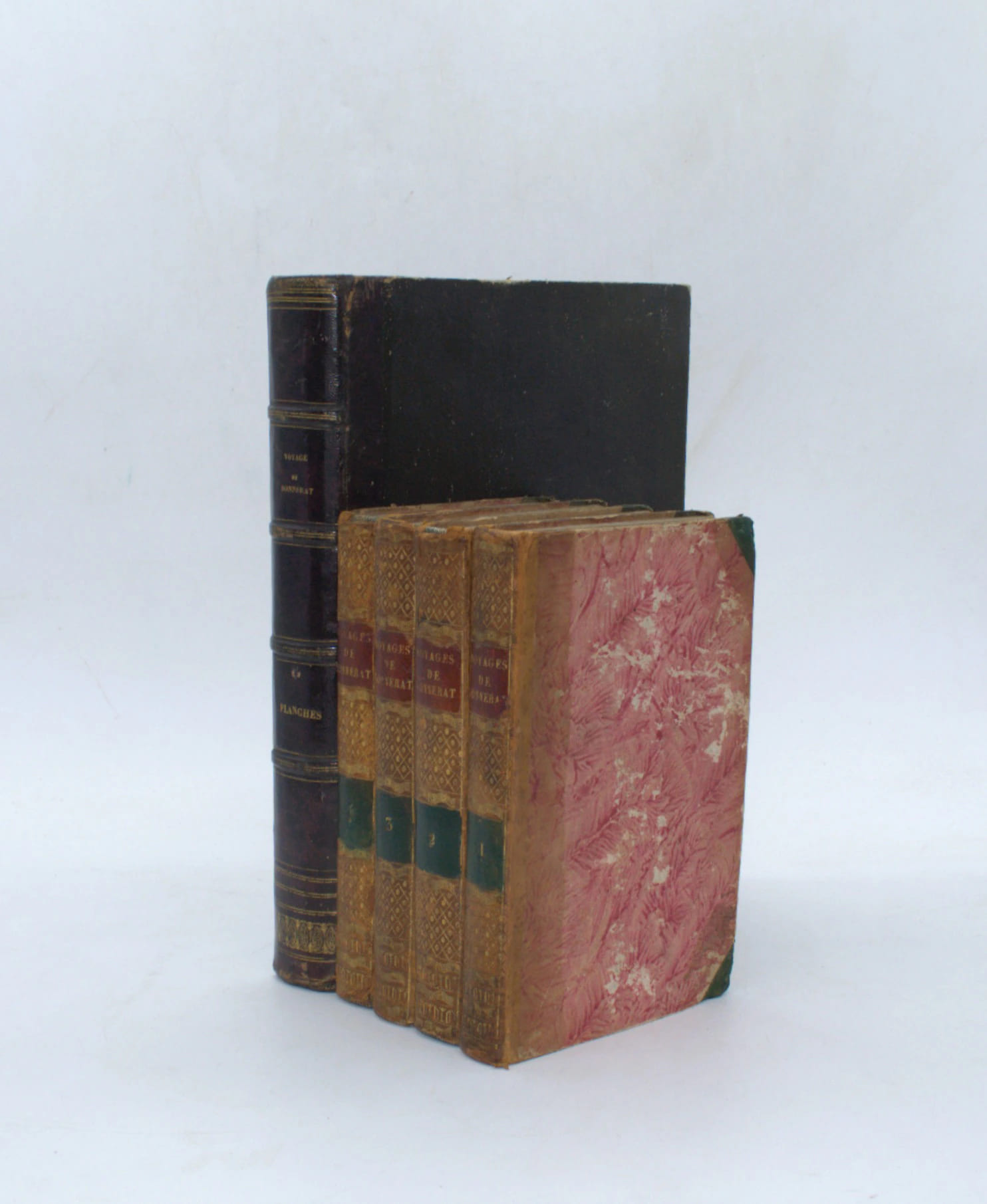
1806réf. PHO-2636Paris, Dentu, 1806. 5 Volumes, 4 volumes de texte in-8 et 1 atlas in-4. Texte : 4 vol. in-8 (20x13cm), demi reliure et coins époque, dos lisse orné avec pièces de titre rouges et de tomaison vertes, frottements, coiffes usées ou arasées. Atlas : 1 vol. in-4 (29,5x22cm), titre, liste des planches et 140 gravures, demi reliure aubergine, dos à nerfs avec titre et tomaison, quelques frottements, coins usés.
2004191 pages. Signed and inscribed by author upon title page. "Jim Soliski writes real travel. Fast-paced, punchy and often very funny, this is the man to read if you know what travel is." - from back cover. Clean and unmarked with very light wear. A nice copy. Book
réf. DADAX0313209782New unknown