888 résultats
2020réf. DBS-9781774073254Delve 2020. 1st. Hardcover. New. Delve hardcover
2026réf. LRB30002536Paris: Editions Recreasoft 2026 Idioma: Español. Aproximadamente 552 páginas. Español : Reimpresión bajo demanda. Edición original : 1886. Obra en español. Este libro es una obra fundamental sobre los aranceles y la instrucción de aduanas en Filipinas recopilando las disposiciones legales que los reforman o adicionan. Publicado originalmente en 1886 el texto ofrece un análisis detallado de las regulaciones fiscales y aduaneras de la época proporcionando una visión histórica y jurídica de gran valor para estudiosos de la administración colonial y el derecho tributario. Imágenes del libro no contractuales English: Print-on-demand reprint. Original edition : 1886. Text in Spanish. This book is a fundamental work on tariffs and customs instructions in the Philippines compiling the legal provisions that reform or add to them. Published originally in 1886 the text offers a detailed analysis of the fiscal and customs regulations of the time providing a historical and legal perspective of great value for scholars of colonial administration and tax law. Book images are non-contractual. Editions Recreasoft. Softcover. New. Editions Recreasoft paperback
Madrid, Viuda y Sucesores de Manuel Minuesa de los Rios, 1897. 4to. menor; XIX-546 pp. Cubiertas originales.
Madrid, Viuda y Sucesores de Manuel Minuesa de los Rios, 1898. 4to. menor; XIX-544 pp. Cubiertas originales.
Madrid, Librería General de Victoriano Suárez, Imprenta de la Sucesora de Manuel Minuesa de los Rios, 1905. 4to. menor; XVI-527 pp. Cubiertas originales.
M., Plus-Ultra, 1973, 28 x 21'5 cm., 655 figuras intercaladas, 449 págs. - 1 h. - VIII láminas en colores.
Madrid : Libreria General V. Suarez, 1949. 4to. mayor; 8 hojas, 88 folios numerados, 3 hs. Edición limitada y numerada de 100 ejemplares. Cubiertas originales.
(Al fin:) Madrid, Tipografía Clásica Española, 1949, 26,5 x 18,5 cm., holandesa piel de época con puntas, edición facsímil de la publicada en Manila en 1747, 1 hoja + (facsímil:) 5 hojas + 88 folios + (Apéndice por C. Bayle:) 4 hojas, la última blanca.
réf. 13976375Paris; Genève : Adam Biro; Association des Amis du Musée Barbier Muller, 1999 in-4, 197 pages, 158 illustrations couleurs, 9 ill. N/B et 5 cartes géographiques. Broché, couv. illustrée, bon état. Sommaire: Interview: Laurence Mattet, Les confidences de Douglas Newton. - Jean-Louis Zimmerman, Démosthène au Musée Barbier-Mueller. - Monika Retterath, Une statuette néolithique japonaise. - Luis Alberto Sanchez, Le crocodile mythique du Panama. - Enquête: Monique Barbier-Mueller, Un orfèvre ébrié de la Côte d'Ivoire. - Suzanne Preston Blier, Un chef d'oeuvre de la sculpture Vodun du sud Bénin. - Evènement: Petty Benitez Johannot, Le plus ancien bulul connu. - Brian Durrans, Témoignage du passé ifugao. - Georges Breguet, Un tissu des Toraja Rongkong. - Carol Ivory, Un récipient des îles Marquises. - Dossier: Jean Paul Barbier, Vraies falsifications et fausses tromperies. - Jean Paul Barbier, Confidentiellement vôtre.
1981réf. 3cb6in4 toilé sous jaquette illustrée sous rhodoïd. Abondante iconographie dont 8 planches couleurs. Texte bilingue français/anglais
réf. ria9780851991627_inpHardback. New. New Book; Fast Shipping from UK; Not signed; Not First Edition; The book provides a thorough assessment of the opportunities for increasing land productivity including crop diversification. It evaluates the successes and limitations of the Green Revolution for rice in Asia and projects economic and hardcover
1996A clean, unmarked book with a tight binding. Tears on worn dust jacket. Full gray cloth boards. 9"w 9 3/4"h. 144 pages. Many color illustrations.
2001réf. LFA-126730297Un ouvrage de 278 pages, format 160 x 240 mm, illustré, broché couverture couleurs, publié en 2001, Les Portes du Large, bon état
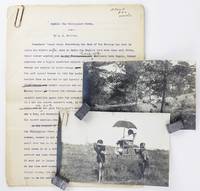
1905réf. 5191N.p. 1905. About very good. 3pp. rectos only. About 900 words. Folio. Typescript with manuscript corrections and notations. Light wear and soiling slight creasing. Together with two silver gelatin photographs. A short but interesting essay on the mountain city of Baguio. It reads a bit like a travel article or potential newspaper puff piece for tourism and has been edited by hand with manuscript notations and corrections. It opens "Somewhere 'round about Petersburg the Czar of the Russias has what he calls his winter palace; down in Indian the English have what they call Simla their summer capital and here we Americans have Baguio." The author goes on to discuss the oppression of the tropics and therefore the need for cooler cities to enable functional government discussing the needs of the "white man" for livable conditions in such a place: "In the Philippines there are some months of the year that are extraordinarily summer summer in all the sense that the word implies summer until one can't rest and do it comfortably. It is during this time that the summer capital comes in as a life-saving station for the overworked and rundown public servant and such others as care to take advantage of the rural pueblo. . drudging all year in a comparatively warm atmosphere and then to be hit with a blast that seems like a draft from the furnace of the place that has its main thoroughfare paved with good resolutions is more than the average Anglo-Saxon can stand." He continues: "Shortly after the arrival of the civil commission in the islands the Governor wasn't long in deciding.that the English were pretty wise in having their summer capitals. He also decided the Philippines must have one. It was necessary if the white man was to stay indefinitely." He describes the process of locating Baguio in the pine forests and establishing a small town there despite the lack of a road and precipitous ascent to the area: "The committee reported the climate fine incomparable just like that of the United States in late fall and that one had to sleep under heavy blankets at night to keep warm. . despite skepticism . it proved a fact and one that was a blessing. Think of the pleasure of residing in the Philippines where flies seldom bother where mosquitos as a rule are few where patent leather shoes never crack.and having a delightfully hilly resort not ninety miles away to go to when one's spleen enlarges from a languid life or the malaria attacks with unrelenting persistence." He goes on to note that it costs nearly as much to go to Baguio as it does to travel to China "so that its full benefit has not yet been felt by the more humble in life". The typescript is accompanied by two photographs of the Philippines one depicting a trail through a pine forest presumably around Baguio and the other showing a Filipino woman being carried by two Filipino men in a sedan chair. unknown
1905réf. 5191N.p. 1905. About very good. 3pp. rectos only. About 900 words. Folio. Typescript with manuscript corrections and notations. Light wear and soiling slight creasing. Together with two silver gelatin photographs. A short but interesting essay on the mountain city of Baguio. It reads a bit like a travel article or potential newspaper puff piece for tourism and has been edited by hand with manuscript notations and corrections. It opens "Somewhere 'round about Petersburg the Czar of the Russias has what he calls his winter palace; down in Indian the English have what they call Simla their summer capital and here we Americans have Baguio." The author goes on to discuss the oppression of the tropics and therefore the need for cooler cities to enable functional government discussing the needs of the "white man" for livable conditions in such a place: "In the Philippines there are some months of the year that are extraordinarily summer summer in all the sense that the word implies summer until one can't rest and do it comfortably. It is during this time that the summer capital comes in as a life-saving station for the overworked and rundown public servant and such others as care to take advantage of the rural pueblo. . drudging all year in a comparatively warm atmosphere and then to be hit with a blast that seems like a draft from the furnace of the place that has its main thoroughfare paved with good resolutions is more than the average Anglo-Saxon can stand." He continues: "Shortly after the arrival of the civil commission in the islands the Governor wasn't long in deciding.that the English were pretty wise in having their summer capitals. He also decided the Philippines must have one. It was necessary if the white man was to stay indefinitely." He describes the process of locating Baguio in the pine forests and establishing a small town there despite the lack of a road and precipitous ascent to the area: "The committee reported the climate fine incomparable just like that of the United States in late fall and that one had to sleep under heavy blankets at night to keep warm. . despite skepticism . it proved a fact and one that was a blessing. Think of the pleasure of residing in the Philippines where flies seldom bother where mosquitos as a rule are few where patent leather shoes never crack.and having a delightfully hilly resort not ninety miles away to go to when one's spleen enlarges from a languid life or the malaria attacks with unrelenting persistence." He goes on to note that it costs nearly as much to go to Baguio as it does to travel to China "so that its full benefit has not yet been felt by the more humble in life". The typescript is accompanied by two photographs of the Philippines one depicting a trail through a pine forest presumably around Baguio and the other showing a Filipino woman being carried by two Filipino men in a sedan chair. unknown books
B., Juventud, 1943, 17 x 12'5 cm., 318 págs. - 1 h.
2021réf. DBS-9781774077924ARCLER PRESS 2021. 1ST. Hardcover. New. ARCLER PRESS hardcover
2021réf. DBS-9781774077924ARCLER PRESS 2021. 1ST. Hardcover. New. ARCLER PRESS hardcover
2021réf. AME_9781774077924ARCLER PRESS 2021. UNKNOWN. Hardcover. New/New. _ ARCLER PRESS hardcover
19448vo., Second Impression, with endpaper maps; olive cloth, backstrip lettered in brown, a very good, bright, clean copy in price-clipped, lightly age-soiled dustwrapper. SCARCE IN THE DUSTWRAPPER. Enser, p.55 (recording the first edition).
Valencia, Editorial Castalia, 1957. 4to. mayor; 99 pp., 5 hs. Ilustraciones. Cubiertas originales.
The standard (and dare I say the only) bibliography in the field. 2405 items described. Fully indexed. Printed on good paper. Edition limited to 2,000 numbered copies. 4to. Original wraps. Fine.
réf. 3750Madrid, P. Vindel, Librero-Anticuario, MCMXI (1911). 1 volume in-12, 436+251 pp., half-leather new binding, with cloth-boards, Illustrated with 14 fold out facsimiles and some drawings. Text in Spanish. Paper is toned, cover page of Tome I has been restored and is brittle, inside pages are clean but yellowed by time, a good copy.
1974réf. 21182Paris Maisonneuve & Larose 1974 1 vol. relié fort in-8, toile éditeur, VI-424-XX+737+127 pp. 5267 numéros décrits (avec une table des prix in-fine) constituant une précieuse bibliographie sur l'Amérique et les Philippines. Excellent état.