[Philippines]. [Promotionals]Biblio.com
837 risultati
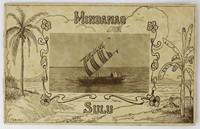
1905rif. 5045Manila: Sugar News Press 1905. Very good. 22pp. Illustrated. Oblong quarto. Original pictorial wrappers stapled. Moderate dust-soiling and edge wear. Light even toning to text. An early and seemingly-unrecorded promotional touting the people and scenery in Mindanao and Sulu in the southern Philippines in the first decade of the 20th century. The work opens with a Foreword detailing the positive aspects of Mindanao particularly its principal city described here as the "Metropolis of Mindanao and Sulu" with "a population of more than thirty thousand a mixture of Moros or Mohammedan Filipinos Christian Filipinos Chinese Japanese and Europeans." Following the Foreword the remainder of the work is mostly comprised of thirty-four duotone photographic prints printed mostly two per page but occasionally with from one to five per page. The photographs feature numerous scenic and street views in and around Zamboanga including various "Moro houses" and about fifteen portraits of indigenous Filipinos such as a "Moro woman weaving materials for head-turbans and sarongs" a view inside a "weaving school" "Yakan Moros on the island of Basilan" "Muhammad Jamallul Sultan of Sulu" "Joloano Warriors" "Moro Kulintang" and their musical instruments Bogobo and Cotabato warriors "Bajaos - the sea gypsies of Sulu" and "Bogobo musicians." The final two pages of the work are taken up with two poems -- the first is a traditional Filipino poem entitled "No Te Vayas" noted as "Zamboanga's 'Auld Lang Syne" and one titled simply "Zamboanga" by Susan Hart Dyer. The front cover is decorated with a central photograph of an indigenous sailing vessel surrounded by an illustrated beach scene signed at bottom left "Jh. Mendoza." The inside front cover contains an illustration of the Philippine Islands from Batanes down to Sulu. We could locate no other copies of the work by title and imprint information in OCLC. Sugar News Press unknown
1945A clean, unmarked book with a tight binding. 7 1/2"w x 10 1/4"h. 62 pages. Sepia illustrations.
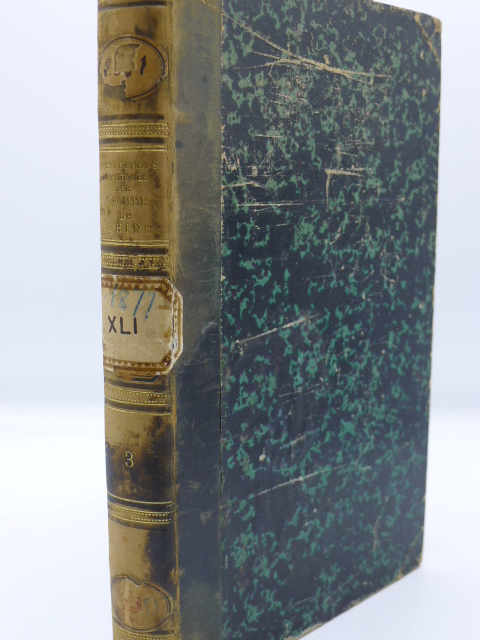
rif. 13403Paris, Imprimerie Nationale, MDCCLXXVII (1877). 1 volume in-8, demi- basane, plats cartonnés marbrés, dos frotté et insolé, 387 pp, bon état. Cachets du Ministère de la Marine et des Colonies.
rif. 6952Paris, Imprimerie Nationale, MDCCLXXVII (1877). 1 volume in-8, demi- basane, plats cartonnés marbrés, dos frotté et insolé, 387 pp, bon état. Cachets du Ministère de la Marine et des Colonies.
19128vo., First Edition thus, with frontispiece (original tissue guard present) and numerous illustrations; original red cloth, gilt back, a remarkably well-preserved, bright, crisp, clean copy. The US edition was published in the previous year. SCARCE IN THIS CONDITION
Madrid, Imprenta y Fundición de Don Eusebio Aguado, 1846. 4to.; 7 hs., 320 pp. y una lámina dibujada y grabada por C. Acquisti. Encuadernación de la época en media piel. La obra, dedicada a la Provincia del Santísimo Rosario de Filipinas, contiene interesantes noticias de todos los dominicos españoles que de Filipinas pasaron a Tonkín.
Madrid, Imprenta del Cuerpo de Artillería, 1892 (y) 1893. Veintitres tomos en 4to.; 864 pp. en paginación continuada y 31 láminas, la mayoría plegadas + 512 pp, en paginación continúada, y 23 láminas, la mayoría plegadas + 815 pp., en paginación continuada, y 23 láminas, la mayoría plegadas + 782 pp., en paginación continúada, y 18 láminas, la mayoría plegadas. Cubiertas originales. Contiene, entre otros textos, la continuación y conclusión del extenso "Nuestro Cuerpo en la Oceanía" de Francisco J. de Moya y Antonio Menacho, "Artillería de costa. Buques de combate" de Francisco Cerón y Cuervo, y las singulares biografías contenidas en la "Lista por órden alfabético de los muertos el 2 de Mayo de 1808 en Madrid" de Juan Pérez de Guzmán.
Madrid, Imprenta del Cuerpo de Artillería, 1890. Once volúmenes en 4to.; pp. 97 a 688, en paginación continúada, y 18 láminas, la mayoría plegadas + 800 pp. en paginación continúada, y 33 láminas, la mayoría plegadas. Cubiertas originales. Contiene, entre otros textos, "Biografía del General de división Don Felipe Alverico y Vivanco" de Tomás de Reina y Reina, "El antiguo Brigadier de Artillería Don José Guerrero de Torres" de Antonio Remón y Zarco del Valle, "La defensa del Pirineo y la artillería de plaza" de José Milán, y "La calle de Temprado en Teruel" de Ricardo Pascual de Quinto.
Madrid, Imprenta del Cuerpo de Artillería, 1894. Doce volúmenes en 4to.; 640 pp. en paginación continuada y 19 láminas, la mayoría plegadas + 688 pp, en paginación continúada, y 19 láminas, la mayoría plegadas. Cubiertas originales. Contiene, entre otros textos, "Monografía político-militar de Mindanao" de Francisco J. de Moya, "La Fábrica de Trubia" de Salvador Diaz Ordoñez, "Sitios de Gerona en 1808" de Manuel Cabanyes, "Los Peñones de Vélez de la Gomera y Alhucemas" y "Las Islas Chafarinas" de Francisco J. de Moya .
Madrid, Imprenta del Cuerpo de Artillería, 1895. Doce volúmenes en 4to.; 704 pp. en paginación continuada y 29 láminas, la mayoría plegadas + 688 pp, en paginación continúada, y 17 láminas, la mayoría plegadas. Cubiertas originales. Contiene, entre otros textos, "Monografía político-militar de Mindanao", "Consideraciones militares sobre la campaña de Cuba" y "Archipiélago de Fernando Poo" de Francisco J. de Moya, "Empleo de la artillería en la campaña de Cuba" y "El pequeño material de artillería para la campaña de Cuba" de de Gabriel Vidal y Ruby, " El 11º Batallón de Artillería de plaza y su marcha a Cuba de Francisco F. de la Puente, y "Apuntes sobre la defensa de la bahía de Algeciras" de Salvador Ordoñez
Madrid, Simón y Osler, 1882, 19,5 x 14 cm., holandesa piel de época, XL + 445 págs. + 1 hoja + 1 mapa plegado en colores.
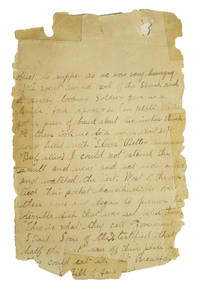
1902rif. 311327np 1902. 5-67 manuscript pages on the rectos of unbound sheets. 8 x 5 inches. Lacking the first 4 leaves and an indeterminate number at end several leaves quite worn each crudely taped or pasted to modern paper and then crudely cropped at the top edge without loss of text. 5-67 manuscript pages on the rectos of unbound sheets. 8 x 5 inches. This account consists of pages five to sixty-seven of what appears to be a diary or copied letters of an unnamed soldier in the 21st United States Infantry. The author who may have been a corporal remains unidentified by name. The account begins in August 1898 at Camp Hobson Lithia Springs GA; in September he is transferred to Plattsburgh NY rejoining the bulk of his regiment which had suffered heavy losses in Cuba. The Philippine-American war ran from February 1899 to July 1902 and was regarded as a continuation of a war for independence by the Philippines and as an insurrection by the United States of America. This account spans the duration of it providing rich detail on topics ranging from food to the war-ravaged environment and American-Philippino interactions both on and off the battlefield. An epic train ride across the country and then a boat from San Francisco brought the 21st US Infantry to Manila on 11 May 1899 in the fourth month of the conflict. The author mentions shipboard conditions an engine breaking down and comments "We caught 4 sharks in our trip. The largest was 12 feet long and took the whole crowd to land him aboard. the men used the bones for rings and pen holders and in fact every thing you could think." Their first combat was the capture of an insurgent outpost at Guadaloupa Ridge on 9 June 1899 where they "joined General Lauter's Flying Column . with eight chinamen to carry our rations." The description of this combat and its aftermath pages 33-41 is the most dramatic passage in the memoir. The writer was sent with another soldier to gather up some supplies that had been left behind but they were separated from the regiment with no food or water. They made a makeshift fort from some old haversacks and brush when they were unable to return to the trenches that night. The author describes scavenging after battle as follows: "About 10:00 oclock there was several chinamen came looking around and picking up what-ever they seen. They came to close to us to suit me and we shot 4 and the rest ran away." Going out in search of water at about four in the morning despite ongoing fire the author found several dead and mortally wounded soldiers from a black regiment including a graphic description of one man who had been shot at close range and had a hole the size of a fist in his belly and was covered in blood. Of the only survivor the author says: "Found one poor cuss shot through the hip. He could not move. I gave him some hard tack and he gave me water then I went back to our haversacks." Another disoriented soldier whom the author names as H. McBain was found wandering without most of his clothing brandishing a bottle of wine and an axe. After waiting until the 11th for a reclamation detail the author and his companion crawled through the brush for a mile to San Peter McCarty and eventually rejoined their regiment at Los Penes where their captain threatened to have them court-martialed for losing their haversacks. Later while hospitalized the author was befriended by Señora Edna Luna cousin of an insurgent general who took him out riding daily: "She was stuck on me and that is no lie. I think I ought to go back and hook up with her as she has all that is required. She is hansome & plenty of money" page 45. The author -- first too ill to be moved then put in a wheel chair and with trouble with his vision -- was transferred back to the States on 15 May 1900 page 48 by way of Nagasaki May 21 1900 and Yokohama arrived in San Francisco on June 9 1900 then was sent to recover at Hot Springs Arkansas concluding in Vancouver Barracks Washington circa July 1901. Some of the pages are torn and some text is lost at the bottom edges due to wear but the handwriting is clear and the voice of the author shines through. This narrative though it took place before World War One reads more akin to a Vietnam War narrative than a Civil War diary in tone and disregard for authority and the morality of war. unknown books
1902rif. 311327np 1902. 5-67 manuscript pages on the rectos of unbound sheets. 8 x 5 inches. Lacking the first 4 leaves and an indeterminate number at end several leaves quite worn each crudely taped or pasted to modern paper and then crudely cropped at the top edge without loss of text. 5-67 manuscript pages on the rectos of unbound sheets. 8 x 5 inches. This account consists of pages five to sixty-seven of what appears to be a diary or copied letters of an unnamed soldier in the 21st United States Infantry. The author who may have been a corporal remains unidentified by name. The account begins in August 1898 at Camp Hobson Lithia Springs GA; in September he is transferred to Plattsburgh NY rejoining the bulk of his regiment which had suffered heavy losses in Cuba. The Philippine-American war ran from February 1899 to July 1902 and was regarded as a continuation of a war for independence by the Philippines and as an insurrection by the United States of America. This account spans the duration of it providing rich detail on topics ranging from food to the war-ravaged environment and American-Philippino interactions both on and off the battlefield. An epic train ride across the country and then a boat from San Francisco brought the 21st US Infantry to Manila on 11 May 1899 in the fourth month of the conflict. The author mentions shipboard conditions an engine breaking down and comments "We caught 4 sharks in our trip. The largest was 12 feet long and took the whole crowd to land him aboard. the men used the bones for rings and pen holders and in fact every thing you could think." Their first combat was the capture of an insurgent outpost at Guadaloupa Ridge on 9 June 1899 where they "joined General Lauter's Flying Column . with eight chinamen to carry our rations." The description of this combat and its aftermath pages 33-41 is the most dramatic passage in the memoir. The writer was sent with another soldier to gather up some supplies that had been left behind but they were separated from the regiment with no food or water. They made a makeshift fort from some old haversacks and brush when they were unable to return to the trenches that night. The author describes scavenging after battle as follows: "About 10:00 oclock there was several chinamen came looking around and picking up what-ever they seen. They came to close to us to suit me and we shot 4 and the rest ran away." Going out in search of water at about four in the morning despite ongoing fire the author found several dead and mortally wounded soldiers from a black regiment including a graphic description of one man who had been shot at close range and had a hole the size of a fist in his belly and was covered in blood. Of the only survivor the author says: "Found one poor cuss shot through the hip. He could not move. I gave him some hard tack and he gave me water then I went back to our haversacks." Another disoriented soldier whom the author names as H. McBain was found wandering without most of his clothing brandishing a bottle of wine and an axe. After waiting until the 11th for a reclamation detail the author and his companion crawled through the brush for a mile to San Peter McCarty and eventually rejoined their regiment at Los Penes where their captain threatened to have them court-martialed for losing their haversacks. Later while hospitalized the author was befriended by Señora Edna Luna cousin of an insurgent general who took him out riding daily: "She was stuck on me and that is no lie. I think I ought to go back and hook up with her as she has all that is required. She is hansome & plenty of money" page 45. The author -- first too ill to be moved then put in a wheel chair and with trouble with his vision -- was transferred back to the States on 15 May 1900 page 48 by way of Nagasaki May 21 1900 and Yokohama arrived in San Francisco on June 9 1900 then was sent to recover at Hot Springs Arkansas concluding in Vancouver Barracks Washington circa July 1901. Some of the pages are torn and some text is lost at the bottom edges due to wear but the handwriting is clear and the voice of the author shines through. This narrative though it took place before World War One reads more akin to a Vietnam War narrative than a Civil War diary in tone and disregard for authority and the morality of war. unknown
1944rif. 26768Paris, Les Editions de la Nouvelle France, 1944. Un vol. au format gd in-12 (195 x 148 mm) de 260 pp. Reliure de l'époque de demi-basane glacée émeraude, dos à nerfs orné de filets gras à froid, titre doré, premier plat de couverture conservé.
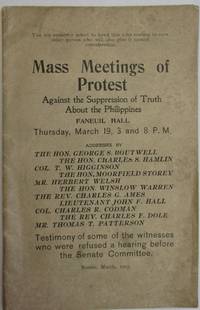
1903rif. 37755Boston 1903. Original printed wrappers with wrapper title as issued and original staples. At head of title: "You are earnestly asked to hand this after reading to some other person who will also give it careful consideration." Rear wrapper repeats the first sentence of the title. 56 pages. Wrappers lightly dusted else Fine. An anti-imperialist protest against American efforts to "to conquer a foreign nation and to impose our sway upon it against its will. We are departing from the principles upon which our government is founded and which we have always held to be self-evident truths." The Philippine conflict was a guerilla war of unbridled brutality instigated by the American decision to become a Pacific power. unknown books
2021rif. DBS-9781774077061Society Publishing 2021. 1st. Hardcover. New. Society Publishing hardcover
2021rif. DBS-9781774077061Society Publishing 2021. 1st. Hardcover. New. Society Publishing hardcover
2020rif. DBS-9781774071489Society Publishing 2020. 1st. Hardcover. New. Society Publishing hardcover
2020rif. DBS-9781774071489Society Publishing 2020. 1st. Hardcover. New. Society Publishing hardcover
1999rif. 3016z1999. Hardcover. Good. Hardcover/pub. 1999/Gd. condition/427 pages - A parade of Food. Recipes from around the Islands.H23016z hardcover
2020rif. DBS-9781774072134Society Publishing 2020. 1st. Soft Cover. New. Society Publishing paperback
2020rif. DBS-9781774072134Society Publishing 2020. 1st. Soft Cover. New. Society Publishing paperback
2020rif. AME_9781774072134Society Publishing 2020. UNKNOWN. Soft Cover. New/New. Society Publishing paperback
2020rif. DBS-9781774072158Delve 2020. 1ST. Hardcover. New. Delve hardcover
2020rif. DBS-9781774072158Delve 2020. 1ST. Hardcover. New. Delve hardcover