755 résultats
1983réf. 2091502135413933Research Institute of Publishing 1983. Soft Cover. Fine. Volume: 11 Research Institute of Publishing paperback
réf. 27011701Seoul n.d. ca 1900-1930's.Brown blind-stamp embossed album 34 x 26.5 cm. black pages most are collo-type photos some are hand-colored others are later glossy types all by and large clean all corner mounted in period album. RARE NICE! The album contains 23 pages in all each page with 3 or 4 average per page total postcard count is 76 in all. BEGINNING PAGE: The beginning page shows a "Korean District Governor at out" the a "Bird's-eye view of Seoul" which is a very RARE double photo postcard 2 attached. Then a "View of Seoul City." 1st. page: Begins with a picture of the King's ancient carriage Koka Gate of Shotoku Palace Throne Room and a Korean family of middle class. 2nd. page: Kokamon Seoul Nandimon 3 different photos two with an electric trolley. 3rd. page: The mourning dress man Full dresses two women: Keenan A student 4th. page: Choson Hotel Sin Song guide Game of checkers and three lower class women. 5th. page: The home dress of the Corean gentlemen another gentleman Keenan. 6th. 2 photos of Keenan girls. 7th. The lady going out on carriage. Buffalo vendor fishers house. 8th. The Pagoda Park Seoul 2 each Seoul Korea in Soul. The East Great Gate. 9th. Porters of water a Idol and a carrier Imperial musicians. 10th. Washing clothes in the river 2 each harvest of wheat Corean children collecting Hay. 11th. The front of Custom House Chemulpo Port of Chemulpo. 12th. Street in Seoul Nagate Dori Street of Fusan Corean cottages called Ondoru the middle below this house Chosan. 13th. Suckka Tower Grave of the Monmoo King Buddha statues. 14th. Bool Kuk Temple 2 each Grove of the domestic fowl stone pond. 15th. Chosen hotel Keijo Temple of Heaven in Choson hotel. Boy's school at Chinnampo Methodist Episcopal Mission The Old Korea news agency Korea Government building. The above are all old collotype photos probably from 1900-1915 period some hand-tinted. Next begins other photo postcards probably from the 1930's most are b.w. some color we state "color" in that case. . 16 th. Korean man smoking pipe women looking at a pond Keenan Upper class Korean gentleman. 17th. Royal Assembly Hall Ferry crossing the river Fusan Station color Capitol building. 18 th. White Buddha temple Royal Assembly Hall shows 2 girls. 19 th. City wall and gate Pyong Yang with long penned inscription Korean women weaving and spinning basket seller. 20 th. Water-wheel a firewood carrier carriers of timber. 21 st. Young porter beggar boy. Ferry below the Han River Labor of Corea. 22. nd. 4 color cards: Government of Korea two Keenan girls on the pond Sedan chair Main street Fusan a rendering not a photo card. The collection is superb with great examples of Korean-types people in native costume at daily chores and the sights of Korea its old buildings temples waterways and the like. A keen insight to the land people customs of old Korea and the Japanese administration period. CAPTIONS: Some captions are in English others in Japanese Hangul or Korean. . unknown
réf. PE29Oblong Quarto album ca. 268x364 cm. 30 card stock leaves. With ca. 215 mounted original gelatin silver photographs from ca. 87x144 cm 3 ½ x 5 ¾ in to ca. 69x67 cm 2 ¾ x 2 ½ in five real photo postcards ca. 108x139 cm 4 ¼ x 5 ½ in and six printed postcards ca. 137x87 cm 5 ½ x 3 ½ in. Most photos with period white pencil captions in French on the mounts at least seven photos including one real photo postcard with captions in negatives. Full ornamented cloth album fastened with a string. Several photos with mild silvering but otherwise a very good album with strong interesting photographs. Historically interesting album of lively vernacular photographs apparently taken by a French resident of Canada during his trans-Pacific voyage from Vancouver to the Orient in the late 1934 and early 1935. The compiler and his travel companions left Vancouver aboard the “RMS Empress of Canada” and sailed to Hong Kong with a stopover in Saigon Vietnam. From there they traveled overland to Beijing and Seoul and then continued to Japan visiting Kyoto and Nikko. On the return journey they stopped in Honolulu and New York. The album contains 215 well executed photographs from the voyage and opens with over sixty images of Saigon showing rare views of the first tea factory in the East-South Asia the Bank of Vietnam and candid street scenes of native huts boutiques and restaurants. Especially interesting is a striking image of half-naked ethnic locals sitting on the ground beside a bicycle and posing for the camera. The other photos from the region capture topographical views riverside fishing gear on the Huong River and snapshots of the compiler and his companions throughout their journey by cars in canoes along the Mekong River etc. Among twenty-five photographs of Hong Kong a standout image illustrates a bustling street scene filled with residents in traditional attire shopfronts with Chinese signs and flags of the Wang Jingwei regime flying alongside the British Union Jack. The rest of the images show the city’s port waterfront glowing night views and moments of the travel group golfing. In Beijing the focus shifts to historical landmarks documenting the Summer Palace Nine Dragon Screen Ming Tombs Temple and Altar of Heaven and the iconic Chinese guardian lions. A dozen photographs of the Great Wall offer a rare glimpse of life along its slopes with locals carrying goods in baskets and leading donkeys through the rugged terrain. The Japanese portion of the journey includes evocative views of Kyoto’s Chion-in Temple the historic Yaami Hotel and a Buddhist temple with a monk standing solemnly at the gate. The group also visited Nikko capturing sites such as the Toshogu Shrine the ornate Yomeimon Gate a stone basin and tranquil views of Lake Chuzenji. The album closes with about forty photos of Seoul Temple of Heaven Honolulu views of the waterfront photos on deck and Arizona Grand Canyon. Overall historically interesting album of lively vernacular photographs apparently taken by a French resident of Canada during his trans-Pacific voyage from Vancouver to the Orient in the late 1934 and early 1935. hardcover
1970réf. 2091502135708598Institute of Ethnic Culture Korea University 1970. Soft Cover. Fine. The book is in fine condition. Institute of Ethnic Culture, Korea University paperback
1992réf. 2110502151005369Kokusho Publishing Association 1992. Soft Cover. Fine. Number of books: 5 Kokusho Publishing Association paperback
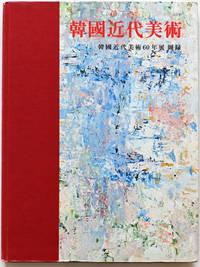
réf. MKF-BOOK-002AModern Korean Art: 60 Years Exhibition Catalogue – First Edition 1973 An illustrated first-edition publication documenting sixty years of modern Korean art published in 1973 by Kwangmyong Publishing Company and edited by the National Museum of Modern Art Korea. This historically significant volume presents an overview of the development of Korean modern art featuring artists including Ko Hui-dong and Chun Kyung-ja. It offers a valuable visual and documentary record of Korea's artistic development during the twentieth century. Published in Korea in 1973 the book is of particular interest to collectors of Korean art art historians researchers museums and institutions building collections of East Asian art and exhibition publications. Bibliographic Details Title: Modern Korean Art: 60 Years Exhibition Catalogue Publication Year: 1973 Publisher: Kwangmyong Publishing Company Korea Editor: National Museum of Modern Art Korea Edition: First Edition Language: Korean Condition: Near Mint with excellent overall preservation for its age. Please examine all photographs carefully as they form part of the condition description. The actual book shown in the photographs will be shipped from South Korea with protective packaging and tracking. Kwangmyong Publishing Company hardcover
réf. 162576N.p.: N.p. 1974. Collection of eleven vintage borderless black-and-white photographs of rock pop and jazz musicians performing circa 1973 taken by noted French photographer Claude Gassian. With Gassian's stamp on the verso of every photograph. Collection includes two photographs of Alice Cooper one photograph of J.J. Cale one photograph of Chick Corea Stanley Clarke and Al Di Meola Return to Forever one photograph of Carla Bley at an electric keyboard two photographs of Bryan Ferry with Roxy Music one photograph of John McLaughlin and Jean-Luc Ponty Mahavishnu Orchestra one photograph of Alvin Lee with Ten Years After and one photograph of Tom Johnston Jeff "Skunk" Baxter and Patrick Simmons The Doobie Brothers. Born in Paris in 1949 Claude Gassian began his career in the 1970s capturing numerous iconic images of rock-and-roll musicians throughout that decade. His work has been the subject of several exhibitions and has been featured in several photography books including "Rock Images" 1990 and "Claude Gassian photographies 1970-2001" 2001. 9.5 x 7 inches. Very Good to Near Fine some with light edgewear and faint aging to the emulsion. N.p. unknown
1932réf. 2091502135403752Not Available 1932. Soft Cover. Fine. Volume: 37 Not Available paperback
1984réf. 2091502135421260Korea Seongsa 1984. Soft Cover. Fine. Volume: 11 (Korea) Seongsa paperback
réf. Z1-F-048-01076Springer Verlag. Used - Good. Ships from UK in 48 hours or less usually same day. Your purchase helps support Sri Lankan Children's Charity 'The Rainbow Centre'. Ex-library so some stamps and wear but in good overall condition. 100% money back guarantee. We are a world class secondhand bookstore based in Hertfordshire United Kingdom and specialize in high quality textbooks across an enormous variety of subjects. We aim to provide a vast range of textbooks rare and collectible books at a great price. Our donations to The Rainbow Centre have helped provide an education and a safe haven to hundreds of children who live in appalling conditions. We provide a 100% money back guarantee and are dedicated to providing our customers with the highest standards of service in the bookselling industry. Springer Verlag unknown
1937réf. 2091502135421511Not Available 1937. Soft Cover. Fine. Volume: 11 Not Available paperback
1918réf. 2091502135420922Not Available 1918. Soft Cover. Fine. Number of books: 2 Not Available paperback
1911réf. 2092902138301906Not Available 1911. Soft Cover. Fine. Number of pages: 8242p Size: 23cm Not Available paperback
1939réf. 2091502135500430Geumgangsan Electric Railway Co. Cheolwon-gun Gangwon-do Korea 1939. Soft Cover. Fine. Number of pages: Many photographs 181 text pages Size: 19 x 26 cm Geumgangsan Electric Railway Co., Cheolwon-gun, Gangwon-do, Korea paperback
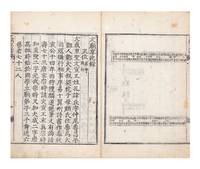
réf. 9430Four leaves of illus. 30 folding leaves. Large 8vo 305 x 208 mm. orig. yellow semi-stiff wrappers upper wrappers somewhat soiled both wrappers with some worming new stitching. Korea: 1765. First edition of this book published on royal command by King YÅngjo of ChosÅn. The book was compiled by Kim Kwi-ju 金龜柱 1740-86 the older brother of Queen Consort ChÅngsun 1745-1805. The royal Preface is furthermore written in Kim’s standard script calligraphy. Years after the compilation of this book factional intrigue under YÅngjo’s successor ChÅngjo led to Kim being exiled after which he soon died. Our book outlines sacrifices at the Confucian temple in Seoul including the KyesÅng å•“è–ç¥ and SongjÅl 崇節祠 shrines. The KyesÅng shrine built in 1669 was the site of sacrifices to the fathers of several Confucian sages including Confucius and Mencius. At the temple as a whole a number of Chinese and Korean Confucian sages and worthies were worshipped. The book contains illustrations outlining the layout of the shrines with the placement of the tablets for the various Confucian scholars marked with their names. The royal Preface is dated 1765. Ordering the compilation of a record of past exemplars apparently made the king reflect on his own character and actions. He wrote “when I with my shallow learning recite the writings of the sages and worthies but remain unable to learn the Way of the sages and worthies and when I admire the deeds of the sages and worthies but cannot act in their manner it is like knowing what something tastes like but not get to eat it or like knowing the road but being unable to follow it. Even though I might laugh at people of the past why would people of the future not laugh at me too” Minor worming mostly marginal towards end. See WorldCat 855527023 for a digital copy. unknown
1973réf. 2092902141600506Masterpiece publication 1973. Soft Cover. Fine. Size: 42.3x30.8 cm Number of books: 15 Masterpiece publication paperback
1968réf. 2081402109800259Not Available 1968. Soft Cover. Fine. Volume: 13 Not Available paperback
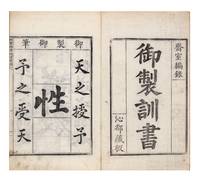
réf. 942941 folding leaves. Large 8vo 337 x 206 mm. orig. semi-stiff wrappers new stitching. Korea: Simdo æ²éƒ½ 1756. First edition and rare; WorldCat lists only one printed copy at Berkeley. This book of exhortations on good government with striking royal calligraphy was written by King YÅngjo or Yeongjo of ChosÅn 1694-1776 in 1756. At this time YÅngjo was commemorating the death of his father the previous king. According to Fang Chaoying 1908-85 YÅngjo then in his 65th year “could not foresee that he was to live twenty more years and so it appears that he was trying to justify himself in his own mind with regard to posterity as well as to the ancestors whom he expected to face any day” The Asami Library 115. YÅngjo offered three main principles for a king to follow: “to venerate Heaven to love the people and to treat the officials with respect” ibid. Large standard script characters written by the king himself are reproduced in the beginning of the book. The king’s brush records Confucian assertions such as “the following of human nature is called the Way / the cultivation of the Way is called instruction.” Accepting the Mencian dictum that human nature is inherently good the king continues: “I possess the good human nature / to realize the bright mandate of Heaven.” The main text of the book is reproduced in the handwriting of the important scholar-official SÅ MyÅng-ŭng or Seo Myeong-eung å¾å‘½è†º 1716-87. SÅ wrote in many genres and had a cosmopolitan outlook. For example he wrote a Preface to one of the major multilingual lexicographical works produced in ChosÅn in the 18th century see Söderblom Saarela “Mandarin over Manchu” 379-80. Very fine and fresh copy beautifully printed. References Fang Chaoying. The Asami Library: A Descriptive Catalog. Edited by Elizabeth Huff. Berkeley: University of California Press 1969. Söderblom Saarela Mårten. “Mandarin over Manchu: Court-Sponsored Qing Lexicography and Its Subversion in Korea and Japan.” Harvard Journal of Asiatic Studies 77.2 2017. unknown
1797réf. 111991797. Woodblock-printed. 4 1 16 39; 40 33 2 folding leaves. Three kwÅn in two volumes. Small folio 341 x 216 mm. orig. semi-stiff patterned wrappers handwritten title on upper covers old stitching. HansÅng: Chujaso Preface dated 1797. Very rare Korean collection of community rituals K. hyangnye 鄉禮 compiled by and printed for the King of Korea. We find no copy in Korea and only three copies in WorldCat Berkeley Columbia and Harvard. The reign of King ChÅngjo of Korea r. 1776-1800 witnessed a shift in the sovereign’s role in relation to Confucian teachings. “ChÅngjo sought to formulate the sage-king as an active ruler who instructed his ministers rather than received instruction from them was directly involved in the administration of the state and exercised discretion when and how he in his sagely wisdom deemed fit.”–Christopher Lovins King ChÅngjo SUNY: 2019 p. 29. As the guardian and propagator of Confucian learning he oversaw various editorial and printing projects carried out by the royal publishing house the Chujaso 鑄字所. The compilation and publication of the Collected Community Rituals reflected King ChÅngjo’s belief that a king’s ritual transformation of his people must begin at the local level. The Collected Community Rituals opens with the royal edict dated 1797 followed by a list of community ritual records compiled throughout Chinese and Korean history. The bulk of the work is devoted to the rituals of the banquet and archery competitions followed by coming-of-age K. kwanrye 冠禮 and marriage rituals. Detailed interlinear commentaries were compiled by scholars of the Kyujanggak 奎章閣 the Royal Library of the Korean court under the leadership of Yi PyÅng-mo 1742-1806. Their names are listed at the end of volume two. The original printing used the chÅngyuja ä¸é…‰å— kabinja style of movable metal type of 1777 and copies were distributed to localities throughout Korea. They were also sent to regional governmental printing houses where they were cannibalized to produce woodblocks for further printing. Nice set preserved in a jil. Our copy also has prayers for ancestral mountain and land deities as well as instructions for offering rites all handwritten in black ink on the endpapers. Red leaf-shaped seals on the first leaf of both volumes read 逸民山水 . â§ Asami Library 4.14. King ChÅngjo Hongjae chÅnsÅ 弘齋全書 in Han’guk munjip ch’onggan 韓國文集å¢åˆŠ digital access via krpia.co.kr. unknown
réf. 2091502135500199Not Available N.A. Soft Cover. Fine. Size: B5 size Not Available paperback
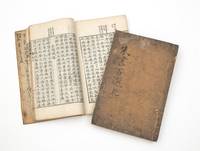
réf. 889392.5; 95 folding leaves. Two vols. Small folio orig. yellow-brown patterned wrappers some soiling to wrappers old stitching. ChÅnju today’s Jeonju: 1795 or possibly later. A selection of 100 letters written by Zhu Xi 1130-1200 the great synthesizer of the philosophical school known as Neo-Confucianism. Zhu Xi who lived in southeastern coastal China far from the center of power became extremely influential in East Asia for centuries following his death. His interpretation of Neo-Confucianism a metaphysically argued philosophy of the self the family and the state became official orthodoxy in late imperial China and ChosÅn Korea promulgated largely through the civil service examination system. However there were challenges to its primacy from intellectuals especially from the 18th century onward. “In the opinion of many historians the Song’s preeminent philosopher Zhu Xi outshined Confucius himself. He was the only person in Chinese history apart from Confucius and Mencius whom the official hagiography addressed as Master” Kuhn The Age of Confucian Rule 103. Given Zhu Xi’s standing in Korea several collections of excerpts from his works were published beginning in the 16th century. On account of its authorship Royally Authorized Selection of One Hundred Letters by Zhu Xi became one of the most widely circulated such collections for the last century of the ChosÅn period. According to the court chronicle the culturally ambitious King ChÅngjo 1752-1800 himself made the selection on the basis of Zhu Xi’s collected works a voluminous oeuvre that numbered 2354 pieces of writing in one scholar’s recent count. Text-critical notes e.g. on place names personal names official titles and expressions that might be unfamiliar to Korean readers were then added by four high civil officials which were printed in the upper margin of the text. The book was finished on the 25th day of the 12th month of the 18th year of ChÅngjo’s reign Qianlong 59 which corresponds to 15 January 1795. While most of the 18th year corresponds to 1794 it is incorrect to date the book to that year. The book was first printed in Seoul with metal movable type — the so-called chÅng’yu cha ä¸é…‰å— set of type cast in 1777 the chÅng’yu year when ChÅngjo ascended the throne. Further editions were subsequently published at several provincial offices using woodblocks intended for wide dissemination among the educated elite. Our copy belongs to one of these provincial woodblock editions. The title-page says ŭlmyo wanyÅng kan’in ä¹™å¯å®Œç‡ŸåˆŠå° meaning that it was printed in 1795 the ŭlmyo year in the provincial government offices at ChÅnju Jeonju in what is now southern South Korea. However it is possible that the actual copy was struck later than that date as the blocks remained on the site. They were moved to the local official Confucian school in 1899 where they remain today. Fine set of a very rare book. Minor staining and soiling at beginning and end of each volume. â§ WorldCat accession number 874756267. References Kuhn Dieter. The Age of Confucian Rule: The Song Transformation of China. Cambridge: Mass.: Harvard University Press 2011. unknown
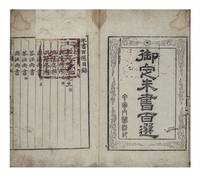
réf. 11191. 1 p.l. 4 25 34 29; 37 30 28 folding leaves. Six kwÅn in two volumes. Small folio 360 x 223 mm. orig. wrappers some wear & rubbing handwritten title on covers orig. stitching. HansÅng: Kyujanggak ca. 1799. A royal gift presented by the king of Korea. In 1794 King ChÅngjo 1752-1800 of the ChÅson dynasty compiled and had printed a collection of the letters of the great Neo-Confucian philosopher Zhu Xi 朱熹 1130-1200 to be disseminated throughout his kingdom. As King ChÅngjo wrote on this occasion “the learning of Master Zhu in its expansive and oceanic plentitude is best represented by his collected writings; the writings of Master Zhu in their utmost subtlety and precision are best represented by his personal correspondences” “ChusÅ paeksÅn yukkwÅn” 朱書百é¸å…å· in Hongjae chÅnsÅ 弘齋全書 Collected Writings of King ChÅngjo kwÅn 180. Drawing from a number of established collections he selected 100 letters and carefully arranged them “beginning with the letter to Yanping 延平 i.e. Li Tong æŽä¾— 1093-1163 Zhu Xi’s teacher to pronounce his lineage of instruction and ending with the letter to Zhiqing ç›´å¿ i.e. Huang Gan 黃干 1152-1221 Zhu Xi’s disciple to demonstrate the bestowment of teachings.” That 1794 edition with moderate marginal annotations on “personal and place names as well as philological glosses and references” was sent to be printed with the chÅngyuja ä¸é…‰å— metal type cast in the year 1777. Printed copies were sent to various official printing houses throughout the kingdom and used as models to carve woodblocks for a xylographic edition ibid. Sometime around 1799 realizing that in the capital only metal type copies of the book remained the king ordered woodblocks to be made locally as well for the work so that more copies could be printed and distributed ChÅngjo “Sinin ogyÅng…” æ–°å°äº”經… in Hongjae chÅnsÅ kwÅn 36. Most woodblock re-editions of this work retain the original title-page which contains not only the title Royal Edition of a Hundred Selected Letters of Zhu K. ŎjÅng chusÅ paeksÅn å¾¡å®šæœ±æ›¸ç™¾é¸ but also the inscription in seal script that reads ç”²å¯…å…§é–£æ´»å° — “palace edition printed with movable type in the kabin year 1794.” This title-page compounded with the absence of any additional paratextual information likely resulted in the description of these woodblock re-editions as the original metal type 1794 edition in spite of lacking the features of metal typography. We have carefully examined our copy and found that it was likely printed with the woodblocks carved around 1799 undoubtedly through the cannibalization of a typographic copy and kept within the royal library. Certain qualities of our copy make it distinctive: not only are the cursive characters rendered with impressive clarity the marginal annotations mentioned in King ChÅngjo’s edict are also preserved in faux-manuscript style — a feature absent in some other copies we have consulted erroneously described as the 1794 edition. The best evidence that our copy was printed by the royal library K. kyujanggak 奎章閣 of course is the fact that it was a royal gift K. naesabon 內賜本 presented by the king himself to notable officials or individuals in this case an examinee from SuwÅnbu 水原府. The “Record of Presentation” K. naesagi 內賜記 is handwritten on the front endpaper of the first volume as usual and is dated to the second month of Xianfeng 5 1855. However both the name of the recipient and the official responsible for the Record have been obscured. A name Im Hŭi-ji 林熙之 is written next to the name of the recipient but in a clearly different hand and ink. Records of the Royal Secretariat K. SŭngjÅngwÅn ilgi 承政院日記 states that on the 29th day of this month copies of the Hundred Selected Letters were indeed bestowed to six examinees but all their names are not given. On the first leaf of the table of contents and facing the title-page is the Seal of Presentation K. naesa’in å…§è³œå° which reads å¥Žç« ä¹‹å® Treasure of the Kyujanggak. This seal was used for presentation copies roughly between 1782 and 1894 as shown by Lee & Song in “A Study on Naesabon Preserved in Kyujanggak” in Journal of Korean Library and Information Science Society 43 no. 2. This book is rare outside of East Asia. We find three copies under WorldCat 35891835 with a misspelled title and described as the 1794 edition on account of the aforementioned title-page which our copy also possesses. None of them is described as a presentation copy. Very good set. Some occasional soiling and dampstaining. Unimportant worming mostly marginal. â§ King ChÅngjo Hongjae chÅnsÅ 弘齋全書 in Han’guk munjip ch’onggan 韓國文集å¢åˆŠ digital access via krpia.co.kr. unknown
2022réf. 2081502111905065Shanghai science and technology literature 2022. Soft Cover. Fine. The book is in fine condition. Shanghai science and technology literature paperback
2021réf. 2081502111906550Shanghai Dictionary Publishing House 2021. Soft Cover. Fine. The book is in fine condition. Shanghai Dictionary Publishing House paperback