National Museum of KoreaBiblio.com

2 127 résultats
2006réf. 64115KyÅnggi-do P'aju-si: An Gŭrap'iksŭ 2006. Large 8vo pp. 260; illustrated throughout mostly in color; fine copy in original red cloth and publisher's slipcase. Parallel text in English and Korean. Korean treasures from the Paleolithic Age to the 19th century including furniture ceramics textiles paintings manuscripts etc. An Gŭrap'iksŭ unknown
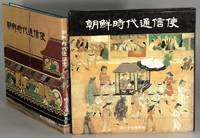
1986réf. 65283Seoul: Sanhe Publishing 1986. Square 4to pp. 155 1; text in Korean; color text illustrations throughout; full green cloth gilt title on spine; fine in fine dust jacket and slipcase. During the Joseon Choson period the government sent a number of envoys to Japan for diplomatic missions. Those missions were met with intense curiosity by the local Japanese and became the subjects of many works from paintings to popular prints. Sanhe Publishing unknown
2017réf. X19831xSouth Korea: Kungnip Chungang Tosogwan Komunhonkwa 2017. Hardcover. Very Good/Very Good. Clean In Very Good Condition. With No Remarks Or Highlights. 295 Pages. Inside The Text Is In Very Good Condition. Creased Dust Jacket.- Specializing in academic collectible and historically significant providing the utmost quality and customer service satisfaction. For any questions feel free to email us. Kungnip Chungang Toso?gwan Komunho?nkwa, hardcover
1925réf. 64345Tokyo Japan: Japanese Government Railways; Chosen Government Railways; South Manchuria Railway Company et al. Toppan Printing Co. 1925. Oblong 4to. 8.6 x 8 in. 2 72 18 columns i.e. 46 pp. printed in double columns throughout although some ads are double-column size and in red & black decorative red borders. With text illustrations & diagrams in red 4 colour maps 1 4-column or double-page. photo illustrations throughout. Self-printed colour-illustrated softcovers front cover art of Mt. Fuji by Hokusai colour map back cover for the N.Y.K. & O.S.K. Steamship lines slight dustsoiling very faint tidemark at foot of spine slight edgewear still a VG bright copy. First edition of this combination land promotion and travel brochure later available at the Japanese pavilion in the ill-fated 1926 Sesquicentennial International Exposition held in Philadelphia PA. Potential Asia travelers are supplied with travel information steamship instructions details on the Railways including the J.G.R. places to visit in Taiwan Formosa; cities sites and experiences in Korea along the Chosen Government Railway line as well as travel through Japanese-controlled Manchuria China during the Roaring 20’s. Worldcat locates 1 copy U of DE. [Japanese Government Railways; Chosen Government Railways; South Manchuria Railway Company, et al. (Toppan Printing Co.)], paperback
1910réf. 64663London UK: Chatto & Windus 1910. Tall 8vo. xvi 1 247 1 pp. Colour frontisp. 23 colour sepia tinted and colour-tinted plates 1 large folding colour map. Green publisher’s cloth illustration in blind black lettering front cover gilt lettering on spine some minor wear rubbing minor bumping head of spine still a VG bright partially uncut & unopened copy. First edition of this British woman adventurer and artist who published this as her follow-up to the 1909 “Face of China” and later expanded with “Wanderings in Chinese Turkestan” in 1914. These travel observations illustrations and account focus on her experiences as Japan has taken over Korea and begun expanding into Manchuria as well as Russian Empire areas in the aftermath of the 1905 Russo-Japanese War. Kemp 1860-1939 and her travel companion May Meiklejon MacDougal focused on local schools the welfare of women the roles of encroaching Western Christian missionaries and their impact on Asian societies. Chatto & Windus, hardcover
réf. A9781032850863Hardback. New. In the early 1980s the new reproductive technologies available supposedly offered infertile women a chance to have children. Originally published in 1985 this book describes the technologies being used and researched in the areas of in vitro fertilization ’test-tube babies’ sex-predetermination and embryo transfer at the time. hardcover
réf. 3319817868.Gpaperback. Good. Access codes and supplements are not guaranteed with used items. May be an ex-library book. paperback
2005réf. 50531Seoul Korea: Hongik Taehakkyo 2005. 4to. vi 187 leaves. Many colour and black & white illustrations. Gray cloth gilt lettering on front cover NF copy inscribed by author on 2nd flyleaf. First edition of this scarce dissertation examining the iconography and importance of peony flower and butterfly motifs in Korean Landscape painting during the Joseon Dynasty. Hongik Taehakkyo, hardcover
1998réf. 43469Seoul Korea: Pandacom Press 1998. Sml. 4to folding out in accordion style folds to 1 large double-sided broadside w/ photos & directions for solving the book with the images. NF copy from the collection of Dr. Rochelle Martin. First edition of this fascinating artist’s book providing random views and yet connections and instructions to scenes and places in Seoul. Pandacom Press, unknown
2003réf. 42615Los Angeles: Centennial Committee of Korean Immigration to the United States 2003. 8vo. 703 3 pp. Numerous photo illusts. text illusts. maps. Colour-illust. boards w/ d.j. mnr bmpng to ft of spine VG/VG copy. First edition of this fascinating collection of oral histories and memoirs of Korean immigrants coming to the Western United States from the beginning of the 20th century into the 21st. Most of the work is published in Korean but there are two papers in English including Lonesome Journey. The Korean American Century and The dawn of a new generation. Centennial Committee of Korean Immigration to the United States, hardcover
réf. ria9781394218349_inpPaperback / softback. New. New Book; Fast Shipping from UK; Not signed; Not First Edition; N/A paperback
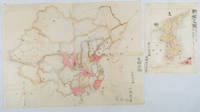
1902réf. 220266Japan. No date. Circa1902. Two very attractive colour folded manuscript maps one showing China and the other Korea. Map of China: Watercolour map 48 x 63.5cm. Closed tear now professionally repaired. Map of Korea: Finely detailed watercolour map a few tiny holes very neatly repaired on the verso with archival washi. 33 x 24.5cm Two delicate hand-painted maps one of China and one of Korea produced by a Japanese student cartographer named Koike Tokushige 小池徳重. The undated map of China appears to have been produced in the first five years of the twentieth century: a time when Japan had recently colonized Taiwan and when Japanese economic and political interest in the region was rapidly expanding. The inscription on the map suggests that it was a third year college project. But the high level of detail suggests that the artist had considerable experience of map making. The map of China shows the main provinces rivers major transport routes the Great Wall and the location of key cities although the names of the cities are not included. It also shows outlines of the Korean Peninsula Taiwan and the Japanese island of Kyushu but not the rest of Japan. The map of Korea is more detailed. It provides an accurate outline of the Korean Peninsula with careful hatching indicating changes in elevation. Rivers and major road routes are shown on the map and the locations of major towns are marked though only Busan and Incheon are named. Dotted lines show coastal sea routes and routes between Kyushu and Busan and between Incheon and China. The map shows the Gyeongin railway line between Seoul and Incheon which was completed in 1899 and route of the Gyeongbu railway line between Busan and Seoul whose construction started from both ends in 1901. But the map depicts only small sections of this line close to Seoul and Busan as being completed with the rest more lightly outlined to show the projected route implying that the map was drawn around 1901-1902 and certainly before the Gyongbu line was opened in 1904. Inserted text gives the land area and population of Korea. Rather strangely though the figure given for the Korean population is vastly underestimated. Ikeda gives this as 5.7 million when in fact at that time is was around 18 million. . unknown
réf. 0803277954.Gpaperback. Good. Access codes and supplements are not guaranteed with used items. May be an ex-library book. paperback
réf. L17L-01760HarperCollins. Used - Good. Good condition. A copy that has been read but remains intact. May contain markings such as bookplates stamps limited notes and highlighting or a few light stains. HarperCollins unknown
2013réf. Gyan-9789333306973Facsimile Publisher 2013. Hardcover. New. 22.59 x 14.34 x 3.73 cm. English Facsimile Publisher hardcover
2013réf. Gyan-9789333306973Facsimile Publisher 2013. Hardcover. New. 22.59 x 14.34 x 3.73 cm. English Facsimile Publisher hardcover
réf. 1565912403.Gperfect. Good. Access codes and supplements are not guaranteed with used items. May be an ex-library book. unknown
2010réf. UT1513821Dong Bukayeoksajaedan 2012-01-01. Hardcover. Like New. 10x6x2. Hardcover. Fine. Clean tight and unmarked. Heavy and/or oversized. International Shipping may require additional postage. In Korean language. Dong Bukayeoksajaedan hardcover
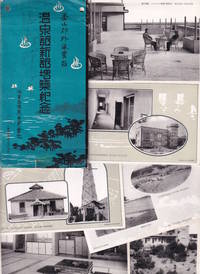
1920réf. 223564Japan.: 海雲台温泉合資会社. Kaiundai Onsen Goshi Kaisha. Circa 1920's. Eight black and white postcards presented in a paper folder. The cards are all in very good condition the paper folder is worn with two small punch holes along upper edge a sellotape stain long lower edge. Very good. A set of eight black and white postcards of Haeundae Hot Spring Resort near Busan South Korea produced in the colonial era probably 1920s and published in Japan. The postcards are contained in a decorative sleeve and show the modern buildings of the hot spring resort the surrounding coastal landscape and interior shots of the Japanese style rooms and the big hot spring tubs with women and children enjoying their baths. The postcards were produced at a time when the Japanese government was enthusiastically encouraging Japanese tourism to the colony of Korea and this spa resort probably run by Japanese owners appears to be part of the growing network of Japanese tourist sites in Korea Taiwan and later Manchuria. . 海雲台温泉合資会社. [Kaiundai Onsen Goshi Kaisha]. unknown
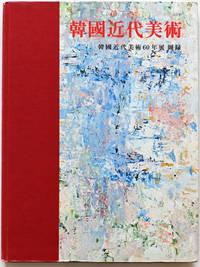
réf. MKF-BOOK-002AModern Korean Art: 60 Years Exhibition Catalogue – First Edition 1973 An illustrated first-edition publication documenting sixty years of modern Korean art published in 1973 by Kwangmyong Publishing Company and edited by the National Museum of Modern Art Korea. This historically significant volume presents an overview of the development of Korean modern art featuring artists including Ko Hui-dong and Chun Kyung-ja. It offers a valuable visual and documentary record of Korea's artistic development during the twentieth century. Published in Korea in 1973 the book is of particular interest to collectors of Korean art art historians researchers museums and institutions building collections of East Asian art and exhibition publications. Bibliographic Details Title: Modern Korean Art: 60 Years Exhibition Catalogue Publication Year: 1973 Publisher: Kwangmyong Publishing Company Korea Editor: National Museum of Modern Art Korea Edition: First Edition Language: Korean Condition: Near Mint with excellent overall preservation for its age. Please examine all photographs carefully as they form part of the condition description. The actual book shown in the photographs will be shipped from South Korea with protective packaging and tracking. Kwangmyong Publishing Company hardcover
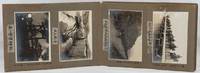
1923réf. 220274Taisho 12 1923. Over fifty black and white photographs annotated laid down in concertina style cloth covered photograph album 18 x 26.5cm most photographs measure 9.3 x 13.5cm nine measure 10 x 7cm. Some silvering of photographs but most are in very good condition. A fascinating concertina-folded album of high-quality photos dating from 1923 and showing Japanese military training exercises in northeastern Korea as well as scenes of everyday life in the surrounding region including the Ranam Cheongjin Hoeryong and Gando areas. Many of the photos appear to have been produced by a professional photographer but acquired by the soldier who has created this album who has added his own annotations based on personal experience. The first photo shows an inset portrait of a soldier named Takuuchi next to the flag of the Japanese Imperial Army's 75th Infantry Division. This is followed by a series of photos of Japanese colonial buildings in Korea including the military base of the 75th Infantry Base an overview of the city of Hoeryong on which the owner has placed a cross in ink marking the location of the recently contructed Hoeryong Shinto Shrine Heoryong's hospital and railway station and a street in the city centre an overview of Cheongjin and a panoramic overview of Ranam City also with the Ranam Shinto Shrine marked with a cross. The attention paid to these shrines which were crucial symbols of Japanese colonial rule emphasises the album creator's nationalist sentiment. There are two images of the landscape of the Tuman River and a photo of sacks of soy beans being unloaded in Gando. Other photos show scenes of everyday life including women washing clothes and grinding grain and two photos of a Korean wedding ceremony. A few of these photos including one of a village of thatched-roofed houses are in a smaller format than the images in the rest of the album and may have been taken by the album's owner himself. Twenty of the photos show 1923 training exercises conducted by the 75th Infantry Division in the Ranam area. These have also been annotated with the album owner's comments providing extra information about the content of the photos. The album concludes with two striking images of thick ice on a river probably the Tuman and of the Hoeryong Shinto Shrine in late evening. . hardcover
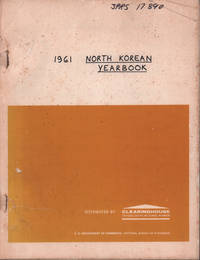
1963réf. 180349Springfield.: Clearinghouse. 1963. 572pp. Photographically reproduced technical report distributed by the Clearinghouse for Federal Scientific and Technical Information for research library circulation. Text very clean and sound original paper upper cover with a handwritten title on cover and spine and contractor code written in ink worn and a little torn at the staples lacks lower cover but otherwise complete. Clearinghouse card with the name and address of the University of Sydney employee who originally ordered it together with other details loosely inserted. A firm copy. Originally issued by the US Department of Commerce/ National Bureau of Standards. A US translation produced for America's Joint Publications Research Service of the "Korea Central Yearbook" Choson Chungang Nyongnam the official North Korean Yearbook for 1961. One of a series of yearbooks published annually since 1949 by the North Korean Central News Agency this volume covers policy developments North Korea's geography and population weather economic developments trade economic cooperation particularly with the USSR transport and commmunications education health sports the arts publications and broadcasting major events of the year and North Korea's engagement with international organizations. There are also extensive negative assessmentss of economic and social developments in South Korea. The yearbook's 570 pages are filled with the North Korean government's upbeat assessments of the wonders of its own nation's achievements but the volume is nonetheless a fascinating window into North Korean at a crucial point in its history. In 1961 North Korea was in the midst of the "Chollima Movement" - a plan which aimed to fast-track industrialisation - and the country had just completed its first five-year economic plan. It had also recently begun a program of encouraging the large-scale "repatriation" of ethnic Koreans from Japan and the report includes a section entitled "The Problem of Koreans Residing in Japan" which details North Korean support for Korean schools in Japan negotiations over the extension of the "repatriation" movement and efforts to remedy the "materialistic pholosophy" of Koreans who had relocated from Japan to North Korea. Despite the government's emphasis on economic autarchy North Korea was also cautiously expanding links to the outside world and the yearbook mentions the signing of trade agreements with non-governmental agencies in Japan India Australia and other countries. The section on the arts provides rich detail on North Korea's promotion of socialist realism and works depicting the "fervent patriotism and indominitable spirit of the revolutionary fighters". The yearbook details the successful songs plays musical dramas and films of the year and the expansion of artistic circles in workplaces schools etc. One element of the five year plan had been the promotion of athletics contests and the outcomes of this promotion program are discussed in the yearbook but it is interesting to note that the mass games which were later to become a cantral feature of North Korean perfomance art were only in their infancy and just receive a brief mention. The volume is an exceptionally rich and valuable resource for anyone interested in the history of often impenetrable North Korean state. . Clearinghouse. unknown
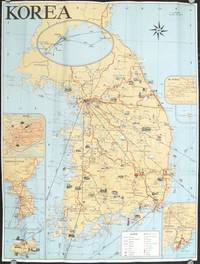
1960réf. 207712Seoul Korea.: Ministry of Transportation Republic of Korea. circa1960. Folding colour pictographic / pictorial map inset maps of Seoul Chejudo Mt. Sorak Kyongju Pusan and map showing air routes to various Asian cities and to the California coast 67.5 x 51 cms; 22.5 x 10 cms folded small fold tear without loss index and five distance tables printed on the verso in very good condition. Uncommon pictorial map of the Korean Peninsula showing wildlife natural wonders numerous temples hotsprings seaports and railways many sights designated "National Treasures". Printed for the tourist market one of the inset maps shows the flight routes from key Southeast Asian ports to Seattle and San Francisco. . Ministry of Transportation Republic of Korea. unknown
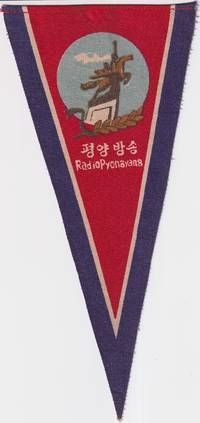
1960réf. 219665No publication details. circa1960s –70s based on design and material. Printed fabric pennant promoting Radio Pyongyang North Korea’s official broadcasting service. The image shows a stylised monument of two figures possibly symbolising industry and broadcasting with a laurel motif and radio waves under a red sky. Text in both Korean and English. Radio Pyongyang. “평양 방송” translates directly as Pyongyang Broadcasting. Text in Korean and English. 23.5 height x 11cm at top edge. A scarce example of early North Korean visual propaganda. Radio Pyongyang was founded in October 1945 and inaugurated programming with a live broadcast of Kim Il Sung's victory speech when he returned to Pyongyang at the end of WWII. The image on this pennant features a statue of two figures a worker and a peasant woman carrying a sheaf of rice riding the mythical horse Chollima symbolising speed strength and the spirit of the North Korean people. The Chollima movement which began in 1956 encouraged citizens to achieve extraordinary production and labour targets indicated by the sheaf of wheat symbolic of agricultural abundance. Radio Pyongyang helped to disseminaate the ideals of the Chollima movement and this pennant probably dates from after the Chollima Monument was unveiled in 1961. Provenance: Bought in China by a western collector in the late 20th century. . No publication details. unknown
réf. 26320967like new. unknown