36 résultats
1997réf. 144195Seoul Korea: Korea Foundation 1997. Hardcover. G DJs have average edge wear and some fading or sunning near spines; books themselves and pages are clean and clear. 4 vols. Blue cloth gilt letters on spine gilt decoration on front cover dark blue-black & color illus. dust jackets total 1029 pp. many color illus. A four-volume set of Korean cultural history arranged by general topic and gleaned from articles published in the periodical KOREANA from 1987-1995. Vol. 1. Fine arts. Vol. 2. Thought and religion. Vol. 3. Performing arts. Vol.4. Traditional lifestyles. All highly illustrated and informative. Korea Foundation hardcover books
2012réf. 144241Seoul Korea: National Museum of Korea 2012. Softcover. VG Rear cover has inconsistent sunning and has changed color; otherwise clean inside and out. Turquoise & white & color illus. wraps French flaps 232 pp. many color illus. Text is in Korean and English. Issued in conjunction with a 2012 exhibition of these pieces. Arranges the catalog according to which museums the artwork comes from: Honolulu Museum of Art Brooklyn Museum Los Angelese County Museum of Art Museum of Fine Arts in Boston Asian Art Museum in San Francisco Philadelphia Museum of Art The Metropolitan Museum of Art The Cleveland Museum of Art and the Arthur M. Sackler Museum and Harvard Art Museums. with essays by Kumja Paik Kim and Keum-jin Yoon. National Museum of Korea paperback books
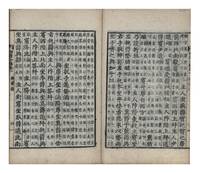
1797réf. 111991797. Woodblock-printed. 4 1 16 39; 40 33 2 folding leaves. Three kwÅn in two volumes. Small folio 341 x 216 mm. orig. semi-stiff patterned wrappers handwritten title on upper covers old stitching. HansÅng: Chujaso Preface dated 1797. Very rare Korean collection of community rituals K. hyangnye 鄉禮 compiled by and printed for the King of Korea. We find no copy in Korea and only three copies in WorldCat Berkeley Columbia and Harvard. The reign of King ChÅngjo of Korea r. 1776-1800 witnessed a shift in the sovereign’s role in relation to Confucian teachings. “ChÅngjo sought to formulate the sage-king as an active ruler who instructed his ministers rather than received instruction from them was directly involved in the administration of the state and exercised discretion when and how he in his sagely wisdom deemed fit.”–Christopher Lovins King ChÅngjo SUNY: 2019 p. 29. As the guardian and propagator of Confucian learning he oversaw various editorial and printing projects carried out by the royal publishing house the Chujaso 鑄字所. The compilation and publication of the Collected Community Rituals reflected King ChÅngjo’s belief that a king’s ritual transformation of his people must begin at the local level. The Collected Community Rituals opens with the royal edict dated 1797 followed by a list of community ritual records compiled throughout Chinese and Korean history. The bulk of the work is devoted to the rituals of the banquet and archery competitions followed by coming-of-age K. kwanrye 冠禮 and marriage rituals. Detailed interlinear commentaries were compiled by scholars of the Kyujanggak 奎章閣 the Royal Library of the Korean court under the leadership of Yi PyÅng-mo 1742-1806. Their names are listed at the end of volume two. The original printing used the chÅngyuja ä¸é…‰å— kabinja style of movable metal type of 1777 and copies were distributed to localities throughout Korea. They were also sent to regional governmental printing houses where they were cannibalized to produce woodblocks for further printing. Nice set preserved in a jil. Our copy also has prayers for ancestral mountain and land deities as well as instructions for offering rites all handwritten in black ink on the endpapers. Red leaf-shaped seals on the first leaf of both volumes read 逸民山水 . â§ Asami Library 4.14. King ChÅngjo Hongjae chÅnsÅ 弘齋全書 in Han’guk munjip ch’onggan 韓國文集å¢åˆŠ digital access via krpia.co.kr. unknown books
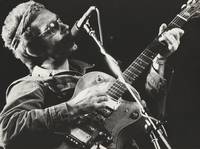
réf. 162576N.p.: N.p. 1974. Collection of eleven vintage borderless black-and-white photographs of rock pop and jazz musicians performing circa 1973 taken by noted French photographer Claude Gassian. With Gassian's stamp on the verso of every photograph. Collection includes two photographs of Alice Cooper one photograph of J.J. Cale one photograph of Chick Corea Stanley Clarke and Al Di Meola Return to Forever one photograph of Carla Bley at an electric keyboard two photographs of Bryan Ferry with Roxy Music one photograph of John McLaughlin and Jean-Luc Ponty Mahavishnu Orchestra one photograph of Alvin Lee with Ten Years After and one photograph of Tom Johnston Jeff "Skunk" Baxter and Patrick Simmons The Doobie Brothers. Born in Paris in 1949 Claude Gassian began his career in the 1970s capturing numerous iconic images of rock-and-roll musicians throughout that decade. His work has been the subject of several exhibitions and has been featured in several photography books including "Rock Images" 1990 and "Claude Gassian photographies 1970-2001" 2001. 9.5 x 7 inches. Very Good to Near Fine some with light edgewear and faint aging to the emulsion. N.p. unknown books
1999réf. 237831999. Softcover. VG. White wraps. 15 pp. 12 color plates. Text in Korean and English. Includes an introductory essay by Ann Landi a biographical chronology and the intriguing illustrations. paperback books
1964réf. 197821964. Anonymous photographs of African American soldiers stationed in Korea and Europe produced c. 1960s document Black military service during the Cold War and provide primary-source evidence for the study of U.S. Army deployments racial integration in the post-World War II military and lived experience within forward operating environments near geopolitical flashpoints. The images place African American servicemen at installations including Camp Kaiser in South Korea located within proximity to the Korean Demilitarized Zone and in European urban and alpine settings indicating rotational or multi-theater deployment. The archive supports research into the role of Black soldiers in Cold War containment strategy as well as the everyday conditions mobility and social environments encountered by enlisted personnel across Asia and Europe during a period of sustained global military presence. Archive of 24 original black and white silver gelatin photographs c. 1960s primarily measuring approximately 4" x 3". At least half of the images are identified as taken in Korea with multiple captions including "Camp Kaiser" "Korean Home" "Village" and "CO Area" situating the group within a U.S. Army installation environment composed of cinder block structures and Quonset huts approximately 60 miles north of Seoul and within range of North Korean artillery positions. One overhead view shows the full layout of Camp Kaiser while other images depict African American soldiers in field conditions described as "Cold Wet" trekking and camping in rugged terrain. Additional Korean scenes include a soldier leaning against a tank marked "Kimchee" and an airfield photograph showing a chrome fighter jet surrounded by personnel alongside additional aircraft including a biplane. European photographs include a parade observed from an apartment window in a German-speaking alpine town featuring a float labeled "General Knuller" as well as street-level images of crowds deployed fire engines and soldiers observing from a Volkswagen Beetle. One image shows an African American soldier standing outside a synagogue marked by a Star of David with a flag bearing the inscription "Troop Att 1964" indicating interaction with local religious or commemorative sites. The photographs align with the global positioning of U.S. forces during the Cold War particularly in South Korea following the Korean War armistice and across Western Europe as part of NATO-aligned defense strategy. African American soldiers serving in an officially desegregated military after 1948 participated in these deployments while navigating both military hierarchy and broader social transformations associated with the Civil Rights era. The archive captures a range of activities from patrol and training environments to civic encounters and public events offering a geographically dispersed visual record of Black military presence within U.S. Cold War operations. Light wear and minor handling present; captions and details remain legible; overall very good condition. unknown books
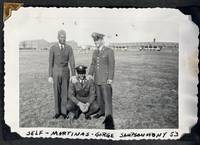
1953réf. 212881953. African American military photo album 1953-1960 documenting the service and personal life of a Black U.S. Air Force serviceman across multiple postings during and after the Korean War. The album records military duty daily routines and interpersonal relationships within an increasingly integrated armed forces providing visual evidence of African American participation in Cold War military infrastructure. The material captures both overseas deployment in Korea and domestic life across U.S. bases situating individual experience within broader patterns of military service and social change following desegregation. Album comprises 101 black-and-white silver gelatin photographs most measuring approximately 3.5" x 3.5" mounted on black pages with corner mounts. Early images place the serviceman at Kessler Air Force Base in Mississippi followed by extensive documentation of his time in Korea likely associated with the 650th Aircraft Control and Warning Squadron as indicated by a tent marked with unit insignia. Photographs show military encampments with tents and barracks vehicles including trucks and jeeps and groups of soldiers engaged in daily routines. One caption identifies "Our home in Korea" accompanying images of base infrastructure. Additional scenes include a USO performance at "K-6 Korea 54" where servicemen gather beneath a "Camp Shows" banner. The album continues with postings at Ellsworth Air Force Base in South Dakota and locations in Alaska where winter conditions specialized vehicles and outdoor activities are visible. Social and interpersonal life is extensively documented with repeated appearances of individuals identified as "Daril" "Bunky" "Peanuts" and others shown in uniform at leisure and in group settings. Domestic scenes include family gatherings such as "Roger's Birthday Party June 59" and images of women and children identified as "Mary" "Rochelle" and "Teresa" indicating sustained family connections. Travel photographs include roadside markers such as "Welcome to Illinois" and "Entering Indiana" while Alaska-based images depict community events including dog sled races and local festivals. Created during the transitional period following the desegregation of the U.S. military these photographs provide a sustained record of African American service members operating within integrated units while maintaining personal and family networks across geographic distances. The combination of overseas deployment domestic postings and family life offers a comprehensive view of military and social experience during the 1950s. Album pages show some loss and covers are detached; photographs remain sharp with strong tonal quality and are largely well-preserved; overall very good condition. This album offers an extensive documentary record of African American military life and community formation in the Korean War and early Cold War period. unknown books
1956réf. 215131956. African American Military History Korean War Unidentified photographer African American soldiers in South Korea 1956 documents Black military service within the early post armistice U.S. occupation of Korea and provides visual evidence of desegregation in practice following Executive Order 9981. Produced three years after the Korean Armistice Agreement the images situate African American enlisted men within the operational landscape of U.S. military engineering and logistical support during the Cold War consolidation of American presence on the Korean peninsula. The archive documents the role of Black soldiers in infrastructure maintenance transport and base security while also recording their proximity to Korean civilian life in a recovering war zone. The identification of the 376 Engineer Battalion places the material within the institutional framework of the U.S. Army Corps of Engineers whose work underpinned military mobility and reconstruction during this period. South Korea 1956. Archive of 22 black and white silver gelatin photographs most measuring approximately 5 x 4 inches depicting African American soldiers stationed near a U.S. military installation likely in the Uijeongbu or Dongducheon corridor north of Seoul where engineering and support units were concentrated. Multiple images include signage identifying the "376 Engineer Battalion" while others show mixed-race groups of soldiers gathered near convoys of M35 2½ ton cargo trucks and smaller support vehicles used for personnel and supply transport. One photograph includes a Fairchild C-119 Flying Boxcar aircraft in the background confirming the logistical environment of cargo movement and aerial supply. Soldiers appear in standard issue fatigues with visible non commissioned officer insignia engaged in routine duties such as transport checkpoint supervision and base operations. Several photographs depict Korean civilians moving through nearby marketplaces and village spaces including women wearing traditional hanbok passing through areas of visible economic strain characterized by unpaved roads and temporary structures. English and Hangul signage including a storefront labeled "Kind Shop" further situates the images within a localized commercial environment shaped by U.S. military presence. The archive documents a transitional period in both U.S. military policy and Korean society as the formal desegregation of the armed forces intersected with the realities of overseas deployment in a recently devastated region. While integrated units are visible the clustering of Black soldiers within shared duties and informal groupings indicates the persistence of racialized social structures within the ranks. At the same time the photographs establish the everyday presence of American troops within civilian Korean spaces during early Cold War reconstruction linking military labor to broader geopolitical objectives in East Asia. Light surface wear including minor creasing and scattered abrasions; images remain clear with strong contrast. Overall very good condition. A cohesive visual record of African American military labor postwar occupation and cross cultural contact in Korea during a formative phase of U.S. global military expansion. unknown books
1972réf. 128666Seoul Korea: Samhwa 1972. Hardcover. VG/ VG/ VG. Light brown cloth boards dark green dj with bw illus. stiff paper slipcase; 64 pp of text 200 pp of illustrations 100 plates chiefly in color tipped-in errata sheet In Korean and English. From the foreword: likely the museum's first color publication. Plates of works in the museum with annotations in both languages. Samhwa hardcover books
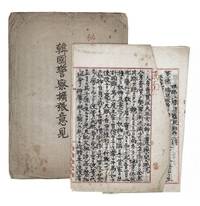
réf. 1116770 folding leaves all roughly 250 x 170 mm. Korea: mostly dated between 1910 and 1913. This fascinating collection comprises a series of handwritten administrative and case notes pertaining to police spying activities regulations and security planning in colonial Korea under Japanese rule. The documents were prepared by operatives in the Police Bureau of the Government-General of ChosÅn . Our documents are diverse in scope ranging from operational details such as surveillance and sentry procedures at the Amnok River Bridge 鴨緑江橋 the natural border between North Korea and China today accompanied by a folding colored map of the river oversight of local shrines and temples investigations into human trafficking and the abduction of women and civil police deployment plans covering major port cities. Certain entries are dated and bear the personal annotations of Akashi Motojiro who served as Chief of Police in the Government-General of ChosÅn and later became Governor-General of Taiwan. His contributions include a "Proposal to Expand the Ethnic Korean Police" marked "secret" and dated December 1911 as well as memoranda documenting statistics and tallies of Japanese and Korean police officers as of October 1912. Akashi's involvement underscores the significance of these notes for understanding the structure and priorities of the colonial police. Japan's formal annexation of Korea in 1910 inaugurated a colonial regime 1910-45 that employed its police force to maintain public order suppress dissent enforce new regulations and monitor civil society - overseeing everything from resident registration and religious activities to labor and public health. While the "military rule" of the 1910s gave way to a "cultural rule" with some reforms after 1919 police surveillance and public-security operations continued as fundamental mechanisms of control. This collection offers an extremely rare perspective on both the daily operations and the broader institutional planning of Japanese colonial policing. Fine condition. unknown books
1992réf. 89921Korea: Yesul ui Chondang 1992. Paperback. Very Good. color illustrations approx. 204p. Softcover in original wrapper. 25cm. Printed in upper left corner of front cover: Korean Paintress Association. Yesul ui Chondang paperback books