536 resultados
ref. 36797Paris, Alpha/Laffont, 1980. 23 x 30, 120 pp., très nombreuses illustrations en couleurs (et en N/B), cartes en couleurs, cartonnage d'édition imprimé, état neuf.
1) xlix + 48pp. + 3+66 plates (detailed photographic reproductions of "Monument I", "Monument II" and "Monument III" + photographs showing general views and archaeological objects found near the monuments] + 1 map, 38cm., original 1892-edition, fine modern half cloth binding (gilt lettering on spine, original wrappers preserved), good condition [contains contributions by A. Heikel, G. v.d. Gabelentz, G. Devéria & O. Donner on the expedition and on the Orkhon inscriptions which are the oldest known examples of Old Turkic writings and an important source of Turkic legendary history, inscribed in Orkhon script on monuments erected in the 8th century in the Orkhon valley in honour of 2 Göktürk princes] & 2) 224pp., 25cm., original 1896-edition, in the series "Suomalais-Ugrilaisen Seuran Toimitsukia / Mémoires de la Société Finno-Ougrienne" vol.5, bound in cart.cover (marbled plates, leather spine with gilt lettering, original wrappers preserved), good condition, [contains the edition with transcription and French translation of the inscriptions by Thomsen who was able to decipher them], X74890
ref. X74890Helsingfors, Imprimerie de la Société de Littérature Finnoise 1) 1892 & 2) 1896 1) xlix + 48pp. + 3+66 plates (detailed photographic reproductions of "Monument I", "Monument II" and "Monument III" + photographs showing general views and archaeological objects found near the monuments] + 1 map, 38cm., original 1892-edition, fine modern half cloth binding (gilt lettering on spine, original wrappers preserved), good condition [contains contributions by A. Heikel, G. v.d. Gabelentz, G. Devéria & O. Donner on the expedition and on the Orkhon inscriptions which are the oldest known examples of Old Turkic writings and an important source of Turkic legendary history, inscribed in Orkhon script on monuments erected in the 8th century in the Orkhon valley in honour of 2 Göktürk princes] & 2) 224pp., 25cm., original 1896-edition, in the series "Suomalais-Ugrilaisen Seuran Toimitsukia / Mémoires de la Société Finno-Ougrienne" vol.5, bound in cart.cover (marbled plates, leather spine with gilt lettering, original wrappers preserved), good condition, [contains the edition with transcription and French translation of the inscriptions by Thomsen who was able to decipher them], X74890
1906ref. 185"Vacation Letters. Pictures. Mongolia with China 1906. We stopped at this little Mongol settlement for our noon rest one day on the way to Tabol. A new family had just moved in and we saw them put up their tent. This shows the frame work of the tent before the felt covers are roped on." "Vacation Letters: Pictures. Tabol. Mongolia. 1906. Mrs. Larson's tent. These three women are the wives of Mongols in Mr. Larson's employ. The tent at the right is Mrs. Larson's kitchen tent where her servants lived and booked for her." Frans August Larson 1870-1957 a Swedish missionary was first sent to Urga Ulaanbaatar in 1893. In 1895 he went to Kalgan made a tour of a month in the neighboring portion of Mongolia and opened a mission station at Hara Oso where he pitched a Mongol tent each summer. He married an American missionary Mary Rodgers of Albany NY in 1897 and their city and country homes became a center for missionary recreation. During the Boxer Rebellion Larson was able to lead a rescue caravan using the 20 camels and 15 horses belonging to the British consul at Beijing but pastured near Kalgan north to Urga and Kiachta. "His ability to speak the Mongolian language and to arrange all matters of business together with his courage and his known skill with his rifle were a means of salvation to all his comrades." Larson and another missionary comrade James Hudson Roberts published an account in 1903 Pilgrim Press Little Brown Boston: A Flight for Life and An Inside View of Mongolia. Larson next pitched his tents at Tabol 85 miles from Kalgan on the Urga road. In 1902 the British and Foreign Bible Society hired him to distribute bibles to Buddhist monks - using 5 horses 4 Mongolian assistants and 10 camels. In 1922 Larson started a lucrative trucking business Dodge trucks from America covering the road from Kalgan to Urga in 4 days instead of a month by camel. The Larsons moved to the U.S. eventually starting a successful chicken business in San Francisco. In 1930 Larson wrote Larson Duke of Mongolia Little Brown Boston After Mary's death Larson wandered ending by spending the winters with a daughter in California but the summers with a young Swedish couple he helped establish on Vancouver Island.
ref. 13974171Paris: Musée de l'Homme, Museum National d'Histoire Naturelle, 1973 in-4, nombreuses illustrations. Broché, cachet, très bon état. Sommaire : Laurence DELABY. Une corde d'ongon mongole. - Suzanne LALLEMAND. Symbolisme des poupées et acceptation de la maternité chez les Mossi. - Philippe SAGANT. Les travaux et les jours dans un village du Népal oriental.
1963ref. 2091502135420334Not Available 1963. Soft Cover. Fine. Number of books: 1 Not Available paperback
1970viii + 288pp., 25cm., 1st ed., in the series "Indiana University Publications, Uralic and Altaic series" vol.89, softcover (some use), [contains about 10 000 words in English together with their equivalents in Modern Mongolian], X68983
1970ref. X68983Bloomington, Indiana University 1970 viii + 288pp., 25cm., 1st ed., in the series "Indiana University Publications, Uralic and Altaic series" vol.89, softcover (some use), [contains about 10 000 words in English together with their equivalents in Modern Mongolian], X68983
ref. awd-1155S. n. (Arcueil) 1984. In-8 en feuilles, couverture illustrée en couleurs, emboitage en toile bleue (imprimé en rouge) de l’éditeur (32 pp.).
2002ref. 123624Phébus, 2002, in-8°, 299 pp, traduit de l'anglais par Eric Chédaille, une carte, broché, couv. illustrée, bon état
2010Mm 170x240 Rivista semestrale, anno 14, numero 2, secondo semestre 2010. Brossura originale, paginazione da 129 a 288. Copia come nuova, spedizione in 24 ore dalla conferma dell'ordine.
1900ref. 21241London, Rowland Ward, 1900. In-8 de XII-324 pages + 8 pages pour le catalogue des livres édités par Rowland Ward. Pleine percaline bleue d'éditeur.
1959ref. 2091502135421306Not Available 1959. Soft Cover. Fine. Number of books: 1 Not Available paperback
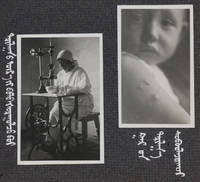
ref. P23Oblong Quarto ca. 265x32 cm. 17 card stock album leaves. With 84 mounted and three loosely inserted original gelatin silver photographs of various size from ca. 11x185 cm 4 ¼ x 7 ¼ in to ca. 4x5 cm 1 ½ x 2 in. Most photos with manuscript white ink captions in traditional Mongolian script on the mounts. With five leaves of tissue paper with period typewritten notes and commentaries in Russian mounted on verso of the album leaves. Original brown full cloth binding with blind-stamped floral ornaments and a faded gilt-stamped title in traditional Mongolian script on the front board. One leaf slightly detached from the stub a couple of photos mildly faded but overall a very good album of strong interesting photos. Historically significant content-rich original visual source on the first years of the State Sanitary-Bacteriological Institute of Mongolian People’s Republic. Founded in Ulanbataar in 1933 the Institute was a part of a large-scale program of medical assistance to Communist Mongolia run by the Soviet Union in the 1920-1940s. The program aimed to establish the Mongolian system of public healthcare and medical education to eliminate widespread tuberculosis and venereal diseases and to suppress and control frequent outbreaks of measles typhus and plague. The fight with plague which continuously threatened the Soviet regions of Transbaikalia and southern Siberia bordering Mongolia was a critical task for the Soviet government. Its actions in the late 1920s and 1930s were driven by the strive to accomplish the industrialization of the economy. In the case of the plague epidemic in Russia the West which provided the equipment qualified workforce and technology for Soviet industrialization would implement the quarantine sanctions which could stop or significantly slow down the process. For this reason the second and third medical expeditions to Mongolia organized by the Soviet People’s Commissariat of Public Health Narkomzdrav in 1928 and 1930-1936 actively investigated plague outbreaks in the country. In 1930 the member of the third Narkomsdrav expedition a noted Soviet microbiologist Abram Lvovich Berlin 1903-1939 founded the first Mongolian anti-plague laboratory in Ulaanbaatar. In 1933 he also created the Mongolian State Sanitary-Bacteriological Institute. The album summarizes the results of the Institute’s work for the first four years 1933-1936 covering a wide range of activities and providing numerous photos with detailed captions in Mongolian and extensive typewritten notes in Russian. The comprehensive and somewhat official approach suggests that the album was made to illustrate an official report. The photos show the Institute’s building in Ulanbataar taken from the street interiors of the clinic laboratory operation room and museum; there are also scenes of patients’ examination and vaccination portraits of patients suffering from measles typhus and other diseases several photos of laboratory animals and tests on them bottles of prepared vaccines against rabies typhus and measles etc. Fourteen individual and one group portrait show Russian and Mongolian associates of the Institute including Abram Berlin individual portraits - upper row centre right; the group portrait – middle row third from left. Over twenty photos at the end show the premises of the anti-plaque research settlement founded by Abram Berlin 5 km away from Ulaanbaatar. An aerial photo shows the location of the settlement’s main structures. Another photo provides the view of the main office with the readable sign in Mongolian and Latin scripts “Eryyliig Kamagaalka aamanii Tarbagan takaliig esergyyceke Tob Laboratory” can be translated as “Mongolian Plague Prevention Service and Laboratory”. There is also a clear photo of the sign in Mongolian and Russian reading in translation “A present of Narkomzdrav of the RSFSR to the 10th year of Mongolian People’s Revolution.” Other photos show the interior of the anti-plague lab researchers working in protective equipment disinfecting and looking after laboratory animals. The photos taken during a sanitary expedition show the associates wearing protective equipment disinfecting an infected nomad camp and assisting a sick Mongolian; there are also photos of an infected Tarbagan rodent and bodies of deceased victims of the plague outbreak. Overall a unique original source on the first years of bacteriological and anti-plague medical services in Mongolia. Abram Berlin was a noted Soviet epidemiologist who for the most part of his life worked in the Institute of Microbiology and Epidemiology of the South-east of the USSR in Saratov. He authored numerous articles and books including “Tibeskaya meditsina i chuma” Tibetan Medicine and plague// Revue de Microbiologie d’Épidémiologie et de Parasitologie. Institut de Microbiologie et d’Épidémiologie du Sud-Est de l’URSS à Saratov. T. XIX Issue 3-4. Saratov 1940 and “Kratkoye Rukovodstvo po bor’be s chumoy” A concise manual on the fight with plague; Medgiz 1941. In 1937 he successfully tested on himself the first Soviet anti-plague vaccine but tragically died of pulmonary plague in 1939 after working with infected animals in the Saratov laboratory. hardcover
ref. 14841Petit album photographique montrant la capitale de la Mongolie à l'époque de l'Union Soviétique. Chaque photo est légendée au dos en russe. 18 photos. Broché Très bon 1 volume in-8°
2015ref. qi1797Grasset Cartonné 2015 In-4 (24,7 x 33 cm), cartonné, 496 pages, photographies en couleurs ; comme neuf. Livraison a domicile (La Poste) ou en Mondial Relay sur simple demande.
1960In 8°, t.t. edit. ill. con sovracc. ill. (discreta, tracce d'uso, strappetti e piccole mancanze), pp. 374,(2), con fot. b/n f.t.; coll. "grandi viaggi illustrati", prima ed., volume in buono stato. (MAG ZA4/d) (spedizione standard SEMPRE tracciata con raccomandata-piego di libri, eventuale FATTURA da richiedere all'ordine)
1929In-8 p., tela editoriale figurata in blu e oro (picc. spacco al dorso), di pp. XIX,(3),407; al risg. anteriore è riprodotta una cartina geografica relativa alla “Main route of expedition through India, Sinkiang, Altai, Mongolia and Tibet”; con un ritratto di Nicholas Roerich all’antiporta e ben illustrato f.t. da 19 tavole in b.n. che riproducono scene dipinte dall’A. In fine un interessante glossario. "Prima edizione". Diario di viaggio suddiviso in 12 parti: “India (1924) - Sikhim (1924) - Pir-Panzal (1925) - Ladak (1925) - Lamayuru-Hemis (1925) - Leh-Karakorum-Khotan (1925) - Khotan (1925) - Takla Makan-Karashahr (1926) - Karashahr-Dzungaria (1926) - Altai (1926) - Mongolia (1926-1927) - Tibet (1927-1928)”. Firma di apparten. al frontespizio, altrimenti esemplare ben conservato.
1964ref. X71594Leiden, Brill 1964 vii + 296pp., 25cm., in the series "Handbuch der Orientalistik. Erste Abteilung: Der Nahe und der Mittlere Osten" vol.5, softcover, good condition, X71594
1964ref. X100154Leiden, Brill 1964 vii + 296pp., 25cm., in the series "Handbuch der Orientalistik. Erste Abteilung: Der Nahe und der Mittlere Osten" vol.5, softcover, pages still uncut, good condition, X100154
1964vii + 296pp., 25cm., in the series "Handbuch der Orientalistik. Erste Abteilung: Der Nahe und der Mittlere Osten" vol.5, softcover, good condition, X71594
1964vii + 296pp., 25cm., in the series "Handbuch der Orientalistik. Erste Abteilung: Der Nahe und der Mittlere Osten" vol.5, softcover, pages still uncut, good condition, X100154
1980278pp.with ills. in colour and bl./w., 31cm., cloth, dustwrapper, G, X71641
1980ref. X71641Leipzig, Seemann 1980 278pp.with ills. in colour and bl./w., 31cm., cloth, dustwrapper, G, X71641
ref. 8202Paris, Musée Cernuschi, 1979. 1 volume in-8, 26 pp., broché, couvertures imprimées conservées, enrichi de 19 illustrations, très bon état.