JÉSUITES] CARAYON AugusteLivre Rare Book

1236 risultati
1865rif. 25004Paris L'Ecureux 1865 in-8 demi-basane fauve à coins, dos à nerfs muet, couverture conservée [Rel. moderne]
1923Very Good Turkish, Ottoman (1500-1928) Original pictorial wrappers. Demy 8vo. (22 x 14 cm). In Ottoman script (Old Turkish with Arabic letters). 302 p. Slightly chipped on extremities, stains on cover. Otherwise a good copy. First Ottoman Turkish edition of this Arabic historical novel that takes its subject from Arabic nights. "Romance and intrigue provide the central plot of the novel that is woven into the broader picture of the fall of the Barmakis. Harun held his sister Abbasa in great affection and loved to spend his evenings in her company. But his favorite companion was Ja'far. It was quite unsuitable for a man from outside the family to be admitted to the company of a young woman, but Harun found a way to arrange things; he decided to marry them to each other in what the French call a "marriage blanc". As he explained to Ja'far "you see her only in my company, your body never approaches hers and you have no conjugal relations with her. You may thus share our evenings of pleasure without risk." Ja'far accepted and swore solemnly in front of witnesses never to visit his young wife, stay alone with her or even spend a minute under the same roof unless Harun was present. But Jafar was handsome and Abbasa's beauty was second to none. The inevitable occurred. How and why no one is certain. There was a great political advantage for Ja'far to unite himself with the sister of the Caliph. But did his mother who was close to both her son and Abbasa prod them in that direction? Or was their deep love sufficient to consummate their marriage, as Zaidan seems to imagine? No one knows for sure and the novel does not speculate on what really happened. The only sure thing is that Abbasa became pregnant and gave birth to at least one child and perhaps two as related in the novel. And when Harun learned of the relationship, this was the beginning of the end for the Barmakis. The close friendship between Harun and Ja'far spawned jealousies among the Caliph's entourage. Chief among them was the hostility that Al-Fadl ibn al-Rabi' had towards Ja'far. The two men detested each other and did everything they could to destroy each other. Last but not least Zubayda, Harun's favorite Hashemite wife also did not like Ja'far. He had been a tutor to al-Ma'mun, the son of a Persian slave girl, her son's rival. It was known that Harun admired Ma'mun's gifts and was thinking of promoting him over Al-Amin in the order of succession. There is every reason to believe that Zubayda exercised her considerable influence against Ja'far. She comes across as shrewd, skillful, and willful. Zaidan never explicitly speculates to what extent al-Rashid's reaction was politically or emotionally motivated. The narrative and dialogue suggest a combination of those factors. Ja'far had been disloyal to Harun and had stained the family honor: his disobedience could not go unpunished. But Harun was shrewd and feared for his power and influence - to the extent that the Barmakis might usurp the Abbasid caliphate. Within this broad historical canvass, Zaidan's fast-paced narrative with its twists and turns is full of suspense. It covers only a few months of Harun al-Rashid's reign but one that fatefully changed the course of 'Abbasid history." (Source: The Zaidan Foundation). Zaidan was a prolific Lebanese novelist, journalist, editor, and teacher, most noted for his creation of the magazine Al-Hilal, which he used to serialize his twenty-three historical novels. His primary goal, as a writer and intellectual during the Nahda, was to make the common Arabic population know their own history through the entertaining medium of the novel. He has enjoyed widespread popularity. He is also considered to have been one of the first thinkers to help formulate the theory of Arab nationalism. OCLC: 780178860.; Özege 2.
1898rif. 2200017Annville PA: Lebanon Valley College 1898. Hardcover. Good-. 8vo - over 7¾ - 9¾" tall. See photos for condition details. Hardcover blue cloth boards quarter bound with ivory cloth to spine. Exterior shows bumping and edge wear with soiling present and most notable on the ivory cloth. Floral decorated end pages and front and rear no handwriting or bookplates noted. Pages are toned due to age and foxing and smudge marks/stains are present throughout. Page five which contains the photo of the editorial staff has a small tear along the top edge about 1 inch. Last few pages show creases at corners. A rare early yearbook with the senior class listing only 11 members. Lebanon Valley College hardcover
rif. 35514Carte au format 9 x 11,5 cm - bon état -
rif. 52003Stock 1978, in-8 broché, 273 p. (pli de lecture au dos, sinon très bon exemplaire ; non réédité) Celui qui était le chef des Druzes porte un regard d'ensemble sur le sanglant conflit libanais ainsi que sur le monde arabe en général ; peu après ces entretiens, il fut à son tour assassiné...
1984rif. HIS1608M1984 / 324 pages. Broché. Editions Grasset.
1997rif. 68289Tirage à 1000 exemplaires numérotés (n° 593), 1 vol. in-4 reliure éditeur pleine toile bleue imprimée, Aux Trois Hussards, Paris, 1997, 366 pp.
1998rif. 33005Beyrouth librairie orientale, imprimerie Catholique 1998 GRAND In-8 Toile éditeur sous jaquette Texte en Français photos en noir
1993rif. 32995librairie orientale, imprimerie Catholique 1993 GRAND In-8 Toile éditeur sous jaquette, nombreuses illustrations en noir et le fac-simile dépliant du plan de Beyrouth de Julius Loytved de 1876
1977rif. 32996librairie orientale, imprimerie Catholique 1977 GRAND In-8 Toile éditeur sous jaquette, nombreuses illustrations en noir et carte dépliante
1995rif. 33007Beyrouth librairie orientale, imprimerie Catholique 1995 GRAND In-8 toile éditeur sous jaquette Texte en Français photos en noir
rif. 53392Beyrouth, Dar el-Machreq Editeurs 1985, format à l'italienne 22,5 x 24,5 cm) cartonnage illustré de l'éditeur, 336 p. (bel état ; non réédité) Histoire, art et archéologie du Liban, s'appuyant sur une vaste iconographie ; textes en anglais et en français.
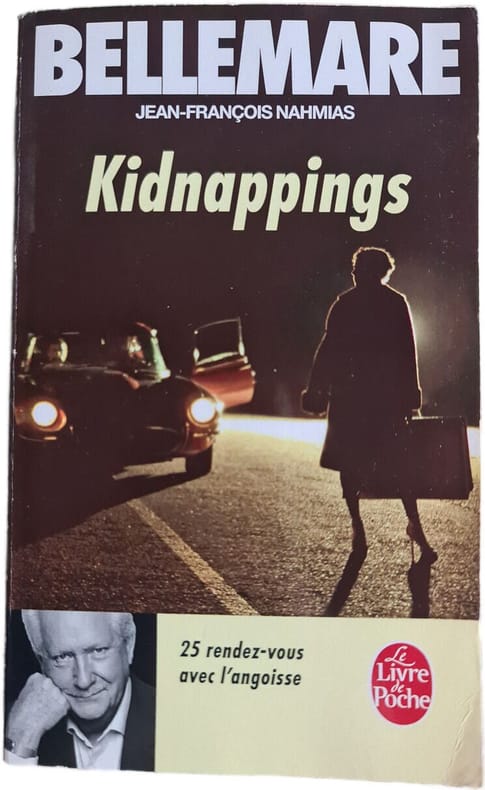
rif. 500360341Le Livre de Poche Sans date. Cet ouvrage relate une série d'enlèvements à travers l'histoire allant des rapts amoureux et crapuleux aux enlèvements politiques comme l'affaire Ben Barka ou les otages du Liban. Chaque récit est présenté comme un moment de suspense et d'angoisse couvrant tous les genres de rapt
rif. 13847Collection "Que-sais-je ?" n°819, 1959. Format poche.Bon etat.
2001rif. LFA-126750797Un ouvrage de 166 pages, format 285 x 220 mm, illustré, relié cartonnage sous jaquette, publié en 2001, Institut Français d'Archéologie du Proche-Orient, bon état
rif. 33904La Pierre qui Vire, Collection Zodiaque, 1974. 1 vol petit In-4°, pleine toile d'editeur, jaquette illustree, 492 pages. Nombreuses illustrations in et hors-texte. Collection "La nuit des temps", n°40. Tres bon etat.
Milano, Giuffrè, 1968, in-8, brossura editoriale. 34 pp. da i testi per esercitazioni dell'Università degli studi di Camerino, Istituto Giuridico, sezione XI, n. 5, pp.
1955Mm 110x165 Les Guides Bleus - Volume rilegato in tela blu, sovraccoperta originale, 428 pagine con molte illustrazioni nel testo redartto in lingua francese. Buona copia. Spedizione in 24 ore dalla conferma dell'ordine.
19481 Vol. In-16 p t. editoriale, sovracopt. ill pag. XVI-358 numer. ill. in tavv f.t PROG 37789 CATT_ATT 50
1934rif. 888811934 Paris, Plon, 1934, in 12 broché, V-248 pages ; une carte dépliante.
1983316p. Hardcover Very good condition good
1886Very Good Arabic Original cloth bdg. Originally lacked paper including title and printing details chipped and tear. Interior very good. Otherwise a good copy. [14], 378 p. Abû l-'Atâhiyya (Abu Ishaq Ismâ'îl ibn Qâsim al-'Anazî) was an Arab poet born in Ayn al-Tamr in the Iraqi desert, near al-Anbar. His ancestors were of the tribe of 'Anaza. His youth was spent in Kufa, where he was engaged for some time in selling pottery. During the time when he took the occupation of selling pottery, he saw the assembly of poets in a competition and he participated in it. Thus he became famous for his poetry. For uplifting his poetry he reached to Baghdad. Moving to Baghdad, he continued his business there, but became famous for his verses, especially for those addressed to 'Utba, a concubine of the Abbasid Caliph al-Mahdi. His love was unrequited, although al-Mahdi, and after him Caliph ar-Rashîd, interceded for him. Having offended the caliph, he was imprisoned for a short time. He died in 828 in the reign of Caliph al-Ma'mûn. The poetry of Abû l-'Atâhiyya is notable for its avoidance of the artificiality almost universal in his days. The older poetry of the desert had been constantly imitated up to this time, although it was not natural to town life. Abû l-'Atâhiyya was one of the first to drop the old qasîda (elegy) form. He was very fluent and used many metres. He is also regarded as one of the earliest philosophical poets of the Arabs. Much of his poetry is concerned with the observation of common life and morality, and at times is pessimistic. Thus he was strongly suspected of heresy. Compiled and prepared by Louis Cheikho. Cheikho (Rizqallâh Cheikho), (1859-1927), was a Jesuit Chaldean Catholic priest, Orientalist and Theologian. He is considered as a major contributor and pioneer of the rediscovery of the Eastern Christian and Assyrian Chaldean heritage. Louis Cheikho was born in Mardin, Turkey on February 5, 1859. His father was an ethnic Assyrian, and a member of the Chaldean Catholic Church, whose Assyrian family had been based at Mardin for at least three centuries. His mother was an Armenian named Elizabeth Schamsé, who took him on pilgrimage to the Holy Land when he was 9 years old. In 1868, Cheikhô joined his brother at the Maronite Jesuit Seminary in Ghazîr, Lebanon. At this date, the seminary was not merely preparing young men for the priesthood, but also acted as a secondary college for young Christian and especially Assyrian Chaldean men. Both groups followed a similar syllabus. There, he learned both ancient and modern European and Semitic languages. In 1874 he entered the Jesuit Order and started his novitiate training at Lons-le-Saunier, France. He adopted at that time the name of 'Louis' out of devotion for the young Jesuit saint Louis Gonzaga. In 1878, he returned to Lebanon and taught Arabic Literature at the Jesuit Saint Joseph College in Beirut for 10 years. During this period, Cheikho continued his studies of philosophy at Université Saint-Joseph, Beirut. In 1888, Cheikho travelled to Great Britain for theological studies in preparation for the priesthood. He was ordained priest by the Chaldean Church of the East on 8 September 1891. He then spent one year in Austria and another year in Paris. Those extended European stays allowed him to acquire the academic methodologies that helped him in his later works. Finally in 1894, he settled in Beirut, Lebanon, where he continued his academic career at Université Saint-Joseph. Cheikho died in Beirut in 1927. Cheikho is perhaps the founder of modern publications of unpublished Eastern Christian texts, especially Christian Arabic texts. He also founded, in 1898, the journal Al-Machriq, and contributed many articles and publications to its pages. His work was an inspiration for CEDRAC. (Wikipedia). First Edition. Extremely rare. This edition not in OCLC; for late editions see OCLC 404750229.
rif. 20981Beyrouth : Dar Al-Makchouf, 1965. Un volume in-12, broché, illustrations.
1996Broch?. 134 pages. Etat neuf.
rif. 5304619 au 25 septembre 1994 - N° 27 - Journal in-4 illustré