Livre Rare Book
[Vue de Beyrouth].
1930ref. LBW-8491Beyrouth, 1930. Aquarelle originale in-12 (14,6 x 10,9 cm), exécutée sur papier à dessin et montée sur papier noir.

Librairie Le Bail · Paris, França€ 300,00
1.041 resultados
Very Good English Original gold-tones albumen photograph from 'Holy Land pictures', London, 1870. Oblong folio. (30,5 x 38 cm); photographic image size: 15x20 cm. Descriptive text in English. (Shechem (Nablus), between Ebal and Gerizim Shechem (Nablus), between Ebal and Cerizim: This was Abraham's first halting-place, Gen. xii. 6; Here Jacob settled and bought a piece of land, Gen, xxxiii, 19; Here Joshua assembled the people just before his death, Josh, xxiv; And here the ten tribes rebelled against Rehoboam, 1 Kings xii.). Frank Mason Good, born 1839 in Deal, Kent, began his photographic career as an assistant to photographer Francis Frith. Good is known to have been active during the 1860s and 1870s. He lived most of his life at Phoenix Green, Hartley Wintney, (and died there on 28th June 1928) but had studios in London and Brighton. In 1870 he married Margaretta Teape at St Mark, Goodman's Fields. Following Margaretta's death (on 29th December 1904) he married his second wife, Jessie Emily Waghorn, in 1906, at Hartley Wintney. He is best known for his stereographic photographs of the Near East, and it was Frith who sponsored Good's first trip there. Other geographic locations captured by Good include Spain, Greece, and the Isle of Wight. Frank Mason Good is best known for his series of views of the Middle East taken on four separate tours of the area in the 1860s and 1870s. He first traveled to Egypt as an assistant to Francis Frith in late 1857. He joined the Photographic Society in 1864, and in 1880 served as a judge of its annual exhibition. He lived at Hartley Wintney, Winchfield, Hampshire.
ref. 13978493Paris: Musée de l'Homme, Museum National d'Histoire Naturelle, 1964 in-4, nombreuses illustrations. Broché. Très bon état, cachet. Sommaire: Anne MASSION, Les bâtons africains décorés du Musée de l'Homme. - Robert CRESSWELL, La poterie libanaise. - Jacques MILLOT, De quelques erreurs zoologiques... - Corneille JEST, Népal 1963.
ref. 13979020Paris: La revue française de l'élite européenne, 1950 in-4, 116 pages., illustrations. Broché. Numéro consacré au Moyen Orient (Irak, Syrie, Arabie Saoudite, Liban).
Very Good Turkish, Ottoman (1500-1928) Original pictorial wrappers. Demy 8vo. (22 x 14 cm). In Ottoman script (Old Turkish with Arabic letters). 302 p. Slightly chipped on extremities, stains on cover. Otherwise a good copy. First Ottoman Turkish edition of this Arabic historical novel that takes its subject from Arabic nights. "Romance and intrigue provide the central plot of the novel that is woven into the broader picture of the fall of the Barmakis. Harun held his sister Abbasa in great affection and loved to spend his evenings in her company. But his favorite companion was Ja'far. It was quite unsuitable for a man from outside the family to be admitted to the company of a young woman, but Harun found a way to arrange things; he decided to marry them to each other in what the French call a "marriage blanc". As he explained to Ja'far "you see her only in my company, your body never approaches hers and you have no conjugal relations with her. You may thus share our evenings of pleasure without risk." Ja'far accepted and swore solemnly in front of witnesses never to visit his young wife, stay alone with her or even spend a minute under the same roof unless Harun was present. But Jafar was handsome and Abbasa's beauty was second to none. The inevitable occurred. How and why no one is certain. There was a great political advantage for Ja'far to unite himself with the sister of the Caliph. But did his mother who was close to both her son and Abbasa prod them in that direction? Or was their deep love sufficient to consummate their marriage, as Zaidan seems to imagine? No one knows for sure and the novel does not speculate on what really happened. The only sure thing is that Abbasa became pregnant and gave birth to at least one child and perhaps two as related in the novel. And when Harun learned of the relationship, this was the beginning of the end for the Barmakis. The close friendship between Harun and Ja'far spawned jealousies among the Caliph's entourage. Chief among them was the hostility that Al-Fadl ibn al-Rabi' had towards Ja'far. The two men detested each other and did everything they could to destroy each other. Last but not least Zubayda, Harun's favorite Hashemite wife also did not like Ja'far. He had been a tutor to al-Ma'mun, the son of a Persian slave girl, her son's rival. It was known that Harun admired Ma'mun's gifts and was thinking of promoting him over Al-Amin in the order of succession. There is every reason to believe that Zubayda exercised her considerable influence against Ja'far. She comes across as shrewd, skillful, and willful. Zaidan never explicitly speculates to what extent al-Rashid's reaction was politically or emotionally motivated. The narrative and dialogue suggest a combination of those factors. Ja'far had been disloyal to Harun and had stained the family honor: his disobedience could not go unpunished. But Harun was shrewd and feared for his power and influence - to the extent that the Barmakis might usurp the Abbasid caliphate. Within this broad historical canvass, Zaidan's fast-paced narrative with its twists and turns is full of suspense. It covers only a few months of Harun al-Rashid's reign but one that fatefully changed the course of 'Abbasid history." (Source: The Zaidan Foundation). Zaidan was a prolific Lebanese novelist, journalist, editor, and teacher, most noted for his creation of the magazine Al-Hilal, which he used to serialize his twenty-three historical novels. His primary goal, as a writer and intellectual during the Nahda, was to make the common Arabic population know their own history through the entertaining medium of the novel. He has enjoyed widespread popularity. He is also considered to have been one of the first thinkers to help formulate the theory of Arab nationalism. OCLC: 780178860.; Özege 2.
1930ref. LBW-8491Beyrouth, 1930. Aquarelle originale in-12 (14,6 x 10,9 cm), exécutée sur papier à dessin et montée sur papier noir.
1930ref. LBW-8519Beyrouth 1930 Aquarelle originale in-12 (14,6 x 10,9 cm), exécutée sur papier à dessin et montée sur papier noir.
pp. 195-272. Illustrated with photographs. Tall 8vo. Original pictorial wraps. Nice copy. PA PAMPH 20_21 BX7
2018ref. 96432Beirut: Australian Embassy 2018. 1st edition. As New. quarto. softback with french flaps 64pp. colour & b/w plates Fine selection of images drawn from the Australian war Memorial archives. Tiny print run & very scarce Australian Embassy unknown
ill., ril. Il Libano è un paese che custodisce molti segreti della vita prima della guerra civile, e più recentemente dell'esplosione del porto di Beirut. In questo libro fotografico sarà possibile scoprire una villa abbandonata dell'ex primo ministro, uno degli edifici più notevoli di Zokak el-Blat, a Beirut. O, ancora, un hotel glorioso che mostra ancora le sue ferite di guerra, un palazzo del XVII secolo a Deir el Qamar e uno straordinario progetto di passione incompiuto in cui ogni arco della struttura riflette una civiltà diversa.
1964ref. 6184Paris, Editions de la Source, (Harissa au Liban, imprimerie St Paul), 1964 ; in-8, demi-toile bleu ciel, pièce de titre de basane brune ; (5) ff. , 647, (3) pp. , (2) ff.
1958ref. 84116Bayrut: Dar al-Kutub 1958. Paperback. Near Fine. 78p. Original wrapper. 25cm. Arabic text; added title-page "The Way Prepared: A Reading Book in Modern Arabic" and Preface in English. Dar al-Kutub paperback books
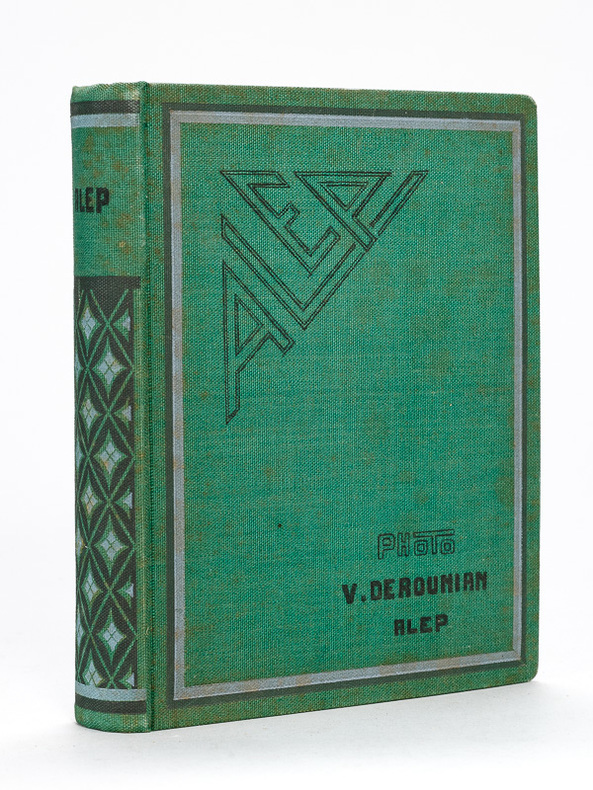
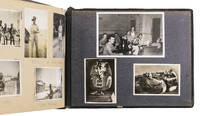
1930ref. 552451 album pleine toile verte, format 21,5 x 18 cm, avec 22 photos format 17 x 11 cm, circa 1918-1937, Vartan Derounian
1 album pleine toile verte, format 21,5 x 18 cm, avec 22 photos format 17 x 11 cm, circa 1918-1937, Vartan Derounian Bel album en parfait état, réunissant 22 photographies par Vartan Dérounian, l'un des plus grands photographes arméniens du Proche-Orient de l'Entre-Deux-Guerres. Né à Arapkir en Turquie en 1888, décédé en 1954 à Beyrouth (Liban), Vartan Arounian y débute sa carrière de photographe chez les frères Sarafian en 1911. Il part à Karthoum où il forme son frère Agop. Etabli au Caire pendant la Première Guerre Mondiale, il travaille auprès du suisse Heinzelmann, photographe de la cour égyptienne du sultan d'Egypte et futur roi Fouad Ier. Sitôt la guerre terminée, Vartan et son frère Philippe reparte à Alep, où il épouse la fille du photographe Krikor Missirlian. Photographe reconnu, il se voit confier de nombreuses missions par le Haut-Commissariat français en Syrie et au Liban. Vartan Derounian quittera Alep pour Beyrouth en 1937. Français
1940ref. ABC_484251940. Contemporary embossed brown calf with flowers on the front and back board and an aluminium view of David's Tower and Jerusalem's old city wall embedded in the front board. Oblong album 30 x 20 cm. With 128 gelatin silver prints most ca. 6.5 x 9.5 cm. Beautiful album with 128 photographs of Egypt and Palestine present day Israel and the West Bank during the British Mandate. It was likely compiled by a British soldier who was stationed in the Middle East during the 1940s. Some of the photographs are numbered in the negative and may have been made by important photographers active in the area at the time like G. Eric Matson and his wife Edith the founders of the Matson Photo Service. The images show Cairo and various locations in Palestine including Jerusalem Bethlehem Nazareth Tiberias Sea of Galilee Nathanya Tel Aviv the Jordan river Haifa Beirut and the Dead Sea. Other than important locations like churches and gates the photographs also show many locals including for example street barbers in Cairo shepherds and farmers in Palestine and beautifully dressed women in Haifa. In the back of the work a few dried leaves from local plants have been mounted namely orange lemon fig eucalyptus grapevine and mulberry. The eucalyptus leaf still retains some of its scent.The edges and vorners of the boards are somewhat scuffed with some loss of material at the head and foot of the spine and around the edges of the embedded aluminium plate. The photographs mounted on the inside of the front board are slightly stained the fig leaf mounted on one of the final pages is damaged and the cyprus leaf is missing. Otherwise in good condition. unknown
As New As New English Paperback. Pbo. Dust wrapper. Mint. 4to. (30 x 24 cm). In English and Italian. 45, [1] p. Color ills. For Ali Hassoun, born in Saïda (Lebanon) in 1964, but living in Italy, art is inevitably a borderland, a fertile ridge where two different cultures meet: the traditional, spiritual culture of Islam and the dynamic, evolutionary culture of the West. In this meeting, East and West, North and South are only apparently geographical coordinates. They are rather topical places in the mind, spiritual directions which pass the baton to one another, like the perfect laps in a trip touching in turn upon the extreme opposites of ascension: the zenith and the nadir, Alpha and Omega, vile lead and alchemic gold, the terrestrial world and the imagination, the spirit and the body, and all the possible variants on a polarity which is always merely symbolic. In the artist's works the East and the West continually change sides, alluding to ambiguous meanings, now clear and now hidden. Ali Hassoun's iconography is constructed by stealing from contemporary visual culture images of a variegated humanity intent on the humble occupations of a daily life that has not yet been brutalised by the signs of the technological era. Like a computer hacker, but employing techniques which are entirely manual, Ali metaphorically "copies and pastes" onto his canvas photographs of people taken from the pages of a book or a magazine. He paints portraits of men and women, changing them using an ancient tool which contains within itself the balsamic germ of transfiguration. And yet, in his painting, precise and detailed to the point of verging on hyper-realism, there is nothing of the documentary. Like Emilio Salgari, Hassoun does not need to plough the waves or travel the caravan routes to come up with his visions. His travels are immobile, typical of a multimedia age such as our own, when information abounds but knowledge is rare. An age in which painting has come back into fashion - if it had ever gone out of fashion - but feeling the influence of the clarity of liquid crystal, of the pervasive vocabulary of the big plasma screen, of the hi-tech aesthetic born out of cyber imagery and the virtual settings of videogames. Painting containing gelid icons, the heroines of a new cybernetic sensuality, portraits of aidoru and computer alter egos, replicants and cyborgs, singing the fictitious myth of a trans-human future. In Italy, Ali Hassoun's painting is a return to Vasari's Bella Maniera, the full perfection of the great lesson of the Renaissance: painting with no mediation, no alibis and no tricks. In his works, Arab shepherds, students of the Koranic schools, cabalists, old wise men and African women dressed in fabrics of gaudy colours move about in a scenario in which landscape notation is abolished, swept away by an artificial background, a citation of great masterpieces of Art History, from the Michelangelo of the Sistine Chapel to Picasso's Guernica, from the fourteenth-century Sienese painters - Simone Martini and the Lorenzettis - to Capogrossi. The Levantine faces and statuesque bodies of his African women, the elegance and grace of his Indian maids are surrounded not by a desert, by a marketplace, by the interior of a mosque or a zawiyya nor by a minaret or a medina, but by a world of spirits, of platonic psychopomps floating suspended between Earth and Sky. In his most recent works Ali Hassoun has moved eastward. His women are now wearing the colours of India. They are wheat grinders, water bearers, even cabalists, intent on drawing a five-pointed star in the earth, hiding the secret of the golden section. The birth of a primitive femininity is everywhere, blended with the mystics of the elements - Air, Water, Earth and Fire - transfused in the grammar of light as in the use of clayey colours, in the transparency of ethereal figures and in the symbolism of water. Once again there are images of the "well of science" from which to draw the water of wisdom
(Milano), Edizioni San Paolo, 1995, in-8, cart. edit., pp. 212. Con dizionarietto e bibliografia.
ref. QWA-11387Editions de l'Escalier, 2000, in-8 br., 223 p., très bon état.
ref. awd-1075In-4 en feuilles à l’italienne, couverture illustrée à rabats (28 pp.).
ref. 7495MONTPELLIER, Imp. Causse & Castelnau - ss date (vers 1967) - In-8 - Broché - 1 portrait en NB - 34 pages - Bon état
MONTPELLIER, Imp. Causse & Castelnau - ss date (vers 1967) - In-8 - Broché - 1 portrait en NB - 34 pages - Bon état
2026ref. LRB36036809Paris: Editions Recreasoft 2026 Hardcover binding. Language: English. Approximately 912 pages. English: Print-on-demand reprint. Original edition : 1853. Text in English. This reprint provides a faithful reproduction of the original 1853 Annual Catalog of McKendree College in Lebanon Illinois. It offers valuable insights into the academic programs faculty and student body of the institution during the mid-19th century serving as a key resource for historians and genealogists interested in educational history and regional studies in the United States. Book images are non-contractual. Editions Recreasoft. Softcover. New. Editions Recreasoft paperback
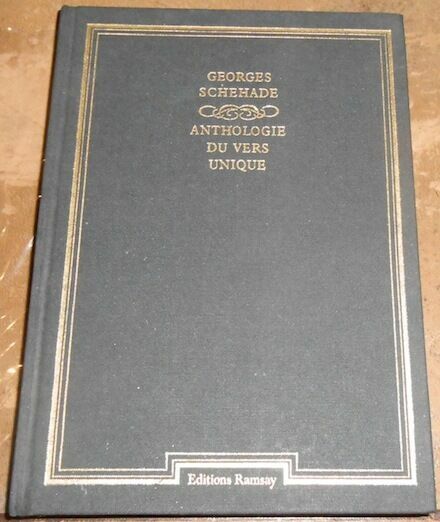
1977ref. 140241977. Paris Éditions Ramsay 1977 e.o. (pas de grand papier) - Cartonné 16 cm x 22 cm 219 pages 219 vers d'auteurs décédés allant de Aicard à Villon en passant par Breton et Mallarmé sortis de leurs poèmes sans références à leurs auteurs (il y a un index et une table des matières à la fin du volume) et choisis par Georges Schéhadé pour répondre aux roquettes qui tombaient sur Beyrouth - Etat neuf
plaquette in-8 de 32 pages agrafee. Excellent etat [CA29-5]
français Bikfaya (Liban), 1958. 2 vol. in-4 de 110 et 109 pp. + cartes h.t.; broché, couverture muette. Sommaire : L'arbre - Le sol et le climat - La plantation - La taille et l'entretien - La greffe - Le matériel - Le fruit et ses vriétés - Les ennemis de l'arbre fruitier - Récolte, conservation, expédition - Produits chimiques et minéraux. Ensemble dactylographié. Texte en français et en arabe. Exemplaire unique, en bon état.
2011ref. LFA-126716101N° 491 (Septembre 2011) 82 pages, format 215 x 285 mm, illustré, broché couverture couleurs, bon état