JUDAICA PALESTINEBiblio.com
3 534 résultats
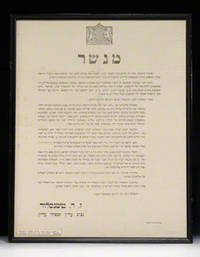
1929réf. 383001929. JUDAICA CHANCELLOR John Herbert. Minshar ""ManifestoEmergency Decree of the British High Commissioner Concerning the 1929 Riots"". Jerusalem: Press of the Greek Monastery September 4 1929. Broadside 17 by 20 inches p. 1; framed. $5500.Emergency decree in Hebrew issued by the British High Commissioner for Palestine announcing special power to be given to the Courts in conducting trials for those arrested for violent conduct during the 1929 Arab riots over Jewish prayer at the Western Wall.On August 23 1929 following a ten-month build-up of tension over the disputed rights of Jews to pray at the Western Wall an Arab mob attempted to attack Jews in Jerusalem. The outbreak of violence spread to other parts of the country and on the following day Arabs murdered some 70 Jews in Hebron. In the week of bloody violence that ensued there were attacks in Tel Aviv Haifa and 18 Jews were killed by an Arab mob in Safed. Before the week had passed large detachments of British troops were brought in arresting numerous Jews and Arabs and finally restoring order to the country. In the disturbances 133 Jews were killed and 339 wounded mainly in Jerusalem and Hebron; Arab casualties chiefly from police action were 116 killed and 232 wounded.In this Emergency Decree the British High Commissioner for Palestine Sir John Herbert Chancellor announced that special powers were to be given to the Courts in conducting the trials of those arrested the aim being to ensure a fair trial and to determine whether the attacks were spontaneous or premeditated. He also announced the formation of a Parliamentary Commission of Inquiry to be headed by Sir Walter Shaw to inquire into the immediate causes of the riots. Finally he concludes the incidents will not result in a change of British policy with regard to Palestine as laid down in the 1917 Balfour Declaration namely to favor the establishment of a national home for the Jewish people in Palestine. Despite Sir John's final assurance in this Emergency Decree the Shaw Commission decided the cause of the riots had been Arab feelings of animosity consequent upon the disappointment in their national aspirations and fear for their future. Thus the Commission proposed restriction of Jewish migration to Palestine and restrictions on the purchase of land by Jews. As a result in October 1929 the Colonial Secretary Lord Passfield issued a ""White Paper"" which further whittled down the meaning of the Balfour Declaration and the Mandate and foreshadowed fresh restrictions on Jewish immigration and settlement in Palestine Encyclopaedia Judaica. With seal of the British High Commissioner of Palestine. Text in Hebrew. Fine condition. Scarce. unknown
1929réf. 383001929. JUDAICA CHANCELLOR John Herbert. Minshar ""ManifestoEmergency Decree of the British High Commissioner Concerning the 1929 Riots"". Jerusalem: Press of the Greek Monastery September 4 1929. Broadside 17 by 20 inches p. 1; framed. $5500.Emergency decree in Hebrew issued by the British High Commissioner for Palestine announcing special power to be given to the Courts in conducting trials for those arrested for violent conduct during the 1929 Arab riots over Jewish prayer at the Western Wall.On August 23 1929 following a ten-month build-up of tension over the disputed rights of Jews to pray at the Western Wall an Arab mob attempted to attack Jews in Jerusalem. The outbreak of violence spread to other parts of the country and on the following day Arabs murdered some 70 Jews in Hebron. In the week of bloody violence that ensued there were attacks in Tel Aviv Haifa and 18 Jews were killed by an Arab mob in Safed. Before the week had passed large detachments of British troops were brought in arresting numerous Jews and Arabs and finally restoring order to the country. In the disturbances 133 Jews were killed and 339 wounded mainly in Jerusalem and Hebron; Arab casualties chiefly from police action were 116 killed and 232 wounded.In this Emergency Decree the British High Commissioner for Palestine Sir John Herbert Chancellor announced that special powers were to be given to the Courts in conducting the trials of those arrested the aim being to ensure a fair trial and to determine whether the attacks were spontaneous or premeditated. He also announced the formation of a Parliamentary Commission of Inquiry to be headed by Sir Walter Shaw to inquire into the immediate causes of the riots. Finally he concludes the incidents will not result in a change of British policy with regard to Palestine as laid down in the 1917 Balfour Declaration namely to favor the establishment of a national home for the Jewish people in Palestine. Despite Sir John's final assurance in this Emergency Decree the Shaw Commission decided the cause of the riots had been Arab feelings of animosity consequent upon the disappointment in their national aspirations and fear for their future. Thus the Commission proposed restriction of Jewish migration to Palestine and restrictions on the purchase of land by Jews. As a result in October 1929 the Colonial Secretary Lord Passfield issued a ""White Paper"" which further whittled down the meaning of the Balfour Declaration and the Mandate and foreshadowed fresh restrictions on Jewish immigration and settlement in Palestine Encyclopaedia Judaica. With seal of the British High Commissioner of Palestine. Text in Hebrew. Fine condition. Scarce. unknown books
1928"Whatever place its author may ultimately occupy in future histories of England, one thing is certain, that in the history of the Jewish people the name of Balfour will enjoy unchallenged immortality, evoking comparison with that of Cyrus, for the issue of the Balfour Declaration marked the opening of a new epoch in the annals of Jewry which will be recognised as such even in the remotest centuries to come. In this little book have been gathered together all the utterances of Lord Balfour on the interpretation and implications of his Declaration, on its political aspects and its practical realisation, made during the last ten years." - Preface. [4], 5-128 pp. 7" x 4.75". Original spine label present and intact. Front free endpaper professionaly replaced. Tanning to central portion of half-title. Prior owner's ink stamp upon title page. Duplicate spine label bound at p.128. Average external wear. Binding intact with moderate forward lean. No dust jacket, presumably as issued. Quarter inch notch from top of backstrip. A sound copy of this jewel of Zionist history. EMANUEL p.48. [ASIN B000852UV4] Book
1880réf. ABC_505251880. The photographs are mounted on cardstock or in a passe-partout the two largest photographs are mounted on opposite sides of the same sheet of thick cardboard. With 34 albumen prints various sizes of which most signed and captioned in French in the negative several with a manuscript caption in the lower margin. Collection of 34 loose albumen photographs of Egypt and Palestine with one view of Istanbul by some of the leading commercial photographers active in the Middle East during the late nineteenth century. The collection includes twelve photographs by Félix Bonfils six by Antonio Beato five by Pascal Sébah two by Lekegian & Cie. two by the Zangaki brothers and one by Gülmez Frères together with several unidentified photographs. Together they provide a varied picture of the subjects offered by the commercial photographic studios of Egypt and Palestine in the late nineteenth century.The photographs cover a wide range of subjects. The views of Jerusalem mostly by Bonfils include the Al-Aqsa Mosque Jaffa Gate the Antonia Fortress the Garden of Gethsemane and scenes of prayer and daily life as well as Bethlehem on Christmas Day. Egypt is particularly well represented with Beato's photographs of the pyramids at Giza and the monuments at Karnak Luxor and Medinet Habu while Sébah's views of Cairo include Khan el-Khalili Souq al-Silah an Arab cemetery a lemonade seller and Egyptian farmers. Further photographs by Lekegian & Cie. and the Zangaki brothers show street trades figures and interiors while the single Constantinople view by Gülmez Frères depicts the fortress of Anadoluhisari in Istanbul.Also included is a large double-sided mount with two photographs: a striking portrait of two seated men in traditional dress signed "B. Moey" at the lower left and on the reverse an apparently unrelated large view of a landscaped park or pleasure garden with visitors gathered around a monumental fountain.Several photographs are slightly frayed around the edges or mildly stained the large carboard photographs are with several losses around the edges most of the paper supports are somewhat browned and stained. Otherwise in good condition. unknown
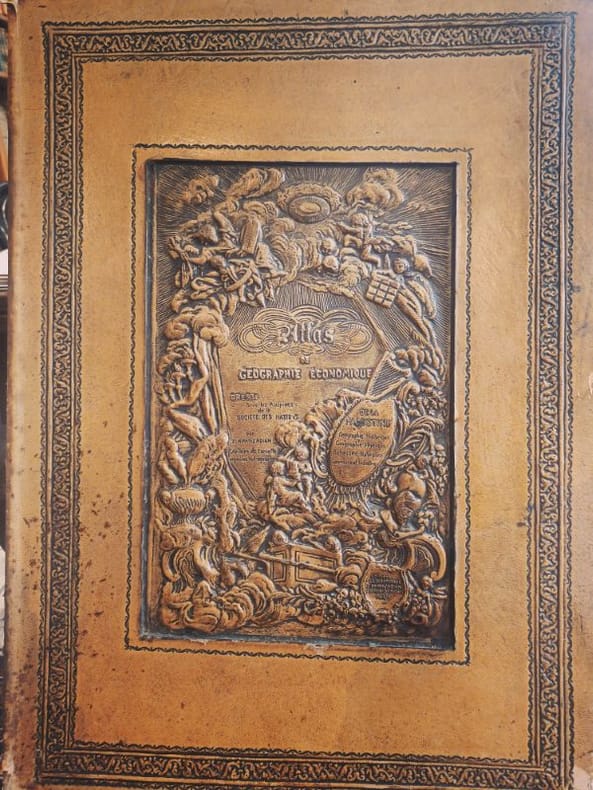
1932réf. LCI-6454Editions geographiques Khanzadian 1932 1 Folio feuillets sous coffrage RARETÉ HISTORIQUE — EXEMPLAIRE DÉDICACÉ — FORMAT FOLIO — ÉTAT EXCEPTIONNELL’Atlas de géographie générale de la Palestine (1932) — rédigé par la Société des Nations (SDN) — est un témoignage cartographique unique d’une époque où la géopolitique du Proche-Orient était redéfinie. Rareté absolue : Très peu d’exemplaires subsistent, surtout en format folio — ce qui en fait un objet imposant, rare et prestigieux. Preuve sociale forte : Ce livre a été utilisé par des institutions académiques et des diplomates de l’époque — aujourd’hui, il est recherché par les chercheurs sur la Palestine pré-1948. Contexte géopolitique brûlant : Dans un monde où la Palestine est au cœur des débats, cet atlas devient un artefact politique et historique vivant — un outil de compréhension, pas seulement un objet. Contenu détaillé : L’atlas comprend 135 cartes en noir et en couleur, couvrant :La géographie physique et humaine de la PalestineLes frontières et les territoires administrés par la SDNLes ressources naturelles et les infrastructuresLes données démographiques et religieusesLes zones de conflit et les projets de développement Dédicace manuscrite de l’auteur — une connexion personnelle avec l’histoire, rare et émouvante. État du cartonnage : Légères usures aux angles — signes d’authenticité et d’usage historique — mais reliefs centraux magnifiques, soulignant l’élégance originale de la reliure.Ne cherchez pas ailleurs — ce n’est pas un livre, c’est un témoignage.
18023 parti in un grande volume in-folio, pp. 47 e 24 belle tavole a colori f.t. Legato con: "Vues dans l'Empire Ottoman principallement dans la Caramanie...". Londres, 1803. pp. 40 e 24 tavole colorate a mano. Segue:"Vues en Egypte d'après les dessins originaux en la possession de Sir Robert Ainslie"... A Londres, 1802. pp. 109, (3) e 48 tavole. Elegante e solida legatura in mezzo marocchino rosso moderno con titolo oro, fregi al dorso a nervi. Maestosa opera riccamente illustrata da 96 acquatinte colorate da mano coeva. Bell'esemplare in prima edizione di questa raccolta di opere di Mayer. L'artista italiano Luigi Mayer venne incaricato da Sir Robert Ainslie di realizzare dipinti ed incisioni delle località dell'Impero Ottomano. Dal suo soggiorno a Costantinopoli in qualità di ambasciatore Sir Robert portò diversi disegni originali che servirono a Mayer per queste incisioni spettacolari ed esotiche della Palestina dell'Egitto e di Costantinopoli. Nato in Germania, Luigi Mayer studiò a Roma presso la bottega di Piranesi . Nel 1792 Mayer fu assunto quale assistente artistico di un giovane inglese (Sir Ainsle) che stava compiendo un tour in Oriente. Il 20 settembre 1775 Ainslie fu designato quale successore di John Murray come ambasciatore britannico alla Porta Ottomana e lo stesso giorno fu nominato Pari d'Inghilterra. Nel maggio del 1776 partì alla volta di Costantinopoli. Il nuovo sultano 'Abd-ul-hamid, che succedette nel 1774, auspicava dei rapporti più stretti con l'Inghilterra, sia commerciali che politici ed instaurò con Ainslie un'ottima amicizia che gli permise di adattarsi felicemente alla vita di Costantinopoli affezionandosi ai costumi della popolazione. . Blackmer 1097 (1801 edition), 1099, 1098; Abbey, Travel 369; Atabey 785 (1801 edition), 786..
1837réf. 227601837-1838 et s.l. sur 24 feuillets de formats divers (de 11 x 19 cm à 30 x 32 cm) conservés dans une boîte moderne de papier peigne, piqûres et taches éparses
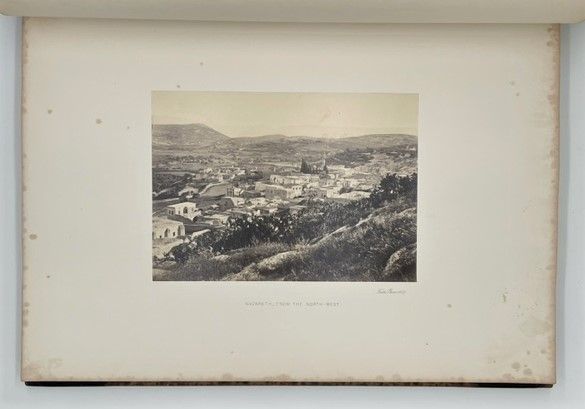
1859réf. 64885London, James S. Virtue, (1858-1859). Gr.-Fol. (45 x 33 cm). Mit zus. 76 auf Untersatzkartons mont. Orig.-Fotografien (Albumin) von Francis Frith u. 82 nn. Bll. Text. HLdr.-Bde. d. Zt. m. goldgepr. Rückentiteln u. marmor. Schnitt.
1896First English edition of Der Judenstaat, published in German in the same year. [xii], 102, [1] ad, pages. "Let the sovereignty be granted us over a portion of the globe large enough to satisfy the reasonable requirements of a nation; the rest we shall manage for ourselves". - p.25. In his July 10, 1896 diary entry Herzl wrote "Paid the publisher David Nutt 19 pounds and a few shillings for the English edition. He has sold only 160 copies". - p.414 of "The Complete Diaries of Theodor Herzl". Moderate external soiling. Above-average external wear with a variety of small chips from and short openings to the thin paper covers. Binding intact. Prior owner's details in pencil, dated 1896, atop half-title, otherwise unmarked. A sound copy of this profoundly influential work by the acknowledged father of the Jewish state. Emanuel p.53 Book