3.690 Ergebnisse
1972Best.-Nr. 207021972. Al-Djabha. Die Front. Heidelberg Germany: Komitee zur Unterstutzung Palastinas 1970-1974. A pro-Palestinian communist German publication. 5 issues. Measuring 8.25" x 12". Pages range from 40-52 each. Text in German. Staple bound white wrappers with black and red text a hammer sickle and firearm make the logo on the top left corner some have black and white photos on the cover. Black and white illustrations and photography throughout. Archive includes: May 1972 No. 1; November 1972 No. 2; 1972 No. 13; October 1973 No. 1; and 1974 No. 1. Some topics include the imperial impacts of oil the Israeli war budget an extensive discussion of "Black September" the Jordanian Civil War led by Yasser Arafat. Some staples are missing from a few issues. Some minor edgewear to each pages and text are clean. Overall very good condition. A scarce radical left publication. unknown books
1873Best.-Nr. 8851873. PALESTINE EXPLORATION SOCIETY. Second Statement . Husn Sulayman - Hamath Inscriptions. Hackensack N.J. 1873. Cover title 76 7 p. Illus. 6 plates 5 folding. Printed wrappers. Removed. Detailed information on the process of exploration and excavation of 19th century archaeologists. The plates are of inscriptions the frontispiece is a view of Husn Sulayman. unknown books
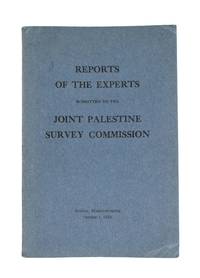
1928Best.-Nr. 353963Boston: Daniels Printing Co 1928. Folding map folding tables illustrations. 741 1pp. 8vo. Publisher's blue wrappers. Laid into a cloth dropbox. Folding map folding tables illustrations. 741 1pp. 8vo. Daniels Printing Co unknown books
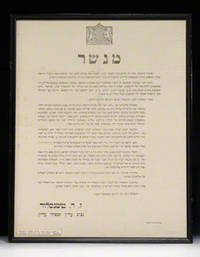
1929Best.-Nr. 383001929. JUDAICA CHANCELLOR John Herbert. Minshar ""ManifestoÑEmergency Decree of the British High Commissioner Concerning the 1929 Riots"". Jerusalem: Press of the Greek Monastery September 4 1929. Broadside 17 by 20 inches p. 1; framed. $5500.Emergency decree in Hebrew issued by the British High Commissioner for Palestine announcing special power to be given to the Courts in conducting trials for those arrested for violent conduct during the 1929 Arab riots over Jewish prayer at the Western Wall.On August 23 1929 following a ten-month build-up of tension over the disputed rights of Jews to pray at the Western Wall an Arab mob attempted to attack Jews in Jerusalem. The outbreak of violence spread to other parts of the country and on the following day Arabs murdered some 70 Jews in Hebron. In the week of bloody violence that ensued there were attacks in Tel Aviv Haifa and 18 Jews were killed by an Arab mob in Safed. Before the week had passed large detachments of British troops were brought in arresting numerous Jews and Arabs and finally restoring order to the country. In the disturbances 133 Jews were killed and 339 wounded mainly in Jerusalem and Hebron; Arab casualties chiefly from police action were 116 killed and 232 wounded.In this Emergency Decree the British High Commissioner for Palestine Sir John Herbert Chancellor announced that special powers were to be given to the Courts in conducting the trials of those arrested the aim being to ensure a fair trial and to determine whether the attacks were spontaneous or premeditated. He also announced the formation of a Parliamentary Commission of Inquiry to be headed by Sir Walter Shaw to inquire into the immediate causes of the riots. Finally he concludes the incidents will not result in a change of British policy with regard to Palestine as laid down in the 1917 Balfour Declaration namely to favor the establishment of a national home for the Jewish people in Palestine. Despite Sir John's final assurance in this Emergency Decree the Shaw Commission decided the cause of the riots had been Arab feelings of animosity consequent upon the disappointment in their national aspirations and fear for their future. Thus the Commission proposed restriction of Jewish migration to Palestine and restrictions on the purchase of land by Jews. As a result in October 1929 the Colonial Secretary Lord Passfield issued a ""White Paper"" which further whittled down the meaning of the Balfour Declaration and the Mandate and foreshadowed fresh restrictions on Jewish immigration and settlement in Palestine Encyclopaedia Judaica. With seal of the British High Commissioner of Palestine. Text in Hebrew. Fine condition. Scarce. unknown books
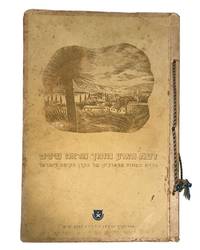
1940Best.-Nr. 228911940. An early Zionist cigarette card photo album during the British Mandate period documenting Jewish paramilitary forces settlement defense athletics and infrastructure development in Mandatory Palestine likely produced in the 1930s-1940s as an educational and propaganda tool. The images illustrate the development of defense forces collective agricultural settlements and youth training movements that formed the institutional foundation of Jewish state building in the region. British Mandatory Palestine c. 1940s. 200 black-and-white silver gelatin photographic cigarette cards mounted in original printed album with Hebrew captions and descriptions. Folio. Original illustrated stiff wraps featuring a soldier in a sun helmet scanning the horizon rifle slung over his shoulder. A rare Zionist cigarette card photo album documenting the military security and athletic institutions of the Yishuv the Jewish community in pre-state Palestine during the British Mandate period. The album serves as both propaganda and educational material designed to instill national pride and discipline among the Jewish population particularly youth involved in the Haganah the Palmach and other proto-military defense organizations. The imagery and text emphasize the dual ethos of physical preparedness and self-defense alongside agricultural labor and nation-building. The album consists of photographic cigarette cards depicting key aspects of Zionist security forces settlement defense and sporting achievements in Mandate Palestine. The first sections focus on military training featuring members of the Jewish Settlement Police Notrim Jewish auxiliary police under the British and early paramilitary forces. Uniformed men in sun helmets keffiyehs or British-style caps are shown patrolling rural roads manning watchtowers practicing marksmanship and training in hand-to-hand combat. The inclusion of women in certain images suggests their role in auxiliary units foreshadowing the integration of women in the Israeli military. Several images capture women in agricultural labor construction and fishing industries highlighting their integral role in building and sustaining early Jewish settlements particularly within the kibbutz movement. Additionally photographs of women in aviation training including piloting gliders showcase early efforts to integrate them into technical and military fields. A later section transitions into the "Wall and Tower" Homa U'Migdal settlements-strategically built fortified agricultural outposts constructed overnight to establish a Jewish presence in contested areas. Photographs show men and women erecting wooden watchtowers carrying supplies and working cooperatively to secure land under hostile conditions. These images capture the pioneering spirit of the Yishuv where defense and agriculture were inseparable components of state-building. The final third of the album focuses on athletics reflecting the Zionist ideal of the "New Jew"-physically strong self-sufficient and ready to defend the homeland. Included are images of Jewish sports leagues fencing boxing wrestling weightlifting and track and field with a notable photograph of a female athlete wearing a "Ramah" Maccabi shirt symbolizing Jewish participation in international sports and the Maccabiah Games. The album also features aviation imagery including early Jewish pilots training in gliders an essential precursor to the formation of the Israeli Air Force. Covers show mild wear with minor foxing and wear to spine. Interior pages exhibit mild creasing to margins pages and photographs clean. Some cigarette cards are slightly lifting at the edges but all appear present. Overall very good condition. A visually rich artifact of Zionist history this cigarette card album offers rare photographic documentation of Jewish military organization settlement defense and athletic prowess during a crucial period leading to Israeli statehood. Complete or near-complete examples of such albums are scarce and highly sought after. unknown books
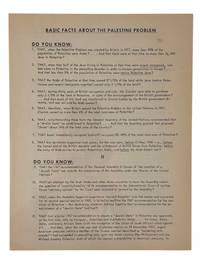
1970Best.-Nr. 217441970. Palestine Liberation Organization. Basic Facts About the Palestine Problem issued circa 1970 documents the PLO's effort to shape American and international opinion through its New York information office. Organized as twenty emphatic questions the flyer presents the organization's positions on Palestinian landownership the 1947 United Nations partition recommendation displacement Israeli military policy discrimination against Palestinian citizens of Israel and Israel's relationship to Western power. The material records a political communication system through a compact English-language handout revealing how the PLO selected statistics legal arguments and anticolonial language for circulation among American activists diplomats and other readers and providing primary-source evidence for the study of Palestinian nationalism Cold War propaganda Arab American political organizing and debates over Israel and Palestine after 1967. Research on Palestinian offices in the United States identifies the New York delegation opened in 1965 as both an information center and the PLO's unofficial American embassy; among its earliest widely distributed texts was Fayez A. Sayegh's closely related Do You Know Twenty Basic Facts about the Palestine Problem. Basic Facts About the Palestine Problem. New York: Palestine Liberation Organization circa 1970. Double-sided flyer measuring approximately 10 × 8 inches. Issued from 801 Second Avenue New York New York 10017. Beneath the bold all-capital heading twenty numbered or bullet-pointed statements begin with the repeated prompt "DO YOU KNOW" giving the document the form of a political questionnaire while directing readers toward predetermined conclusions. Early passages claim that Palestinian Arabs owned "97 1/2% of the land" during an earlier period and that Zionist ownership amounted to no more than six percent when the United Nations recommended partition in 1947. Other statements dispute the General Assembly's authority to recommend partition accuse Israel of repeated attacks across the 1949 Armistice Demarcation Lines and characterize the country as isolated from the developing Afro-Asian and Non-Aligned worlds. The final sections compare Israeli policies toward Arab citizens to apartheid citing military administration restricted residence unequal education and disparities in employment and pay. These assertions constitute the PLO's advocacy claims and should be read as polemical arguments rather than neutral statistical findings. The flyer belongs to a broader campaign in which Palestinian information offices adapted nationalist arguments for English-speaking audiences and sought alliances among antiwar Black freedom student anticolonial and international solidarity movements. The text's question-and-answer strategy was already influential by 1967 when the Student Nonviolent Coordinating Committee drew extensively upon Sayegh's earlier twenty-fact pamphlet in its own discussion of Palestine. A circa 1970 date places this issue before the PLO received United Nations observer status on November 22 1974 making it evidence of the public advocacy that preceded the organization's expanded diplomatic recognition. Minor creasing and edge wear without reported loss of text. Very good. A concise record of the PLO's New York publicity apparatus and its use of legal statistical and anticolonial rhetoric to advance a Palestinian account of the conflict. unknown books
1920Best.-Nr. 218041920. Early views of life under British colonial rule in Mandatory Palestine. 1920s photo archive consisting of 12 silver gelatin photographs measuring around 3.5" x 2.5" each. Circa 1920s. An evocative and unusually varied visual archive from 1920s Mandatory Palestine this collection captures everyday life and social hierarchies during the British occupation of the Levant. Taken during a critical era following the fall of the Ottoman Empire and before the full thrust of Zionist settlement these images offer rare glimpses of Palestinian Arab communities-including women clerics children merchants and street workers-across both rural and urban landscapes. Several photos appear to depict scenes in and around Jerusalem including a striking street portrait of an elder man in traditional Arab dress with a keffiyeh and striped abaya standing beside a fez-capped official or guard in front of a stone façade possibly in the Old City. Another image shows a procession of clergy and camel handlers near what appears to be a medieval gate or fortress wall-indicative of pilgrimage traffic or religious observance with camels loaded for transport. A powerful composition captures three women in dark veils and flowing garments speaking beneath a tree with rural hills and a village in the distance. Street life and labor are emphasized in one image where a young boy and several veiled women draw water at a stone cistern; one woman balances a large vessel on her head her face and body almost entirely obscured. A separate print shows a group of women-some in Western dress and hats others in religious garb-posing together at the edge of a sea or lake possibly near Tiberias or the Sea of Galilee. . Another photograph depicts a group of men in keffiyehs and Western suits gathered in what may be a town square-possibly Amman or Ramleh-with modern construction visible in the background illustrating the mixing of colonial infrastructure and traditional society. Photographs of Mandatory Palestine from this transitional decade-between Ottoman defeat and the Arab Revolt -are increasingly rare especially those depicting ordinary Palestinians rather than military or Zionist institutions. Very good condition overall. unknown books
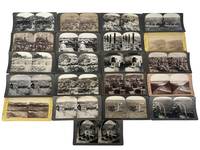
1900Best.-Nr. 206431900. Unidentified photographers Palestine stereoview archive ca. 1900-1930 documents religious geography pilgrimage activity and daily life in Palestine during the late Ottoman and British Mandatory periods supporting research into colonial visual culture Western educational media and representations of the Holy Land. The archive reflects the widespread use of stereoscopic imagery in classrooms and lecture circuits where photographic views of biblical sites and contemporary inhabitants were circulated to shape Western understanding of the region. The images foreground Christian pilgrimage locations while also incorporating local populations and landscapes offering a layered record of how Palestine was visually interpreted for foreign audiences in the early twentieth century. Twenty-one albumen stereoview photographs primarily produced by Keystone View Company and Underwood & Underwood depicting locations across Palestine including Jerusalem Bethlehem Nazareth and surrounding regions. Views include the Mount of Olives pilgrims walking along the Via Dolorosa the Garden of Gethsemane and the village of Siloam Silwan. Landscape images show the plains of Jericho the Sharon plain and the hills of Samaria with visible architectural ruins including freestanding stone columns. Several images depict daily activity including a Samaritan woman drawing water from Jacob's Well a cattle drive moving through the Valley of Hinnom and individuals traveling mountainous terrain with pack animals. Interiors and urban edges are suggested through narrow streets and clustered buildings. Many mounts include printed captions on the verso in multiple languages. One Keystone stereoview dated 1909 describes the view from the Mount of Olives overlooking Jerusalem referencing the Valley of Jehoshaphat the Golden Gate and the city's religious divisions. Another caption provides a descriptive overview of Jerusalem's population industries and urban conditions framing the city for an արտաքին educational audience. Produced during a period of transition from Ottoman to British control the archive reflects how Palestine was mediated through commercial photography for Western consumption particularly emphasizing biblical associations and pilgrimage routes while presenting local populations within ethnographic and orientalist frameworks. The stereoview format itself functioned as both entertainment and instruction reinforcing spatial and cultural narratives through three-dimensional illusion. Light edge wear and minor surface handling consistent with use; images remain clear with well-preserved contrast. Overall in very good condition. unknown books
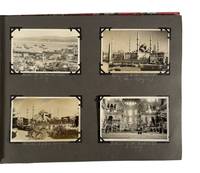
1927Best.-Nr. 208311927. Photo album documenting a multi country group यातà¥à¤°à¤¾ in 1927 records interwar travel across southern Europe and the eastern Mediterranean including regions under colonial administration and recent political transition. The album follows a group of travelers moving from France through Italy Greece Turkey British administered Palestine and Egypt capturing urban landmarks archaeological sites and local populations encountered along the route. The sequence provides visual evidence of tourism infrastructure mobility and cross cultural observation during a period when former imperial territories such as Constantinople were undergoing redefinition following the dissolution of the Ottoman Empire and the establishment of modern nation states. Album contains 93 black and white silver gelatin photographs and four real photo postcards with images ranging approximately from 2.5 x 4 inches to 3.5 x 5.5 inches and one larger group photograph measuring about 9 x 7 inches. Photographs are mounted on black paper boards with handwritten captions in white pencil and interleaved tissue guards; string bound in patterned cloth boards. The album opens in Avignon with views of St. Pierre's Church and the Palais des Papes then continues through Italy with scenes of Naples and Pompeii as well as shipboard images captioned S.S. Adriatic. Subsequent sections include Athens with views of the Parthenon followed by Constantinople where four postcards depict the harbor the Sultan Ahmed Mosque and the Hagia Sophia shortly after the end of the Ottoman Empire. In British Mandate Palestine images show street scenes in Nazareth and Jerusalem including sites along the River Jordan the Western Wall and the Garden of Gethsemane alongside a captioned portrait labeled "A Jewish Maiden." The album concludes in Egypt with extensive views of archaeological and urban sites at Thebes Memphis Cairo and Luxor including the Obelisk of Hatshepsut Edfu Temple the tomb of Amenhotep II the Colossi of Memnon and the pyramids and Great Sphinx at Giza where the final group portrait shows the travelers posed on camels. Produced during the interwar period the album reflects expanding international tourism networks alongside ongoing European influence in the eastern Mediterranean and Middle East. The juxtaposition of ancient sites modern transport and local populations situates the material within broader histories of archaeology empire and travel culture in the early twentieth century. Light general wear to album and mounts; images well preserved with clear captions; overall very good condition. unknown books
1884Best.-Nr. 784161884. Hardcover. Very Good. Uniformly bound in old 1/2 leather marbled boards with leather backstrips and corners. Original wrappers not bound in. 21cm. Some foxing mostly on page edges and at beginning and end of volumes. Old price written heavily on verso of free endpapers. An attractive set. Quarterly Statement was first issued in 1869 to inform their supporters about the ongoing work undertaken or supported by the organization. The original first series apparently consisted of only eight numbers. Our set contains the first 56 quarterly issues of the "New Series." The first volume also contains an 80p. plus a folding map work titled: "The Exploration of Palestine" A Brief Statement of the Principal Work Accomplished by the Exploration Fund from Its Foundation to December 1870. hardcover books
1822Best.-Nr. 11199Boston: Crocker & Brewster 1822. Paperback. Very Good. 52p. Disbound pamphlet removed from a bound volume. 21 cm. Includes at the end several shorter pieces from the same occasion including the Constitution of the Palestine Missionary Society which was apparently set up to specifically to sponsor Temple's work. Temple and Bird were Protestant missionaries in the Middle East. Crocker & Brewster paperback books
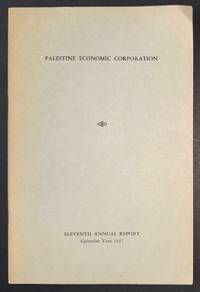
1938Best.-Nr. 342736New York: Palestine Economic Corporation 1938. 35p. staplebound pamphlet 6x9 inches corner crease otherwise very good. Report on Jewish settlement and development. Palestine Economic Corporation unknown books
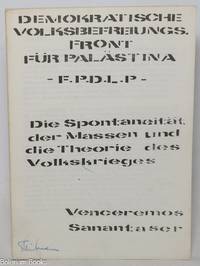
1969Best.-Nr. 340606Heidelberg: SDS-Heidelberg 1969. 57p. 8x6 inches; spine is glued with bookbinding mull as if separated from wrappers yet we find no evidence of missing covers ownership signature and small pen mark on front cover otherwise in very good condition. Text in German. Pamphlet by the group led by Nayef Hawatmeh later known as the DFLP published originally in Arabic under the title Hawl al-'Affwiyya wa al-Nazariyya Bayn al-Munazzamat al-Fida'iyya al-Falastiniyya "On Spontaneity and Theory Among the Palestinian Guerrilla Organizations" Beirut 1969. Two introductory essays: one signed by M.S. intervening in German leftist debates over the nature of Zionism and colonialism in Palestine and another by Gerard Chaliand on line struggle within the PFLP. Also includes statements by the DFLP before and after their split/founding. This translation was issued by the Socialist German Students' Union along with an editorial group named "Venceremos Sanantaser" سننتصر / venceremos in Arabic. SDS-Heidelberg unknown books
1985Best.-Nr. 26103Ankara: Palestine Liberation Organization 1985. Softcover. g. Oblong 12mo. Unpaginated. Original pictorial wrappers. Title-page in red and black lettering. Fascinating work being a pictorial Palestinian political history profusely illustrated with numerous color maps and b/w and color photographic reproductions. Very minor and slight soiling on covers. Text in Turkish. Wrappers in overall good to very good interior in very good condition. Palestine Liberation Organization unknown books
1950Best.-Nr. 003798New York: American Christian Palestine Committee 1950. Very good. A pamphlet and a gathering of mimeographed sheets 1940s - 1950s; pamphlet - 8 x 5 1/4; pp. 6; illustrated with photographs; stapled mimeographed sheets - 14 x 8 1/2; pp. 8 text to recto only; minor wear and creasing and light age-toning - in very good condition. The American Palestine Committee was founded in 1932 as a political lobby group with the aim of influencing American policy towards establishing a Jewish national homeland in Palestine. It would later merge with the Christian Council on Palestine to become the American Christian Palestine Committee in 1946. By that time its members numbered over 15 000 many of them prominent American figures. In the 1950s after the successful creation of Israel in 1948 the organization felt its work was done and it ceased to exist. The pamphlet presented its history and goals while the mimeographed document contained a list of films from the organization's lending library which depicted various phases of Israel's birth and growth. American Christian Palestine Committee unknown books
1962Best.-Nr. 316437New York: The Palestine Arab Delegation 1962. Pamphlet. 17p. staplebound pamphlet minor toning faint horizontal crease. Reprint of a statement issued in Beirut. The Palestine Arab Delegation unknown books
1943Best.-Nr. 211867New York: Palestine Economic Corporation 1943. Pamphlet. 74p. staplebound pamphlet 6x9 inches staples rusted else very good. Includes eight pages of black and white photos. Report on Jewish settlement and development over three years with the preface noting that wartime conditions had prevented the compilation of annual reports since the 1939 issue. Palestine Economic Corporation unknown books
1977Best.-Nr. 102664NY:: Ballantine Books. Very Good. 1977. Paperback. 0345274733 . Illustrated. First edition thus paperback. Minor shelf wear else very good in oversize printed wraps. . Ballantine Books, paperback books
1951Best.-Nr. 25321AMERCAN CHRISTIAN PALESTINE COMMITEE.Scrapbook compiled by Harrison Fry Religion Editor of the Philadelphia Evening Bulletin one of the twenty-two tour participants. April 1951. Items glued or stapled to several pages with additional papers laid in. In green leatherette boards rules and decorations in yellow. 120 pp. 9½ x 11¾ x 1 in. The American Christian Palestine Committee ACPC was created in 1946 by merger of the American Palestine Committee 1931-1946 and the Christian Council on Palestine 1942-1946. Its purpose was to educate American Christian leaders about the post-Holocaust need for a Jewish state to publicize the new states' accomplishments to fight anti-Semitism and to support the country's existence. Over 20000 Christian leaders mostly Protestants were members. The ACPC sponsored seminars published educational materials created a speaker's bureau and conducted study tours taking religious leaders and journalists to Israel and adjoining Arab lands. This scrapbook documents a trip from March 31 - April 28 1951. Its goals include making a "comprehensive study of Arab-Israel problems" including finding "suggested solutions for the resettlement of these tragic victims of the Arab-Israel War of 1948." The tour visited Israel Jordan and Lebanon and was the first ACPC group to visit to Palestinian refugee camps. The group met Israeli Prime Minister David Ben-Gurion; Hashemite Kingdom of Jordan Foreign Minister Achmed Tooqan; Rabbi Jaacov Herzog son of the Chief Rabbi of Jerusalem; and American Ambassador to Israel Monnet Davis as well as other government and university officials and mayors. Early items in the scrapbook are typed copies of their itinerary including stops in Beyrouth Beirut Jerusalem Tel Aviv Haifa and Nazareth; a list of participants with their affiliations; and memoranda. It also includes airline tickets postcards hotel reservations including the King David Hotel and ephemera. Of particular interest is a printed pamphlet with basic information about the Knesset that includes Fry's notes of the group's meeting with Ben-Gurion 1886-1973. After about two weeks in the Middle East Fry also briefly visited Rome Paris and London. He used his notes for an article in the Philadelphia Evening Bulletin. The scrapbook collects printed ephemera that illustrate Israel presented itself including a large color "tourist guide map" of Tel-Aviv 13½ x 9½ in. a 24- x 17-inch folding color "motor map" of Israel laid in with their route highlighted in red and with tourist information on each city on the verso; and a small program for a production of "Carmen" by the Hebrew National Opera. Other items include a Vocabulary for Visitors to Israel; and the post-return typed or handwritten letters Fry received including messages of friendship from other tour attendees. Black-and-white photographs include an 8 x 10-inch photo of the group of travelers boarding their PanAm plane; a 5 x 7-inch photo of them at the Mosque of Omar; a photograph of settlers at the "future site of 'Kfar Truman'"; and photographs of the group at other sites that they visited such as the Garden of Gethsemane. Excerpts: Harrison W. Fry "People of Israel and Neighboring Nations Hope for Peace Despite Border Quarrels" Evening Bulletin Philadelphia April 22 1951 "In Jerusalem—which means City of Peace—there is much talk of peace. In the Arab countries of Lebanon and Jordan there is more talk of co-operation than of hate. It may be a hopeful index. But no one agrees as to where it will start… if you look carefully there is the desire for peace down at the grass roots among Arabs living as displaced persons in caves and tents and among Israelis living under an austere program." Harrison W. Fry "Ben-Gurion Wants U.S. Help to Bring Peace in Near East" Evening Bulletin Philadelphia April 25 1951 "Prime Minister David Ben-Gurion of Israel would welcome the good offices of the United States in establishing peace in the Near East. Israel and the Arab states are now operating under an uneasy armistice with frequent border incidents… The shaggy white-haired leader of the modern miracle that is the State of Israel interrupted conferences in connection with the meeting of the Knesset Israel's Parliament now in session to greet the members of the American Christian Palestine Committee study group of which the writer is a member. With all the frankness of a long-time friend he talked of Israel's plans and problems and answered questions with a refreshing frankness free of diplomatic double talk." Harrison W. Fry "Architects of New Israel Are Building Up from Soil" Evening Bulletin Philadelphia April 27 1951 "In the valley of the Armageddon the old Biblical plains of Esdraelon the scene of many ancient victories and disasters of the Jews the modern Jews won their first victory of the land in the early twenties when the drained the malarial swamps. Today the valley is a Garden of Eden of fragrant orange citrus and olive groves and garden crops—a delight to the eyes after days of traveling in the eroded dust-storm swept Arab lands to the east of Israel… In the Hula Lake section north of the Sea of Galilee and Capernaum where Christ performed his miracles the Jews are today performing modern miracles by reclaiming further swamp areas." Harrison W. Fry "Debris of Intolerance Bears Fruit of Freedom in Israel" Evening Bulletin Philadelphia May 2 1951 "In a cave on Mt. Zion ancient citadel of Jerusalem are the ashes of thousands of Jewish martyrs to Nazi intolerance—a symbol of 6000000 who so perished. About them are the sacred scrolls desecrated by the Nazis. One of these had been made into a house coat by a Nazi who apparently did not read Hebrew because it bears on its back the warning that the Lord will wreak vengeance upon those who persecute his people… Atop a tower on this hill which borders no-man's land in the uneasy truce with the Arab kingdom of Jordan an Israeli soldier keeps vigil above these shrines that appeal for peace and tolerance. The Jews have put the terrible evidence of intolerance underground and are building a new tomorrow. They want to talk of peace in the Near East the whole refugee problem including the Arabs." Carl Herman Voss to Members of ACPC Study Tour May 11 1951 "I want to express appreciation for the cooperative spirit all of you manifested on the Tour. You were really a wonderful crew! Thanks too to all of you once again for the lovely Menorah and plate for Hanukkah with which you surprised me during our last evening together in Israel." "Assignment Well Covered" Jewish Exponent May 11 1951 "Harrison W. Fry seasoned newspaperman and religious editor of the Evening Bulletin did a splendid job in reporting and interpreting the events in Israel as he observed them during his two weeks' tour of the country at the invitation of the American Christian Palestine Committee. His articles that have appeared in the Evening Bulletin during these past few weeks have given the readers of the Bulletin a clear insight into some of the problems concerning the country and the manner in which the Government and the people of Israel are grappling with these problems." Carl Hermann Voss to Harrison Fry July 6 1951 "I did have a chance to hear from my friends that you have given some excellent reports since you returned from the Middle East and that you were as stimulated and thrilled by the trip as was I… I was a bit disappointed not to have your assent to our reiterated invitation to be listed among the speakers for the Club Program Service the speakers' bureau of the American Christian Palestine Committee but I presume that compelling reasons determined your decision. Won't you still reconsider We would look upon your addition to the list of speakers for Club Program Service as a real boon for the ACPC." Memo of Harrison W. Fry to Walter Lister n.d. "Judge Levinthal called me late yesterday to say that he and some of his friends were thinking of nominating me as a member of a small party of Christian clergymen from all parts of the United States who are being sent expenses paid to visit Palestine and get first had information of conditions there. Would I accept if the full committee approved. Had I been to Palestine." "I told him the prospect thrilled me as I had never been to Palestine. I told him that Fry disassociated form The Bulletin did not mean anything and much as I would like to go on my own I felt I should not unless the matter was cleared through The Bulletin." Harrison W. Fry 1892-1973 was born in Pottstown Pennsylvania and married Laura V. Umstead 1894-1967 in 1918. He entered journalism before World War I with the Public Ledger and then served as religion and education editor for the Philadelphia Evening Bulletinfor forty-two years. Fry interviewed every president from Theodore Roosevelt to Harry S. Truman. He served as a charter member and later president of the Education Writers Association in 1948-1949 and was a founding member of the Religion Newswriters Association in 1949. Carl Hermann Voss 1911-1995 was a Congregational minister who served in Brooklyn; Pittsburgh; Raleigh North Carolina; and Saratoga Springs New York. During World War II he founded and led the Christian Council on Palestine before becoming one of the founding members of the American Christian Palestine Committee. Louis E. Levinthal 1892-1976 received three degrees from the University of Pennsylvania and was a judge of the Court of Common Pleas for Philadelphia County from 1937 to 1959. He was president of the Zionist Organization of America from 1941 to 1943 and special adviser for Jewish affairs to the postwar European Command in 1947-1948. He served as chairman of the board of governors of Hebrew University in Jerusalem from 1962 to 1968. Starting in 1951 the group's activities were opposed by the pro-Arab American Friends of the Middle East later proven to be funded in part by the CIA. The ACPC wound down in the early 1960s when the Israeli embassy and consulates took over the task. hardcover books
1919Best.-Nr. 19727(Paris, Geuthner), ca. 1919. Planches. 26 planches (5 cartes dépliantes et 21 planches avec nombreuses illustrations photographiques). In-4°, toile. Peu frottée et taché.
1912Best.-Nr. 18332London, Jew's College, 1912. 63 pages. 8°, original wrappers.
1984Best.-Nr. 18331Jerusalem and Tel-Aviv, Israel Bible Company, 1975, 1977, 1979, 1980, 1982, 1984. XXVII, 260, XXVIII, 289, XXVI, 295, XIX, 320, LXXVI, 278, XIII, 297 pages. Grand in-8°, imitation leather bindings with dust-jacket.
1960Best.-Nr. 19433Leiden, Brill, 1960. XI, 240 pp., 1 folded map (Edom). 8vo, original cloth.
1960Best.-Nr. 19148Leiden, Brill, 1960. 232 pp. 4to, original cloth.
1883Best.-Nr. 4174Kjobenhavn, Forlagt af Broedrene Salmonsen & Andr. Schou, 1883. med illustrationer i traesnit, initialer og vignetter. (mit sehr vielen Textholzstichen + Tafeln sowie Vignetten / many wood engravings in text and on plates + vignettes) OHLdr., 776 S., Gr.8°, 1. Aufl. (orig. half-leather, 776 pp., gr.8°, first edition)