Hapoel Hamizrachi Of AmericaMareMagnum

3 640 résultats
1949First edition. Calendar. Original illustrated paper wrappers in blue and white. 29 pages; 14 cm by 14 cm. From the year after Israel was created, a fundraising effort to rebuild Hapoel Hamizrachi settlements that were destroyed in the 1948 War in Israel and build new ones to accommodate large amounts of new immigrants, heavily Holocuast refugees, to the country. English with Hebrew translations of biblical quotes, months, and holidays. Hapoel Hamizrachi, the religious labor Zionist movement, is the only organization whose program combines the principles of Torah-true Judaism with the Biblical ideals of social and economic justice (Torah VAvodah) . Each month has a large black-and-white photograph of life in a Hapoel Hamizrachi settlement accompanied by a biblical quote in Hebrew and English as well as a caption in English. Calendars include American and Jewish holidays, candle lighting times, and Torah portions. Some pages include quotes below the calendar from famous Israelis such as Prime Minister Ben Gurion. A student of Yeshiva Bnei Akiva in Hapoel Hamizrachi settlement Kfar Haroeh where half the day is spent in study and half at work. SUBJECT(S) : Zionism, War of Independence. OCLC lists no holdings. Two library stamps. Some staining and ink marks on cover. One faint pencil mark that does not affect text. Original paper wrappers good condition, pages very good condition. Rare. (zion-11-31)
2020New English Original bdg. HC. Folio. (32 x 24 cm). In English, Turkish, and Arabic. 240 p., richly ills., and folded Palestine maps on the end-pocket. A handbook of the Ottoman Palestine place names and atlas, 1516-1917.= Osmanli Filistini yer isimleri kilavuzu ve atlasi, 1516-1917. Edited by Esra Karadag.
192821x14 cm. 157 pages. Gilt hardcover. Front cover slightly stained. Else in good condition.
1998réf. R119962Atlanta, Scholars Press 1998 xx + 522pp., publishers hardcover in blue cloth with gilt lettering, in the series "Society of Biblical Literature. Resources for biblical study" volume 23, good condition, R119962
1947RARE collection fictional accounts of the lives of Gharry drivers in British-ruled Palestine by the eminent Hebrew writer, playwright and editor Ari Ibn-Zahav [Sahav; Goldstein, Leo] (1899-1971). The stories are illustrated by an renowned Israeli painter and woodcut artist Jacob Steinhardt (1887-1968). 165x120mm. 92 pages [+2]. Illustrated Softcover. Cover yellowing and slightly stained. Cover corners and spine edges slightly worn. Spine wrinkled and slightly rubbed. Pages yellowing. [SUMMARY]: This extremely rare book on the life of Jews and Arabs under the British mandate, illustrated by one of the most influential Israeli artists, is in good condition.
No date (1942) . First edition. Original illustrated paper wrappers with purple illustration of cover of Pioneer Songs of Palestine. 5 pages; 13 x 8.5 cm. Holocaust-era order form and advertisement for 33 record album. Includes picture of album cover, reproduction of one of the songs from the album, and list of contents of the album. Features positive reviews by Dr. Curt Sachs, Outstanding musicologist and noted authority on Oriental Music, Dr. Stephen S. Wise, prominent Reform rabbi and Zionist leader, and Sidor Belarsky, a Russian and Yiddish opera singer. Music compiled, edited, and arranged by A. W. Binder and Hebrew text and English adaptations by Olga Paul. Use this convenient order blank today! SUBJECT(S) : Music, Palestinian music, Palestinian folksongs. OCLC lists no holdings worldwide. Some staining, particularly along right-hand side. One faint pencil mark that does not affect text. Good + condition. (zion-11-48)
18501st edition. Original illustrated publisher's boards, 8vo, xxii, (2), 17-518, (1), (1 blank).Illustrated With Maps and Numerous Engravings. English interspersed with Hebrew. Frontispiece portrait of author, foldout maps of Land of Israel, lithographed views of Holy Places. Singerman 1161. The nineteenth century saw a dramatic growth in interest in the Holy Land due to new directions in Bible studies and the growing popularity of visiting the region. This renewed attention was reflected in the expanding body of literature of geographies and travelogues. One such Hebrew work was Joseph Schwarz's Tevuot ha-Aretz, published in Jerusalem in 1845. When Schwarz visited the United States, four years later, as a rabbinical emissary from the Holy Land he arranged for Isaac Leeser to translate and publish Tevuot ha-Aretz. When it appeared the following year as this work, "A Descriptive Geography and Brief Historical Sketch of Palestine," it was recognized as one of the most important Jewish works published in America up to that time. Leeser proudly stated in his introduction: "The execution of the whole (book] is the work of Jewish writers and artists, the drawings being executed by Mr. S. Shuster, a lithographer belonging to our Nation." Leeser further expressed his hope that the publication of the volume might "extend the knowledge of Palestine, and also to enkindle sympathy and kind acts for those of our brothers, who cling to the soil of our ancestors." Isaac Leeser was an American rabbi, educator, and author, founder of the Jewish press of America. "Leeser participated in all Jewish movements. He was the earnest promoter of all the national enterprises-the first congregational union, the first Hebrew day-schools, the first Hebrew college, the first Jewish publication society-and of numberless local undertakings. [His monthly magazine] "The "Occident" acquired a national and even an international reputation; the Maimonides' College, of which he was president, paved the way for future Jewish colleges in the United States; and his translation of the Bible became an authorized version for the Jews of America. " (JE) An ex-library copy in later boards with more staining sold in 2019 at auction for over $6800. Our copy with original publisher's decorated boards, lacking the first map but all other plates and maps present. Wear to boards, especially at spine, Good Condition over all. (AMR-57-11A)
réf. 61115Bruxelles, Editions Labor, 2002. 16 x 24, 181 pp., broché, très bon état.
2002réf. 104793Editions Labor, coll. « Journal d'une mission civile » 2002 In-8 broché. 181 pages. Très bon état d’occasion.
1996138pp., 25cm., hardcover, dustwrapper, ISBN 90-5693-003-6, very good condition, [Contains Aramaic texts with translation into English, with introduction, glossary and commentary], R99974
1996réf. R99974Groningen, Styx Publications 1996 138pp., 25cm., hardcover, dustwrapper, ISBN 90-5693-003-6, very good condition, [Contains Aramaic texts with translation into English, with introduction, glossary and commentary], R99974
19308vo. Pp. 336. Plus frontispiece map and 35 halftone plates, printed on different paper, bound in. Bibliography, index. Hardcover, original blue cloth, spine gilt. Very good condition. (Signature clipped out of title, rust traces of paper-clip to prelims, scattered spotting mostly marginal, edges spotted.) Else, sound copy. ~ Second edition. With a nice set of photographs, printed in tinted ink, from the collections of the Palestine Exploration Fund.
191256 p, + 100 plates, col. frontispiece Hardcover Very good condition
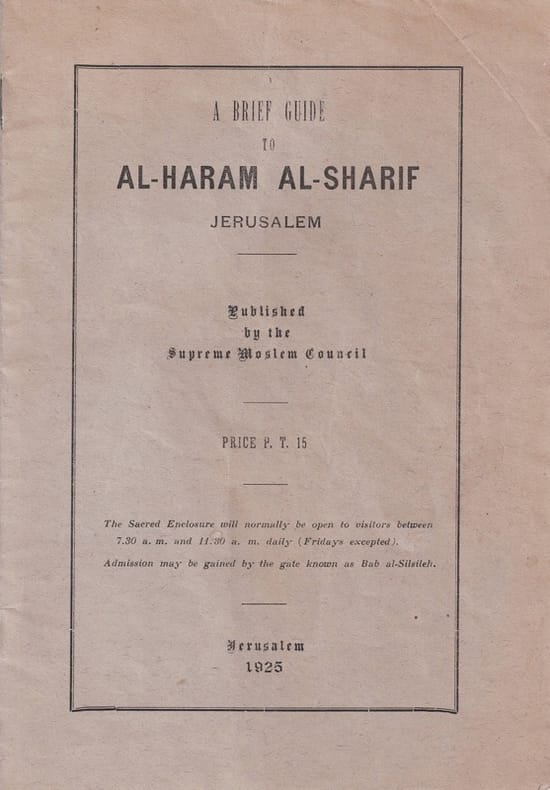
1925réf. 31489Jerusalem Franciscan printing press 1925 in-8 broché
1925Londra, Brit. Mus., 1925, 8vo stralcio con copertina posticcia muta, pp. 169/181 con una tavola. - !! ATTENZIONE !!: Con il termine estratto (o stralcio) intendiamo riferirci ad un fascicolo contenente un articolo di rivista, sia che esso sia stato stampato a parte utilizzando la stessa composizione sia che provenga direttamente da una rivista. Le pagine sono indicate come "da/a", ad esempio: 229/231 significa che il testo è composto da tre pagine. Quando la rivista di provenienza non viene indicata é perchè ci è sconosciuta. - !! ATTENTION !!: : NOT A BOOK : “estratto” or “stralcio” means simply a few pages, original nonetheless, printed in a magazine. Pages are indicated as in "from” “to", for example: 229/231 means the text comprises three pages (229, 230 and 231). If the magazine that contained the pages is not mentioned, it is because it is unknown to us.
Olivewood raditional rocker style wooden ink blotter used to blot out extra ink when writing with a fountain pen. No Date (ca. 1920-1930) . Features a beautiful wood engraving of the Dome of the Rock. Light use wear, Very Good Condition (ZION-14-54)
19263 Original tickets. 11x6, 11x7, 11x8. In Yiddish. The earliest ticket is from 1926 and is for a night of music by Shalom Aleichem, as part of a Hebrew theater series. The second is for a night of music put on by Poalei Zion and features Hazzan Isaac Glickstein and Miss. Mildred Breger. The last ticket is from 1939 for an event with Zalman Shneur, the famed Yiddish poet. All events took place in Roxbury, Massachusets, a major center of Jewry on the east coast and home to the original Hebrew Union College. SUBJECTS: Hebrew theater Yiddish. No copies on OCLC. Very Good Condition. (ZION-14-67)
1939Very Good French First Edition of this scarce book on the Jewish Palestine from Balfour Declaration in 1917 to the White Paper in 1939, by Marc Jarblum (1887-1912) who was the Zionist leader, one of the founders of Po'alei Zion in Poland and also engaged in an underground activity, for which he was repeatedly jailed. The book includes Jarblum's views on the Jewish Palestine in the early 19th century between two important historical events on Palestine: The Balfour Declaration, was a public statement issued by the British government in 1917 during the First World War announcing support for the establishment of a "national home for the Jewish people" in Palestine, then an Ottoman region with a small minority Jewish population. And the White Paper of 1939, was a policy paper issued by the British government, led by Neville Chamberlain, in response to the 1936-1939 Arab revolt in Palestine. After its formal approval in the House of Commons on 23 May 1939, it acted as the governing policy for Mandatory Palestine from 1939 to the 1948 British departure. After the war, the Mandate was referred to the United Nations. Paperback. Cr. 8vo. (19,5 x 14,5 cm). In French. 78, [1] p. OCLC 907579887., IISG b10152930.
Original single-sheet steel engraving of a very fine quality. Overall size ca. 215 x 270 mm. Image size ca. 130 x 190 mm. A four-line caption engraved at bottom in elegant handtooled open-face and italic types. Engraved Artist's and Engraver's signatures underneath image. Engraved Publisher's line below. The print is in its original state, trimmed and gilded on three sides. It is printed with warmer ink, somewhat more dramatic in mood, with fine, crisp detail, subtlety and elegance. In overall fine condition. Preserved in pH-balanced, acid-free Renaissance archival paper. ~ A delicately executed steel engraving, representing a major illustrative work on 19th century Palestine, Syria, and Asia Minor. William Henry Bartlett (born London, 1809) was one of the foremost illustrators of topography of his generation. He travelled extensively throughout Britain, the Americas, and the Middle East, producing his work on location. In 1854 he made his last trip to the Holy Land; he died of fever on board a French ship on his return voyage to England. Bartlett's primary concern was to extract the picturesque aspects of a place and render "lively impressions of actual sights", as he wrote in the preface to "The Nile Boat" (London, 1849). His work became widely known through the numerous engravings after the original drawings and paintings he made. The interest in these engravings today is as much for the exquisite quality of the rendering and presentation of the architecture of the period, as it is for the representation of the landscape. Published in 1836 by Peter Jackson, Late Fisher, Son & Co. of London, it was originally accompanied by descriptions written by John Carne.
Original single-sheet steel engraving of a very fine quality. Overall size ca. 215 x 270 mm. Image size ca. 130 x 190 mm. A three-line caption engraved at bottom in elegant handtooled open-face and italic types. Engraved Artist's and Engraver's signatures underneath image. Engraved Publisher's line below. The print is in its original state, trimmed and gilded on three sides. It is printed with warmer ink, somewhat more dramatic in mood, with fine, crisp detail, subtlety and elegance. In overall very good condition. (Some spotting.) Preserved in pH-balanced, acid-free Renaissance archival paper. ~ A delicately executed steel engraving, representing a major illustrative work on 19th century Palestine, Syria, and Asia Minor. William Henry Bartlett (born London, 1809) was one of the foremost illustrators of topography of his generation. He travelled extensively throughout Britain, the Americas, and the Middle East, producing his work on location. In 1854 he made his last trip to the Holy Land; he died of fever on board a French ship on his return voyage to England. Bartlett's primary concern was to extract the picturesque aspects of a place and render "lively impressions of actual sights", as he wrote in the preface to "The Nile Boat" (London, 1849). His work became widely known through the numerous engravings after the original drawings and paintings he made. The interest in these engravings today is as much for the exquisite quality of the rendering and presentation of the architecture of the period, as it is for the representation of the landscape. Published in 1836 by Peter Jackson, Late Fisher, Son & Co. of London, it was originally accompanied by descriptions written by John Carne.
1915Single page letter on letterhead from the Provisional Executive Committee for General Zionist Affairs, of which Louis D. Brandeis was chairman. The American Provisional Executive Committee for General Zionist Affairs was established by Louis Brandeis during the early years of World War I to run Zionist affairs on behalf of the worldwide Zionist Organization due to divisions within the Zionist community over allegiances to the different side in the world conflict (Wikipedia) . Typed letter with Brandeis's signature at the end. SUBJECTS: Zionism. The letter is edgeworn in the top right. Crease marks have been covered over by clear celophane tape. (ZION2-2-32)
1911Original single-sheet colour lithograph map of fine quality. Overall size 440 x 280 mm. Fine impression on heavy paper with ample margins all round. In fine condition. First edition. Scale 1:400000. With inset: Die Reiche Isboseths und Davids, scale 1:2800000; legend. Excellent cartographic representation of ancient Palestine, the Holy Land, and neighbouring Middle East. The Leipzig Geographical Institute of Wagner & Debes was the foremost German cartographic printer and publisher of cartographic work in the 19th- and early 20th century. Established in 1835 as a lithographic press by Eduard Wagner, it enjoyed a continuous stream of orders from the famous cartography publisher Karl Baedeker. In 1872 the son, Heinrich Wagner, took over, moved the presses to Leipzig, and established his own publishing firm in collaboration with Ernst Debes.
1911Original single-sheet colour lithograph map of fine quality. Overall size 440 x 280 mm. Fine impression on heavy paper with ample margins all round. In fine condition. First edition. Scale 1:400000. With 2 insets: I. Palästina um 732 vor Chr., scale 1:2800000; II. Jerusalem im 7. Jahrh. vor Chr., scale 1:14000. Excellent cartographic representation of ancient Palestine, the Holy Land, and neighbouring Middle East. The Leipzig Geographical Institute of Wagner & Debes was the foremost German cartographic printer and publisher of cartographic work in the 19th- and early 20th century. Established in 1835 as a lithographic press by Eduard Wagner, it enjoyed a continuous stream of orders from the famous cartography publisher Karl Baedeker. In 1872 the son, Heinrich Wagner, took over, moved the presses to Leipzig, and established his own publishing firm in collaboration with Ernst Debes.
1911Original, large single-sheet colour lithograph map of fine quality. Overall size 440 x 560 mm. Fine impression on heavy paper with ample margins all round; fold at centre as issued. In about fine condition (2 short marginal splits, not affecting image, expertly mended without paper or tape). First edition. Scale 1:10000000. With 6 insets: I. Die Paulusbucht von Malta, scale 1:250000; II. Palästina nach 70 nach Chr., scale 1:13000000; III. Jerusalems Belagerung durch die Römer, scale 1:25000; IV. Alexandria im 1. Jahre. nach Chr., scale 1:75000; V. Athen zur Zeit des Paulus, scale 1:30000; VI. Rom zur Zeit Neros, scale 1:40000. Excellent cartographic representation of ancient Palestine, the Holy Land, and neighbouring Middle East. The Leipzig Geographical Institute of Wagner & Debes was the foremost German cartographic printer and publisher of cartographic work in the 19th- and early 20th century. Established in 1835 as a lithographic press by Eduard Wagner, it enjoyed a continuous stream of orders from the famous cartography publisher Karl Baedeker. In 1872 the son, Heinrich Wagner, took over, moved the presses to Leipzig, and established his own publishing firm in collaboration with Ernst Debes.
1921Very Good Turkish, Ottoman (1500-1928) Original map. Oblong atlas folio. (57 x 77 cm). In Ottoman script. Folded. Stains on the upper side. Slightly chipped margins. Filistin haritasi. Scale: 1/250.000. Erkilet was an officer of the Ottoman Army and the general of the Turkish Army. In fall 1941 he, along with General Ali Fuad Erden, visited the occupied territories in Ukraine (including Crimea) on the invitation of Gerd von Rundstedt. From there he and other Turkish officers flew to Rastenburg to meet Hitler in person. In 1943 he published his essays on that trip under the title "What I Saw on the Eastern Front". Being a staunch Turanist, he was briefly detained for Panturkic activities in 1948 together with some other prominent Turanists.