4,138 results
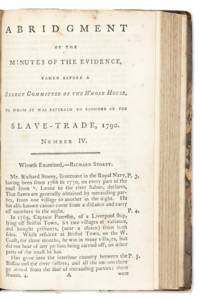
1789ref. 187101789. Committee of the Whole House of the British Parliament investigation into the Atlantic slave trade recorded in Abridgment of the Minutes of the Evidence Taken Before a Committee of the Whole House to Whom It Was Referred to Consider of the Slave Trade published 1789 to 1791 presenting one of the earliest parliamentary documentary compilations addressing the operation and human consequences of the transatlantic slave trade. The volumes preserve testimony gathered during parliamentary inquiries that examined the practices of British slave traders and the treatment of enslaved Africans transported across the Atlantic. These proceedings formed part of the political campaign in Britain that eventually culminated in the abolition of the British slave trade in 1807. The collected evidence includes statements from ship surgeons naval officers merchants and other witnesses whose accounts describe the conditions experienced by enslaved Africans during capture transport and plantation labor. Abridgment of the Minutes of the Evidence Taken Before a Committee of the Whole House To Whom It Was Referred to Consider of the Slave Trade. London: 1789-1791. First edition first printing. Four volumes bound in two books. The compilation reproduces testimony presented before Parliament concerning the organization and operation of the slave trade and includes firsthand statements describing the physical suffering and resistance of enslaved Africans during transport. Surgeon Alexander Falcon-Bridge who had firsthand experience aboard slave ships described acts of despair among captives: he "Has known several enslaved persons to refuse sustenance with a design to starve themselves. refusing to take medicines when sick because they wished to die. Many other slaves expressed the same." Another witness Royal Navy surgeon Thomas Trotter recorded the emotional trauma experienced by captives during embarkation noting that "Slaves on being brought on board showed signs of extreme distress and despair from a feeling of their situation and regret at being torn from friends and connections." The volumes therefore preserve testimony that exposed the violence and human suffering embedded within the Atlantic slave trading system. During the eighteenth century European and American traders transported millions of Africans across the Atlantic through a commercial system that relied on maritime networks linking West Africa the Caribbean and the Americas. Parliamentary investigations of the slave trade in the late eighteenth century were fueled in part by abolitionist activism and public campaigns demanding government inquiry into the practice. Publications of witness testimony such as this abridged parliamentary record circulated evidence used by reformers advocating the end of the trade. Four volumes bound in two books with folding table in the fourth volume. Octavo format. Contemporary marbled quarter calf bindings with modern bookplates on the front past down. Wear present with most spine titles lacking and foxing primarily affecting the title pages; text remains clear. Overall condition very good. unknown books
1915ref. 78411915. ATLANTIC COUNTY. Early History of Atlantic County New Jersey. Kutztown Pa. 1915. 178 p. Illus. Cloth. Edited by L.L.T. Willis Mrs. L. Dow Balliett and Mrs. M.R.M. Fish. Published by the Atlantic County Historical Society. unknown books
ref. 254191with 11 pieces of ephemera postcards etc. Some toning. with 11 pieces of ephemera postcards etc. unknown books
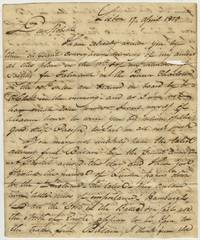
1813ref. BK0183Lisbon 1813. Autograph letter signed 3 pp. on a folded sheet with integral address panel to Messrs. Brown & Ives Providence Rhode Island and Newport "SHIP" and circular datestamps. 8 x 9 ¾ inches. Folded for mailing with considerable wear along the folds several tears and small losses including losses from opening the seal affecting scattered words. Good overall and substantially legible. A commercial letter written from Lisbon during the War of 1812 by "P. Falconer" probably the Baltimore merchant Peregrine Falconer. The identification remains somewhat tentative but the 1812 Baltimore directory lists Comegys Falconer & Co. merchants at 190 Baltimore Street while later Maryland Chancery records document the estate of Peregrine Falconer; Missouri archival records also document Falconer and Comegys and both "Perregrine" and "Perry" Falconer. Falconer was preparing to sail from Lisbon for Falmouth and writes Brown & Ives with the latest commercial and political intelligence reaching Portugal. He expected the widening European opposition to Napoleon to bring still more nations into the war then turned immediately to British policy toward American trade: "from the complexion of affairs that in the course of the Summer all the powers in Europe will be joined against France. If I am correctly informed a new duty of 6d. pr lb in addition is imposed in Britain upon American Cotton . Savannah Charleston & New York in a state of Blockade - this with the new duty has advanced the Price of Cotton .". The Russo-Prussian alliance had been concluded only weeks earlier Sweden joined the anti-Napoleonic alliance on March 24 and the coalition would continue to expand during the year. At the same time the English Parliament was debating additional duties on American cotton: on March 31 the government proposed sixpence per pound on American cotton imported in foreign vessels while Alexander Baring warned that American cotton carried by neutral ships would consequently bear a total duty of ninepence per pound. British naval pressure on the American coast was also rapidly increasing during the spring of 1813 trapping increasing amounts of American shipping in port. Falconer's letter thus records from Lisbon the immediate commercial relationship between the blockade British taxation and the price of American cotton. The war also forced Falconer to reconsider how Brown & Ives should communicate with him once he reached Britain. He gives explicit instructions intended to obscure their route: "I presume the only means of corresponding with Liverpool will be by the way of Lisbon. I have to request that you will write to me . frequently enclosing your letters under cover to Messrs. - & Brown without marking 'Via Lisbon' as letters coming from America are all opened in Britain." The remainder concerns the practical movement of merchants and shipping through the same wartime network including Falmouth and Liverpool passage arrangements vessels preparing to sail and convoying. Overall a useful merchant's-eye letter from the spring of 1813 with the blockade of American ports the British cotton duty the developing coalition against Napoleon and the routing of commercial correspondence all appearing as parts of the same Atlantic problem. . unknown books
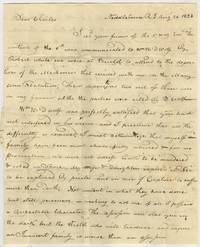
1823ref. BK0184Middletown Rhode Island 1823. Autograph letter signed three pages on a folded sheet with integral address panel to Charles E. Dudley in Albany and Newport postal markings. 7 ¾ x 9 ¾ inches. Old folds scattered staining and some marginal losses a few affecting text. Good to very good. A letter from Newport mariner John Wood concerning his acrimonious departure from the DeWolf family's Mary Ann plantation in Cuba and the ensuing legal dispute with James DeWolf and Charles Collins. Wood was almost certainly the same John Wood whose signature appears on an 1806 Newport agreement for an illegal voyage transporting enslaved Africans from Cape Coast to Havana now held by the Smithsonian's National Museum of African American History and Culture.1 By 1823 he was residing on the Mary Ann plantation one of several Cuban estates belonging to the DeWolfs among the most prominent families involved in the American slave trade. His relationship with DeWolf and Collins had evidently collapsed over his obligations on the estate resulting in what he describes as his forced departure from Cuba under apparently dangerous conditions with his family and a contentious effort to settle their accounts. Writing to his friend Charles E. Dudley then mayor of Albany and a New York state senator Wood reports that three mechanics who had resided with him on the plantation had recently given depositions in Bristol Rhode Island. Two of the three had testified in his favor though all had been called by DeWolf. Wood was particularly incensed by the circumstances surrounding his family's departure from Cuba writing: "I must acknowledge that myself & family have been most shamefully abused & for no provocation we were set adrift liable to be murdered & robbed on Shore My Wife & Daughter exposed at Sea to be captured By pirates and in case of Capture to suffer more than Death; Not content in what they have done but still persevere in wishing to rob me of all I possess a Respectable Character. The assassin will stab you in the dark but the Wretch who will traduce and injure an Innocent family is worse than an assassin." Wood goes on to describe receiving two writs from DeWolf and Collins and transcribes an August 8 letter from James DeWolf explaining his decision to pursue legal action despite their previous discussions of an amicable settlement: "Lest you should think me inconsistent in causing an action to be brought after the last conversation we had I take leave to explain my wishes to come to an amicable settlement by referring to men as we talked remains the same my object is to put the business in a legal and proper train for bringing it to a close . & to enable me to avail of the testimony of the people who were on the Estate with you." Wood expected the Rhode Island Supreme Court meeting at Bristol the following month to appoint referees to settle the accounts. The precise origin of the disagreement is not stated though the depositions of the mechanics and the references to outstanding accounts suggest a dispute over Wood's contractual obligations or activities on the plantation. Wood 1770-1826 was a Newport merchant and captain with longstanding connections to Atlantic commerce. He died at Cape Coast West Africa in 1826 three years after writing the present letter. James DeWolf 1764-1837 then serving in the United States Senate had amassed a substantial fortune through the slave trade and his Cuban plantation interests. Charles Collins his brother-in-law had served as collector of customs at Bristol from 1804 to 1820 an appointment closely connected to the family's slave-trading operations. The Mary Ann plantation is documented in the DeWolf Papers at the Rhode Island Historical Society which include inventories from 1818 and 1820 and contemporary plans of the plantation grounds. The present letter preserves Wood's account of his treatment by the DeWolf family together with his transcription of DeWolf's explanation for pursuing legal action. 1 "Agreement facilitating illegal trade of enslaved Africans" National Museum of African American History & Culture accessed October 12 2026 https://nmaahc.si.edu/object/nmaahc_2019.28.1. . unknown books
1939ref. 599257Atlantic Highlands New Jersey: Atlantic Highlands High School 1939. Softcover. Fair. First edition. Slim small quarto. Heavily illustrated from photographs; title page illustration by "R. Lukshis". Maroon patterned stapled wrappers heavily worn with a cover stain first and last pages tanned staples pulling but still a sound but fair only copy of this charming New Jersey yearbook. The pages have a short slight crease but are otherwise bright. Atlantic Highlands High School unknown books
1988ref. 600284Atlantic Highlands New Jersey: Atlantic Highlands Elementary School 1988. Unbound. Fine. Stated "First Edition." Small quarto. Eight corner-stapled leaves printed rectos only. A fine copy of this sweet elementary school newspaper that prints goings-on at the school student poems and a one-page activity sheet titled "GET PUZZLED Atlantic Highlands Elementary School) unknown books
1933ref. 175261933. Archive of Walter Johnson's 1933 Atlantic City High School yearbook and related reunion materials documents African American student life within a formally integrated but socially segregated New Jersey public school during the Great Depression. Johnson a graduating senior in 1933 appears in a yearbook extensively inscribed by classmates whose messages span both commencement year and later reunions preserving contemporaneous peer networks across four decades. Created in a city where redlining confined most Black residents to Atlantic City's Northside neighborhood the volume and accompanying ephemera situate one student's educational experience within broader histories of African American urban life public schooling in the Jim Crow North Depression-era youth culture and Black alumni civic organization. Archive dates primarily from 1933 with later additions from 1978 and subsequent reunion years; ten items total. Central volume is Atlantic City High School yearbook published by Westbrook Publishing Company Philadelphia 1933 183 pages hardcover 10.5 x 7.75 inches extensively inscribed throughout by classmates in 1933 and again at the 45th reunion in 1978. The school's divisions are organized by Technical Classical and Commercial tracks with individual portrait sections and personal profile prompts listing favorite activities characteristic phrases and anticipated futures including one sardonic entry predicting a destination "In the ranks of the unemployed." Accompanying materials include a June 16 1933 telegram in original envelope from the Negro Alumni Associates of Atlantic City High School congratulating Johnson on his graduation; two reunion pamphlets from the 45th and 50th reunions; several envelopes including one bearing a lengthy handwritten note from reunion organizer Ben Ginsburg; and two printed advertisements for Atlantic Coast Amusement Enterprises promoting comedians and song-and-dance acts associated with Atlantic City's boardwalk entertainment industry. Produced in the depths of the Great Depression the yearbook captures a graduating class confronting economic uncertainty while articulating ambition humor and collective identity. Its Art Deco stylistic elements and commercial advertising reflect Atlantic City's resort economy during its interwar peak while the presence of a formal Negro Alumni organization in 1933 demonstrates structured African American institutional engagement within a multiracial public school setting. Later reunion annotations underscore continuity of alumni networks across five decades. Light general wear consistent with age; inscriptions legible and internally clean; associated ephemera well preserved with minor handling wear. Overall very good condition. Cohesive documentation of African American secondary education alumni organization and urban community formation in Depression-era New Jersey extending into the late twentieth century. unknown books
1887ref. 513254New York: Press of Fleming Brewster & Alley 1887. Softcover. Very Good. First edition. 16mo. 8pp. illustrated by H.R. Ward. Printed wrappers sewn with red cord as issued. Front cover is moderately dust soiled else very good. An epic poem issued by the Western and Atlantic railroad: "St. Valentine February Fourteenth 1887" in remembrance of the Battle of Kennesaw Mountain in Georgia between the armies of Johnston and Sherman. The poem is issued in holograph facsimile with two full-page illustrations. Uncommon. (Press of Fleming, Brewster & Alley) unknown books
1852ref. 54244Providence: Knowles Anthony and Co 1852. 12mo pp. 24; original brown printed wrappers; small sticker at the top outer corner of the front wrapper bottom corner of front wrapper curled; all else about fine. With the ownership signature of Henry J. Beckwith at the top. The Atlantic deLaine Company "for manufacturing and other purposes" was founded by Josiah Chapin Charles T. James Paris Hill Joseph Carpenter and George W. Chapin. The original Atlantic De Laine factory was located near the junction of Hartford Plainfield and Manton streets in Providence. The company was founded in 1851 to manufacture delaine - a wool muslin which was one of the earliest mass produced worsteds. The company went bankrupt in the Panic of 1873. Not found in OCLC. Knowles, Anthony and Co unknown books
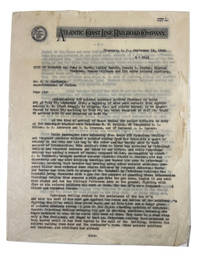
1944ref. 929931944. Good. Letter dated September 13 1946. 28 cm. Carbon copy on thin Atlantic Coast Line Railroad Company letterhead stationery. Substantial chipping around edges no loss of text on first leaf. Our unnamed Captain of Police reports on an incident which began when around 200 African American soldiers were changing trains. Local police arrested two of the soldiers for intoxication and took them to the local Police Station. When police returned to the railroad station they found six of the soldiers assaulting two military policemen and intervened to help the MPs using the butt end of a riot gun to break up the fight. When a large number of other soldiers came to join the fight they were stopped at gunpoint by the local policemen with assistance from the MPs and military officers. The African American soldiers marched in formation to local Police Headquarters where 133 soldiers were charged with disorderly conduct and five others differently charged. Almost all pleaded not guilty but all were found guilty the next day and remained in jail another night until their fines were paid -- $17 each for the 133 soldiers and up to $100 for the five who were differently charged. All 138 soldiers were then marched back the the train station and departed. One wonders how accurately the incident was described to our unnamed Captain by those he interviewed. There is nothing in his letter to suggest that he interviewed any of the African American soldiers. unknown books
1870ref. 31135Springfield Mo. 1870. Stitched in original printed wrappers. 41 1 blank pp. Very Good. The opening is "a great event in the history of St. Louis and of the State of Missouri.The South Pacific Railroad has burst through upon the prairies of Southwest Missouri and has welded its western terminus upon the rails of the Atlantic and Pacific Railroad. This latter road is going to the Pacific coast as rapidly as it is possible to construct a road in this day of rapid railroad building." The pamphlet describes "the celebration" including speeches and festivities; the route; and the many exciting possibilities the Road will create for the State and Nation. BRE 175 4 locations. Sabin 57393. unknown books
1963ref. 2331145New York: James F. Drake Inc 1963. Stapled Binding. Near Fine. 0x0x0. No publisher date circa 1963. Paper clip mark to several pages. 82 pp. Ninth co-operative catalog of Members of the Middle Atlantic Chapter of the Antiquarian Booksellers Ass'n. of America Inc. James F. Drake, Inc unknown books
1937ref. 40282Berlin: Freiheitsverlag G.m.b.H. 1937. First edition. Softcover. g to vg. Quarto. 64pp. Original photo-illustrated dust-jacket over blind stiff wrappers. A collection of 45 photogravures documenting Mussolini's 5-day official visit to his friend and ally Adolf Hitler in Germany in late September 1937. Many of the photographs featured in this work were taken by Hitler's personal photographer Heinrich Hoffmann. Striding side by side the two dictators and partners of the Berlin-Rome Axis are seen touring Munich where they laid wreaths on various Nazi monuments. Among these was the Feldherrnhalle in Königsplatz which held the bodies of 16 Nazi heroes killed in the 1923 Munich Putsch. The next series of photographs were taken in the little village of Lalendorf where Hitler and Mussolini witnessed the most impressive military manoeuvres of post-WWI Germany. The following images show the two leaders visiting the mighty Krupp munitions works at Essen. Two photographs of Benito Mussolini attending a luncheon given by Göring and his wife at their famous hunting lodge Karinhall are placed between the largest series of pictures showing the two men during the grandiose Berlin celebrations in their honor. Indeed an estimated crowd of 650000 people attended the demonstration organized on the Maifeld the polo ground adjoining the Olympic Stadium. At the official tribune Mussolini delivered a speech where he spoke of the awakening of Germany through the Nazi revolution Bolshevism the common enemy and Germany's friendly stand during the Ethiopian War. The speech ended with a stress on the 115 million Germans and Italians and the need for them to unite "in one single unshakable determination." Closed tear and soiling at back cover of dust-jacket. Moderate abrasion along fore-edge of DJ. Clear and minor water-staining along fore-edge of the first 32 pages not affecting lettering. Text in German gothic script. DJ in overall good- wrappers and interior in good to very good photographs in very good condition. Freiheitsverlag G.m.b.H. unknown books
1950ref. 222892Boston: Atlantic Monthly 1950. First. hardcover. very good. Volume 185. 36 issues 4to bound in green buckram; pictorial wrappers included. Boston: Atlantic Monthly January - December 1950. The Atlantic Monthly was created in 1857 as a literary & cultural commentary magazine. It was important for recognizing and publishing new writers. Included in this issue are Nicolas Nabokov Virginia Woolf Edwin O'Connor James Norman Hall C.S. Lewis Louis Auchincloss Edna St. Vincent Millay & many others. Atlantic Monthly unknown books
ref. 37000TRADE CATALOGUE ATLANTIC TERRA COTTA. Volume VII Number 7. Atlanta: Atlantic Terra Cotta Company 1925. 4to. Wrappers. 16 pages. Subtitled "English Tudor Terra Cotta 1522." Trade journal printed monthly for architects. Illustrated with photographs of buildings and architectural features using ornamental terra cotta. Very good. unknown books
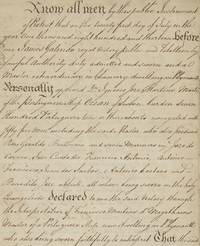
1813ref. List1947Plymouth 1813. Plymouth Devon England: 21st July 1813. Folio 7 pages 13 1/8 x 8 ¼ inches duty blindstamp small ink stamp to upper inner margin of the first page two seals to the last page signed twice by Galindo. Toned some small repaired tears using reversible archival ph-neutral paper-repair tape very good to near fine. Very Good. An interesting document of privateering in the Peninsular war this 'Public Instrument of Protest' documents a Portuguese captain and crew complaint in detail to an English notary. After sailing from Calcutta to Brazil and then from Rio to just outside of Lisbon their ship the 700-ton 'Oceano' was seized and comprehensively ransacked by a French privateer the 'Lion' out of Lorient. Most of the crew and passengers were offloaded onto a passing American vessel the 'Leda' bound for Lisbon. Meanwhile the 'Lyon' escorted her prize towards the nearest French port but before a friendly haven was reached they were both set upon by the brigantine HMS 'Achates'. The 'Lyon' escaped but the 'Ocean' was captured by Commander Morrison and the 'Achetes'. The 'Ocean' was taken to Plymouth and moored in the Hamoaze. The remaining Portuguese crew who had been forced to remain aboard the 'Ocean' by the French got a message to the 'Ocean's Master Dn. Ignacio Joze Martins and he and the boatswain made their way to Plymouth as quickly as possible. The sworn statement presented here is in English thanks to the translation given by Francisco Martins d' Magalhaens master of a Portuguese ship "now dwelling in Plymouth" The 'Oceano' sailed from Calcutta to Brazil arriving 10th February 1813. She left Rio on 4th April all was plain sailing until the afternoon of the 7th June off the Rock of Lisbon when the 'Lion' showed up first under false British colors then French. The fighting was fierce the privateer was driven off once but eventually the 'Oceano' was taken. The night of the 7th June was spent by the French 'conveying everything Moveable and Valuable from the Ocean to the Privateer'. The 'Leda' the US vessel landed the majority of the 'Ocean's crew including the Master in Lisbon on the evening of the 9th June.Monday 14th June the 'Lyon' engaged in a running battle with HMS 'Achates' and escaped but the 'Achates' did capture the 'Ocean'. Wednesday 16th June the 'Ocean' arrived in Plymouth under the watchful eye of the 'Achates'. Receiving the crew's message the Captain of the 'Ocean' left Lisbon for Falmouth and then Plymouth arriving on the 20th July. The document was dated 21st July 1813. Full transcription available. unknown books
1910ref. 2090New York: Canada Atlantic and Plant Steamship LIne 1910. EPHEMERA TRAVEL TOURIST ADVERTISING BROCHURE. The Matthews-Northrup Co. Complete-Art Printing Works Buffalo N.Y. Map: Routes of Canada Atlantic & Plant Steamship Line Between New England and Maritime Provinces Buffalo N.Y.: The Matthews-Northrup Co. No date ' Map: Map of the Plant System of Railway Steamer and Steamship Lines and Connections Buffalo N.Y.: The Matthews-Northrup Co. No date Map: Routes of Canada Atlantic & Plant Steamship Line in the Maritime Provinces Buffalo N.Y.: The Matthews-Northrup Co. No date 8vo 8 ½" x 6"; 30pp; printed glazed paper wrapper photographic illustration vignette on front map on rear showing routes; 2 staple binding; map on verso front wrapper 6 full page illustrations and one center fold; light soiling to wrapper 1 ½" separation of fold at foot of spine wrapper partially detached at the staples; very good. Not recorded. An interesting turn of the 20th century brochure advertising excursions and "vacation outings in the maritime provinces" by the Canada Atlantic and Plant Steamship Line. Full-page photographic illustrations of the steamer "S.S. Halifax" and "S.S. Olivette" include descriptions of their services. Illustrations of scenery at the port destinations include a bird's eye view of Halifax N.S. In addition there are descriptions of the winter resorts in Tampa Port Tampa and Winter Park Florida with a map on the inside of the rear wrapper detailing the "Plant System" of railway and steamship routes. Estimation of publishing date based on clothing represented in the photographic illustrations in the brochure. Canada Atlantic and Plant Steamship LIne unknown books
1995ref. 183246Las Palmas de Gran Canaria: Centro Atlantico de Arte Moderno 1995. Softcover. VG. Color illustrated wraps red spine with white lettering; 238 pp; profusely illustrated in bw and color. Text in Spanish; foreword and essays also in English and German. German expressionism: Atlantic Center for Modern Art November 14 1995 - January 7 1996. Includes bibliographical references. Centro Atlantico de Arte Moderno paperback books
1996ref. 144557Las Palmas Spain: Centro Atlántico de Arte Moderno 1996. Softcover. VG- Average wear to cover edges and some scuffs to cover; interior is good. Black & color illus. wraps decorated flyleaves 277 pp. many BW & color illus. Majority of the text is in Spanish with English translations at the rear. Issued in conjunction with an exhibition of artwork related to volcanoes. With seven illustrated essays and many depictions from a variety of artists. Intriguing for both art and science aficionadoes. Centro Atlántico de Arte Moderno paperback books
2000ref. 227532000. Softcover. VG one copy with bumped corner. Lime green wraps. 222 pp. Numerous bw & color plates. Text in Spanish. paperback books
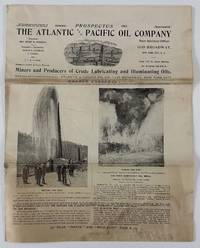
1902ref. 12944New York 1902. 8pp. Illustrated. Folio. Original self wrappers stapled. Moderate staining and soiling old folds minor edge wear. Good condition. Illustrated with black & white photos and two maps one of holdings in Knox County Kentucky the other in the East Texas Oil Belt centered on Beaumont. The company -- miners and producers of crude lubricating and illuminating oils -- was incorporated in April 1901 under the state laws of Delaware. This prospectus solicited investors and presented its balance sheet and current activities listed officers and presented the "expert opinions" of geologist Major J.W. Otley the original surveyor of the Beaumont and other fields as to the worthiness of the company's properties at nearby Sour Lake Texas. No listings found on OCLC. A unique and early oil company prospectus with notable content on Kentucky and Texas oil. unknown books
ref. 232056Richmond VA: Whittet & Shepperson. Hard Cover. Very Good binding. No pencil or ink markings in text. Blue cloth binding with gilt lettering. Light edgewear to boards. Very Good binding. Whittet & Shepperson unknown books
1881ref. 35023Ottawa: Printed by MacLean Roger & Co. 1881. Original printed salmon wrappers stitched. 2 10 large folding map short closed tear 20 11 3 2 2 pp as issued. Vertical fold light edgewear. Very Good. offered with Booth C.J. President: THE CANADA ATLANTIC RAILWAY CO'Y. PROSPECTUS. Ottawa: 1889. 4 pp printed on rectos only. Caption title as issued. Pinned at upper blank corner and docketed in ink on final blank "Canada Atlantic RR Prospectus January 1889." Fine. The map in excellent condition is titled "Canada Atlantic Railway Map December 1881" accomplished by "Geo. Bishop & Co. Lith. Montreal." It measures 18" x 35" with the route of the railway; extensions and other railways also noted; other boundaries in green. All the documents creating the Company set forth in the title of the pamphlet are printed each individually numbered. The Railway as the Prospectus states "extends from Ottawa in a south easterly direction a distance of 142 miles and connects with the Central Vermont Railroad at the village of Alburgh Springs Vt. U.S.A." "The Canada Atlantic Railway CAR was a small regional railway created in 1880 by lumber baron John Rodolphus Booth. Initially planned as part of the transportation network for his vast lumber holdings the railway quickly grew into a general-purpose railway serving passengers and communities along the route. Booth's first target was to gain access to Vermont in order to connect with the Central Vermont Railway CV and further exploit the US markets" "Canada Atlantic Railway" Ontario Railways accessed at Canada-Rail website May 2018. As of January 2026 2026 we do not locate either of these documents-- or the map-- on OCLC. Printed by MacLean, Roger & Co. unknown books
1946ref. 222887Boston 1946. First. hardcover. very good. Volumes 179 180 & 181. 36 issues bound in 3 volumes of green buckram. Boston: Atlantic Monthly January 1946 - December 1948. The Atlantic Monthly was created in 1857 as a literary & cultural commentary magazine. It was important for recognizing and publishing new writers. Included in these issues are Carl Sandburg Lord Dunsany Robert Frost Wallace Stegner Thomas Wolfe Somerset Maugham May Sarton and many others. The first 12 issues are bound without wrappers; the others have thei original printed wrappers and starting with November 1947 pictorial wrappers. unknown books