4 138 résultats
1913réf. 44456Charleston: Lanneau's Art Store. 1913. Paperback. Portfolio containing twenty architectural lithographs and introduction; still in original portfolio cover. One of the South's early preservationists Alice Huger Smith collaborated with her father historian D. E. Huger Smith providing architectural drawings for two important publications: Twenty Drawings of the Pringle House 1914 and The Dwelling Houses of Charleston South Carolina. The contents are housed in original hinged 16- x 18-inch paper-covered boards with moderate to heavy smudging mostly in area of three slots for closure although ribbon or cardboard for these slots is now missing. Contents pages loose as intended include title page; "The Colonial House of Miles Brewton: With Some Account of its owners" a three-page essay by D. E. Huger Smith; all 20 prints which are lightly foxed with "holes" along edges of at least one print does not affect image itself and appears to be a thinning or defect in paper. ; . Lanneau's Art Store, paperback
1823réf. BK0184Middletown Rhode Island 1823. Autograph letter signed three pages on a folded sheet with integral address panel to Charles E. Dudley in Albany and Newport postal markings. 7 ¾ x 9 ¾ inches. Old folds scattered staining and some marginal losses a few affecting text. Good to very good. A letter from Newport mariner John Wood concerning his acrimonious departure from the DeWolf family's Mary Ann plantation in Cuba and the ensuing legal dispute with James DeWolf and Charles Collins. Wood was almost certainly the same John Wood whose signature appears on an 1806 Newport agreement for an illegal voyage transporting enslaved Africans from Cape Coast to Havana now held by the Smithsonian's National Museum of African American History and Culture.1 By 1823 he was residing on the Mary Ann plantation one of several Cuban estates belonging to the DeWolfs among the most prominent families involved in the American slave trade. His relationship with DeWolf and Collins had evidently collapsed over his obligations on the estate resulting in what he describes as his forced departure from Cuba under apparently dangerous conditions with his family and a contentious effort to settle their accounts. Writing to his friend Charles E. Dudley then mayor of Albany and a New York state senator Wood reports that three mechanics who had resided with him on the plantation had recently given depositions in Bristol Rhode Island. Two of the three had testified in his favor though all had been called by DeWolf. Wood was particularly incensed by the circumstances surrounding his family's departure from Cuba writing: "I must acknowledge that myself & family have been most shamefully abused & for no provocation we were set adrift liable to be murdered & robbed on Shore My Wife & Daughter exposed at Sea to be captured By pirates and in case of Capture to suffer more than Death; Not content in what they have done but still persevere in wishing to rob me of all I possess a Respectable Character. The assassin will stab you in the dark but the Wretch who will traduce and injure an Innocent family is worse than an assassin." Wood goes on to describe receiving two writs from DeWolf and Collins and transcribes an August 8 letter from James DeWolf explaining his decision to pursue legal action despite their previous discussions of an amicable settlement: "Lest you should think me inconsistent in causing an action to be brought after the last conversation we had I take leave to explain my wishes to come to an amicable settlement by referring to men as we talked remains the same my object is to put the business in a legal and proper train for bringing it to a close . & to enable me to avail of the testimony of the people who were on the Estate with you." Wood expected the Rhode Island Supreme Court meeting at Bristol the following month to appoint referees to settle the accounts. The precise origin of the disagreement is not stated though the depositions of the mechanics and the references to outstanding accounts suggest a dispute over Wood's contractual obligations or activities on the plantation. Wood 1770-1826 was a Newport merchant and captain with longstanding connections to Atlantic commerce. He died at Cape Coast West Africa in 1826 three years after writing the present letter. James DeWolf 1764-1837 then serving in the United States Senate had amassed a substantial fortune through the slave trade and his Cuban plantation interests. Charles Collins his brother-in-law had served as collector of customs at Bristol from 1804 to 1820 an appointment closely connected to the family's slave-trading operations. The Mary Ann plantation is documented in the DeWolf Papers at the Rhode Island Historical Society which include inventories from 1818 and 1820 and contemporary plans of the plantation grounds. The present letter preserves Wood's account of his treatment by the DeWolf family together with his transcription of DeWolf's explanation for pursuing legal action. 1 "Agreement facilitating illegal trade of enslaved Africans" National Museum of African American History & Culture accessed October 12 2026 https://nmaahc.si.edu/object/nmaahc_2019.28.1. . unknown
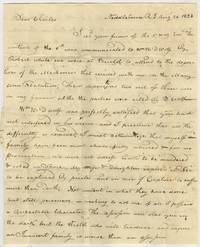
1823réf. BK0184Middletown Rhode Island 1823. Autograph letter signed three pages on a folded sheet with integral address panel to Charles E. Dudley in Albany and Newport postal markings. 7 ¾ x 9 ¾ inches. Old folds scattered staining and some marginal losses a few affecting text. Good to very good. A letter from Newport mariner John Wood concerning his acrimonious departure from the DeWolf family's Mary Ann plantation in Cuba and the ensuing legal dispute with James DeWolf and Charles Collins. Wood was almost certainly the same John Wood whose signature appears on an 1806 Newport agreement for an illegal voyage transporting enslaved Africans from Cape Coast to Havana now held by the Smithsonian's National Museum of African American History and Culture.1 By 1823 he was residing on the Mary Ann plantation one of several Cuban estates belonging to the DeWolfs among the most prominent families involved in the American slave trade. His relationship with DeWolf and Collins had evidently collapsed over his obligations on the estate resulting in what he describes as his forced departure from Cuba under apparently dangerous conditions with his family and a contentious effort to settle their accounts. Writing to his friend Charles E. Dudley then mayor of Albany and a New York state senator Wood reports that three mechanics who had resided with him on the plantation had recently given depositions in Bristol Rhode Island. Two of the three had testified in his favor though all had been called by DeWolf. Wood was particularly incensed by the circumstances surrounding his family's departure from Cuba writing: "I must acknowledge that myself & family have been most shamefully abused & for no provocation we were set adrift liable to be murdered & robbed on Shore My Wife & Daughter exposed at Sea to be captured By pirates and in case of Capture to suffer more than Death; Not content in what they have done but still persevere in wishing to rob me of all I possess a Respectable Character. The assassin will stab you in the dark but the Wretch who will traduce and injure an Innocent family is worse than an assassin." Wood goes on to describe receiving two writs from DeWolf and Collins and transcribes an August 8 letter from James DeWolf explaining his decision to pursue legal action despite their previous discussions of an amicable settlement: "Lest you should think me inconsistent in causing an action to be brought after the last conversation we had I take leave to explain my wishes to come to an amicable settlement by referring to men as we talked remains the same my object is to put the business in a legal and proper train for bringing it to a close . & to enable me to avail of the testimony of the people who were on the Estate with you." Wood expected the Rhode Island Supreme Court meeting at Bristol the following month to appoint referees to settle the accounts. The precise origin of the disagreement is not stated though the depositions of the mechanics and the references to outstanding accounts suggest a dispute over Wood's contractual obligations or activities on the plantation. Wood 1770-1826 was a Newport merchant and captain with longstanding connections to Atlantic commerce. He died at Cape Coast West Africa in 1826 three years after writing the present letter. James DeWolf 1764-1837 then serving in the United States Senate had amassed a substantial fortune through the slave trade and his Cuban plantation interests. Charles Collins his brother-in-law had served as collector of customs at Bristol from 1804 to 1820 an appointment closely connected to the family's slave-trading operations. The Mary Ann plantation is documented in the DeWolf Papers at the Rhode Island Historical Society which include inventories from 1818 and 1820 and contemporary plans of the plantation grounds. The present letter preserves Wood's account of his treatment by the DeWolf family together with his transcription of DeWolf's explanation for pursuing legal action. 1 "Agreement facilitating illegal trade of enslaved Africans" National Museum of African American History & Culture accessed October 12 2026 https://nmaahc.si.edu/object/nmaahc_2019.28.1. . unknown books
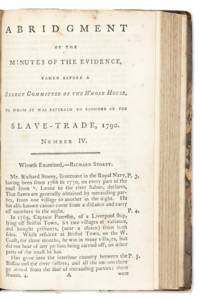
1789réf. 187101789. Committee of the Whole House of the British Parliament investigation into the Atlantic slave trade recorded in Abridgment of the Minutes of the Evidence Taken Before a Committee of the Whole House to Whom It Was Referred to Consider of the Slave Trade published 1789 to 1791 presenting one of the earliest parliamentary documentary compilations addressing the operation and human consequences of the transatlantic slave trade. The volumes preserve testimony gathered during parliamentary inquiries that examined the practices of British slave traders and the treatment of enslaved Africans transported across the Atlantic. These proceedings formed part of the political campaign in Britain that eventually culminated in the abolition of the British slave trade in 1807. The collected evidence includes statements from ship surgeons naval officers merchants and other witnesses whose accounts describe the conditions experienced by enslaved Africans during capture transport and plantation labor. Abridgment of the Minutes of the Evidence Taken Before a Committee of the Whole House To Whom It Was Referred to Consider of the Slave Trade. London: 1789-1791. First edition first printing. Four volumes bound in two books. The compilation reproduces testimony presented before Parliament concerning the organization and operation of the slave trade and includes firsthand statements describing the physical suffering and resistance of enslaved Africans during transport. Surgeon Alexander Falcon-Bridge who had firsthand experience aboard slave ships described acts of despair among captives: he "Has known several enslaved persons to refuse sustenance with a design to starve themselves. refusing to take medicines when sick because they wished to die. Many other slaves expressed the same." Another witness Royal Navy surgeon Thomas Trotter recorded the emotional trauma experienced by captives during embarkation noting that "Slaves on being brought on board showed signs of extreme distress and despair from a feeling of their situation and regret at being torn from friends and connections." The volumes therefore preserve testimony that exposed the violence and human suffering embedded within the Atlantic slave trading system. During the eighteenth century European and American traders transported millions of Africans across the Atlantic through a commercial system that relied on maritime networks linking West Africa the Caribbean and the Americas. Parliamentary investigations of the slave trade in the late eighteenth century were fueled in part by abolitionist activism and public campaigns demanding government inquiry into the practice. Publications of witness testimony such as this abridged parliamentary record circulated evidence used by reformers advocating the end of the trade. Four volumes bound in two books with folding table in the fourth volume. Octavo format. Contemporary marbled quarter calf bindings with modern bookplates on the front past down. Wear present with most spine titles lacking and foxing primarily affecting the title pages; text remains clear. Overall condition very good. unknown
1789réf. 187101789. Committee of the Whole House of the British Parliament investigation into the Atlantic slave trade recorded in Abridgment of the Minutes of the Evidence Taken Before a Committee of the Whole House to Whom It Was Referred to Consider of the Slave Trade published 1789 to 1791 presenting one of the earliest parliamentary documentary compilations addressing the operation and human consequences of the transatlantic slave trade. The volumes preserve testimony gathered during parliamentary inquiries that examined the practices of British slave traders and the treatment of enslaved Africans transported across the Atlantic. These proceedings formed part of the political campaign in Britain that eventually culminated in the abolition of the British slave trade in 1807. The collected evidence includes statements from ship surgeons naval officers merchants and other witnesses whose accounts describe the conditions experienced by enslaved Africans during capture transport and plantation labor. Abridgment of the Minutes of the Evidence Taken Before a Committee of the Whole House To Whom It Was Referred to Consider of the Slave Trade. London: 1789-1791. First edition first printing. Four volumes bound in two books. The compilation reproduces testimony presented before Parliament concerning the organization and operation of the slave trade and includes firsthand statements describing the physical suffering and resistance of enslaved Africans during transport. Surgeon Alexander Falcon-Bridge who had firsthand experience aboard slave ships described acts of despair among captives: he "Has known several enslaved persons to refuse sustenance with a design to starve themselves. refusing to take medicines when sick because they wished to die. Many other slaves expressed the same." Another witness Royal Navy surgeon Thomas Trotter recorded the emotional trauma experienced by captives during embarkation noting that "Slaves on being brought on board showed signs of extreme distress and despair from a feeling of their situation and regret at being torn from friends and connections." The volumes therefore preserve testimony that exposed the violence and human suffering embedded within the Atlantic slave trading system. During the eighteenth century European and American traders transported millions of Africans across the Atlantic through a commercial system that relied on maritime networks linking West Africa the Caribbean and the Americas. Parliamentary investigations of the slave trade in the late eighteenth century were fueled in part by abolitionist activism and public campaigns demanding government inquiry into the practice. Publications of witness testimony such as this abridged parliamentary record circulated evidence used by reformers advocating the end of the trade. Four volumes bound in two books with folding table in the fourth volume. Octavo format. Contemporary marbled quarter calf bindings with modern bookplates on the front past down. Wear present with most spine titles lacking and foxing primarily affecting the title pages; text remains clear. Overall condition very good. unknown books
réf. 10787Magyar Helikon 1972. Hardcover. First edition. Very Good hardcover with light wear along the bottom boards light rubbing to two tips light remains of a sticker to the ffep and light handling wear in a Very Good dust jacket with light wear at the edges and extremities a short tear with chip to the back at the crown and light chipping at the crown. Black paper-covered boards with crisp gold-stamped title to the front and spine in dust jacket. All dust jackets are protected by a clear mylar cover. BOOKS SHIP THE NEXT BUSINESS DAY WRAPPED IN PADDING IN A BOX. 108 pages with a foldout list of plates at the rear; 96 b&w photographs plus 2 plates printed in blue on vellum; 8.25 x 10 inches. Text in Hungarian. An energetic and hallucinatory view of New York City in the late 1960s presented through an "anything goes" embrace of techniques and layout similar to Daido Moriyama. One of the classics of modern photographic literature. See Parr & Badger The Photobook p.262-263; Auer p.540. Magyar Helikon hardcover
2002réf. 60148Centro Atlantico De Arte Moderno Las Palmas De Gran Canaria; Et Al. New. Paperback. FREE UPGRADE to Courier/Priority Shipping Upon Request – – IN STOCK AND IMMEDIATELY AVAILABLE FOR SHIPMENT - Flawless copy brand new pristine never opened -- Text in Spanish with portions in English as well. 360 pp. With 257 ills. 228 col. . 28 x 25 cm. -- with a bonus offer-- . 2002. 84891526 . Centro Atlantico De Arte Moderno, Las Palmas De Gran Canaria; Et Al paperback
1949réf. 063518Lancaster Kutztown Collegeville PA: Pennsylvania Dutch Folklore Center/Pennsylvania Folklife Society 1949. Book. Fine. Hardcover. 1st Edition. 4to - over 9¾" - 12" tall. Complete run of The Pennsylvania Dutchman/Pennsylvania Folklife 1949-1997. This influential periodical began as a biweekly newspaper first issue dated 5 May 1949 eventually migrating to a quarterly magazine final issue dated Spring 1997. Vols. 1-22 are custom-bound in brown leatherette lettered in gilt on front covers and spine panels Vols. 1-3 in the original elephant folio format of the Dutchman Vols. 4-22 in standard quarto magazine format. Note that the title changed to "Pennsylvania Folklife" with Vol. 9. Vols. 23-46 are unbound each issue individually sleeved. Vol. 1 consists of 25 issues with some still bright white suggesting that they are possibly from a later reprint Vols. 2-3 of 22 each Vols. 4-5 of 15 each Vols. 7-45 mostly of 4 each with some volumes in the '60s including an unnumbered 5th "Folk Festival" issue and Vol. 46 of 3 issues all published totaling about 260 issues. The entire set is solid Near Fine to Fine the bound volumes all essentially as issued except of course for having been bound in hardcover and the unbound issues show only slight handling wear in some cases most virtually unworn. The bound volumes show two former owner signatures/stamps on the front flyleaf of each volume but are otherwise unmarked. A rare opportunity to purchase a complete run of a publication that has become almost impossible to assemble "in the wild." Delivery options possible depending on location. Pennsylvania Dutch Folklore Center/Pennsylvania Folklife Society Hardcover
1823réf. PHO-1666London, John Murray, 1823 et 1828, 2 volumes In-4, relié pleine toile orange, dos lisse avec pièce d’auteur et titre, date en pied, xvi-768pp. et xxvi-320pp.cvii-1f., tome 1, tâche sur les 5 premiers feuillets, petites rousseurs, mouillure angulaire sur les planches au tome 2, petits frottements à la reliure. Édition originale, illustrée de 30 planches dont 11 en couleurs pour le tome et de 31 planches au tome 2, les cartes manquent, Cachet Émile Petitot, Ex-libris manuscrit, Ex-libris Jean-Pierre Legrand-Deloron. Avec une mention signée : "membre de l'Expédition arctique T.A. 23 , 1972-1973" .
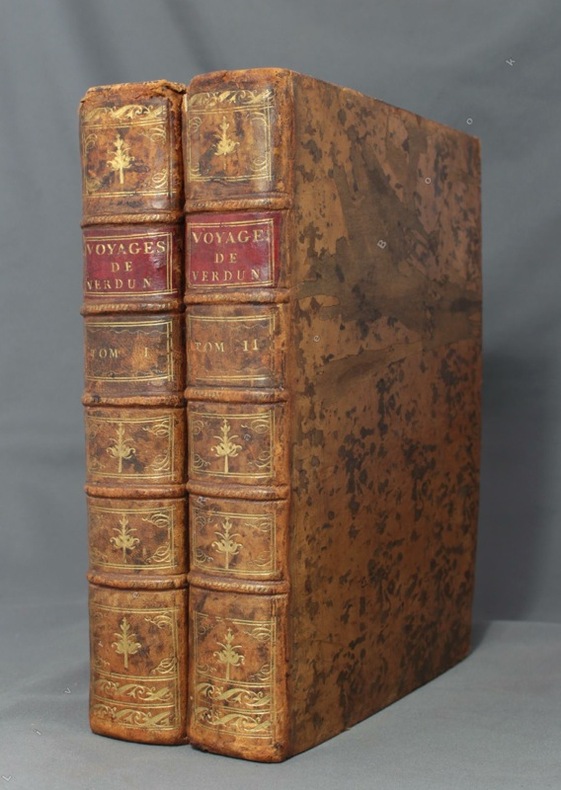
1778réf. 8670Paris, de l'Imprimerie Royale, 1778. 2 volumes in-4 de [4]-389-[1]-XIX-[3]; [8]-500-XXXII pages, plein veau marbré brun, dos à nerfs ornés de filets et fleurons dorés, pièces de titre en maroquin rouge, tranches mouchetées, petits accrocs aux coiffes supérieures, épidermures, coupes et coins frottés, tampon sur les pages de titre, quelques pâles rousseurs.
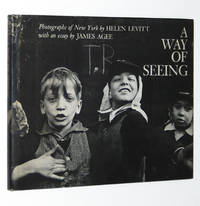
1965réf. 17250New York: Viking Press 1965. Hardcover. First edition first printing. SIGNED with a signed postcard. Near Fine clothbound hardcover with crisp text to the front and spine with a light bump to the heel and a light scuff to the front in a Very Good dust jacket with light shelf wear two tiny tears at the crown and a light moisture stain to the lower tips visible on the verso and flaps. A very nice copy of the first book by Helen Levitt 1913-2009 put together in 1946 but printed in 1965. A seminal 20th century photobook. Photographs by Helen Levitt; essay by James Agee. SIGNED BY LEVITT on the title page; no inscription. 8 78 pages; 51 full-page gravure-printed b&w plates; 9.25 x 7.75 inches. LAID-IN is a signed postcard from Levitt instructing the recipient to take the book to her gallery where she will sign it. Ref: Parr & Badger Photobook Vol 1 p.252-253; Open Book p.214-215; Roth Book of 101 Books p.178-179; Auer 802 Photo Books p.447. All dust jackets are protected by a clear mylar cover. Ships the next business day wrapped in padding in a box. Viking Press hardcover
1930réf. 010937NY. Unpublished notebook 9" x 11 1/4" containing original artwork and designs official documents orders and correspondence pertaining to regimental coats of arms and distinctive insignia for the period 1922-1930. Notebook opens with three pages of formal guidelines for regimental colors and devices then begins in earnest with original signed Adjutant General order No. 244 October 1922 calling Falls "to active duty without pay or allowances for service in connection with submission of coats of arms for colors distinctive badges insignia etc." The notebook contains 2 full-page original watercolors and 16 original crest and shield drawings in color pencil State National Guard Headquarters and 7 regiments - 10th 14th 71st 105th 106th 107th 108th Infantry along with correspondence blueprints design approval documents and finely printed samples for some designs. There is detailed correspondence on Falls' New York State "Half Moon" design when the Quartermaster Corp of the War Department in Washington severely altered his original conception. Author artist military general and New York City socialite DeWitt Clinton Falls 1864-1937 was an authority on military heraldry and uniforms and a designer of military insignia. His papers are held by the New York Public Library and the American Numismatic Society. This Notebook includes: Original watercolor "Half Moon" Nov 1922; 2 letters Dec 1922; Memorandum from the Secretary of War Dec 1922 approving the design; Original watercolor "Regimental Colors for New York National Guard" 1922; Correspondence with Adjutant General's Office and the War Department with 2 blueprints; Copy of "First Design submitted by War Department for emblem of State of New York. Disapproved by Adjutant General Oct 1922"; 2 letters to Falls from Adjutant General's Office Apr 1923 with a proof copy of the QM's altered "Half Moon" crest; Reply by Falls Apr 1923 that the Quartermaster' altered design "is awful and under no circumstances should be accepted"; 2 page detailed letter from Adjutant General's Office to Quartermaster General War Department Apr 1923 noting QM's five major and several minor deviations from Falls' original which had been approved by the General Staff; Reply by War Department May 1923 that the Quartermaster Corps drawing was done in accordance with what was shown and described in "The Hudson Fulton Celebration 1909" submitted in a report to the NY State legislature in 1910 and that revisions to the drawing would be made if the State of New York "does not consider the report as being historically correct and will so state and furnish evidence which it considers authentic"; AG letter May 1923 to Falls requesting he draft a second endorsement; Falls' June 1923 reply that "it was not so much the historical points that he criticized about the QM design "as the faulty drawing and bad proportions of many of the details." He points out technical and aesthetic weaknesses with the eye of an artist of the Quartermaster drawing that can be easily resolved.; Letter and enclosures to Falls from Adjutant General's Office June 25 that they are in receipt of Quartermaster revisions and asking him to review; Falls June 28 reply "it is about as near right as we can get it and same can be returned approved"; Original color pencil drawing "Headquarters Device" with 1 page description. Undated; Original color pencil drawing "10th Infantry" Approved Nov 1923 War Department with letter of approval. Notation: "This design not being satisfactory to the regiment permission was given Jan 1926 to submit new design"; 2 original color pencil drawings - one for crest and one for shield with a printed sample of shield in use "10th Infantry" with 1 page description. Approved W.D. June 1926 with letters of approval for each. 2 original color pencil drawings - one for crest and one for shield "14th Infantry" with 1 page description. Approved W.D. May 1925 with 2 letters of app . Very Good. Hard. 1st. 1930. unknown
1976Codice Atlantico (Codex Atlanticus). Giunti, Barbera, Firenze, 1976. Il Codice Atlantico è la più vasta raccolta di documenti leonardeschi conosciuti. Alla fine del 1500 a Madrid lo scultore Pompeo Leoni con numerosi fogli e frammenti contenevano la quasi totale produzione intellettuale di Leonardo ha creato una composizione curiosa e spettacolare che rappresenta ogni aspetto del genio vinciano: l’ appassionato interesse per la meccanica e la matematica, l'astronomia, la geografia fisica, la botanica, la chimica e l'anatomia, nonché le arti figurative. Disegni per progetti tecnici innovativi, dispositivi idraulici, armi, fortificazioni, macchine volanti, imbarcazioni e automi, oltre agli studi con annotazioni teoriche e pratiche per L'Adorazione dei Magi, Leda e il cigno, e il Battaglia di Anghiari. Inoltre, al suo interno, i progetti per i monumenti equestri, mai eseguiti, a Francesco Sforza e Gian Giacomo Trivulzio, nonché i progetti architettonici per il rinnovamento urbano di Milano e la residenza reale di Romorantin in Francia. L'opera è composta da dodici volumi, in facsimile, formato 44x65 cm. e dodici volumi di testo (formato 22x30 cm. di trascrizione diplomatica e critica a cura di Augusto Marinoni e un volume contenente l'indice per materie e l'indice alfabetico a cura di Pietro C. Marani ), tutti rilegati a mano in piena pelle, con impressioni in oro sul dorso. Edizione limitata di 998 copie. Condizioni ottime.