PISANI Vittorio -MareMagnum

1.863 Ergebnisse
1958Roma, 1958 novembre 9, copertina illustrata a colori in fascicolo originale completo di pp. 32 de "La Tribuna illustrata" .
1958In-8°, leg. in tutta tela edit. con tit. al dorso, pp. 423. Con alcune ill. in nero intercalate nel testo, 18 doppie tavv. f.t. di foto a colori e 2 carte geografiche su doppia pagina.
1989Best.-Nr. 2801989 - broché - Published by CTA - Produced and designed by Chayce Publications - Printed by E.P. Lowe Ltd. - 1989 - In-8 (24 x 18 cm) broché - 93 pages- ISBN-10 : 9290810572 ISBN-13 : 9789290810575 - Ouvrage en anglais - This volume is one of nine agricultural bibliographies. Other books in the Agricultural development in SADCC countries include: Botswana, Lesotho, Malawi, Mozambique, Swaziland, Tanzania, Zambia, Zimbabwe - The Southern African Centre for Cooperation in Agricultural Research (SACCAR) is a unit of the Southern African Development Coordination Conference (SADCC). It was established at Gaborone, Botswana in 1984 to provide a centre for the promotion of regional cooperation in agricultural research and the development of research manpower and training.
Best.-Nr. ORD-14550Toulon. Paul Tissot. 1909. In-8 (155 x 243mm) broché, couverture verte imprimée, 31 pages. Texte de Henri Gallian, daté de Pignans, 19 août 1909, avec le cachet du Comié Henri Gallian. Toulon. Bords de feuilles effrités, bon état intérieur. Rare brochure témoignant des atrocités judiciaires commises à Madagascar.
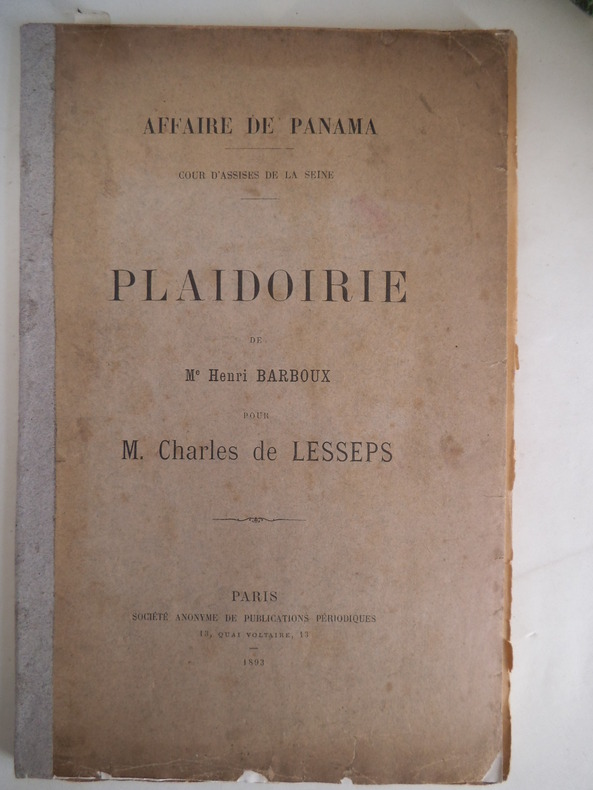
1893Best.-Nr. 36In 8 broché, couverture imprimée, 138 pages, Société anonyme de publications périodiques.1893.
First edition, 8vo (212 x 125 mm), x, [1], 290pp., ownership inscription on upper margin of title "John S. V. Vernon. Novr. 1847.", some spotting of the text in places, orig. cloth, spine faded, head of spine and lower hinge partly frayed, uncut, gilt lettering on spine. Coulter was surgeon aboard the whaler "Stratford", which left London in October 1832, bound for the Pacific, by way of Cape Horn. He gives a detailed and lengthy account of the Marquesas, where he assumed native dress, was tattooed, and became involved in a tribal war. Other islands visited included the Falkland Islands, the Galapagos Islands, Chatham Island, the Gilberts, and the Tuamotu Archipelago. There were stops at the ports of South and North America, New Guinea and Melanesia. He made three stops at Tahiti and provides a general account of the island, as well as a detailed discussion of the English Missionaries there. Chapter V11 gives a description of fitting up a ship for sperm whaling, and gives an account of his first successful attempt at killing a whale. The "Stratford" returned to England in 1836. Sabin, 17142; Hill, 1, p.70.
1955208 pages including index and black and white illustrations. "From much accumulated data we have woven a non-fiction historical book which it is hoped will fill a practical need in the literature of the Pacific Coast and the Hawaiian Islands, and may interest readers in Canada, the United States, Hawaii and Great Britain... Extracts of Vancouver's original 1798 charts were photographed and are included, while in some instances these are compared with modern maps." - from foreward. Decorated front board. Average wear. Binding intact. Solid copy. Book
1971Best.-Nr. 010436The Hydrographer of the Navy broché Couverture Illustrée 1971 165 pages en format 15 - 24 cm
1994108 pages including index. Tells the story of the salmon'e epic journey far out into the Pacific Ocean and back. Brings together science and mythology in a fascinating story that reveals secrets of the Adam's River sockeye that are only now coming to light. Includes many colour and black and white photographs plus 16 original drawings by Tom Moore. Usual library markings. Average wear. Book
Best.-Nr. 23683415-nnew. unknown
Best.-Nr. 23683415like new. unknown
1974Best.-Nr. 748366PN. New. 1974. Soft Cover. Date is original print. This is a reprint edition. . PN paperback
1972Best.-Nr. 745463PN. New. 1972. Soft Cover. Date is original print. This is a reprint edition. . PN paperback
1972Best.-Nr. 745466PN. New. 1972. Soft Cover. Date is original print. This is a reprint edition. . PN paperback
1972Best.-Nr. 745457PN. New. 1972. Soft Cover. Date is original print. This is a reprint edition. . PN paperback
1972Best.-Nr. 745465PN. New. 1972. Soft Cover. Date is original print. This is a reprint edition. . PN paperback
1972Best.-Nr. 745454PN. New. 1972. Soft Cover. Date is original print. This is a reprint edition. . PN paperback
1972Best.-Nr. 745464PN. New. 1972. Soft Cover. Date is original print. This is a reprint edition. . PN paperback
1972Best.-Nr. 745456PN. New. 1972. Soft Cover. Date is original print. This is a reprint edition. . PN paperback
1972Best.-Nr. 745455PN. New. 1972. Soft Cover. Date is original print. This is a reprint edition. . PN paperback
1972Best.-Nr. 77592Washington DC: United States Department of the Navy Maury Center for Ocean Science 1972. Presumed First Edition First printing. Spiral bound. Good. 4 210 pages. Consists of data graphically displayed. Arrival Angle. DB Loss Noise DB and Depth in meters. This is part of the Long Range Acoustic Propagation Project. There is a distribution limitation statement at the bottom of the front cover "This document may be further distributed by the holder only with the specific prior approval of the Director Long Range Acoustic Propagation Project ONR Code 102-OS" However it is understood that this limitation no longer applies due to the passage of time and advances in technology. Passive Sonar is a device that detects the source of acoustic vibrations or noise and determines the direction or bearing to the source. It is used as a hydroacoustic direction finder. Passive sonars operate in the range of sonic ultrasonic and infrasonic frequencies. They are used on submarines on surface vessels in containers lowered from helicopters and on buoys Passive sonars consist of sonic detector compensator filter amplifier and display device. Anti-submarine warfare ASW or in older form A/S is a branch of underwater warfare that uses surface warships aircraft or other submarines to find track and deter damage or destroy enemy submarines. Successful anti-submarine warfare depends on a mix of sensor and weapon technology training and experience. Sophisticated sonar equipment for first detecting then classifying locating and tracking the target submarine is a key element of ASW. To destroy submarines both torpedoes and naval mines are used launched from air surface and underwater platforms. ASW also involves protecting friendly ships. United States, Department of the Navy, Maury Center for Ocean Science unknown
1972Best.-Nr. 77594Washington DC: United States Department of the Navy Maury Center for Ocean Science 1972. Presumed First Edition First printing. Spiral bound. Good. 4 180 pages. Consists of data graphically displayed. Arrival Angle. DB Loss Noise DB and Depth in meters. This is part of the Long Range Acoustic Propagation Project. There is a distribution limitation statement at the bottom of the front cover "This document may be further distributed by the holder only with the specific prior approval of the Director Long Range Acoustic Propagation Project ONR Code 102-OS" However it is understood that this limitation no longer applies due to the passage of time and advances in technology. Passive Sonar is a device that detects the source of acoustic vibrations or noise and determines the direction or bearing to the source. It is used as a hydroacoustic direction finder. Passive sonars operate in the range of sonic ultrasonic and infrasonic frequencies. They are used on submarines on surface vessels in containers lowered from helicopters and on buoys Passive sonars consist of sonic detector compensator filter amplifier and display device. Anti-submarine warfare ASW or in older form A/S is a branch of underwater warfare that uses surface warships aircraft or other submarines to find track and deter damage or destroy enemy submarines. Successful anti-submarine warfare depends on a mix of sensor and weapon technology training and experience. Sophisticated sonar equipment for first detecting then classifying locating and tracking the target submarine is a key element of ASW. To destroy submarines both torpedoes and naval mines are used launched from air surface and underwater platforms. ASW also involves protecting friendly ships. United States, Department of the Navy, Maury Center for Ocean Science unknown
1972Best.-Nr. 77591Washington DC: United States Department of the Navy Maury Center for Ocean Science 1972. Presumed First Edition First printing. Spiral bound. Good. 4 240 pages. Consists of data graphically displayed. Arrival Angle. DB Loss Noise DB and Depth in meters. This is part of the Long Range Acoustic Propagation Project. There is a distribution limitation statement at the bottom of the front cover "This document may be further distributed by the holder only with the specific prior approval of the Director Long Range Acoustic Propagation Project ONR Code 102-OS" However it is understood that this limitation no longer applies due to the passage of time and advances in technology. Passive Sonar is a device that detects the source of acoustic vibrations or noise and determines the direction or bearing to the source. It is used as a hydroacoustic direction finder. Passive sonars operate in the range of sonic ultrasonic and infrasonic frequencies. They are used on submarines on surface vessels in containers lowered from helicopters and on buoys Passive sonars consist of sonic detector compensator filter amplifier and display device. Anti-submarine warfare ASW or in older form A/S is a branch of underwater warfare that uses surface warships aircraft or other submarines to find track and deter damage or destroy enemy submarines. Successful anti-submarine warfare depends on a mix of sensor and weapon technology training and experience. Sophisticated sonar equipment for first detecting then classifying locating and tracking the target submarine is a key element of ASW. To destroy submarines both torpedoes and naval mines are used launched from air surface and underwater platforms. ASW also involves protecting friendly ships. United States, Department of the Navy, Maury Center for Ocean Science unknown
1972Best.-Nr. 77593Washington DC: United States Department of the Navy Maury Center for Ocean Science 1972. Presumed First Edition First printing. Spiral bound. Good. 4 240 pages. Consists of data graphically displayed. Arrival Angle. DB Loss Noise DB and Depth in meters. This is part of the Long Range Acoustic Propagation Project. There is a distribution limitation statement at the bottom of the front cover "This document may be further distributed by the holder only with the specific prior approval of the Director Long Range Acoustic Propagation Project ONR Code 102-OS" However it is understood that this limitation no longer applies due to the passage of time and advances in technology. Passive Sonar is a device that detects the source of acoustic vibrations or noise and determines the direction or bearing to the source. It is used as a hydroacoustic direction finder. Passive sonars operate in the range of sonic ultrasonic and infrasonic frequencies. They are used on submarines on surface vessels in containers lowered from helicopters and on buoys Passive sonars consist of sonic detector compensator filter amplifier and display device. Anti-submarine warfare ASW or in older form A/S is a branch of underwater warfare that uses surface warships aircraft or other submarines to find track and deter damage or destroy enemy submarines. Successful anti-submarine warfare depends on a mix of sensor and weapon technology training and experience. Sophisticated sonar equipment for first detecting then classifying locating and tracking the target submarine is a key element of ASW. To destroy submarines both torpedoes and naval mines are used launched from air surface and underwater platforms. ASW also involves protecting friendly ships. United States, Department of the Navy, Maury Center for Ocean Science unknown
1972Best.-Nr. 77590Washington DC: United States Department of the Navy Maury Center for Ocean Science 1972. Presumed First Edition First printing. Spiral bound. Good. 4 240 pages. Consists of data graphically displayed. Arrival Angle. DB Loss Noise DB and Depth in meters. This is part of the Long Range Acoustic Propagation Project. There is a distribution limitation statement at the bottom of the front cover "This document may be further distributed by the holder only with the specific prior approval of the Director Long Range Acoustic Propagation Project ONR Code 102-OS" However it is understood that this limitation no longer applies due to the passage of time and advances in technology. Passive Sonar is a device that detects the source of acoustic vibrations or noise and determines the direction or bearing to the source. It is used as a hydroacoustic direction finder. Passive sonars operate in the range of sonic ultrasonic and infrasonic frequencies. They are used on submarines on surface vessels in containers lowered from helicopters and on buoys Passive sonars consist of sonic detector compensator filter amplifier and display device. Anti-submarine warfare ASW or in older form A/S is a branch of underwater warfare that uses surface warships aircraft or other submarines to find track and deter damage or destroy enemy submarines. Successful anti-submarine warfare depends on a mix of sensor and weapon technology training and experience. Sophisticated sonar equipment for first detecting then classifying locating and tracking the target submarine is a key element of ASW. To destroy submarines both torpedoes and naval mines are used launched from air surface and underwater platforms. ASW also involves protecting friendly ships. United States, Department of the Navy, Maury Center for Ocean Science unknown