[Texas]: [Mexican Border War]Biblio.com
387 résultats
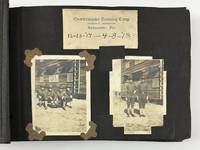
1918réf. 2322Various locations in Texas 1918. Very good. Fifteen leaves illustrated with fifty-five mounted photographs and a few ephemeral clippings identifying locations. Oblong octavo. Contemporary black cloth string-tied. Light soiling to covers. Minor wear to some photographs but overall a handsome selection. A unique collection of vernacular photographs collected by a soldier in the 8th U.S. Cavalry identified simply as D. Watson serving in southwest Texas during the Mexican Border War. The first two pictures emanate from Quartermaster Training Camp in Jacksonville Florida. This is followed by one photo from Barron Field in Everman Texas. The remaining photographs document Watson's time in Ruidosa Texas an unincorporated Texas-Mexico border town in Presidio County about a hundred miles from Terlingua. Here Watson includes photographs of himself and other soldiers and their horses posed in front of old stone structures in orange groves amongst canyons in front of an automobile and more with images of Mexican adobes a wagon advertising an "electric light company" the cavalry preparing their horses scenes of the wilds of southwest Texas and the E.H. Carlton company store. E.H. Carlton was also a principal in the Carlton Van Loan Company an oil speculation firm active in the 1920s. An eclectic and intriguing selection of Texas-Mexico border images from an important period in history. unknown
1916réf. 12895Des Moines IA: Hebard-Showers Company September 1916. Panoramic photograph 8 x 37.5 inches with numerous captions in the negative. Rolled tightly. A few soft creases minor wear at bottom right corner. Very good. An unusually informative panorama of Brownsville and Matamoros taken from the American side of the Rio Grande during the heat of the Mexican Revolution. The photograph was produced by the form of Hebard-Showers here spelled Hedard-Showers likely scratched backwards in the negative of Des Moines Iowa. The image captures the scene along the Red River from a portion of Fort Brown in the east west to Brownsville's Union Station with the International Bridge visible downriver. Directly across the river from Brownsville is labeled "Santa Cruz Mexico" with Matamoros a bit further south. Other landmarks identified on the Brownsville side include the aforementioned Union Station and the International Bridge as well as Fort Brown a river landing the customs house and various locations for American state guard units. Near the landing is the Brownsville Transfer Company's building. More pertinent to the Mexican Revolution are some of the captions identifying locations on the Mexican side. These include "Casa Mata Fort or place of execution" "Blanco's Battlefield June 3rd 1913" and "Villa's Battlefield March 27 - Apr. 13 1915. 100 Killed." Also identified on the Mexican side are a Mexican bull ring the "Bone yard" and a river landing. Interestingly a small rowboat containing a few people can be seen approaching the Mexican side on the Rio Grande. Naturally Hebard-Showers Company mainly documented Des Moines and its surrounding areas but they shot a handful of Brownsville border views over several years at least between the present example and about 1921. SMU holds an example of the later panorama; comparisons between the present example and SMU's does reveal some changes in the area over the course of those five years and the present example includes many more detailed captions in the negative. Hebard-Showers Company, September unknown
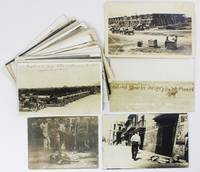
réf. 47618Various publishers & dates. Extensive photographic archive documenting events on both sides of the U.S.-Mexico Border during the Mexican Revolution focused primarily on the Border Wars in Texas and the Veracruz Incident of 1914 comprised entirely of contemporary images all but a few of which are original vintage prints. The collection includes: • Sixty-one commercially-produced real-photo postcards ca. 14cm x 9cm or the reverse; • Six commercially-printed postcards using non-photographic processes same dimensions; • Three carte-de-visite portraits ca 9cm x 6cm mounted to cards; • Eight small-format photographs ranging from 14cm x 8cm to 11cm x 16cm of which three appear to be commercial images; • Three 8x10 20cm x 25cm photographic prints printed at some later date from original plates but apparently not contemporary; • One vintage 4x6 10cm x 16cm photograph mounted on board. All but a dozen or so images are captioned in the negative and most are additionally captioned in pencil in a later hand on verso. Approximately half the images include no photo credit; of those that do we have identified the following photographers: W.H. Horne D.W. Hoffman Walter P. Hadsell Van Zile & Chalk and L.O. She. Condition is generally Very Good. Two of the photo postcards are damaged with abrasions to significant portions of image area; the remainder show various degrees of edge wear aging and creasing but by and large image quality remains excellent. None of the postcards are postally used though a few include brief contemporary notes on verso. The refusal of Mexican President Porfirio Dîaz to cede power to his rival Francisco Madero in the elections of 1910 resulted in a violent large-scale revolt by campesinos and leftists setting off the thirty-year long Mexican Revolution. American involvement in the conflict began in 1911 when President William H. Taft under the guise of heightening border security moved to back Díaz against the rebels. The resulting mobilization - Taft sent more than 20000 American troops nearly a quarter of all American forces to the Mexican border with especially heavy concentrations in Texas and New Mexico - was to that date the largest mobilization of American military forces in peacetime. At the same time many Americans whose sympathies were not aligned with the Díaz dictatorship including anarchists wobblies Native Americans and more than a few soldiers of fortune went south to fight on the side of the rebels. The resulting border conflict which took place over nearly a decade occasionally pitting American insurrectos against American Federal troops resulted in thousands of Mexican and hundreds of American deaths. The Border Wars reached their climax around the period 1912-1914 which happened to coincide with a near-hysterical vogue for postcards among the American public. The result is that the Mexican Revolution is perhaps the first major armed conflict to have been extensively photo-documented in real time and certainly the first to have had a significant mass audience for that documentation. At least three hundred commercial photographers have been identified in association with the Mexican Revolution and they produced tens of thousands of images ranging from the relatively innocuous e.g. peaceful street and harbor scenes in Veracruz to the horrific lynchings and sidewalk cremations. This entire range of content is represented in the current collection along with portraits of most of the key players on the Mexican side including El Presidente Porfirio Díaz; his primary rival and successor Francisco Madero; Madero's successor by coup Victoriano Huerta; and various military figures including General Juan Navarro Felipe Angeles Ramírez and numerous others. Many of these semi-professional images though produced with commercial intent "professional" remains a guarded term in the context of what was essentially battlefield exploitation photography are valuable for their almost off-hand depictions of violent day-to-day life on the contested border including the casual destruction and acceptance of death from both sides that seemed to define this conflict. Of particular note are numerous of photographs of African-American troops the so-called "Buffalo Soldiers" as well as at least one image depicting Native American soldiers in uniform. Locales represented include Camp Grossmont in California; El Paso and Laredo in Texas and their cross-border sister cities Juarez and Nuevo Laredo; Veracruz site of the American incursion of 1914 known as the "Veracruz Incident"; and various unidentified encampments and battle sites in both Texas and Mexico. A wide-ranging and compelling photographic collection documenting not only a key period in U.S. military diplomacy - one which for better or worse set the tone for American-Mexican relations for the succeeding century - but also a tangible manifestation of the first widespread public incarnation in America of the picture-postcard as a vehicle for both propaganda and photojournalism. unknown
1921réf. 6158Various places in Mexico Texas and Arizona 1921. Overall about very good. 106 real photo postcards including six duplicates. Varying sizes but most approximately 3.5 x 5.5 inches. Scattered contemporary and later manuscript annotations. Light wear at edges occasionally a bit heavier. Some scattered damp and dust soiling. A substantial collection of over 100 real photo postcards that depict scenes from the Mexican Revolution and the related border war interventions of the United States Army. The images included here some quite violent in nature are dated from 1913 to 1922; most are captioned in the negative. They show ruined buildings military encampments injured soldiers and corpses on both sides of the U.S.-Mexican border and in Veracruz. Also included are identified portraits of individuals such as Francisco Madero Pancho Villa on his deathbed and American General John Pershing. Many of the images are by El Paso photographer W.H. Horne who was one of the most prominent photographers of Border War incidents captured the Columbus Raid in New Mexico and photographed skirmishes near his home in El Paso. Also present are a short series of images by Cal Osborn who documented border incidents near Douglass Arizona and a group by William Hadsell William Hadsell an American resident of Veracruz who ran a Kodak store and was a prolific recorder of events there. Several Mexican photographers are represented as well. Many of the photos are quite gruesome in nature and show corpses in various states of decomposition as well as the aftermath of battles and executions but in all provide an arresting visual document of the interventions by the United States in Mexico during the 1910s. Powerful images of the Mexican Revolution and the resulting upheaval there and along the border with the United States. unknown
réf. 9058501442.Gpaperback. Good. Access codes and supplements are not guaranteed with used items. May be an ex-library book. paperback
réf. ST20972dParis: Nicolas Vivien early 16th century. 197 x 130 mm. 7 3/4 x 5 1/8". Single column 28 lines gothic typeface. Ruled in red each leaf with several one- to three-line initials painted gold on red or blue ground and A LOVELY ANIMATED FULL BORDER DONE IN MANUSCRIPT with trompe-l'oeil flowers a moth a fly and a bird on painted gold ground. Light soiling and a couple small stains to vellum one initial a bit smudged but in excellent condition overall. This beautifully embellished leaf from a printed Book of Hours demonstrates the enduring demand for manuscript illumination in the incunabular period and beyond. While the text here was completed on a printing press the initials and border were done entirely by hand adding luxury and luster to an otherwise unadorned page. Although this leaf likely belonged to a Book of Hours printed in Paris possibly an edition printed for Nicolas Vivien in or around 1503 the trompe-l'oeil style seen in the border was particularly popular among Flemish and Netherlandish illuminators of the period. The large blossoms and acanthus here seem to pop off the page because of the artist's use of subtle shading to indicate shadows and there is additional pleasure to be found in the small creatures--a bird carrying a small flower a moth and a housefly--that share the space. Nicolas Vivien(?) unknown
1850réf. 26013MADRID: Por Aguado Impresor de Cámara 1850. 4º.- Cartoné de época.- 101 páginas. El texto es de Felice Romani y la música del mallorquín Francisco Frontera de Valldemosa. Por Aguado, Impresor de Cámara unknown
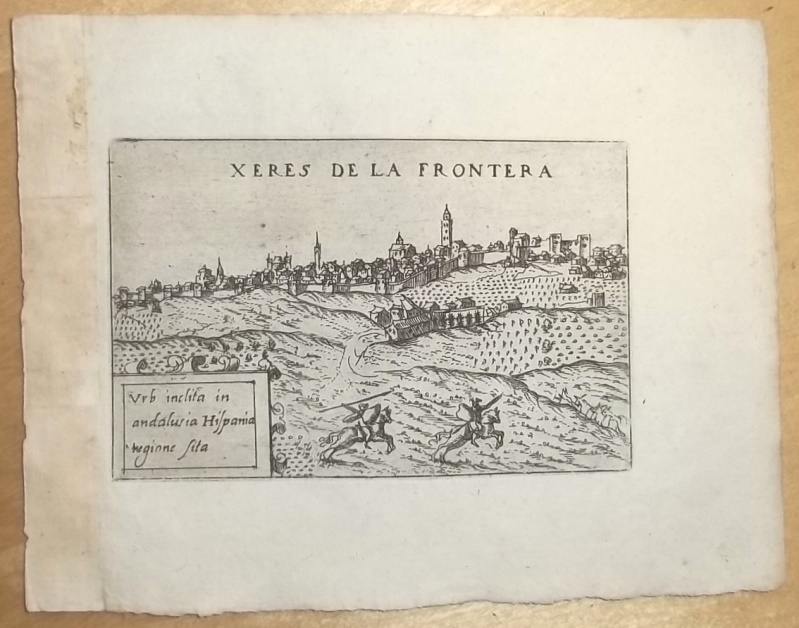
1600réf. 17001Venedig, Valegio, um 1600. Ca. 8,5 cm x 13 cm.
2001Ilustraciones "Faros y Costas" de Eduardo Sanz. Del índice: "DOS FRAGMENTOS DE LA COSTUMBRE DE VIVIR", por J.M. Caballero Bonald. "LA LUCIDEZ Y EL ÓXIDO", por Luis García Montero. "UN POEMA", por Francisco Brines. "ENTREVISTA: ABDELKRIM TABBAL, EL POETA DE XAUEN". "JEAN COCTEAU: LA AVENTURA ESPAÑOLA", por Juan Lamillar.
1985Sin lugar a dudas es este un nuevo acto de aproximación entre dos sectores, el científico y el industrial.
S.l., s.n.t., s.d. (anni '10 del sec. XX), in-16, cartoncino edit. con dorso e cop. post. fittizi, pp. 15, (1).
2007lettere senza frontieremedici senza frontiere testimonianze operatori umanitari