13 083 résultats
réf. DADAX0415886368New unknown
1900réf. 232871900. India glass lantern slide archive documenting class hierarchy dichotomy in British India with scenes of village labor bazaar exchange railway movement industrialization Sikhs and colonial cavalry circa 1900-20. Images clearly depict the class divide and caste system; villagers and laborers are shown seated on bare ground in carpentry work men and goats occupy an unpaved settlement space Sikh men stand beside a railway carriage tied to imperial transport networks a factory scene introduces mechanized industry and a formal portrait of turbaned cavalry soldiers. Photo archive of 8 glass lantern slides 3.25" x 3.25" India circa 1900 to 1920. Several slides retain manuscript captions on the mounts including "Central India" "Village School" "Bazaar Calcutta" and "MV. parannis an Indian carpentry clas." "Parannis" is probably a misspelling or misreading of "Pariahs" a historical caste/community term used in colonial-era descriptions of South Indi The British largely preserved formalized and exploited the Indian caste system rather than dismantling it. Their relationship with caste was pragmatic: caste became a tool for administration taxation labor control military recruitment and social organization across British India. The "Village School" slide shows a line of children and adults posed before a low building under dense tree cover with one figure standing forward in the open yard. The carpentry slide shows a large group of Indian boys outdoors beneath a tree seated or crouched on the ground around planks and hand tools with timber laid across the foreground and simple structures behind. The Calcutta bazaar scene places vendors baskets and goods in an open market setting under palms while the village scene presents men in loose garments in what seems to be a cattle farm setting. One slide shows Sikh men beside a railway carriage one barefoot in the foreground and others gathered near the rail car doors linking Indian bodies to the movement of goods troops and passengers through the colonial rail system. Another slide presents four uniformed soldiers in turbans possibly the Madras cavalry posed formally with boots sashes and weapons before a masonry wall. The factory view shows smoking industrial works with long roofs tracks and an extended production yard further cementing colonial industrialization within the archive. British rule in India relied on linked systems of extraction transport discipline and military force and these slides place those systems beside the people who bore their unequal social effects. Railways expanded under colonial finance and administration to move troops raw materials and commercial goods; industrial sites grew beside older economies of hand labor and bazaar trade; Indian soldiers and cavalry units served within an army organized to secure imperial control; and rural schools workshops and village scenes expose the local social world that existed under those pressures rather than outside them. Light edge wear some mount loss to several slides; no cracks or chips. Overall very good condition. British colonialism widened India's class divide by concentrating wealth transport and military power in imperial systems while leaving many Indians in village labor and low paid market work. unknown books
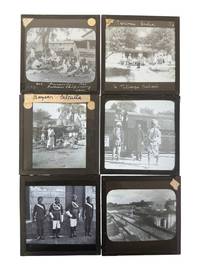
1900réf. 232871900. India glass lantern slide archive documenting class hierarchy dichotomy in British India with scenes of village labor bazaar exchange railway movement industrialization Sikhs and colonial cavalry circa 1900-20. Images clearly depict the class divide and caste system; villagers and laborers are shown seated on bare ground in carpentry work men and goats occupy an unpaved settlement space Sikh men stand beside a railway carriage tied to imperial transport networks a factory scene introduces mechanized industry and a formal portrait of turbaned cavalry soldiers. Photo archive of 8 glass lantern slides 3.25" x 3.25" India circa 1900 to 1920. Several slides retain manuscript captions on the mounts including "Central India" "Village School" "Bazaar Calcutta" and "MV. parannis an Indian carpentry clas." "Parannis" is probably a misspelling or misreading of "Pariahs" a historical caste/community term used in colonial-era descriptions of South Indi The British largely preserved formalized and exploited the Indian caste system rather than dismantling it. Their relationship with caste was pragmatic: caste became a tool for administration taxation labor control military recruitment and social organization across British India. The "Village School" slide shows a line of children and adults posed before a low building under dense tree cover with one figure standing forward in the open yard. The carpentry slide shows a large group of Indian boys outdoors beneath a tree seated or crouched on the ground around planks and hand tools with timber laid across the foreground and simple structures behind. The Calcutta bazaar scene places vendors baskets and goods in an open market setting under palms while the village scene presents men in loose garments in what seems to be a cattle farm setting. One slide shows Sikh men beside a railway carriage one barefoot in the foreground and others gathered near the rail car doors linking Indian bodies to the movement of goods troops and passengers through the colonial rail system. Another slide presents four uniformed soldiers in turbans possibly the Madras cavalry posed formally with boots sashes and weapons before a masonry wall. The factory view shows smoking industrial works with long roofs tracks and an extended production yard further cementing colonial industrialization within the archive. British rule in India relied on linked systems of extraction transport discipline and military force and these slides place those systems beside the people who bore their unequal social effects. Railways expanded under colonial finance and administration to move troops raw materials and commercial goods; industrial sites grew beside older economies of hand labor and bazaar trade; Indian soldiers and cavalry units served within an army organized to secure imperial control; and rural schools workshops and village scenes expose the local social world that existed under those pressures rather than outside them. Light edge wear some mount loss to several slides; no cracks or chips. Overall very good condition. British colonialism widened India's class divide by concentrating wealth transport and military power in imperial systems while leaving many Indians in village labor and low paid market work. unknown
1900réf. 1742Great Marlborough Street London: Hurst & Blackett 1900. 1st Edition. Hardcover. Used - Very Good. Contents unmarked but with some foxing binding strong though page edges show wear and age. Boards are slightly worn but illustration and gilt on front board remain clear. Hurst & Blackett hardcover
1909réf. 027193Edinburgh 1909 JOHN GRANT Hardcover
1957réf. nn1050Éditions Piccoli Série le Monde Album cartonné 1957 In-8 (18 x 23,5 cm), album cartonné, 18 pages, illustrations en couleurs de Mariapia ; traces à la couverture jaunie, coiffes et coins frottés, intérieur frais, par ailleurs assez bon état général. Livraison a domicile (La Poste) ou en Mondial Relay sur simple demande.
1962in 8° br. pp.52, ben tenuto
1973bross. edit. ill.
1814réf. 27018Paris Le Normant 1814 2 vol. in-8 demi-chagrin vert, dos à nerfs orné de filets et caissons dorés, tr. jaspées [Rel. postérieure], petite mouill. marg. au début du t. 1
1814réf. 29346Paris Le Normant 1814 2 tomes en un fort vol. in-8 basane fauve racinée, dos lisse orné de filets, larges fleurons et semis géométriques dorés, pièce de titre cerise, tranches marbrées [Rel. de l'époque], coins émoussés, coiffes un peu frottées
1814réf. 21998Paris Lenormant 1814 -in-8 bradel 2 volumes, Reliures d'Epoque bradel papier imitation plein veau frisé vieux rose in-octavo(binding full calfskin) (23 x14 cm), dos long (spine without raised band) décoré or (gilt), titre frappé "or", pièce de titre sur fond chocolat avec double filets "or", tomaison frappée "or" dans un écu "or", double filets "or" en place des nerfs et en tête et en pied, entre nerfs à fleuron "or", coiffe supérieure du tome 1 frottée, plats décorés "or" ornés d'une chainette "or" et d'un filet "or" en encadrement, plats légèrement frottés, toutes tranches non-rognées, orné d'une grande carte dépliante en couleurs sur papier fort+un tableau des monnaies, poids et mesures dépliant imprimé en noir, (xvj + 372) + (408) Pages, 1814 Paris Lenormant Editeur,
in-8, 382 pp., illustrations, cartes aux gardes, cartonnage de l'éditeur. Bon état. [CA30-6]
réf. 1104395681.Gpaperback. Good. Access codes and supplements are not guaranteed with used items. May be an ex-library book. paperback
réf. 1165699869.Gpaperback. Good. Access codes and supplements are not guaranteed with used items. May be an ex-library book. paperback
1996Very Good English Paperback. Pbo. Cr. 8vo. (20 x 14 cm). In Turkish. [xvi], 176 p., color and b/w ills. Geleneksel Hint mutfagi. Üstün bir tat. [= Un gout superieur la cuisine traditionnelle de l'Inde]. Translated by Müheyya Izer.
réf. 119180Bangalore, Indian Institute of Spirituality 1995, 220x140mm, 138Seiten, broschiert. Schönes Exemplar.
réf. 5198, The Publications Division, Ministry of Information and Broadcasting, Delhi, 1954., Boud in half-cloth, 30x21cm, 157pp.
1986réf. 110749Paris Bibliothèque nationale de France 1986 1 vol. broché petit in-4, broché, couv. illustrée, 194 pp. (couverture un peu défraîchie, ride au dos), nombreuses reproductions en noir et en couleurs. Catalogue de l'exposition à la Galerie Mansart, mars-juin 1986. Bon état.
réf. 2227Publications Chitra, Boulogne-sur-Seine, 1928.
1982réf. 89020London Hayward Gallery 1982 1 vol. broché in-4, broché, couv. illustrée, 231 pp., nombreuses photos en noir et en couleurs, glossaire, bibliographie. Texte en anglais. Très bon état.
ISBN : 2713100348. MARCUS.. 1987. In-12 Carré. Broché. Bon état. Couv. légèrement pliée. Dos satisfaisant. Intérieur frais. 64 pages. Quelques illustrations en noir et blanc dans le texte.
1987réf. R150147248MARCUS.. 1987. In-12. Broché. Bon état, Couv. légèrement pliée, Dos satisfaisant, Intérieur frais. 64 pages. Quelques illustrations en noir et blanc dans le texte.. . . . Classification Dewey : 954-Asie du Sud, Inde
ISBN : 2830702670. MINERVA.. 1995. In-4 Carré. Cartonnage d'éditeurs. Bon état. Couv. convenable. Dos satisfaisant. Intérieur frais. 126 pages. Nombreuses illustrations en couleurs dans le texte et hors texte.