123 résultats
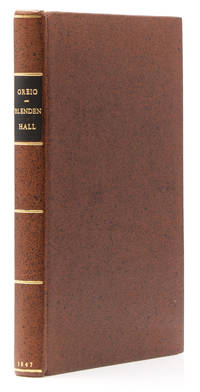
1847réf. 316972New York: William H. Colyer 1847. First Edition. Frontis. 209pp. Bound in full modern mottled brown calf. Fine. First Edition. Frontis. 209pp. Huntress 166 William H. Colyer unknown books
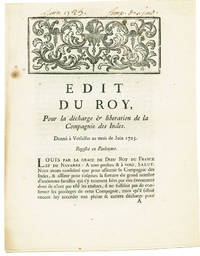
1725réf. 40677Paris. 1725. Reorganizing the Compagnie des Indes after the Mississippi Bubble A French royal decree releasing the Compagnie from some of its debts an important step in its reorganization. In 1721 the Compagnie had declared bankruptcy and was reorganized after the Mississippi Bubble burst. "This decree discharges the Compagnie des Indes of a large number of financial burdens which had been weighing on it for a number of years" - Maggs. Wroth locates only one copy at NYPL; OCLC identifies three more copies. Scarce. From the library of Cardinal Etienne Charles de Lomenie de Brienne 1727–94 Minister of Louis XVI Archbishop of Toulouse and of Sens. A friend of Voltaire and a member of the Académie Française Brienne wielded significant power as head of the Finance Ministry which earned him many enemies. He died in prison during the French Revolution despite having renounced Catholicism in 1793 presumably as an attempt to save his life. Quarto. Unbound folded sheets. Minor foxing. Light soiling along spine edge. Contemporary inscription. Very good. MAGGS FRENCH COLONISATION OF AMERICA 311 this copy. WROTH ACTS OF FRENCH ROYAL ADMINISTRATION 1101. OCLC 62370774. unknown books
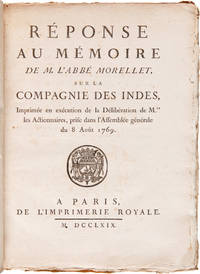
1769réf. 47671Paris. 1769. Jacques Necker 1732-1804 was serving as a director of the French East India Company when he penned this rebuttal to the MÉMOIRE of Abbe Morellet. Morellet had argued against the Compagnie's trading monopoly which Necker here defends. Necker would become Finance Minister under Louis XVI until the French Revolution. Quarto. Contemporary marbled wrappers stitched. Spine lightly worn and faded. Minor foxing to first and last leaves. Very good plus. unknown books
1688réf. 24522London: J. Richardson for Samuel Titmarsh 1688. First edition. Hardcover. Three quarter brown calf marbled boards rebacked. Near fine. 6 223 1. 81 1 34 pages. 18 x 12 cm. The anonymous author of this work attempts to refute the "slanderous imputations" of the work Justification of the Directors of the Netherlands East-India Company reprinted here in full with a separate title following page 223. He proclaims that it is "such a tedious rhapsody of fictitious fallacious inferences and arguments confusedly mixt with some distorted truths spun out. that it would be tiresome to the reader to trace all the prevarication's mis-recitals and sophistry contained in it. I shall proceed to detect his willful mistakes by which he endeavours to honest many injurious and insolent violations of right done by the Dutch towards the English in India directly contrary to the Articles of Peace." KRESS 1675. WING. I90 J1259. Interior contents clean and bright. Raised bands red leather spine label printed in gilt. J. Richardson for Samuel Titmarsh hardcover books
1788réf. 47799Paris. 1788. Memorial of the French East India Company freshly reconstituted in 1785 after its liquidation in 1769. Twenty-four pages of tables provide a detailed accounting of the Compagnie's commercial activities from 1769 through 1777 while the text advocates the importance of the Compagnie and details its further activities to date. Fewer than ten copies are located in OCLC. Quarto. Contemporary blue paper wrappers stitched. Minor wear and soiling. Near fine. unknown books
1844réf. 022107London: J. Hatchard and Son 1844. First Edition. Hardcover. Partly unopened; scattered foxing but text and plates mostly clean. Some fraying along spine edges; gilt fairly bright. Easily Very Good in a Fine clamshell box. Two 6-1/2" x 9-3/4" volumes in publisher's gilt-decorated and lettered green cloth: xii 478; vii i 459 1 pages. Housed in a green cloth clamshell box. Illustrated with 32 color chromolithographic plates with tissue guards. Lieutenant-Colonel William Henry Sleeman who spent his entire career in India was best known for his fight to suppress the activities of "thugs" bands of criminals who attacked robbed and often murdered innocent travelers. In these volumes he describes his experiences doing so as well as his thoughts on various aspects of Indian life including Hinduism local festivals and folklore natural history governance military discipline and the justice system. In 1828 Sleeman made the first documented discovery of dinosaur fossils in Asia before the term "dinosaur" was even formally coined. ABBEY TRAVEL 466. J. Hatchard and Son hardcover books
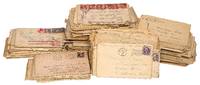
1924réf. 426129Missouri Illinois Maine New Jersey Colorado Washington DC Kansas New York 1924. Unbound. Near Fine. A collection of 209 letters from 1914 through 1924 from a young man sailor writing home to his wife with some later correspondence. Near fine with small tears and some age toning most on the envelopes. The majority of the letters are written from Garnett Blair Martin to his wife India Faye Martin née Gentry with some written from India to Garnett while he was serving in the Navy during World War I. He was stationed in several different base camps and moved around frequently as the letters are from various places in the United States including Missouri Illinois Maine New Jersey Colorado Washington DC Kansas New York among others. A large portion of the letters are holiday and birthday cards along with a few postcards sent to Martin's daughter explaining he will be home soon. However most of the letters are written affectionately to Martin's wife and with her letters replying in kind. Some of the letters discuss Martin's experience at the army bases from packing and moving constantly to having physical ailments such as poor eyesight sores and cuts. He also critiques the living situations while at war "it's cold and cramped here I can't even smoke a cigarette without blowing it in someone's face." Most of the letters somehow find a way back to lovelorn acclamations to his wife about how "a sweet kiss from your dear lips could cure it soon." Accompanied by a few letters and postcards from friends. A collection of romantic correspondence from a wife and husband separated during the World War. unknown books
1730réf. 5023Copperplate engraving 83.5 x 55.5 cm 1 folio. Fold marks minor edge wear otherwise a very good copy in very crisp dark impression. Rare large-format engraved print produced in 1730 as part of the celebrations of the 200th anniversary of the Augsburg Confession 1530 one of the foundational documents of Lutheranism. The subject of the print is the famous Tranquebar Mission in southern India which was established by King Frederick IV of Denmark 1671-1730 and led by the German missionaries Bartholomäus Ziegenbalg 1682-1719 and Heinrich Plütschau 1676-1752 who are noted for having translated the Bible into Tamil and arranged for its printing. The engraving executed by Johann Jacob Kleinschmidt after a design by Elias Riedinger is a splendid example of 18th-century Augsburg printmaking. It takes as its compositional conceit a church altar surmounted by a framed retable. The image above the altar depicts the German missionaries preaching to an audience of natives; in the background of this scene can be glimpsed a statue of 'Biruma oder Brama' Brahma. The elaborately carved frame of the retable is enlivened with vignettes illustrating the successes of the Lutheran mission e.g. an Indian smashing an idol a native being baptized a domesticated elephant symbolizing the people under God's yoke etc. Placed atop the altar are oval portraits of Ziegenbalg and Plütschau their names written in Tamil and the books they translated an Indian bible an Indian catechism and an Indian hymnal. A map of southern India hangs on the front face of the altar. Flanking the altar are two young natives: the boy on the left holds the Danish Royal arms and the boy on the right displays the architectural plan of the New Jerusalem Church in Tranquebar built by the Germans and dedicated in 1719. In front of the altar are fallen symbols of the old dispensation. At the foot of the sheet is a poem in Latin and German celebrating the expansion of the Lutheran faith to all corners of the world. The engraving is one of several quite ambitious broadside prints produced in Augsburg to commemorate the bicentennial of the Augsburg Confession some of which apparently reproduced paintings executed for the occasion. These rather disparate graphic productions were collected by Johann Michael Roth in 1730/31 and released as a small-edition composite volume with an added engraved title page reading Augspurgisches Iubel-Gedächtnüs. The contents of this rather odd production vary greatly from copy to copy. Kleinschmidt's Vorstellung der Evangelisch-Ost-Indischen Kirche engraving apparently was a commercial success because in 1736 citing demand he released a small-format version of the work its composition slightly altered. OCLC locates U.S. examples of the Augspurgisches Iubel-Gedächtnüs at Illinois Duke Getty Stanford Princeton Yale Harvard Emory Concordia Seminary and Cal. State Sutro. The Getty copy includes Kleinschmidt's Vorstellung der Evangelisch-Ost-Indischen Kirch but it is not clear which other examples include this engraving. Drugulin Historischer Bilderatlas 4112; S. Neill A History of Christianity in India. Kleinschmidt books
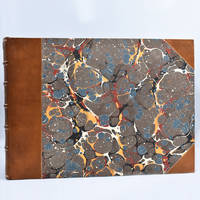
1906réf. 321920Poona and Bombay India 1906. Comprising 17 album leaves with approximately 84 mounted photographs ranging in size from 16 full page and 8 half page photographs to smaller snapshots mounted with some thought many with detailed captions identifiers and dates in ink. 1 vols. Oblong folio 10-3/4 x 14 inches. Modern three quarter brown morocco and marbled boards new endpapers a.e.g. Some toning to a few album leaves the photographs generally clean and fresh. Comprising 17 album leaves with approximately 84 mounted photographs ranging in size from 16 full page and 8 half page photographs to smaller snapshots mounted with some thought many with detailed captions identifiers and dates in ink. 1 vols. Oblong folio 10-3/4 x 14 inches. A nice little family album of foxhunting and equestrian scenes relating to the Poon and Bombay Hunts as well as views of landscape and family life. The paterfamilias is identified in captions as A.W.S. a British officer and his wife R.A.S. even while numerous others members of hunts or parties are identified by name and rank. "Ruth" and "Baby" complete the family unit and RUth can be seen seated among a line of children in hunting kit at the "Children's Fancy Dress Party / Given by Poona Bachelors / Poona Gymkhana" and then mounted on a pony in panoramic Hunt portraits. One leaf with six photographs depicts the stages of a meet from draw to check to who'oop! with the central image captioned "Ruth's first brush given by J.A. Lord Esq. M.F.H. / Snapshots by Capt. Jennings" and another contemporary hand has added in pencil " run near Saula Creek Bombay Hunt . 1905". Other groups of images show views at "Singhur 1901-1905" and domestic scenes. unknown books
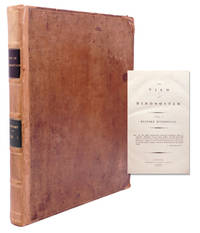
1798réf. 319520London: Henry Hughes 1798. First edition. Folding map frontispieces plates. xv 263 9 index; x 374 12 pp. 2 vols. 4to 11 x 9 inches. Contemporary full tan calf rebacked retaining original boards lower corner of Vol. I repaired. 19th-century ownership inscriptions to first blanks 1-inch tear to map near mount some thumb soiling and scattered spotting. First edition. Folding map frontispieces plates. xv 263 9 index; x 374 12 pp. 2 vols. 4to 11 x 9 inches. "This tireless naturalist and antiquary reached out to the ends of the world to gather in knowledge" Cox. These are volumes one and two on India and Ceylon of an intended 14-volume series entitled "Outlines of the Globe." Welshman Pennant died in 1798 the year of publication and only two more volumes China and Japan were published after his death by his son. ESTC T145966; Cox I p. 307 Henry Hughes unknown books
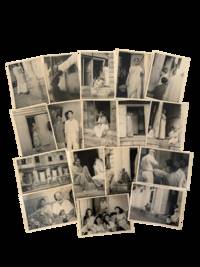
1958réf. 231781958. Bombay red light district photographs of women seated in brothel doorways gathered in interior rooms and receiving male visitors circa 1958 recording the sex trade as it operated in post independence India under the combined pressures of urban poverty migration and state regulation. Drawn from a merchant marine album and anchored by a source page marked 1958 the group preserves an outsider's view of brothel based sex work at the moment when independent India's Suppression of Immoral Traffic in Women and Girls Act had just come into force. British rule had already concentrated prostitution into regulated urban zones in Bombay with districts such as Kamathipura shaped by segregation policing and the management of commercial sex. The 1956 law effective 1 May 1958 targeted brothel keeping procuring and related activities without removing the economic structures that kept poor women in the trade. Photo archive of 17 silver gelatin photographs each 2.75" x 4" Bombay India circa 1958. Several images show women in saris seated on stone thresholds and steps outside narrow ground floor rooms watching the street conversing with one another or facing the camera from darkened doorways. Other photographs move inside the premises where a group of young women pose on a sofa beneath patterned wallpaper one beside a Western man holding a camera while another interior view shows several women crowded before a wall mirror with the same man visible in reflection behind them. Street level exterior views record a worn multistory building with open upper windows shuttered lower bays pedestrians passing and an automobile and hand pulled or cycle traffic in front fixing the brothel within a dense commercial streetscape rather than an isolated interior world. One of the most arresting images shows a white clothed man carrying a tray as he faces several figures in a narrow passage potentially showcasing the work surrounding and upkeeping the trade. The archive belongs to a longer history in which Bombay's sex districts were formed under colonial urban governance and continued after 1947 as sites where caste class migration policing and women's labor met in highly unequal ways. These photographs show the raw historical context of such professions with women waiting at entrances living in cramped quarters and occupying semi public thresholds where domestic space commercial exchange and street visibility collapse into one another. Light surface wear small edge chips and album glue residue en verso. Overall very good condition. The album context fixed 1958 dating and repeated views of the same doorway spaces make this a concise photographic record of brothel based sex work in postcolonial Bombay. unknown books
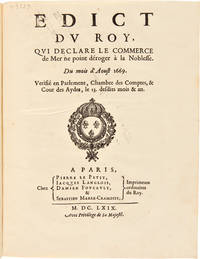
1669réf. 15822Paris. 1669. The French Aristocracy Freely Admitted to Maritime Trade A variant issue with a slightly different title of this important edict which allows members of the nobility to trade by sea without foregoing any of their privileges. Previously their activities had been circumscribed by ordinances preventing their entering commerce. Apparently a catalyst for this edict was the formation of the Compagnie des Indes in 1664 which is specifically mentioned in the text. A note on the last page states that this copy was collated against the King's Ministry copy. OCLC locates only one copy at the University of Oxford. Rare. 7pp. Small quarto. Modern boards leather label. Light soiling around the edges. Very good. WROTH ACTS OF FRENCH ROYAL ADMINISTRATION 95 ref. MAGGS FRENCH COLONIZATION OF AMERICA 10 ref. hardcover books
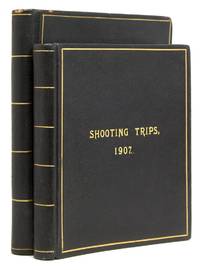
1909réf. 312711N.p. India 1909. 126 tipped in gelatin photographs 63 in each volume; with four manuscript sketch maps 2 in each volume. 153 pp.; 7 numbered a-g 124 ff. including blanks. 2 vols. 8vo and 4to. Contemporary full brown morocco covers ruled and lettered in gilt black coated endpapers by Thacker & Co. Bombay with their red ticket at the back. Corners bumped faintest traces of rubbing. 126 tipped in gelatin photographs 63 in each volume; with four manuscript sketch maps 2 in each volume. 153 pp.; 7 numbered a-g 124 ff. including blanks. 2 vols. 8vo and 4to. Substantial detailed and extensively illustrated chronicle of travel and sport in the area north and east of Simla Sutlej River Adampur Jhansi and elsewhere in India including a trip in the Himalayas. The author was Lawrence Christian Gordon a major in the artillery; at this time he was staioned in Jhansi. The first volume is divided in three parts: Part I. Trip near Adampur after black buck and gazelle pp. 1-26 dated 23 December 1906 to 3 January 1907 Part II. Near Jhansi after black buck pp. 27-37 Part III. Himalayas after burhel and ibex pp. 39-153 dated April to July 1907 up the Sutlej river from Simla with mention of Asirang Lipi Jangi The second volume is a continuous narrative describing short shooting and fishing trips in 1908 and one longer account of three months' shooting leave March to June 1909 in the terrain upriver from Simla close to the border with Tibet and indeed many of the villages and monasteries passed were of TIbetan culture. The photographs are well composed and printed; burhel was the chief game hunted. Gordon writes candidly with many observations on local conditions and weather. Provenance: Norman James Anderson Galleries 9 November 1928 lot 784; Harvard Travellers Club in May 1934 bookplates unknown books
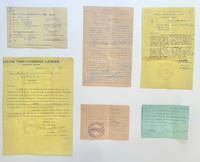
1943réf. 010675Kyaiklat Burma British India 1943. Handwritten. Very Good. Loose Leaf. 4to - over 9¾ - 12" tall. Correspondence from Chettiar in Tamil from IIL in English. 9 letters from Chettiar and IIL in manuscript and typescript; 10 pieces of correspondence from IIL on note cards with IIL letterhead; 1 IIL membership card for Chettiar. CONDITION: Overall Very Good old folds some splitting and tape repairs along folds of documents by IIL but Chettiar's letters largely free of wear or tear text legible throughout. All documents now housed in sleeves that are mounted onto backing but it remains easy to remove documents from enclosures. This collection contains English translations of Chettiar's letters presumably made by the previous owner who also wrote captions describing each piece of correspondence on their respective mounts. An evocative collection of correspondence document- ing an Indian nationalist organization's coercion of funds from a member of a prominent money-lending Burmese-Tamil family. These letters show the Indian Independence League's attempt to extort money from a wealthy man whom they had identified as being in a position to help "free India from bondage and for the maintenance of the Indian National Army." This was M.S.M. Somasundarum Chettiar a 63-year-old merchant who operated his business on Strand Road in Kyaiklat a town in the Pyapon District of Burma. A recent historical study by Suppiah and Raja on the Chettiar families of Burma suggests that Somasundaram was part of a "distinguished ethnic group comprising the business class among Malaysian Indian-Tamils" who made their fortunes by lending money to the Indian working class in Burma. The Chettiar ethnic group boasted "a centuries long tradition as an indigenous banking caste in South India" and thus due to a combination of "stringent business regulations during British colonialism in the Madras Presidency and economic opportunities in the newly opened British colonies in Southeast Asia" both the Indian working class in Burma and members of the Straits Settlement Chinese utilized "Chettiar agents in order to conduct bank transactions.in the middle of the nineteenth century." This reliance upon the Chettiar's services only increased by the turn of the twen- tieth century as the demand rose for rubber and tin made in Southeast Asia. As "local Chinese and Malays with only small and medium capital sources relied on loans from Chettiar agents to develop land plant rubber and open mines.Chettiar agents" became "known as the leading moneylenders" in late-colonial Burma. Somasundaram would thus have been part of a known community of capitalists "who accumulated capital for further expansion of their activities at the expense of the Indian working class." The Indian Independence League and the Indian National Army were closely intertwined movements during WWII both led by Subhas Chandra Bose and governed by the Azad Hind Provisional Government in Exile.They worked to unite the Indian diaspora in Southeast Asia to support the cause of independence and sought military support from Japan to facilitate an armed wing for their movement. Primary source documentation of the Azad Hind government's activities is scant institutionally. We locate a scrapbook created by a member of the Indian National Army held at the Institute of Social Research in the Netherlands and a letter from Subhas Chandra Bose asking for a loan from the Hikari Kikan of Syonan held by the National Library Board of Singapore. This would be the only comparable collection held in North America.A rich collection of correspondence highlighting the conflicting poles between Indian diasporic wealth and Indian nationalists' aspirations for the nation's self-rule listing credit Pico Banerjee Peek A Boo Rare Books & Ephemera . unknown books
réf. TK0040India: 19th century. Collection from various sources meaning clearly this group includes work from several different artists. Please view added illustrations online under this description. [19th century]. unknown books
1859réf. 320421Calcutta: Thacker Spink & Co. printed by P.M. Craneburgh at the Bengal Military Orphan Press 1859. First edition. iv 244 viii pp. 8vo. Original blue ribbed cloth spine gilt bookplate to front pastedown of Sir Charles P. Hobhouse Bart. Bradford-on-Avon presentation inscription to title page. A fine copy. First edition. iv 244 viii pp. 8vo. Inscribed on the title page: "For Annie with the Author's love." This copy also formerly belonged to Sir Charles Parry Hobhouse 3rd Baronet of Westbury. A crisp copy recording the anonymous author's seven month's of exploring through South East Asia in 1851 and 1853. Departing 8 September 1851 the author who remains anonymous to this day spent four months travelling to Ceylon and Singapore before returning to Calcutta. In 1853 he set off again this time for a three month excursion to the Madras and Bombay Presidencies. There are vivid descriptions of Singapore Penang Malacca Madras Calcutta Bombay Bangalore and Candy as well as coffee plantations and Buddhist temples. The author spends quite some time travelling overland and describes an ascent of Pedro Tallagalla and Kilkamany and camping at Makoortie Peak. Despite the scarcity of this little book it did attract critical attention. A favourable notice appeared in the Calcutta Review which states that the author had "seen and noted down . as much as any one who had preceded or who has since followed him in the same track." The work concludes with an appendix in two parts the first being a table showing the route modes of transport ship rail bandy pony and the amount of time spent at each location. The second is titled "Hints for travellers" which concludes: "Travellers will find it wiser never to have coolies to their palanquins when they can procure bearers; never to go in palanquins when they can with safety from the sun ride; never ride down passes when they can walk and never to be discouraged by indifference or dissuaded by alarms from prosecuting any enterprise." There is nothing in the preface to explain the six year delay between the conclusion of his travel and the publication of the account. Exceedingly rare. No copies on OCLC or COPAC. The only other copy we know of is the Brooke-Hitching copy identically bound; the present copy is in superior condition. The Calcutta Review vol. 33. July-December 1859. Serampore: "Friend of India" Press 1859 pp. lxviii-lxxi Thacker, Spink & Co. (printed by P.M. Craneburgh at the [Bengal] Military Orphan Press) unknown books
1796réf. 398421796. The archive comprises: 1. Autograph letter signed "John Canning." Bifolium 13 x 8 1/4 inches 21 lines in fine Malay Jawi with Arabic opening formula docketed "Calcutta 10 Dec 1796"; octagonal red-wax armorial seal of the Canning family. Letter requests that local rulers receive Capt. Hogan "as our agent. to conclude a treaty advantageous to both sides" dated 22 Jumada II 1211 / 10 Dec 1796. 2. to 5. 4 Paper wrappers. English addresses in a copperplate hand & parallel Jawi headings each with intact Canning seal. Addressed to the Sultan of Magindanao King of Mempawah Borneo King of Bali Sultan of Borneo. 6. to 8. 3 Yellow-silk diplomatic covers. Golden satin sleeves with paper address bands in two languages; two remain unopened and sealed. Addressed to the Sultan of Johor unopened King of Sumbawa unopened Sultan of Sulu wrapper only. An exceptional archive uniting British Malay and Islamic manuscript traditions that captures the East India Company’s first concerted overtures to the island-states of Southeast Asia. Drafted in the wake of the Dutch East India Company's collapse and the French Revolutionary Wars this archive documents the East India Company's first concerted diplomatic overtures to the maritime courts of the Malay world. With Dutch control unraveling after the 1795 Batavian Revolution Britain saw a strategic opportunity to enter the lucrative Spice Island trade. Lacking on-the-ground alliances the Company turned to private initiative: Captain Michael Hogan an Irish-American merchant and former convict transport captain was enlisted as unofficial envoy aboard his ship Marquis Cornwallis. The diplomatic texts were composed by Captain John Goodall Canning then Harbour-Master of the port in refined court Malay using Jawi script the Islamic-inflected lingua franca of diplomacy from Aceh to Sulu. In keeping with regional tradition the letters open with Islamic invocation and florid honorifics followed by carefully phrased expressions of friendship and commercial intent. The surviving autograph letter fixes the date of the mission and declares its purpose: "to plant affection and concord and if Your Highness deem it good to enter with us into a compact benefiting both realms." After disembarking convicts in Port Jackson Sydney in February 1796 the Marquis Cornwallis passed northward through Torres Strait calling at New Guinea the Moluccas and ports across the Java Sea almost certainly delivering these and parallel documents en route. The silk wrappers signal the elevated diplomatic status of the messages which were meant to be presented in person by Hogan and opened only in the presence of the addressee. The present archive offers a rare and vivid glimpse into the hybrid ceremonial linguistic and political world of early modern Southeast Asia and into the improvisational diplomacy of the Company at the edge of empire. unknown books
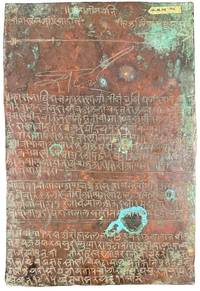
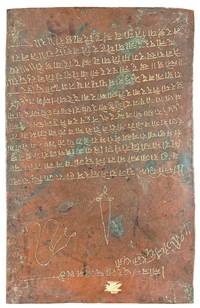
1819réf. 42798Eastern India possibly Bengal or Assam circa 18th-19th century. Copper plate 13 7/8 x 9 1/8 inches engraved on both sides. The principal face with several lines of incised text at the head followed by a large engraved validating or emblematic mark and below this three dense sections of text divided by ruled horizontal lines. The reverse largely uninscribed with three small engraved seals or validating marks near the edge. An inscribed copper plate of Indian origin possibly Bengal or Assam engraved in a Bengali or Bengali-Assamese script and preserving a formal documentary text in metal. This copper plate belongs to the South Asian tradition of preserving legal devotional and administrative records on durable metal supports. Copper plate documents often described as tamrapatra or copper charters were used for grants endowments title rights decrees and other formal acts their material permanence giving them authority beyond that of ordinary manuscript documents. The present example appears to preserve a substantial text arranged in ruled sections and accompanied by validating marks. The script appears close to Bengali or Bengali-Assamese. The letterforms show rounded and looped shapes consistent with scripts used in eastern India. If confirmed this would suggest an origin in Bengal Assam or a neighbouring region where related scripts were used for administrative and religious writing. From their earliest centuries of development copper plate inscriptions have occupied a central place in South Asian documentary culture particularly in the recording of land grants royal edicts temple endowments and other formal transactions. Their durability made them suitable for preserving records intended to endure and they were often deposited in temples or held by families or institutions as proof of rights and privileges. While earlier examples are frequently associated with royal chancelleries the practice continued into the early modern and colonial periods with regional administrations and local authorities maintaining related forms of documentation. The present plate appears to belong to this later phase of the tradition when such documents were still being produced for administrative legal or commemorative purposes. Its relatively large format and the density of inscription suggest a formal text of some substance while the additional engraved devices indicate an effort to authenticate or formalise the record. The copper plate offers a direct example of a documentary practice that bridges manuscript culture and more durable forms preserving both the text itself and the physical conventions of its transmission. unknown books
1819réf. 42797Western or Northern India circa 18th or 19th century. Copper plate 15 1/2 x 9 3/4 inches engraved on both sides one face densely filled with horizontal lines of incised text and with additional marks including a dagger or torch device and other validating or ownership marks. The reverse more sparsely inscribed with two lines of text. An inscribed copper plate of Indian origin engraved on both sides and belonging to the South Asian tradition of preserving legal devotional and commemorative texts. A striking survival from the documentary culture of South Asia where copper served as a durable support for records intended to outlast paper and palm leaf. Such copper records often described as tamrapatra or copper charters were valued because they were portable difficult to alter and capable of serving as enduring witnesses to grants decrees endowments title rights and other formal acts. The script appears to belong to the Nagari family possibly Devanagari or a related cursive administrative hand such as Modi the script long used for Marathi official and business writing. From their earliest centuries of development copper plate inscriptions have occupied a central place in South Asian documentary culture particularly in the recording of land grants royal edicts temple endowments and other formal transactions. Their durability made them suitable for preserving records intended to endure and they were often deposited in temples or held by families or institutions as proof of rights and privileges. While earlier examples are frequently associated with royal chancelleries the practice continued into the early modern and colonial periods with regional administrations and local authorities maintaining related forms of documentation. The present plate appears to belong to this later phase of the tradition when such documents were still being produced for administrative legal or commemorative purposes. Its relatively large format and the density of inscription suggest a formal text of some substance while the additional engraved devices indicate an effort to authenticate or formalise the record. The copper plate offers a direct example of a documentary practice that bridges manuscript culture and more durable forms preserving both the text itself and the physical conventions of its transmission. unknown books
1880réf. 3050981880. Albumen prints approximately 9 x 11-1/2 in. mounted on card with manuscript captions 61 signed and numbered in the negative by Bourne the rest unattributed. 1 vols. Oblong folio. Contemporary full pebbled morocco. Light traces of rubbing occasional light foxing to mounts. Albumen prints approximately 9 x 11-1/2 in. mounted on card with manuscript captions 61 signed and numbered in the negative by Bourne the rest unattributed. 1 vols. Oblong folio. An excellent and varied view of British India in the 1860s with large-format photographs supplied by one of the longest running photography firms in the world. The images grouped by location generally show architectural views as well as some Himalayan and rural views. Images include scenes from Goverdhan Deig Cawnpore Lucknow Benares Calcutta Darjeeling Udaipur Palace in the Lake and Ahmedabad. unknown books
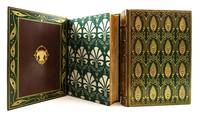
1906réf. ST20132London: Printed by the Edinboro Press for the Grolier Society 1906-07. Edition magnifique letter J of 26 lettered sets. 260 x 180 mm. 10 1/4 x 7". Nine volumes volume II bound without two-page Appendix IV Jackson A. V. Williams. SPLENDID CONTEMPORARY EMERALD GREEN MOROCCO lavishly gilt and with delicate scarlet morocco inlays forming a repeating peacock feather motif surrounded by Art Nouveau twining vines all within a gilt French fillet spine similarly decorated raised bands BROWN MOROCCO DOUBLURES with a central inlaid and gilt triple elephant motif within a wide green morocco frame adorned by gilt peacock feathers with indigo morocco inlays unusually elaborate floral silk flyleaves top edge gilt other edges untrimmed. WITH 153 PLATES including 72 photographic reproductions on shiny paper and 81 plates in three states with printed tissue guards: one hand colored; one tipped on in black & white; and one sepia; plus numerous black & white illustrations 68 of these being full-page; and one double-page map. Spines uniformly sunned to a light tan but bindings otherwise lustrous and virtually unworn; one tissue guard stuck to the plate facing p. 150 in volume IV a few corner creases other trivial imperfections but very clean and fresh with some leaves still unopened. This nine-volume history of India features a luxurious binding with sparkling gilt and vibrant morocco inlays forming motifs that perfectly suit its contents. Intended to present the history of India from the "earliest times" through the British Raj this profusely illustrated work was written by some of the most prominent Victorian scholars on the subject and edited by an esteemed professor of Indo-Iranian languages at Columbia University. Volume I "From the earliest times to the sixth century B.C." is the work of native Calcutta historian Romesh Chunder Dutt 1848-1909 author of major works on the cultural and economic history of the country. Volume II "From the sixth century B.C. to the Mohammedan conquest" is the contribution of Irish antiquarian Vincent Arthur Smith 1848-1920 who wrote the "Oxford History of India" which DNB says "was to exert a vast influence over generations of students." Volumes III and IV "Medieval India from the Mohammedan conquest to the reign of Akbar the Great" and "From the reign of Akbar the Great to the fall of the Moghul empire" come from British orientalist and numismatics expert Stanley Lane-Poole 1854-1931 praised by DNB as "a versatile writer able to produce both academic reference works . . . and popular versions of his biographies and introductions to historical subjects." Volumes V-VIII were written by former administrators of the Raj who had taken up Indian history as an avocation. Volume V "The Mohammedan period as described by its own historians" was prepared by editors from earlier works by Sir Henry Miers Elliot 1808-53. Volumes VI and VII "From the first European settlements to the founding of the English East India Company" and "The European struggle for Indian supremacy in the seventeenth century" were penned by Sir William Wilson Hunter 1840-1900 who spent 25 years in the Indian Civil Service before retiring to write about the history of colonialism in India. The penultimate volume "From the close of the seventeenth century to the present time" was written by someone who actually lived key parts of that history Sir Alfred Comyn Lyall 1835-1911 survivor and hero of the Indian Mutiny lieutenant-governor of the North-Western Provinces and longtime member of the Council on India. In the final volume editor Abraham Valentine Williams Jackson 1862-1937 compiles "Historic accounts of India by foreign travellers classic oriental and occidental." All volumes are copiously illustrated with photo plates of life in Victorian India many taken from Jackson’s own photographs and with examples of Indian art architecture and crafts. Though unsigned the spectacular bindings were clearly the work of a master possibly Sangorski & Sutcliffe. The quality of materials skill of finishing and elaborate motifs are consistent with those produced by that outstanding bindery or another of equal skill and taste. While the work occurs with some regularity on the market it is extremely rare in such a beautiful decorative dress as seen here. Printed by the Edinboro Press for the Grolier Society unknown books
1865réf. 311412Madras: Lawrence Asylum Press 1865. Illustrated with 12 mounted albumen photographs captioned in ink. Text within braided rule borders. ii 65 pp. 1 vols. 8vo. Full black morocco spine with gilt rules boards with gilt roll borders ornamental cornerpieces titled in gilt on upper cover yellow endsheets with orange ticket Bound at the Lawrence Asylum Press within border. Some minor rubbing occasional foxing. Fine. Gift inscription on first blank "J. Michael with the kindest regards of J.C.H. July 17th 1875. Illustrated with 12 mounted albumen photographs captioned in ink. Text within braided rule borders. ii 65 pp. 1 vols. 8vo. Spectacular unrecorded privately printed diary recounting a hunting expedition in Kerala southern India from 27 July to 22 September 1865 "the best shikar trip I have ever had". The narrator and his companion A.M.D. bagged 43 heads of eleven different types of big game including tiger bear elephant bison chettul and others with original albumen photographs mounted and captioned in a neat hand. The unnamed narrator mentions passing hunting parties one such Brown Jones and Robinson suggests that he read Trollope when the novel appeared as a serial in the Cornhill; the terrain around Hassanoor Ghaut was familiar to him for he had planted fruit trees and roses near a camp building; mention is made also of Hamilton Brooke and Faulkener hunting the area the previous year. This may be Douglas Hamilton who in 1892 published a long retrospective 'Records of Sport in Southern India'. The narrator buys prepared photographic plates from a departing hunter who had ordered them from the Patent dry Collodion Co. of Birmingham. The two hunters were accompanied by the dog Scamp chief among a pack that included Tinker and a plucky three-legged dog Pinko both killed by a panther and bearers of cowardly deportment save for the plucky Rajii who stood by when the narrator faced bear and elephant. At times the grass was too high for a man to get through easily. Notably the hunter describes many photographic incidents including how the frontispiece "The Tiger's Siesta" came to be made. One day D. encountered a a tigress atop the head of a young elephant and shot her despite the commotion. The young elephant ran off. The next day going to photograph the tigress the narrator was charged by a herd of elephants. He shot an elephant cow and they moved on to photograph the elephant "taking the tigress with us. The men who carried her threw her body into the elephants arms and it looked so strange the tigers mouth being curiously drawn up as if she were laughing that I thought I would try a picture in that position.". UNRECORDED in all the usual references and catalogues Lawrence Asylum Press unknown books
1893réf. 3075751893. 193 original albumen prints ranging in size from 180mm x 260mm to 239mm x 290mm mounted on card most captioned in ink in English in a fin-de-siècle Vienna hand; approx. 60 with small printed captions mounted to boards; 8 photographs untitled. 2 vols. Oblong 4to. Housed in two contemporary morocco backed cases stamped in gilt "Indien" on spine and upper covers with third box to match. Some occasional bowing of boards photographs fine and well preserved with exception of a stock image of the Taj Mahal lightly faded and some soiling to the mount. 193 original albumen prints ranging in size from 180mm x 260mm to 239mm x 290mm mounted on card most captioned in ink in English in a fin-de-siècle Vienna hand; approx. 60 with small printed captions mounted to boards; 8 photographs untitled. 2 vols. Oblong 4to. Group of 193 original albumen print photographs documenting the Indian portion of the world tour of Archduke Franz-Ferdinand of Austria 1863-1914. This official voyage of the Archduke lasting from December 1892 to October 1893 had explicit diplomatic ethnographic and scientific aims as well as an unspoken goal of permitting the Archduke to recover his health after a diagnosis of tuberculosis. The royal party traveled aboard the imperial cruiser Kaiserin Elisabeth the most modern vessel of the Austrian fleet. They spent two weeks in Ceylon now Sri Lanka before arriving in India in mid-January 1893. The party spent two-and-a-half months in India before touring Nepal returning briefly to Calcutta to embark for Singapore at the end of March. The world tour continued with visits in Australia the Pacific Islands Japan Canada and the American West before the Archduke sailed from New York to Le Havre. The Archduke's stay in India included diplomatic engagements military reviews and a formal visit to the sixth Nizam of Hyderabad who was in late Victorian times the richest man in the world. The Archduke was put up in the Nizam's Bashir Bagh palace. The Archduke also spent considerable time hunting hawking pigsticking bagging some 20 tigers and leopard antelope sambhur black buck and just about every other beast of the chase in Ceylon he had hunted elephant. Franz-Ferdinand was a devoted hunter whose lifetime game bag exceeded 200000 animals; on the world tour his entourage included a huntsman and his taxidemist Eduard Hodek 1858-1929 who was also the Archduke's photographer and boon companion. The itinerary of the Archduke's travels permits the close dating of many of the photographs and events of the trip. A detailed list of the photographs is available. An exhibition in Vienna in 1894 publicized the collections made by the Archduke during his world travels and his diary was published as Tagebuch meiner Reise um die Erde in two volumes 1895-6. Upon the death of his father in 1896 Franz-Ferdinand became the heir to the Austrian throne. His assassination at Sarajevo in 1914 proved the spark that sent Europe and the world into war. The photographs document a wide range of subjects both formal and informal including views of the Archduke's activities grand receptions by the Nizam of Hyderabad military reviews sporting and equestrian events topographical vistas palace scenes as well as ethnographic and hunting images including substantial game bags. Many of the formal photographs of events in Hyderabad were taken by Lala Deen Dayal 1844-1905 noted court photographer to the Nizam and the first Indian photographer to gain international recognition for his work as a pioneer of photography in India only a few bear his studio stamp; but the images are identified in Höfer. Some of the views of and around Calcutta are from Samuel Bourne or Bourne and Shepherd. A spectacular visual record of 1890s India the opulence of the court of Hyderabad and sporting episodes in the life of Franz-Ferdinand. Regina Höfer Imperial Sightseeing: Die Indienreise von Erzherzog Franz-Ferdinand von Österreich-Este Vienna Museum für Völkerkunde Wien 2010 unknown books