13.021 risultati
rif. 24731One item from ‘Allen’s Indian Mail’ 28 March 1887. Three items marked as from the periodical ‘India’ 1902 1903 and 1906. Another ‘Reprinted from “INDIA” August 16 1901.’. Five galley-proofs of articles written during the high-point of the Raj by leading Victorian journalist in India W. Martin Wood editor of the Times of India founder and editor of the Bombay Review. Ephemeral items creased and worn but with text clear and entire. ONE: Headed ‘ALLEN’S INDIAN MAIL / THE LATE MR. EDWARD BROOME C.E. / Mr. M. Martin Wood writes to us as follows: -’. Sixty-two lines in small print follow beginning: ‘Some little time back your “Domestic Occurrences” contained the name of Mr. Edward Broome Civil Engineer as having died at Southport something under 60 years of age. It struck me then that a note of Mr. Broome’s quiet work in India ought to be made’. TWO: Annotated at head by Wood ‘India Sep 16th. 1902’. Sixty-eight lines of small print. Three sections concerning drought ‘in Gujerat and the Deccan’. The first begins: ‘An esteemed correspondent writes: Telegrams from India during the last few weeks have told us very little about the suspension and in certain districts what almost threatens failure of the later monsoon rains.’ The second starts: ‘But this passive creed is nto that of their masters from the West’. The third: ‘Meantime what has become of the Scott-Moncrieff comprehensive Water-Supply and Irrigation Report’ THREE: Headed ‘INDIA’S CHRONIC DEFICIT. / FROM AN ANGLO-INDIAN CORRESPONDENT. Annotated by Wood at head: ‘From India Feb. 13th. 03’. Beginning ‘Those few of our official financiers at Simla or in the palace overlooking St. James’s Park who are at all sensitive to Press criticism must have felt happy when in the last Financial Statement they recorded the line - “the entry under Exchange has become of minor importance.”’ Ninety-three lines of text. FOUR: Headed ‘INDIA’S SEABORNE TRADE: / BALANCED ONLY BY DEADWEIGHTS.’ Annotated at head by Wood: ‘From India Jan 15. 06’. Begins: ‘Only within the last fortnight have come to hand detailed returns of India’s trade with the outside world during the first six months of its current financial year - April 1 to September 30.’ Eighty-one lines in small print. FIVE: Headed ‘Reprinted from “INDIA” August 16 1901. / INDIAN LOANS GUARANTEE. / AN EMERGENT ILLUSTRATION. / BY AN ANGLO-INDIAN.’ Beginning ‘The miscarriage of the proposed Indian sterling loan of £3000000 last month must have recalled attention to the often pressed always postponed demand for a British Treasury guarantee in support of the public debt of India.’ Sixty-five lines of small print. One item from ‘Allen’s Indian Mail’, [28 March 1887]. Three items marked as from the periodical ‘India’, [1902], 1903 unknown
rif. 24732One item from ‘Allen’s Indian Mail’ 28 March 1887. The other ‘Reprinted from “INDIA” August 16 1901.’. Two galley-proofs of articles by leading Victorian journalist in India W. Martin Wood editor of the Times of India founder and editor of the Bombay Review. Ephemeral items creased and worn but with text clear and entire. ONE: Headed ‘ALLEN’S INDIAN MAIL / THE LATE MR. EDWARD BROOME C.E. / Mr. M. Martin Wood writes to us as follows: -’. Sixty-two lines in small print follow beginning: ‘Some little time back your “Domestic Occurrences” contained the name of Mr. Edward Broome Civil Engineer as having died at Southport something under 60 years of age. It struck me then that a note of Mr. Broome’s quiet work in India ought to be made’. TWO: Annotated at head by Wood ‘India Sep 16th. 1902’. Sixty-eight lines of small print. Three sections concerning drought ‘in Gujerat and the Deccan’. The first begins: ‘An esteemed correspondent writes: Telegrams from India during the last few weeks have told us very little about the suspension and in certain districts what almost threatens failure of the later monsoon rains.’ The second starts: ‘But this passive creed is nto that of their masters from the West’. The third: ‘Meantime what has become of the Scott-Moncrieff comprehensive Water-Supply and Irrigation Report’ THREE: Headed ‘INDIA’S CHRONIC DEFICIT. / FROM AN ANGLO-INDIAN CORRESPONDENT. Annotated by Wood at head: ‘From India Feb. 13th. 03’. Beginning ‘Those few of our official financiers at Simla or in the palace overlooking St. James’s Park who are at all sensitive to Press criticism must have felt happy when in the last Financial Statement they recorded the line - “the entry under Exchange has become of minor importance.”’ Ninety-three lines of text. FOUR: Headed ‘INDIA’S SEABORNE TRADE: / BALANCED ONLY BY DEADWEIGHTS.’ Annotated at head by Wood: ‘From India Jan 15. 06’. Begins: ‘Only within the last fortnight have come to hand detailed returns of India’s trade with the outside world during the first six months of its current financial year - April 1 to September 30.’ Eighty-one lines in small print. FIVE: Headed ‘Reprinted from “INDIA” August 16 1901. / INDIAN LOANS GUARANTEE. / AN EMERGENT ILLUSTRATION. / BY AN ANGLO-INDIAN.’ Beginning ‘The miscarriage of the proposed Indian sterling loan of £3000000 last month must have recalled attention to the often pressed always postponed demand for a British Treasury guarantee in support of the public debt of India.’ Sixty-five lines of small print. One item from ‘Allen’s Indian Mail’, [28 March 1887]. The other ‘Reprinted from “INDIA,” August 16, 1901.’ unknown
rif. 25035One letter from 1914 the other nine from 1915. Each on his letterhead 42 Frederick Street Victoria Chambers Edinburgh. In one of the present letters Hay signs himself as ‘Retired Behar Indigo planter’ and the material provides an knowledgeable commentry on the colonial textiles industry at the beginning of the First World War. Some of the material was printed in the Journal of the Royal Society of Arts. The recipient George Kenneth Menzies 1869-1954 was Secretary to the Royal Society of Arts between 1917 and 1935. A total of 21pp 4to. Each bears the stamp of the RSA some with manuscript docketting. Three of the letters appear to be incomplete: those of 4 and 9 January 1915 consists of an unsigned first page only and that of 5 January 1915 is paginated to 7 but lacks p.6. Each of the eight letters with a final page is signed ‘Lewis J. E. Hay.’ The condition of the material is good on lightly aged paper some items with pin holes from the attachment of pages. The first two letters 18 December 1914 and 4 and 9 January 1915 concern ‘Dr. F. Mollvo Perkin’s Lecture’ copies of which Hay requests in order to send them ‘to my friends who are interested in the Indian Indigo industry’. In the second letter he writes: ‘As a Planter I well know that many valuable lectures have been given and discussions have taken place at the Royal Society on Indigo and its Competitors which we planters in India never even heard of though we were vitally interested in the matter!’ He would like to ‘guard against this happening on this occasion’ as there seems to him to be ‘some chance of reviving our Industry provided Dr. F. Molvo Perkin’s most sound advice is taken.’ The incomplete letter of 5 January 1915 six pages of seven is headed ‘Natural Indigo’ and consists of ‘some comments on the generally speaking very accurate description given by the Author of the manufacture of the above dye as practised in Behar’. Topics touched on include ‘the colour of the steeped liquor’ indoxyl ‘the Dutch planters process’ ‘known differences in dyeing strength’ ‘vitamines’ ‘the Chinese method of extracting Indigo’. He ends with a warning of the need to ‘hold the fort against a German monopoly’: ‘our home manufacturers . will assuredly suffer should Germany reach her goal a monopoly of the dye-stuffs of the World’. In another letter of the same date he responds positively to Menzies telegram proposal to ‘publish bulk of your letter in Society of Arts Journal’. Incomplete letter of 9 January 1915 first page only contains comments on ‘Chinese Alkaline Extraction Vat’. A three-page letter of 11 January 1915 is signed ‘Lewis J. E. Hay / Retired Behar Indigo planter.’ It discusses the ‘Alkaline method of Extraction’. In the following four-page letter 14 January 1915 Hay seeks to ‘sum up my conclusions on the existing Behar process and give my suggestions briefly for a possible alternative one’. A two-page letter 18 January 1915 discusses the relative merits of ‘Natural Dye’ and ‘Synthetic’. A postscript reads: ‘It would be helpful if Dr. Perkin Professor Armstrong & other scientists could be induced to give their views for alternative processes. If you thought of publishing my letter of 14th. inst. perhaps Dr. Perkins would very kindly write a note for publication at the same time. / L H.’ The final letter 8 February 1915 concerns a completely different subject being a covering letter for a paper ‘Re Possible Origin of Malignant Diseases’: ‘I don’t know if my Article is suitable for publication but it may prove of interest to investigators engaged in Cancer Research - also the causes of some forms of Insanity.’ One letter from 1914, the other nine from 1915. Each on his letterhead, 42 Frederick Street, Victoria Chambers, Edinburgh. unknown
rif. 2660310 November 1855. Document 39 x 25cm part manuscript part-printed folded good condition. Appointment of Beauchamp Colclough Urquhart as a Lieutenant of Infantry "in the Service of the East India Company on the Bengal Establishment". Signed by Lord Canning Governor-General of India later the first Viceroy; George Anson soon to become Commander in Chief in India; J.P. Grant later to become Lieutenant-Governor of Bengal 1859–1862 and as Governor of Jamaica; B. Peacock "credited with authoring the Indian Penal Code." All four feature in Wikipedia. It is counter-signed by R.J.H. Birch Secretary to the Government of India Military Department. Note: "Beauchamp Colclough Urquhart was born in Waterford Ireland. He was the only son of George Urquhart and Bridget Colclough.He fought with the 85th Regiment of Foot which took part in the burning of the White House and Washington in 1814." Wikitree See Image. 10 November 1855 unknown
18332 parti in un vol. in-4, pp. 99; 62, (2), leg. carta color. coeva. Con 7 tavv. inc. in rame nell’Appendice raff. testi e lettere a caratteri indiani. La prima parte è costituita da una grammatica della lingua indostana; nella seconda parte sono contenuti esempi letterari in lingua originale indostana con traduzione a fronte. Molto interess. e raro. Insignif. fioriture ma bell’esempl. molto marginoso e in barbe.
1833rif. 19686Paris Librairie de H. Fournier 1833 2 vol. in-8 demi-bas. verte, dos ornés, armes aux dos [Rel. de l'époque]
1888rif. 39034Caen Typographie Veuve A. Domin 1888 in-12 basane verte, dos lisse, titre doré en long, couv. impr. conservée [Rel. moderne]
rif. 69880P., Honoré Champion, 1926, un volume petit in 4 relié en DEMI-MAROQUIN ROUGE A COINS SIGNEE CANAPE, couvertures imprimées conservées, non rogné (reliure de l'époque), (2), 175pp.
rif. 93223aafin-4to, oblong, 17 orig. photogr. (20.5 x 15.5 cm) ‘Asian Photos’ with typewritten inscriptions / 14 photos (16.5 x 12 cm), orig. clothbound photogr. albums.
rif. 91631aafParis, Paulin, Ledentu, / Arbois, Imprimerie d’Aug. Javel, 1843, in-8vo, 2 ff. + 554 p. brochure originale imprimée, dos fendillé.
1945A two-volume illustrated French translation of Bromfield's classic novel about India. A beautiful livre d'artiste, with 17 STUNNING FULL-PAGE HORS-TEXTE COLOR LITHOGRAPHS (and numerous ornaments, printed in red) BY GERARD COCHET. From a total edition of 550 numbered copies, this is ONE OF ONLY 25 PRINTED ON FINE JAPON MANCHOU PAPER, WITH A SECOND SUITE OF THE 17 LITHOGRAPHS printed in black on fine Rives wove paper. This copy was printed for the publisher, Jacques Boutelleau. Large 4to. Loose as issued. FINE AND BRIGHT, WITH NO DEFECTS, in the original (lightly worn and discolored) wraps and the original (somewhat worn) board slipcases. One of very few livres d'artiste depicting Indian culture and scenery.
3 voll. in 8°, leg. coeva mz pelle ed angoli, tit. e fregi in oro ai dorsi, pp 463, 420, 260, timbro ai frontespizi, bruniture diffuse ma buon esemplare in edizione originale.
17782 voll. in-8, pp. XII, 332; 264, leg. carta color. coeva. Ediz. orig. Cioranescu 59311. Barbier II, 406: l’opera è anche attribuita a Roberto de Nobili missionario che fu in India prima del 1606, primo europeo che tradusse il sanscrito. Forse fu tradotta da un bramino da lui convertito. Mancanza al d., ma perfetto esempl. in barbe.
rif. 35600530, La Haye, Gosse, 1775. Frontispice d'Eisen gravé par Launay, XLII pp., grande carte dépliante, 222 pp. - Frontispice d'Eisen par Helman, 2 ff., 240 pp. 2 vol. in-8, cart. bleu marb. (Reliure moderne). EDITION ORIGINALE EN Français. L'auteur de ce livre est Guillaume BOLTS (né en Hollande en 1740). Il occupa des postes importants dans la Compagnie Anglaise des Indes. Etabli à Calcutta il fut nommé un des aldermen du seul tribunal anglais existant alors.
1870rif. X114143Paris, Adolphe Labitte 1870-1871 Ouvrage complet en 3 tomes, iv,624 + 608 + viii,603 pp., 25cm., reliures cart. uniformes modernes et très solides (dos en toile verte avec titre doré), qqs. cachets sur les pages de titre, texte frais et en bon état, poids: 3.2kg., X114143
rif. 904503BGo.J. Blattmaß: 41,5 x 29 cm.. Plattenmaß: 25 x 13,5 cm.
rif. DADAX0367625563New unknown
rif. DADAX1851969411New unknown
1847rif. 770431847 Paris, Librairie Poussielgue-Rusand, Librairie Perisse, 1847-1854, 4 volumes in 8° reliés demi-basane verte, dos lisses ornés, XI-380, VII-416, 459 et 498 pages ; 1 carte dépliante (mutilée de sa partie supérieure par le couteau du relieur) dans le tome I, 3 lettres en fac-similé, dépliantes (2 dans le tome II et une dans le tome III) et 1 plan d'église à pleine page dans le tome IV ; quelques rousseurs ; petits frottis.
19178vo., First Edition, with a coloured frontispiece, 14 plates, 5 full-page maps in the text and 3 folding maps on japon, title lightly dust-soiled; handsomely bound in burgundy full morocco, back gilt with five raised bands, second and fourth compartments lettered and ruled in gilt, all other compartments tooled and ruled in gilt, uncut, a most attractive copy ideal as a gift or for presentation. THIS COPY WAS FORMERLY IN THE LIBRARY OF SIR REGINALD SPENCE AND BEARS HIS FINE ENGRAVED ARMORIAL BOOKPLATE ON FRONT PASTE- DOWN. Sir Reginald Spence, prominent merchant, philanthropist and educationalist, spent much of his career in India. He was a prominent wine merchant (Master of the Worshipful Company of Distillers 1949-1950) and an eminent freemason (District Grand Master of Bombay and Northern India); the Lodge Reginald Spence was founded in his memory. A fervent educationalist, he co-founded Barnes School in Devlavi, one of the finest institutions of its type in Western India where a school house now bears his name. A NOTABLE ASSOCIATION COPY OF A WORK SELDOM FOUND IN THE ORIGINAL EDITION.
1835rif. 125871835 cartonné bleu-marine éditeur (editor hard-back) à plaques spéciales pour le dos et les plats (with specials covers editor for the spine and the cover) in-octavo, toutes tranches dorées (all edges gilt), 22 illustrations d'après les dessins originaux de (22 engravings from original drawings by) William Daniell, 263 pages, 1835 London Bull and Churton Holles Street Cavendish Square,
1843rif. 76121843 2 volumes (two books), demi-reliure bleu-marine à coins (half binding with corners) grand in-octavo, dos long (spine without raised band) - fers spéciaux (between the raised bands specials blocking stamps) - titre frappé or (gilt title) et tomaison (volume numbering), mors et coins à filets gras or (joints and corners with broad gilt lines), papier marbré aux plats (cover with marbled paper) - quatrième plat abîmé (back cover lightly damaged), tranches jaspées (marbled edges), pages de garde peignées à motif "coquille sur fond caillouté" (painting flyleaf), illustration : carte repliée in fine déchirée mais complète (torn but complete folding map at rear), naissances de rousseurs (beginning of the redness marks), 278+284 pages, 1843 à Bruxelles Wouters - Raspoet et Compagnie Imprimeurs-Libraires,
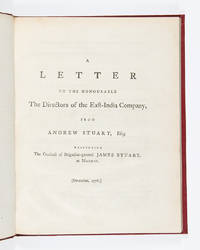
rif. 123245London 1778. . First edition; small 4to 24.5 x 19 cm; modern quarter red morocco gilt rolled red cloth boards spine lettered in gilt all edges speckled red a fine copy; ii 83 vi pp. An important letter appealing to the East India Company in regards to the controversy surrounding the arrest of George Pigot 1719-1777 Governor of Madras in 1776. As soon as Pigot arrived in Madras he was at odds with the the majority of his council members. This resulted in a legal wrangle where Pigot tried to reinstate the lands of the Rajah of Tanjore without approval. He refused to sign documents in several highly strung meetings and was eventually arrested by Brigadier-General James Stuart as ordered of a majority of the council and died in captivity in 1777. This pamphlet was written by James Stuart's brother as a defence of his actions for which he would eventually be pardoned in a court martial in 1780. Pickett 1137. [London], 1778. hardcover
1792rif. 911831792. London. 1792. Dark green cloth gilt type to spine. Sugar report 64 pages followed by six appendices 1789-1790; together with "Thanks to Lord Cornwallis and the Officers Serving in India" and debate 1793 161 pages;"Regulations Proposed to form the By-Laws" 27 pages; "The Debates at the East India House on the 18th of June 1794 on the Consideration of the Report of the Committee of By-Laws and on Mr Twining's Motion . . . " reported by William Woodfall with an Appendix containing letters etc. necessary to elucidate the subject 1794 52 pages; "The Debates at the East India House on Wednesday the 21st of January 1795 on the mode of forming into a by-law Mr Twining's motion . . . which had been carried by Ballot and also on the subject of the Company's Shipping" reported by William Woodfall 1795 134 pages. Corners a little bumped spine and margins of boards sl. damp-mottled edges of boards rubbed. A few marks in blue and red pencil to title-page of Sugar Report. hardcover
1892rif. 1737Calcutta Bombay: Thacker Spink & Co. 1892. 3rd Edition. Hardcover. Used - Very Good. A large book with spine and boards hardly fading though the corners show not excessive wear. Very little yellowing or foxing excellent condition. The illustrations are excellent and protected. Chapters on all large species of Indian wildlife - except for lion and now extinct cheetah - as well as chapters on the logistics of hunts and preservation of skins. Thacker, Spink & Co. hardcover