Le Maistre de la TourMareMagnum
LESUEUR (Daniel, Jeanne LOISEAU pseud.)Livre Rare Book
Lettre autographe signée
réf. 23045Parmain, 6 juillet 1909. In-folio, 2 pp. 1/2.

L'Ancienne Librairie · Paris, France350,00 €
12 000 résultats
2 voll legati in un tomo in 16° (cm 9,3 x 15,6), legatura piena pelle coeva con titoli in oro al dorso, pp xii, 344; (4), 179. Due frontespizi. Esemplare in buone condizioni,lleggere tracce d'uso. Antiche firme alle sguardie e al primo frontespizio. A partire da p 141 del secondo tomo, minuscole gallerie di tarlo al margine inferiore, con minima perdita di testo a poche lettere; tarletto al margine superiore bianco alle stesse pp. Seconda edizione (la prima Paris, chez Cailleau, contenente anche una tavola, 1783), molto più rara della precedente, della biografia di Haidar Ali, sultano di Mysore, narrata dall'ufficiale francese che servì nel suo esercito: il più irriducibile antagonista asiatico mai incontrato dagli inglesi in India. Oltre alla vita, vengono descritte le sue imprese guerresche e la struttura amministrativa del suo governo. Abbiamo trovato solo due esemplari censiti in CCFr di questa edizione.
réf. 23045Parmain, 6 juillet 1909. In-folio, 2 pp. 1/2.
1807réf. PHO-454Paris,Le Normant et chez l'Auteur, 1807. 2 Vol. In 8° (200 x 135 mm) relié demi-veau vert,dos lisse orné , frises dorées sur les plats (ép.) 326 pp - 245 pp Bon exemplaire Description de l'Inde à la fin du XVIIIe Siècle par un ancien missionnaire refermant un plein chapitre sur les idiomes et dialogues en langue Tamoul. 2 Vol. In 8 ° 200 x 125 mm hardcover decorated vintage calf 326 pp - 245 pp Good copy Description of India at the end of the 18th Century by a former missionary closing a full chapter on idioms and dialogues in the Tamil language. Bel exemplaire dans une élégante reliure verte
Cm. 26; pp. 26, (2) bianche. Without wrappers. Some wormholes not touching text. Good copy. Very scarce relationship of the Archibishp of Goa India. (India, Goa) 1487/P
1771réf. 39627Paris P.G. Simon 1771 in-4 cartonnage de papier marbré grenat, pièce de titre verte [Rel. moderne]
ISBN : 2743304081. IMPRIMERIE NATIONALE. 2001. In-Folio Carré. Relié, Jaquette. Bon état. Couv. convenable. Dos satisfaisant. Intérieur frais. 310 pages augmentées de nombreuses photos en couleur dans et hors texte . Jaquette en bon état . TROIS PHOTOS DISPONIBLES PREFACE DE PAUL VEYNE // SOMMAIRE : DANS L ENGRENAGE DE L HISTOIRE - COMMERCES ET CARAVANES - MONUMENTS CIVILS ET URBANISME - SANCTUAIRES ET DIVINITES - L ART FUNERAIRE - CARTE DU PROCHE ORIENT - PLAN DE PALMYRE ETC
2001réf. RO40268290IMPRIMERIE NATIONALE. 2001. In-Folio. Relié. Bon état, Couv. convenable, Dos satisfaisant, Intérieur frais. 310 pages augmentées de nombreuses photos en couleur dans et hors texte . Jaquette en bon état . TROIS PHOTOS DISPONIBLES. Avec Jaquette. . . Classification Dewey : 954-Asie du Sud, Inde
Paris, Dauvin et Fontaine, 1840, 25’5 x 16’5 cm., bella encuadernación firmada por Boutigny en pleno marroquin, filete dorado y figura gofrada en ambas tapas, lomo con adornos, cortes dorados, 2 h. – 290 págs. – 1 h. y 22 láminas grabadas al acero.
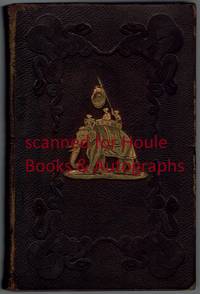
1835réf. 8652First edition. Octavo. Descriptive account by Rev. Hobart Caunter. 22 engravings from original drawings by William Daniell. 263 pages 4 pages of advertisements. Original gilt and blindstamped dark brown morocco spine with gilt stamped design of a palm tree and camel covers with gilt stamped vignette of 3 men riding on an elephant surrounded by blindstamped border of intertwined snakes a.e.g. rubbing to extremities. Very good. No foxing. Binder's ticked of F. Westley. Bookplate of H. Scofield and C.W. Nicolay with Nicolay's ink signature dated 1835. Bull and Churton hardcover
1835réf. 8652First edition. Octavo. Descriptive account by Rev. Hobart Caunter. 22 engravings from original drawings by William Daniell. 263 pages 4 pages of advertisements. Original gilt and blindstamped dark brown morocco spine with gilt stamped design of a palm tree and camel covers with gilt stamped vignette of 3 men riding on an elephant surrounded by blindstamped border of intertwined snakes a.e.g. rubbing to extremities. Very good. No foxing. Binder's ticked of F. Westley. Bookplate of H. Scofield and C.W. Nicolay with Nicolay's ink signature dated 1835. Bull and Churton hardcover books
1952Very Good English Original typed paper by Mukerjee with some autograph corrections in text andsignature. 4to. (30 x 24 cm). In English. [21] p. Type paper with autograph corrections and signature. Signed 'Radhakamal Mukerjee'. Paper for the International Congress of Sociology, Istanbul Session. Watermarked 'Glorious Bond' paper made in Sweden. Mukerjee, a leading thinker and social scientist of modern India, was Professor of Economics and Sociology and Vice-Chancellor of the University of Lucknow. Mukerjee played an important and constructive role in the Indian independence movement. He was a highly original philosopher of history and a discerning interpreter of culture and civilization and a 1962 recipient of the third highest Indian civilian honour of the Padma Bhushan. Mukerjee was the son of a barrister in Baharampur, West Bengal, a city located some 185 km north of Kolkata. He grew up in a household with a scholarly focus and a library devoted to history, literature, the law and Sanskrit texts. After attending Krishnanagar College, he gained an academic scholarship to Presidency College, under the University of Calcutta. He earned his honours degrees in English and History. Mukerjee opened the discourse of the Ashtavakra Gita into English with his posthumous work published in 1971. Mukherjees theory of society sought to explain the values of civilization. In sense, Radhakamal was a pioneer of transdisciplinary approach in science. Radhakamal Mukerjee emphasized interdisciplinary disciplinary approach towards the understanding of life. Mukerjee sought to break the barriers between physical sciences and sciences relating to persons aspects. He was a pioneer of Sociology in the 1900s. (Wikipedia).
2016réf. x-149396416XSpringer Verlag 2016. Hardcover. New. 443 pages. 9.25x6.25x1.00 inches. Springer Verlag hardcover
1914réf. 180951914. Certificate awarded to the Vicereine of India Lady Hardinge of Penshurst upon her visit to the Indraprastha Hindu Girls School in Delhi. 1914. Measures 10" x 16" inches. Text enclosed in ornately decorative box with the school's seal centered at the top reading "The Hindu Girls School Delhi First deserve then desire 1904." The certificate's attractive green script reads in part "To her excellency Lady Hardinge of Penshurst May it please your Excellency It is with feelings of the profoundest joy and gratitude that we to-day welcome Your Excellency to the Indraprastha Hindu Girls School Delhi.Your Excellency's loving interest in the advancement of the women of this land and motherly affection for the children your care for the suffering poor the exemplary fortitude which you have shewn in the time of danger and the heroic devotion to your husband--our ideals of womanhood--have endeared your name to every woman and child in India and we pray you to accept our reverential and warm-hearted welcome to-day." Lady Hardinge of Penshurst Winifred Selina Sturt married her first cousin Henry Sturt a racing magnate and close friend of Edward Prince of Wales. She served as a Woman of the Bedchamber to the Princess of Wales before her husband by then a Baron was named Viceroy of India. The concurrence of monarchical rule and colonialism put aristocratic families with close ties to the royal family put aristocratic Europeans in positions of power worldwide no matter their qualifications. The family moved to India where Lady Hardinge worked to advance women's education. She was instrumental in starting the Lady Hardinge Medical College in Delhi the first medical school exclusively for women in India. She died in November of 1914 just 8 months after receiving this certificate. Signed by the school's President Lady Superintendent and Secretary. Creased along lines where paper was folded. 3 small holes along left side do not affect text. 1" tears along top do not affect text. Tape attached to verso. Very good condition. unknown
1914réf. 180951914. Certificate awarded to the Vicereine of India Lady Hardinge of Penshurst upon her visit to the Indraprastha Hindu Girls School in Delhi. 1914. Measures 10" x 16" inches. Text enclosed in ornately decorative box with the school's seal centered at the top reading "The Hindu Girls School Delhi First deserve then desire 1904." The certificate's attractive green script reads in part "To her excellency Lady Hardinge of Penshurst May it please your Excellency It is with feelings of the profoundest joy and gratitude that we to-day welcome Your Excellency to the Indraprastha Hindu Girls School Delhi.Your Excellency's loving interest in the advancement of the women of this land and motherly affection for the children your care for the suffering poor the exemplary fortitude which you have shewn in the time of danger and the heroic devotion to your husband--our ideals of womanhood--have endeared your name to every woman and child in India and we pray you to accept our reverential and warm-hearted welcome to-day." Lady Hardinge of Penshurst Winifred Selina Sturt married her first cousin Henry Sturt a racing magnate and close friend of Edward Prince of Wales. She served as a Woman of the Bedchamber to the Princess of Wales before her husband by then a Baron was named Viceroy of India. The concurrence of monarchical rule and colonialism put aristocratic families with close ties to the royal family put aristocratic Europeans in positions of power worldwide no matter their qualifications. The family moved to India where Lady Hardinge worked to advance women's education. She was instrumental in starting the Lady Hardinge Medical College in Delhi the first medical school exclusively for women in India. She died in November of 1914 just 8 months after receiving this certificate. Signed by the school's President Lady Superintendent and Secretary. Creased along lines where paper was folded. 3 small holes along left side do not affect text. 1" tears along top do not affect text. Tape attached to verso. Very good condition. unknown books
Due voll. in 8° (cm. 20,0) cc. 2 n.n. + pp.XXXII + 491 (1); cc. 2 n.n. + pp. 559 (1). Ben legati in pieno vitello biondo; dorsi riccamente decorati in oro con titt. su doppio tassello. Tagli marmorizzati. Bell'esemplare. Rara ediz. orig. di un'opera pubblicata per la prima volta a Londra nel 1817 dal manoscritto in francese. L'abate Dubois fondò la missione di Pettah, nei pressi di Seringapatam. Egli acquisì una conoscenza approfondita della lingua e dei costumi dell'India e divenne membro delle Società Asiatiche di Londra e Parigi. Nella prefazione ad un' edizione successiva del 1899, l'editore sottolinea come "... l'edizione originale di quest'opera del 1825 sia divenuta quasi introvabile". Vedasi anche Graesse, t.II, pag.438; Brunet, t.II, pag,102.
2020réf. BN561234Taylor & Francis Ltd 2020. 2020. Hardcover. Component-Based Software Engineering Component-Based Software Engineering Umesh Kumar Graphic Era Deemed to be University India Tiwari Santosh Graphic Era Deemed to be University Dehradun India Kumar Taylor & Francis Ltd hardcover
Second Edition, 88pp., recently bound in quarter red morocco with red cloth boards, spine lettered in gilt, a nice copy. A letter addressed to John Crawfurd, by a native author who bears his views on the inadequacy of present imports, and failure of returns from India. Goldsmiths'-Kress, 26232.100.
First edition, half-title, [4], 99, [1]pp., disbound, half-title detached. A former officer in the East India Company's armies and Commander in Chief of the Great Mogul's Forces, Major John Morrison, returned to Britain in 1772 styled as 'Commander in Chief of the Great Mogul's forces'. Morrison was regarded as a traitor by the East India Company but he did succeed in publishing a pamphlet entitled "The Advantage of an Alliance with the Great Mogul" in 1774. Positioning himself alongside advocates of direct Crown control over Indian territories, Morrison suggested that Shah Alam II would be willing to cede Bengal to George III. The emperor's rough treatment at the hands of the Company, especially the non-payment of tribute, was lambasted as 'a dishonourable blow to the law of nations'. A proper agreement between kings would restore 'the stability and dignity of regal government', and replace 'the fluctuating and unsteady resolve of a Company of private men'. Kress, S2527; Goldsmith, 11155; Higgs, 5981.
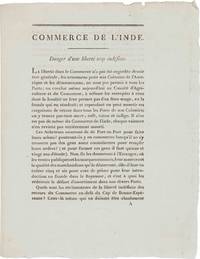
1790réf. 47670Paris: Didot 1790. Brief work cautioning against too much freedom of trade with the East Indies. Three copies in OCLC at the John Carter Brown Library and the national libraries of France and Australia. Quarto on a folded folio sheet. Old fold lines. Minor soiling. Very good. Untrimmed. unknown
1790réf. 47670Paris: Didot 1790. Brief work cautioning against too much freedom of trade with the East Indies. Three copies in OCLC at the John Carter Brown Library and the national libraries of France and Australia. Quarto on a folded folio sheet. Old fold lines. Minor soiling. Very good. Untrimmed. unknown books
1952réf. 052344India: Autograph note: Paper for the International Congress of Sociology Istanbul Session 1952 1952. Soft cover. Very Good. 4to - over 9¾ - 12" tall. Original typed paper by Mukerjee with some autograph corrections in text andsignature. 4to. 30 x 24 cm. In English. 21 p. Type paper with autograph corrections and signature. Signed 'Radhakamal Mukerjee'. Paper for the International Congress of Sociology Istanbul Session. Watermarked 'Glorious Bond' paper made in Sweden. Mukerjee a leading thinker and social scientist of modern India was Professor of Economics and Sociology and Vice-Chancellor of the University of Lucknow. Mukerjee played an important and constructive role in the Indian independence movement. He was a highly original philosopher of history and a discerning interpreter of culture and civilization and a 1962 recipient of the third highest Indian civilian honour of the Padma Bhushan. Mukerjee was the son of a barrister in Baharampur West Bengal a city located some 185 km north of Kolkata. He grew up in a household with a scholarly focus and a library devoted to history literature the law and Sanskrit texts. After attending Krishnanagar College he gained an academic scholarship to Presidency College under the University of Calcutta. He earned his honours degrees in English and History. Mukerjee opened the discourse of the Ashtavakra Gita into English with his posthumous work published in 1971. Mukherjees theory of society sought to explain the values of civilization. In sense Radhakamal was a pioneer of transdisciplinary approach in science. Radhakamal Mukerjee emphasized interdisciplinary disciplinary approach towards the understanding of life. Mukerjee sought to break the barriers between physical sciences and sciences relating to persons aspects. He was a pioneer of Sociology in the 1900s. Wikipedia. [Autograph note: Paper for the International Congress of Sociology, Istanbul Session], 1952 paperback
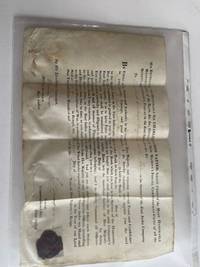
réf. 2687430 July 1850. Vellum Document 40 x 25cms bottom edge sl. crumpled faint water stin lright margin text clear and complete. With Seal. SIGNED by General Sir Charles James Napier Commander-in-Chief in India and J.P. Kennedy John Pitt Kennedy Military Secretary East Indies see Wikipedia entry a productive life. See Image. 30 July 1850. hardcover
réf. 1655331 January 2 May and 3 October 1822. All three from East India House London. The three items in fair condition on lightly aged and worn paper. All three addressed to 'My dear George' and one with valediction from 'your affectionate Father'. The letters are described below in reverse chronological order. ONE: AL. 3 October 1822. 8pp. folio. A long letter on two bifoliums half of which describes an interview between Bosanquet and the new Foreign Secretary and future Prime Minister George Canning in which Bosanquet presses his son's case for preferment within the diplomatic service George was at the time attached to the British Embassy in Paris and would rise to the post of chargé d'affairs at Madrid 1828-1830. Bosanquet begins by stating that he has had the meeting with 'Mr Canning' George Canning 1770-1827 and 'was received with apparent great cordiality. I congratulated him on his late appointment as Foreign Secretary on 13 September & told him that as I considered Lord Londonderry i.e. Castlereagh the previous Foreign Minister who had committed suicide on 12 August 1822 as the real minister of the country he had I considerd sic stept into his shoes & that he had a great & important business to perform but that I might say I felt that he stood in an awful & difficult situation - that the winds would blow very hard in the next year & that if through his means we could weather the storm alluding to his song upon Pit sic being the man who had weathered the storm all the nation would be indebted to him - This seeme'd to please him much'. He tells Canning that 'the country was in the most wretched state that the agriculturalist had lost at least 1/3d I thought half of their capital that considering this capital was at least 3 hundred millions it was a fearful moment'. As the conversation proceeds Canning states that they 'think alike upon this subject'. He drops his 'preliminary discourse' and states to Canning 'many points relative to Turkey'. Canning introduces Bosanquet to Sir Joseph Planta 1787-1847 with whom he intends to 'settle the subject'. Bosanquet tells him that he has 'lost a friend in Lord Londonderry - that he had plac'd you in your present situation & I had hopes he would have protected you in it' and that he hopes Canning will do the same. Canning 'seemed to draw up more than I expected upon this'. He enumerates the 'load of applications & remembrances' he has received stating that they cannot 'all be satisfied'. Bosanquet continues to press his son's case stating that he does not 'ask for a life of idleness' and that he is 'not fitted for such a slave as I knew any inferior retainer of Government was'. As the conversation proceeds Canning discusses one of the Paris attaches - 'I have forgot his name that had been recommended by Sir Charles Stewart sic for Sir Charles Stuart 1779-1845 British Ambassador in Paris and hence George's boss- he was the person I imagine whom you supposed Sr. Charles would have taken to Vienna if he had you there'. The 'conference' with Canning over Bosanquet speaks to Planta whom he finds 'a most Gentlemanly person - he speak sic plain - which I like - He was almost the right hand of Lord Londonderry & will I dare say be so to any person who fills the office of Foreign secretary - he has risen by his merit alone & is very unlike Hamilton i.e. William Richard Hamilton see next letter'. He tells his son he realises that there is nothing to give him 'much pleasure in this long detail' and advises him to 'stay as long as you can be useful at Paris - What will be the result of all Political measures that are going & will go on no person can tell or foresee - I have been trusted and was consulted when it was thought I could be of use & it may be the case again'. He concludes in praise of Castlereagh and with a little domestic news. TWO: ALS. 31 January 1822. 5pp. 4to. With a further page of mathematical calculations. The first part of the letter concerns an untraced pamphlet 'suppos'd to be written by Mr Hamilton William Richard Hamilton 1777-1859 antiquary and diplomat under the immediate superintendence of Lord Londonderry' which he is sending him. Bosanquet is critical of this which he regards as 'evidently the ministers manifesto'. 'Hamilton is I understand certainly to go to Naples as envoy I wish I could hear of your going somewhere.' He continues on the topics of his 'chimney business' and 'an agricultural meeting at Hertford on Fryday sic'. THREE: ALS. 2 May 1822. 4pp. 4to. He is forwarding the answer of 'Thomas' to questions he posed him on the subject the recipient posed to him in a letter. Regarding the economic crisis in England he writes: 'Here we are struggling with difficulties of every kind of which agricultural distress is the most prominent Whether it will lead to any thing like parliamentary reform I dont know - but I should not be at all surpris'd if it were to prepare the way for something & I think our constitution is something like a stocking if a stitch runs & is not stopt immediately there is no saying where the <rip> will end. We know by the example of Dr. Jno <Colpeper> Stocking that a silk stocking may be darn'd into a worsted one or vice versa.' He has just returned from a 'Bank of England meeting where it has been resolv'd that one of their privileges should be given up viz "that no banks shall be established with more than 6 partners" - as far as relates to 60 or 65 miles from London when now the number of partners will be unlimited'. He discusses this with reference to 'the monopoly of the old Lady in Leaden Hall Street i.e. the East India Company'. 31 January, 2 May and 3 October 1822. All three from East India House, London. unknown
réf. 20045Paris 20 March 1817. Four pages 12mo very good condition. His correspondent's letter eventually reached him in Paris where he'd resided since the last August "in coinsequence of my son-in-law the Baron de Montalembert being appointed by the French Government Minister at the Court of Wurtemberg . but political reasons and the difficulty of procuring a suitable house in that small capital have hitherto prevented our joining him." His daughter has to go through a "Municipal marriage" under the Napoleonic Code to establish her children's legitimacy. They plan to return to Stuttgart for a time then return down the Rhine with his grandson to Brussels and then to England. "I shall then make you one of my earliest calls at the British Museum when I trust I shall find you well - illness and the sad state of my daughter's health . prevented my visiting any of my friends except the day that I did underlined twice call on Mr Planta yourself & Mr Combe . In the meantime have the goodness to add my name to the list of your subscribers for 2 copies of your interesting work of sic the ruins of Babylon - I fear I have no way of sending the amount from here - I assure you I am always happy to have the pleasure of seeing or hearing from you - & particularly wished it during the publication of the Oriental Memoirs - but you were tehn generally out of town & I believe not in good health ." Note: Claudius Rich Author of: 'Memoir on the Ruins of Babylon' 'Mines de l'Orient' reprinted London 1815; 'Second memoir on the ruins' London 1818 Paris, 20 March 1817 unknown
1914in tedesco in 16°, tela edit. con titoli oro e fregi a secco al piatto e al dorso, tagli marmorizzati, pp. LXXIV, 358, minime rotture alla tela, lieve brunitura alle sguardie, firma di appartenenza