11 974 résultats
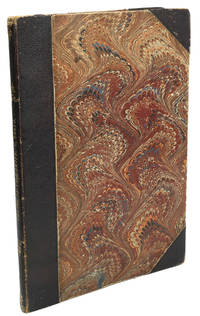
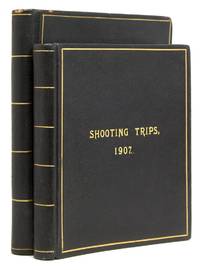
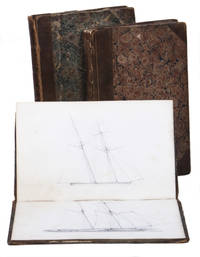
1822réf. ABC_49460Aboard the Winchelsea written and drawn at sea 1822. Contemporary half gold-tooled brown calf marbled paper sides each volume with a different marbled paper the journal volume with marbled endpapers. 8vo. The two sketchbooks contain a total of ca. 100 pages of sketches of ships done in pencil including 1 page containing signal flags in colour. 3 volumes. With: Two sketchbooks with pencil drawings of ships. A neatly-written and illustrated sea journal kept by James Dudman the second mate on board the East India Company's ship Winchelsea during a 1822-23 voyage to India. Launched in 1803 the Winchelsea was already a veteran East Indiaman this being her ninth voyage - she made a total of eleven voyages for the EIC before she was broken up in 1834. On the present voyage commanded by Captain William Adamson she carried 592 people including the 17th and 44th Regiments of Foot and detachments of the King's and EIC's soldiers and a number of women and children. The sea journal volume is accompanied by two additional volumes by Dudman containing pencil sketches of unidentified masted sailing vessels.The Winchelsea's journey from its departure at Blackwall Dock on April 24 1822 to its arrival in Bengal and eventual return to England via St. Helena and The Downs on May 24 1823 reflects the extensive maritime routes integral to British imperial dominance. The ship's role in transporting personnel and cargo exemplifies the strength of the EIC's logistical network sustaining Britain's colonial and economic interests in India. The journal with its careful record-keeping offers an intimate glimpse into the daily operations experiences and extraordinary events encountered by the second mate aboard an East Indiaman during Britain's height of imperial expansion.The journal written in Dudman's beautiful scribe-like handwriting opens with an entry dated 24 April 1822 at Blackwall Dock where the voyage started "bound for Bengal." The next few pages contain a detailed listing of the people on board beginning with the ship's company of 122 men with names followed by the troops on board: "List of a detachment of His Majesty's Troops belonging to the 44th Regt. of Foot on board the Honable. Company's Ship Wincelsea for Bengal" comprising name and rank of 367 men followed by the names of 42 women on board as well as the name and age of 57 children on board including 3 who died at sea plus 4 additional passengers.At Saugur meaning Sagar Island they took on board further passengers duly noted in an additional "List of H.M. 17th Regiment of Foot with the Women and Children accompanying them. Embarked on board the Honble. Company's ship Winchelsea at Saugur New Anchorage for England."Beyond the usual records of position winds weather and other ships Dudman includes interesting notes on unusual occurrences. Perhaps the most fascinating event was recorded on February 10 1823: a major earthquake off the coast of India experienced by the Winchelsea: "At 10 minutes past 1 PM every one on board was greatly alarmed at the singular feel of the ship which was in a violent trembling motion as if the ship was grazing over a rocky shoal and a loud rumbling noise similar to the roll.g! of a Bull quickly along the deck this very singular seuration lasted certainly not less than a minute those below ran on deck to enquire the cause and those below the poop below to ask the same question. I was in the round house at the time when it comen'd. The noise appeared to me as coming along the quarter deck and instantly over the poop the sea was smooth and the day clear. I looked out at the stern windows but saw no appearance of any shoal which I certainly would have done had such existed. The water being very clear and the ship not going more than 2 knots I cannot account for this very singular phenomenon in any other way than its being the shock of an Earthquake".The voyage journal of the Winchelsea during its 1822-23 journey to Bengal provides valuable insight into the maritime operations of the EIC its commercial and colonial reach and the strategic importance of British trade with India in the early 19th century. As a veteran East Indiaman the Winchelsea was part of the vast trading network that connected Britain with the Indian subcontinent transporting soldiers goods and passengers under the auspices of the EIC which functioned as both a commercial enterprise and a colonial governing force.The journal volume contains the typographic book plate of Mr. Jas. Dudman on the front pastedown and a manuscript inscription in ink on the first flyleaf by Lumsden Dudman who was married to Mary Anne Shirreff "Joseph H. Shirreff from L.S. Dudman Xmas 1892" one of the sketchbooks contains a manuscript inventory list in Greek of goods for sale on the first flyleaf and one of the sketchbooks with ownership signature "L: Dudman / Sept. 27 1836" likely Rev. Lumsden S. Dudman perhaps a brother of James Dudman. Some general wear to the leather spines and corners of the boards of the volumes occasionally foxed but overall internally clean. Overall in good condition. unknown
réf. SONG8122129188Bible Society Of India 0000-00-00. leather_bound. Used: Good. 9.76x6.77x1.97. Buy with confidence. Excellent Customer Service & Return policy. Bible Society Of India hardcover
1796réf. ABC_49403Various places including Saudi Arabia and Yemen 1796. Contemporary or slightly later half black morocco marbled boards. Small folio ca. 19 x 30.5 cm. English manuscript on watermarked paper. With a loosely inserted manuscript map titled A Chart shewing the Track of HMS Ship Myrtle of the Bay of Biscay and Portugal and a hand-coloured manuscript signal chart. A detailed description of the voyage of the East India company vessel the Swift from 1794-1795 featuring visits to both Saudi Arabia and Yemen. Twelve pages of observations are dedicated to Jeddah alone witnessed at the height of the influx of pilgrims during the Hajj followed by a description of Mocha also Mokha in Yemen. Other ports visited include those of Brazil South Africa India the Nicobar Islands Malaysia and Sri Lanka.Jeddah the author says "has a very pleasant appearance as you approach it from the sea . The houses are all of stone of the coral kind." However as the Swift had arrived in the midst of the Hajj and its crew found provisions difficult to acquire as thousands of pilgrims poured into Jeddah: "It is astonishing the number of Mahometans arriving from all parts of the world to attend the yearly ceremony at Mecca called Hadgi from thence to Medina." Several accounts are given of particular Muslim practices through occasionally somewhat confused British eyes: "When near Geddah all the Pilgrims going their first journey altered their dress assuming what is called the Ihhram a piece of linnen ! which is wrapped round the loins leaving the rest of the body naked in this state they proceed through the rest of the pilgrimage till they have visited the Kaaba at Mecca; the other garment they are then suffered to wear is a cloth of linen over their shoulders. . Some of them carry a trade of muslins and some other little articles which if they are not robbed by the Bedouins wild Arabs they make out tolerably well . The landing of the pilgrims with their wives and household utensils would have been an excellent view for the inimitable Hogarth."The Swift appears to be one of the ships which accompanied the Suffolk a 64-gun ship to escort a convoy to India under the command of Captain Peter Rainier 1741-1808 later Admiral of the Blue and namesake of Mount Rainier. This particular voyage was in itself notable as a trial for the implementation of a citrus diet for sailors to ward off scurvy which was ultimately successful and became Admiralty policy the following year. On the first page of the account we find the following: "The beer being expended ordered the Company to be served wine mixed with 1oz of sugar and oz of lemon juice to every pint it was very nice tipple."The boards show mild traces of use. With a few small smudges on some of the leaves. Otherwise in excellent condition. hardcover
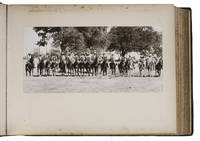
1933réf. ABC_45905Cambridge Mumbai New Delhi: Scott & Wilkinson Clifton & Co Hamilton Studios and Kinsey Bros. 1933. Oblong half morocco photograph album by W. Johnson & sons London. With 105 photographs mounted in the album ranging from 16 x 28 cm to 4 x 6 cm 2 photographs loosely inserted and a watercolour mounted at the back 11.5 x 21 cm. Unique photograph album showcasing the vigorous "fox" hunting scene in British India in the early 1930s particularly around Delhi. Most of the photographs show members of the British upper class in India often mounted on horses or posing for a group photograph and accompanied by hounds. The album contains no titles captions or inscriptions and the photographs do not seem to figure recurring individuals which suggests that it was probably compiled to commemorate the hunting and or riding club and its activities in the early 1930s. Numerous photographs show groups of mostly men posing with hounds at lunches and possibly a hunt ball or mounted on horses at jumping events and even a few cup trophies. The very first photograph is by Scott & Wilkinson in Cambridge active before 1933 and was therefore probably taken in England. The other inscribed photographs are by Clifton & Co. and Hamilton Studios from Bombay and Kinsey Bros. which started in New Delhi in 1935.British life in India mirrored life in native Britain and included popular equestrian activities such as hunting. Starting in the second half of the 19th century foxhounds were imported from Britain and subsequently bred in India. Regiments and brigades kept their own packs but at the beginning of the 20th century these had morphed into local hunts. Hounds were kept at over 12 hunting clubs which included Delhi Meerut Narbuda Vale Jaora Poona Bombay Bangalore Ooty Madras Lahore Quetta Peshawar and Karachi. Although the Indian silver fox was sometimes hunted the most common prey was the golden jackal.A different type of hunting popular in India was pig sticking: the chase of a wild boar on horseback with the spear. Several photographs in the album show pig sticking parties either posing or in action and sometimes accompanied by spectators on elephants. In contrast to the jackal-hunt parties the pigstick groups are composed of more military looking men and also include Indian men as opposed to the British-only hound groups.Most photographs show the area around Delhi and include a hunt near Shah Alam's Tomb. A photograph of this event is loosely inserted in the album and dated 1933/34 on the back. Other photographs show the Rashtrapati Bhavan one group shows the Earl later Marquess of Willingdon India's Governor-General from 1931 to 1936. Two images show the monumental Gateway of India completed in 1924 in Bombay Mumbai which can also be seen in an aerial photograph. Several photographs show what is probably the airfield at Karachi as it shows two airplanes loading mail on apparently the first voyage of the Indian Transcontinental Airways. Imperial Airways liner "Hanno" departing from Croydon had left for Karachi on 1 July 1933 via Bahrain and Sharjah. In Karachi the cargo was transferred to the Transcontinental airliner "Arethusa" as can be seen on the photographs.It is unclear why only half of the album was used. It is possible the compiler transferred to Kut in British Mesopotamia Kut al-Imara in modern Iraq. A watercolour on the final page of the album is captioned "A river bank north of Kut".Binding slightly rubbed and worn at the edges. Album leaves foxed throughout but most of the photographs in very good condition. The paper of the large photograph of the group near Shah Alam's Tomb is heavily damaged at the top and left side but the image itself is undamaged. A unique collection of British-Indian hunting photographs in very good condition.l Cf. Hamid "Riding with the Peshawar Vale hunt" thefridaytimes.com; Hunt "Delhi" in: Ten cities that made an empire; "1933 Eastwards: Karachi to Calcutta" indianairmails.com; Lucas Hunt and working terriers pp. 116-120; Mitter et al. The artful pose. Scott & Wilkinson, Clifton & Co, Hamilton Studios and Kinsey Bros., unknown
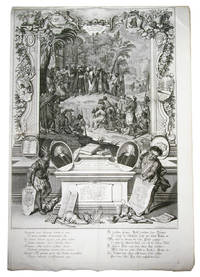
1730réf. ABC_47423Augsburg 1730. 86 x 59 cm. Copperplate engraving. A grand engraving commemorating the achievements of the August Protestant Church in India features various scenes and elements. In the background there are mountains palm trees houses and people including a Chinese person. The foreground shows deciduous and palm trees with a lit grotto holding an idol inscribed with "Brama". In front of the grotto an evangelical missionary preaches to a large congregation of natives while holding a book of music in his left hand and pointing to Brama with his right hand. The missionary wears a turban a priest's cloak and has flappers. The audience under the hill is depicted in interesting groups with some closer to us appearing larger and clearer. At the bottom of the engraving there is an art altar with several books including the "Biblia Malabarica" "Catechism Malabaricus" and the hymnal "Liber Cantion. Malabar." The engraving was made by the German engraver painter draughtsman and art publisher Johann Elias Ridinger 1698-1767. He trained in Ulm and Augsburg under Christoph Resch and Johann Falch and learned engraving from Georg Philipp Rugendas. Ridinger later spent three years in Regensburg where he developed his style through coursing and visits to the riding school. His ornamental works show Rococo stylistic tendencies and he founded his own publishing house in Augsburg. His precise and tasteful drawings were highly regarded and transferred to decoration porcelain and ceramics.With two minor tears one partly repaired the other one not affecting the engraving. Overall in very good condition.l Thienemann Leben und Wirken des unvergleichlichen Thiermalers und Kupferstechers Johann Elias Ridinger 913; Thienemann "Nachträge Zusätze und Berichtigungen C. L. zu : Leben und Wirken des unvergleichlichen Thiermalers und Kupfer stechers Johann Elias Ridinger etc." in Archiv für die zeichnenden Künste 5 1859 pp. 148-149. unknown
1959réf. 62583London: Robert Hale Ltd. 1959. 8vo. 191 1 pp. Numerous photo plates. Burgundy-coloured publisher’s boards gilt lettering on spine minor foxing & dustsoiling to upper fore-edge of textblock occasional light foxing w/ d.j. cover art of Tiger by Val Biro slight dustsoiling shelfwear still a VG/NF copy. Second printing of this authoritative work on tiger hunting in the Game Departent of Gwalior State Madyhya Pradesh and Jaipur Rajasthan relating his sagas of tiger hunts hunting and killing cattle-stealing tigers man-eating tigers terrorizing villages as well as organizing hunts of the Maharaja’s along with King George V Lord Reading and Lord Mountbatten. Robert Hale, Ltd., hardcover
1920réf. 62786Paris: Librairie Chapelot 1920. 4to. 222 pp. Colour frontisp. 80 photo plates woodcut-engrave vignettes decorated initials w/ Indo-Persian motifs. Original colour-illustrated front softcover bound-in as second frontisp. into recent half-blue goatskin over marbled boards brown & gilt spine label minor repairs to corners on end leaves minor dustoiling to first and last leaves still a VG copy. First edition of this original French ethnological travel account through India and present-day Pakistan and Afghanistan between the Wars. Chauvelot 1879-1937 was a French Colonial administrator ethnologist travel writer and novelist who made extensive trips through South Asia East Asia and Southeast Asia in the early 20th Century. This was first published in English translation the next year in 1921. Librairie Chapelot, paperback
1957réf. 62102New York: Oxford Univ. Press 1957. Three works in one vol. 8vo. xiii 1 233 1; 188; 197 1 pp. With illust. title photo plate tables charts. Orange tweed boards tiger paw print on front cover pictorial map endpapers minor shelfwear slight rubbing w/ d.j. cover art of tiger stalking minor scuffing edgewear price-clipped still VG/VG copy. First American omnibus edition of this extraordinary trilogy recounting Corbett’s experiences as big game hunter of Man-Eating Tigers in his lifetime career in India. He hunted down eight man-eating tigers and two man-eating leopards and in The Chowgarh Tigers he records his year-long quest from 1929-1930 to hunt and ill a female tiger that killed over 64 people in her five-year rampage. Corbett was a meticulous hunter expert tracker and persistent in preparation and often carried his favorite rifles - an M98 bolt-action Rigby-Mauser and a .450-400 Double Barrel Nitro Express. Oxford Univ. Press, hardcover
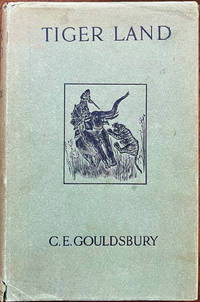
1913réf. 62084London: Chapman & Hall Ltd. 1913. Thick 8vo. xvi 2 216 1 pp. plus 4 pp. publisher’s ads. Photo frontisp. 23 photo plates. Pictorial green linen publisher’s cloth gilt illustration front cover of tiger attacking elephant and hunter gilt lettering front cover & spine very slight bumping to couple corners minor shelfwear slight foxing to fore-edges w/ d.j. dark gray-green paper illust. repeated on front cover in blue blue lettering VG/NF copy w/ “Association for Promoting Christian Knowledge” prize bookplate on front pastedown to F.H. Giltrap of Mountjoy School in 1914. Second edition of this informative memoir drawn from personal interviews experiences and notebooks of big game hunter and late Inspector General of Police Bombay Digby Davies as well as the author’s own sporting experiences. At the time he had been specifically requested to eliminate all personal names and references in the incidents with Davies whom Gouldsbury would specifically mention in the follow-up “Tiger Slayer by Order” 1915. Gouldsbury writes of numerous encounters with tigers in his own adventures hunting from elephant back and machans as well as leopards and maruading elephants with additional references to bison ibex and others. Davies relates his time serving during the Sepoy Mutiny work as a sporting inspector and specifically hunting down tigers elephants and others endangering villagers and livestock. One chapter specifically mentions hunting a 419 lb. tiger stretching over 10 feet 7 inches from nose to end of tail and standing 3 1/2 feet which had terrorized villagers killing cattle across Bengal. Very rare in original dustjacket. Chapman & Hall, Ltd., hardcover
1951réf. 62170London: Museum Press Ltd. 1951. 8vo. 288 pp. Photo frontisp. numerous photo plates. Black publisher’s cloth silver lettering on spine slight shelfwear very slight rubbing minor foxing to fore-edges w/ d.j. cover art photo of author on palanquin atop an Indian elephant minor shelfwear slight rubbing still VG/VG copy inscribed by author on ffep. First edition inscribed of this informative memoir by the author detailing his service with artillery in British-India Colonial Army tiger hunting in India Iraq and on the borders with Afghanistan prior to World War II. Of additional interest is his section on the sparsely populated region of India Ladakh bordering Tibet. Museum Press, Ltd., hardcover
1909réf. 312711N.p. India 1909. 126 tipped in gelatin photographs 63 in each volume; with four manuscript sketch maps 2 in each volume. 153 pp.; 7 numbered a-g 124 ff. including blanks. 2 vols. 8vo and 4to. Contemporary full brown morocco covers ruled and lettered in gilt black coated endpapers by Thacker & Co. Bombay with their red ticket at the back. Corners bumped faintest traces of rubbing. 126 tipped in gelatin photographs 63 in each volume; with four manuscript sketch maps 2 in each volume. 153 pp.; 7 numbered a-g 124 ff. including blanks. 2 vols. 8vo and 4to. Substantial detailed and extensively illustrated chronicle of travel and sport in the area north and east of Simla Sutlej River Adampur Jhansi and elsewhere in India including a trip in the Himalayas. The author was Lawrence Christian Gordon a major in the artillery; at this time he was staioned in Jhansi. The first volume is divided in three parts: Part I. Trip near Adampur after black buck and gazelle pp. 1-26 dated 23 December 1906 to 3 January 1907 Part II. Near Jhansi after black buck pp. 27-37 Part III. Himalayas after burhel and ibex pp. 39-153 dated April to July 1907 up the Sutlej river from Simla with mention of Asirang Lipi Jangi The second volume is a continuous narrative describing short shooting and fishing trips in 1908 and one longer account of three months' shooting leave March to June 1909 in the terrain upriver from Simla close to the border with Tibet and indeed many of the villages and monasteries passed were of TIbetan culture. The photographs are well composed and printed; burhel was the chief game hunted. Gordon writes candidly with many observations on local conditions and weather. Provenance: Norman James Anderson Galleries 9 November 1928 lot 784; Harvard Travellers Club in May 1934 bookplates unknown
réf. ria9780847828623_inpHardback. New. New Book; Fast Shipping from UK; Not signed; Not First Edition; N/A hardcover
réf. 032502765X-11-31222306HEINEMANN. New. 0x0x0. HEINEMANN unknown
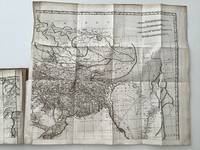
1800réf. 19106AB1800. Paris Poignee An VIII 1800 Four large folding engraved maps six engraved foloding maps and one plan. The four large folding engraved maps are forming the 'Carte de L'Indostan ou de L'Empire Mogol' the oulines contemporary hand-coloured. First French edition with maps revised by Jean Nicholas Buache incorporating the four maps that compose Rennell's "second great work. the construction of the first approximately correct map of India" DNB. "The Father of Indian Surveying" Gole "Early Maps of India" Rennell charted the currents through the India Ocean and around Africa and later surveyed the Indian interior. He recognized Europe's growing fascination with India: "As almost every particular relating to Hindoostan is become an object of popular curiosity it can hardly be deemed superfluous to lay before the public an improved system of its geography" Rennell Preface. With Rennell's first map of Hindoostan the result of 500 separate surveys and stretching from the Himalayas in the north to Ceylon in the south and the "Great Sandy Deserts" in the west. Born in Chudleigh in Devon England James Rennell who was to become one of the mosst celebrated cartographers of his time joined the British Navy as a midshipman at the age of 14. Amidst the Seven Years' War 1756-1763 he travelled the world and learned marine surveying and hydrography. This led to his appointment at age 24 as surveyor of the British East India Company's dominions in Bengal. In 1765 Rennell began surveying India. By this time the British East India Company had maintained its foothold on the region for over one hundred years but it was still another century before Queen Victoria would set her eyes eastward and Rennell's explorations and accounts helped to fill that gap in time. Rennell combined data from British Army columns with Ain-e-Akbari 1598 a translation of Islamic geography of the empire which helped him acquire information about old divisions he therefore subdivided the country according to the Mughal provinces of 'subas'. unknown
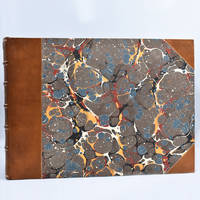
1906réf. 321920Poona and Bombay India 1906. Comprising 17 album leaves with approximately 84 mounted photographs ranging in size from 16 full page and 8 half page photographs to smaller snapshots mounted with some thought many with detailed captions identifiers and dates in ink. 1 vols. Oblong folio 10-3/4 x 14 inches. Modern three quarter brown morocco and marbled boards new endpapers a.e.g. Some toning to a few album leaves the photographs generally clean and fresh. Comprising 17 album leaves with approximately 84 mounted photographs ranging in size from 16 full page and 8 half page photographs to smaller snapshots mounted with some thought many with detailed captions identifiers and dates in ink. 1 vols. Oblong folio 10-3/4 x 14 inches. A nice little family album of foxhunting and equestrian scenes relating to the Poon and Bombay Hunts as well as views of landscape and family life. The paterfamilias is identified in captions as A.W.S. a British officer and his wife R.A.S. even while numerous others members of hunts or parties are identified by name and rank. "Ruth" and "Baby" complete the family unit and RUth can be seen seated among a line of children in hunting kit at the "Children's Fancy Dress Party / Given by Poona Bachelors / Poona Gymkhana" and then mounted on a pony in panoramic Hunt portraits. One leaf with six photographs depicts the stages of a meet from draw to check to who'oop! with the central image captioned "Ruth's first brush given by J.A. Lord Esq. M.F.H. / Snapshots by Capt. Jennings" and another contemporary hand has added in pencil " run near Saula Creek Bombay Hunt . 1905". Other groups of images show views at "Singhur 1901-1905" and domestic scenes. unknown
réf. A9789380177205Hardback. New. Papers presented at an international seminar. hardcover
réf. A9781345110678Hardback. New. hardcover
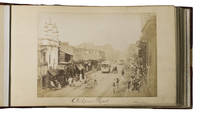
1874réf. ABC_46925Calcutta 1874. Contemporary gold-tooled half red morocco brown cloth sides. Oblong 8vo. With 33 mounted sepia albumen prints ca. 15/15.5 x 10.5/11 cm all captioned. Manuscript title and captions of the pictures in English written in brown ink in a neat 19th-century cursive hand. Photograph album containing 33 albumen prints of buildings important places views and people in Calcutta in the 1870s. The album opens with some architectural photographs including the governor's house the new market the post office St. Paul's cathedral and the high court. Also included are views of roads and streets that are still important today such as Benting Street Chilpore Road Russell Street and Strand Road and 5 albumen prints of the B.Y. Docks. The album also contains views near Kalighat and Barnatore especially of the landscape but also of a Hindu temple. The album concludes with some photographs of people living in Calcutta showing beggars carpenters palki bearers a barber ending the album with a group of Rohillas.The album includes a photograph of the statue of Sir James Outram unveiled in Calcutta on 22 May 1874 an all photographs seem likely to have been made soon after that.Binding a little worn and scuffed endpapers a little dust-soiled some leaves marginally slightly dust-soiled some leaves slightly browned some occasional foxing paper of the last photograph slightly damaged not affecting the image some images a little faded but overall in good condition. A highly interesting album showing life in Calcutta in the 1870s.l For dating the statue of Sir James Outram: Catalogue of the sculpture of J.H. Foley in: Dublin Historical Record 32 3 1979 pp. 108-116. hardcover
1897réf. 59126London Calcutta & Madras: W. Thacker & Co. 2 Creed Lane; Higginbotham & Co. 1897. Thick 8vo. xxvii 1 435 1 pp. plus xii 4 pp. publisher’s ads. With numerous plates text illustrations diagrams. Burgundy-coloured cloth gilt inset panel on front cover from original binding w/ original spine laid back down on spine renewed endpapers minor edgewear rubbing occasional toning still a VG- copy w/ bookplate of Albert Sayman on front pastedown. Third edition and considered the “best” edition of this fishing classic for South Asia detailing the angler’s pursuit of the “Mahseer” the chief of the Indian game fishes. Included are expanded and substantially revised chapters on flyfishing live bait fishing bottom fishing for Labeo freshwater sharks and much more all augmented with expanded illustrations. W. Thacker & Co., 2, Creed Lane; Higginbotham & Co., hardcover
réf. B9789380177205Hardback. New. Papers presented at an international seminar. hardcover
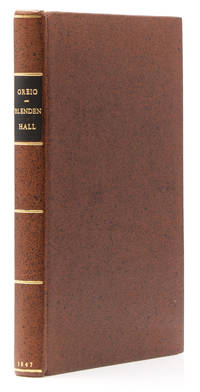
1847réf. 316972New York: William H. Colyer 1847. First Edition. Frontis. 209pp. Bound in full modern mottled brown calf. Fine. First Edition. Frontis. 209pp. Huntress 166 William H. Colyer unknown
2021réf. AME_9781774076521Delve 2021. UNKNOWN. Hardcover. New/New. _ Delve hardcover
2021réf. AME_9781774077238Delve 2021. UNKNOWN. Hardcover. New/New. _ Delve hardcover
2021réf. AME_9781774076538Delve 2021. UNKNOWN. Hardcover. New/New. _ Delve hardcover
2021réf. AME_9781774078013Delve 2021. UNKNOWN. Hardcover. New/New. _ Delve hardcover