[EAST INDIA COMPANY].Biblio.com
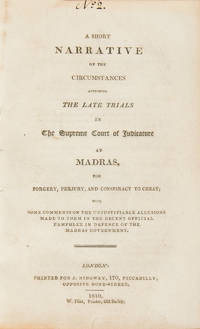
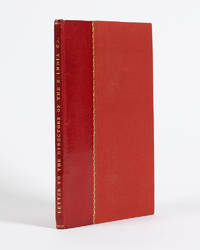
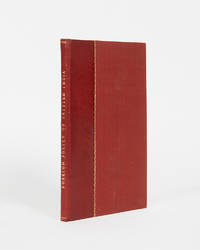
réf. 123252London J. Ridgway 1810. . First edition; 8vo 21 x 13.5 cm; modern quarter red morocco gilt rolled red cloth boards spine lettered in gilt all edges speckled red a fine copy; ii ii 98 ii ads. pp. Scarce pamphlet revealing the specific crime of forging specific bonds on the Nawab of the Carnatic's debts which were rumoured to soon be restructured and liquidated by the East-India Company. Only 7 copies in UK institutions BL Edinburgh Manchester Newcastle Cambridge UCL Sheffield. London, J. Ridgway, 1810. hardcover
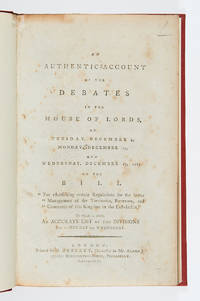
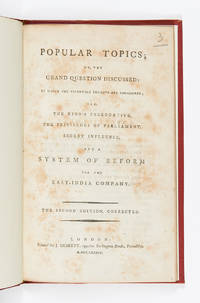
réf. 123251London J. Debrett 1783. . First edition; 8vo 21 x 13.5 cm; modern quarter red morocco gilt rolled red cloth boards spine lettered in gilt all edges speckled red a fine copy; iii 152 pp. Scarce and important pamphlet recounting the failure of the Fox-North East India Bill which was the first attempt at reforming the East India Company in the eighteenth century. It passed the Commons but failed at the Lords due to Fox's unpopularity with the King: it would shortly be followed by Pitt's India Bill much along the same lines which would establish the Board of Control and the take the first step in removing control of India from the East India Company. 1784 was the first renewal of the East-India Company's charter since 1742 during which the Seven Years War American Independence and Mysore Wars had drastically altered Britain on the world stage. In the wake of the 1772 British Credit Crises the efficiency of the Company and arguments for monopoly had started to erode and this debate was one of the first cracks in the unwavering belief in monopoly. Scarce only 6 copies in UK institutions BL London Library Manchester Edinburgh St Andrews Senate House. Pickett 1325. London, J. Debrett, 1783. hardcover
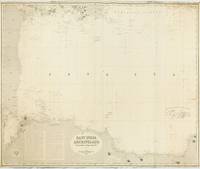
1881réf. 143683London: James Imray and Son 1881. Good. London James Imray and Son 1881. A very large engraved chart in two sheets combined printed surface 1039 × 1240 mm overall sheet size 1039 × 1264 mm with minimal hand-colouring mounted together on the original blue backing paper with the publisher's title-label on the verso. Minor chipping at the edges with minimal loss to the headline title above the top border; a few light stains and creases; a short sealed tear to the middle of the left and right sides one extending about 100 mm into the printed surface; a few old pencil annotations; in good condition. A very large and detailed blueback chart of the western part of the Java Sea the passages connecting it to the Indian Ocean the Sunda Strait and the South China Seas the Karimata Gaspar and Bangka Straits and Batavia Jakarta. Lighthouses are highlighted with spots of red and yellow colouring. The publisher's inkstamp dated 1882 appears near the imprint. The title-label on the verso reads 'Chart No. 161. Western Route to China. In Six Charts. Chart No 1. Price 7s. 6d.'. James Imray and Son unknown
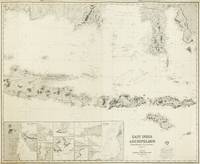
1881réf. 143682London: James Imray and Son 1881. Very Good. London James Imray and Son 1881/ 1863. A very large engraved chart in two sheets combined size approximately 1040 × 1285 mm with minimal hand-colouring mounted together on the original blue backing paper with the publisher's title-label on the verso. Head and foot slightly cropped with slight loss to the text outside the border; some marginal chips and tears with two that extend slightly into the printed surface now expertly sealed; short left-hand portion of the top margin a little waterstained not affecting the printed surface; a few trifling spots of foxing and some unobtrusive creases; overall in very good condition. A very large and detailed blueback chart of the Java Sea including the eastern half of the Indonesian archipelago and the southern coasts of Borneo and Sulawesi. It includes twelve inset charts: the Baly Bali Strait; Sapie Bay; Labuan Tring Bay; Tafel Hoek; Segoro Wedie Bay; Beliling and Sangsit Roads; Bunkolan and Lirang Roads; Koeboe Road; Amok Bay and Padang Cove; Tiulik Road; Oedyon Road; and Macassar. Lighthouses are highlighted with small spots of red and yellow colouring. The publisher's inkstamp dated 1882 appears below the title. The title-label on the verso reads 'Chart No. 171. Eastern Passages to China & Japan in Nine Charts. Chart No 1. Price 7s. 6d.'. James Imray and Son unknown
1796réf. ABC_49403Various places including Saudi Arabia and Yemen 1796. Contemporary or slightly later half black morocco marbled boards. Small folio ca. 19 x 30.5 cm. English manuscript on watermarked paper. With a loosely inserted manuscript map titled A Chart shewing the Track of HMS Ship Myrtle of the Bay of Biscay and Portugal and a hand-coloured manuscript signal chart. A detailed description of the voyage of the East India company vessel the Swift from 1794-1795 featuring visits to both Saudi Arabia and Yemen. Twelve pages of observations are dedicated to Jeddah alone witnessed at the height of the influx of pilgrims during the Hajj followed by a description of Mocha also Mokha in Yemen. Other ports visited include those of Brazil South Africa India the Nicobar Islands Malaysia and Sri Lanka.Jeddah the author says "has a very pleasant appearance as you approach it from the sea . The houses are all of stone of the coral kind." However as the Swift had arrived in the midst of the Hajj and its crew found provisions difficult to acquire as thousands of pilgrims poured into Jeddah: "It is astonishing the number of Mahometans arriving from all parts of the world to attend the yearly ceremony at Mecca called Hadgi from thence to Medina." Several accounts are given of particular Muslim practices through occasionally somewhat confused British eyes: "When near Geddah all the Pilgrims going their first journey altered their dress assuming what is called the Ihhram a piece of linnen ! which is wrapped round the loins leaving the rest of the body naked in this state they proceed through the rest of the pilgrimage till they have visited the Kaaba at Mecca; the other garment they are then suffered to wear is a cloth of linen over their shoulders. . Some of them carry a trade of muslins and some other little articles which if they are not robbed by the Bedouins wild Arabs they make out tolerably well . The landing of the pilgrims with their wives and household utensils would have been an excellent view for the inimitable Hogarth."The Swift appears to be one of the ships which accompanied the Suffolk a 64-gun ship to escort a convoy to India under the command of Captain Peter Rainier 1741-1808 later Admiral of the Blue and namesake of Mount Rainier. This particular voyage was in itself notable as a trial for the implementation of a citrus diet for sailors to ward off scurvy which was ultimately successful and became Admiralty policy the following year. On the first page of the account we find the following: "The beer being expended ordered the Company to be served wine mixed with 1oz of sugar and oz of lemon juice to every pint it was very nice tipple."The boards show mild traces of use. With a few small smudges on some of the leaves. Otherwise in excellent condition. hardcover
réf. 5104Without place or date circa 1820. One page octavo. Very good. On paper with 'C TAYLOR' Britannia watermarked paper. Possibly an East India Company document. Of obscure meaning headed 'List of Different Houses' and consisting of two columns the left-hand one of sixteen lines and the right-hand of eleven. Includes 'Moorshedabad' 'Massulipatam' 'Poona the Money paid to Mr. Mallet' 'Ahumabad the Residency of their Correspondent's' and 'The Mahratta Army'. With 'Exd: W D' in bottom left-hand corner. Docketed on reverse of second leaf of bifolium with reference 'No. 149. A. Entd at Dell <d.> " - MS'. Scan on application. Without place or date [circa 1820?]. unknown
1924réf. AQ32179Simla: Government of India Press 1924. vii 1 181pp 1. Original publisher's printed powder blue wrappers. Heavily rubbed and marked spine worn several small worm-tracks. Inked ownership inscription and later coloured pencil shelf-marks to title page. The comprehensive report of a royal commission charged with enquiring into the organisation and general conditions of the Civil Services in India financial and otherwise; the possibility of transferring any of their present duties and functions to services constituted on a provincial basis; and the best methods for ensuring and maintaining the recruitment of Europeans and Indians respectively. . First edition. 8vo. [Government of India Press] unknown
réf. 123244London 1784. . First edition; 8vo 21 x 13.5 cm; modern quarter red morocco gilt rolled red cloth boards spine lettered in gilt all edges speckled red a fine copy; ii 54 pp. Written by Edward Cotsford 1740-1810 bidding for the role of Governor of Madras following the impending replacement of Lord Macartney after he declined the governor-generalship of India. Macartney had successfully negotiated the Treaty of Mangalore with Tipu Sultan which saw the end of the Second Anglo-Mysore War in 1784. Edward Cotsford had served in Madras since the age of 17 becoming Chief at Masulipatam and was a frequent critic of the limitations of the governance of Madras. He returned to England with a considerable fortune and after failing to be considered for the Governorship turned to politics and was a staunch opponent of the Pitt administration. Pickett 1446. [London], 1784. hardcover
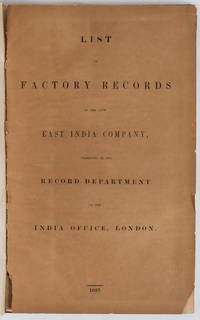
1897réf. 219014London.: The India Office. 1897. xxviii 91pp. Black cloth covered boards lettered in silver on the spine housing the original report in paper wrappers front wrapper detached. Wrappers fragile but contents very good. 32 x 19cm. Short check list style listings of the correspondence of many locations of East India Company interest in India and beyond including: Borneo Celebes Ceylon China and Japan Dacca Egypt and Red Sea Java Persia and Persian Gulf St. Helena Siam Straits Settlements and Sumatra. . The India Office. hardcover
réf. 124733London 1787-97. . Small folio 32 x 21; manuscript account book on paper 177pp. with index to front discreet booksellers ticket to pastedown several additional notes tipped in or loosely inserted a few minor marginal stains; full reverse calf blind rolled frame to boards remains of label to spine all edges marbled some wear a little shaken internally very good. The account book of a major East India Company agent or merchant from 1787 to 1797 likely William Agnew who captained the EIC ships Vansittart in 1783-5 and Triton in 1788-89 and 1790-91 on their voyages to Madras and Bengal. The ledger covering a ten-year period shows the activities of a highly prominent London based merchant with Irish connections handling considerable sums of money in connection with the East India Company and trade to India and China. The accounts show extensive involvement with some of the foremost traders and ship makers of the day especially Sir Robert Wigram 1744-1830 and John St Barbe 17421816 and banks such as Martin Stones & Foot Co. Robarts Curtis & Co. and Vere & Williams Co. The author had shares and interests in more than eighteen East-India Company ships including ships Lascelles 1779 Osterley 1780 Vansittart 1780 Britannia 1783 Fonthill 1783 Worcester 1785 Rockingham 1785 Henry Dundas 1786 Triton 1787 Tartar 1787 True Briton 1790 Orpheus 1794 Tellicherry 1796 Hindostan 1796 Walmer Castle 1796 Eurydice 1797 Admiral Gardner 1797 and Earl St Vincent 1799 with most being 32nd or 16th shares but some higher and the most being Triton at a 4th share. William Agnew captained the Triton to Madras and Calcutta Diamond Harbour on its first journey 1788-9 and Madras and Canton Whampoa on its second 1790-1. The ledger shows the sum of £5000 being exchanged for the command of the Triton which was bound to be a profitable venture and the expense and purchase lists for both journeys as well as continuing 'Bengal' and 'China' investments. The expenses of the first journey show the varying responsibilities and financial demands of such an undertaking not just the normal provisions such as dried herbs lime juice tripe and corks but also the money paid for searching and pilot fees chronometers and a launch dinner costing £50. The further investments in Bengal show the myriad names involved in enterprise in Calcutta and also the sums of money flowing through the city adding up to tens thousands of pounds a year millions in today's money. The same can be said for the investments in Canton: on a single day the 2nd of December the ledger records £7000 made on sales of tea. Apart from the broad series of investments the ledger includes specific interest in the sales of pepper coffee linen and cotton the latter two the only items noted in direct association with specific partners. The attribution of William Agnew as the author of this ledger is based on several factors. The mentions of direct purchase of the command of the Triton correlate with the ship's logs held in the British Library which list William Agnew as the Captain. There is also as one of the loose sheets an extra line of accounts inserted into the China pages with 'Wm. Agnew' signed on the reverse. Then there is mention of an 'Estate of my late brother Robert' with the three beneficiaries being Patrick Agnew likely Patrick Alexander Agnew Fourth of Dalreagle 1764-c.1813 who was the first Military Governor of British Ceylon James Farrell likely James Agnew Farrell 1760-c.1840 who was a land owner in County Antrim in Ireland and 'myself': surely an Agnew. The Irish connection is confirmed by a separate entry of an estate in Ballyclare in County Antrim and part of the land James Agnew Farrell owned was Magheramorne the larger part of the Glynn parish where this ledger was sold as part of the library of Glynn House in County Antrim. [London (?)], 1787-97. hardcover
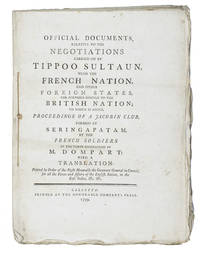
1799réf. ABC_45147Calcutta: Honorable Companys Press 1799. Never bound but side stitched through 3 holes. Super Royal 4to 33.5 x 25 cm. A British propaganda publication printed in Calcutta transcribing secret documents that the British supposedly found in the palace of Seringapatam: primarily Tipu Sultans correspondence with the French considered a betrayal of the British. Tipu Sultan 1750-1799 ruler of the Kingdom of Mysore in southern India took part in a long-standing military feud with the British but made peace with them in 1792. When the French under Napoleon made a push for India in 1798 the British attacked Tipus forces once again starting the Fourth Anglo-Mysore War and eventually killing Tipu Sultan in the attack on Seringapatam. He had a fearsome reputation as the Tiger of Mysore and the present publication attempts to discredit him as a traitor. His supposed affiliation with the French Jacobin Club would have especially concerned British readers. Most of the correspondence between Tipu Sultan the French and their allies including Zaman Shah Durrani ruler of what was to become Afghanistan is printed in parallel columns in English and French. Also included is the text of a letter from Tipu Sultan printed letterpress in Persian in the nastaliq script: 9 lines of type apparently set in the nastaliq type cut under the direction of Charles Wilkins 1749-1836 who served the East India Company in India and became their leading orientalist. It was first used at Calcutta in 1781. The only earlier type for the script that has been clearly documented is thought to have been cut in the 1590s for the Propaganda Fide in Rome who used it around 1633. Neil Benjamin Edmonstone translated the Persian and G.G. Keble the French. Although the book is a true very large quarto point holes along the fold at the head and deckles at the foot and fore-edge the chainlines are vertical though one would not expect sheets this large to be made in double moulds the usual reason for chainlines parallel to the long axis of the sheet.In good condition. Wholly untrimmed and with most bolts unopened and the point holes present.l Shaw Printing in Calcutta 359; Shaw SABREB sab00086; not in Cat. East-India Comp. Honorable Companys Press, unknown
réf. 123247London J. Debrett 1784. . Second edition corrected; 8vo 21 x 13.5 cm; modern quarter red morocco gilt rolled red cloth boards spine lettered in gilt all edges speckled red title a little spotted a fine copy; ii 34 pp. Criticism of the lack of reform of the East-India Company following the failure of the Fox-North Bill and subsequent collapse of the government. Pitt's government and India Bill would answer many of the criticisms but not the most fundamental: it cries 'Is there then to be a Charter of Government given to any man or set of men to rob and murder millions at their pleasure Or is a monopoly to be given to any Company in the trade of which the nation is deeply concerned without guarding the public against the effects of its bankruptcy.' Pickett 1464. London, J. Debrett, 1784. hardcover
réf. 123249London John Murray 1829. . First edition; 8vo 21 x 13.5 cm; modern quarter red morocco gilt rolled red cloth boards spine lettered in gilt all edges speckled red a fine copy; iv 95 pp. Interesting tract defending the continued governance of India by the East-India Company and the belief that a small body of professionals was better suited to managing the intricate affairs of India more readily than appointed politicians. Thomas Campbell Robertson 1789-1863 spent his entire career in India and Burma. He was a Judge at the Bengal Presidency District Magistrate in Chittagong British Political Officer of Arakan in Burma Civil Commissioner in Pegu and Ava when the Treaty of Yandaboo was signed Agent to the Governor General on the North East Frontier Agency President of the council of India & Deputy Governor of Bengal even provisionally being Governor-General in acting capacity. London, John Murray, 1829. hardcover
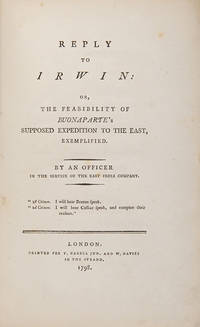
réf. 108549London Printed for T. Cadell Jun. and W. Davies 1798. . First and only edition 8vo 22 x 14.5 cm; armorial bookplate of Sir Archibald Grant of Monymoske to front pastedown dated advertisement half title occasional light spotting; morocco back marbled boards title in gilt to spine corners lightly rubbed; 53 1pp. A very good copy. The anonymous reply by an officer of the East India Company to Eyle Irwin's d. 1817 An Enquiry into the Feasibility of the Supposed Expedition of Buonaparte to the East 1798. In his treatise Irwin born in Calcutta to an officer of the Company had downplayed Napoleon's purported ambition to conquer British possessions in Asia following his defeat in the Battle of the Nile. Without wishing to 'damp the universal joy' which had infected the public mood following Nelson's victory at the Nile earlier in the year the anonymous author of the Reply sounds a more cautionary note urging his readers not to allow their current enthusiasm to become reckless jingoism. Diagnosing the issue as an 'aversion to bestow praise on an enemy' the author predicted that an alliance of French and Russian forces could undertake a joint invasion of India a threat which almost came true but for Napoleon's reluctance to expose his already army tired army to defeat. ESTC records copies at only four locations in the British Isles BL Derry and Raphoe Diocesan Library King's College London and the Royal Irish Academy and a further six in North America Kansas Missouri NYPL Rutgers UTS and Virginia. ESTC T44625. London, Printed for T. Cadell Jun. and W. Davies, 1798. hardcover
réf. 123186London Black Kingsbury Parbury and Allen 1819. . First edition; 8vo 20.5 x 13 cm; half-title present; marbled wrappers printed title label to upper wrapper all edges red a fine copy; 50 pp. The earliest printing of the speech given by George Canning 1770-1827 then President of the Board of Control in the House of Commons commending Francis Rawdon-Hastings 1st Marquess of Hastings and Governor-General in India 1754-1826 in his successful prosecution of the Third Anglo-Maratha War. London, Black, Kingsbury, Parbury, and Allen, 1819. unknown
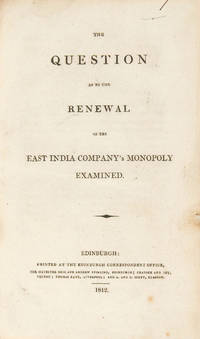
réf. 123243Edinburgh printed at the Edinburgh Correspondent Office for Silvester Doig and Andrew Stirling. 1812. . First edition; 8vo 21 x 13.5 cm; modern quarter red morocco gilt rolled red cloth boards spine lettered in gilt all edges speckled red a fine copy; iv 117 pp. Scarce work advocating for the removal of the monopoly from the East-India Company. In particular the author pays attention to the long worn out arguments of the Directors of India that the monopoly is necessary for political control and without it India would fall into rebellion and destitution. Scarce only 7 UK institutional copies BL Edinburgh Glasgow LSE National Library of Scotland RAS Senate House. Edinburgh, printed at the Edinburgh Correspondent Office for Silvester Doig and Andrew Stirling..., 1812. hardcover
réf. TK0040India: 19th century. Collection from various sources meaning clearly this group includes work from several different artists. Please view added illustrations online under this description. [19th century]. unknown
réf. TK0040India: 19th century. Collection from various sources meaning clearly this group includes work from several different artists. Please view added illustrations online under this description. [19th century]. unknown books
réf. 202204037Paris, Les editions genet , 1929 ; in-8, 308 pp., br. Page non coupé.
réf. 44642Boulogne sur Seine, Chitra, 1928, in 8° broché, 504 pages ; couverture illustrée.
réf. 122631Nova Goa Panaji 1874. . 4to 31 x 20.5 cm; Portuguese manuscript in ink 471 ll. in fair copy paper watermarked 'ALMASSO' 'MARIA NAIA' 'THOMA'; later half calf blue cloth boards gilt morocco spine label near fine internally. Fair manuscript copies of four of the original founding documents of the first convent in India the Convent of Santa Monica in Goa founded in 1598 and completed in 1627. The four documents were originally compiled by Frei Diogo de Santa Anna 1571-1644 the sole confessor of the convent probably in 1627 as part of the dedication of the completion of the building. The imprimatur of the compilation was given by Frei Sebastian de San Pedro ca. 1549-1629 the Archbishop of Goa on 10 February 1628. This present volume was copied from the original compiled manuscript in 1874 in Goa under the supervision of Joaquim Heliodoro da Cunha Rivara 1809-1879 the Secretary General of the Portuguese colony of Goa. He brought this volume back to Portugal in 1877 and it was then donated on his death two years later to the Biblioteca Publica de Evora. The documents themselves contain the Statutes Regimen and Divine Office of the Convent and the dedicatory sermon delivered on the completion of the convent in 1627 by Frei Diogo de Santa Anna. The sermon also contains the history of the first years of the convent. The only portion we can find record of is the sermon of which a single manuscript copy survives in the Arquivo Nacional da Torro do Tombo MS no.1869. We can find no record of the original manuscripts of the Statutes Regimen and Divine Office from which this volume. Nova Goa, [Panaji], 1874. hardcover
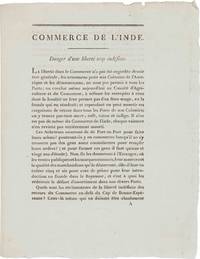
1790réf. 47670Paris: Didot 1790. Brief work cautioning against too much freedom of trade with the East Indies. Three copies in OCLC at the John Carter Brown Library and the national libraries of France and Australia. Quarto on a folded folio sheet. Old fold lines. Minor soiling. Very good. Untrimmed. unknown
1788réf. 47799Paris. 1788. Memorial of the French East India Company freshly reconstituted in 1785 after its liquidation in 1769. Twenty-four pages of tables provide a detailed accounting of the Compagnie's commercial activities from 1769 through 1777 while the text advocates the importance of the Compagnie and details its further activities to date. Fewer than ten copies are located in OCLC. Quarto. Contemporary blue paper wrappers stitched. Minor wear and soiling. Near fine. unknown
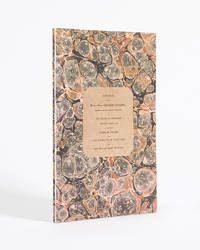
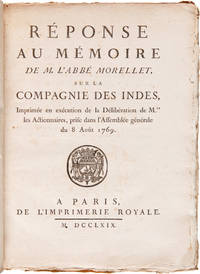
1769réf. 47671Paris. 1769. Jacques Necker 1732-1804 was serving as a director of the French East India Company when he penned this rebuttal to the MÉMOIRE of Abbe Morellet. Morellet had argued against the Compagnie's trading monopoly which Necker here defends. Necker would become Finance Minister under Louis XVI until the French Revolution. Quarto. Contemporary marbled wrappers stitched. Spine lightly worn and faded. Minor foxing to first and last leaves. Very good plus. unknown
1790réf. 47670Paris: Didot 1790. Brief work cautioning against too much freedom of trade with the East Indies. Three copies in OCLC at the John Carter Brown Library and the national libraries of France and Australia. Quarto on a folded folio sheet. Old fold lines. Minor soiling. Very good. Untrimmed. unknown books