British India LegislatureBiblio.com

11.949 Ergebnisse
Best.-Nr. 0331684888.Gpaperback. Good. Access codes and supplements are not guaranteed with used items. May be an ex-library book. paperback
1910Best.-Nr. 011422Calcutta: Superintendent of Government Printing India 1910. Book measures 33x21.5.cm. 2363pp. Bound in original publishers printed boards. Boards rubbed. dust marked sellotaped spine library label and withdrawal stamp binding slightly loose. Internally occasional library stamp or mark. Pages in very god clean condition. A good clean copy. . Hard Cover. Good. Quarto. Superintendent of Government Printing India Hardcover
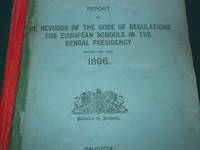
1898Best.-Nr. 011421Calcutta: Office of the Superintendent of Government Printing India 1898. Book measures 33x21.cm. v 209pp. Bound in original publishers printed boards. Boards rubbed dust marked spine sellotaped library label and withdrawal stamp. Binding in good condition. Internally occasional library stamp or mark. Pages in very good clean condition. A good clean copy. . Hard Cover. Good Plus. Quarto. Office of the Superintendent of Government Printing, India Hardcover
1900Best.-Nr. 011425Calcutta: Office of the Superintendent of Government Printing India 1900. Book measures 33x21.cm. ii64pp. Bound in original publishers printed boards. Boards rubbed dust marked spine sellotaped library label and withdrawal stamp. Internally occasional library stamp or mark. Pages in very good clean condition. A good clean copy. . Hard Cover. Good. Quarto. Office of the Superintendent of Government Printing, India Hardcover
1898Best.-Nr. 011424Calcutta: Office of the Superintendent of Government Printing India 1898. Book measures 33.5x21.5.cm. ii316pp. Bound in original publishers printed boards. Boards rubbed dust marked spine sellotaped library label and withdrawal stamp binding slightly loose. Internally occasional library stamp or mark. Pages in very good clean condition. A good clean copy. . Hard Cover. Good. Quarto. Office of the Superintendent of Government Printing, India Hardcover
Best.-Nr. 0265530865.Ghardcover. Good. Access codes and supplements are not guaranteed with used items. May be an ex-library book. hardcover
Best.-Nr. 0282685278.Gpaperback. Good. Access codes and supplements are not guaranteed with used items. May be an ex-library book. paperback
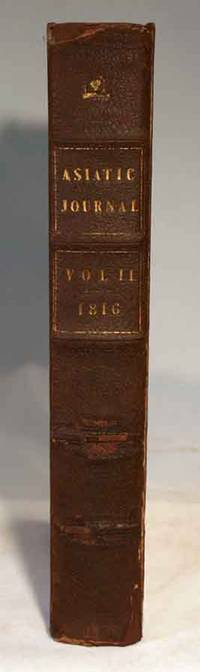
1816Best.-Nr. 1007220027Black Parbury & Allen 1816. Hardcover. Good. Black Parbury & Allen 1816 printing. 8vo. 1/2 leather marbled boards. 663 pp. Clean unmarked pages. Binding solid boards professionally reattached. Readable can be safely opened and used without fear of damaging book. Spine rebacked and missing part of the original leather. See pictures for appreciation. Sponsored by the East India Company the Asiatic Journal covered 1. Original Communications 2. Memoirs of Eminent Persons 3. History Antiquities Poetry 4. Natural History Geography 5. Review of New Publications 6. Debates at the East-India House 7. Proceedings at the East-India Colleges of Hertford and For William and Military Seminary 8. Appointments Promotions Resignations 9. Births Marriages and Deaths 10. East India Shipping Intelligence Arrivals and Departures 11. Lists of Passengers to and from India 12. Ship Letter-Mails 13. London Markets Prices Stocks etc. The series provides a fascinating window into an earlier world of discovery imperialism and exploration. While primarily focused on British India the Journal connects seemingly disparate places and events from Cape Good Hope to Nagasaki and beyond and presents it for a contemporary British audience. The growth of American commerce in China in 1827 the news of the day from Bombay in 1829 Chinese musical instruments debates of the day dealing with the East India company a mission to Siam in 1822 an essay on the relative value of East and West Indies possessions early translations of Persian and Sanskrit poetry are but a few of the events chronicled. A must for all historians of 19th century Asia. Black, Parbury, & Allen hardcover
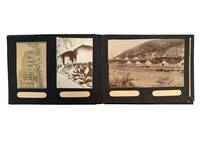
1912Best.-Nr. 235531912. Missionary education and colonial album depicting India circa 1912 recording Western presence in a British ruled colony through girls' schooling domestic compounds rural labor and major sites of imperial tourism. One of the first images show a group of Indian girls posed with three Western women standing behind them likely a mission school or mission supported classroom during the period when Protestant and Catholic missions made female education one of their central claims to social reform in India. The album also records the wider colonial setting around that work with Western men and women appearing in bungalows on a tennis court and among Indian workers and residents placing missionary possibility inside the everyday social and racial ordering of colonial life. Photo album of 20 silver gelatin photographs each approximately 4 x 3 inches in a 6.5 x 5 inch album India circa 1910s with one image captioned "Holgate 1912." The photos show Indian girls grouped outside a building with three Western women at the rear; children or young laborers crouched in a field; men carrying harvested material along a road; an Indian woman seated at a weaving apparatus; another photo of young Indian girls in seated position in front of grass housing units potentially implying another educational setting; other images show Western figures in colonial settings including a woman holding a tennis racket players on a tennis court with the caption "Holgate 1912" a Western man and children on the veranda of a bungalow a Western woman standing in a brick doorway a Western man with a horse before a house and a large residence set behind a lawn. Architectural and travel views include the Taj Mahal another domed Mughal or Indo Islamic building a street scene with horse drawn vehicles outside commercial buildings a rural village at the base of hills and a settlement or station in a dry mountainous landscape. At the turn of the twentieth century Western women in India came as missionaries teachers medical workers wives of colonial officials tourists and members of expatriate religious and commercial communities. Mission boards used girls' schools orphanages zenana visiting Bible instruction and medical missions to enter spaces that male missionaries could not easily reach while British colonial rule supplied the legal linguistic transport and racial framework that made such work possible and unequal. Light surface wear fading silvering and album wear with some prints unevenly toned. Overall good condition. A compact visual record of Western missionary possibility colonial domestic life Indian labor and tourist seeing in India under the British Raj. unknown books
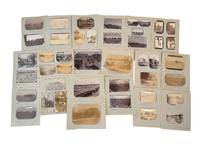
1917Best.-Nr. 235951917. British frontier military photo archive documenting the garrison system of the North West Frontier during the final years of the First World War 1917 to 1918 showing how the British Indian Army organized training logistics aviation medical services and daily military life across what is now Pakistan. Centered on Risalpur with additional views of Nowshera Sibi and other frontier stations the archive records the infrastructure that sustained Britain's defensive frontier against Afghanistan while thousands of Indian Army troops remained committed to imperial service overseas. Contemporary manuscript captions on many versos identify locations dates military units and events preserving an unusually well-documented record of the frontier during one of the British Empire's most militarized periods. Photo archive of 52 silver gelatin photographs most measuring approximately 3 x 5 inches British India principally Risalpur and the North West Frontier 1917 to 1918. The photographs depict cantonments parade grounds barracks military camps mounted troops cavalry exercises soldiers in formation and group portraits of officers and enlisted men. Other photographs show military hospitals and Red Cross personnel aviation facilities transport columns aerial views of cantonments engineering works fortified compounds rail infrastructure and frontier outposts. Civilian scenes appear as part of the military landscape rather than separate subjects including bazaars camel caravans village streets fruit vendors brick makers ox drawn carts river crossings market stalls and local residents interacting with soldiers. Several photographs record strategic infrastructure including the Attock Bridge mosques military compounds and river transport essential to frontier communications. Numerous versos carry contemporary inscriptions identifying subjects with captions such as "Camp of the 22nd Squadron M.G. Corps at Risalpur Dec. 1917-May 1918" "Risalpur 1918" "Mosque at Nowshera 1917" "Aeroplane accident" and "Filling ammunition belts 22nd M.G. Squadron Risalpur" substantially increasing the documentary precision of the archive. By 1917 the North West Frontier had become one of the British Empire's principal military districts supplying cavalry machine gun units aviation personnel transport and logistical support while simultaneously guarding the Afghan frontier. Risalpur developed into one of the subcontinent's major military centers housing cavalry regiments the Machine Gun Corps flying facilities and training establishments that would remain central to frontier defense through the Third Anglo Afghan War of 1919 and beyond. Photos emphasize the construction and occupation of cantonments preparation of ammunition medical organization transportation networks reconnaissance engineering and the constant interaction between British military institutions and the civilian communities surrounding them. Light surface wear with occasional corner bumps and scattered silvering; manuscript captions remain clear and legible. Overall in very good condition. A concentrated record of the British Indian Army's military infrastructure and frontier administration on the North West Frontier during the closing years of the First World War. unknown books
1917Best.-Nr. 235941917. British frontier military photo archive documenting the administration of Britain's North West Frontier during the final years of the First World War and its immediate aftermath 1917 to 1919 showing how the Indian Army sustained imperial communications cavalry training transport and everyday life across what is now Pakistan. Made at stations including Nowshera Risalpur Sibi Quetta and surrounding cantonments the archive records the military infrastructure supporting British control over one of the Empire's most strategically important frontier regions bordering Afghanistan. Compiled during the years surrounding the Third Anglo Afghan crisis and the closing campaigns of the First World War the photographs preserve both the operational machinery of the frontier and the civilian landscapes through which imperial authority was exercised. Photo archive of approximately 96 sepia and black and white photographs ranging from 2 x 3 to 4 x 5 inches North West Frontier Province and Baluchistan British India 1917 to 1919. Nearly every photograph is mounted on album leaves with careful contemporary manuscript captions identifying places dates and subjects. The photographs depict cavalry exercises mounted reviews riding school instruction the 21st Lancers horse lines transport trains railway stations ferries crossing the Kabul River at Nowshera the boat bridge at Nowshera cantonment buildings military camps and barracks. Other photographs record the "Victory Sports" at Risalpur in December 1918 an aeroplane accident at Risalpur in December 1917 with multiple views of the wreckage and assembled soldiers soldiers posing with local residents officers on horseback rail travel between Nowshera and Sibi and military groups assembled before stores and equipment. Civilian life appears throughout in photographs captioned "Making bricks" "Melons" "Cooks" "Native carts Baluchistan" "The Kabul River Nowshera" "Ferry boat on Kabul River Risalpur" and market scenes at Bagaran. Additional views document Quetta Sibi Baluchistan landscapes bridges forts irrigation works mosques camel caravans washermen working along the Kabul River ox drawn transport and portraits of Punjabi Pashtun and Baluchi residents encountered throughout the frontier. The North West Frontier formed the principal buffer between British India and Afghanistan after the Durand Line agreement of 1893 and by 1917 the region had become one of the Empire's largest concentrations of cavalry transport and logistical forces. Cantonments at Nowshera and Risalpur served as major cavalry and aviation centers while Sibi and Quetta anchored the railway linking the Punjab to Baluchistan and the Bolan Pass a route essential for imperial communications and frontier defense. Rather than concentrating on combat alone this archive records the systems that sustained British rule: transport networks mounted units engineering works indigenous labor military recreation and the daily interactions between colonial personnel and local communities across the frontier. Contemporary manuscript captions throughout provide unusually precise geographical and chronological documentation. Album leaves show edge wear creasing and occasional corner losses; photographs generally remain clean. Overall in very good condition. A concentrated visual record of the military and civilian infrastructure that maintained British authority across the North West Frontier during the closing years of the First World War and the transition to the postwar imperial frontier. unknown books
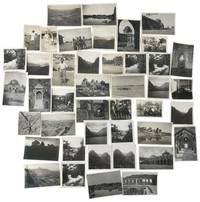
1940Best.-Nr. 232161940. British India photo archive following an unidentified man likely a serviceman in Mhow and Mandu during World War II 1942-1943 preserving a localized record of colonial wartime life through mess scenes sport staff bungalows named companions imposed colonial social frameworks and visits to the major Islamic monuments of Mandu. The captions place the central figure in the company of "Carroll Sahib" Ken Davis and other men in uniform-style dress while repeated references to the "mess" weapon training staff and cantonment-like grounds situate the photographs within a British colonial wartime environment in central India. The group shows one participant moving between military or officer-adjacent daily life and the monumental landscape of Mandu at a moment when India remained a crucial base of Allied wartime activity. Photo archive of 43 silver gelatin photographs ranging from 2 x 3.5 to 2.5 x 2.5 inches Mhow and Mandu India 1942-1943. Most photographs bear substantial contemporary handwritten inscriptions on the versos often dated. Identifiable scenes include two men with tennis rackets outside a bungalow captioned as taken after tennis; a portrait inscribed "Me the Carroll Sahib & Ken Davis outside the Mess 25/12/42"; a group of eight men captioned "two scotsmen our four weapon training instructors the Carroll Sahib me outside the W/T staff bungalow 25/12/42"; men wearing garlands outside the mess; a sports or gymkhana ground with riders or runners in formation; tented grounds beside a large building; and a portrait of a man identified as "Machdo our bearer." The architectural and landscape views are closely tied to Mandu with captions naming the Jami Masjid Jahaz Mahal Rupmati's Pavilion Baz Bahadur's Palace mosque interiors courtyards pools lake views ravines and elevated plateaus. Several photographs show men posed on open parade or sports grounds in light uniform-style dress including group portraits outside the mess and the W/T staff bungalow with tennis rackets bicycles garlands and temporary tent lines indicating a social world organized around exercise communal dining and station routine. Other images turn to Mandu's built landscape in much greater detail with framed views of domed pavilions arcaded courtyards carved entrances long interior corridors water tanks and palace ruins seen from terraces lakesides and elevated lookouts. The landscape scenes broaden that record further including steep ravines river and waterfall views and plateau panoramas that place the serviceman's movements within the wider terrain of central India. During World War II Mhow remained an important cantonment in British India and these photographs place one serviceman within the daily social world of that station where tennis communal dining staff housing local attendants and holiday gatherings existed alongside travel to nearby historic sites. The Mandu views record the same hand moving through one of central India's best-known Sultanate monument complexes with captions naming the Jami Masjid Jahaz Mahal Rupmati's Pavilion Baz Bahadur's Palace and associated interiors courtyards pools and landscape features. Light general wear occasional silvering and minor handling marks; inscriptions strong and legible on most versos. The dense captioning and photographic record show British colonial India during World War II through the the personal lens colonial rank and language staff organization sport and leisure during wartime Indian attendants and movement through one of central India's historic architectural landscapes. unknown books
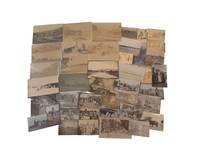
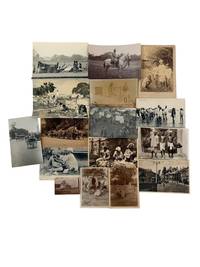
1890Best.-Nr. 234981890. Colonial Indian labor photo archive depicting street work informal commerce transport labor and social hierarchy under British rule circa 1890s-1920s. British India depended on low-paid manual labor to move people goods food and raw materials through cities ports hill stations and military cantonments. The group contrasts workers seated on the ground with baskets tools tents carts and roadside goods against riders on horseback and passengers carried by rickshaw carriage and bullock cart. Photo archive of 16 silver gelatin photographs and black-and-white real photo postcards various sizes India circa 1890s-1920s. Marketplace sellers sit among baskets cloth tents and on the ground goods; families and workers gather beside tents and rough encampments; men pull or guide rickshaws carriages and ox-drawn carts through colonial streets. A mounted man sits formally on a white horse while views of Simla show pedestrians commercial buildings and hill-station streets associated with British administration and seasonal elite life. Additional scenes show an outdoor "Hindu barber" "Indian coolies" carrying large baskets men seated by stonework near a Gothic-style building children posed in white garments some hand written captions en verso identify locations or tasks. The archive records the everyday labor that supported colonial India before independence when caste landlessness debt and imperial wage economies shaped who carried cleaned hauled shaved sold and served. Ligh toning handling and edge wear; overall in very good condition. A late colonial documentation of Indian labor and social separation grounded in street work transport marketplace survival and the visible privileges of those being carried or served. unknown books
1912Best.-Nr. 235531912. Missionary education and colonial album depicting India circa 1912 recording Western presence in a British ruled colony through girls' schooling domestic compounds rural labor and major sites of imperial tourism. One of the first images show a group of Indian girls posed with three Western women standing behind them likely a mission school or mission supported classroom during the period when Protestant and Catholic missions made female education one of their central claims to social reform in India. The album also records the wider colonial setting around that work with Western men and women appearing in bungalows on a tennis court and among Indian workers and residents placing missionary possibility inside the everyday social and racial ordering of colonial life. Photo album of 20 silver gelatin photographs each approximately 4 x 3 inches in a 6.5 x 5 inch album India circa 1910s with one image captioned "Holgate 1912." The photos show Indian girls grouped outside a building with three Western women at the rear; children or young laborers crouched in a field; men carrying harvested material along a road; an Indian woman seated at a weaving apparatus; another photo of young Indian girls in seated position in front of grass housing units potentially implying another educational setting; other images show Western figures in colonial settings including a woman holding a tennis racket players on a tennis court with the caption "Holgate 1912" a Western man and children on the veranda of a bungalow a Western woman standing in a brick doorway a Western man with a horse before a house and a large residence set behind a lawn. Architectural and travel views include the Taj Mahal another domed Mughal or Indo Islamic building a street scene with horse drawn vehicles outside commercial buildings a rural village at the base of hills and a settlement or station in a dry mountainous landscape. At the turn of the twentieth century Western women in India came as missionaries teachers medical workers wives of colonial officials tourists and members of expatriate religious and commercial communities. Mission boards used girls' schools orphanages zenana visiting Bible instruction and medical missions to enter spaces that male missionaries could not easily reach while British colonial rule supplied the legal linguistic transport and racial framework that made such work possible and unequal. Light surface wear fading silvering and album wear with some prints unevenly toned. Overall good condition. A compact visual record of Western missionary possibility colonial domestic life Indian labor and tourist seeing in India under the British Raj. unknown
1917Best.-Nr. 235951917. British frontier military photo archive documenting the garrison system of the North West Frontier during the final years of the First World War 1917 to 1918 showing how the British Indian Army organized training logistics aviation medical services and daily military life across what is now Pakistan. Centered on Risalpur with additional views of Nowshera Sibi and other frontier stations the archive records the infrastructure that sustained Britain's defensive frontier against Afghanistan while thousands of Indian Army troops remained committed to imperial service overseas. Contemporary manuscript captions on many versos identify locations dates military units and events preserving an unusually well-documented record of the frontier during one of the British Empire's most militarized periods. Photo archive of 52 silver gelatin photographs most measuring approximately 3 x 5 inches British India principally Risalpur and the North West Frontier 1917 to 1918. The photographs depict cantonments parade grounds barracks military camps mounted troops cavalry exercises soldiers in formation and group portraits of officers and enlisted men. Other photographs show military hospitals and Red Cross personnel aviation facilities transport columns aerial views of cantonments engineering works fortified compounds rail infrastructure and frontier outposts. Civilian scenes appear as part of the military landscape rather than separate subjects including bazaars camel caravans village streets fruit vendors brick makers ox drawn carts river crossings market stalls and local residents interacting with soldiers. Several photographs record strategic infrastructure including the Attock Bridge mosques military compounds and river transport essential to frontier communications. Numerous versos carry contemporary inscriptions identifying subjects with captions such as "Camp of the 22nd Squadron M.G. Corps at Risalpur Dec. 1917-May 1918" "Risalpur 1918" "Mosque at Nowshera 1917" "Aeroplane accident" and "Filling ammunition belts 22nd M.G. Squadron Risalpur" substantially increasing the documentary precision of the archive. By 1917 the North West Frontier had become one of the British Empire's principal military districts supplying cavalry machine gun units aviation personnel transport and logistical support while simultaneously guarding the Afghan frontier. Risalpur developed into one of the subcontinent's major military centers housing cavalry regiments the Machine Gun Corps flying facilities and training establishments that would remain central to frontier defense through the Third Anglo Afghan War of 1919 and beyond. Photos emphasize the construction and occupation of cantonments preparation of ammunition medical organization transportation networks reconnaissance engineering and the constant interaction between British military institutions and the civilian communities surrounding them. Light surface wear with occasional corner bumps and scattered silvering; manuscript captions remain clear and legible. Overall in very good condition. A concentrated record of the British Indian Army's military infrastructure and frontier administration on the North West Frontier during the closing years of the First World War. unknown
1917Best.-Nr. 235941917. British frontier military photo archive documenting the administration of Britain's North West Frontier during the final years of the First World War and its immediate aftermath 1917 to 1919 showing how the Indian Army sustained imperial communications cavalry training transport and everyday life across what is now Pakistan. Made at stations including Nowshera Risalpur Sibi Quetta and surrounding cantonments the archive records the military infrastructure supporting British control over one of the Empire's most strategically important frontier regions bordering Afghanistan. Compiled during the years surrounding the Third Anglo Afghan crisis and the closing campaigns of the First World War the photographs preserve both the operational machinery of the frontier and the civilian landscapes through which imperial authority was exercised. Photo archive of approximately 96 sepia and black and white photographs ranging from 2 x 3 to 4 x 5 inches North West Frontier Province and Baluchistan British India 1917 to 1919. Nearly every photograph is mounted on album leaves with careful contemporary manuscript captions identifying places dates and subjects. The photographs depict cavalry exercises mounted reviews riding school instruction the 21st Lancers horse lines transport trains railway stations ferries crossing the Kabul River at Nowshera the boat bridge at Nowshera cantonment buildings military camps and barracks. Other photographs record the "Victory Sports" at Risalpur in December 1918 an aeroplane accident at Risalpur in December 1917 with multiple views of the wreckage and assembled soldiers soldiers posing with local residents officers on horseback rail travel between Nowshera and Sibi and military groups assembled before stores and equipment. Civilian life appears throughout in photographs captioned "Making bricks" "Melons" "Cooks" "Native carts Baluchistan" "The Kabul River Nowshera" "Ferry boat on Kabul River Risalpur" and market scenes at Bagaran. Additional views document Quetta Sibi Baluchistan landscapes bridges forts irrigation works mosques camel caravans washermen working along the Kabul River ox drawn transport and portraits of Punjabi Pashtun and Baluchi residents encountered throughout the frontier. The North West Frontier formed the principal buffer between British India and Afghanistan after the Durand Line agreement of 1893 and by 1917 the region had become one of the Empire's largest concentrations of cavalry transport and logistical forces. Cantonments at Nowshera and Risalpur served as major cavalry and aviation centers while Sibi and Quetta anchored the railway linking the Punjab to Baluchistan and the Bolan Pass a route essential for imperial communications and frontier defense. Rather than concentrating on combat alone this archive records the systems that sustained British rule: transport networks mounted units engineering works indigenous labor military recreation and the daily interactions between colonial personnel and local communities across the frontier. Contemporary manuscript captions throughout provide unusually precise geographical and chronological documentation. Album leaves show edge wear creasing and occasional corner losses; photographs generally remain clean. Overall in very good condition. A concentrated visual record of the military and civilian infrastructure that maintained British authority across the North West Frontier during the closing years of the First World War and the transition to the postwar imperial frontier. unknown
1940Best.-Nr. 232161940. British India photo archive following an unidentified man likely a serviceman in Mhow and Mandu during World War II 1942-1943 preserving a localized record of colonial wartime life through mess scenes sport staff bungalows named companions imposed colonial social frameworks and visits to the major Islamic monuments of Mandu. The captions place the central figure in the company of "Carroll Sahib" Ken Davis and other men in uniform-style dress while repeated references to the "mess" weapon training staff and cantonment-like grounds situate the photographs within a British colonial wartime environment in central India. The group shows one participant moving between military or officer-adjacent daily life and the monumental landscape of Mandu at a moment when India remained a crucial base of Allied wartime activity. Photo archive of 43 silver gelatin photographs ranging from 2 x 3.5 to 2.5 x 2.5 inches Mhow and Mandu India 1942-1943. Most photographs bear substantial contemporary handwritten inscriptions on the versos often dated. Identifiable scenes include two men with tennis rackets outside a bungalow captioned as taken after tennis; a portrait inscribed "Me the Carroll Sahib & Ken Davis outside the Mess 25/12/42"; a group of eight men captioned "two scotsmen our four weapon training instructors the Carroll Sahib me outside the W/T staff bungalow 25/12/42"; men wearing garlands outside the mess; a sports or gymkhana ground with riders or runners in formation; tented grounds beside a large building; and a portrait of a man identified as "Machdo our bearer." The architectural and landscape views are closely tied to Mandu with captions naming the Jami Masjid Jahaz Mahal Rupmati's Pavilion Baz Bahadur's Palace mosque interiors courtyards pools lake views ravines and elevated plateaus. Several photographs show men posed on open parade or sports grounds in light uniform-style dress including group portraits outside the mess and the W/T staff bungalow with tennis rackets bicycles garlands and temporary tent lines indicating a social world organized around exercise communal dining and station routine. Other images turn to Mandu's built landscape in much greater detail with framed views of domed pavilions arcaded courtyards carved entrances long interior corridors water tanks and palace ruins seen from terraces lakesides and elevated lookouts. The landscape scenes broaden that record further including steep ravines river and waterfall views and plateau panoramas that place the serviceman's movements within the wider terrain of central India. During World War II Mhow remained an important cantonment in British India and these photographs place one serviceman within the daily social world of that station where tennis communal dining staff housing local attendants and holiday gatherings existed alongside travel to nearby historic sites. The Mandu views record the same hand moving through one of central India's best-known Sultanate monument complexes with captions naming the Jami Masjid Jahaz Mahal Rupmati's Pavilion Baz Bahadur's Palace and associated interiors courtyards pools and landscape features. Light general wear occasional silvering and minor handling marks; inscriptions strong and legible on most versos. The dense captioning and photographic record show British colonial India during World War II through the the personal lens colonial rank and language staff organization sport and leisure during wartime Indian attendants and movement through one of central India's historic architectural landscapes. unknown
1890Best.-Nr. 234981890. Colonial Indian labor photo archive depicting street work informal commerce transport labor and social hierarchy under British rule circa 1890s-1920s. British India depended on low-paid manual labor to move people goods food and raw materials through cities ports hill stations and military cantonments. The group contrasts workers seated on the ground with baskets tools tents carts and roadside goods against riders on horseback and passengers carried by rickshaw carriage and bullock cart. Photo archive of 16 silver gelatin photographs and black-and-white real photo postcards various sizes India circa 1890s-1920s. Marketplace sellers sit among baskets cloth tents and on the ground goods; families and workers gather beside tents and rough encampments; men pull or guide rickshaws carriages and ox-drawn carts through colonial streets. A mounted man sits formally on a white horse while views of Simla show pedestrians commercial buildings and hill-station streets associated with British administration and seasonal elite life. Additional scenes show an outdoor "Hindu barber" "Indian coolies" carrying large baskets men seated by stonework near a Gothic-style building children posed in white garments some hand written captions en verso identify locations or tasks. The archive records the everyday labor that supported colonial India before independence when caste landlessness debt and imperial wage economies shaped who carried cleaned hauled shaved sold and served. Ligh toning handling and edge wear; overall in very good condition. A late colonial documentation of Indian labor and social separation grounded in street work transport marketplace survival and the visible privileges of those being carried or served. unknown
1917Sm. 8vo., strongly bound in modern green boards, upper board with printed paper label, radial corners, grey endpapers, ORIGINAL PRINTED WRAPPERS PRESERVED, some light age-soiling else a very good, bright, clean copy. With advertisement endpapers on pink stock at front and rear. Not to be confused with the similar title 'Our Indian Empire' which is considerably more common. VERY SCARCE.
Best.-Nr. 0526619570.Ghardcover. Good. Access codes and supplements are not guaranteed with used items. May be an ex-library book. hardcover
Best.-Nr. 1018283692.Ghardcover. Good. Access codes and supplements are not guaranteed with used items. May be an ex-library book. hardcover
Best.-Nr. 1018288333.Gpaperback. Good. Access codes and supplements are not guaranteed with used items. May be an ex-library book. paperback
Best.-Nr. 1019422505.Ghardcover. Good. Access codes and supplements are not guaranteed with used items. May be an ex-library book. hardcover
1964Leg. edit. t. tela in-8, tit. su tass. oro al ds., pp. 383-(5) e 491-(5), tavv. in nero f.t. Ottimi entrambi.
1964Milano, Dall'Oglio, 1964, 8vo legatura tutta tela con tasselli e titoli dorati al dorso, sovraccoperta illustrata, pp. 383 con 23 figure nel testo e 28 con tavole fotografiche fuori testo (Cultura contemporanea) .