1970bross. edit. ill., minime tracce d'uso al dorso, firma di appartenenza
19438° bross. sovrac. figur. (strappetto senza perdite alla parte poster.), pp. 252.
1942251, [10] pp.; 20,5 cm. Bross. edit. Legg. tracce d'uso alla copertina, tagli polverosi e con qualche fioritura
1942Un volume di 251 pagine, brossura editoriale con sovracoperta illustrata e parziale velina protettiva in sottile plastica trasparente. Dimensioni: 12x20,5 cm. Minime tracce d'uso alla sovracoperta, leggera brunitura dei margini delle pagine, firma di possesso alla pagina bianca. Per il resto ottime condizioni. Prima edizione.
Best.-Nr. 0267492308.Ghardcover. Good. Access codes and supplements are not guaranteed with used items. May be an ex-library book. hardcover
Best.-Nr. 1330196082.Gpaperback. Good. Access codes and supplements are not guaranteed with used items. May be an ex-library book. paperback
2008Best.-Nr. G9332536732I5N00MACLINO.H. SOLSOR.L. 2008. Paperback. Acceptable. Readable copy. Pages may have considerable notes/highlighting. ~ ThriftBooks: Read More Spend Less.Dust jacket quality is not guaranteed. MACLIN,O.H., SOLSO,R.L. paperback
1970Best.-Nr. 299VARANASI. INDOLOGICAL BOOK HOUSE. 1970. GRAND IN-8 DE XII + 159 PAGES, RELIURE DE L'EDITEUR PERCALINE ROUGE. ILLUSTRE DE 8 VIGNETTES, D'UNE CARTE REPLIEE ET DE 4 PLANCHES HORS-TEXTE PRESENTANT 197 PIECES, LA PLUPART RECTO-VERSO. COMPLETE PAR UN IMPORTANT INDEX. BON EXEMPLAIRE.
1972Best.-Nr. 120321Paris, Presses Universitaires de France, coll. « Publications du Musée Guimet. Recherches et documents d’art et d’archéologie », n° 11 1972 In-4 28 x 22,5 cm. Broché, couverture grise, auteur & titre en noir sur le dos et le premier plat orné d’une vignette, 188 pp., 193 figures, liste des plans et dessins, liste des figures, table analytique des matières, plans et dessins,, table des matières. Exemplaire en bon état.
Best.-Nr. RO80070748***. XIXème siècle.. In-12. En feuillets. Etat d'usage, Livré sans Couverture, Dos satisfaisant, Intérieur acceptable. 2 pages de texte + une carte dépliante en couleurs de 26 / 28 cm. Feuillets extraits d'un ouvrage.. . . . Classification Dewey : 954-Asie du Sud, Inde
Best.-Nr. RO20263728"CALENDARS EMPORIUM, BOMBAY. NON DATE. In-12. Broché. Etat d'usage, Couv. convenable, Dos satisfaisant, Quelques rousseurs. 12 cartes postales en couleur, vierges - 2 photos disponibles - annotation ""1970"" sur le 1er plat - Environ 14 x 10 cm - reliure spirale en plastique dont un bout est manquant. . . . Classification Dewey : 954-Asie du Sud, Inde"
Best.-Nr. 6497quatorze sculptures indiennes décrites par Victor GOLOUBEW .Collection Paul MALLON décrite par Alexandre MORET. Avec la collaboration de Maurice PEZARD deuxième fascicule.Petit in folio,portefeuille cartonné,à rabats,fermoir à rubans, titre,feuillet descriptif pour chaque sculpture, photos contrecollées sur papier fort. Trois déchirures marginales.Portefeuille manié avec quelques restaurations. Ensemble très correct, peu courant.deuxième fascicule. Portefeuille cartonné à rabats,fermoir à rubans.Titre sur le premier plat et en long au dos.Titre et suite de 23 planches avec texte descriptif,portefeuille restauré, ensemble de nouveau très solide. Peu courant
Best.-Nr. 606939Paris, P.U.F., 1972. In-4 broché, couv. ill. en coul., 188 pp., 13 plans et 193 ill. photogr. réunies en planches, tables. Ex. non coupé.
2026Best.-Nr. x-1032841125Taylor & Francis Ltd 2026. Paperback. New. 127 pages. 6.14x0.30x9.21 inches. Taylor & Francis Ltd paperback
2015Best.-Nr. 1-0670088455India Penguin 2015. Hardcover. New. 688 pages. 9.50x6.15x2.30 inches. India Penguin hardcover
Best.-Nr. 0670088455.Ghardcover. Good. Access codes and supplements are not guaranteed with used items. May be an ex-library book. hardcover
2004(Oxford India Paperbacks)"This collection brings together for the first time, award-winning playwright Vijay Tendulkar's best-known plays, translated from Marathi. It includes a preface by Tendulkar on his induction into the art of writing plays, and a piece on what he considers to be the essential skills of a playwright. The introduction by Samik Bandyopadhyay discusses the role of power in Tendulkar's plays." 598p. Fine except for remainder marks. Book
1900Best.-Nr. 100865c. 1900. 54 diapositive glass lantern slides 3-1/4 x 4 and 3-1/4 x 3-1/4 inches six hand-colored bound at edges with gummed paper or metal frame some with manufacturer's printed label and manuscript caption; a few with hairline cracks. Housed in contemporary wooden box with lid. A varied collection of ethnographic and architectural scenes largely from Northern India with a few of Ceylon Sri Lanka tea production. Some of the locations include Darjeeling Mumbai Bombay Kakinada Elephanta Caves Mumbai Calcutta including many of the Hooghly River Dehli Sinla Ceylon Kashmir as well as one scene of European tourists scaling pyramids in Egypt. The collection appears to have been gathered from various sources with plates manufactured by T.H. McAllister New York William Garrison Reed Boston J. Moore Birmingham and William H. Rau Philadelphia. unknown
1950Best.-Nr. 373277Communist Party of India 1950. First Edition. Softcover. Good set in the original stiff-card wrappers; edges slightly nicked and dust-dulled as with age. Physical description; four reports. Contents; Provisional Report on the Strategy and Tactics of the Communist party of India 1948-1950 and the correction of policy now taking place ; Summary of Document Entitled ""Resolutions Adopted by the Central Committee on 13. 6. 50"" Dealing with Organisation ; Letter of the New C.C. Reconstituted by the C.C. elected at the 2nd Party Congress to all party members and sympathisers ; Resolution of the Central Committee on P.C. Joshi's Appeal Against Expulsion. Subjects; Communist Party of India. Communist Party of India paperback
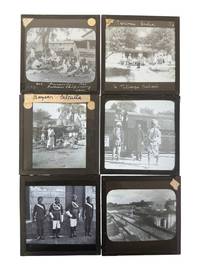
1900Best.-Nr. 232871900. India glass lantern slide archive documenting class hierarchy dichotomy in British India with scenes of village labor bazaar exchange railway movement industrialization Sikhs and colonial cavalry circa 1900-20. Images clearly depict the class divide and caste system; villagers and laborers are shown seated on bare ground in carpentry work men and goats occupy an unpaved settlement space Sikh men stand beside a railway carriage tied to imperial transport networks a factory scene introduces mechanized industry and a formal portrait of turbaned cavalry soldiers. Photo archive of 8 glass lantern slides 3.25" x 3.25" India circa 1900 to 1920. Several slides retain manuscript captions on the mounts including "Central India" "Village School" "Bazaar Calcutta" and "MV. parannis an Indian carpentry clas." "Parannis" is probably a misspelling or misreading of "Pariahs" a historical caste/community term used in colonial-era descriptions of South Indi The British largely preserved formalized and exploited the Indian caste system rather than dismantling it. Their relationship with caste was pragmatic: caste became a tool for administration taxation labor control military recruitment and social organization across British India. The "Village School" slide shows a line of children and adults posed before a low building under dense tree cover with one figure standing forward in the open yard. The carpentry slide shows a large group of Indian boys outdoors beneath a tree seated or crouched on the ground around planks and hand tools with timber laid across the foreground and simple structures behind. The Calcutta bazaar scene places vendors baskets and goods in an open market setting under palms while the village scene presents men in loose garments in what seems to be a cattle farm setting. One slide shows Sikh men beside a railway carriage one barefoot in the foreground and others gathered near the rail car doors linking Indian bodies to the movement of goods troops and passengers through the colonial rail system. Another slide presents four uniformed soldiers in turbans possibly the Madras cavalry posed formally with boots sashes and weapons before a masonry wall. The factory view shows smoking industrial works with long roofs tracks and an extended production yard further cementing colonial industrialization within the archive. British rule in India relied on linked systems of extraction transport discipline and military force and these slides place those systems beside the people who bore their unequal social effects. Railways expanded under colonial finance and administration to move troops raw materials and commercial goods; industrial sites grew beside older economies of hand labor and bazaar trade; Indian soldiers and cavalry units served within an army organized to secure imperial control; and rural schools workshops and village scenes expose the local social world that existed under those pressures rather than outside them. Light edge wear some mount loss to several slides; no cracks or chips. Overall very good condition. British colonialism widened India's class divide by concentrating wealth transport and military power in imperial systems while leaving many Indians in village labor and low paid market work. unknown
1900Best.-Nr. 232871900. India glass lantern slide archive documenting class hierarchy dichotomy in British India with scenes of village labor bazaar exchange railway movement industrialization Sikhs and colonial cavalry circa 1900-20. Images clearly depict the class divide and caste system; villagers and laborers are shown seated on bare ground in carpentry work men and goats occupy an unpaved settlement space Sikh men stand beside a railway carriage tied to imperial transport networks a factory scene introduces mechanized industry and a formal portrait of turbaned cavalry soldiers. Photo archive of 8 glass lantern slides 3.25" x 3.25" India circa 1900 to 1920. Several slides retain manuscript captions on the mounts including "Central India" "Village School" "Bazaar Calcutta" and "MV. parannis an Indian carpentry clas." "Parannis" is probably a misspelling or misreading of "Pariahs" a historical caste/community term used in colonial-era descriptions of South Indi The British largely preserved formalized and exploited the Indian caste system rather than dismantling it. Their relationship with caste was pragmatic: caste became a tool for administration taxation labor control military recruitment and social organization across British India. The "Village School" slide shows a line of children and adults posed before a low building under dense tree cover with one figure standing forward in the open yard. The carpentry slide shows a large group of Indian boys outdoors beneath a tree seated or crouched on the ground around planks and hand tools with timber laid across the foreground and simple structures behind. The Calcutta bazaar scene places vendors baskets and goods in an open market setting under palms while the village scene presents men in loose garments in what seems to be a cattle farm setting. One slide shows Sikh men beside a railway carriage one barefoot in the foreground and others gathered near the rail car doors linking Indian bodies to the movement of goods troops and passengers through the colonial rail system. Another slide presents four uniformed soldiers in turbans possibly the Madras cavalry posed formally with boots sashes and weapons before a masonry wall. The factory view shows smoking industrial works with long roofs tracks and an extended production yard further cementing colonial industrialization within the archive. British rule in India relied on linked systems of extraction transport discipline and military force and these slides place those systems beside the people who bore their unequal social effects. Railways expanded under colonial finance and administration to move troops raw materials and commercial goods; industrial sites grew beside older economies of hand labor and bazaar trade; Indian soldiers and cavalry units served within an army organized to secure imperial control; and rural schools workshops and village scenes expose the local social world that existed under those pressures rather than outside them. Light edge wear some mount loss to several slides; no cracks or chips. Overall very good condition. British colonialism widened India's class divide by concentrating wealth transport and military power in imperial systems while leaving many Indians in village labor and low paid market work. unknown books
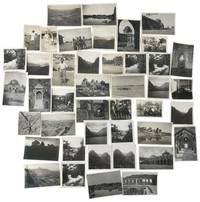
1940Best.-Nr. 232161940. British India photo archive following an unidentified man likely a serviceman in Mhow and Mandu during World War II 1942-1943 preserving a localized record of colonial wartime life through mess scenes sport staff bungalows named companions imposed colonial social frameworks and visits to the major Islamic monuments of Mandu. The captions place the central figure in the company of "Carroll Sahib" Ken Davis and other men in uniform-style dress while repeated references to the "mess" weapon training staff and cantonment-like grounds situate the photographs within a British colonial wartime environment in central India. The group shows one participant moving between military or officer-adjacent daily life and the monumental landscape of Mandu at a moment when India remained a crucial base of Allied wartime activity. Photo archive of 43 silver gelatin photographs ranging from 2 x 3.5 to 2.5 x 2.5 inches Mhow and Mandu India 1942-1943. Most photographs bear substantial contemporary handwritten inscriptions on the versos often dated. Identifiable scenes include two men with tennis rackets outside a bungalow captioned as taken after tennis; a portrait inscribed "Me the Carroll Sahib & Ken Davis outside the Mess 25/12/42"; a group of eight men captioned "two scotsmen our four weapon training instructors the Carroll Sahib me outside the W/T staff bungalow 25/12/42"; men wearing garlands outside the mess; a sports or gymkhana ground with riders or runners in formation; tented grounds beside a large building; and a portrait of a man identified as "Machdo our bearer." The architectural and landscape views are closely tied to Mandu with captions naming the Jami Masjid Jahaz Mahal Rupmati's Pavilion Baz Bahadur's Palace mosque interiors courtyards pools lake views ravines and elevated plateaus. Several photographs show men posed on open parade or sports grounds in light uniform-style dress including group portraits outside the mess and the W/T staff bungalow with tennis rackets bicycles garlands and temporary tent lines indicating a social world organized around exercise communal dining and station routine. Other images turn to Mandu's built landscape in much greater detail with framed views of domed pavilions arcaded courtyards carved entrances long interior corridors water tanks and palace ruins seen from terraces lakesides and elevated lookouts. The landscape scenes broaden that record further including steep ravines river and waterfall views and plateau panoramas that place the serviceman's movements within the wider terrain of central India. During World War II Mhow remained an important cantonment in British India and these photographs place one serviceman within the daily social world of that station where tennis communal dining staff housing local attendants and holiday gatherings existed alongside travel to nearby historic sites. The Mandu views record the same hand moving through one of central India's best-known Sultanate monument complexes with captions naming the Jami Masjid Jahaz Mahal Rupmati's Pavilion Baz Bahadur's Palace and associated interiors courtyards pools and landscape features. Light general wear occasional silvering and minor handling marks; inscriptions strong and legible on most versos. The dense captioning and photographic record show British colonial India during World War II through the the personal lens colonial rank and language staff organization sport and leisure during wartime Indian attendants and movement through one of central India's historic architectural landscapes. unknown
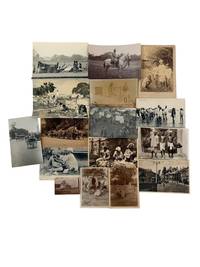
1890Best.-Nr. 234981890. Colonial Indian labor photo archive depicting street work informal commerce transport labor and social hierarchy under British rule circa 1890s-1920s. British India depended on low-paid manual labor to move people goods food and raw materials through cities ports hill stations and military cantonments. The group contrasts workers seated on the ground with baskets tools tents carts and roadside goods against riders on horseback and passengers carried by rickshaw carriage and bullock cart. Photo archive of 16 silver gelatin photographs and black-and-white real photo postcards various sizes India circa 1890s-1920s. Marketplace sellers sit among baskets cloth tents and on the ground goods; families and workers gather beside tents and rough encampments; men pull or guide rickshaws carriages and ox-drawn carts through colonial streets. A mounted man sits formally on a white horse while views of Simla show pedestrians commercial buildings and hill-station streets associated with British administration and seasonal elite life. Additional scenes show an outdoor "Hindu barber" "Indian coolies" carrying large baskets men seated by stonework near a Gothic-style building children posed in white garments some hand written captions en verso identify locations or tasks. The archive records the everyday labor that supported colonial India before independence when caste landlessness debt and imperial wage economies shaped who carried cleaned hauled shaved sold and served. Ligh toning handling and edge wear; overall in very good condition. A late colonial documentation of Indian labor and social separation grounded in street work transport marketplace survival and the visible privileges of those being carried or served. unknown
1940Best.-Nr. 232161940. British India photo archive following an unidentified man likely a serviceman in Mhow and Mandu during World War II 1942-1943 preserving a localized record of colonial wartime life through mess scenes sport staff bungalows named companions imposed colonial social frameworks and visits to the major Islamic monuments of Mandu. The captions place the central figure in the company of "Carroll Sahib" Ken Davis and other men in uniform-style dress while repeated references to the "mess" weapon training staff and cantonment-like grounds situate the photographs within a British colonial wartime environment in central India. The group shows one participant moving between military or officer-adjacent daily life and the monumental landscape of Mandu at a moment when India remained a crucial base of Allied wartime activity. Photo archive of 43 silver gelatin photographs ranging from 2 x 3.5 to 2.5 x 2.5 inches Mhow and Mandu India 1942-1943. Most photographs bear substantial contemporary handwritten inscriptions on the versos often dated. Identifiable scenes include two men with tennis rackets outside a bungalow captioned as taken after tennis; a portrait inscribed "Me the Carroll Sahib & Ken Davis outside the Mess 25/12/42"; a group of eight men captioned "two scotsmen our four weapon training instructors the Carroll Sahib me outside the W/T staff bungalow 25/12/42"; men wearing garlands outside the mess; a sports or gymkhana ground with riders or runners in formation; tented grounds beside a large building; and a portrait of a man identified as "Machdo our bearer." The architectural and landscape views are closely tied to Mandu with captions naming the Jami Masjid Jahaz Mahal Rupmati's Pavilion Baz Bahadur's Palace mosque interiors courtyards pools lake views ravines and elevated plateaus. Several photographs show men posed on open parade or sports grounds in light uniform-style dress including group portraits outside the mess and the W/T staff bungalow with tennis rackets bicycles garlands and temporary tent lines indicating a social world organized around exercise communal dining and station routine. Other images turn to Mandu's built landscape in much greater detail with framed views of domed pavilions arcaded courtyards carved entrances long interior corridors water tanks and palace ruins seen from terraces lakesides and elevated lookouts. The landscape scenes broaden that record further including steep ravines river and waterfall views and plateau panoramas that place the serviceman's movements within the wider terrain of central India. During World War II Mhow remained an important cantonment in British India and these photographs place one serviceman within the daily social world of that station where tennis communal dining staff housing local attendants and holiday gatherings existed alongside travel to nearby historic sites. The Mandu views record the same hand moving through one of central India's best-known Sultanate monument complexes with captions naming the Jami Masjid Jahaz Mahal Rupmati's Pavilion Baz Bahadur's Palace and associated interiors courtyards pools and landscape features. Light general wear occasional silvering and minor handling marks; inscriptions strong and legible on most versos. The dense captioning and photographic record show British colonial India during World War II through the the personal lens colonial rank and language staff organization sport and leisure during wartime Indian attendants and movement through one of central India's historic architectural landscapes. unknown books