LES INDES SAVANTES, OlivierBiblio.com
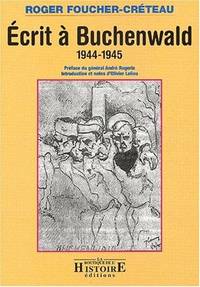
Écrit à Buchenwald 1944-1945
réf. 2910828204.Gpaperback. Good. Access codes and supplements are not guaranteed with used items. May be an ex-library book. paperback
Bonita · États-Unis73,14 $US≈ 65,34 €
4 257 résultats
réf. 23811‘The Hague / November 28th. 1860’. An excellent letter in which a serving Victorian ambassador discusses the nature of diplomacy and gives a vivid assessment of his former superior Sir Hamilton Seymour whom he jokingly characterizes ‘the great Elchee’. See both men’s entries in the Oxford DNB. 7pp 4to. On two bifoliums. In good condition lightly aged and with creases from folding into a packet. Minuted on reverse of last leaf. Addressed to ‘The Honble. George Elliot’ he received his KCB in 1862 and headed ‘Private’. Beginning on the subject of his brother-in-law Henry Lockwood 1825-1882 Napier writes: ‘My dear Elliott Many thanks for your kind letter informing me that Lord John Russell had moved Lockwood from Constantinople to Stockholm. It must be in many respects a great advantage to Lockwood and he will be very grateful to Lord John for the change. I hope that my brother in Law did not incur any blame from being involved in the dissensions of the Constantinople Embassy. I do not know all the circumstances indeed I have heard one side much more than the other. The malignant atmosphere of the place could not have been more strikingly shewn than in a musunderstanding between a most amiable Minister and a very devoted and agreeable subordinate. Such at least was Lumley to Sir Hamilton when I knew him.’ Napier had served as first secretary to Sir Hamilton Seymour in St Petersburg with John Lumley-Savile the future Lord Savile as second secretary. Napier considers Lumley as secretary to the Constantinople ambassador Sir Henry Bulwer is in Napier’s view ‘most in the wrong. Bulwer has a natural fondness for the twilight in business matters and this fanciful partiality for secrecy and winding may have led him to keep some things close from his Secretary’. After a comment on Lords Cowley and Shatford he continues: ‘The great Elchee never gave me a key or shewed me a Dispatch but when I wanted to know anything I would go to his room and talk to him about George Canning or the greek Revolution; or Sophocles or the Emperor Nicholas. Shaking such provocations in the face of that furious genius he would rowse up and open the flood gates of his conversation one thing led on another and at length he had disburdened himself of the past the present and the future. I was young and liked the humour of the thing besides I admired the old man angry so intense so handsome so austere so like Cato outside. And we cannot deny them generous sympathies and great services. Cowley Henry Wellesley 1st Earl Cowley who had been Minister Plenipotentiary was older and more than even on a foot of equality. He could not ever abide him. In fact your Secretary seems the natural enemy of his Chief. Please God I may not find it so if I ever become an Ambassador.’ Over two pages he discusses the ‘most just and wise regulations’ of the Foreign Office and what may happen ‘if your Ambassador is as wild as Nebuchadnezar and your Secretary not as discreet as Daniel’ before continuing: ‘You must have observed that Diplomacy is becoming a caste that we are a sort of Brahmins. Every man has a son in the possession. The diplomatic qualities will become progressive and hereditary. The Children will be wiser than their fathers. I have myself a son who is as smooth as Jacob and who never smiles unless he meets another young augur.’ He jokes: ‘You must be prepared to have an application soon for an unpaid attachéship. My second son is turbulent. I intend him for a naval reformer. I suppose your brother Henry has some of the same.’ This leads to a discussion of Elliot’s wider family the Mintos and the jesting reproach: ‘You are allowing Elcho and The Duke of Argyle to run away with the sympathies of Scotland. This must not be. There will not be a piece of bannock left in the land for a true Whig.’ ‘The Hague / November 28th. 1860’. unknown
réf. 240968 August 1859. The Hague Holland. See his entry in the Oxford DNB. 4pp 12mo. Bifolium. In good condition with slight discoloration along central fold. Large bold signature ‘Napier’. Addressed to ‘The Honble. George Elliott’ with salutation to ‘My dear Elliott’. As he does not know where Elliott’s sister Lady Dunfermline is ‘residing at this moment’ he is placing in Elliott’s hands ‘for transmission’ a letter from the wife of the Turkish ambassador at the Hague. He expresses to Elliott’s family his sympathy at the loss of their father. ‘I can never forget the kindness which he shewed me when I was unequally associated with him in his duties in Italy. He continued the same goodness and partiality to me afterwards.’ Added to Napier’s ‘personal attachment’ is ‘the highest appreciation of his manly unaffected sincere character and of his great and useful capacity’. He is sure ‘there never was a better father and never one more loved’. He urges Elliott to consider that his ‘distress must be tempered by the reflection that his disorder was incurable and that his life could only be prolonged amidst suffering and infirmity’. He considers that there is ‘no family more united by affection’ than Elliott’s. He concludes in the hope that they ‘may be preserved to each other and see good days and happy homes and that wherever you go you may be gathered to the banks of the Teviot at last’. 8 August 1859. The Hague [Holland]. unknown
réf. 2425523 October 1906; 119 The Avenue West Ealing London. See his entry in the Oxford DNB. 11pp 12mo with three of the pages written lengthwise. On three bifoliums. In good condition folded once. The hurried loose handwriting of this long letter presents a considerable challenge: even the signature ‘Geo Birdwood.’ ‘Gen Birdwood.’ and the name of the recipient ‘Fagan’ are doubtful. The letter begins with a reference to the ‘extract from Lady Dorothy Nevills - Reminiscences - given in the cutting from the Globe of yesterday enclosed in your kind note of today’. He states that he had ‘nothing to do with the origination of the Primrose League & I refused to have anything to do with it when asked to join in its constitution. It was Primrose Day I founded’. The passage which follows is opaque. Later on he states ‘I never wd have anything to do with the League. I abominate woman in politics: & I only joined the League when they conferred on me the Grand Cross of the Order in express recognition of my founding P. D.’ In his opinion ‘the Tariff Reform movement & all involved in its success - which I fear - is completely making up our old political & after a period of Chaos the country will settle down with quite a new country with new parties which will be as little interested in the England of Gladstone & D’Israeli & Russell - as we are in the world & politics of the moon’ 23 October 1906; 119 The Avenue, West Ealing [London]. unknown
réf. 25095Without date or place. See his entry in the Oxford DNB. A good large bold signature with the autograph valediction of a letter. On one side of a 20 x 9 cm piece of wove paper. In good condition lightly aged. Reads: ‘Your’s sic very truly / V. Lovett Cameron / Commander R. N.’ See Image. Without date or place. unknown
réf. 23810‘Trin. Coll. Sunday 12 o’clock’. 24 November 1839; Trinity College Cambridge. See Napier’s entry and that of his sister Maria’s husband John Gellibrand Hubbard 1805-1889 1st Baron Addington in the Oxford DNB. 3pp 4to. In good condition lightly aged and discoloured with small closed tear to a crease. Part of letter torn away on opening and now under small black wax seal good impression of crest with letter N. Folded four times. Addressed with three postmarks on reverse of second leaf to ‘The Rt Honble The Lady Napier Kew Green’. Minuted by Lady Napier: 'Cambridge Novr. 1838’. 64 lines of neatly-written text. He greets his mother as ‘My dear Mamma’ and begins by expressing delight at the arrival of his sister Maria on the previous day ‘though it happened at rather an unfortunate time for my occupations. I am glad to see her looking so very well and wearing her curls but I miss you very much and I wish you had been able to come along with them.’ Despite the fact that ‘Cambridge is particularly wet & dirty’ Maria and ‘Hubbard’ Maria had married John Hubbard the future Lord Addington in 1837 breakfasted with him that morning. ‘Sedgwick and we sat talking till Church time when we got squeezed into St Mary’s and heard Melville preach much worse than usual.’ The letter proceeds with references to ‘Whewell’ Trinity Chapel ‘Thorp’ ‘the Philosophical society’ ‘Ld & Lady Fitzalan’ ‘Lucy’ Lady Kinlock. He reports that ‘Cambridge was very much shocked by the Duke of Wellington's reported stroke and delighted to hear it was only a cold.’ Turning to personal matters he writes: ‘Maria is very much cut up about her cook who after appearing to be a pattern of culinary morality for some months has turned out a peculating thief besides having had several children in the house which she clandestinely conveyed out of the way in the dirty clothes basket’. One of Sedgwick’s dog’s five puppies is mousing for him. ‘Maria says that Sir Alexander has at last gone north and high time it was for I see Mr Ewart has gone down to stand for the boroughs he has been petting so long through Patrick.’ He ends by mentioning ‘Sir Thomas misfortunes whiuch are so very hard upon his old age but Maria declares that he seems to bear it very cheerfully.’ He concludes: ‘I write this dull letter late at night dear Mother it is only to announce Maria’s happy arrival and I intend to despatch a longer one to 9. this week. Lady Fitz. is pale and plain & Maria cust her out.’ The letter is signed ‘Napier / Trin. Coll. Sunday 12 o’clock’. ‘Trin. Coll. Sunday 12 o’clock’. [24 November 1839; Trinity College, Cambridge.] hardcover
réf. 2910828204.Gpaperback. Good. Access codes and supplements are not guaranteed with used items. May be an ex-library book. paperback
2009réf. 36777Central Zoo Authority India 2009. 4th revision. Fine/No Jacket. Paper covers An important document that regulates zoos and wildlife parks in India. Central Zoo Authority (India) unknown
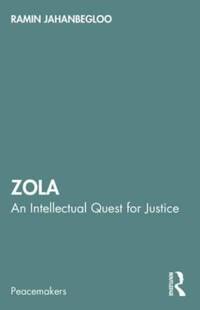
réf. ria9781032439945_inpPaperback / softback. New. New Book; Fast Shipping from UK; Not signed; Not First Edition; This book examines the figure of the public intellectual through the work of Emile Zola in the Dreyfus Affair. It analyses Zola’s famous letter “J’Accuse†supporting Alfred Dreyfus and its philosophical and political consequence paperback
réf. 4882New Haven: Connecticut Academy of Arts and Sciences 1934-1936. First edition. Light edge wear to wrappers on the spine many pages un-opened; a tight and clean copy in near fine condition. Pp. iv 483; 8 full page folding plates 1 folding maps 200 text-figures line-drawings. Original printed green wrappers lg 4to 12 x 9.5 inches. Memoirs of the Connecticut Academy of Arts and Sciences volume VIII-X. This work presents the entire results of the Yale North India Expedition as published by the Connecticut Academy of Arts and Sciences. The five volumes contain 24 articles on the geological history Paleolithic stone tools invertebrate and vertebrate fossils and the extant invertebrate and vertebrate faunas collected by the Yale North India Expedition of the 1930s. There are two articles in volume VIII: Hawkes et al. - Palaeolithic human industries in the Northwest Punjab and Kashmir and their geological significance; and De Terra - Geological Studies in the Northwest Himalaya between Kashmir and the Indus valley. Volume IX contains four articles: Wodehouse - The Pleistocene pollen of Kashmir; Branson - A Labrinthodont from the Lower Gondwana of Kashmir; Weller - Permain Trilobites from the Central Himalayas; and Vokes - Unionidae of the Siwaliks Series. Volume X contains 18 articles on the Diptera: Ephydridae; Triclad Turbellaria; Coleoptera: Staphylinidae; Carabidae; Phyllopod Crustacea; Gammarus; Hydracarina; terrestrial Hemiptera-Heteroptera; Rotatoria; Land Isopod; Hirudinea; Myriapods; Diplura; Thysanura; Collembola; Cladocera; and Fishes: Cobitidae Sisoridae and Cyprinidae. Single circular stamp of Staten Island Institute in the lower outer corner of the front wrapper of each volume; no other ownership marks and very few signs of use. New Haven: Connecticut Academy of Arts and Sciences, 1934-1936. First edition. unknown
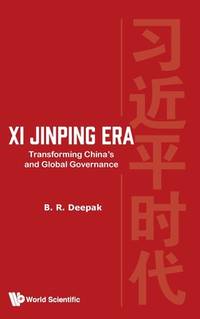
2026réf. x-9819832136World Scientific Publishing Co Pte Ltd 2026. Hardcover. New. 480 pages. 6.00x0.65x0.35 inches. World Scientific Publishing Co Pte Ltd hardcover
1997réf. AME_9781883001346Eye On Education 1997. 1St. Paperback. New/New. _ Eye On Education paperback
réf. 1883001420.Gpaperback. Good. Access codes and supplements are not guaranteed with used items. May be an ex-library book. paperback
2020réf. DBS-9781774073247Delve 2020. 1st. Hardcover. New. Delve hardcover
2020réf. DBS-9781774073247Delve 2020. 1st. Hardcover. New. Delve hardcover
2021réf. DBS-9781774071847Society Publishing 2021. 1st. Hardcover. New. Society Publishing hardcover
2021réf. DBS-9781774071847Society Publishing 2021. 1st. Hardcover. New. Society Publishing hardcover
2021réf. AME_9781774071847Society Publishing 2021. UNKNOWN. Hardcover. New/New. _ Society Publishing hardcover
réf. 1019834544.Ghardcover. Good. Access codes and supplements are not guaranteed with used items. May be an ex-library book. hardcover
1959réf. 164581959. Chand Kailash. An Appeal to Members of Parliament of India and the World at Large 1959 a public petition challenging the legal and social preference for paternal lineage in India and advocating the right of individuals to identify through their mothers. Addressing members of the Indian Parliament and an international audience Chand argued that recognition of maternal descent would advance women's equality while eliminating the stigma attached to children born outside marriage. His appeal followed his efforts to establish through India's courts the right to identify with his mother's lineage rather than his father's challenging prevailing conventions governing family descent legitimacy and the legal standing of mothers. Chand Kailash. An Appeal to Members of Parliament of India and the World at Large. Bombay: Society for the Cause of Mother's Lineage Theosophical Colony 1959. One sheet printed on both sides measuring 10 x 7.75 inches. The handbill presents Chand's arguments for recognizing maternal ancestry as an alternative to patrilineal descent. Central to his proposal was the contention that children should be entitled to their mothers' lineage regardless of their parents' marital status thereby removing distinctions that subjected children born outside marriage to social discrimination. Issued under the auspices of the Society for the Cause of Mother's Lineage the appeal sought support for changes in the treatment of ancestry and legitimacy under Indian law. Published during the first decade following India's independence the appeal addressed questions of family law and women's legal status amid continuing debates over marriage inheritance and social reform. The Hindu Marriage Act of 1955 and the Hindu Succession Act of 1956 had introduced major changes to Hindu personal law although customary preferences for paternal descent remained influential. Chand's 1959 petition advanced a distinct proposal: recognizing maternal lineage as a means of challenging both the subordinate status of women in family relationships and the discrimination faced by children classified as illegitimate. Blue pen check marks on the second page and horizontal folds. In very good condition. unknown
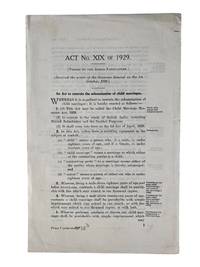
1929réf. 219671929. Government of India An Act to Restrain the Solemnisation of Child Marriages 1929 documents the legal system created to restrict child marriage in British India and supports research into women's rights colonial law childhood and social reform in South Asia. The Act commonly known as the Sarda Act after reformer Har Bilas Sarda reveals how legislation sought to regulate marriage age through statutory definitions penalties and enforcement provisions. It provides primary-source evidence for the study of Indian feminist legal history colonial governance and campaigns against patriarchal marriage customs. Government of India. An Act to Restrain the Solemnisation of Child Marriages. Calcutta: Government of India Central Publication Branch 1929. First edition. Official pamphlet printing of Act No. XIX of 1929 passed by the Indian Legislature and assented to by the Governor General on October 1 1929. The Act defines "child" "child marriage" "contracting party" and "minor" sets age thresholds for boys under eighteen and girls under fourteen and establishes penalties for adult men contracting child marriages as well as for those who solemnize arrange or permit such ceremonies. Its jurisdiction extends across British India including British Baluchistan and the Santhal Parganas with enforcement beginning April 1 1930. The printed price of "1 anna or 1½d" indicates official distribution for public and administrative use. The pamphlet documents a legal enforcement system for marriage reform through statutory age limits criminal penalties and responsibility assigned to adult men parents priests and other facilitators demonstrating the process by which colonial law entered debates over gender childhood and personal status. The timing is significant because Indian social reformers and women's rights advocates used the late colonial legal arena to challenge early marriage and forced domestic subordination. Minor edge creasing; overall very good condition. A concise official printing of a foundational statute in South Asian women's rights law and the legal history of childhood protection. unknown
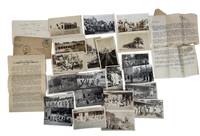
1941réf. 209861941. Gregson Anita. A.P. Mission City School archive 1941-1942 documenting girls' education missionary activity and community life in Ambala Punjab during World War II. This material records daily instruction social interaction and local conditions within a mission-run school for girls alongside written correspondence and institutional reporting that situate the school within wartime pressures and colonial India's educational landscape. The archive provides direct evidence of classroom practices gendered education and the integration of local families into school environments as well as the impact of global conflict on regional communities. Archive comprises 21 original black and white and sepia photographs one typed letter and one annual report. Photographs measuring approximately 2" x 3" to 3" x 5" frequently bear handwritten or typed captions on the verso likely by Anita Gregson identifying subjects and activities. Images show groups of schoolgirls engaged in classroom exercises and outdoor instruction including one scene of students constructing a ground map of India to illustrate agricultural production. Another photograph depicts a semicircle of young children seated outdoors during a lesson with their teacher identified as Miss Atmaran and a veiled mother observing her burkha partially drawn back. Additional images document craft instruction including girls weaving coconut palm leaves into fans and producing woven ties on frames. Musical activity is also present with students playing instruments. Beyond the school photographs depict village life in Punjab including oxen operating a water-drawing mechanism children gathered around a missionary playing a ukulele and a merchant carrying goods suspended from a yoke. The accompanying letter dated June 14 1942 from Gregson to a correspondent in New York references World War II noting international observances and local enlistment: "The young men in our Indian community are continuing to sign up for the army navy and air force." The annual report for the 1941-1942 school year details wartime financial strain fundraising efforts and instructional programs including an adult literacy course for women teaching reading writing and arithmetic. Created while India functioned as part of the British Empire during World War II these materials document the intersection of missionary education wartime mobilization and local social life. The inclusion of adult literacy instruction for women reflects ongoing efforts to expand female education under colonial conditions while the letter and report connect the school directly to global conflict and its local consequences. Light wear and minor fading to photographs; handling wear present. Letter on thin paper with tears and fragility consistent with wartime materials poor to fair condition; remaining materials overall very good condition. This archive provides a concentrated visual and textual record of girls' education and community experience in wartime Punjab. unknown
1929réf. 151011929. Act No. XIX of 1929 Passed by the Indian Legislature.An Act to Restrain the Solemnisation of Child Marriages 1929 records the enactment of the Child Marriage Restraint Act an early statutory attempt in British India to restrict marriages involving children. Receiving the Governor-General's assent on October 1 1929 and taking effect April 1 1930 the Act defined a "child" as a male under eighteen or a female under fourteen and imposed criminal penalties on adult men contracting child marriages and on persons performing conducting or directing such marriages. The legislation is commonly associated with reformer Harbilas Sarda and became known as the Sarda Act. Act No. XIX of 1929 Passed by the Indian Legislature.An Act to Restrain the Solemnisation of Child Marriages. 1929. Pamphlet. The text specifies the "punishment for male adult below twenty one years of age marrying a child" the "punishment for male adult above twenty one years of age marrying a child" and the punishment for "solemnising a child marriage." Under the original Act a male between eighteen and twenty-one who contracted a child marriage could be fined up to one thousand rupees; a male over twenty-one could receive up to one month of simple imprisonment a fine of up to one thousand rupees or both. Comparable penalties applied to a person who performed conducted or directed a child marriage. The pamphlet preserves the statutory language by which the colonial legislature sought to regulate marriage age through penalties imposed upon adult participants and officiants. The Act preceded later Indian legislation that progressively raised legal marriage ages and strengthened protections against child marriage. Its provisions document an early legislative attempt to intervene directly in the solemnization of marriages involving children and to assign legal responsibility to adult husbands and those conducting such marriages. unknown
2020réf. DBS-9781774071908Society Publishing 2020. 1st. Hardcover. New. Society Publishing hardcover
2020réf. DBS-9781774071908Society Publishing 2020. 1st. Hardcover. New. Society Publishing hardcover
2020réf. AME_9781774071908Society Publishing 2020. UNKNOWN. Hardcover. New/New. _ Society Publishing hardcover